It was 10 years ago this month that Southern Innovator‘s first issue launched in New York during the UN’s General Assembly week (UNGA). It focused on mobile phones and information technology for a reason: these connectivity transformations were re-shaping how people lived their lives, even in the poorest and remotest places on earth.
The content was based on global research, beginning in 2007, funded by the United Nations.
“What a tremendous magazine your team has produced! It’s a terrific tour de force of what is interesting, cutting edge and relevant in the global mobile/ICT space… This is great, engaging, relevant and topical stuff.” Rose Shuman, Founder & CEO, Open Mind and Question Box, Santa Monica, CA, U.S.A.
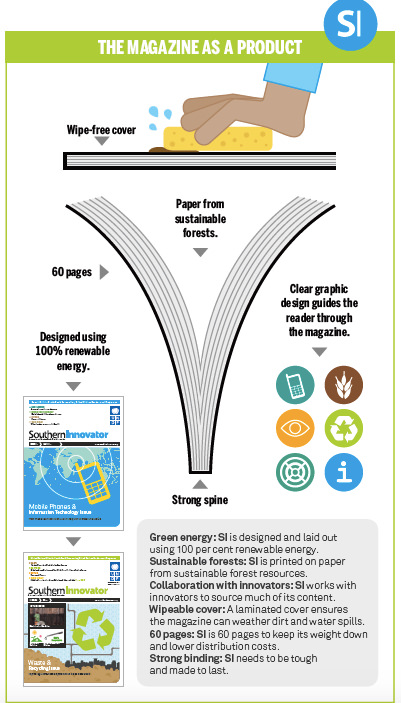
Every issue was launched somewhere new around the world. While Southern Innovator’s digital presence has been key to its success and global reach, the hard copy of the magazine was designed with special features. The magazine needed to be robust and able to stand a fair bit of abuse and hard wear. It needed to be easy to read in low light conditions. And it needed to look sharp and eye-catching to reach as wide an audience as possible.
In 2010, as we prepared to launch Southern Innovator, the branding and website for David South Consulting was re-visioned by Icelandic graphic designer and illustrator Sólveig Rolfsdóttir. David South Consulting has been working with clients around the world since 1991.
Graphic Designer and Illustrator: Sólveig Rolfsdóttir.
Expertise: Innovation, innovators, human development, South-South development, United Nations, policy and policy innovation, South-South cooperation, South-South trade, global trends, strategy, online content, global memes, Internet, mobile phones, information technology, global South, resilience strategies, crisis response.
Locations: London, UK and New York, U.S.A. 2007 to 2016
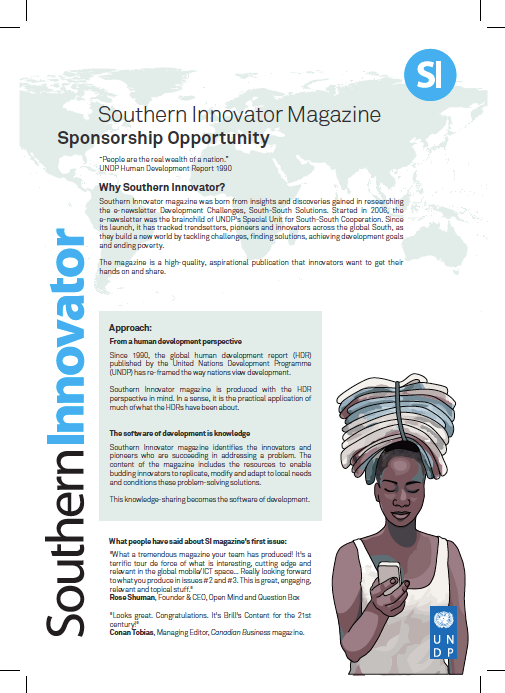
Since the start of 2007, global international development and media consultancy David South Consulting (DSC)/David South International (DSI) has been working with the UNDP-associated United Nations Office for South-South Cooperation (UNOSSC) (formerly the Special Unit for South-South Cooperation) to raise the profile of South-South cooperation and the global South in global development through its innovators, as well as influencing the switch to an innovation-led approach to how development is delivered at the United Nations and at the country level. Based in London, UK and with a design studio in Reykjavik, Iceland, DSC/DSI did this with two highly influential media: the monthly e-newsletter Development Challenges, South-South Solutions, and its sister magazine Southern Innovator.
About
With the global economic crisis unfolding in 2007, we asked “what would inspire people?” What is going on in the global South that would improve human development under these circumstances and make people more resilient?
In 2007, discussing the global South, or solutions from the South, had a far lower profile in international development, the media and with the general public. Being one of the first sources to regularly chronicle the 21st-century world emerging from the crisis, the two publications (e-newsletter Development Challenges, South-South Solutions and its sister magazine Southern Innovator) were able to open up a space for greater coverage of the global South, while drawing attention to a new generation of development innovators.
“Great economic and business reporting! Very helpful for us.” Africa Renewal, Africa Section, Strategic Communications Division, United Nations Department of Public Information
“I just went over your June newsletter. It’s very well done and far reaching. Congratulations!” Violette Ruppanner, Director, 3D -> Trade – Human Rights – Equitable Economy, Geneva, Switzerland
“Just to let you know I enjoyed the newsletter a lot – it was interesting to learn about things going on that I would never otherwise find out about, and also the listing of future conferences and events proved very useful.” Ian Sanderson, Deloitte, Geneva, Switzerland
“Congratulations on another great newsletter that’s packed with fascinating information! I really enjoy getting it each month.” Whitney Harrelson, Making Cents, Washington D.C.
By adopting a strategy to exploit developments in online and digital media (and the space opened up by the global economic crisis), the reach of the e-newsletter and magazine was far greater than would have been possible just a year prior, back in 2006. This proved useful for reaching the growing number of people in the global South who were being digitally connected either through mobile phones or the Internet, or both.
The e-newsletter was not only distributed every month to subscribers, it was also simultaneously posted online in many platforms to reach as wide an audience as possible. It was kept simple in its design so as to be easy to access by readers with low bandwidth or high data costs. It exploited new online services to reach an as wide as possible audience.
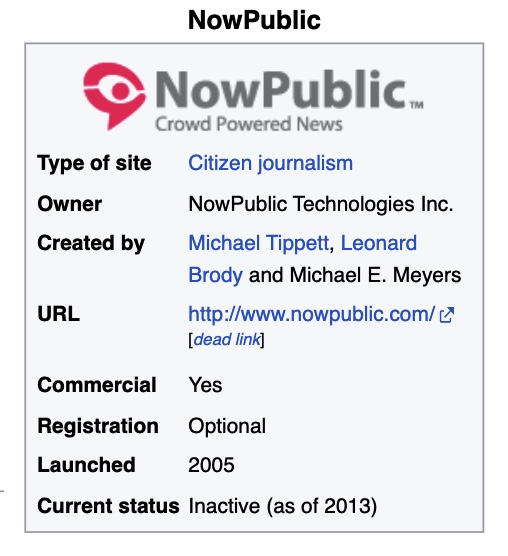
As an example, the arrival of ‘crowd-powered’ media in 2007 allowed for posting of stories to a global audience to test responses and reactions in real time. An experiment from 2008 to 2010 on the innovative Vancouver, Canada-based NowPublic platform proved very effective in developing the right tone for the stories. Many of these stories have been cited in publications and online (please see below for citations).
With 201 Development Challenges, South-South Solutions stories posted on the NowPublic platform, a total of 336,289 views by 2012 had occurred, according to the NowPublic counter.
Various websites offering publishing and archiving services (Scribd for example) meant it was easy to access the stories from any place, device or platform, bypassing firewalls and censors – a very serious concern in many countries of the global South. And social media such as Twitter made it easy to spread the word to the right people.
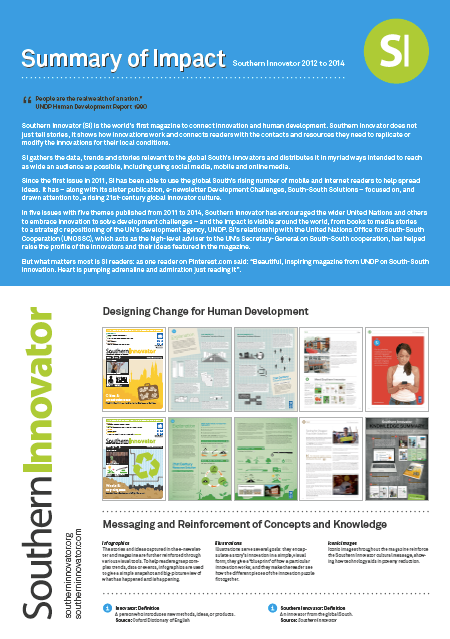
The two publications proved influential on a number of fronts, being early to draw attention to the following: the rising use of mobile phones and information technology in development, the world becoming an urban place, innovative food solutions including the nascent insect food sector (now a big thing), altering perspectives on what is possible in Africa, the use of data science to innovate development, and tracking the growing number of technology hubs and the fast-growing start-up culture in the global South. The publications were cited for shaping the new strategic direction adopted by the United Nations Development Programme (UNDP) (the UN’s leading development organisation) and its first youth strategy, and the development of the Sustainable Development Goals (SDGs). As the world’s first global innovator magazine, Southern Innovator’s design had to be appropriate for a diverse audience. It has drawn praise for being both “beautiful” and “inspiring”, while its use of sharp, modern graphic design and infographics inspired others in the UN to up their game when it comes to design.
Today, there are many sources for sharing stories on solutions from the global South; in fact, it could be called ‘cool’. South-South cooperation and innovation have now become the key methodology for the UN’s delivery of its programmes and projects. In 2015, China pledged US $2 billion to “support South-South cooperation” and called for the international community to “deepen South-South and tripartite cooperation”. In development parlance, they have been “Mainstreaming South-South and Triangular Cooperation” in their plans.
The current policy vogue for innovation in developing and developed countries can trace its roots back to some of the early work done by these two publications (and which was further amplified by the annual Global South-South Development Expo, which often would feature innovators from the two publications, spreading the innovation message around the world). Both publications had set out to inspire and “champion a global 21st century innovator culture”. And they have done this, as can be seen from concrete evidence and anecdotal responses from individuals and organizations alike.
Crucial to success has been integrity. As was disclosed in arrests made by the Federal Bureau of Investigation (FBI) in October 2015, a news service claiming to be associated with the United Nations (South-South News) had not followed either the letter or the spirit of the UN’s Global Compact. It had received substantial funding from a Macau casino owner featured in a 2010 investigation by International Risk Ltd., which found he “is characterized in the media as a ‘Macau Crime Lord’ and a kingpin of the international slave prostitution trade”. To date, a number of his co-conspirators have been found guilty of various charges and sentenced. He was convicted 28 July 2017 on six counts “for his role in a scheme to bribe United Nations ambassadors to obtain support to build a conference center in Macau that would host, among other events, the annual United Nations Global South-South Development Expo“. He used the news service as a “conduit for bribery and money laundering” at the United Nations, according to the FBI, something admitted to by the various co-conspirators in court and under oath. Read more on this case here: http://www.reuters.com/article/us-un-corruption-idUSKCN0XH2DL. And the conviction here: Chairman of a Macau Real Estate Development Company Convicted on All Counts for Role in Scheme to Bribe United Nations Ambassadors to Build a Multi-Billion Dollar Conference Center
The case of South-South News points to the dangers of cutting corners and the importance of approach and methodology; to not just mouth support for the UN Global Compact but to embrace its letter and spirit as well. As can be seen from this particular case, the reputational damage can be severe if the wrong strategy is pursued. Clients need to be very aware of whom they are working with and conduct due diligence for service provider credentials and also investigate the credentials of potential donors and funders.
Southern Innovator needed to be true to its ethos of championing genuine innovation that improves human development in the global South. It had to be free to pursue its search without interference.
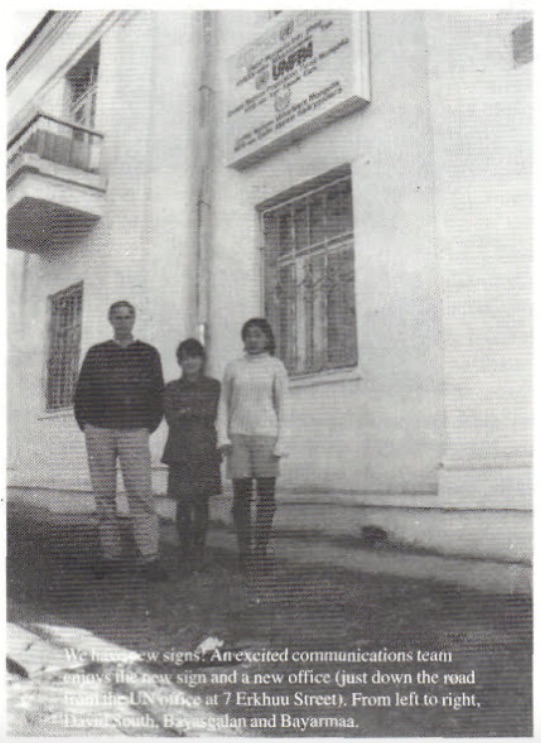
To avoid censorship and interference, its editorial operations were based in London, UK and its design studio was based in Reykjavik, Iceland (a high-ranking country in the World Press Freedom rankings and a former top place holder in the UNDP Human Development Index). Using a women-led design studio, it developed a design vision that could communicate across borders using clear graphic design and high-quality images. For example, when it launched in 2011, infographics were rare in development publications and at the UN; now they are commonplace. It also tried to be as a ‘green’ as possible. The studio was powered on 100 per cent renewable energy (in particular, geothermal energy); the hard copy of the magazine is printed on paper from renewable forests.
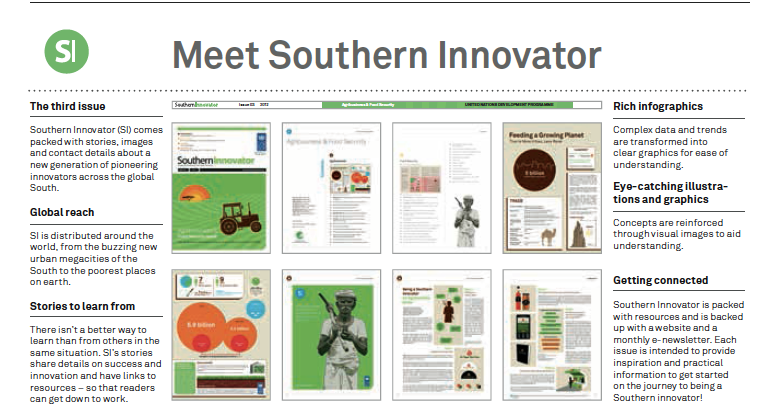
To date, five issues of Southern Innovator have been published on key themes identified by the United Nations: mobile phones and information technology, youth and entrepreneurship, agribusiness and food security, cities and urbanization and waste and recycling.
All of the issues collate and explain the trends, innovations and innovators for a large, global audience spanning many countries and regions.
Timeline
2007: David South Consulting begins work on the e-newsletter Development Challenges, South-South Solutions for the Special Unit for South-South Cooperation at the United Nations.
2009: Adjust e-newsletter content based on reader responses. Begin posting content on Twitter platform.
2010: Begin development of initial concepts for innovator magazine and assemble creative team with Icelandic graphic designer and illustrator Solveig Rolfsdottir and graphic designer Eva Hronn Gudnadottir.
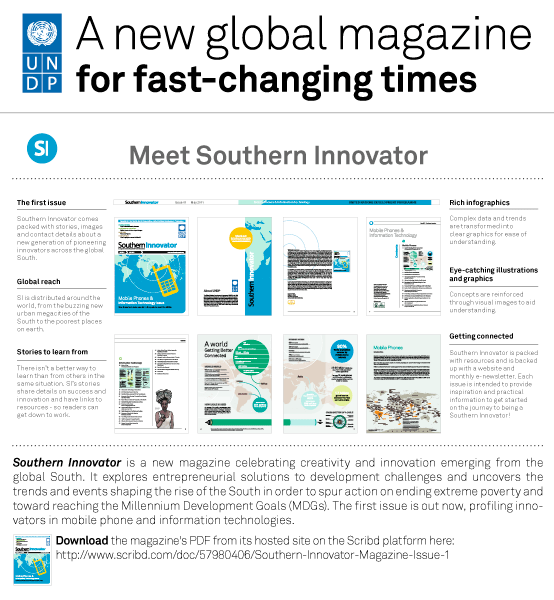
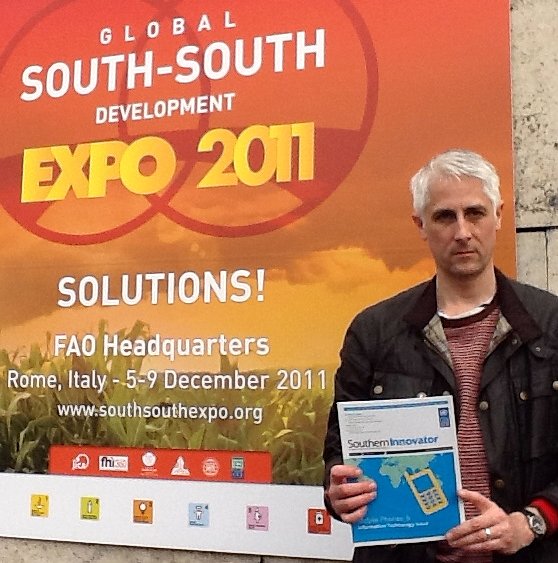
2011: Attend Global South-South Development Expo in Rome, Italy. Launch first issue of Southern Innovator magazine on mobile phones and information technology. It is called “a terrific tour de force of what is interesting, cutting edge and relevant in the global mobile/ICT space…”. Launch www.southerninnovator.org website and social media including Twitter account @SouthSouth1.
2012: Attend Global South-South Development Expo in Vienna, Austria. Launch issues 2 (youth and entrepreneurship) and 3 (agribusiness and food security) of Southern Innovator magazine. Called a “Beautiful, inspiring magazine from UNDP on South-South innovation.”
2013: Attend Global South-South Development Expo in Nairobi, Kenya. Launch issue 4 of Southern Innovator magazine (cities and urbanization). Called “fantastic, great content and a beautiful design!” and “Always inspiring.”.
2014: Attend Global South-South Development Expo in Washington, D.C., U.S.A. Launch issue 5 of Southern Innovator magazine (waste and recycling). The Twitter account @SouthSouth1 called “ one of the best sources out there for news and info on #solutions to #SouthSouth challenges.” Final issues of e-newsletter Development Challenges, South-South Solutions published.
Testimonials
“The e-newsletter Development Challenges, South-South Solutions proved to be a timely and prescient resource on the fast-changing global South, tracking the rise of an innovator culture driven by the rapid adoption of mobile phones and information technology …
“In 2010, work began on the development of the world’s first magazine dedicated to the 21st-century innovator culture of the global South. My goal was to create a magazine that would reach across countries and cultures, meet the UN’s standards, and inspire action. Southern Innovator was the result. Mr. [David] South played a vital role in the magazine’s development from its early conception, through its various design prototypes, to its final global launch and distribution.
“Both the e-newsletter and magazine raised the profile of South-South cooperation and have been cited by readers for inspiring innovators, academics, policy makers and development practitioners in the United Nations and beyond.
“I highly recommend Mr. [David] South as a thoughtful, insightful, analytical, creative and very amicable person who has the unique ability to not only grasp complex problems but also to formulate a vision and strategy that gets things done. … ” Cosmas Gitta, Former Assistant Director, Policy and United Nations Affairs at United Nations Office for South-South Cooperation (UNOSSC) in UNDP
“I think you [David South] and the designer [Solveig Rolfsdottir] do great work and I enjoy Southern Innovator very much!” Ines Tofalo, Programme Specialist, United Nations Office for South-South Cooperation
Southern Innovator Issue 5
“@SouthSouth1 is one of the best sources out there for news and info on #solutions to #SouthSouth challenges.” Adam Rogers, Assistant Director, Regional Representative, Europe, United Nations Office for South-South Cooperation (UNOSSC)
“Btw, I really enjoyed reading them, impressive work & a great resource. Looking forward to Issue 6. My best wishes to you & your team at SI.”
“The magazine looks fantastic, great content and a beautiful design!”
Southern Innovator Issue 2
“Thank you David – Your insight into the issues facing us a[s] [a] “global Village” is made real in the detail of your article – 10 out of 10 from the moladi team.” Moladi, South Africa (http://www.moladi.net/index.htm)
Southern Innovator Issue 1
“What a tremendous magazine your team has produced! It’s a terrific tour de force of what is interesting, cutting edge and relevant in the global mobile/ICT space… Really looking forward to what you produce in issues #2 and #3. This is great, engaging, relevant and topical stuff.” Rose Shuman, Founder & CEO, Open Mind and Question Box
“Looks great. Congratulations. It’s Brill’s Content for the 21st century!” Conan Tobias, Managing Editor, Canadian Business
What they are saying about SI on Twitter: From @CapacityPlus Nice job RT @ActevisCGroup: RT @UNDP: Great looking informative @SouthSouth1 mag on South-South Innovation; @UNDP Great looking informative @SouthSouth1 mag on South-South Innovation; @JeannineLemaireGraphically beautiful & informative @UNDP Southern Innovator mag on South-South Innov.
“Beautiful, inspiring magazine from UNDP on South-South innovation. Heart is pumping adrenaline and admiration just reading it”
Impact
Micro
developed content for highly influential UN e-newsletter Development Challenges, South-South Solutions from 2007 to 2014. The monthly briefing is distributed across the UN and to subscribers
developed and launched world’s first global innovator magazine for the United Nations, Southern Innovator
contacted and networked with innovators around the world to raise the profile of their work
attended global events to champion power of 21st century global innovator culture. Visited United Nations agency headquarters around the world to share the innovator message and distribute the publications
cited as a key resource on trends in the global South
Macro
significantly raised profile of global South innovators and 21st century global innovator culture
cited as contributor to new strategic plans for UNDP and its switch to an innovation and South-South focus
There is a trend occurring across the global South that some are calling the next great wave of innovation. It has different names but many are dubbing it ‘frugal innovation’. Frugal innovation is basically innovation done with limited resources and investment. In short, innovation on the cheap but packing a big punch.
The phenomenon has several strands. One involves innovators and companies from the developed world setting up in the developing world and beta testing their inventions and innovations there. Another strand involves innovators in companies and governments in the global South increasingly targeting the so-called ‘BOP’ – bottom of the pyramid – market of the poor.
Another strand is focused on capitalizing on innovations for tackling the problems of the poor that are coming from the poor. Many of these innovations are improvised solutions. They may not be slick but they solve a problem.
And finally, there are companies and entrepreneurs in the global South taking their innovations to the markets of the wealthy, developed countries and finding a welcome reception from price-savvy consumers.
In the global South, frugal innovation is transforming lives – and it is finding its way into developed, wealthy countries too. It has been celebrated in the new book Jugaad Innovation: A Frugal and Flexible Approach to Innovation for the 21st Century (http://jugaadinnovation.com/) by Navi Radjou, Jaideep Prabhu and Simone Ahuja. The authors are innovation experts with a wide mix of backgrounds, from an academic to a Silicon Valley “thought leader and strategic consultant” to the founder of a marketing and strategy consultancy specialising in emerging markets innovation.
The authors propose “jugaad innovation” as a solution to the urgent need to innovate quickly and efficiently in a fast-changing world where little can be taken for granted. This breed of frugal innovation comes from India. Jugaad is a Hindi word (http://en.wikipedia.org/wiki/Jugaad) and basically means a work-around, improvised solution to a problem because it is cheaper. This is commonly used to describe makeshift vehicles people construct in India (http://wheels.blogs.nytimes.com/2011/03/25/jugaad-cheaper-than-a-nanobut-watch-for-splinters/).
As champions of the jugaad philosophy, the authors proclaim the old innovation paradigm is obsolete. The idea that throwing more capital and more resources at a problem will boost innovation, no longer works, they contend. Better results can come from being frugal and flexible. Being more creative allows for a fluid and improvised innovation culture to develop.
“In today’s interconnected world powered by social media, top-down R&D (research and development) systems struggle to open up and integrate the bottom-up input from employees and customers,” the authors say on their website.
“Jugaad on the other hand is flexible, frugal and democratic: it is often bottomup rather than top-down and involves a much larger number of people beyond those who are typically tasked with doing innovation in corporations. The strength of jugaad innovators lies in their ability to get more from less,experiment continually, and creatively engage people who are typically left out of the innovation process.”
And they have a message for the Western, developed nations. They must look to “places like India, China, and Africa for a new, bottom-up approach to frugal and flexible innovation,” if they want to experience continuing prosperity in the 21st century.
For global South inventors, entrepreneurs and manufacturers, this will prove a great opportunity. As debt-laden Western consumers deal with their lower spending power and incomes, they will be looking for products that cost less and yet tackle problems and improve their standard of living with minimal expenditure.
The Indian company Mahindra and Mahindra (http://www.mahindra.com/What-We-Do/automotive) sells its small tractors to American hobby farmers. The Chinese company Haier (http://www.haier.net/en/about_haier/haier_global/china/) has a range of frugal products that have become popular sellers. They include air conditioners, washing machines and wine coolers. Haier is so successful with these products it has been able to capture 60 per cent of the market in these categories in the United States.
Some of the hallmarks of frugal products are their efficient production, rapid development cycle, lower price point, and appeal to poorer customers.
The book argues that adopting a “jugaad” mindset will enable people and companies to innovate “faster, better and cheaper,” “generate breakthrough growth” and “outperform competition.”
“Jugaad innovation has three major benefits. First, it is frugal: it enables innovators to get more with less. Second, it is flexible: it enables innovators to keep experimenting and rapidly change course when needed. Third: it is democratic: it can therefore tap into the wisdom of otherwise marginalized customers and employees.”
“In contrast to the traditional structured approach to innovation, jugaad is inherently more customer-centric rather than technology or product centric.
Because jugaad innovators seek to solve a customer problem first and then develop a suitable solution, jugaad is more market-based than more structured approaches (that may be driven by the motivation to develop technology for technology’s sake) are.”
There are so many of these innovations and inventions happening, a culture has emerged to gather and document them and share them with others.
But this dynamic innovators culture is not limited to India. Across Africa,information technology hubs and start-ups have been sprouting up. One of the more well-known is the iHub in Nairobi, Kenya (http://ihub.co.ke/pages/home.php) but there are centres of information technology innovation in Ghana, South Africa, Uganda and Nigeria.
One of the more outstanding and pioneering chroniclers of this frugal innovation culture in Africa has been the Afrigadget website (afrigadget.com).
It is packed with home-grown inventions. These include a young Kenyan boy using a rigged network of light bulbs to ward of lions from the cattle herd, a mobile phone security system for cars, and a home-made remote control toy car for children. Another great way to see this movement in action is at the Maker Faire Africa (http://makerfaireafrica.com/) which has been bringing together every year “handcrafters from Africa’s tiniest villages to her most expansive urban burgs”.
Development Challenges, South-South Solutions was launched as an e-newsletter in 2006 by UNDP’s South-South Cooperation Unit (now the United Nations Office for South-South Cooperation) based in New York, USA. It led on profiling the rise of the global South as an economic powerhouse and was one of the first regular publications to champion the global South’s innovators, entrepreneurs, and pioneers. It tracked the key trends that are now so profoundly reshaping how development is seen and done. This includes the rapid take-up of mobile phones and information technology in the global South (as profiled in the first issue of magazine Southern Innovator), the move to becoming a majority urban world, a growing global innovator culture, and the plethora of solutions being developed in the global South to tackle its problems and improve living conditions and boost human development. The success of the e-newsletter led to the launch of the magazine Southern Innovator.
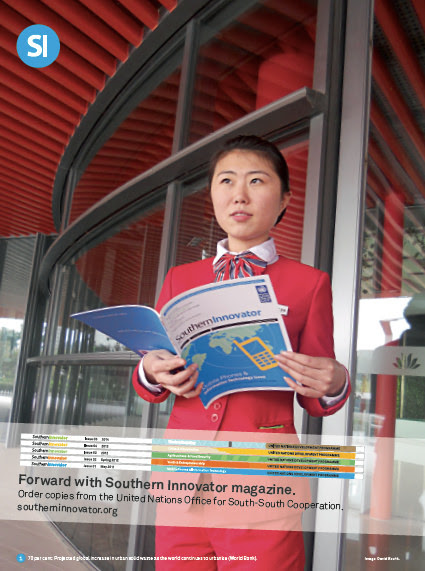
Launched in May 2011, the new global magazine Southern Innovator (ISSN 2222-9280) is about the people across the global South shaping our new world, eradicating poverty and working towards the achievement of the Millennium Development Goals (MDGs).














 David South Consulting
You must be logged in to post a comment.