Categories
Archive Development Challenges, South-South Solutions Newsletters Southern Innovator magazine

Prisons With Green Solutions

By David SouthDevelopment Challenges, South-South Solutions

SOUTH-SOUTH CASE STUDY

An ingenious solution is helping Rwanda reduce the cost of running its bursting prisons, while improving conditions for the prisoners and helping protect the environment.

The country’s prison population soared to a peak of 120,000 suspects awaiting trial for their role in the 1994 genocide, in which 800,000 Tutsis and moderate Hutus were killed. The traditional court system, gacaca, is being used for national reconciliation, but the process is slow and costly for a country where 90 per cent of the population exist on subsistence agriculture, and where food production has dropped below 70 per cent of the levels needed for self-sufficiency (USAID).

But thanks to enormous, bee-hive shaped human manure digesters, a steady supply of biogas is on tap for cooking and lighting at prisons – the first country in Africa to do this. Five of the country’s largest prisons – two at Gitarama and one each in Butare, Kigali and Cyangugu – now have biogas plants producing 50 per cent of the gas needed to cook for prisoners. It has also saved half of each prison’s US $44,000 a year firewood costs. The money saved is being ploughed back into renovations to the prisons to improve conditions, and to provide more services like healthcare.

Biogas is produced from the fermentation of household or agricultural waste or animal or human feces, and has become a viable alternative when traditional gas sources become more expensive. The waste is placed in a 150 cubic meter beehive-shaped digester and fermented until a gas is produced. According to lead engineer on the project, Ainea Kimaro, 100 cubic meters of waste is turned into 50 cubic meters of fuel by bacteria devouring the manure in just four weeks.

The digesters are a project of the Kigali Institute of Sciences, Technology and Management ‘s Center for Innovations and Technology Transfer.

“Biogas kills two birds with one stone,” Kimaro told the BBC. It gets rid of all the human waste and helps cover the enormous costs of feeding so many prisoners. Prior to the digesters, the quantity of human waste was a real problem: it was flooding down hillsides and leaking into rivers and lakes.

A school, the Lycee de Kigali , also has a digester. “The methane gas is used to cook for 400 students and for operating Bunsen burners in the school laboratories”, Kimaro said.

Many would think this a smelly affair, but in fact the whole process isn’t that pungent. Most of the digester is underground and the gas produced burns a clean, blue smokeless flame. It is much cleaner than the smoke from firewood. The remaining sludgy residue is used as an odourless compost for soil. This is used in the prison gardens to grow maize, mangos, bananas and tomatoes – all of which ends up back on the prisoner’s plates, improving the quality of their nutrition.

“The firewood savings are excellent – they really make a difference for us,” a Cyangugu prison warden said, adding that the odour-free compost had done wonders for the prison gardens. “Look at all these bananas! This fertiliser really is the best,” he said to the BBC.

In Uganda, human urine and feces are being mixed with banana peels, algae, water hyacinth and poultry droppings to make biogas. In Uganda’s rural Mukono district, biogas is used for cooking, lighting pressure lamps and to power engines. The slurry left over is then used to fertilise the soil. For Ugandans, most of whom are rural dwellers, electricity is rare and petrol to run generators and refrigeration units is expensive.

“It keeps the environment free of organic wastes, is convenient, time-saving and reduces smoke-related illnesses often associated with the use of firewood,” said Patrick Nalere, country director of the Heifer Project International, an American NGO which shares livestock and knowledge to reduce poverty. “If the majority of Ugandans adopted biogas, we would preserve our biodiversity. People should exploit decomposing raw materials, which are free. Therefore, no monthly power tariffs.”

Published: February 2008

Development Challenges, South-South Solutions was launched as an e-newsletter in 2006 by UNDP’s South-South Cooperation Unit (now the United Nations Office for South-South Cooperation) based in New York, USA. It led on profiling the rise of the global South as an economic powerhouse and was one of the first regular publications to champion the global South’s innovators, entrepreneurs, and pioneers. It tracked the key trends that are now so profoundly reshaping how development is seen and done. This includes the rapid take-up of mobile phones and information technology in the global South (as profiled in the first issue of magazine Southern Innovator), the move to becoming a majority urban world, a growing global innovator culture, and the plethora of solutions being developed in the global South to tackle its problems and improve living conditions and boost human development. The success of the e-newsletter led to the launch of the magazine Southern Innovator.  

Follow @SouthSouth1

Google Books: https://books.google.co.uk/books?id=waeXBgAAQBAJ&dq=Development+Challenges+February+2008&source=gbs_navlinks_s

Slideshare: http://www.slideshare.net/DavidSouth1/development-challengessouthsouthsolutionsfebruary2008issue

Southern Innovator Issue 1: https://books.google.co.uk/books?id=Q1O54YSE2BgC&dq=southern+innovator&source=gbs_navlinks_s

Southern Innovator Issue 2: https://books.google.co.uk/books?id=Ty0N969dcssC&dq=southern+innovator&source=gbs_navlinks_s

Southern Innovator Issue 3: https://books.google.co.uk/books?id=AQNt4YmhZagC&dq=southern+innovator&source=gbs_navlinks_s

Southern Innovator Issue 4: https://books.google.co.uk/books?id=9T_n2tA7l4EC&dq=southern+innovator&source=gbs_navlinks_s

Southern Innovator Issue 5: https://books.google.co.uk/books?id=6ILdAgAAQBAJ&dq=southern+innovator&source=gbs_navlinks_s

Creative Commons License
This work is licensed under a
Creative Commons Attribution-Noncommercial-No Derivative Works 3.0 License.

ORCID iD: https://orcid.org/0000-0001-5311-1052.

© David South Consulting 2023
Categories
Archive Development Challenges, South-South Solutions Newsletters Southern Innovator magazine

Global South Eco-cities Show How the Future Can Be

By David SouthDevelopment Challenges, South-South Solutions

SOUTH-SOUTH CASE STUDY

The world is currently undergoing a high-stress transition on a scale not seen since the great industrial revolution that swept Europe in the 19th and 20th centuries. Today’s urban and industrial transition involves many more people and is taking place on a greater proportion of the planet. With rapid urbanization comes a demand for middle class lifestyles, with their high-energy usage and high consumption of raw materials.

This is stretching the planet’s resources to breaking point. And as many have pointed out, if the world’s population is to continue past today’s 7 billion to reach 9 billion and beyond, new ways of living are urgently required. Radical thinking will be necessary to match the contradictory goals of raising global living standards for the world’s poor with pressured resources and environmental conditions.

But there are innovative projects already under development to build a new generation of 21st-century cities that use less energy while offering their inhabitants a modern, high quality of life. Two examples are in China and the Middle East.

Both projects are seen as a way to earn income and establish viable business models to build the eco-cities of the future. Each project is seeking to develop the expertise and intellectual capacity to build functioning eco-cities elsewhere. In the case of the Masdar City project in the United Arab Emirates, international businesses are being encouraged to set up in Masdar City and to develop technologies that can be sold to other countries and cities – in short, to create a green technology hub akin to California’s hi-technology hub ‘Silicon Valley’. Masdar City is also being built in stages as investors are found to help with funding. Both projects hope to prove there is money to be made in being green and sustainable.

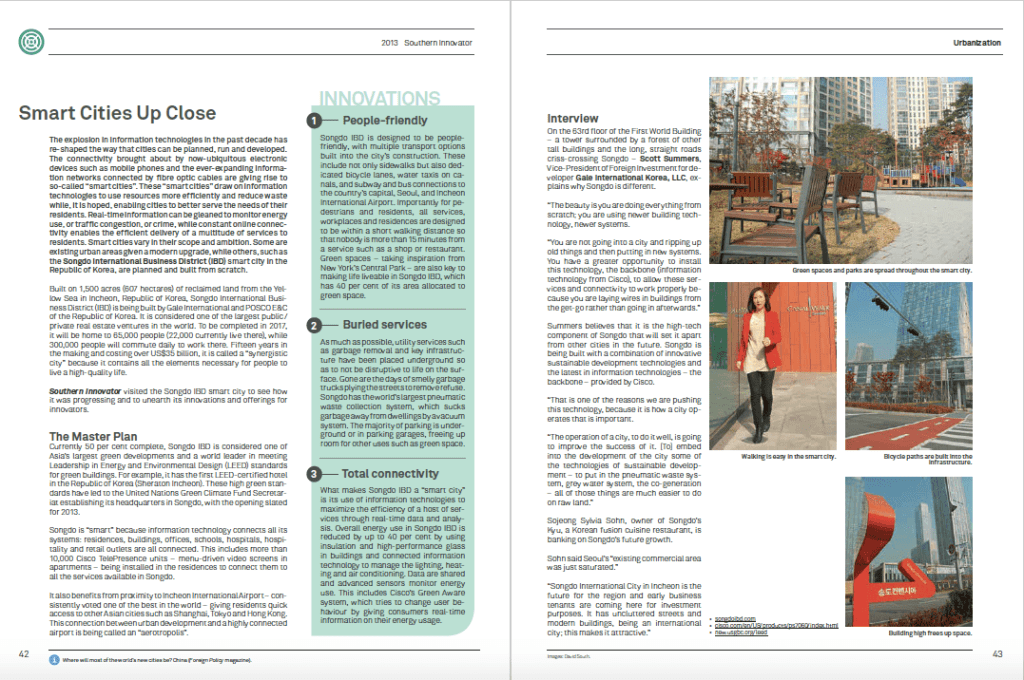
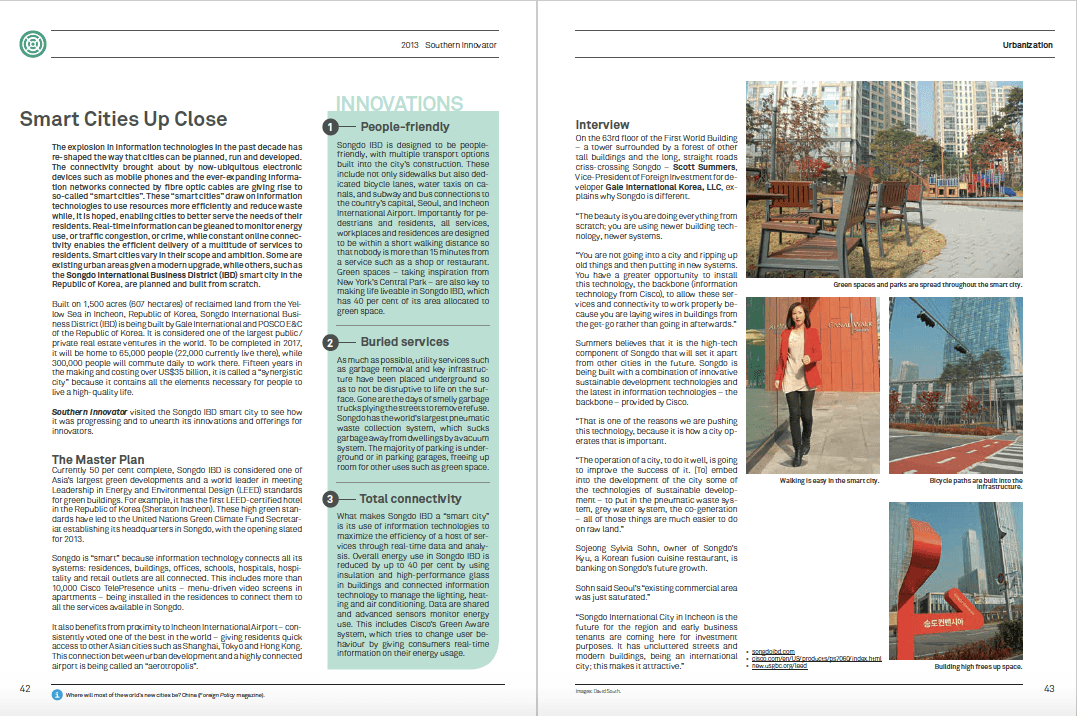
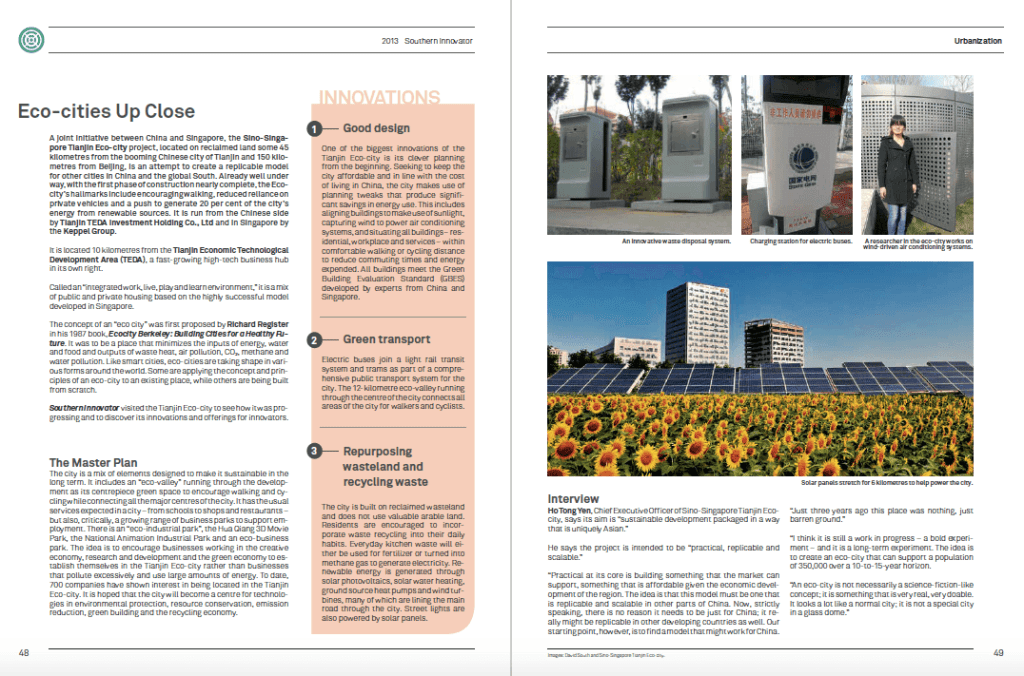
The Tianjin Eco-city (tianjinecocity.gov.sg) project is a joint venture between China and Singapore to build a 30 square kilometre city to house 350,000 residents.

Tianjin (http://en.wikipedia.org/wiki/Tianjin) is a large industrial city southeast of China’s capital, Beijing. It is a place that wears the effects of its industrial expansion on the outside. Air pollution is significant and the city has a grimy layer of soot on most outdoor infrastructure.

China has received a fair bit of criticism for its polluted cities as the country has rapidly modernized in the past two decades. This sprint to be one of the world’s top economic powers has come at a cost to the environment. In this respect, China is not unusual or alone. Industrialization can be brutal and polluting, as Europe found out during its earlier industrial revolution.

But China is recognizing this can’t go on forever and is already piloting many initiatives to forge a more sustainable future and bring development and high living standards back in line with what the environment can handle.

Sino-Singapore Tianjin Eco-city is the second large-scale collaboration between the Chinese government and Singapore. The first was the Suzhou Industrial Park (http://www.sipac.gov.cn/english/).The Tianjin project came up in 2007 as both countries contemplated the challenges of rapid urbanization and sustainable development.

The project’s vision, according to its website, is to be “a thriving city which is socially harmonious, environmentally-friendly and resource-efficient – a model for sustainable development.”

The philosophy behind the project is to find a way of living that is in harmony, with the environment, society and the economy. It is also about creating something that could be replicated elsewhere and be scaled up to a larger size.

The city is being built 40 kilometres from Tianjin centre and 150 kilometres from Beijing. It is located in the Tianjin Binhai New Area, considered one of the fastest growing places in China.

Construction is well underway and can be followed on the project’s website (http://www.tianjinecocity.gov.sg/gal.htm). It will be completed in 2020.

This year, the commercial street was completed and is ready for residents to move in.

Residents will be encouraged to avoid motorized transport and to either use public transport or people-powered transport such as bicycles and walking.

An eco-valley runs down the centre of the city and is meant to be a place for pedestrians and cyclists to enjoy.

The basic building block of the Eco-city – its version of a city block – is called the Eco Cell. Each Eco Cell measures 400 metres by 400 metres, a comfortable walking distance. Four Eco Cells make a neighbourhood. Several Eco Neighbourhoods make an Eco District and there are four Eco Districts in the Eco-city. It is a structure with two ideas in mind: to keep development always on a walkable, human scale and also to provide a formula for scaling up the size of the Eco-city as the number of residents increases.

It is a logical approach and seeks to address one of the most common problems with conventional cities: sprawling and unmanageable growth that quickly loses sight of human need.

Agreement was also reached on the standards that should be achieved for a wide variety of criteria, from air and water quality to vegetation, green building standards, and how much public space there should be per person.

An ambitious project in the United Arab Emirates is trying to become both the world’s top centre for eco cities and a living research centre for renewable energy. Masdar City (http://www.masdarcity.ae/en/)is planned to be a city for 40,000 people. It is billed as a high-density, pedestrian-friendly development where current and future renewable energy and clean technologies will be “marketed, researched, developed, tested and implemented.”

The city hopes to become home to hundreds of businesses, a research university and technology clusters.

This version of an eco-city is being built in three layers in the desert, 17 kilometres from the Emirati capital Abu Dhabi. The goal is to make a city with zero carbon emissions, powered entirely by renewable energy. It is an ambitious goal but there are examples in the world of cities that use significant renewable energy for their power, such as Reykjavik, Iceland in Northern Europe, which draws much of its energy from renewables and geothermal sources.

Masdar City is designed by world-famous British architect Norman Foster (fosterandpartners.com) and will be 6.5 square kilometres in size.

The design is highly innovative. The city will be erected on 6 metre high stilts to increase air circulation and reduce the heat coming from the desert floor. The city will be built on three levels or decks, to make a complete separation between transport and residential and public spaces.

The lowest deck will have a transportation system based on Personal Rapid Transport Pods. These look like insect eyes and are automated, controlled by touch screens, using magnetic sensors for propulsion. On top of this transport network will be the pedestrian streets, with businesses, shops and homes. No vehicles will be allowed there, and people will only be able to use bicycles or Segway (segway.com) people movers to get around. An overhead light railway system will run through the city centre, all the way to Abu Dhabi City.

“By layering the city, we can make the transport system super-efficient and the street level a much better experience,” Gerard Evenden, senior partner at Foster + Partners, told The Sunday Times. “There will be no car pollution, it will be safer and have more open spaces. Nobody has attempted anything like this.”

Masdar City is being built in stages as funding comes, with the goal of completion by 2016. It hopes to achieve its aspiration to be the most technologically advanced and environmentally friendly city in the world. As for water supplies in the desert, there is a plan: dew collected in the night and morning and a solar-powered desalination plant turning salt water into drinking water.

Electricity will come from a variety of sources. Solar panels will be on every roof and double as shade on alleyways. Non-organic waste will be recycled, while organic waste will be turned into fuel for power plants. Dirty water will be cleaned and then used to irrigate green spaces. Because of the design, the planners hope the city will just use a quarter of the energy of a conventional city.

To keep the city smart and the project on top of developments in renewable energy, the Masdar Institute of Science and Technology (http://www.masdar.ac.ae/) will specialize in renewable energy technology.

The cost for the city was pegged at US $22 billion in 2009.

The chief executive of Masdar – Abu Dhabi’s renewable-energy company – is Sultan Al Jaber. He sees the city as a beacon to show the way for the rest of the Emirate to convert from a highly inefficient consumer of energy to a pioneer in green technology.

“The problem with the renewable-energy industry is that it is too fragmented,” he told The Sunday Times. “This is where the idea for Masdar City came from. We said, ‘Let’s bring it all together within the same boundaries, like the Silicon Valley model (in California, USA).’”

The project needs to gather much of its funding as it progresses. The United Nations’ Clean Development Mechanism (http://cdm.unfccc.int/) is helping with financing. Companies can earn carbon credits if they help fund a low-carbon scheme in the global South. The sultan is ambitious and sees this as a “blueprint for the cities of the future.” It has been able to bring on board General Electric (GE) and the Massachusetts Institute of Technology (MIT) to sponsor the university.

It is possible to visit Masdar City and take a tour (http://www.masdarcity.ae/en/105/visit-masdar-city/) and it is also possible to view online what has been built so far (http://www.masdarcity.ae/en/32/built-environment/).

Published: June 2012

Resources

1) Center for Innovation, Testing and Evaluation (CITE): Located in Texas, USA, CITE is a fully functioning city with no residents to test new technologies before they are rolled out in real cities. Website: http://www.pegasusglobalholdings.com/test-center.html

2) Digital Cities of the Future: In Digital Cities, people will arrive just in time for their public transportation as exact information is provided to their device. The Citizen-Centric Cities (CCC) is a new paradigm, allowing governments and municipalities to introduce new policies. Website: http://eit.ictlabs.eu/action-lines/digital-cities-of-the-future/

3) Eco-city Administrative Committee: Website: http://www.eco-city.gov.cn/

4) Sino-Singapore Tianjin Eco-city, Investment and Development Co., Ltd. Website: tianjineco-city.com

5) ‘The Future Build’ initiative, a new green building materials portal from Masdar City. Website: thefuturebuild.com

6) UNHABITAT: The United Nations Human Settlements Programme is the UN agency mandated to promote socially and environmentally sustainable towns and cities with the goal of providing adequate shelter for all. Website: http://www.unhabitat.org

Creative Commons License

This work is licensed under a
Creative Commons Attribution-Noncommercial-No Derivative Works 3.0 License.

ORCID iD: https://orcid.org/0000-0001-5311-1052.

© David South Consulting 2022

Categories
Archive Southern Innovator magazine

Press Release 1 | Southern Innovator

Press Release for General Distribution

New Magazine Targets Innovators in Global South

United Nations, New York, 20 September 2011

  • Global magazine Southern Innovator profiles innovation culture ending poverty
  • 60-page color magazine gives snapshot of fast-changing world

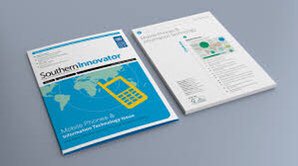
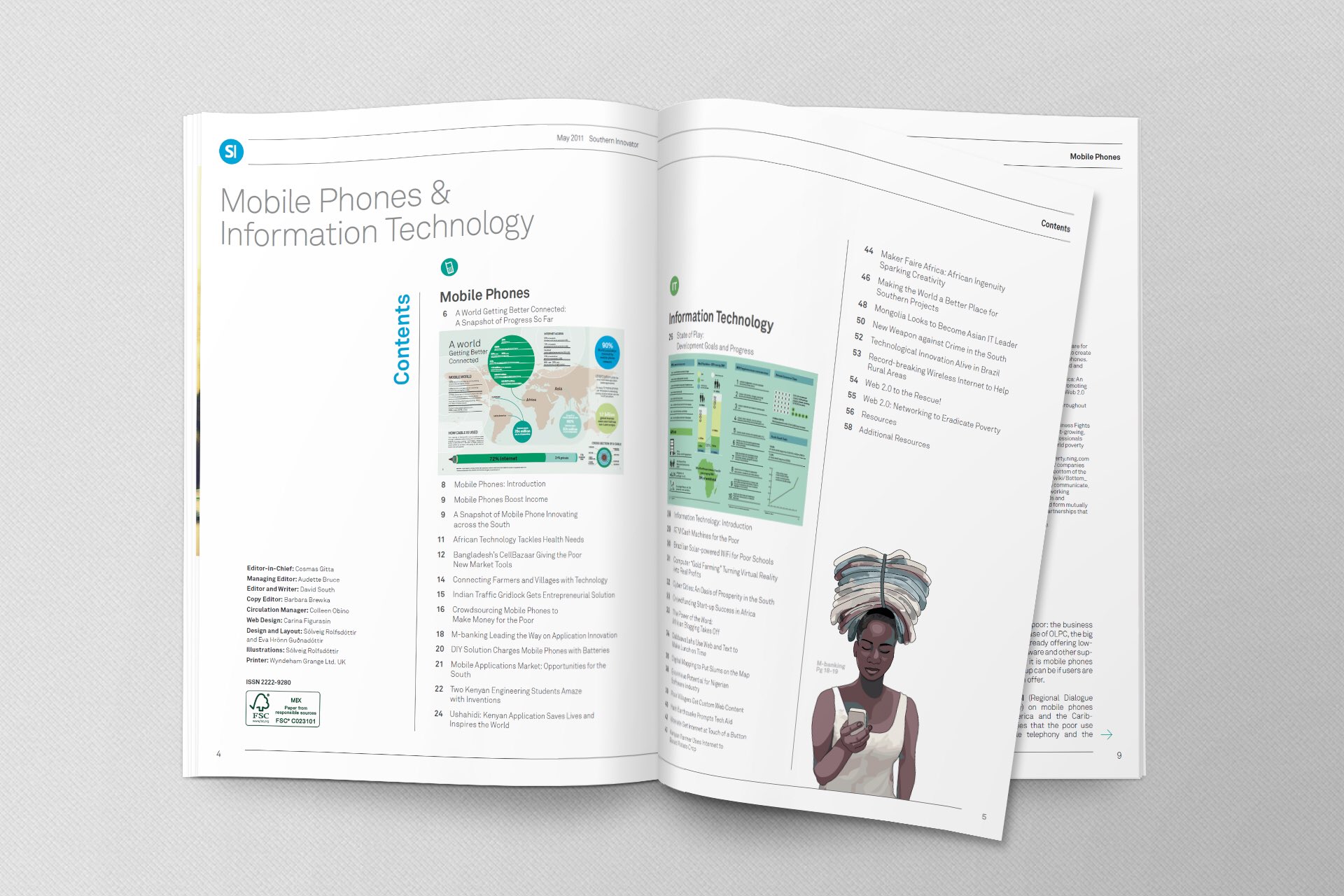
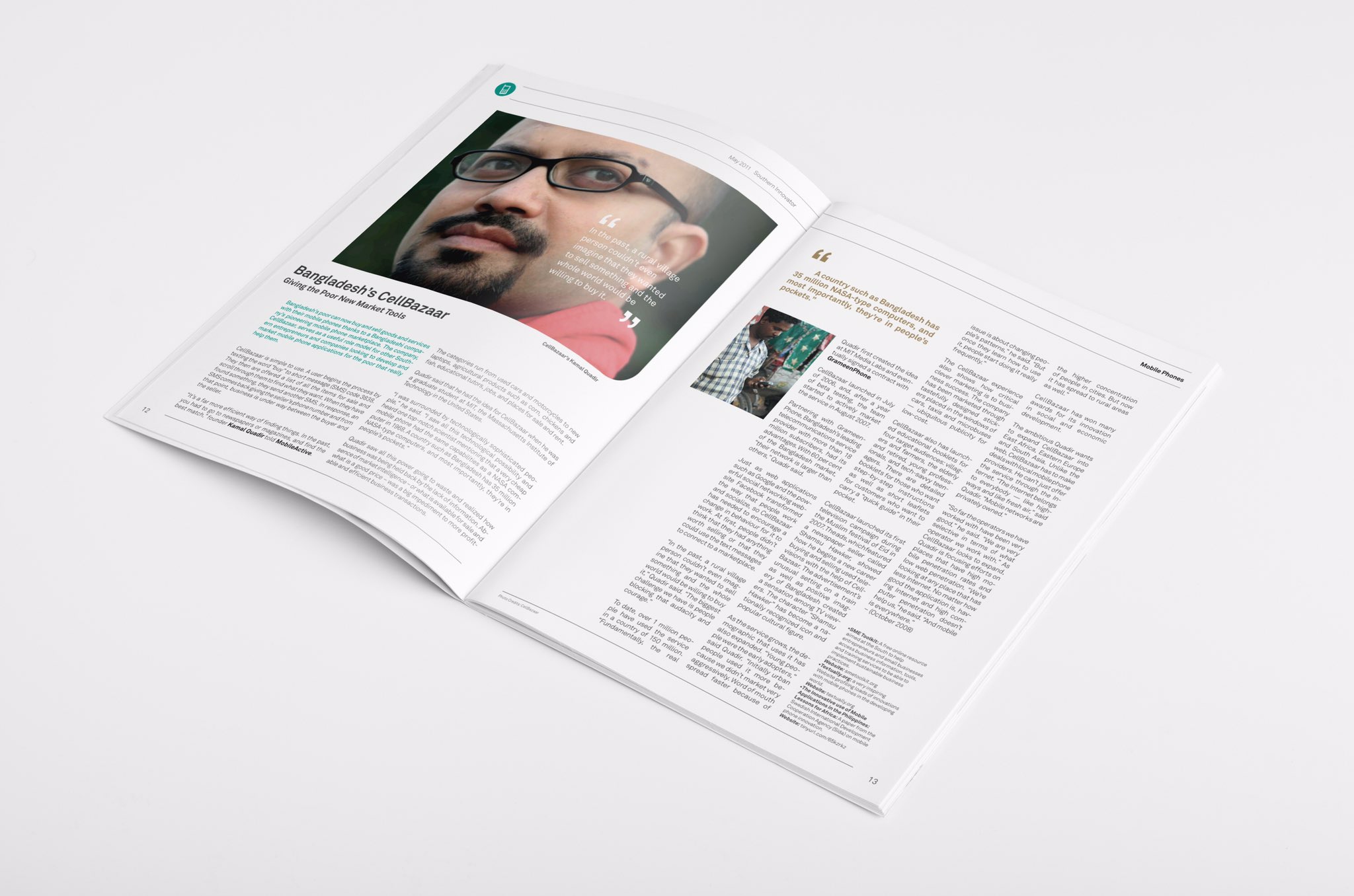
Southern Innovator (SI) is a new magazine for a fast-changing world. It profiles and celebrates the innovators across the global South finding new ways to tackle poverty, create wealth and improve human development and achieve the millennium development goals (MDGs). In its first issue, Southern Innovator features the people who are re-shaping new technologies – from mobile phone ‘apps’ to Internet technologies – to overcome poverty and to improve the quality of life in some of the poorest places on earth.

SI is based on intensive research and is produced by UNDP’s Special Unit for South-South Cooperation (www.southerninnovator.org). The Unit is the leading organisation in the world tasked with the goal of sharing knowledge across the global South. It organises events including the yearly South-South Expo (www.southsouthexpo.org), a roaming celebration and gathering of Southern innovators previously held in New York and Geneva, Switzerland. This year’s Expo will be held in Rome, Italy (5 to 9 December 2011).

SI is being distributed around the world through the United Nations network and partners and reaches some of the poorest and remotest places as well as the vibrant but stressed growing global megacities. It is hoped the magazine will inspire budding innovators with its mix of stories, essential information, facts and figures, images and graphics. The magazine will evolve based on reader responses and this first issue is very much the beginning of a journey. As became clear while researching this first issue, many things can change in a short space of time. Few could have imagined the rapid take-up of mobile phones in Africa and how these phones have become integral to development goals across the continent.

SI magazine is a quarterly publication and the next issues will launch in September and December of this year.

A summary for publication is here:

“Southern Innovator (ISSN 2222-9280) is a quarterly magazine published by the United Nations Development Programme’s Special Unit for South-South Cooperation. Launched in May 2011, SI is a new magazine celebrating creativity and innovation emerging from the global South. It explores entrepreneurial solutions to development challenges and uncovers the trends and events shaping the rise of the South in order to spur action on ending extreme poverty and toward reaching the Millennium Development Goals (MDGs).”

We hope you enjoy the magazine and find its content interesting and illuminating: a snapshot of a fast-changing world awash, as we found out, with innovators, creators and do-ers making their world a better place.

For more information on Southern Innovator contact Cosmas Gitta at cosmas.gitta@undp.org or editor David South at southerninnovator@yahoo.co.uk.

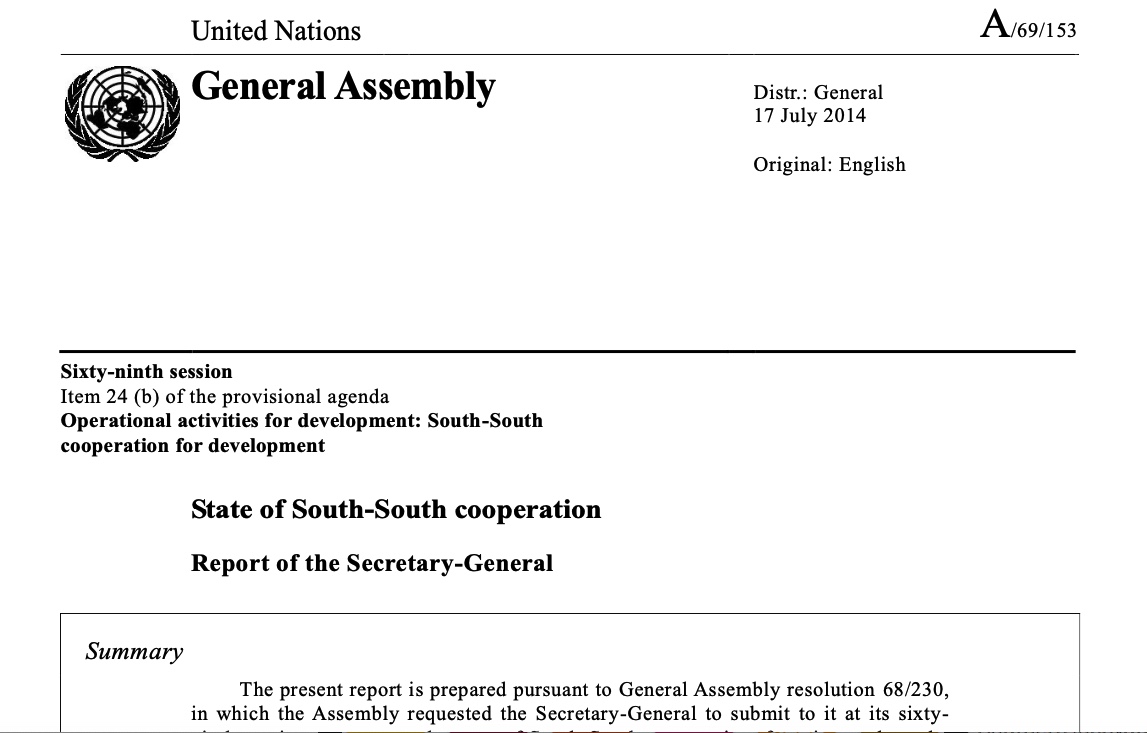
United Nations General Assembly: Sixty-ninth session, Item 24 (b) of the provisional agenda, Operational activities for development: South-South cooperation for development, 17 July 2014.
The research informing Southern Innovator Magazine played a part in the formulation of the UN’s post-2015 development agenda, including the Sustainable Development Goals (SDGs).

https://davidsouthconsulting.org/southern-innovator-scale-up-fundraiser/

ORCID iD: https://orcid.org/0000-0001-5311-1052.

© David South Consulting 2022

Categories
Archive Development Challenges, South-South Solutions Newsletters Southern Innovator magazine

Global South’s Rising Megacities Challenge Idea of Urban Living

By David SouthDevelopment Challenges, South-South Solutions

SOUTH-SOUTH CASE STUDY

The world crossed the threshold from being a majority rural world to a majority urban one at the end of the first decade of the 21st century. The reason for this is the fast-growing urban areas of the global South. And this is having a profound affect on how the world’s people live.

Across the global South, there are many examples of unchecked growth leading to squalor and poor housing conditions, and in turn to poor health and high rates of crime and disorder. Yet, the urbanization happening today across the global South is unprecedented for both its speed and its scale.

And, unlike previous surges in urbanization, it is this quality that is far more challenging for governments and policymakers.

Many countries and regions are experiencing highly stressed environmental conditions, with poor access to water and rising air pollution damaging human health, for example. But on the other side, there is also unprecedented change in technology and communications taking place. Every year, more and more of the world’s population gain access to 21st century communications such as smart phones and the Internet or ‘apps’ (applications), allowing the exchange of solutions and ideas at a rapid pace.

Many are weighing up the benefits and downsides of such an urban, dense world. Denser cities make it easier and more efficient to deliver services, and proponents see a rapid rise in living standards in these megacities. Others see wide-scale poverty and vicious fights over resources in crime-ridden, unhealthy packed megacities. These pessimists point to current conditions in many megacities across the global South.

No matter what perspective, many agree there has to be a cultural change in how people live and behave to make the megacities work.

The contrasting approaches taken by two giants of the global South – India and China – provides lessons and ideas.

The first big push from rural to urban took place in Europe in the 19th century. In 1800, just three per cent of the world’s population lived in cities. All the cities now seen as cosmopolitan hubs of economic and creative energy were just shadows of themselves prior to the 19th-century industrial revolution.

Lessons were learned from hard experience and one of the most important lessons was this: if a city is to grow – and grow quickly – then it must plan for this growth and put the well-being of people at the centre of this plan. This is critical to ensure public health is improved and that the transition to more dense living conditions improves human well-being, rather than making it worse.

A megacity is a city with a population greater than 10 million people (http://en.wikipedia.org/wiki/Megacity). The number of such cities will double over the next 10 to 20 years and many of these cities are in south and east Asia. By 2025, seven of the world’s top 10 megacities will be in Asia. Whole new cities are rising up that most people across the world have never heard about – yet.

One of the most rapidly urbanizing countries in the world is China. At the beginning of 2012, Chinese authorities announced the country was now a majority urban place, with most citizens living in cities. This population of 690.79 million people outpaced the rural population of 656.56 million people.

China is exploring a variety of solutions to making high-density city living work. Some of these solutions include creating multiplexes containing modern shopping, leisure, recreational and housing in one location. One example of this is The New Century Global Centre (http://cd.qq.com/a/20101018/000099.htm) in Chengdu, the capital of Sichuan. It is being called the world’s largest standalone complex. Chengdu is now a city of 14 million people and projected to be heading to 20 million people.

It includes design by noted Iraqi architect Zaha Hadid (zaha-hadid.com).

There are 1.5 million square metres of floor plans, two 1,000-room five-star hotels, an ice-skating rink, a 20,000 capacity marine park with 400 meters of artificial coastline and 5,000 square metres of artificial beach, including hot springs.

In contrast, the more chaotic and unplanned approach taken in India – also a country experiencing rapid growth in its cities – has come under intense criticism. Dr Rumi Aijaz of the Delhi-based Observer Research Foundation (observerindia.com) told The Guardian that Indian infrastructure improvements will be difficult to achieve: “Our urban areas are in a raw form.

All the basics are at a very low level. And the Indian state has been trying for a very long time to address this but a lack of capacity and endemic corruption has meant not much success.”

In 2001, India had 290 million people living in cities. By 2008, this reached 340 million. It is predicted this will reach 590 million people – 40 per cent of the population – by 2030. McKinsey and Company (mckinsey.com) believe by 2030 India will have 68 cities of more than one million people, 13 will have four million people and six megacities will be greater than 10 million people.

India faces an urban infrastructure crisis of epic proportions, McKinsey believes. Many millions will not have access to clean drinking water, adequate sewage, and will have to cope with poor transport.

China, on the other hand, has invested seven times more in urban infrastructure than India. And one example of how this investment pays off is Chengdu.

The fast-growing city of Chengdu’s mayor is trying to manage growth directly through the city’s policies. This involves managing the push and pull incentives driving people to cities and lifting the standard of living in the surrounding countryside.

Chengdu’s mayor Ge Honglin told The Guardian: “The first thing I did was to improve the conditions – schools, shops, garbage collection, the sewage system. We had to cut the gap between rural and urban areas. If people could have a brighter future in the countryside, they’d stay there. So we’re not seeing people swarm into the city= Instead there are people in the city considering moving to the country.”

“Chengdu is the only super-large central city that has narrowed the urbanrural income gap alongside rapid economic growth in China,” Ge said.

Hundreds of schools have been built surrounding Chengdu and partnerships made between rural and urban schools to help raise standards.

Chengdu is also pioneering new ways to address urban squalor with new information technologies. Patrols use mobile phones and cameras to document broken infrastructure and health and safety problems, and to locate and assist the homeless.

“You can barely see a begger in Chengdu,” said Gu. “We have a special system for monitoring them, and it works. Beggars are taken to the assistance centre, where they are given food and shelter and money to take them back to their home. If I say there are no more than 10 beggars on the street you will think there’s some sort of tyranny, but there isn’t. We’re trying to solve their problems.”

Published: May 2012

Resources

1) Endless City and Living in the Endless City: LSE Cities is an international centre at the London School of Economics and Political Science that carries out research, education and outreach activities in London and abroad. Its mission is to study how people and cities interact in a rapidly urbanizing world, focussing on how the design of cities impacts on society, culture and the environment. Website: http://lsecities.net/publications/books/the-endless-city/

2) Planet of Slums by Mike Davis: According to the United Nations, more than one billion people now live in the slums of the cities of the South. Mike Davis explores the future of a radically unequal and explosively unstable urban world. Website: http://books.google.co.uk/books/about/Planet_Of_Slums.html?id=FToaDLPB2jAC

3) An infographic from The Guardian newspaper showing the rise of the megacity in world history. Website: http://image.guardian.co.uk/sysimages/Observer/Pix/pictures/2012/01/21/urban2.jpg

4) Arrival City by Doug Saunders: A third of humanity is on the move. History’s largest migration is creating new urban spaces that are this century’s focal points of conflict and change — unseen districts of rapid transformation and febrile activity that will reshape our cities and reconfigure our economies.Website: http://arrivalcity.net/

5) Global Urbanist: The Global Urbanist is an online magazine reviewing urban affairs and urban development issues in cities throughout the developed and developing world. Website: http://globalurbanist.com/

6) The Spirit of Cities: Why the Identity of a City Matters in a Global Age by Daniel A. Bell and Avner de-Shalit. Website: amazon.com

7) Rise of the Asian Megacity: Website: http://www.bbc.co.uk/news/worldasia-pacific-13800944

8) Capitals of the Connected World: Mapping the New Global Power Structure. Website: http://www.theatlantic.com/special-report/capitalsconnected-world/

Creative Commons License

This work is licensed under a
Creative Commons Attribution-Noncommercial-No Derivative Works 3.0 License.

ORCID iD: https://orcid.org/0000-0001-5311-1052.

© David South Consulting 2023