Categories
Archive Development Challenges, South-South Solutions Newsletters

Housing Innovation in South’s Urban Areas

By David SouthDevelopment Challenges, South-South Solutions

SOUTH-SOUTH CASE STUDY

As urban populations around the South increase, the quality of city housing will be critical to the quality of life and sustainability of improvements to living standards.

Living in crowded and chaotic urban and semi-urban areas does not have to mean suffering poor quality housing. A variety of Southern architects are showing how new perspectives on common problems like cramped spaces, traffic noise, minimal green spaces and tight budgets can be addressed with clever thinking and new concepts.

The bustling and crowded Brazilian city of Sao Paulo has evolved in a chaotic fashion over the years. As Brazilian photographer Reinaldo Coser admitted to design and architecture magazine Dwell (www.dwell.com) , in many places it is “very ugly.”

Sao Paulo suffers from the downside of rapid urban and semi-urban development familiar to cities across the South: traffic gridlock, pollution, noise. It’s a toxic combination of factors that turns even simple tasks like buying groceries into depressingly long, stressful ordeals.

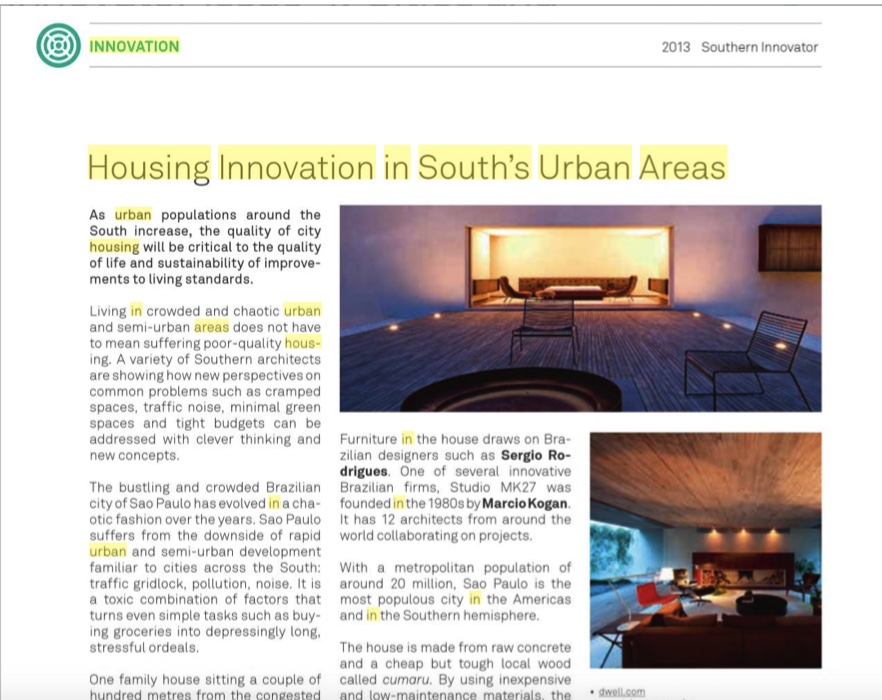
Coser’s family home sits a couple hundred metres from the congested Avenida Brigadeiro Faria Lima (http://en.wikipedia.org/wiki/Avenida_Brigadeiro_Faria_Lima) , the city’s unofficial main street. Yet the dwelling has been cleverly designed to make living in the centre of this modern urban hurly burly a peaceful and calming oasis. Designed by Brazilian architects Studio MK27 (http://www.marciokogan.com.br) – and in keeping with the rich Brazilian modernist tradition pioneered by Oscar Niemeyer in the country’s capital, Brasilia (http://en.wikipedia.org/wiki/Bras%C3%ADlia) – the home uses clever techniques to build calm into chaos.

The front and back gardens are level with the living room, creating an enormous living space that seamlessly flows from indoor to outdoor space. By using a large overhang over the gardens, even on rainy days the home can be lived in almost without walls.

Furniture in the home draws on Brazilian designers like Sergio Rodrigues (http://www.sergiorodrigues.com.br).

One of several innovative Brazilian firms, Studio MK27 was founded in the 1980s by Marcio Kogan. It has 12 architects from around the world collaborating on projects.

With a metropolitan population of around 20 million, Sao Paulo (http://en.wikipedia.org/wiki/S%C3%A3o_Paulo) is the most populous city in the Americas, and in the Southern hemisphere.

While it is easy to point out the downsides of rapid and chaotic urban development, Coser, a professional photographer, lives and loves Sao Paulo nonetheless because, like so many cities across the South, it is a vibrant and dynamic place to be.

And by choosing a design for his home that is calming, he has been able to introduce balance into his family’s life while benefiting from the economic opportunities of the city.

“This house has actually changed the rhythm of our lives,” he told Dwell. “We eat at home more. We go to bed earlier. We wake up earlier. We sleep more.”

And how has the calm helped his two daughters? One is able to play without disturbing the neighbours, and the other can quietly study her books, which was difficult when the family lived in the noise and buzz of a small two-bedroom apartment.

And – something often overlooked in development plans cooked up by economists and urban planners – the aesthetics of the house are very appealing. “Our house is so pretty,” says his wife, Sophia. “Sometimes I like to just look at it for a long time.”

This calm home was created out of basic need. The family needed more space with a second daughter on the way, and had become frustrated with the congestion of the city and the lack of green space. Architect Marcio Kogan was consulted for a solution.

“We wanted a place where we could just shut the door and travel,” says Reinaldo.

The house is made from raw concrete and a cheap-but-tough local wood called cumaru (http://tinyurl.com/3y8kh8v) . By using inexpensive and low maintenance materials, the home is able to weather the environmental stresses of a polluted, tropical city with harsh sunshine.

Kogan deployed his previous experience as a filmmaker to make the home feel and look more spacious and open than it is. He calls it “looking at the world through a wide-screen lens.” The design of the home is seen as a “narrative”, leading the occupant from the garden to the living room, up the stairs, past bedrooms to a rooftop deck with panoramic views of the city.

Another innovative solution in Sao Paulo is USINA (http://www.usinactah.org.br) – a finalist for the World Habitat Awards (http://www.worldhabitatawards.org/about/?lang=00) – which brings people together to build high-density urban housing. It has aided more than 5,000 people to build with their own labour multi-storey buildings. These new apartments are not isolated from other services, but come with community facilities, childcare facilities, professional training courses and other employment-generating activities.

It is estimated up to 15 percent of the city’s population live in slums. This community organising approach is in contrast to the existing ad-hoc building of homes in the slums – often with no technical assistance – or public housing projects built by developers looking for quick profits while ignoring quality and services. USINA’s approach has led to Sao Paulo being a pioneer in participatory housing policies.

USINA provides the technical assistance to social movements looking to build housing for the poor. The cost for the buildings is borne by a combination of public funding and the labour of the residents (working 16 hours per week per household). The cost per housing unit tends to be between US $12,000 and US $15,000 (with land usually donated free by public authorities).

Architectural innovation is also underway in Indonesia, another country that has experienced spurts of rapid economic growth and urbanization, and where a growing middle class is demanding a higher quality of life.

The country’s capital, Jakarta (http://en.wikipedia.org/wiki/Jakarta) , with a population over 8 million, is a mixed bag of modern skyscrapers, crumbling colonial architecture, suburbs and slums.

In the Jakarta suburb of Bekasi (population more than 2 million), Nugrohu Wisnu was looking for a little more space for his family.

At first, the family encountered the downside of poorly designed housing. They bought a house which was infested with termites and was uncomfortable to live in. Frustrated, they began shopping around for something better. And they turned to Indonesian architects Djuhara + Djuhara (http://djuhara.com/home.html).

“We thought that an all-steel house like the one that Mr. Djuhara had built just down the road would be termite resistant,” Wisnu told Dwell.

Djuhara is a high-profile architect and chair of the Jakarta chapter of the Indonesian Institute of Architects (http://www.iai.or.id) and helped to modernize the city’s planning regulations.

The stereotype of young Indonesian architects is that they only work on luxury hotels. But Djuhara was designing and building suburban homes and this grabbed Wisnu’s attention.

Also against stereotype, Djuhara was actually attracted by a tight budget and the small space for the house. In a crowded city, using every bit of space efficiently is critical. The existing house was torn down and Djuhara set about building a new home. The majority of the building materials were sourced within the immediate area: an easy thing to do in Jakarta since there are many vendors selling building supplies on the streets.

By buying local like this, shipping costs were eliminated from the cost of the house. The home’s cost, US $20,000, is just 2/3 of what a more conventional Indonesian home would cost.

Djuhara revelled in the job: “Ad-hocism is my religion,” he told Dwell.

The split-level design of the home uses the space well. The kitchen opens up into the garden.

“Family breakfasts are great in here,” says Wisnu. “And the open kitchen encourages the kids to head out into the garden and run and play.”

There is also a strong environmental component to the design. Airflow cavities in the ceiling are used in the bedrooms to cool them. The house also uses heavy wooden shutters to keep the house cool during the day: “The shutters are unusual, but they are thick and sturdy,” Wisnu explains.

“They really shade the master bedroom to the extent that it feels mellow and cool. They let us reduce our air-conditioning consumption, even during the height of the day.”

And Djuhara also has another difference from many other architects: he refuses to patent his design.

“My friends have asked me why I don’t patent my low-cost houses,” he explains, “but they completely miss the point. I actually want my designs to be copied. I want Indonesian society to rethink its attitudes towards urban architecture.”

Published: June 2010

Resources

https://davidsouthconsulting.org/2021/10/21/cities-for-all-shows-how-the-worlds-poor-are-building-ties-across-the-global-south/

https://davidsouthconsulting.org/2022/05/23/debt-free-homes-for-the-poor/

https://davidsouthconsulting.org/2021/11/11/decent-and-affordable-housing-for-the-poor/

https://davidsouthconsulting.org/2021/11/11/housing-solution-for-worlds-growing-urban-population/

https://davidsouthconsulting.org/2020/12/14/innovation-in-growing-cities-to-prevent-social-exclusion/

https://davidsouthconsulting.org/2021/10/22/lima-to-delhi-what-can-be-learned-on-urban-resilience/

https://davidsouthconsulting.org/2022/11/19/securing-land-rights-for-the-poor-now-reaping-rewards/

https://davidsouthconsulting.org/2017/11/08/smart-cities-up-close-2013/

https://davidsouthconsulting.org/2022/05/23/solar-bottle-bulbs-light-up-dark-homes/

https://davidsouthconsulting.org/2021/10/22/south-south-cooperation-for-cities-in-asia/

https://davidsouthconsulting.org/2021/03/05/southern-innovator-issue-4/

https://davidsouthconsulting.org/2021/03/12/southern-innovator-magazine/

https://davidsouthconsulting.org/2022/11/17/tiny-homes-to-meet-global-housing-crisis/

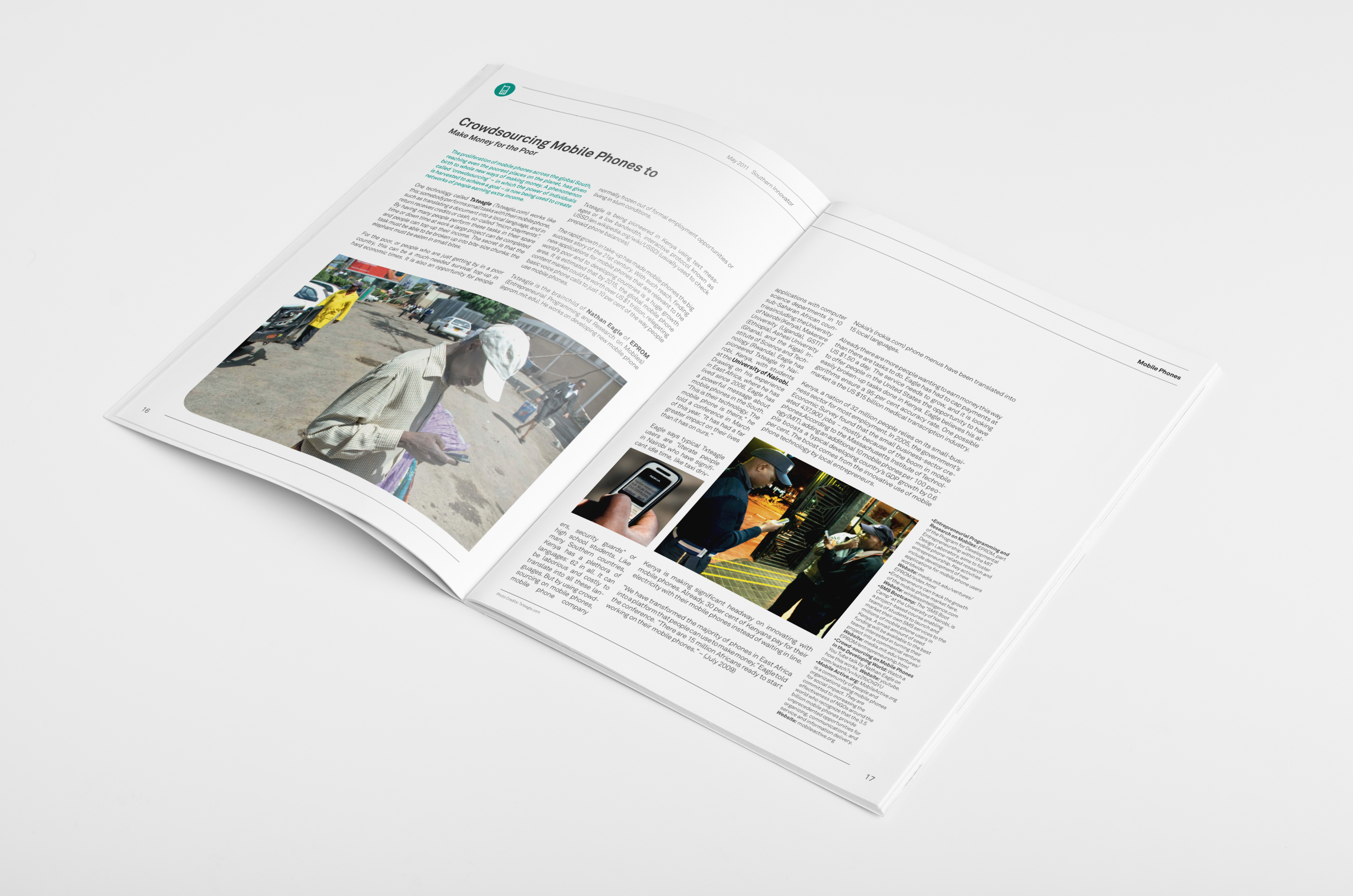
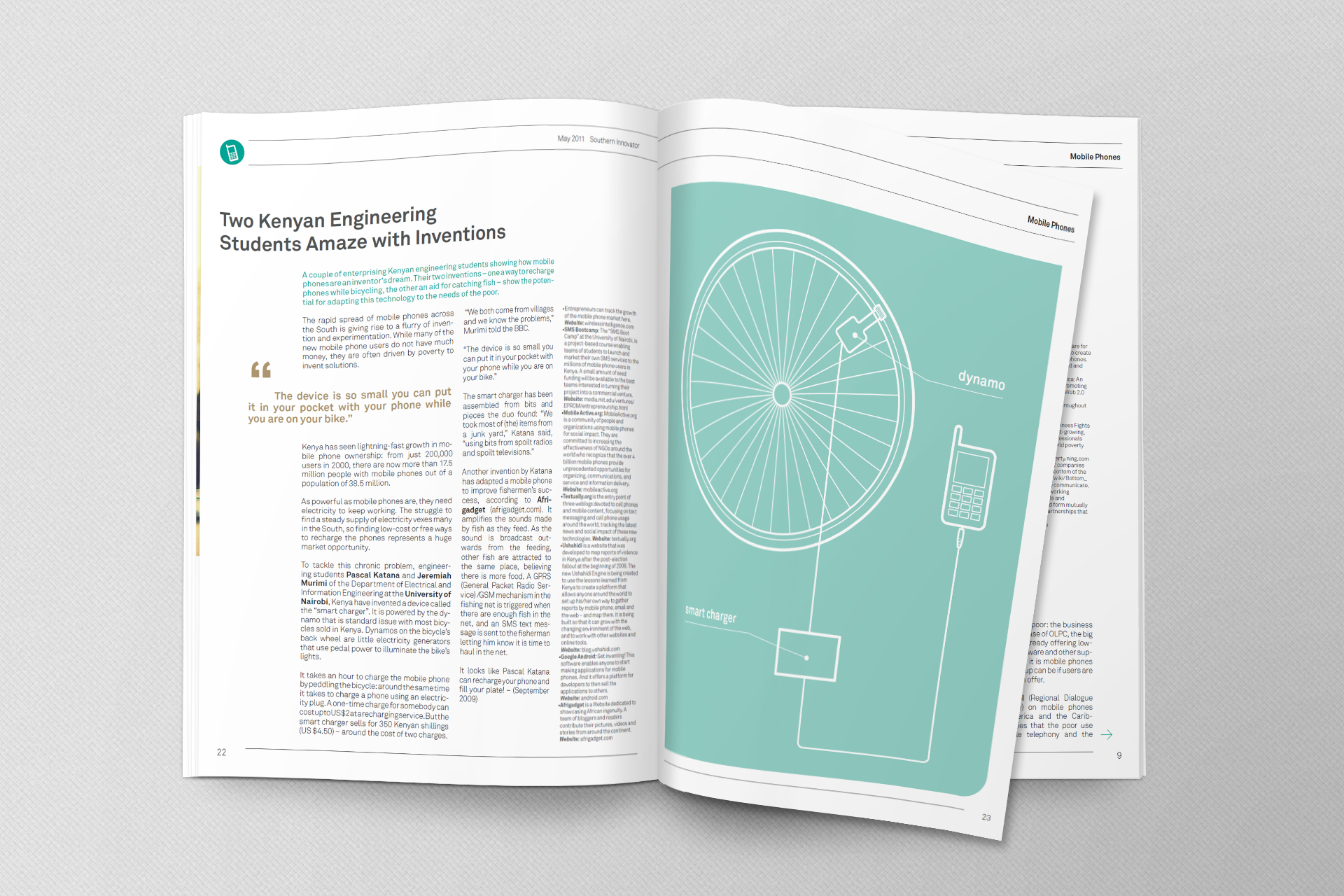
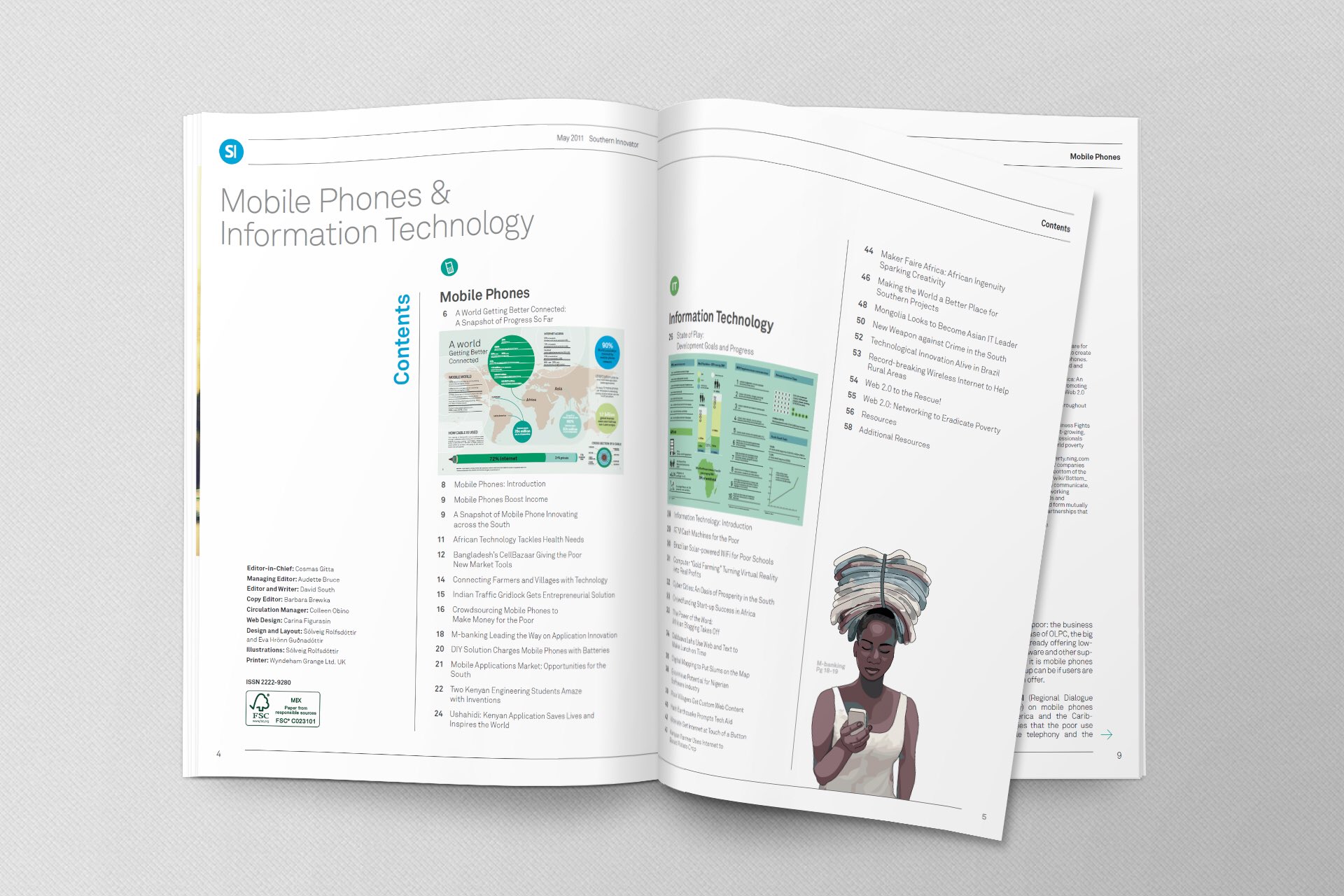
Development Challenges, South-South Solutions was launched as an e-newsletter in 2006 by UNDP’s South-South Cooperation Unit (now the United Nations Office for South-South Cooperation) based in New York, USA. It led on profiling the rise of the global South as an economic powerhouse and was one of the first regular publications to champion the global South’s innovators, entrepreneurs, and pioneers. It tracked the key trends that are now so profoundly reshaping how development is seen and done. This includes the rapid take-up of mobile phones and information technology in the global South (as profiled in the first issue of magazine Southern Innovator), the move to becoming a majority urban world, a growing global innovator culture, and the plethora of solutions being developed in the global South to tackle its problems and improve living conditions and boost human development. The success of the e-newsletter led to the launch of the magazine Southern Innovator. 

Creative Commons License

This work is licensed under a
Creative Commons Attribution-Noncommercial-No Derivative Works 3.0 License.

ORCID iD: https://orcid.org/0000-0001-5311-1052.

© David South Consulting 2023

Categories
Archive Development Challenges, South-South Solutions Newsletters

Maker Faire and the R & D Rise in the South

By David SouthDevelopment Challenges, South-South Solutions

SOUTH-SOUTH CASE STUDY

The majority of the world’s research and development (R & D) in science and technology is now shifting to the global South. Powerhouses like China boast vast numbers of published papers in peer-reviewed journals and hefty cash inputs into research and development.

China increased its R & D spending in 2009 to US $25.7 billion, a 25.6 percent increase over 2008, according to Du Zhanyuan, vice minister of the Ministry of Science and Technology. China is rapidly closing the science funding gap with Japan: in 2009 it allotted US $37.1 billion for R & D.

The times have never been better for those with new ideas in the global South.

And it’s not just big companies that are involved. There is R & D going on at ground level as well. African inventors, innovators and creatives met in Nairobi, Kenya in August as part of the Maker Faire Africa 2010 (http://makerfaireafrica.com). This is research and development on a shoestring, and done in a very practical, problem-solving way. While Africa’s inventors and innovators lack the big budgets of other economies, they are not short on ideas and drive.

The Maker Faire Africa is a family-friendly gathering where the inventors can showcase their work and connect with others. It is a mix of workshops, tips on business skills, awards and a party.

The global economy thrives on innovation and so-called ‘creative destruction’ – as economist Joseph Schumpeter called it (http://en.wikipedia.org/wiki/Creative_destruction) – that takes place as out-of-date technologies and ways of doing are surpassed by better ideas and more efficient methods. The power to innovate is the deciding factor for sustained economic growth.

The philosophy behind Maker Faire Africa 2010 – the brainchild of ‘venture catalyst’ and entrepreneur Emeka Okafor (http://timbuktuchronicles.blogspot.com) – is to prove that innovation doesn’t just happen with computers.

As its website says, “The aim of a Maker Faire-like event is to create a space on the continent where Afrigadget-type innovations (http://www.afrigadget.com), inventions and initiatives can be sought, identified, brought to life, supported, amplified, propagated, etc.”

Maker Faire Africa is working with research organizations like Ghana’s Ashesi University (http://www.ashesi.edu.gh/index.html) and Kwame Nkrumah University of Science and Technology (http://www.knust.edu.gh/pages) “to sharpen focus on locally-generated, bottom-up prototypes of technologies that solve immediate challenges to development.”

In the end, the goal of engaging all this creative and inventive energy is to spur Africans towards building “a manufacturing base that supplies innovative products in response to market needs.”

This initiative stands out in several ways: it is truly inspiring, it gets to the core of how wealth is created, and helps build communities of innovators and inventors to tackle the problems facing Africa – and humanity.

“We have a broader variety of makers this time around,” says Emeka Okafor of the 2010 Maker Faire. He notes makers are bringing more complex systems to the Faire, rather than just single devices. And that they “have more makers who are actually from the region.”

“Maker Faire Africa is essentially a platform whereby innovators, inventers, creative types, across all disciplines, share ideas, showcase their products, interact with attendees and other makers,” he continues. They “begin the process of building what we think is an essential community of what I like to term the productive class. That is essentially where we see ourselves playing a key role. A productive class whose foundation is laid upon building problem-solving systems.”

Okafor believes Africa just doesn’t “have enough wealth creation as we should.”

“We have things backwards. … One of the essential steps is that you had productive systems that allowed those countries (Asia and Europe) to create wealth. And they had to draw those resources from within.

“We see Maker Fair Africa celebrating resources that we already have, with knowledge from within and outside.

“In many ways the Makers as we see them, epitomise the very sense of problem-solving that as a society acquires more of it, it begins to deal with its challenges very differently. And not look elsewhere in terms of dealing with its challenges. We want to make our Makers sexy, we want to make inventors sexy, innovators celebrities.”

Some of the inspiring inventors from this year’s Faire include Norbert Okec from Uganda. His prototype for a solar powered street lighting system comes straight from his frustration with the traffic lights of Kampala, Uganda. Many don’t work and so he has developed a prototype solar-powered traffic light using a mix of recycled local parts and some LEDs (http://en.wikipedia.org/wiki/Light-emitting_diode) brought by a friend from China.

He hopes to produce an e-book on his invention to share with other inventors. He was joined by fellow inventors working on a dashboard for managing wireless networks, how to recycle plastic parts, solar-power torches, water and sanitation products, junk art, community cookers, sculptures, eye glasses, bicycles, and an automatic lighting system for homes.

Okafor is a passionate advocate of the Maker philosophy and how it changes the game: “…building is equivalent to making and making is a joyful thing, it is an interesting thing. It is a very satisfactory thing. It is not work. Most of the individuals around here have the biggest smiles on their faces. They don’t see what they are doing as work.

“The fact they are sitting next to other people like them if anything is one of the biggest take-aways for them. Because for some of them they were toiling away on their own. Now they see others like them. And they realise they aren’t crazy.

“When you build a community and the community begins to get stronger and sustain itself, all the other things come naturally: businesses get formed, partnerships happen: and then everything else people look for first…actually begins to happen.”

And Africa’s future prosperity is what is at stake at the Faire: “There is a market for the products. And we believe as more individuals – Africans and otherwise – come into contact with what is on display, they will come to see their own societies differently. ”

Published: September 2010

Resources

  • Flickr photo gallery: A clickable archive of the Maker Faire inventors and their inventions. Website: http://www.flickr.com/groups/makerfaireafrica/pool/
  • Afrigadget: ‘Solving everyday problems with African ingenuity’: This blog never ceases to amaze and fascinate. Website: http://www.afrigadget.com/
  • Afrobotics: A competition for African engineering students to develop robots. Website: http://www.afrobotics.com/
  • International Development Design Summit: The Summit is an intense, hands-on design experience that brings together people from all over the world and all walks of life to create technologies and enterprises that improve the lives of people living in poverty. Website: http://iddsummit.org/
  • Butterflyworks: A social design studio using design to make social change. They use media, social branding and experiential learning to share knowledge, trigger creativity and build sustainable businesses. Website: http://www.butterflyworks.org
  • AshokaTECH: AshokaTECH is a blog about technology and invention within the realm of social entrepreneurship. It aims to find, support, and celebrate social innovators whose technologies offer fresh, effective approaches to advancing social change. Website: http://tech.ashoka.org/

Development Challenges, South-South Solutions was launched as an e-newsletter in 2006 by UNDP’s South-South Cooperation Unit (now the United Nations Office for South-South Cooperation) based in New York, USA. It led on profiling the rise of the global South as an economic powerhouse and was one of the first regular publications to champion the global South’s innovators, entrepreneurs, and pioneers. It tracked the key trends that are now so profoundly reshaping how development is seen and done. This includes the rapid take-up of mobile phones and information technology in the global South (as profiled in the first issue of magazine Southern Innovator), the move to becoming a majority urban world, a growing global innovator culture, and the plethora of solutions being developed in the global South to tackle its problems and improve living conditions and boost human development. The success of the e-newsletter led to the launch of the magazine Southern Innovator. 

Creative Commons License

This work is licensed under a
Creative Commons Attribution-Noncommercial-No Derivative Works 3.0 License.

ORCID iD: https://orcid.org/0000-0001-5311-1052.

© David South Consulting 2022

Categories
Archive data Development Challenges, South-South Solutions Newsletters digital ID Southern Innovator magazine

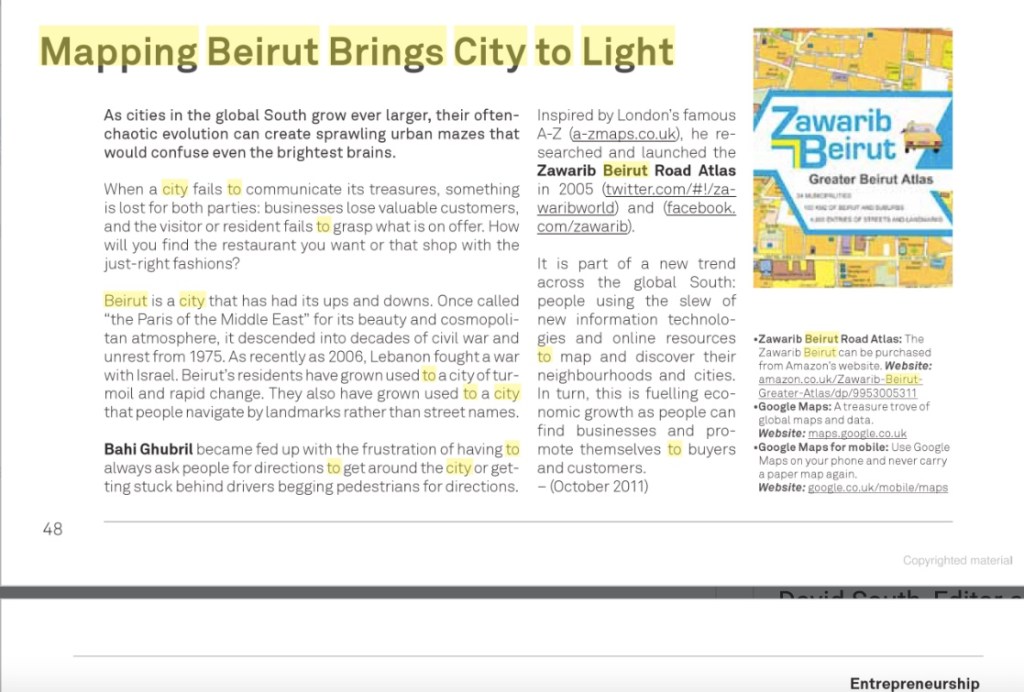
Mapping Beirut Brings City to Light

By David SouthDevelopment Challenges, South-South Solutions

SOUTH-SOUTH CASE STUDY

As cities in the global South grow ever larger, their often-chaotic evolution can create sprawling urban mazes that would confuse even the brightest brains.

Streets can be unnamed, unnumbered, twisty, full of dead ends and alleys. Informal settlements can pop up within weeks, whole neighbourhoods are razed to the ground and replaced by gleaming office buildings and apartments within months. Some countries experience political instability and conflict, disrupting daily life and making planning difficult. All this chaos makes business and travel more inefficient, especially to visiting businesspeople looking to trade or tourists simply wanting to look around.

When a city fails to communicate its treasures, something is lost for both parties: the city’s businesses lose valuable custom and the visitor or resident fails to grasp what is on offer. How will you find the restaurant you want, or that shop with the just-right fashions?

Beirut is a city that has had its ups and downs. Once called “the Paris of the Middle East” for its beauty and cosmopolitan atmosphere, it descended into decades of civil war and unrest from 1975, most recently in 2006 it had a war with Israel. Its residents have grown used to a city of turmoil and rapid change. They also have grown used to a city that people navigate by landmarks rather than street names.

Bahi Ghubril grew fed up with the frustration of having to always ask people for directions to get around the city, or getting stuck behind drivers begging pedestrians for directions.

Inspired by London’s famous A-Z (http://www.a-zmaps.co.uk), he researched and launched the Zawarib Beirut Road Atlas in 2005 (http://twitter.com/#!/zawaribworld) and (http://www.facebook.com/zawarib).

It is part of a new trend across the global South: people using the slew of new information technologies and online resources to map and discover their neighbourhoods and cities. In turn, this is fuelling economic growth as people can find businesses and promote themselves to buyers and customers.

It took Ghubril two years to put together the first guide, gathering street images from satellite photos and then combining them with information collected on foot and from local mayors and cartographers.

“The project was born from a need to organise the city,” he told Monocle magazine, “but also as a socio-political project to open up the city to its residents and visitors.”

As an entrepreneur, Ghubril had no previous experience in publishing. He has been an actor and worked in finance.

During the research for the guide, Ghubril developed a rich knowledge of the city’s structure, its bureaucracy and how people really live their lives. His willingness to do this hard work is paying off.

Zawarib Beirut – which translates as Beirut Alleys – has successfully expanded into editions covering nearby cities, a pocket version, eight versions colourfully decorated by local artists, and the first Beirut bus map.

The service has a database including thousands of street names, landmarks, sectors and districts within the 34 municipal regions making up Greater Beirut. It includes useful phone numbers, car parks and a bus map. During holidays, like the Muslim holy month of Ramadan, it publishes a map of all of Beirut’s mosques.

Ghubril promotes the guide directly to the city’s residents. Wearing blue and black t-shirts asking “Lost? ask me,” young women help to distribute the guide on the streets of Beirut.

Other mapping projects depend on the mobile phones that are more and more part of daily life in the South’s slums – even for the poorest people. With the spread of mobile phones, it is becoming possible to develop a digital picture of a slum area and map its needs and population. It has become possible to undertake digital mapping initiatives to truly find out who is where and what is actually going on.

An NGO called Map Kibera (http://www.mapkibera.org) is working on an ambitious project to digitally map Africa’s largest slum, Kibera in Nairobi, Kenya.

The Map Kibera project uses an open-source software programme, OpenStreetMap (http://www.openstreetmap.org), to allow users to edit and add information as it is gathered. This information is then free to use by anybody wanting to grasp what is actually happening in Kibera: residents, NGOs, private companies and government officials.

It will literally put Kibera on Kenya’s map.

In Brazil, an NGO called Rede Jovem (http://www.redejovem.org.br) is deploying youths armed with GPS (global positioning system)-equipped (http://en.wikipedia.org/wiki/Global_Positioning_System) mobile phones to map the favelas of Rio de Janerio.

The mappers physically travel around the favela and upload information on each individual landmark (restaurants, roads etc.) as they go. They use Nokia N95s mobile phones that are connected to Google Maps (http://www.maps.google.com). The project then uses Wikimapa (http://www.wikimapa.org.br), and Twitter (http://www.twitter.com) to log the information.

Published: October 2011

Resources

1) Zawarib Beirut Road Atlas: The Zawarib Beirut can be purchased from Amazon’s website. Website: http://www.amazon.co.uk/Zawarib-Beirut-Greater-Atlas/dp/9953005311

2) Google Maps: A treasure trove of global maps and data. Website: http://maps.google.co.uk/

3) Google Street View: A global database of photographs showing neighbourhoods and streets. Website: http://maps.google.com/intl/en/help/maps/streetview/#utm_campaign=en&utm_medium=van&utm_source=en-van-na-us-gns-svn

4) Google Maps for mobile: Use Google Maps on your phone, and never carry a paper map again. Website: http://www.google.co.uk/mobile/maps/

https://davidsouthconsulting.org/2022/02/17/digital-mapping-to-put-slums-on-the-map/

https://davidsouthconsulting.org/2022/10/25/indian-city-slum-areas-become-newly-desirable-places-to-live/

https://davidsouthconsulting.org/2022/10/17/mapping-to-protect-kenyas-environment-the-emazingira-solution/

Development Challenges, South-South Solutions was launched as an e-newsletter in 2006 by UNDP’s South-South Cooperation Unit (now the United Nations Office for South-South Cooperation) based in New York, USA. It led on profiling the rise of the global South as an economic powerhouse and was one of the first regular publications to champion the global South’s innovators, entrepreneurs, and pioneers. It tracked the key trends that are now so profoundly reshaping how development is seen and done. This includes the rapid take-up of mobile phones and information technology in the global South (as profiled in the first issue of magazine Southern Innovator), the move to becoming a majority urban world, a growing global innovator culture, and the plethora of solutions being developed in the global South to tackle its problems and improve living conditions and boost human development. The success of the e-newsletter led to the launch of the magazine Southern Innovator. 

https://davidsouthconsulting.org/2021/03/05/southern-innovator-issue-1/

Creative Commons License

This work is licensed under a
Creative Commons Attribution-Noncommercial-No Derivative Works 3.0 License.

ORCID iD: https://orcid.org/0000-0001-5311-1052.

© David South Consulting 2022

Categories
Archive Development Challenges, South-South Solutions Newsletters

2011 Trends for the South

By David SouthDevelopment Challenges, South-South Solutions

SOUTH-SOUTH CASE STUDY

The world has been through a dramatic and fascinating period since the global economic crisis erupted in 2008. While the wealthy, developed nations of the North have been pitched into one crisis after another, the countries of the global South (many of whom are well accustomed to crises) have been part of a powerful new economic phenomenon: the rapid growth of South-South trade, investment and exchange. Its effects include stronger ties between Asia and South America and between China and Africa.

South-South trade is the great economic success story of the past decade. World Trade Organization (WTO) (www.wto.org) figures show South-South trade grew to 16.4 percent of the US $14 trillion in total world exports in 2007, from 11.5 percent in 2000. While the global economic crisis has slowed trade down, the overall trend for South-South trade and connections seems firmly established.

South-South trade made up 20 percent of global exports by 2010, and foreign direct investment to developing economies rose by 10 percent in 2010 due to a rapid economic recovery and increasing South-South flows.

Trade between China and Africa has surged during the decade since China joined the WTO in 2001, from around US $10 billion in 2000 to US $73.3 billion in 2007, a year-on-year increase of 32.2 percent. By 2008, it had soared by 44.1 percent to reach a record high of US $106.84 billion, according to Zhang Yongpeng of the Institute for West Asian and African Studies (IWAAS).

The surge is remarkable and recent. For example, according to accountants KPMG, between 2001 and 2009 China invested just US $215 million in Brazil. But in 2010, China invested US $20 billion in energy and chemical companies in Argentina and Brazil. And Luis Alberto Moreno, president of the Inter-American Development Bank, told the Financial Times that “seven percent of Colombian gasoline has been replaced by domestic ethanol, produced with green Indian technology – while Indian companies, including Infosys and Tata, now have 17,000 employees in Latin America and the Caribbean.”

This jump in investment has also had its downside: coming fast and furious as investment cash chases better investment profits in the global South, it has pushed up inflation and commodity prices and spawned property speculation bubbles. This, as can be seen across North Africa and the Middle East, can lead to political and social instability.

A review of the big trends bubbling under the surface in 2011 shows how important South-South exchange will be in alleviating poverty and improving lives in the run-up to the 2015 Millennium Development Goals (http://www.un.org/millenniumgoals/). It also shows up the dangers inherent in this new environment – rising inflation without economic growth can crush the poor. A focus on innovation and new thinking will be necessary to get through this year and beyond.

Some of the top trends that will have a big impact in 2011 are:

– Inflation: In 2011 it looks like we will hear a lot about inflation. As the global economy tries to stabilize and return to growth, there will be inflation surges for a wide variety of reasons. People will need strategies and new techniques to make sure they can afford the necessities of life. This will be critical if development gains from the past decade are not to be lost.

– Super cycle: Some are putting forward the theory we are entering a ‘super cycle’ (http://www.bloomberg.com/news/2011-01-23/super-cycle-leaves-no-economy-behind-as-davos-shifts-to-growth-from-crisis.html) created by better connectivity, global travel and mobility and the ease of moving around investment to create businesses and jobs. The super cycle theory claims that this will spark the greatest period of human development in history – raising all national economies – as more and more people benefit from rising living standards and opportunities.

– Switch to South-South trade: With the trend of increasing South-South trade now firmly established, there is a greater awareness now of the power of sharing ideas across the South. One example of this idea-sharing is the annual Global South-South Development Expo (http://www.southsouthexpo.org/) run by UNDP’s Special Unit for South-South Cooperation Unit (http://ssc.undp.org/).

– New technologies: The spread of new technologies around the world will continue and bring many changes. Africa is seeing increasing access to high-speed Internet as new undersea cables are laid around the continent. Mobile phones will continue to be a critical tool for many to stay in touch and boost incomes.

– MDGs on horizon in 2015: The Millennium Development Goals (MDGs) target of 2015 is just four years away. This will face the headwinds of the global economic crisis and urgent attention will be needed to make sure gains are not lost as 2015 approaches. The role played by South-South trade will be a critical partner in aiding goal achievements.

– Cities: A surge to the urban was pronounced by 2007 and we are now living in a majority urban world. Innovation and sharing experiences and knowledge will play a key role in ensuring this is not a disaster. A recent book, Arrival City by Canadian journalist Doug Saunders, detailed this urban surge occurring across the global South, the largest movement of people to cities and urban and semi-urban areas in human history. It follows the pattern that was seen in Europe in the 19th century, as economies change and people seek the new opportunities promised by cities, or find rural economies unsustainable.

– The China model of development: The big talking point will be China’s economic model for eradicating poverty on a mass scale. A new book by Dambisa Moyo, How the West Was Lost: Fifty Years of Economic Folly – And the Stark Choices Ahead, investigates the mistakes made in developed, Western nations and what can be learned from the experiences in the global South.

– Food crisis: At the beginning of February, the Food and Agricultural Organization (FAO) issued a warning about the risk of a new global food crisis after its food price index reached a record high in January 2011. The FAO also issued an alert about severe drought in China, the world’s largest wheat producer. Flooding in Brazil and Australia have also devastated crops, much of which are exported to countries across the South. There is also risk to crops from flooding in southern Africa. Wheat, corn and soybean prices are rising, and prices reached a peak just as they did in 2008 (FAO).

Even developed countries normally used to food surpluses are at risk. In the US, corn reserves are at a 15 year low (US Department of Agriculture), and the price of corn has doubled in past six months.

A billion people go to bed hungry every night; someone starves to death every 3.6 seconds – 75 percent are children under five, according to the World Food Programme (http://www.wfp.org/1billion).

Published: 2011

Resources
1) Global Information and Early Warning System on Food and Agriculture: A data mix tracking global food prices and situation reports. Website: http://www.fao.org/worldfoodsituation/wfs-home/en/
2) World Bank Food Crisis blog: Website: http://www.worldbank.org/foodcrisis/
3) Trade Law Centre for Southern Africa: “Building capacity to help Africa trade better”: tralac’s mission is to build trade law capacity in southern Africa so that these countries can participate effectively in the global economy; to negotiate trade agreements that will support their development objectives, and so that they can implement the agreements to ensure that they realise the potential benefits of international trade. Website: http://www.tralac.org/cgi-bin/giga.cgi?cmd=cause_dir_cause&cause_id=1694
4) Future Forum world videos: Compelling animated videos exploring the hard choices of an urbanizing world and the need to promote sustainable development and environmental harmony. Website: http://www.youtube.com/user/forumforthefuture96

Development Challenges, South-South Solutions was launched as an e-newsletter in 2006 by UNDP’s South-South Cooperation Unit (now the United Nations Office for South-South Cooperation) based in New York, USA. It led on profiling the rise of the global South as an economic powerhouse and was one of the first regular publications to champion the global South’s innovators, entrepreneurs, and pioneers. It tracked the key trends that are now so profoundly reshaping how development is seen and done. This includes the rapid take-up of mobile phones and information technology in the global South (as profiled in the first issue of magazine Southern Innovator), the move to becoming a majority urban world, a growing global innovator culture, and the plethora of solutions being developed in the global South to tackle its problems and improve living conditions and boost human development. The success of the e-newsletter led to the launch of the magazine Southern Innovator. 

Creative Commons License

This work is licensed under a
Creative Commons Attribution-Noncommercial-No Derivative Works 3.0 License.

ORCID iD: https://orcid.org/0000-0001-5311-1052.

© David South Consulting 2022