Tag: global economy

  • David South Consulting Books | 1997 – 2014

    David South Consulting Books | 1997 – 2014

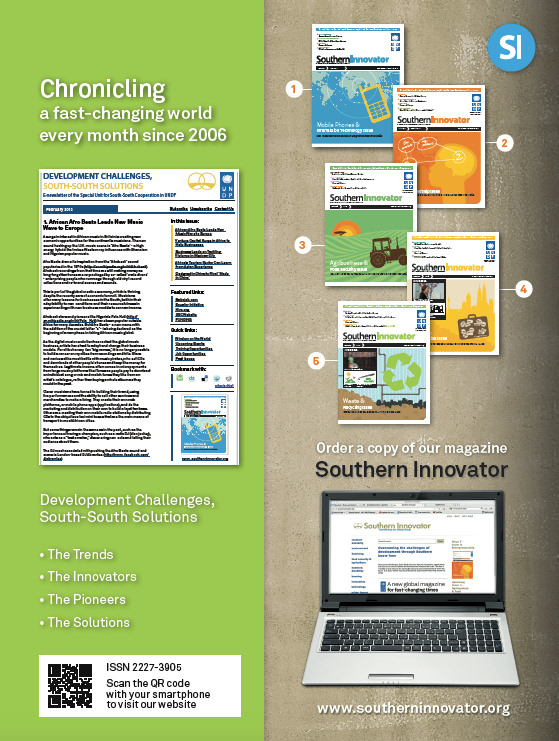
    Southern Innovator Magazine Issue 5: Waste and Recycling, Editor and Writer: David South (ISBN 978-0-9920217-1-9) (ISSN 2222-9280) (Online: ISSN 2227-0523): Southern Innovator’s fifth issue tackles the theme of waste and recycling in the global South. It has unearthed radical new ways to use the Earth’s resources while efficiently raising living standards for the world’s majority. Waste no longer needs to pile up and pollute the environment and communities; it can be a source of wealth and provide sustainable livelihoods.
     
    Radical ways to alter how things are made, such as the production model called cradle-to-cradle, have the potential to meet human needs without harming the environment and human health. Effective use of renewable energy technologies and sources also could eliminate energy poverty in the global South, dramatically raising living standards and boosting human development.

    “We are proud to present our first book entry in David South’s 5th Issue of the Southern Innovator Magazine. The general focus of this paper is to show the rise of the south as a strong economic power, this year’s issue is focussing on the dilemma of strong population growth and limited resources with the focus on waste and recycling issues for example the elephant dung paper production in Thailand, the banning of plastic bags in Uganda or the creation of green fashion in China.”NEEMIC

    “@SouthSouth1 is one of the best sources out there for news and info on #solutions to #SouthSouth challenges.” Adam Rogers, Assistant Director, Regional Representative, Europe, United Nations Office for South-South Cooperation (UNOSSC)

    “Btw, I really enjoyed reading them, impressive work & a great resource. Looking forward to Issue 6. My best wishes to you & your team at SI.”

    “… great magazine, nice design.”

    On Google Books: https://books.google.co.uk/books?id=6ILdAgAAQBAJ&dq=southern+innovator&source=gbs_navlinks_s

    Designed in Iceland

    Follow @SouthSouth1
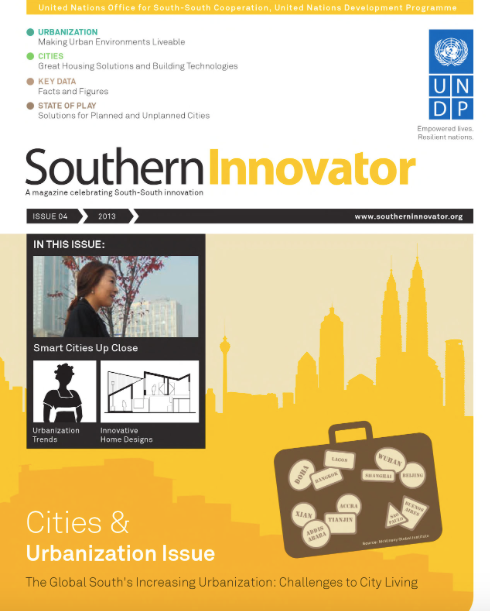
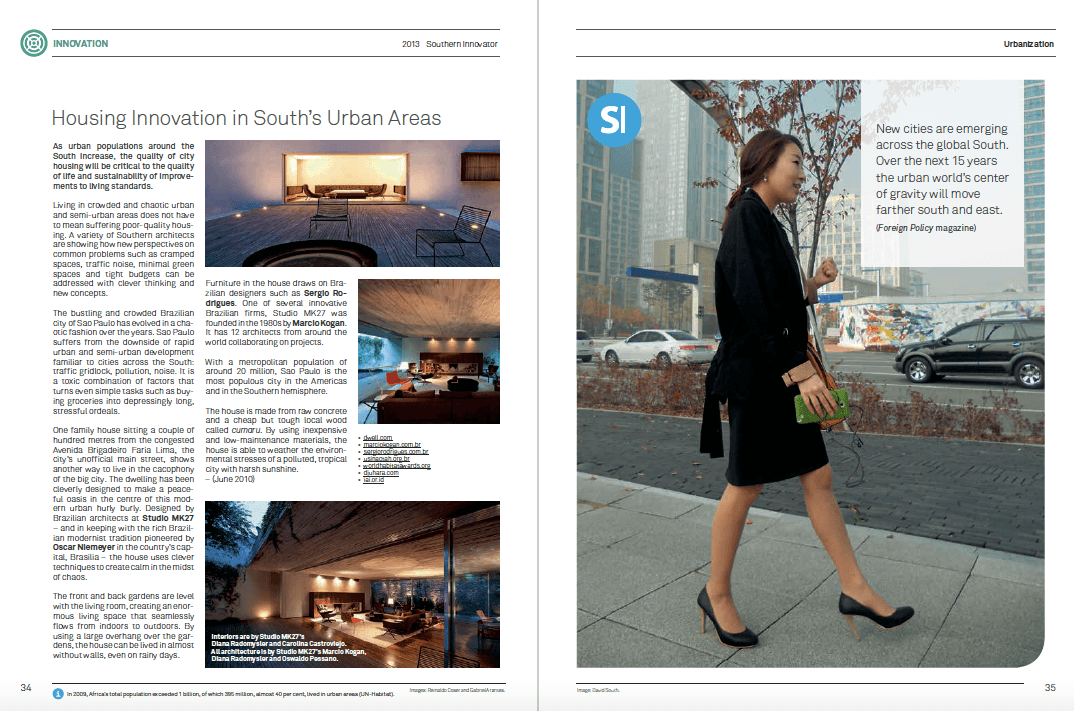
    Southern Innovator Magazine Issue 4: Cities and Urbanization, Editor and Writer: David South (ISBN 978-0-9920217-0-2) (ISSN 2222-9280) (Online: ISSN 2227-0523): Southern Innovator’s fourth issue tackled the theme of cities and urbanization in the global South and how innovators are grappling with one of the biggest challenges of our time: the largest migration in history as the world becomes a majority urban place. Southern Innovator profiles new building technologies and innovative designs and also offers social solutions to make living urban better, while improving human development.

    “I liked your latest Southern innovator! Always inspiring.” Joana Breidenbach, betterplace.org, Berlin, Germany

    “The magazine looks fantastic, great content and a beautiful design!”

    On Google Books: https://books.google.co.uk/books?id=9T_n2tA7l4EC&dq=southern+innovator&source=gbs_navlinks_s

    Designed in Iceland

    Follow @SouthSouth1

    Southern Innovator Magazine Issue 3: Agribusiness and Food Security, Editor and Writer: David South (ISSN 2222-9280) (Online: ISSN 2227-0523): Southern Innovator’s third issue tackled the theme of agribusiness and food security in the global South. It found innovators were proving it is possible to boost farm yields with new techniques that are not costly nor harmful to the environment. It also found the rise of new information technologies, such as mobile phones, offers unlimited options to make farming and food distribution more efficient, profitable and food secure. These information technologies can turn small-scale farmers into agribusinesses if applied correctly.

    On Google Books: https://books.google.co.uk/books?id=AQNt4YmhZagC&dq=southern+innovator&source=gbs_navlinks_s

    Designed in Iceland

    Follow @SouthSouth1

    Southern Innovator Magazine Issue 2: Youth and Entrepreneurship, Editor and Writer: David South (ISSN 2222-9280) (Online: ISSN 2227-0523): Southern Innovator’s second issue tackled the theme of youth and entrepreneurship in the global South. It discovered a growing youth population across the global South and found a disconnect between the enthusiasm and talent of youth and their ability to connect with local economies. This was causing systemic unemployment among youth and wasting a great opportunity to spur growth and innovation in poor countries.
     
    Southern Innovator chronicled various business models that were applicable to young entrepreneurs. Importantly, the business models have been proven to work in developing countries.

    “Thank you David – Your insight into the issues facing us a “global Village” is made real in the detail of your article – 10 out of 10 from the moladi team.” Moladi: Building Communities

    On Google Books: https://books.google.co.uk/books?id=Ty0N969dcssC&dq=southern+innovator&source=gbs_navlinks_s

    Designed in Iceland

    Follow @SouthSouth1
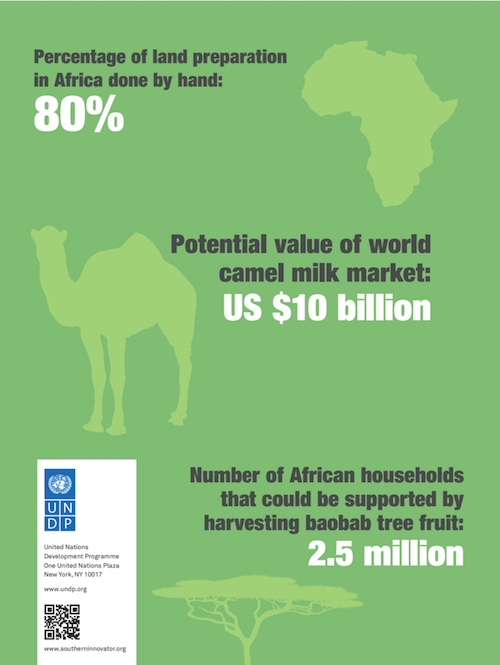
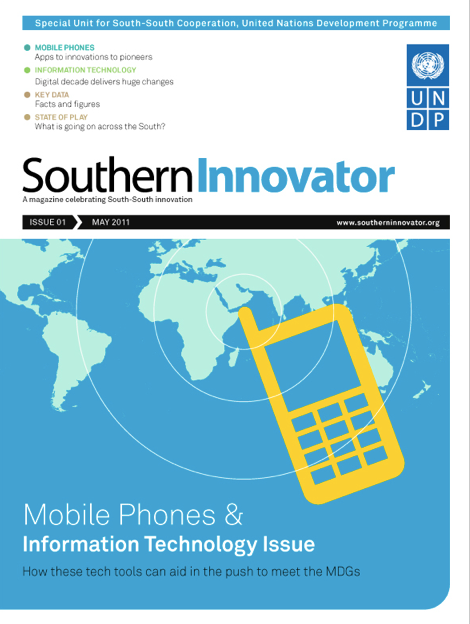
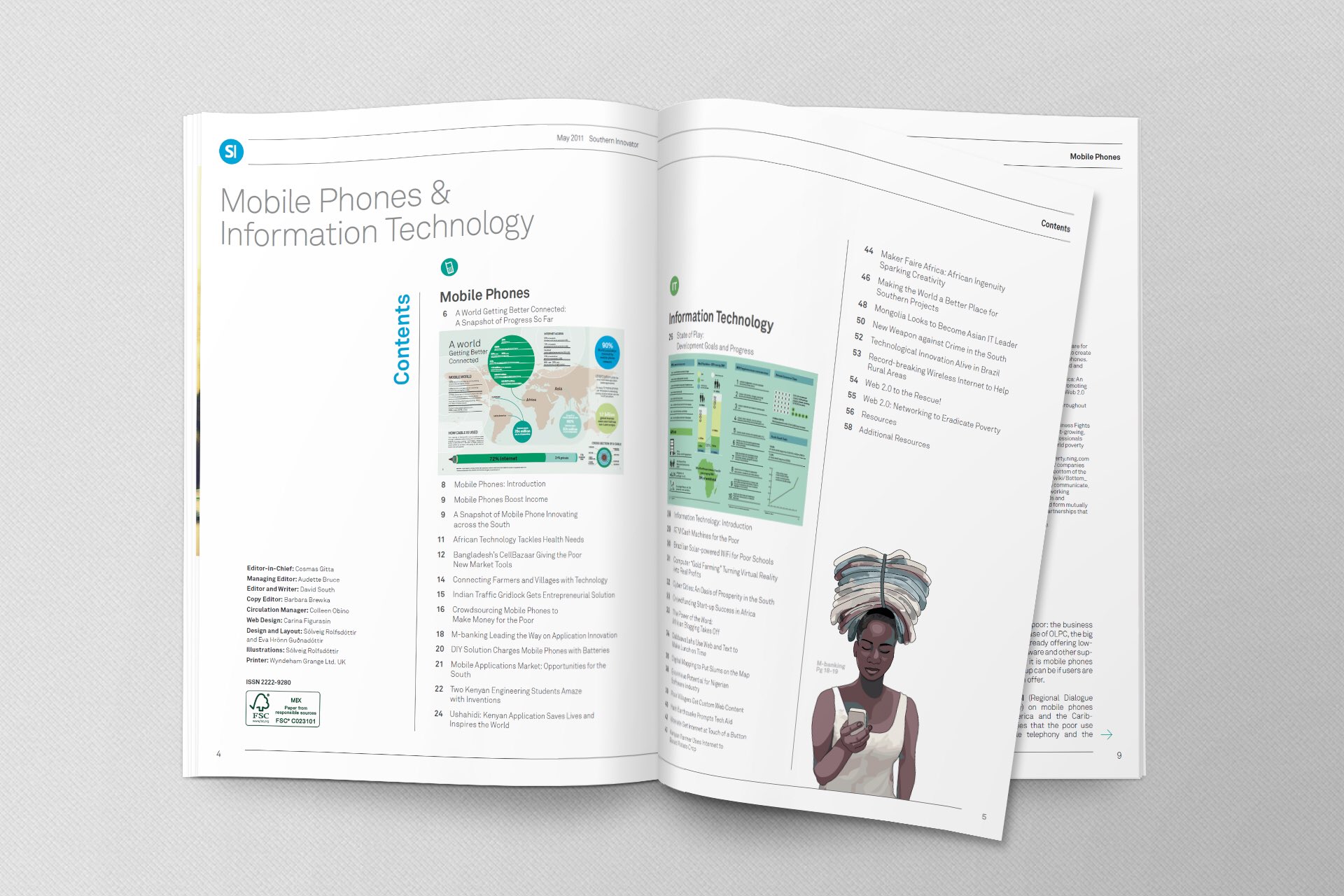
    Southern Innovator Magazine Issue 1: Mobile Phones and Information Technology, Editor and Writer: David South (ISSN 2222-9280) (Online: ISSN 2227-0523): Launched in May 2011, the new global magazine Southern Innovator profiles the people across the global South shaping our new world, eradicating poverty and working towards the achievement of the Millennium Development Goals (MDGs). They are the innovators. It chronicles what has been called the Development 2.0 Revolution: the use of innovative new technologies to radically alter the dynamics of development.
                   
    Southern Innovator’s first issue tackled the theme of mobile phones and information technology in the global South. It identified mobile phone pioneers and transformative information technologies reducing poverty and boosting human development in the global South. It was one of the first publications to document and capture this trend.

    “What a tremendous magazine your team has produced! It’s a terrific tour de force of what is interesting, cutting edge and relevant in the global mobile/ICT space… Really looking forward to what you produce in issues #2 and #3. This is great, engaging, relevant and topical stuff.” Rose Shuman, Founder & CEO, Open Mind and Question Box

    “Looks great. Congratulations. It’s Brill’s Content for the 21st century!” Conan Tobias, Managing Editor, Canadian Business

    What they are saying about SI on Twitter: From “@CapacityPlus Nice job RT @ActevisCGroup: RT @UNDP: Great looking informative @SouthSouth1 mag on South-South Innovation; @UNDP Great looking informative @SouthSouth1 mag on South-South Innovation; @JeannineLemaireGraphically beautiful & informative @UNDP Southern Innovator mag on South-South Innov.”

    “Beautiful, inspiring magazine from UNDP on South-South innovation. Heart is pumping adrenaline and admiration just reading it” Peggy Lee on Pinterest 

    On Google Books: https://books.google.co.uk/books?id=Q1O54YSE2BgC&dq=southern+innovator&source=gbs_navlinks_s

    Designed in Iceland

    Follow @SouthSouth1 

    Designed in Canada

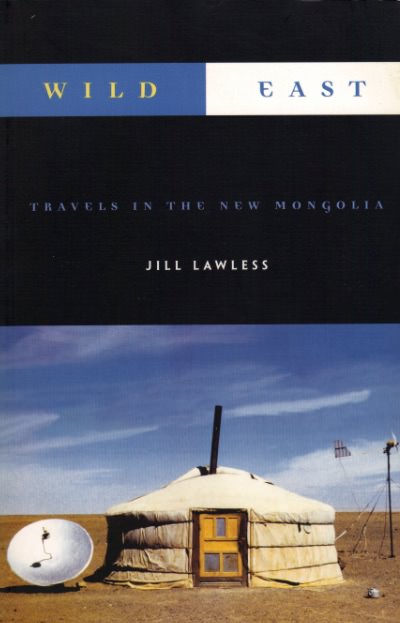
    Wild East: Travels in the New Mongolia by Jill Lawless (ISBN 1-55022-434-4): Covering the period of the late 1990s, with Mongolia embroiled in a major economic, social and political crisis, Wild East gives an insightful snapshot of life lived in a country undergoing significant turbulence.

    “Jill Lawless’ book is not a scholarly tome per se, yet it is of definite value to the contemporary Mongolian scholar, because it captures a mood flushed out by anecdotal detail of a specific period – detail that only a resident, not a visitor, can really discover. Thus the book provides the researcher with all-important firsthand observations of key social and political events, which give life and context to historical analysis.

    “Lawless’ period is 1997-1999, the heart of the tumultuous and ill-spent years of Democratic Coalition Government. These years, not fully representative of Mongolia in the 1990s, were a period of great hopes for democratic flowering and free market enterprise leading the nation to prosperity and progress. The pipe dream was dashed by the immaturity and selfishness of the Coalition party members. Still, those were heady years, and Lawless, as editor of the English language independent newspaper the UB [Ulaanbaatar] Post, was … “ Alicia J. Campi, Mongolian Studies, Vol. 25 (2002), pp. 112-114

    “As Canadian journalist Jill Lawless points out in the introduction to this engaging portrait of modern Mongolia, the short version of the country’s history is simple: They came thundering out of nowhere, terrorized and conquered most of the known world, and then they went home.

    It’s probably not too much of an exaggeration to imagine Mongol warlords at the peak of their power in the 13th century sitting around with Genghis Khan debating the merits of attacking Russia or sacking Burma. Within a space of a few decades they had subdued an area stretching from Korea to Hungary and Vietnam to Afghanistan.

    But the empire of the Khan imploded and the world’s consciousness of these fascinating people, and the great grasslands and deserts of their homeland, faded as they disappeared for centuries under the iron-fisted domination of first China and then the Soviet Union.

    In Wild East, Lawless brings us up to date. Yes, more than half the population of this Europe-sized country still lives on the steppes in felt tents with their horses, sheep and yaks.

    But now you can surf the Internet in Ulan Bator, find Mercedes in the streets, party in Western-style nightclubs and see trendy teens rollerblading around Soviet-era apartment blocks.

    Lawless gives us a revealing, and often amusing, account of her journeys through a beautiful country awakening from a tumultuous era that saw it wrenched from feudalism to communism and then into the uncharted future of rampant capitalism, searching for its future in the new millennium.” The Globe and Mail, Laszlo Buhasz, 25 November 2000 

    Designed in Mongolia

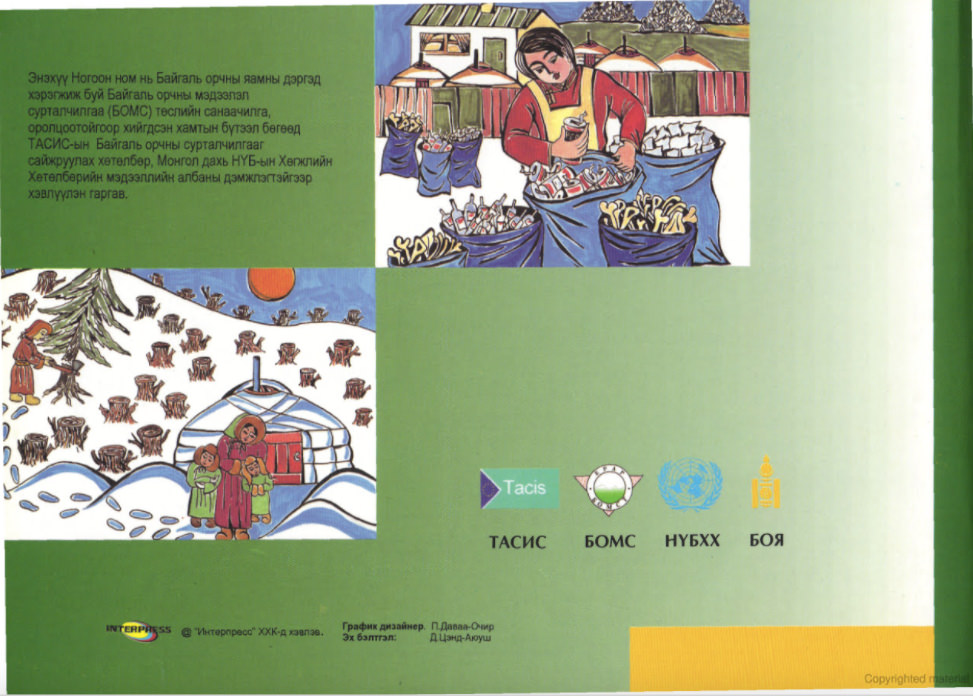
    Environmental Public Awareness Handbook: Case Studies and Lessons Learned in Mongolia by Robert Ferguson (ISBN 9992950137): The Environmental Public Awareness Handbook was published in 1999 and features the case studies and lessons learned by UNDP’s Mongolian Environmental Public Awareness Programme (EPAP). The handbook draws on the close to 100 small environmental projects the Programme oversaw during a two-year period. These projects stretched across Mongolia, and operated in a time of great upheaval and social, economic and environmental distress. The handbook is intended for training purposes and the practice of public participation in environmental protection.

    In its 2007 Needs Assessment, the Government of Mongolia found the EPAP projects “had a wide impact on limiting many environmental problems. Successful projects such as the Dutch/UNDP funded Environmental Awareness Project (EPAP), which was actually a multitude of small pilot projects (most costing less than $5,000 each) … taught local populations easily and efficiently different ways of living and working that are low-impact on the environment.” Many of these ideas live on in the work of both the World Bank and UNEP in Mongolia. 

    Designed in Mongolia

    Mongolian Rock Pop by Peter Marsh (ISBN 99929-5-018-8): In the Mongolian language, the book explores how Mongolia’s vibrant rock and pop music scene led on business innovation and entrepreneurship in the country during the transition years (post-1989). Written by an ethnomusicologist, it details the key moments and events in this story, while splicing the narrative with first-person interviews with the major players. 

    David South, Editor-in-Chief, Julie Schneiderman, Research Editor.

    Designed in Mongolia

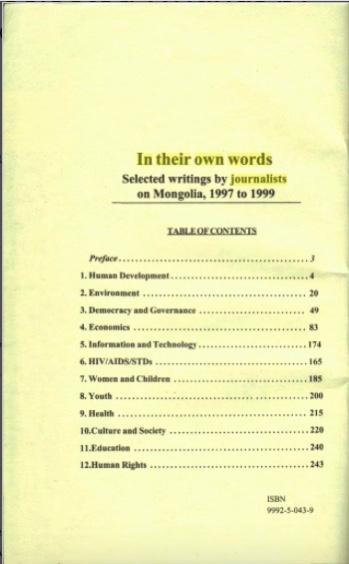
    In Their Own Words: Selected Writings by Journalists on Mongolia, 1997-1999, Editor-in-Chief: David South, Research Editor: Julie Schneiderman (ISBN 99929-5-043-9): In their own words compiles by theme the vast number of stories and features by journalists on Mongolia’s transition experience from 1997 to 1999. A rich and unusual resource for a developing country, this book offers the reader a one-stop snapshot of how a country handles the wrenching social, political, cultural, economic and environmental challenges of changing from one political and economic system to another.

    An excellent resource for scholars of austerity crises and for those seeking understanding on how to plot a path out of an austerity crisis. In particular, the collection of articles and stories show the impact austerity has on people and their lives. Unadorned by backward-looking historical narratives, these are accounts fizzing with the energy of the moment: a first draft of a tough time for most Mongolians. 

    Read online at Google Books or visit the University of Toronto’s Library Catalogue: http://search.library.utoronto.ca/details?3403065

    Designed in Mongolia
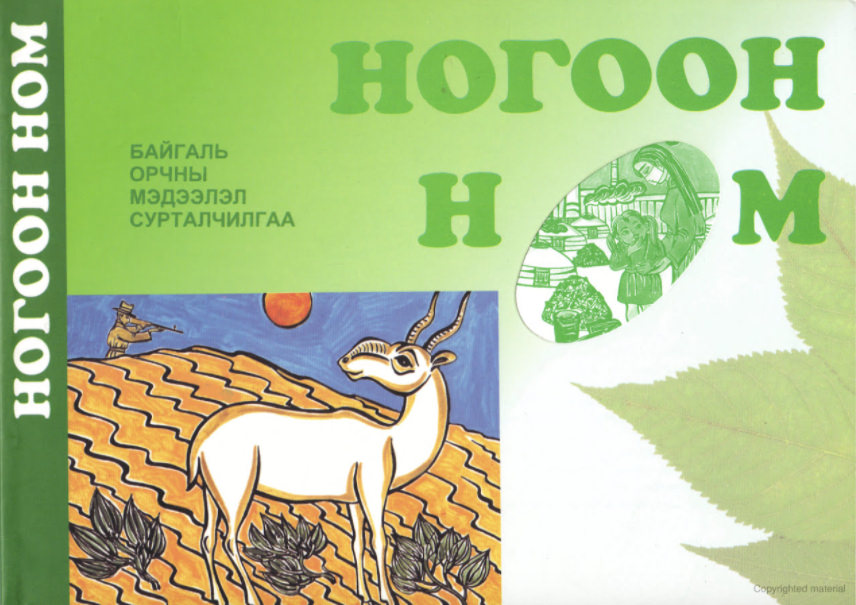
    Mongolian Green Book by Robert Ferguson: In the Mongolian language, the book details effective ways to live in harmony with the environment while achieving development goals. Based on three years’ work in Mongolia – a Northeast Asian nation coping with desertification, mining, and climate change – the book presents tested strategies. 

    Mongolia Update 1998 Book, Editor and Writer: David South, Researcher: G. Enkhtungalug: Whilst in Mongolia as head of the United Nations’ communications (1997-1999), I wrote an update on how Mongolia was coping with hyperinflation, shock therapy, austerity and the Asian economic crisis. The mission simultaneously had to deal with the 1997 Asian Crisis and the worst peacetime economic collapse in post-WWII history.

    This work is licensed under a Creative Commons Attribution 4.0 International License.

    ORCID iD: https://orcid.org/0000-0001-5311-1052.

    © David South Consulting 2017

  • CASE STUDY 7: UNOSSC + UNDP | 2007 – 2016

    CASE STUDY 7: UNOSSC + UNDP | 2007 – 2016

    Expertise: Innovation, innovators, human development, South-South development, United Nations, policy and policy innovation, South-South cooperation, South-South trade, global trends, strategy, online content, global memes, Internet, mobile phones, information technology, global South, resilience strategies, crisis response. 

    Locations: London, UK and New York, U.S.A. 2007 to 2016

    Consultant, Editor, Writer: David South

    Abstract 

    Since the start of 2007, global international development and media consultancy David South Consulting (DSC)/David South International (DSI) has been working with the UNDP-associated United Nations Office for South-South Cooperation (UNOSSC) (formerly the Special Unit for South-South Cooperation) to raise the profile of South-South cooperation and the global South in global development through its innovators, as well as influencing the switch to an innovation-led approach to how development is delivered at the United Nations and at the country level. Based in London, UK and with a design studio in Reykjavik, Iceland, DSC/DSI did this with two highly influential media: the monthly e-newsletter Development Challenges, South-South Solutions, and its sister magazine Southern Innovator. 

    About

    With the global economic crisis unfolding in 2007, we asked “what would inspire people?” What is going on in the global South that would improve human development under these circumstances and make people more resilient?

    In 2007, discussing the global South, or solutions from the South, had a far lower profile in international development, the media and with the general public. Being one of the first sources to regularly chronicle the 21st-century world emerging from the crisis, the two publications (e-newsletter Development Challenges, South-South Solutions and its sister magazine Southern Innovator) were able to open up a space for greater coverage of the global South, while drawing attention to a new generation of development innovators. 

    “Great economic and business reporting! Very helpful for us.” Africa RenewalAfrica Section, Strategic Communications Division, United Nations Department of Public Information

    “I just went over your June newsletter. It’s very well done and far reaching. Congratulations!” Violette Ruppanner, Director, 3D -> Trade – Human Rights – Equitable Economy, Geneva, Switzerland

    “Just to let you know I enjoyed the newsletter a lot – it was interesting to learn about things going on that I would never otherwise find out about, and also the listing of future conferences and events proved very useful.” Ian Sanderson, Deloitte, Geneva, Switzerland

    “Congratulations on another great newsletter that’s packed with fascinating information! I really enjoy getting it each month.” Whitney Harrelson, Making Cents, Washington D.C.

    By adopting a strategy to exploit developments in online and digital media (and the space opened up by the global economic crisis), the reach of the e-newsletter and magazine was far greater than would have been possible just a year prior, back in 2006. This proved useful for reaching the growing number of people in the global South who were being digitally connected either through mobile phones or the Internet, or both. 

    The e-newsletter was not only distributed every month to subscribers, it was also simultaneously posted online in many platforms to reach as wide an audience as possible. It was kept simple in its design so as to be easy to access by readers with low bandwidth or high data costs. It exploited new online services to reach an as wide as possible audience.

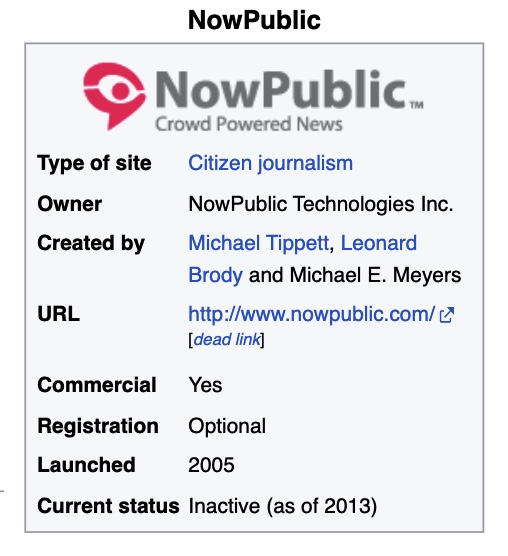
    As an example, the arrival of ‘crowd-powered’ media in 2007 allowed for posting of stories to a global audience to test responses and reactions in real time. An experiment from 2008 to 2010 on the innovative Vancouver, Canada-based NowPublic platform proved very effective in developing the right tone for the stories. Many of these stories have been cited in publications and online (please see below for citations).

    With 201 Development Challenges, South-South Solutions stories posted on the NowPublic platform, a total of 336,289 views by 2012 had occurred, according to the NowPublic counter. 

    Various websites offering publishing and archiving services (Scribd for example) meant it was easy to access the stories from any place, device or platform, bypassing firewalls and censors – a very serious concern in many countries of the global South. And social media such as Twitter made it easy to spread the word to the right people. 

    The two publications proved influential on a number of fronts, being early to draw attention to the following: the rising use of mobile phones and information technology in development, the world becoming an urban place, innovative food solutions including the nascent insect food sector (now a big thing), altering perspectives on what is possible in Africa, the use of data science to innovate development, and tracking the growing number of technology hubs and the fast-growing start-up culture in the global South. The publications were cited for shaping the new strategic direction adopted by the United Nations Development Programme (UNDP) (the UN’s leading development organisation) and its first youth strategy, and the development of the Sustainable Development Goals (SDGs). As the world’s first global innovator magazine, Southern Innovator’s design had to be appropriate for a diverse audience. It has drawn praise for being both “beautiful” and “inspiring”, while its use of sharp, modern graphic design and infographics inspired others in the UN to up their game when it comes to design. 

    Today, there are many sources for sharing stories on solutions from the global South; in fact, it could be called ‘cool’. South-South cooperation and innovation have now become the key methodology for the UN’s delivery of its programmes and projects. In 2015, China pledged US $2 billion to “support South-South cooperation” and called for the international community to “deepen South-South and tripartite cooperation”. In development parlance, they have been “Mainstreaming South-South and Triangular Cooperation” in their plans.

    The current policy vogue for innovation in developing and developed countries can trace its roots back to some of the early work done by these two publications (and which was further amplified by the annual Global South-South Development Expo, which often would feature innovators from the two publications, spreading the innovation message around the world). Both publications had set out to inspire and “champion a global 21st century innovator culture”. And they have done this, as can be seen from concrete evidence and anecdotal responses from individuals and organizations alike.

    Crucial to success has been integrity. As was disclosed in arrests made by the Federal Bureau of Investigation (FBI) in October 2015, a news service claiming to be associated with the United Nations (South-South News) had not followed either the letter or the spirit of the UN’s Global Compact. It had received substantial funding from a Macau casino owner featured in a 2010 investigation by International Risk Ltd., which found he “is characterized in the media as a ‘Macau Crime Lord’ and a kingpin of the international slave prostitution trade”. To date, a number of his co-conspirators have been found guilty of various charges and sentenced. He was convicted 28 July 2017 on six counts “for his role in a scheme to bribe United Nations ambassadors to obtain support to build a conference center in Macau that would host, among other events, the annual United Nations Global South-South Development Expo“. He used the news service as a “conduit for bribery and money laundering” at the United Nations, according to the FBI, something admitted to by the various co-conspirators in court and under oath. Read more on this case here: http://www.reuters.com/article/us-un-corruption-idUSKCN0XH2DL. And the conviction here: Chairman of a Macau Real Estate Development Company Convicted on All Counts for Role in Scheme to Bribe United Nations Ambassadors to Build a Multi-Billion Dollar Conference Center

    The case of South-South News points to the dangers of cutting corners and the importance of approach and methodology; to not just mouth support for the UN Global Compact but to embrace its letter and spirit as well. As can be seen from this particular case, the reputational damage can be severe if the wrong strategy is pursued. Clients need to be very aware of whom they are working with and conduct due diligence for service provider credentials and also investigate the credentials of potential donors and funders. 

    Southern Innovator needed to be true to its ethos of championing genuine innovation that improves human development in the global South. It had to be free to pursue its search without interference. 

    To avoid censorship and interference, its editorial operations were based in London, UK and its design studio was based in Reykjavik, Iceland (a high-ranking country in the World Press Freedom rankings and a former top place holder in the UNDP Human Development Index). Using a women-led design studio, it developed a design vision that could communicate across borders using clear graphic design and high-quality images. For example, when it launched in 2011, infographics were rare in development publications and at the UN; now they are commonplace. It also tried to be as a ‘green’ as possible. The studio was powered on 100 per cent renewable energy (in particular, geothermal energy); the hard copy of the magazine is printed on paper from renewable forests. 

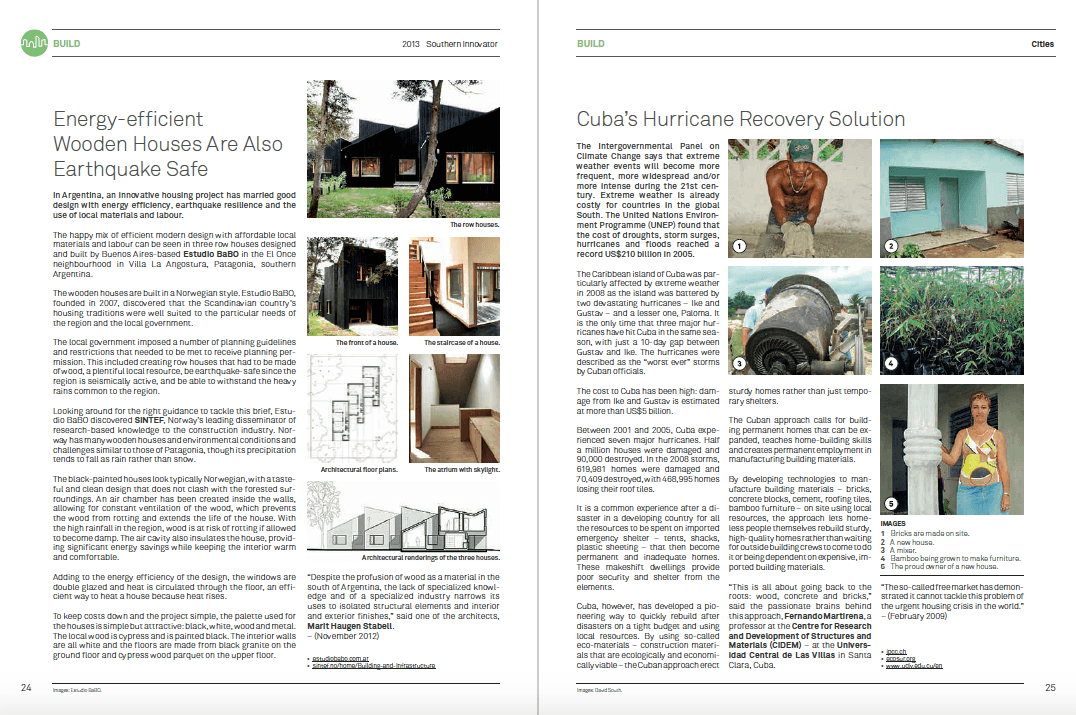
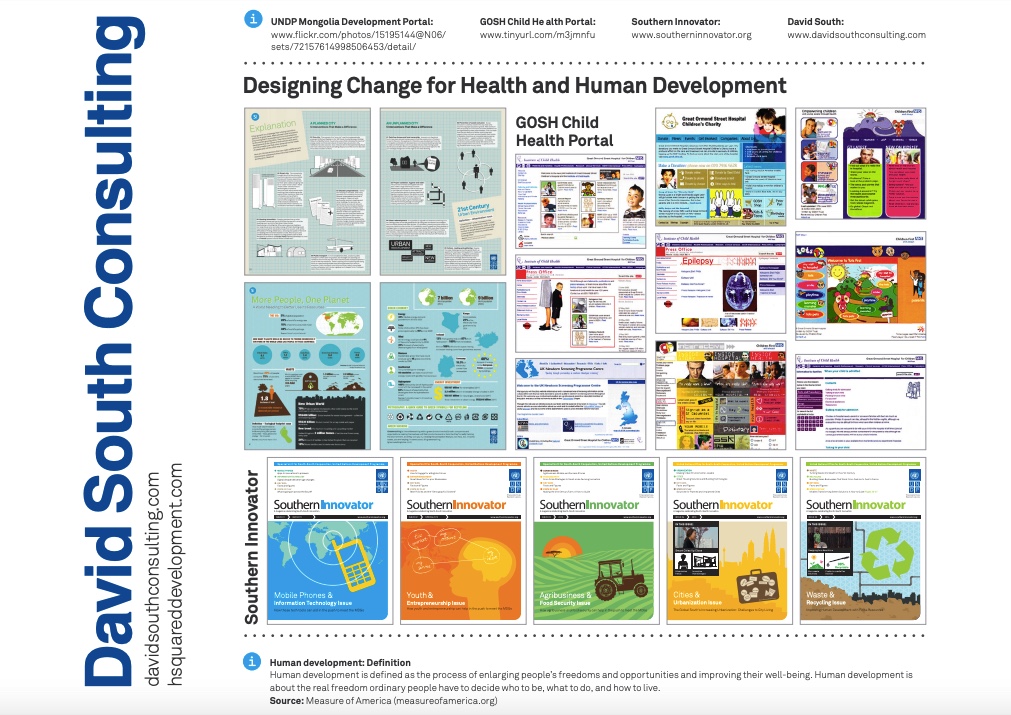
    To date, five issues of Southern Innovator have been published on key themes identified by the United Nations: mobile phones and information technology, youth and entrepreneurship, agribusiness and food security, cities and urbanization and waste and recycling.

    All of the issues collate and explain the trends, innovations and innovators for a large, global audience spanning many countries and regions.

    Timeline 

    2007: David South Consulting begins work on the e-newsletter Development Challenges, South-South Solutions for the Special Unit for South-South Cooperation at the United Nations.

    2008: Reader response experiment begins with crowd-powered news website NowPublic. Initial proposal for the development of book or magazine on innovation. Awarded grant for Cuba study tour by BSHF. 

    2009: Adjust e-newsletter content based on reader responses. Begin posting content on Twitter platform.

    2010: Begin development of initial concepts for innovator magazine and assemble creative team with Icelandic graphic designer and illustrator Solveig Rolfsdottir and graphic designer Eva Hronn Gudnadottir. 

    2011: Attend Global South-South Development Expo in Rome, Italy. Launch first issue of Southern Innovator magazine on mobile phones and information technology. It is called “a terrific tour de force of what is interesting, cutting edge and relevant in the global mobile/ICT space…”. Launch www.southerninnovator.org website and social media including Twitter account @SouthSouth1. 

    2012: Attend Global South-South Development Expo in Vienna, Austria. Launch issues 2 (youth and entrepreneurship) and 3 (agribusiness and food security) of Southern Innovator magazine. Called a “Beautiful, inspiring magazine from UNDP on South-South innovation.”

    2013: Attend Global South-South Development Expo in Nairobi, Kenya. Launch issue 4 of Southern Innovator magazine (cities and urbanization). Called “fantastic, great content and a beautiful design!” and “Always inspiring.”. 

    2014: Attend Global South-South Development Expo in Washington, D.C., U.S.A. Launch issue 5 of Southern Innovator magazine (waste and recycling). The Twitter account @SouthSouth1 called “ one of the best sources out there for news and info on #solutions to #SouthSouth challenges.” Final issues of e-newsletter Development Challenges, South-South Solutions published.  

    Testimonials 

    “The e-newsletter Development Challenges, South-South Solutions proved to be a timely and prescient resource on the fast-changing global South, tracking the rise of an innovator culture driven by the rapid adoption of mobile phones and information technology … 

    “In 2010, work began on the development of the world’s first magazine dedicated to the 21st-century innovator culture of the global South. My goal was to create a magazine that would reach across countries and cultures, meet the UN’s standards, and inspire action. Southern Innovator was the result. Mr. [David] South played a vital role in the magazine’s development from its early conception, through its various design prototypes, to its final global launch and distribution.  

    “Both the e-newsletter and magazine raised the profile of South-South cooperation and have been cited by readers for inspiring innovators, academics, policy makers and development practitioners in the United Nations and beyond.  

    “I highly recommend Mr. [David] South as a thoughtful, insightful, analytical, creative and very amicable person who has the unique ability to not only grasp complex problems but also to formulate a vision and strategy that gets things done. … ”  Cosmas Gitta, Former Assistant Director, Policy and United Nations Affairs at United Nations Office for South-South Cooperation (UNOSSC) in UNDP 

    “I think you [David South] and the designer [Solveig Rolfsdottir] do great work and I enjoy Southern Innovator very much!” Ines Tofalo, Programme Specialist, United Nations Office for South-South Cooperation

    Southern Innovator Issue 5 

    “@SouthSouth1 is one of the best sources out there for news and info on #solutions to #SouthSouth challenges.” Adam Rogers, Assistant Director, Regional Representative, Europe, United Nations Office for South-South Cooperation (UNOSSC) 

    “Btw, I really enjoyed reading them, impressive work & a great resource. Looking forward to Issue 6. My best wishes to you & your team at SI.” 

    “… great magazine, nice design.” 

    Southern Innovator Issue 4 

    “I liked your latest Southern innovator! Always inspiring.” Joana Breidenbach, betterplace.org, Berlin, Germany 

    “The magazine looks fantastic, great content and a beautiful design!” 

    Southern Innovator Issue 2 

    “Thank you David – Your insight into the issues facing us a[s] [a] “global Village” is made real in the detail of your article – 10 out of 10 from the moladi team.” Moladi, South Africa (http://www.moladi.net/index.htm

    Southern Innovator Issue 1 

    “What a tremendous magazine your team has produced! It’s a terrific tour de force of what is interesting, cutting edge and relevant in the global mobile/ICT space… Really looking forward to what you produce in issues #2 and #3. This is great, engaging, relevant and topical stuff.” Rose Shuman, Founder & CEO, Open Mind and Question Box 

    “Looks great. Congratulations. It’s Brill’s Content for the 21st century!” Conan Tobias, Managing Editor, Canadian Business 

    What they are saying about SI on Twitter: From @CapacityPlus Nice job RT @ActevisCGroup: RT @UNDP: Great looking informative @SouthSouth1 mag on South-South Innovation; @UNDP Great looking informative @SouthSouth1 mag on South-South Innovation; @JeannineLemaire Graphically beautiful & informative @UNDP Southern Innovator mag on South-South Innov.  

    And on Pinterest:

    Peggy Lee • 1 year ago

    “Beautiful, inspiring magazine from UNDP on South-South innovation. Heart is pumping adrenaline and admiration just reading it”

    Impact 

    Micro 

    • developed content for highly influential UN e-newsletter Development Challenges, South-South Solutions from 2007 to 2014. The monthly briefing is distributed across the UN and to subscribers
    • developed and launched world’s first global innovator magazine for the United Nations, Southern Innovator
    • contacted and networked with innovators around the world to raise the profile of their work
    • attended global events to champion power of 21st century global innovator culture. Visited United Nations agency headquarters around the world to share the innovator message and distribute the publications
    • cited as a key resource on trends in the global South 

    Macro

    • significantly raised profile of global South innovators and 21st century global innovator culture
    • cited as contributor to new strategic plans for UNDP and its switch to an innovation and South-South focus

    Citations 

    Autonomous Systems in the Intelligence Community: Many Possibilities and Challenges by Jenny R. Holzer, PhD, and Franklin L. Moses, PhD, Studies in Intelligence Vol 59, No. 1 (Extracts, March 2015) 

    Beyond Gated Communities edited by Samer Bagaeen and Ola Uduku (Routledge: 2015)

    Chile in Transition: Prospects and Challenges for Latin America’s Forerunner of Development by Roland Benedikter and Katja Siepmann (Springer: 2015) 

    Decoding the Brand DNA: A Design Methodology Applied to Favela Fashion by Magali Olhats, Universidade Federal de Santa Catarina Florianopolis, 2012 

    Edible Insects and the Future of Food: A Foresight Scenario Exercise on Entomophagy and Global Food Security by Dominic Glover and Alexandra Sexton, Institute of Development Studies, King’s College London, Evidence Report No 149, September 2015 

    High-level Committee on South-South Cooperation Seventeenth Session: Framework of operational guidelines on United Nations support to South-South and triangular cooperation: Note by the Secretary-General22-25 May 2012, New York 

    Innovation Africa: Emerging Hubs of Excellence edited by Olugbenga Adesida, Geci Karuri-Sebina and João Resende-Santos (Emerald Group Publishing: 2016) 

    New Directions in Children’s and Adolescents’ Information Behavior Research edited by Dania Bilal and Jamshid Beheshti (Emerald Group Publishing: 2014) 

    Propagating Gender Struggles Through Nollywood: Towards a Transformative Approach by Nita Byack George Iruobe, Geonita Initiative for Women and Child Development, 17 July 2015

    Recasting ‘truisms’ of low carbon technology cooperation through innovation systems: insights from the developing world by Alexandra Mallett, Innovation and Development, 5:2, 297-311, DOI: 10.1080/2157930X.2015.1049851, Routledge Taylor & Francis Group, 2015

    A Sociological Approach to Health Determinants by Toni Schofield (Cambridge University Press: 2015)  

    Strategic Framework of the United Nations Office for South-South Cooperation, 2014-2017Executive Board of the United Nations Development Programme, the United Nations Population Fund and the United Nations Office for Project Services, 27 to 31 January 2014, New York

    Wearing Your Map on Your Sleeve: Practices of Identification in the Creation and Consumption of Philippine Map T-shirts by Pamela Gloria Cajilig, paper presented at the 6th Global Conference (2014): Fashion: Exploring Critical Issues, Mansfield College, Oxford, United Kingdom, 15th to 18th September 2014

    Youth Empowered as Catalysts for Sustainable Human Development: UNDP Youth Strategy 2014-2017United Nations Development Programme, Bureau for Development Policy

    DSC web address in green_mini (1)

    ORCID iD: https://orcid.org/0000-0001-5311-1052.

    © David South Consulting 2025

  • Innovator Stories and Profiles

    Innovator Stories and Profiles

    Southern Innovator was initially launched in 2011 with the goal of – hopefully – inspiring others (just as we had been so inspired by the innovators we contacted and met). The magazine seeks to profile stories, trends, ideas, innovations and innovators overlooked by other media. The magazine grew from the monthly e-newsletter Development Challenges, South-South Solutions published by the United Nations Office for South-South Cooperation (UNOSSC) since 2006.

    Southern Innovator visited South Korea’s Songdo Smart City in 2012.

    Editor and Writer, David South. 
    Graphic Designer and Illustrator, Solveig Rolfsdottir. 

    This work is licensed under a Creative Commons Attribution 4.0 International License.

    ORCID iD: https://orcid.org/0000-0001-5311-1052.

    © David South Consulting 2021

  • Mongolia Looks to Become Asian IT Leader

    Mongolia Looks to Become Asian IT Leader

    By David SouthDevelopment Challenges, South-South Solutions

    SOUTH-SOUTH CASE STUDY

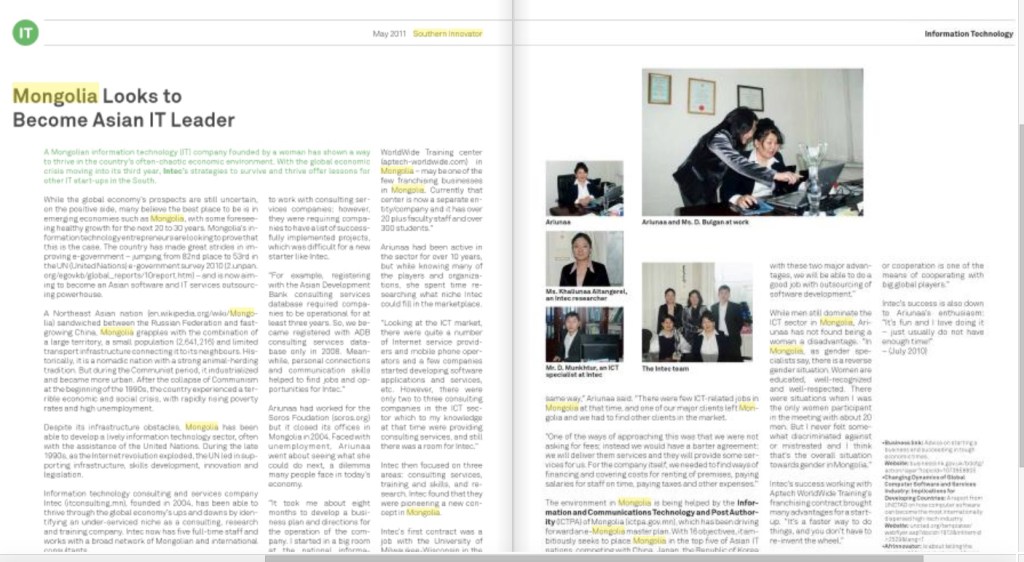
    A Mongolian information technology company founded by a woman has shown a way to thrive in the country’s often-chaotic economic environment. With the global economic crisis moving into its third year, Intec’s strategies to survive and thrive offer lessons for other IT start-ups in the South.

    While the global economy’s prospects are still uncertain, on the positive side, many believe the best place to be is in emerging economies like Mongolia, with some foreseeing healthy growth for the next 20 to 30 years. Mongolia’s information technology entrepreneurs are looking to prove this is the case. The country has made great strides in improving e-government – jumping from 82nd place to 53rd in the UN e-government survey 2010 (http://www2.unpan.org/egovkb/global_reports/10report.htm) – and is now aiming to become an Asian software and IT services outsourcing powerhouse.

    A Northeast Asian nation (http://en.wikipedia.org/wiki/Mongolia) sandwiched between Russia and fast-growing China, Mongolia grapples with the combination of a large territory, a small population (2,641,216) and limited transport infrastructure connecting it to its neighbours. Historically, it is a nomadic nation with a strong animal herding tradition. But during the Communist period, it industrialized and became more urban. After the collapse of Communism at the beginning of the 1990s, the country experienced a terrible economic and social crisis, with rapidly rising poverty rates and high unemployment.

    Despite its infrastructure obstacles, Mongolia has been able to develop a lively information technology sector, often with the assistance of the United Nations. During the late 1990s, as the internet revolution exploded, the UN led on supporting infrastructure, skills development, innovation and legislation.

    Information technology consulting and services company Intec (www.itconsulting.mn) , founded in 2004, has been able to thrive through the global economy’s ups and downs by identifying an under-serviced niche as a consulting, research and training company. Intec now has five full-time staff and works with a broad network of Mongolian and international consultants.

    As is often the case with new businesses, Intec initially found that many doors were closed to start-up enterprises.

    “The major challenges which I faced were to make people understand about the consulting services,” said Intec’s founder, Lkhagvasuren Ariunaa. “The consulting services concept was new to Mongolia and Mongolians at that time and not many organizations were willing to work with consulting services. The international and donor organizations were keen to work with consulting services companies; however, they were requiring companies to have a list of successfully implemented projects, which was difficult for a new starter like Intec.

    “For example, registering with the Asian Development Bank consulting services database required companies to be operational for at least three years. So, we got registered with ADB consulting services database only in 2008. Meanwhile, personal connections and communication skills helped to find jobs and opportunities for Intec.”

    Ariunaa had worked for the Soros Foundation (http://www.soros.org/) but it closed its offices in Mongolia in 2004. Faced with unemployment, Ariunaa went about seeing what she could do next: a dilemma many people face in today’s economy.

    “It took me about eight months to develop a business plan and directions of operation of the company. I started in a big room at the national information technology park building with one table, chair and computer.

    “It has been quite challenging years for bringing a company to the market and finding niches for us. We have franchised the Indian Aptech WorldWide Training center (http://www.aptech-worldwide.com) in Mongolia – may be one of the few franchising businesses in Mongolia. Currently that center is now a separate entity/company and it has over 20 plus faculty staff and over 300 students.”

    Ariunaa had been active in the sector for over 10 years, but while knowing many of the players and organizations, she spent time researching what niche Intec could fill in the marketplace.

    “Looking at the ICT market, there were quite a number of internet service providers, mobile phone operators, a few companies started developing software applications, and services etc. However, there were only two to three consulting companies in the ICT sector which to my knowledge at that time were providing consulting services, and still there was a room for Intec.”

    Intec then focused on three areas: consulting services, training and skills, and research. Intec found they were pioneering a new concept in Mongolia.

    Intec’s first contract was a job with the University of Milwaukee-Wisconsin in the United States to organize a three week course for American students to learn about the digital divide in Mongolia. But the global economic crisis hit Mongolia hard in 2009.

    “It was challenging to survive and continue working the same way,” Ariunaa said. “There were few ICT-related jobs in Mongolia at that time, and one of our major clients left Mongolia and we had to find other clients in the market.

    “One of the ways of approaching this was that we were not asking for fees, instead we would have a barter agreement – we will deliver them services and they will provide some services for us. For the company itself, we needed to find ways of financing and covering costs for renting of premises, paying salaries for staff on time, paying taxes and other expenses.”

    The environment in Mongolia is being helped by the Information and Communications Technology and Post Authority (ICTPA) of Mongolia (http://www.ictpa.gov.mn) , which has been driving forward an e-Mongolia master plan. With 16 objectives, it ambitiously seeks to place Mongolia in the top five of Asian IT nations, competing with South Korea, Singapore, Japan and China.

    Ariunaa believes Mongolia has many competitive advantages. “Mongolia is known for a high-literacy rate and math-oriented training and education, and ICT specialists are targeting to become a software outsourcing country for other countries. Another advantage of Mongolians is that they can easily learn other languages: we are fluent in Russian, English, Japanese, Korean, German and we believe that with these two major advantages, we will be able to do a good job with outsourcing of software development.”

    While men still dominate the ICT sector in Mongolia, Ariunaa has not found being a woman a disadvantage. “In Mongolia, as gender specialists say, there is a reverse gender situation. Women are educated, well-recognized and well-respected. There were situations, when I was the only women participant in the meeting with about 20 men. But I never felt somewhat discriminated or mis-treated and I think that’s the overall situation towards gender in Mongolia.”

    Intec’s success working with Aptech WorldWide Training’s franchising contract brought many advantages for a start-up. “It’s a faster way to do things, and you don’t have to re-invent the wheel.”

    As a Mongolian company, Intec has found it best to play to its local strengths. “National companies have knowledge, expertise and experience of local situations, know players and understand about legal, regulatory matters. … partnership or cooperation are one of the means of cooperating with big global players.”

    Intec’s success is also down to Ariunaa’s enthusiasm: “It’s fun and I love doing it – just usually do not have enough time!”

    Published: July 2010

    Resources

    1)  Advice on starting a business and succeeding in tough economic times. Website:http://www.businesslink.gov.uk/bdotg/action/layer?topicId=1073858805

    2) Changing Dynamics of Global Computer Software and Services Industry: Implications for Developing Countries: A report from UNCTAD on how computer software can become the most internationally dispersed high-tech industry. Website:http://www.unctad.org/templates/webflyer.asp?docid=1913&intitemid=2529&lang=1

    3) Afrinnovator: Is about telling the stories of African start-ups, African innovation, African made technology, African tech entrepreneurship and entrepreneurs. Their mission is to ‘Put Africa on the Map’ by covering these kinds of stories from all over Africa. As their website says, “if we don’t tell our own story, who will tell it for us?” Website:http://afrinnovator.com

    4) TechMasai: Pan-African start-up news and reviews. Website: www.techmasai.com

    5) Ger Magazine Project: Mongolia’s first online magazine pioneered communicating on the web. Website: http://en.wikipedia.org/wiki/Ger_magazine

    Development Challenges, South-South Solutions was launched as an e-newsletter in 2006 by UNDP’s South-South Cooperation Unit (now the United Nations Office for South-South Cooperation) based in New York, USA. It led on profiling the rise of the global South as an economic powerhouse and was one of the first regular publications to champion the global South’s innovators, entrepreneurs, and pioneers. It tracked the key trends that are now so profoundly reshaping how development is seen and done. This includes the rapid take-up of mobile phones and information technology in the global South (as profiled in the first issue of magazine Southern Innovator), the move to becoming a majority urban world, a growing global innovator culture, and the plethora of solutions being developed in the global South to tackle its problems and improve living conditions and boost human development. The success of the e-newsletter led to the launch of the magazine Southern Innovator. 

    Creative Commons License

    This work is licensed under a
    Creative Commons Attribution-Noncommercial-No Derivative Works 3.0 License.

    Launched in 1997 in a major crisis, the UN Mongolia Development Portal (www.un-mongolia.mn) became the country’s largest online bilingual publisher and an award-winning pioneer of web content. It proved Mongolia had the potential to innovate in digital.
    Story featured in the UN E-Government Knowledgebase and E-Government Survey in Media.
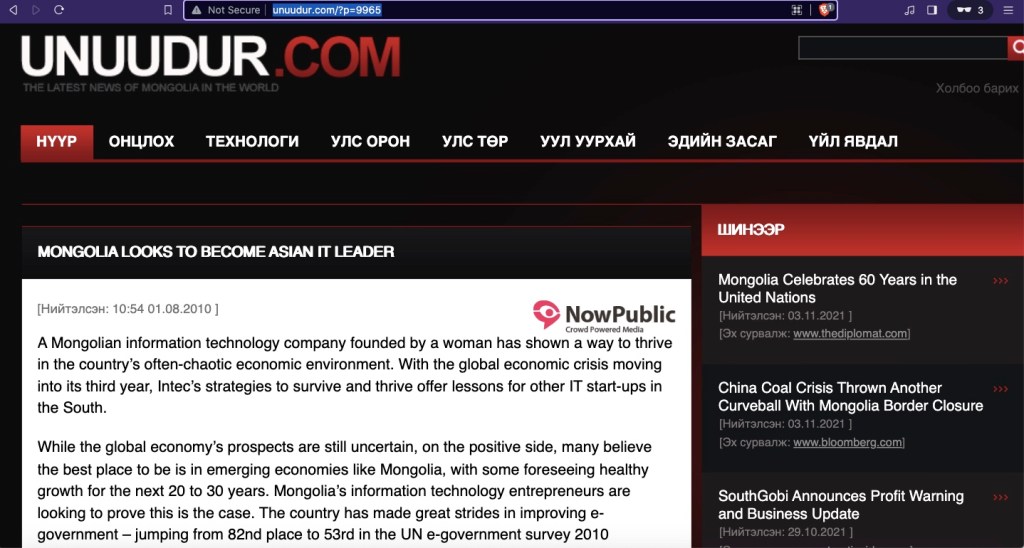
    Posted in 2010 on the Unuudur.com (“The latest news of Mongolia in the world”) website.
    Creative Commons License

    This work is licensed under a
    Creative Commons Attribution-Noncommercial-No Derivative Works 3.0 License.

    ORCID iD: https://orcid.org/0000-0001-5311-1052.

    © David South Consulting 2023