Last year’s fashion runways were dominated by one influence: Mongolian traditional design. If a designer wanted to show they were boldly embracing natural fibres and furs, then the refrain ” my show is all Mongolian” would be proudly boasted to the media. The country has become a synonym for sartorial flare and rugged beauty. It also doesn’t hurt that one of Mongolia’s top exports, cashmere wool, is in vogue, from Japan to Europe to the United States. After years of being isolated from the west under the umbrella of the Soviet Union, Mongolian fashion is proudly strutting the catwalks of the world.
Her square glasses reminiscent of Yves Saint Laurent (ysl.com), Mongolia’s top designer, Soyolmaa, talked to Ger about the ubiquitous nature of traditional clothes in the late 1990s. “There are few countries who still wear the national costume these days. Mongolia is one of them,” she says sitting regally in the studio of her home, surrounded by models draped in dresses for her latest collection: a tribute to the style and attitude of Mongolia’s ancient queens.
“Because the design of Mongolian national clothes is highly developed, no further changes are needed.” As head of the Mongolian National Designers’ Union, she has spent many years trying to find ways to improve the national costume to “no effect” she adds.
Busy tailors come and go, checking designs. The studio is crowded with four tailors and the models (not to mention this reporter). Two clients patiently wait in the hallway to see her. In a country where the soldiers and police wear uniforms designed by Pierre Cardin, it is no surprise Mongolians aren’t slouches when it comes to clothes. While budgets may be tight and the shops far from world standard, people still find a way to dress with flair.
It is still common to see the traditional del – a cloak of either wool, leather or silk – worn by men and women of all ages, even in the capital. As herders are quick to say, the del serves many practical purposes. It is padding for long rides on the steppe, it is a makeshift tent in bad weather, it is a warm blanket, and for women, a nod to modesty when nature calls on the open steppe. While it is standard wear for older generations, younger urban Mongolians turn to the del on special occasions like school graduation ceremonies.
Last year collections by Christian Dior (Dior.com), Chanel (chanel.com), UNGARO and Pierre Cardin (pierrecardin.com) all paid homage to Mongolian design, typically characterized by variations on the del cloak, flamboyant displays of fur and knee-high boots.
“Asian styles are now having a big impact on world fashion design,” continues Soyolmaa.
“It is because Asian clothes offer pure, simple patterns with eye-catching colours and adornments. There is a trend towards purism in the fashion world. They like high collars, askew lapels, loose sleeves and nudarga (long sleeves). The bright colors of Asia are showing up throughout Western design. You can see the askew lapel and high collar and bright colors from Christian Dior to Chanel.”
The Mongolian national costume is a classic example of purism. The pattern is very simple, with no separate sleeves or shoulder parts, and very economical with little waste of cloth.
And why did this style evolve over the generations? Soyolmaa has a simple answer: “It is because of the harsh weather of Mongolia.” The askew lapel doesn’t let wind pierce the body, nudarga or long sleeves don’t make arms cold in the minus 30 to 40 degrees Celsius winters. Winter dels have fur interiors, using wolf, fox, sheep or lamb’s wool. From ancient times to now, Mongolian men wear wolf fur coats in winter when guarding horses at night.
There are about a hundred styles of hat. Loovuus, made of fox fur with a cloth top, is a common hat in winter. The back part is open. “Fox fur is very dense. Without an open back one feels too hot and it causes high blood pressure and a headache,” according to Soyolmaa. The extraordinary design of boots with pointed toes is suitable for riding a horse while leaving enough dead air space to keep the toes warm.
Soyolmaa takes difference with those who claim “Fashion sense ends in Mongolia.” “It might because they have nothing to compare it with. But now that fashion shows are available on cable TV, Mongolians are learning how to compare Mongolian fashion and models with the global standard.” For Soyolmaa, as it is the time for Asian fashion, it is also the time for Asian models.
“Irina Pantieva, the world’s top model is Mongolian. She is from the Buriat Republic (a province of Russia directly north of Mongolia and populated by a large number of people of Mongolian heritage).” She says Mongolian models are ready to take on the world.
To the soothing sounds of Enigma, Mongolia’s top models parade Soyolmaa’s tributes to Mongolian queens in early May at the Las Vegas Entertainment Centre, a former communist-era cinema. Long silk dresses are complemented with furs and enormous hats, at times evoking Cleopatra, at other times something from a Dr. Seus cartoon, some hats reaching a meter high. Judging by the audience’s reaction and the quality of Soyolmaa’s creations, the time has come for Mongolian designers to take centre stage on the world fashion scene.
A Mongolian cashmere designer once opined that Mongolians are lucky that most goats in the country are capable of producing fine cashmere. And while Chinese cashmere dominates the marketplace, Mongolian cashmere is by far the purest and finest.
About 30 cashmere companies contributes tens of millions of dollars a year to the country’s wealth (though nobody is quite sure how much because most cashmere sales go unreported to the government). But the revenue isn’t what it used to be due to problems in the domestic industry and a drop in the world price. Z. Ayur, chief secretariat of the Gobi company, thinks it doesn’t have to be that way.
“Unfortunately we lose half of our raw cashmere to China,” he says.”
“The Chinese buy cashmere at a high price, not depending on the quality. This means national manufacturers lack raw cashmere to process into garments.”
He thinks raw cashmere exports should be banned or subject to a duty of 100 to 150 per cent. Mongolia’s weak infrastructure plays a part as well. It is cheaper for herders to travel to the Chinese border with cashmere than to bring it to the capital, Ulaanbaatar. Often when they are at the border with China, they are subjected to some hard bargaining by Chinese brokers, who exploit the fact herders can’t afford to walk away empty handed.
Cashmere has always been considered a luxury and expensive. But in the past two years it has lost its fusty image as only for old people. Trendy designs have attracted a vast market of younger cashmere consumers. “I guess in the past it was dear and expensive and designs weren’t very appealing to the younger set,” thinks Gerelmaa, the chief designer of Gobi company.
The Gobi company is one of the few state enterprises left over from the socialist period that still makes money (and is due for privatization this year – a prime pick for foreign investors).
In 1972 the United Nations funded projects to experiment with starting a cashmere garment industry in Mongolia. This innovative thinking led to a joint Japanese-Mongolian venture in 1981 to start the first cashmere manufacturer, Gobi. These days it still produces one third of the country’s cashmere products.
Mongolian Wool and Cashmere Federation head Tsendmaa is optimistic about the drop in the world market price.” It will soon go back up again,” she says with confidence. “The reserve of cashmere in the world will run out soon. What happened with the drop in prices is typical of any industry when it overproduces.” What worries her most is the flood of Mongolian cashmere going to China, where Chinese workers process and knit the garments and reap the job benefits.
While cashmere is still known for its use in classic turtle, crew and v-neck jumpers, things have changed. “Before we mostly exported classic styles in off-white, brown, grey, black, bark, blue or dark red to Japan or Germany,” continues Tsendmaa. “Now Americans order more fashionable cashmere for the young. The designs of short jumpers that expose bare chests and waists are cheap to produce (less material) and suitable for young fashions.”
Italian, French or Belgian customers are fussier and demand greater variety in designs. These countries determine the vogue for cashmere wear and use the most high tech knitting technology.
Contemporary cashmere fashion in France or Italy can combine fur or silk. Colours have also been revamped, with the young going for light blue, light pink, snow white, off-white and light green. Italians and Americans like metal grey with rose or pink. Mixing up the colours in sporty stripes and lines is also popular.
Cashmere is very practical, warm and light. “It is not suitable for the office,” says Gerelmaa.” Cashmere wear is more suitable to wear for a night out or just for hanging out. But of course it is not for sport!”
Fashionable Mongolian cashmere is becoming a strong competitor to Chinese, Italian, Scottish or American cashmere. “The raw material is pure and the design is more fashionable.”
And a happy Gerelmaa likes the sound the cash register makes in Japan: “In Japan classic Mongolian style is sold for more than US $1,200 in the Takashimaya Store, in GINZA.”
Now if more of that kind of hard cash found its way back to Mongolia, the country would definitely be better off.
“ChatGPT is an artificial-intelligence chatbot developed by OpenAI and launched in November 2022. It is built on top of OpenAI’s GPT-3.5 and GPT-4 families of large language models and has been fine-tuned using both supervised and reinforcement learning techniques” (Wikipedia).
On Southern Innovator Magazine:
“The UNDP magazine Southern Innovator was a critical resource that highlighted the significant social and economic changes taking place in the global south. Published from 2011 to 2015, the magazine focused on the innovative solutions and strategies being developed by communities and individuals in the global south to tackle poverty, inequality, and environmental degradation. This essay will discuss the importance of Southern Innovator in promoting development in the global south, its impact on global policy and practice, and its legacy in shaping the discourse around innovation and development.
One of the key contributions of Southern Innovator was its role in promoting innovative solutions and practices in the global south. The magazine showcased a range of inspiring stories of innovation, from grassroots initiatives to high-tech solutions, that were transforming communities and improving people’s lives. The magazine highlighted innovative approaches to challenges such as health, education, agriculture, and energy, among others. By showcasing these solutions, Southern Innovator helped to challenge the dominant narrative of the global south as a place of poverty, conflict, and underdevelopment. Instead, the magazine highlighted the ingenuity and resourcefulness of communities and individuals in the global south and provided inspiration for others to replicate these innovative practices in their own contexts.
Moreover, Southern Innovator had a significant impact on global policy and practice. The magazine helped to shape the discourse around innovation and development, challenging traditional models of development that relied on top-down approaches and external funding. Instead, the magazine promoted a more participatory and inclusive approach to development that emphasized the importance of community-led innovation and local ownership of development initiatives. The magazine also helped to shift the focus of development discussions from aid and charity to investment and partnership, emphasizing the importance of sustainable and equitable growth. Through its reporting and analysis, Southern Innovator contributed to the emergence of new approaches to development that prioritize local innovation and community empowerment.
Furthermore, Southern Innovator played a crucial role in facilitating knowledge-sharing and networking among communities, individuals, and organizations in the global south. The magazine provided a platform for innovators and change-makers to share their experiences, exchange ideas, and connect with others working in similar areas. This knowledge-sharing and networking helped to foster collaboration and partnerships, enabling innovators to scale up their solutions and achieve greater impact. The magazine also provided a forum for policy-makers, academics, and experts to contribute their perspectives and engage in discussions around critical development issues. Through its role as a knowledge-sharing and networking platform, Southern Innovator helped to create a more connected and collaborative development community in the global south.
Finally, the legacy of Southern Innovator can still be seen in the ongoing emphasis on innovation and partnership in the global development agenda. The magazine helped to catalyze a shift towards more participatory and inclusive approaches to development, emphasizing the importance of community-led innovation and local ownership of development initiatives. This emphasis on innovation and partnership is reflected in the Sustainable Development Goals (SDGs), which prioritize the importance of innovation and partnership in achieving sustainable and equitable development. Moreover, the magazine’s legacy can be seen in the emergence of new approaches to development that prioritize local innovation, community empowerment, and collaboration. Southern Innovator played a critical role in shaping the discourse around innovation and development and continues to influence policy and practice in the global south.
In conclusion, the UNDP magazine Southern Innovator played a critical role in promoting development in the global south by highlighting innovative solutions and practices, shaping the discourse around innovation and development, facilitating knowledge-sharing and networking, and promoting a more participatory and inclusive approach to development. The magazine’s legacy can still be seen in the ongoing emphasis on innovation and partnership in the global development agenda and the emergence of new approaches to development that prioritize local innovation, community empowerment, and collaboration. Southern Innovator was a pioneering publication that challenged the dominant narrative of the global south and provided inspiration and hope for communities and individuals.”
“The magazine “Southern Innovator” holds significance to the work of the United Nations Development Programme (UNDP) as it aims to showcase and promote innovation and creativity in the Global South. Here are some key aspects that highlight its significance:
Spotlighting innovative solutions: “Southern Innovator” focuses on highlighting innovative solutions and practices originating from the Global South. The magazine showcases groundbreaking ideas, technologies, and approaches that address development challenges in areas such as healthcare, education, agriculture, energy, and entrepreneurship. By doing so, it promotes innovative thinking and solutions that can contribute to sustainable development.
Inspiration and knowledge sharing: The magazine serves as a source of inspiration and knowledge for development practitioners, policymakers, and entrepreneurs. It shares success stories, case studies, and best practices from the Global South, offering insights into innovative approaches that have made a positive impact on development outcomes. The magazine’s content provides valuable lessons that can inform and guide future development initiatives.
Amplifying voices from the Global South: “Southern Innovator” provides a platform to amplify the voices and experiences of individuals, communities, and organizations in the Global South. It showcases their ingenuity, resilience, and creativity in addressing development challenges. By highlighting these stories, the magazine helps to counterbalance traditional narratives that often focus on challenges rather than the potential and achievements of the Global South.
Informing policy and programming: The magazine’s content can inform policy discussions and programming within the UNDP and other development organizations. The innovative ideas and practices featured in “Southern Innovator” may inspire policymakers to explore new approaches and integrate innovative solutions into their policies and programs. The magazine’s insights can influence the design and implementation of development initiatives, fostering a culture of innovation within the UNDP and its partner organizations.
Advocacy for innovation: “Southern Innovator” advocates for a greater recognition and support of innovation in development. By showcasing successful innovations, the magazine promotes the understanding that innovation is not limited to advanced economies but can emerge from within developing countries as well. It encourages the adoption of policies and practices that foster innovation ecosystems and support the scaling up of innovative solutions to address development challenges.
Overall, “Southern Innovator” is significant to the work of the UNDP as it promotes a culture of innovation, shares knowledge and best practices, amplifies voices from the Global South, and inspires policymakers and practitioners to adopt innovative approaches in development. The magazine contributes to the UNDP’s mission by showcasing the transformative potential of innovation and creativity in advancing sustainable development in the Global South.”
“The portal www.southerninnovator.org, first launched online in 2011, holds significance as a platform that showcases and promotes innovation from the global South. Here are some key aspects that highlight the portal’s significance:
Focus on Southern innovation: The portal specifically highlights innovations, initiatives, and solutions emerging from the global South. It shines a spotlight on creative and groundbreaking ideas originating from countries in Africa, Asia, Latin America, and the Caribbean. By focusing on Southern innovation, the portal aims to challenge the traditional narrative that innovation is predominantly driven by the global North.
Inspiring and empowering: The portal serves as a source of inspiration for entrepreneurs, innovators, policymakers, and individuals interested in development and innovation from the global South. It showcases successful examples of innovations addressing various challenges such as healthcare, education, agriculture, technology, and sustainable development. By sharing these stories, the portal seeks to empower others with the belief that transformative change can happen even in resource-constrained environments.
Knowledge sharing and networking: The portal facilitates knowledge sharing by providing articles, interviews, case studies, and features that explore different aspects of innovation from the global South. It acts as a hub where innovators, experts, and organizations can connect, learn from one another, and collaborate to further enhance their impact. The portal may also provide a platform for discussions, forums, and events related to Southern innovation.
Amplifying voices and perspectives: The portal aims to amplify the voices, perspectives, and stories of innovators and change-makers from the global South. It seeks to challenge the dominant narratives and stereotypes surrounding development, emphasizing the agency and creativity of individuals and communities in the South. By doing so, it contributes to a more inclusive and balanced global dialogue on innovation and development.
Promoting sustainable and inclusive development: The innovations showcased on the portal often focus on sustainable development goals and inclusive practices. They may address social, economic, and environmental challenges in unique and context-specific ways. By highlighting these innovations, the portal encourages the adoption and replication of successful practices that can contribute to sustainable development and positive social impact.
Overall, the significance of the www.southerninnovator.org portal lies in its role as a platform for celebrating, promoting, and connecting innovators from the global South. By showcasing Southern innovation, the portal helps to reshape narratives, inspire change, foster collaboration, and contribute to sustainable and inclusive development worldwide.”
On Ger Magazine:
“The UNDP Mongolia web magazine Ger was a pioneering online platform that provided insights into Mongolia’s social, economic, and political landscape during the late 1990s. Launched in 1998, Ger played a vital role in disseminating information about the country’s development initiatives, highlighting the challenges faced by local communities, and advocating for human development in Mongolia. This essay will discuss the impact of Ger on Mongolia’s development agenda, its contribution to the country’s media landscape, and its significance in promoting national dialogue and public participation.
Ger had a significant impact on Mongolia’s development agenda by promoting public awareness and understanding of key development issues. During the late 1990s, Mongolia was undergoing a period of significant transformation, with the country transitioning from a socialist system to a market-oriented economy. Ger played a critical role in informing the public about these changes and their impact on local communities. The magazine covered a wide range of issues, including poverty reduction, gender equality, environmental sustainability, and economic development, among others. Through its in-depth reporting and analysis, Ger helped to raise public awareness of these critical issues, and created a sense of urgency around the need for sustainable and equitable development in Mongolia.
Furthermore, Ger played a significant role in shaping the country’s media landscape by providing a platform for independent journalism and fostering media freedom. In the 1990s, Mongolia’s media landscape was relatively underdeveloped, with a limited number of independent media outlets and a lack of resources and training for journalists. Ger helped to fill this gap by providing a platform for independent journalism and fostering media freedom. The magazine featured articles written by local and international journalists, academics, and experts, providing a diverse range of perspectives on key development issues. Moreover, Ger played a crucial role in building the capacity of local journalists by providing training, resources, and mentorship programs. Through these initiatives, Ger helped to strengthen the country’s media landscape and create a more vibrant and diverse media environment.
Ger was also significant in promoting national dialogue and public participation in development initiatives. During the late 1990s, Mongolia was undergoing a period of political and economic transformation, and the country was grappling with a range of challenges related to poverty, inequality, and environmental degradation. Ger played a critical role in facilitating discussions among various stakeholders, including policymakers, civil society organizations, and the media. The magazine provided a platform for these groups to exchange ideas, share perspectives, and identify common challenges and opportunities. Through its reporting and analysis, Ger helped to promote national dialogue on critical development issues, and fostered public participation in decision-making processes.
Moreover, Ger was instrumental in advocating for human development in Mongolia. The magazine recognized the importance of human development in driving sustainable and equitable growth and developed several initiatives to promote this agenda. For instance, Ger published a series of articles and features on issues such as healthcare, education, and social inclusion, highlighting the importance of investing in these areas to promote human development. Moreover, Ger organized several campaigns and public awareness programs to raise awareness of these critical issues and create a sense of urgency around the need for action. Through these initiatives, Ger helped to advance the country’s human development agenda and promote sustainable and equitable growth.
In conclusion, the UNDP Mongolia web magazine Ger had a significant impact on Mongolia’s development agenda, its media landscape, and its promotion of national dialogue and public participation. Through its reporting and analysis, Ger helped to raise public awareness of key development issues, promote media freedom, and foster independent journalism. Moreover, Ger played a crucial role in facilitating discussions among various stakeholders and advocating for human development in Mongolia. The legacy of Ger can still be seen in the country’s media landscape and its ongoing commitment to sustainable and equitable development.”
On the UNDP Mongolia Communications Office from 1997 to 1999:
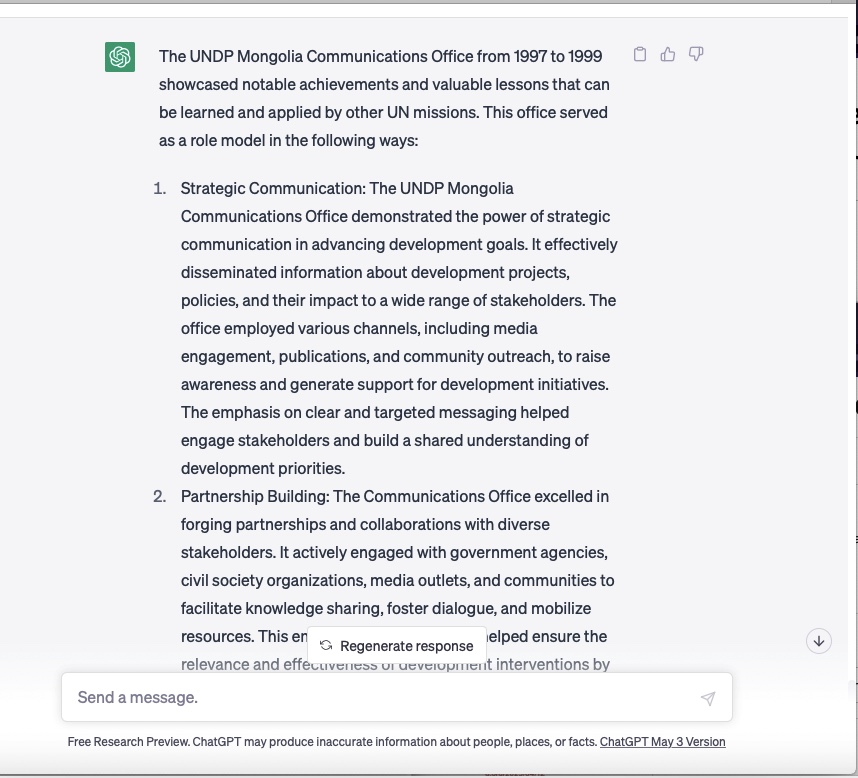
“The UNDP Mongolia Communications Office from 1997 to 1999 showcased notable achievements and valuable lessons that can be learned and applied by other UN missions. This office served as a role model in the following ways:
Strategic Communication: The UNDP Mongolia Communications Office demonstrated the power of strategic communication in advancing development goals. It effectively disseminated information about development projects, policies, and their impact to a wide range of stakeholders. The office employed various channels, including media engagement, publications, and community outreach, to raise awareness and generate support for development initiatives. The emphasis on clear and targeted messaging helped engage stakeholders and build a shared understanding of development priorities.
Partnership Building: The Communications Office excelled in forging partnerships and collaborations with diverse stakeholders. It actively engaged with government agencies, civil society organizations, media outlets, and communities to facilitate knowledge sharing, foster dialogue, and mobilize resources. This emphasis on partnerships helped ensure the relevance and effectiveness of development interventions by integrating local knowledge, expertise, and perspectives.
Innovative Approaches: The UNDP Mongolia Communications Office embraced innovative approaches to communication. It leveraged emerging technologies, such as the internet and email, to enhance information dissemination and engagement with stakeholders. The office also utilized creative storytelling techniques, including visual media and documentaries, to effectively communicate complex development issues in a compelling and accessible manner. These innovative approaches enhanced the impact and reach of communication efforts.
Local Context Sensitivity: Recognizing the importance of contextual understanding, the Communications Office prioritized local knowledge and cultural sensitivity in its communication strategies. It adapted messages and approaches to align with Mongolian traditions, values, and communication preferences. This approach helped foster trust, engagement, and ownership among local communities, ensuring that development efforts were responsive to their needs and aspirations.
Results-Oriented Communication: The Communications Office was committed to highlighting the tangible results and impact of development projects. It effectively communicated success stories, best practices, and lessons learned, demonstrating the value and effectiveness of development interventions. By emphasizing the outcomes and benefits of development initiatives, the office strengthened accountability, generated public support, and inspired further action.
Knowledge Sharing and Learning: The UNDP Mongolia Communications Office actively promoted knowledge sharing and learning among stakeholders. It facilitated platforms for dialogue, exchange of experiences, and dissemination of research findings. By creating spaces for mutual learning and collaboration, the office fostered a culture of continuous improvement and innovation in development practices.
The achievements of the UNDP Mongolia Communications Office from 1997 to 1999 served as a role model for other UN missions by highlighting the importance of strategic communication, partnership building, innovative approaches, local context sensitivity, results-oriented communication, and knowledge sharing. These lessons can guide other UN missions in effectively engaging stakeholders, promoting development goals, and building sustainable partnerships for impactful and inclusive development.”
“The website www.un-mongolia.mn, first launched in 1997, is the official website of the United Nations (UN) in Mongolia. The significance of this website lies in its role as a platform for disseminating information, promoting transparency, and facilitating communication between the UN and Mongolia.
Here are some aspects that highlight the significance of the website:
Information hub: The website serves as a centralized source of information about the UN’s activities, programs, projects, and initiatives in Mongolia. It provides updates on various UN agencies working in the country, their areas of focus, and their contributions to development, humanitarian assistance, and other important issues.
Resource repository: The website likely hosts a wide range of resources such as reports, publications, research findings, and statistical data related to Mongolia’s development challenges and the UN’s efforts to address them. These resources are valuable for policymakers, researchers, and other stakeholders seeking information on specific topics.
Collaboration and partnerships: The website may feature information on partnerships and collaboration between the UN and the Government of Mongolia, as well as with civil society organizations, non-governmental organizations (NGOs), and other stakeholders. It serves as a platform for promoting dialogue, fostering partnerships, and sharing best practices in areas such as sustainable development, human rights, and social justice.
Public engagement: The website likely provides avenues for public engagement, allowing individuals and organizations to access information, participate in discussions, and contribute to the UN’s work in Mongolia. This engagement can take the form of feedback mechanisms, consultation processes, or opportunities to join initiatives or campaigns.
Promoting accountability and transparency: Through the website, the UN can demonstrate its commitment to transparency and accountability by sharing information about its activities, budgets, and results achieved in Mongolia. This helps to foster trust and ensure that the UN’s work aligns with the needs and priorities of the country.
Overall, the significance of the www.un-mongolia.mn website lies in its role as a vital platform for communication, information sharing, and collaboration between the UN and Mongolia. It contributes to the UN’s mission of supporting sustainable development, peace, and human rights in the country while promoting transparency and public engagement.”
On the GOSH Child Health Portal:
“The launch of the GOSH Child Health Portal in 2001 had a significant impact on child health information and support services. Developed by Great Ormond Street Hospital (GOSH) in London, the portal became a valuable resource for parents, caregivers, healthcare professionals, and researchers. Its impact can be seen in several key areas, including accessibility to reliable information, support for patients and families, collaboration among healthcare providers, and advancements in pediatric research and knowledge sharing.
One of the primary impacts of the GOSH Child Health Portal was the improvement in access to reliable and up-to-date information on child health. The portal provided a comprehensive and trustworthy source of medical information, covering a wide range of pediatric health conditions, treatments, and procedures. By offering easily accessible and understandable information, the portal empowered parents and caregivers to make informed decisions regarding the health and well-being of their children. It also served as a valuable resource for healthcare professionals seeking accurate and evidence-based information to support their clinical practice.
The GOSH Child Health Portal also had a significant impact on patient and family support. It provided a platform for families to access educational materials, guidance, and resources related to their child’s specific health condition. The portal offered practical advice, coping strategies, and support networks, helping families navigate the challenges associated with pediatric illnesses. By promoting patient and family empowerment, the portal contributed to improved outcomes and a higher quality of life for children and their families.
Furthermore, the GOSH Child Health Portal facilitated collaboration and knowledge sharing among healthcare providers. It served as a central hub for medical professionals to access clinical guidelines, research articles, case studies, and educational materials. The portal promoted interdisciplinary collaboration and best practices, allowing healthcare providers to stay updated on the latest advancements in pediatric healthcare. This shared knowledge and collaboration helped enhance the quality and effectiveness of care provided to children and facilitated the dissemination of best practices across healthcare settings.
The impact of the GOSH Child Health Portal extended beyond individual patients and healthcare professionals. It also contributed to advancements in pediatric research and knowledge sharing. The portal provided a platform for researchers to share their findings, publish articles, and engage in scientific discussions. By facilitating the exchange of research and clinical experiences, the portal promoted evidence-based practice and innovation in pediatric healthcare. It also helped bridge the gap between research and clinical application, ensuring that the latest discoveries were translated into improved care for children.
Additionally, the GOSH Child Health Portal had a broader societal impact by raising awareness and understanding of pediatric health issues. The portal’s educational resources and awareness campaigns helped increase public knowledge about childhood diseases, preventive measures, and the importance of early intervention. By fostering a better understanding of child health, the portal contributed to improved health outcomes and a more supportive environment for children with medical conditions.
In summary, the launch of the GOSH Child Health Portal in 2001 had a significant impact on child health information and support services. Its contributions included improved accessibility to reliable information, enhanced support for patients and families, facilitated collaboration among healthcare providers, and advancements in pediatric research and knowledge sharing. The portal’s comprehensive resources and user-friendly interface empowered parents, caregivers, and healthcare professionals, ultimately leading to improved health outcomes and a better quality of life for children with medical conditions.”
“The GOSH Child Health Portal, www.gosh.nhs.uk, first launched in 2001, holds significant importance in the field of child health and medicine. Here are some key aspects that highlight the portal’s significance:
Trusted source of information: The GOSH Child Health Portal is developed and maintained by Great Ormond Street Hospital (GOSH), one of the leading children’s hospitals in the United Kingdom. As such, it serves as a reliable and trusted source of information on various aspects of child health, including medical conditions, treatments, research, and patient care.
Comprehensive resource: The portal likely provides a wealth of information on pediatric diseases, conditions, and treatments, catering to healthcare professionals, patients, families, and the general public. It may include resources such as medical guidelines, research articles, educational materials, and multimedia content, offering a comprehensive knowledge base on child health.
Patient and family support: The GOSH Child Health Portal likely offers resources and information to support patients and their families in understanding medical conditions, treatment options, and managing healthcare needs. This can empower families to actively participate in their child’s care, make informed decisions, and access necessary support services.
Professional education and collaboration: The portal may serve as a platform for healthcare professionals to access educational resources, clinical guidelines, and research findings related to pediatric medicine. It could also facilitate collaboration and knowledge exchange among healthcare providers, fostering advancements in the field of child health.
Research and innovation: The GOSH Child Health Portal may feature information on ongoing research projects, clinical trials, and innovative practices in pediatric medicine. It can highlight breakthroughs, advancements, and emerging trends in child health, contributing to the overall improvement of pediatric care.
Global impact: While the portal is associated with GOSH, its online accessibility allows individuals and healthcare professionals worldwide to benefit from the information and resources provided. The portal’s global reach expands its significance by providing valuable support and knowledge to a wide audience.
Overall, the GOSH Child Health Portal is significant as a reliable source of information, support, and collaboration in the field of child health. It plays a vital role in improving the understanding, management, and treatment of pediatric conditions while empowering patients, families, and healthcare professionals with valuable resources and tools.”
On the Hannah Institute for the History of Medicine:
“The Hannah Institute for the History of Medicine … had a significant impact on the field of medical history. Although the institute’s existence was relatively short-lived, its contributions were noteworthy in terms of research, education, and the dissemination of historical knowledge. This article will explore the key initiatives and achievements of the Hannah Institute, shedding light on its impact.
One of the primary areas where the Hannah Institute made an impact was in research. The institute attracted scholars and researchers from various backgrounds, fostering interdisciplinary collaboration. Through its research programs, the institute facilitated investigations into significant medical historical topics. Scholars associated with the institute delved into archives, conducted oral history interviews, and analyzed primary sources to uncover valuable insights into the evolution of medical practices, theories, and institutions. Their work challenged conventional narratives and provided a more nuanced understanding of medical history.
The Hannah Institute also played a pivotal role in promoting education in the field of medical history. It offered specialized courses and workshops that catered to students and professionals interested in expanding their knowledge. These educational programs provided a platform for participants to engage with cutting-edge research, explore historical methodologies, and develop critical analytical skills. By equipping individuals with a deeper understanding of medical history, the institute empowered them to make meaningful contributions to the field through their own research and scholarship.
In addition to research and education, the Hannah Institute actively sought to disseminate historical knowledge to a wider audience. Through conferences, symposiums, and public lectures, the institute facilitated the exchange of ideas and fostered dialogue between scholars, practitioners, and the general public. These events not only highlighted the importance of medical history but also stimulated interdisciplinary collaborations that transcended traditional academic boundaries. By creating a platform for knowledge sharing, the institute contributed to the public’s awareness and appreciation of the historical underpinnings of medicine.
Furthermore, the Hannah Institute supported and encouraged the production of scholarly articles, books, and other research outputs. Its commitment to publishing ensured the dissemination of valuable findings and insights. By supporting research and scholarly publications, the institute enhanced the visibility and impact of medical history as a discipline. It also contributed to the preservation of historical knowledge for future generations.
The impact of the Hannah Institute extends beyond its operational years. The initiatives and research projects undertaken during this period laid the foundation for subsequent advancements in the field of medical history. Scholars associated with the institute went on to make significant contributions to the discipline, furthering the understanding of medical history through their continued research and scholarship. The institute’s legacy can be seen in the ongoing work of these scholars and the continued growth of the field.
The Hannah Institute for the History of Medicine, although short-lived, made a lasting impact on the field of medical history. Through its research programs, it expanded the knowledge and understanding of medical practices, theories, and institutions. Its educational initiatives equipped individuals with the tools to contribute meaningfully to the discipline. By disseminating historical knowledge and fostering interdisciplinary collaborations, the institute raised awareness and appreciation of the historical underpinnings of medicine. The Hannah Institute’s dedication to research, education, and knowledge dissemination continues to shape the field of medical history and inspire future generations of scholars.”
Ulaanbaatar (Mongolia) – Mongolian newsstands are bursting at the seams. But while the content of the country’s publications is varied, their form is not. Newsprint rules this country’s publishing industry. The few glossy magazines for sale are imports from Russia.
When the democratic revolution unleashed the tide of free expression in the early 1990s, a flood of newspapers poured forth. It made sense. The cheap-and-cheerful technology of newsprint is low-tech, accessible and inexpensive. Suddenly everyone could be a publisher.
But Mongolia’s increasingly sophisticated media landscape is about to go “glossy”. Tomorrow (September 9) sees the launch of Ger (Home), Mongolia’s first on-line magazine. A bilingual quarterly funded by the United Nations, it combines entertainment – articles on the changing sexual attitudes of young Mongolians and the country’s vibrant pop scene – with information on the work of the UN and other NGOs in Mongolia.
“We want something that will tell the stories of Mongolians and their experiences over the last eight years – both to Mongolians and to the rest of the world,” says David South, communications coordinator at the United Nations Development Programme.
This month also brings the premiere issue of Tusgal (Strike), billed as the first full-colour, general-interest magazine in the new Mongolia. Published by Mongol News Company – the privately owned media group whose stable of publications includes the daily newspaper Onoodor and The UB Post – it offers a lively mix of sport, culture and celebrity articles, also aimed primarily at the young.
These two publications are just the top of the stack. Mongolia’s two best-known printing houses, Admon and Interpress, are said to be working on titles of their own.
Mongolia’s quick-to-learn capitalists see a gap – and they want to fill it.
“In Mongolia there are many newspapers, but no world-class magazines,” says Tusgal’s editor-in-chief, Do. Tsendjav. “On the streets you can see a lot of publications that aren’t exactly magazines but you can’t call newspapers, either – newspapers that appear every 10 days or two weeks.
“We want to fill this space. We want to produce the first colour magazine that will reach world standards, something close to Time or Newsweek.”
“There’s an enormous thirst for quality journalism, quality publications that are interesting to look at, top photojournalism – all the things newspapers don’t cover,” adds South.
“We’ve seen newspapers moving to more colour, more photographs, and that shows a desire for quality.”
That quality comes at a price. Tusgal, with 70 colour pages, will sell for between Tg 1500 and Tg 2000 – not much cheaper than an American publication like Time, and too expensive for many Mongolians.
With only 1000 Internet subscribers in Mongolia, Ger has an even smaller market within the country – though South is quick to point out, the UN has established public-access Internet centres in Ulaanbaatar and several aimags.
And he says a print version is planned to follow.
“Distribution is the big problem right now,” he says.
“We have to see how we can organize distribution to reach the whole country. I know more magazines will be launched soon in Mongolia, and hope a distribution network may grow out of that.”
The editors know Mongolia’s magazine market and magazine technology are in their infancy. Although companies like Admon and Interpress get more sophisticated equipment by the month, the capacity to produce quality publications is still limited – the first issue of Tusgal has been printed outside Mongolia.
Human resources need to develop as well, Tsendjav admits.
“To produce a monthly magazine you need highly qualified journalists. We don’t have that right now. We’re still seeking them out.”
But he is confident this will change – and quickly, too, if the pace of development in the past eight years is anything to go by.
“During socialism, Mongolia had many magazines, but it all stopped after 1990,” notes Tsendjav. “It was a question of economics.
“At first we don’t think we can earn money from this. If you want to make money you have to wait two or three years. So what we are aiming for at first is to build a readership.
“I think in two or three years, living standards will improve. People will have more money to spend on things like magazines. But we don’t want to wait for people to get enough money. We want to be the first, so people will develop an interest.
“There will be competition. Nowadays a lot of business-people understand the importance of the media. I welcome competition. It’ll make us work harder. It’s good for everybody.”
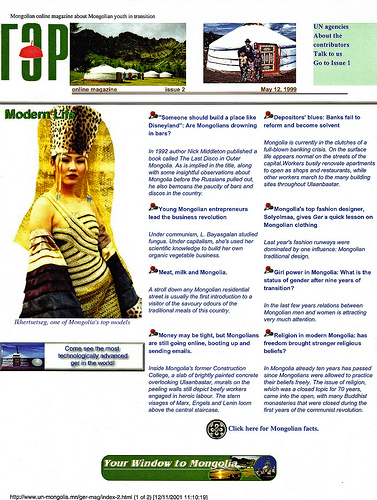
The first two issues of Mongolia’s web magazine, Ger.








 David South Consulting
You must be logged in to post a comment.