Categories
Archive Development Challenges, South-South Solutions Newsletters

Innovation: Cairo’s Green Technology Pioneers

By David SouthDevelopment Challenges, South-South Solutions

SOUTH-SOUTH CASE STUDY

One thing is ubiquitous to every country, community and society: garbage. It’s a social and environmental problem, but far from being mere waste, rubbish has its uses. This by-product of the goods and foods consumed can also be a source of fuel. As such it has many advantages, including providing free fuel to cash-strapped households, independence from unreliable municipal services and a way to dispose of waste.

An enterprising Egyptian man is showing his community how it is possible to lower the cost of gas and hot water while also avoiding the service disruptions common with municipal utilities. In the process, he is pioneering a local green innovation model that can be replicated elsewhere.

Biogas (http://en.wikipedia.org/wiki/Biogas) generators — which can transform organic household waste into fuel — have been very successful in India and China. It is estimated there are 20 million small-scale urban biogas digesters in China and 2 million in India.

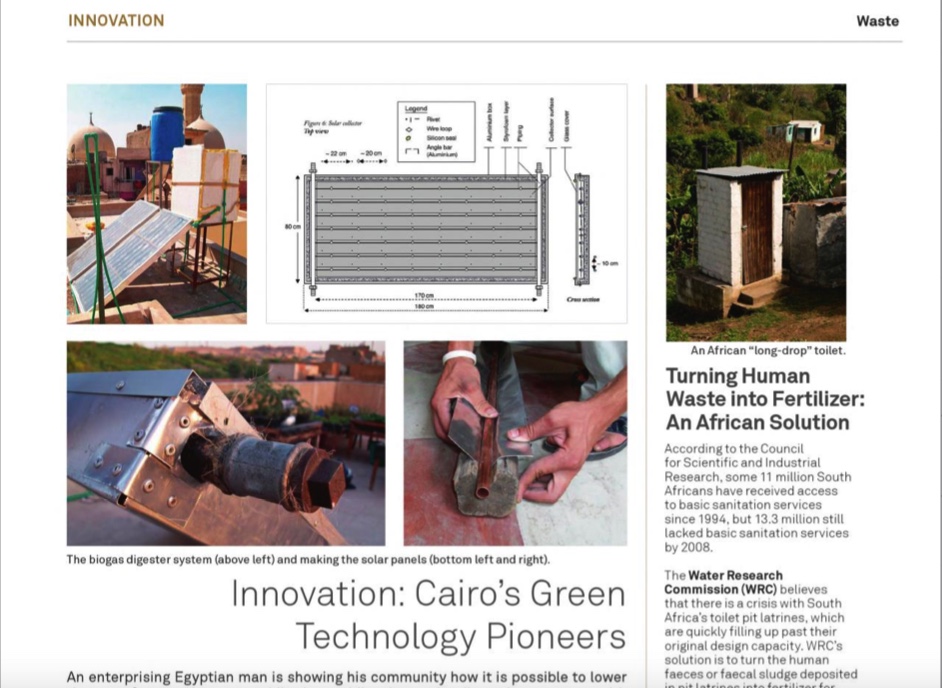
Hanna Fathy’s roof in the Manshiyet Nasser neighbourhood, home to the Coptic Christian Zabaleen community of Cairo – the city’s traditional garbage collectors and recyclers – is now a utility system, providing biogas and hot water.

The area is made of narrow streets and makeshift houses. Residents live cheek-by-jowl in a neighbourhood that is home to tens of thousands of people.

The community was badly hit when the 300,000 pigs the Christian residents have kept for the past 30 years to eat Cairo’s vegetative waste — an effective garbage-disposal system — were slaughtered under government orders to prevent the spread of swine flu (H1N1) (http://en.wikipedia.org/wiki/Swine_influenza).

One woman told U.S. National Public Radio about the hard life in the neighbourhood: “I’m working all the time. My hands get dirty, there’s no water. The price of food is too high. The gas has gone up to seven pounds (US $1.28) a bottle, so it’s expensive to heat.

“Everything is so expensive, and I have to live like this?” she said.

Fathy plops kitchen scraps, stale tea and tap water into a jug which he pours into a homemade biogas maker on the roof of his house. The stew of waste mixes with water and a small quantity of animal manure used to start the process, and overnight makes biogas, which is then used for cooking. The digester is able to provide an hour’s worth of cooking gas a day in winter months, and two hours in the summer, from around two kilograms of waste. The remaining waste by product becomes liquid organic fertilizer for the garden.

Fathy has been developing the biogas digester with the NGO Solar Cities (http://solarcities.blogspot.com), which provides designs, technical advice and support to Cairo citizens keen to embrace green technologies.

What is interesting is not only the technology but how that technology is being developed. The approach is to innovate and adapt the technology to local resources and skills. This increases the chances of take-up and buy-in.

The designs for the digesters and heaters have evolved through experimentation, brainstorming and availability of local materials.

Each biogas system costs about US $150 for materials, a cost that is being picked up right now by donations. Solar Cities believes there are only eight biogas digesters in Egypt so far, most built in 2009.

Solar Cities’ founder, Thomas Culhane, points out many urban dwellers do not believe they can generate biogas and associate it with rural systems that use animal manure. But the abundance of urban kitchen waste is in fact an excellent source material for biogas.

Culhane believes the biogas digesters are an excellent solution to two problems: the vast quantities of garbage piling up in Cairo, which has had its traditional disposal system disrupted by the slaughter of the pigs, and the city’s emissions of greenhouse gases that contribute to climate change.

Fathy has one goal: to be completely self-sufficient. He has been also prototyping a solar heater on his roof as well as the biogas digester. The solar water heater makes use of items that can be easily found: it recycles black garbage bags, has an aluminium frame and a glass cover. The whole thing rests on a Styrofoam block and uses copper tubes. The water is stored in a bright blue barrel.

Biogas, solar power and other forms of green energy face many obstacles if it is to expand further in Egypt. The average cost of each unit will need to come down to match the income of the users and compete with the government-subsidized energy sector.

Fathy has also found neighbours are skeptical and can’t believe biogas can be made this way.

Another man, Hussain Soliman, had both a solar water heater and biogas digester on the roof of his apartment building before the crumbling building collapsed.

The complete solar water heating system designed by Solar Cities can be assembled for under US $500. It uses two 200-litre recycled industrial shampoo barrels for the holding tank and back-up water supply. The solar panels need to be kept clean from dust every week, but other than that, Culhane insists the heaters require little maintenance.

Now in temporary government housing, Soliman is still enthusiastic about the technology and is re-building a solar heater and biogas digester for his new home.

“I’m planning to collect the organic waste from restaurants in the neighborhood to increase my gas output,” he told IPS News. “I’ll give the restaurants plastic bags and they can separate out the organics, and I’ll collect the bags at the end of each day.”

Published: January 2010

Resources

1) Practical Action has technical drawings and guidelines for making a small biogas digester. Website: http://practicalaction.org/practicalanswers/product_info.php?products_id=42

2)  The Anaerobic Digestion Community: Here is an excellent technical explanation of how a digester works, including a short film. Website: http://www.anaerobic-digestion.com/

3) China boasts a fast-growing biogas economy using farm waste. Here is a full summary of their experience. Website: http://www.i-sis.org.uk/BiogasChina.php.

https://davidsouthconsulting.org/2022/09/28/asian-factories-starting-to-go-green/

https://davidsouthconsulting.org/2022/09/27/caribbean-island-st-kitts-goes-green-for-tourism/

https://davidsouthconsulting.org/2021/01/25/creating-green-fashion-in-china/

https://davidsouthconsulting.org/2023/02/03/environmental-public-awareness-handbook-case-studies-and-lessons-learned-in-mongolia/

https://davidsouthconsulting.org/2021/02/01/ethiopia-and-djibouti-join-push-to-tap-geothermal-sources-for-green-energy/

https://davidsouthconsulting.org/2021/08/29/indian-business-model-makes-green-energy-affordable/

https://davidsouthconsulting.org/2021/10/22/innovations-in-green-economy-top-three-agenda/

https://davidsouthconsulting.org/2021/08/07/mongolian-green-book/

https://davidsouthconsulting.org/2022/04/14/prisons-with-green-solutions/

https://davidsouthconsulting.org/2021/02/04/us-450-million-pledged-for-green-economy-investments-at-kenyan-gssd-expo/

Development Challenges, South-South Solutions was launched as an e-newsletter in 2006 by UNDP’s South-South Cooperation Unit (now the United Nations Office for South-South Cooperation) based in New York, USA. It led on profiling the rise of the global South as an economic powerhouse and was one of the first regular publications to champion the global South’s innovators, entrepreneurs, and pioneers. It tracked the key trends that are now so profoundly reshaping how development is seen and done. This includes the rapid take-up of mobile phones and information technology in the global South (as profiled in the first issue of magazine Southern Innovator), the move to becoming a majority urban world, a growing global innovator culture, and the plethora of solutions being developed in the global South to tackle its problems and improve living conditions and boost human development. The success of the e-newsletter led to the launch of the magazine Southern Innovator. 

https://davidsouthconsulting.org/2022/11/01/southern-innovator-magazine-2010-2014/

Creative Commons License

This work is licensed under a
Creative Commons Attribution-Noncommercial-No Derivative Works 3.0 License.

ORCID iD: https://orcid.org/0000-0001-5311-1052.

© David South Consulting 2023

Categories
Archive Development Challenges, South-South Solutions Newsletters

African Fuel Pioneer Uses Crisis to Innovate

By David SouthDevelopment Challenges, South-South Solutions

SOUTH-SOUTH CASE STUDY

Crisis, as the old saying goes, is also a window of opportunity. And there is one African entrepreneur who knows this better than most. Daniel Mugenga has been on a journey of innovation that has led him to become a pioneer in the emerging new field of algae technologies. The story of how he got there is a testament to the power of using business to both solve problems and make profits.

Kenyan entrepreneur Daniel Mugenga has found a solution to the problem of high fuel costs for the transport sector in his country. He has been making money from turning waste cooking oil and inedible vegetable oil into biodiesel (http://en.wikipedia.org/wiki/Biodiesel). He then discovered that he could boost his production of biodiesel by using marine algae as a source for oil.

According to the body that represents the algae fuel industry, Oilgae (oilgae.com), algae are “plant-like organisms that are usually photosynthetic and aquatic, but do not have true roots, stems, leaves, vascular tissue and have simple reproductive structures. They are distributed worldwide in the sea, in freshwater and in wastewater. Most are microscopic, but some are quite large, e.g. some marine seaweeds that can exceed 50 m in length.”

The U.S. Department of Energy has been investigating algae as a fuel source since 1978, and it is being investigated as a potentially transformative fuel source around the world. His business, Pure Fuels Ltd. (http://www.purefuels.co.ke/), is currently seeking venture capital funding for expansion and innovation. Pure Fuels is “a commercial producer of biodiesel and also manufactures biodiesel processors, which we sell to budding entrepreneurs,” says Mugenga.

The Pure Fuels website educates readers on biodiesel as well as offering opportunities for investors and news updates. Pure Fuels was registered as a business in Kenya in 2010.

The business was born out of crisis: in 2008 there were frequent fuel shortages in Kenya and prices were volatile. That was bad news for Daniel Mugenga’s job, working for a transport company with a fleet of trucks. Rising or volatile fuel prices can destroy businesses in areas like trucking, where the biggest expense is fuel.

Mugenga began to do research into fuel alternatives in the crisis and came upon biodiesel. He then set about training in how to produce biodiesel. A period of testing, trials and research ensued between 2008 and 2010, which enabled Pure Fuels to build confidence they had something that was high  quality. The company started producing 120,000 litres of biodiesel in 2010 and increased production to 360,000 litres in 2011 and 700,000 so far in 2012. In 2011, Pure Fuels had revenue of US $230,000 from selling biodiesel.

“We started off using jatropha oil, but when its price went up it was no longer profitable,” Mugenga told the VC4Africa website blog. “Having invested in the machinery, we switched to the next quickest alternative which is used cooking oil. We source it from several of the tourist hotels along the Kenyan coast.”

Turning to cooking oil for biodiesel at first was a good idea. The company was able to get enough waste cooking oil from Kenya hotels and tourist resorts to meet demand. But as demand rose, the thorny problem of Kenya’s tourism business being seasonal arose.

“For about five months of the year, many hotels in Mombasa temporarily shut down or operate at lower capacity. Of course this is affecting the amount of waste cooking oil,” Mugenga said. This is where algae (http://en.wikipedia.org/wiki/Algae) comes in.

Pure Fuels found a biotechnologist in Kenya to help develop a solution using algae as a source for fuel. While the company is keeping details of its innovation secret, it is currently hunting for investors to help increase the quantity of biodiesel it can make – and in turn, revenues.

Investor funds would be used to import non-edible vegetable oil and also to continue the company’s work on extracting oil from marine algae.

Pure Fuels make a bold statement on algae fuel development: it “may actually be Kenya’s next cash crop.”

Pure Fuels sells several products: there is the biodiesel itself, as well as a processing machine called the GXP-200, which can turn customers into biodiesel manufacturers themselves. The company also builds large, industrial-scale processors that can produce between 1,000 litres and 5,000 litres a day.

Pure Fuels currently sells fuel to truck, bus and tuk-tuk companies, and also operates biofuel stations.

The firm has patented its biodiesel and makes all its fuel go through seven quality checks for purity. An in-house laboratory ensures adherence to international standards, and the company is certified by the Kenya Bureau of Standards (http://www.kebs.org/).

Mugenga is a passionate advocate of biodiesel’s advantages: he believes it is cheaper, and better for engines and for the environment. He admits it does have a disadvantage: it gels below 13 degrees Celsius and must be mixed 50-50 with conventional diesel to stay fluid.

Pure Fuels encourages others to use biofuels for business, throwing in a home training kit with the biodiesel processors it manufactures and sells, complete with DVDs, manuals and a business plan. The GXP-200 biodiesel processor was developed after years of experience, and Pure Fuels hopes it will be bought by people who then set up businesses – especially youth, women and the disabled. As a further incentive, Pure Fuels promises to buy the biodiesel produced. The GXP-200 was recently awarded “Most Innovative Product 2012” at a small and medium business entrepreneurs event in Nairobi.

In Israel, there are a number of pioneers working on further developing algae as a biofuel source too. Isaac Berzin of Seambiotic (seambiotic.com) sees algae as a good source for biofuel because it does not compete with food crops like other biofuel sources (sugar, potatoes, corn etc.). Algae is among a group of so-called second-generation biofuels that includes jatropha, wood and castor plants.

The disadvantage of plant-based fuel sources is they need arable land and water. This seriously holds back their ability to meet the world’s demand for fuel since they would just take up too much land and water. Algae takes up less space and produces a higher yield per acre than conventional crops.

Seambiotic makes marine microalgae using the CO2 from electric power plant flue gas. It pioneered making large quantities of fuel algae in the United States, creating the first gallons of bio-diesel and bio-ethanol from marine microalgae.

Seambiotic is also working on a US $10 million commercial microalgae farm in China, partnering with China Guodian (http://www.cgdc.com.cn/), one of the country’s largest power companies. Another Israeli company in this field is UniVerve (http://www.univervebiofuel.com/). Its CEO, Ohad Zuckerman, runs the10-person company in Tel Aviv, Israel. It is developing a new biofuel from a special strain of algae that can grow quickly in a wider range of temperatures.

Published: July 2012

Resources

1) A website with all the details on biodiesel and how to make it. Website: http://www.biodiesel.org/

2) How to make your own biodiesel. Website: http://journeytoforever.org/biodiesel_make.html

3) Oilgae is the global information support resource for the algae fuels industry. Website: http://www.oilgae.com/

4) Algae as a superfood and cancer-fighter: Chlorella. Website: http://en.wikipedia.org/wiki/Chlorella

Creative Commons License

This work is licensed under a
Creative Commons Attribution-Noncommercial-No Derivative Works 3.0 License.

ORCID iD: https://orcid.org/0000-0001-5311-1052.

© David South Consulting 2023

Categories
Archive Development Challenges, South-South Solutions Newsletters Southern Innovator magazine

Biogas Digester-in-a-Bag Brings Portability

By David SouthDevelopment Challenges, South-South Solutions

SOUTH-SOUTH CASE STUDY

Securing energy sources that are cheap (or free) and renewable can significantly reduce the cost of living for the world’s poor. The cost of fuel for essentials such as cooking and lighting can quickly eat up household incomes.

Gaining access to an inexpensive gas source that is also renewable can help people divert their income into other things, such as education and health care, improving individuals’ well-being and helping boost wealth.

Biogas (http://en.wikipedia.org/wiki/Biogas) is fuel made from biodegradable organic material such as kitchen, animal or human waste. It can be converted into gas either by being heated or using anaerobic bacteria to break down the material and turn it into combustible methane gas (http://en.wikipedia.org/wiki/Methane).

Most biogas systems are complex and large, involving an enormous domed biodigester.

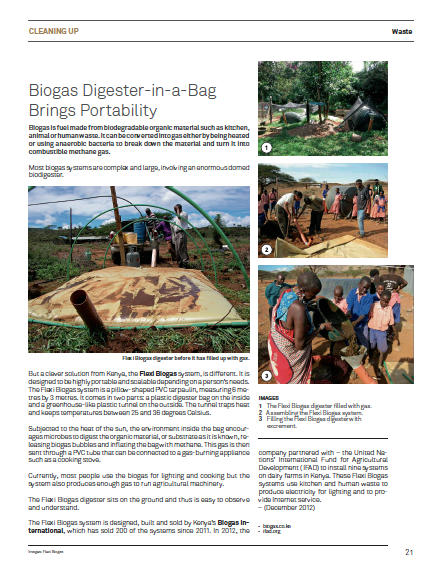
But a clever solution from Kenya, the Flexi Biogas system (biogas.co.ke), is different. It is designed to be highly portable and scalable depending on a person’s needs. The Flexi Biogas system is a pillow-shaped PVC tarpaulin, measuring 6 metres by 3 metres. It comes in two parts: a plastic digester bag on the inside and a greenhouse-like plastic tunnel on the outside. The tunnel traps heat and keeps temperatures between 25 and 36 degrees Celsius.

Subjected to the heat of the sun, the environment inside the bag encourages microbes to digest the organic material – or substrate (http://en.wikipedia.org/wiki/Enzyme_substrate_%28biology%29) as it is known, releasing biogas bubbles and inflating the bag with methane. This gas is then sent through a PVC tube that can be connected to a gas-burning appliance such as a cooking stove.

Currently, most people use the biogas for lighting and cooking but it also produces enough gas to run agricultural machinery.

The Flexi Biogas digester sits on the ground and so is easy to observe and understand.

The Flexi Biogas system is designed, built and sold by Kenya’s Biogas International, which has sold 200 of the systems since 2011. In 2012, the company partnered with IFAD – the United Nations’ International Fund for Agricultural Development (ifad.org) – to install nine systems on dairy farms in Kenya. These Flexi Biogas systems use kitchen and human waste to produce electricity for lighting and to provide Internet service.

Cows produce 15 to 30 kilograms of dung a day (IFAD). By placing 20 kilograms of fresh cow dung into a Flexi Biogas digester it is possible to produce 1,000 litres of cooking gas – enough gas for a family of five to seven people. This amount of cow dung could also produce enough gas to run a 5 horsepower engine for one hour. The engine could also be connected to a car alternator to generate electricity to run lights, a computer or a television set.

A Flexi Biogas system costs US $410, including installation by technicians and all the extras including inlet and outlet pipes and a 15 metre gas pipe.

The cost of the system increased from the first prototypes. Initially, inexpensive plastic was used for the bags and the total cost for the system was US $180. But the makers encountered a problem with durability – the systems were prone to tearing and needed to be replaced after two years. Since then, they have moved to a more expensive PVC tarpaulin bag designed to last 10 years.

The makers point out that access to high-quality plastic and rubber in Kenya is difficult and the system’s costs could be brought down if they were manufactured in China or India.

The makers argue there are several reasons why the Flexi Biogas solution is suited to Africa. One is the difficulty of securing land tenure, necessary for the building of a permanent structure like a biodigester dome. It can also be a challenge to find skilled labour and get access to complex parts such as gas pressure regulators.

In a comparison between the conventional dome biogas digester and the Flexi Biogas system, IFAD found the average cost in Kenya for a dome system was US $1,000, compared to US $410 for the Flexi Biogas system. A fixed dome takes 21 days on average to set up while a Flexi Biogas system can be set up in a day. The Flexi Biogas system also turns the substrate into biogas faster and can operate at higher temperatures. IFAD found various advantages and disadvantages to the Flexi Biogas solution: it is relatively inexpensive, lightweight (10 kilograms), very portable, quick and simple to set up, and easy to operate. The disadvantages include being costly to make, easy to steal, and a relatively short lifespan.

Weighing it all up, IFAD still concluded that “the Flexi Biogas system is an affordable solution that provides household energy while making use of waste products that would otherwise add to emissions.”

Published: December 2012

LINKS:

1) The official portal on anaerobic digestion. Website: http://www.biogas-info.co.uk/

2) REA Biogas: REA Biogas has been championing the cause of anaerobic digestion (AD) and has been the unifying force which has helped to bring the industry forward. Website: http://www.biogas.org.uk/

3) Practical Action: Various renewable energy solutions including biogas. Website: http://practicalaction.org/biogas_expertise

4) Future Biogas: Future Biogas specialise in the construction and operation of biogas plants for the UK. Website: http://www.futurebiogas.com/

https://davidsouthconsulting.org/2022/11/21/africa/

https://davidsouthconsulting.org/2022/08/02/african-fuel-pioneer-uses-crisis-to-innovate/

https://davidsouthconsulting.org/2022/11/19/agricultural-waste-generating-electricity/

https://davidsouthconsulting.org/2022/11/22/bio-ethanol-from-sturdy-and-once-unwanted-indian-plant/

https://davidsouthconsulting.org/2022/02/11/egyptian-youth-turns-plastic-waste-into-fuel/

https://davidsouthconsulting.org/2022/10/25/indian-toilet-pioneer-champions-good-ideas/

https://davidsouthconsulting.org/2023/03/27/pay-for-pee-keeps-indian-town-clean/

https://davidsouthconsulting.org/2022/06/23/recycling-waste-to-boost-incomes-and-opportunities/

https://davidsouthconsulting.org/2022/11/19/saving-water-to-make-money/

https://davidsouthconsulting.org/2022/11/18/successful-fuel-efficient-cookers-show-the-way/

https://davidsouthconsulting.org/2022/11/18/toilet-malls-make-going-better/

https://davidsouthconsulting.org/2022/08/13/turning-animal-waste-into-paper/

https://davidsouthconsulting.org/2021/09/30/turning-human-waste-to-fertilizer-an-african-solution/

https://davidsouthconsulting.org/2022/02/10/urban-farmers-gain-from-waste-water/

Follow @SouthSouth1

Slideshare: http://www.slideshare.net/DavidSouth1/development-challengessouthsouthsolutionsnovember2010issue

Southern Innovator Issue 1: https://books.google.co.uk/books?id=Q1O54YSE2BgC&dq=southern+innovator&source=gbs_navlinks_s

Southern Innovator Issue 2: https://books.google.co.uk/books?id=Ty0N969dcssC&dq=southern+innovator&source=gbs_navlinks_s

Southern Innovator Issue 3: https://books.google.co.uk/books?id=AQNt4YmhZagC&dq=southern+innovator&source=gbs_navlinks_s

Southern Innovator Issue 4: https://books.google.co.uk/books?id=9T_n2tA7l4EC&dq=southern+innovator&source=gbs_navlinks_s

Southern Innovator Issue 5: https://books.google.co.uk/books?id=6ILdAgAAQBAJ&dq=southern+innovator&source=gbs_navlinks_s

Creative Commons License

This work is licensed under a
Creative Commons Attribution-Noncommercial-No Derivative Works 3.0 License.

ORCID iD: https://orcid.org/0000-0001-5311-1052.

© David South Consulting 2023