Most people haven’t heard of Olam International, but they know the brands they work for and they more than likely eat their produce. The story of Olam (http://www.olamonline.com) – a global food supply company in ‘agri-products’ that got its start in Nigeria – shows how a Southern brand can grow and go global, and overcome the difficulties of cross-border trade.
Olam supplies well-known global food brands including Cadbury (chocolate), Nestle, Lavazza (coffee), Mars (chocolate), Tchibo and Planters (peanuts).
Olam not only survived its startup in Nigeria, it has thrived, trading around Africa and across the globe, becoming a major supplier to the world’s top food brands.
The quantity of agri-products harvested in the world is 5.2 billion metric tonnes. In that market, Olam is a significant producer of cashews, peanuts, spices, beans, coffee, cocoa, sheanuts, packaged foods, rice, wheat, barley, sugar, cotton, wood, and rubber. It is already the world’s largest supplier of cashew nuts and sesame nuts and in the top three for peanuts. Olam’s cashew business in Africa provides work for 17,000 people, 95 percent of whom are women.
Olam also uses its success to play a critical role in securing the world’s food supply and has specialized in meeting the food needs of the world’s rapidly growing population, especially in China and India. Between 2001 and 2007, annual increases in the global consumption of agricultural commodities were larger than during the 1980s and 1990s. Higher incomes are leading to higher consumption of proteins like meat. And as meat demand rises, so does the demand for grain and protein feeds to produce the meat. It takes two kilograms of grain to produce one kilogram of chicken, four kilograms of produce for one kilogram of pork, and eight kilograms of produce for one kilogram of beef.
Chris Brett, Olam’s senior vice president and head of corporate social responsibility and sustainability, said the company tries to blend business success with wider social goals.
“We are one of the few businesses investing in rural environments and am tackling the problem of urbanization,” said Brett in Olam’s London office – the company’s global headquarters is in Singapore.
In 2008, it won the World Business Development Award for its contribution to achieving the Millennium Development Goals (MDGs) (http://www.un.org/millenniumgoals/).
Olam also has been recognized for its contribution to global food security. By providing farmers with credit to help build their communities, it has also been able to revive declining rural economies and help stem the outflow of farmers to the big cities and urban slums.
“Many countries are afraid to lend to farmers,” Brett said. “We gather the farmers together in groups of 500 and Olam manages the loan while a local bank receives the money. Defaults have been low and farmers are building up a credit rating. In this way, farming becomes a business not just a subsistence existence.”
The dramatic changes taking place in African countries – especially rapid urbanization that has made the continent home to 25 of the world’s fastest growing cities (International Institute for Environment and Development) – means there is an urgent need to increase food production and stabilize rural economies to support farming.
Olam International, started in 1989 in Nigeria by its India-born CEO Sonny George Verghese has many lessons for any Southern entrepreneurs who have their sights set high.
After developing its skills in exporting cashew nutsfrom Nigeria, Olam moved into cotton, cocoa and sheanuts. From 1993 to 1995, the company explored ways of taking their skills into other countries and different products. It was a period of rapid expansion into other African countries including Benin, Togo, Ghana, Cote d’Ivoire, Burkina Faso and Senegal.
Olam now operates in 26 African countries.
There has been a renaissance in South-South trade in recent years before the current economic crisis, growing by an average of 13 percent per year between 1995 and 2007. By 2007, South-South trade made up 20 percent of world trade.
Olam started with one product, got its supply right, and then started looking around and seeing what other products and services it could offer, applying already-tested expertise and supply skills – what the company calls the ‘Olam DNA’.
Olam claims its success has come from building strong relationships with farmers to guarantee high standards for the food products. The company does this by tightly tracking its stock and its quality. Olam then uses the information to analyze risks to the supply network. The company also keeps both warehouses and field managers close to the farmers. Olam estimates 65 percent of its profit comes from managing the journey from farmer’s field to factory gate.
Its selling point to customers is the ability to guarantee the entire journey from farmer’s field to factory gate, taking on all the risk and stress for ensuring the product is of the right standard and delivered on time.
Its niche is to provide the food products required by some of the world’s top food brands. The company has grown from just one product in Nigeria and two employees in 1989, to directly employing over 10,000 people worldwide and supplying 20 products in 60 countries, according to Brett. He says the company, which had a total 2008 turnover of US $5.75 billion, was “born out of Africa.”
Brett says the company is now “investing heavily in Africa in processing and distribution centres” – proof that a success story feeds back into more success and investment. It has been able to use its profits to go back and buy up failing businesses and former state-run enterprises, and modernize them. Olam now grows the food, processes it, and transports it to market.
Olam actively works with international donors, global NGOs like Technoserve (farmer business development), WWF (environmental impact of supply chain), and the Bill and Melinda Gates Foundation (cocoa and cashew farmers).
Olam, however, has received criticisms for its past practices. The global environmental group Greenpeace attacked its logging in the Democratic Republic of Congo (DRC) (http://www.greenpeace.org.uk/tags/olam), and the International Finance Corporation (IFC) divested its holdings from Olam for it trading illegally cut timber.
Olam and the Gates Foundation project are working with 200,000 cocoa farmers in West Africa to double their incomes. In Ghana, cocoa farming has become synonymous with poverty and perceived as an occupation of last resort. The work force is rapidly aging and the industry will die out if it doesn’t become more profitable and attractive to young people.
“We want the farmers to be profitable, the transporters to be profitable,” Brett said. “We believe a supply chain does not work if one player takes too much.”
And what advice does Olam have for budding food producers and growers? “Catchy, simple brands work. Our Mama Mia pasta caught the wave of the Abba revival.”
“Our Tasty Tom brand became very popular in Africa so we extended the brand into other products than just tomato paste. You reduce the cost of advertising by extending the brand name.”
“We feel SMEs (small, medium enterprises) growth is critical because it would give us more support. If more people invested in SMEs, we would have more people to do business with. We want to be able to make deals: they could be entrepreneurs.
“If you can add extra value it costs nothing but time.”
Brett advises budding SMEs: “It’s all about quality: trust and shared business ethics like formal contracts. When you have those, the bigger brands will give you support.”
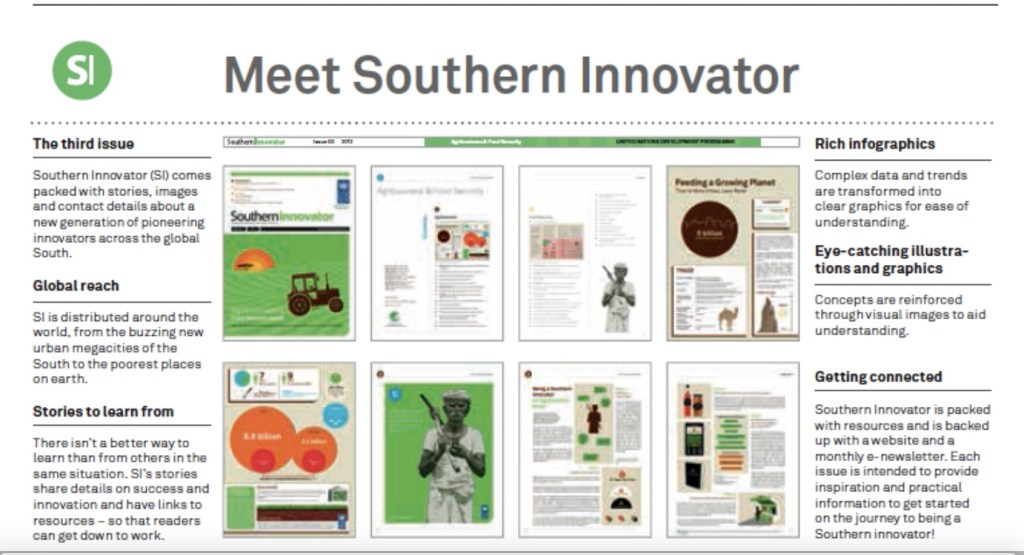
Development Challenges, South-South Solutions was launched as an e-newsletter in 2006 by UNDP’s South-South Cooperation Unit (now the United Nations Office for South-South Cooperation) based in New York, USA. It led on profiling the rise of the global South as an economic powerhouse and was one of the first regular publications to champion the global South’s innovators, entrepreneurs, and pioneers. It tracked the key trends that are now so profoundly reshaping how development is seen and done. This includes the rapid take-up of mobile phones and information technology in the global South (as profiled in the first issue of magazine Southern Innovator), the move to becoming a majority urban world, a growing global innovator culture, and the plethora of solutions being developed in the global South to tackle its problems and improve living conditions and boost human development. The success of the e-newsletter led to the launch of the magazine Southern Innovator.
For many decades, strong American and multinational food brands have penetrated markets in the South. This is a global business success story for those companies, but the downside has been the marginalizing of local alternatives. This not only reduces wealth-creating opportunities for local entrepreneurs, but also leads to products like sugary soda pops (http://tinyurl.com/yzwal98) pushing aside healthier, local alternatives like tea.
But one company in Indonesia has been pioneering a healthy local drinks empire while also seeing off aggressive foreign rivals. Teh Botol Sosro, a tea drink in Indonesia bottled by family-owned business Sosro, was not only the first bottled tea brand in the country, but also in the world, it claims. The company started bottling the jasmine-flavoured black tea drink in the 1970s.
The Indonesian company has shown that it is possible for local flavours to beat powerful international brands like Coca Cola in the battle for drinkers’ palates. While Coca Cola has tried to sell many bottled tea drinks in the Indonesian market, they have not been able to push aside the local product, The Teh Botol Sosro. Brewed by the Sinar Sosro company, it has captured 70 percent of the non-carbonated drinks market.
It is a drink of cool, black, sweetened tea with a hint of jasmine. Invented by the Indonesian family of Sosrodjojos, Sosro (http://www.sosro.com/) was founded in central Java in the 1940s.
Culturally, Indonesians have either coffee or tea with their meals. The brand’s marketing slogan plays on this: “Whatever you eat, you drink Teh Sosro.”
The company has aggressively fought off competition not only from local rivals, but also from Coca Cola’s Frestea brand and Pepsi Cola’s Tekita. The company stayed sharp in its business strategy, never letting a rival product take hold. Just as a rival would introduce a new product, Sosro would reply with a new drink attuned to Indonesian tastes. This ability to not be complacent about the company’s success, and to use its knowledge of local tastes to always outsmart foreign competition, has kept the company where it is today.
Sosro pioneered bottled drinking tea with its launch in 1970 and started with a dried tea only distributed in Central Java.
The journey to cold, bottled tea is an amusing one. The company first wanted to promote its tea in Jakarta, the capital, by having public tastings. But by brewing the tea on the spot, the too-hot tea took too long to drink for impatient Jakartens. The solution was to not brew the tea on the spot, but instead to brew it off-site and deliver to markets in big pans on trucks. But the bad roads made this a bit of a mistake as well: the tea would spill on the journey.
The ‘aha’ moment came when the idea arose to store the brewed tea in bottles. The bottles were eye-catching and have evolved in design over the years.
The drink now comes in various packages, from a returnable glass bottle (220 ml) to a Tetra Pak (1 litre, 250 ml, and 200 ml) and a 230 ml pouch.
The Botol Sosro (http://www.sosro.com/teh-botol-sosro.php) is not the company’s only product: it also brews Fruit Tea, The Botol Kotak and S-Tee. The economic benefits of these popular brands stay local, as Sosro gets the tea from PT Gunung Slamet, which operates three tea estates covering 1,587 hectares in Indonesia.
Published: March 2010
Resources
1) Just Food is a web portal packed with the latest news on the global food industry and packed with events and special briefings to fill entrepreneurs in on the difficult issues and constantly shifting market demands. Website:http://www.just-food.com
2) Brandchannel: The world’s only online exchange about branding, packed with resources, debates and contacts to help businesses intelligently build their brand. Website:http://www.brandchannel.com
4) Growing Inclusive Markets, a web portal from UNDP packed with case studies, heat maps and strategies on how to use markets to help the poor. Website:http://www.growinginclusivemarkets.org
5) Tea Genius: A website from Taiwan packed with information on tea, its health benefits and rituals. Website: http://www.teagenius.com/
Expertise: Crisis leadership, mission leadership, strategy, communications, web strategy, digital media, crisis recovery, public health, Northeast Asia, UN system.
Location: Ulaanbaatar, Mongolia 1997 to 1999
UN/UNDP Mongolia Communications Coordinator:David South
The question posed itself from the start of the assignment: In the middle of a major crisis, is it possible to recover quickly while simultaneously growing and modernizing the United Nations mission (this was the dawn of the digital revolution)? It was only possible by teaching and mentoring colleagues, offering leadership, vision, strategy, and practical actions to get there – all with a budget and mandate for two years.
The mission had to tackle in particular, three, severe crises: the country’s turbulent transition from Communism to free markets and democracy, the social and economic crash this caused, and, later in 1997, the Asian Financial Crisis (Pomfret 2000)* – all combined with the political instability this exacerbated. Richard Pomfret said in 1994, “In 1991 Mongolia suffered one of the biggest peacetime economic collapses ever (Mongolia’s Economic Reforms: Background, Content and Prospects, Richard Pomfret, University of Adelaide, 1994).” From Curbing Corruption in Asia: A Comparative Study of Six Countries by Jon S. T. Quah: “The combined effect of these three shocks was devastating as ‘Mongolia suffered the most serious peacetime economic collapse any nation has faced during this century’. Indeed, Mongolia’s economic collapse ‘was possibly the greatest of all the (peaceful) formerly’” Communist countries.
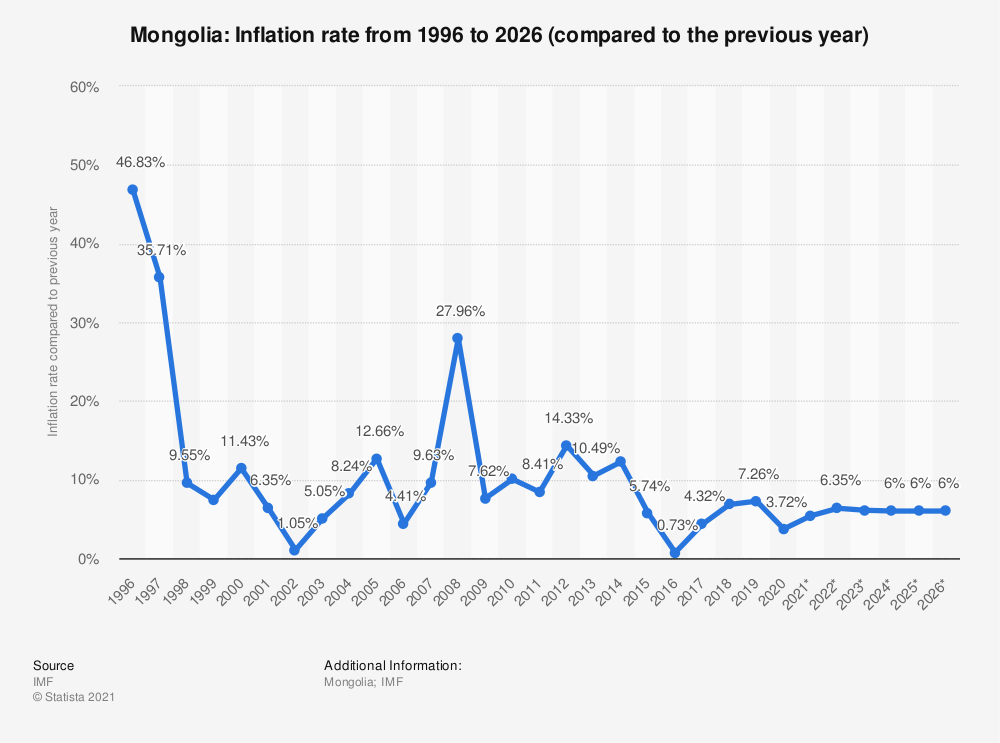
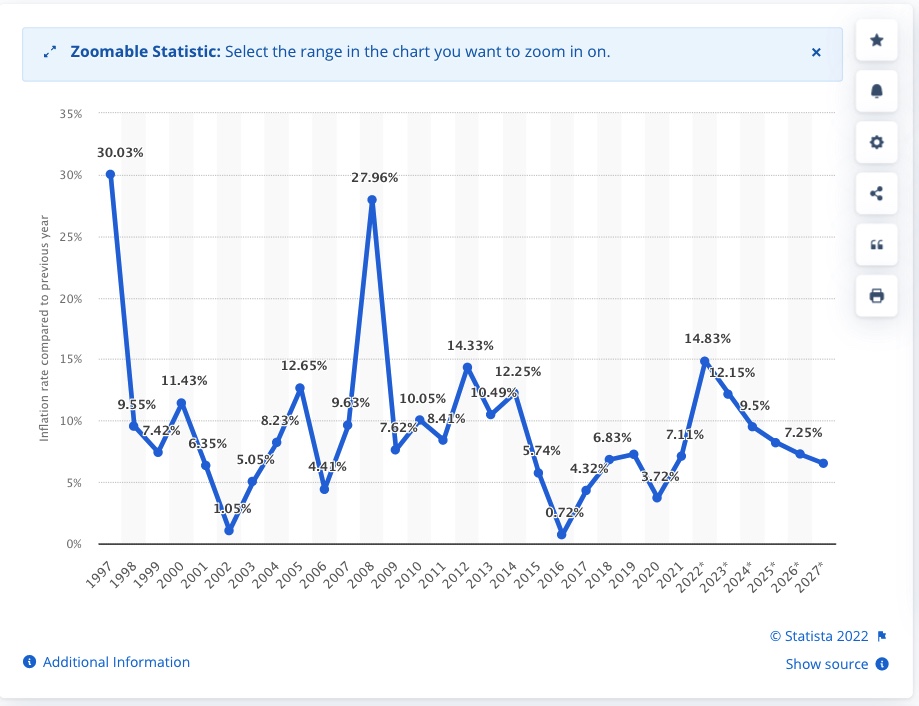
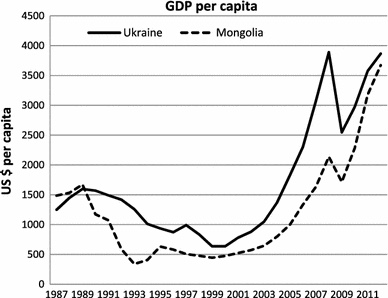
A dramatic decline in inflation paired with political and economic stabilisation allowed Mongolia to enjoy the fruits of the fast-growing economies of the 2000s. Source: Statista.
During the last 16 years the financial and monetary system of our country saw the worst crisis in 1991-1994, there was a recovery in 1995-1997 and another crisis in 1997-1999. However, it has entered a stable stage since 2000.
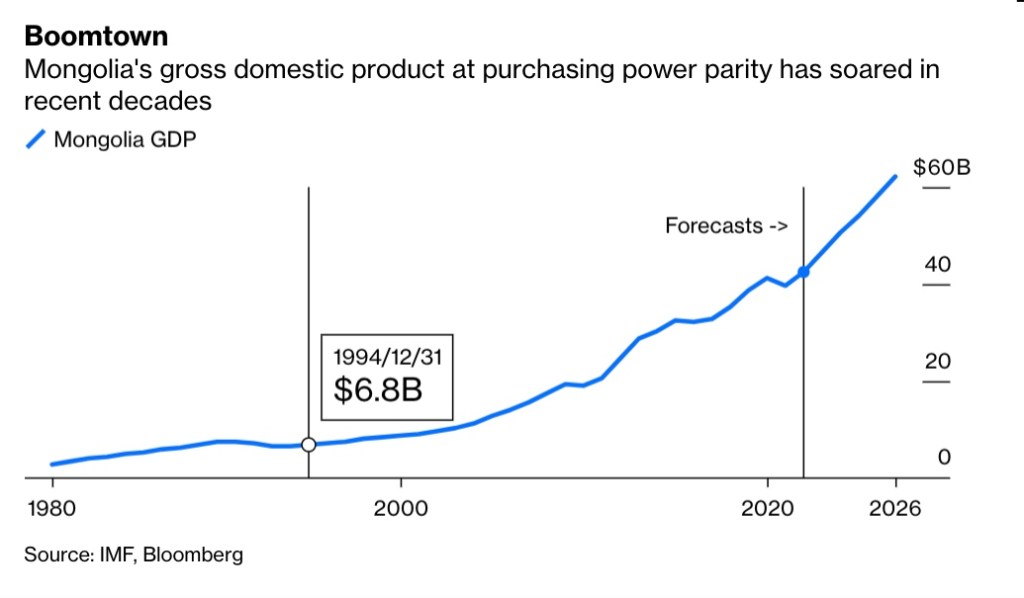
A resources “boomtown” throughout the 2000s. Source: Bloomberg. When I left in 1999, Mongolia’s PPP was US $8.8 bn; today (2021) it is US $42.4 bn. Graph from Migration under economic transition and changing climate in Mongolia, Journal of Arid Environments, Volume 185, February 2021. “Urbanization in Mongolia accounted for over 80% of all migration, mostly into the capital city Ulaanbaatar (UB), where nearly 70% of recent population growth was from migration.” As can be seen in this chart, Mongolia’s economic growth since 2000 has benefited greatly from its proximity to China.
As this chart shows, increasing connectivity had a profound impact on living standards in Ukraine and Mongolia post-2000. The extreme turbulence Mongolia experienced in the 1990s – after the collapse of support mechanisms from the Soviet Union – calmed down as Mongolia integrated with the global economy, especially a booming China. Read about my work in Ukraine here: UN Ukraine Web Development Experience | 2000.
The Economist: “Those free-trading Mongolians” was published Apr 24th 1997. I arrived in May of 1997 to find a country on the cusp of great and turbulent change.
In this role, I pioneered innovative uses of the Internet and digital resources to communicate the UN’s work and Mongolia’s unfolding crises. The UN called this work a “role model” for the wider UN and country offices. A survey of United Nations country office websites in 2000 ranked the UN Mongolia website I launched in 1997 and oversaw for two years (1997-1999), third best in the world, saying: “A UN System site. A very nice, complete, professional site. Lots of information, easily accessible and well laid out. The information is comprehensive and up-to-date. This is a model of what a UNDP CO web site should be.” (http://www.scribd.com/doc/274319690/UNDP-Mongolia-United-Nations-2000-Survey-of-Country-Office-Websites)
“The years 1998 and 1999 have been volatile ones for Mongolia, with revolving door governments, the assassination of a minister, emerging corruption, a banking scandal, in-fighting within the ruling Democratic Coalition, frequent paralysis within the Parliament, and disputes over the Constitution. Economically, the period was unstable and rife with controversies.” Mongolia in 1998 and 1999: Past, Present, and Future at the New Millennium by Sheldon R. Severinghaus, Asian Survey, Vol. 40, No. 1, A Survey of Asia in 1999 (Jan. – Feb., 2000). pp. 130-139 (Publisher: University of California)
As part of a strategic plan to raise awareness of Mongolia’s development challenges and to spur action on meeting them, a Communications Office was established for the UN mission in 1997 – a structure that is commonplace in UN missions today. The Office also led on digital communications, marking many firsts, from the first digital photo and video library, the first online magazine, the first web portal, the first online newsletter, and many other firsts. It gathered numerous stories on resilience in a crisis, and documented in data and storytelling the country’s development challenges, while introducing a transparent way of working and communicating unprecedented for the time (the country was still recovering from the state secrecy of its years under Communism), and led on modernizing communications in the country. Acting as a strategic hub, the Communications Office and its dynamic and talented team, were able to leverage the existing budget to spur action on many fronts, including:
I launched it in 1997 in the middle of a major crisis, and oversaw its expansion and development for two years. A pioneering digital resource, this award-winning United Nations Mongolia development web portal was singled out by UN headquarters in New York as an example of what a country office website should be like. It featured extensive resources in both Mongolian and English and also was home to the bilingual online magazine, Ger – Mongolia’s first web magazine. It can be viewed at www.archive.org and there is more at Wikipedia here: https://en.wikipedia.org/wiki/Ger_(magazine).
Media
Working with journalists and media both within Mongolia and outside, the Communications Office was able to significantly raise awareness of Mongolia and its development challenges. This was reflected in a substantial increase in media coverage of the country and in the numerous books and other publications that emerged post-1997. The book In Their Own Words: Selected Writings by Journalists on Mongolia, 1997-1999 (ISBN 99929-5-043-9) published by UNDP Mongolia archived the stories by theme.
Ger Magazine
Ger Magazine (the Mongolian word for home and traditional tent dwelling) was published as the country’s first e-magazine in 1998. There were four issues in total from 1998 to 2000. The launch issue was on the theme of youth in the transition. Mongolia was transitioning from Communism to free markets and democracy and this had been both an exhilarating time and a wrenching time for young people. The magazine drew on talented journalists from Mongolia and the handful of international journalists based there to create a mix of content, from stories about life adapting to free markets to stories on various aspects of Mongolian culture and life.
The second issue of the magazine proved particularly effective and inspiring, with its modern life theme and cover story on a thriving Mongolian fashion scene.
Archived issues of the magazine can be found at the Wayback Machine here: https://archive.org/. Just type in the UN Mongolia website address for the years 1997 to 1999: http://www.un-mongolia.mn.
An online survey of the state of Mongolia’s media and its history (www.pressreference.com/Ma-No/Mongolia.html), had this to say: “An interesting variation from some of the other publications available is Ger Magazine (published online with guidance from the United Nations Development Program, UNDP), which is concerned with Mongolian youth in cultural transition. The name of the magazine is meant to be ironic because a ger is the Mongolian word for yurt—a yurt being traditional nomadic housing—but the magazine is about urbanization and globalization of Mongolian youth.”
Blue Sky Bulletin
The Blue Sky Bulletin newsletter was launched in 1997 initially as a simple, photocopied handout. It quickly founds its purpose and its audience, becoming a key way to communicate what was happening in the country and a crucial resource for the global development community, scholars, the media and anyone trying to figure out what was happening in a crazy and chaotic time. It eschewed the typical ‘grip and grin’ content found in many development newsletters and instead offered stories, data and insights useful to anyone seeking to understand Mongolia’s development challenges. The Blue Sky Bulletin was distributed via email and by post and proved to be a popular and oft-cited resource on the country. The quality of its production also paralleled Mongolia’s growing capacity to publish to international standards, as desktop publishing software became available and printers switched to modern print technologies. The Blue Sky Bulletin evolved from a rough, newsprint black and white publication to becoming a glossy, full-colour, bilingual newsletter distributed around Mongolia and the world.
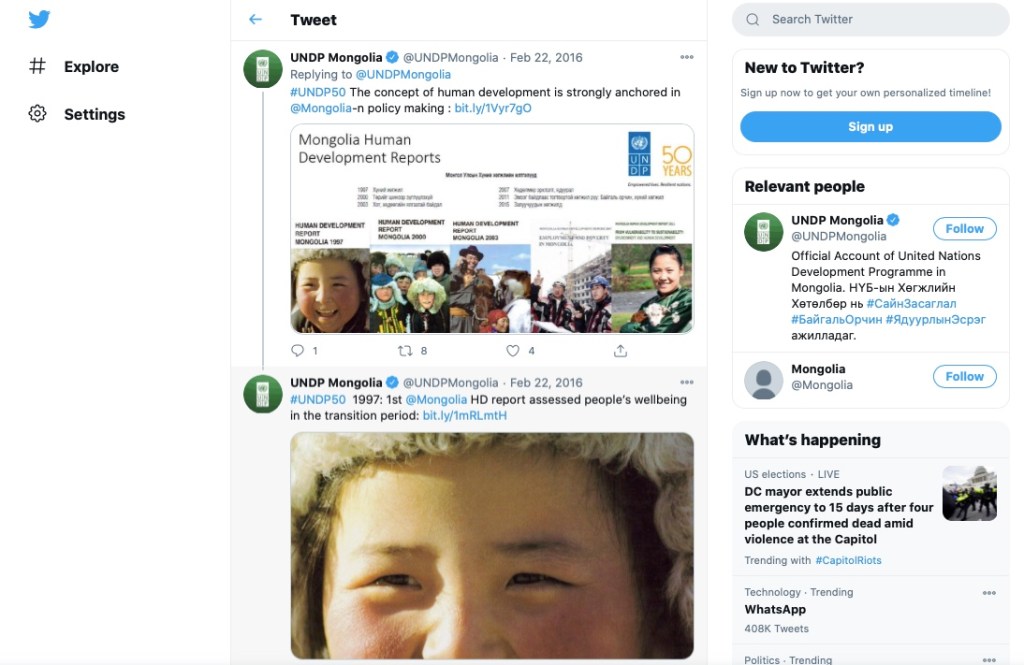
The Mongolian Human Development Report 1997 (MHDR), the country’s first, placed the story of the Mongolian people during the transition years (post-1989) at its heart, using photographs, stories and case studies to detail the bigger narrative at play.
This groundbreaking Mongolian Human Development Report – the country’s first – went beyond just chronicling Mongolia’s state of development in statistics and graphs. Designed, laid out and published in Mongolia, the report broke with the practices of many other international organisations, who would publish outside of Mongolia – denying local companies much-needed work and the opportunity to develop their skills. The report’s costs helped to kick-start a publishing boom in the country and significantly raised standards in design and layout in the Mongolia. The foundations laid down by the project producing the report ushered in a new age in publishing for Mongolia.
The report’s launch was innovative, not only being distributed for free across the country, but also part of a multimedia campaign including television programming, public posters, town hall meetings and a ‘roadshow’ featuring the report’s researchers and writers.
The initial print run of 10,000 copies was doubled as demand for the report increased. To the surprise of many, once hearing about the free report, herders would travel to the capital, Ulaanbaatar, to pick up their copy. The report proved people cared passionately about the development of their country and that development concepts are not to be the secret domain of ‘development practitioners’. The report also became an English language learning tool as readers compared the Mongolian and English-language versions.
1997 saw the launch of the first human development report for Mongolia.
Mongolian AIDS Bulletin
UNDP acted swiftly to address a breaking HIV/AIDS crisis in 1997, offering a key lesson for others working in public health (the Ebola Crisis and global air pollution crisis both show those lessons have still yet to be fully absorbed).
Assembled by a team of health experts after the Fourth International Congress on AIDS in Asia and the Pacific, the Mongolian AIDS Bulletin was published in 1997 in the middle of an HIV/AIDS crisis. It provided timely information and health resources in the Mongolian language and was distributed across the country.
“Mongolia’s first AIDS Bulletin marked the beginning of the UNDP Response to HIV/AIDS/STDs Project back in the autumn of 1997. Over 5,000 copies of the magazine were distributed across the country, offering accurate information on the HIV/AIDS situation. The project has been pivotal in the formulation of a national information, education and communication (IEC) strategy, bringing together NGOs, donors, UN agencies and the government.”
Source: YouandAids: The HIV/AIDS Portal for Asia Pacific
Green Book
In the Mongolian language, the Mongolian Green Book details effective ways to live in harmony with the environment while achieving development goals. Based on three years’ work in Mongolia – a Northeast Asian nation coping with desertification, mining, and climate change – the book presents tested strategies.
EPAP Handbook
The Environmental Public Awareness Handbook was published in 1999 and features the case studies and lessons learned by UNDP’s Mongolian Environmental Public Awareness Programme (EPAP). The handbook draws on the close to 100 small environmental projects the Programme oversaw during a two-year period. These projects stretched across Mongolia, and operated in a time of great upheaval and social, economic and environmental distress. The handbook is intended for training purposes and the practice of public participation in environmental protection.
In its 2007 Needs Assessment, the Government of Mongolia found the EPAP projects “had a wide impact on limiting many environmental problems. Successful projects such as the Dutch/UNDP funded Environmental Awareness Project (EPAP), which was actually a multitude of small pilot projects (most costing less than $5,000 each) which taught local populations easily and efficiently different ways of living and working that are low-impact on the environment.”
Mongolia Updates 1997, 1998, 1999
Mongolia Update 1998 detailed how the country was coping with its hyperinflation and the Asian economic crisis.
1998 proved a tumultuous year for Mongolia. The country’s existing economic crisis caused by the transition from Communism to free markets was made worse by the wider Asian Crisis. The government was destabilised, leading to an often-confusing revolving door of political figures. In order to help readers better understand the political changes in the country, a special edition of Mongolia Update was published that year.
UNDP Mongolia: The Guide
The Guide, first published in 1997, provided a rolling update on UNDP’s programmes and projects in Mongolia during a turbulent time (1997-1999). The mission simultaneously had to deal with the 1997 Asian Crisis (http://en.wikipedia.org/wiki/1997_Asian_financial_crisis) and the worst peacetime economic collapse in post-WWII history.
Each edition came with short project and context summaries, key staff contacts, and facts and figures on how the country was changing. For the first time, any member of the public could grasp what the UN was up to in the country and be able to contact the project staff. An unusual level of transparency at the time for a UN mission.
Memoranda of Understanding
Three Memoranda of Understanding were negotiated with the Mongolian Government to help focus efforts and aid the attainment of internationally-agreed resolutions. This was affirmed by a series of youth conferences, One World, held in 1998 and 1999.
Strategy and Leadership in a Crisis
The scale and gravity of the crisis that struck Mongolia in the early 1990s was only slowly shaken off by the late 1990s. The economic and social crisis brought on by the collapse of Communism and the ending of subsidies and supports from the Soviet Union, led to a sharp rise in job losses, poverty, hunger, and family and community breakdowns.
The challenge was to find inspiring ways out of the crisis, while building confidence and hope. The sort of challenges confronted by the UNDP Mongolia Communications Office included:
1) A food crisis: agricultural production was down sharply, and the traditional nomadic herding economy, while at peak herd, was failing to get the meat to markets and to a high enough standard to restore export levels to where they once were. As a result, a cross-border trading frenzy became the solution to falling domestic food production and availability.
2) HIV/AIDS/STDs crisis.
3) A major banking crisis.
4) Both the Asian Financial Crisis and the Russia Crisis.
5) An ongoing political crisis and an inability to form stable governments.
UN Annual Reports
Editor and designer. 1998 Report called by Under-Secretary-General Nafis Sadik “a clear, well-written, attractive and colourful report.”
One of many documents from that time held in the United Nations Archives Search Engine. In this case, reporting on Mongolia’s follow-up to global conferences to then-Secretary-General Kofi A. Annan in 1999.
Mongolia’s Follow-Up To The UN Global Conferences (1999) UNDP Mongolia Communications Office, Ulaanbaatar, Mongolia.
Production/Design Supervision: David South, UNDP Communications Coordinator; Proof Reading: N. Oyuntungalag, UNDP Communications Officer/David South (1999).
1998: International media tours of the country, launching of Mongolia’s first online magazine, Ger, distribute globally a regular newsletter on Mongolia’s development challenges, Blue Sky Bulletin. Open United Nations Info Shop for the public. Assist the Government of Canada to connect with Canadians working with the United Nations in Mongolia during the first official visit by a Canadian Government Minister.
1999: Launch a string of books documenting insights gleaned from the Mongolia development experience.
Testimonials
“Mongolia is not an easy country to live in and David [South] showed a keen ability to adapt in difficult circumstances. He was sensitive to the local habits and cultures and was highly respected by his Mongolian colleagues. … David’s journalism background served him well in his position as Director of the Communications Unit. … A major accomplishment … was the establishment of the UNDP web site. He had the artistic flare, solid writing talent and organizational skills that made this a success. … we greatly appreciated the talents and contributions of David South to the work of UNDP in Mongolia.” Douglas Gardner, UN Resident Coordinator and UNDP Resident Representative Mongolia
Impact
Micro
strategic communications approach including establishing the UN/UNDP Mongolia Communications Office and team and strategic communications plan
led on digital transformation, including use of digitial media (photo/video archive) and digital publishing (web site, online magazine and newsletter, etc.)
established and ran the United Nations Info Shop – a one-stop resource open to the public with archive of development publications and current periodicals and Internet access
began largest bilingual online and offline publishing programme in country – led on publishing and design modernisation
laid down the foundations for many UN initiatives in Mongolia that are still underway. Contributed to stabilizing the country in a turbulent time. Mongolia was briefly the fastest-growing economy in the world by 2011
championed transparency and access to information and media freedoms
oversaw a period in which Transparency International found lower levels of perceived corruption
managing editor for country’s first Human Development Report
Macro
raised profile of country and its development challenges. Donor pledges rose
2 international media tours
strong relationship with Mongolian and international journalists
championed innovators in commnications
crisis response: AIDS, economy, political
country’s largest website and one of its first. Called “Godfather of the Mongolian web”
called a “role model” for the wider UN
led on new approach to UN communications in the digital age
design-led approach
transparent and timely updates
negotiated three Memoranda of Understanding (MOUs): youth, food security and nutrition, STDs/HIV/AIDS
The response by the UNDP Mongolia Communications Office has been cited in numerous articles, books, publications and stories. It has also contributed to the development of the human development concept and understanding of human resilience in a crisis and innovation in a crisis.
This resource was praised for having: “Very useful references and original materials that documented UNDP Mongolia work. I needed to trace community-based development, and this book provided a valuable source.” Review on Google Books
In 2001, the UN won the Nobel Peace Prize for “their work for a better organized and more peaceful world” and its communications innovations, with work such as that in Mongolia being cited as a contributing factor to the awarding of the Prize.
The Nobel Peace Prize 2001 joint winners.
In 2000, the Millennium Development Goals (MDGs) were launched in a 15-year bid to use a focused approach to development centred around eight goals to accelerate improvements to human development. From 2000 to 2005, consulting work was undertaken in various UN missions (Mongolia, South Africa, Turkmenistan, Ukraine) to communicate the goals and to reshape communications activities around the goals.
More than 80,000 people swarmed Parliament Hill on May 15 at an Action Canada Network and Canadian Labour Congress rally against free trade and other federal policies. In a paper issued just before, the Canadian Centre for Policy Alternatives criticizes Canadian military spending as “carried over from a cold war that no longer exists. At the same time, our assistance to poor nations is actually falling.”
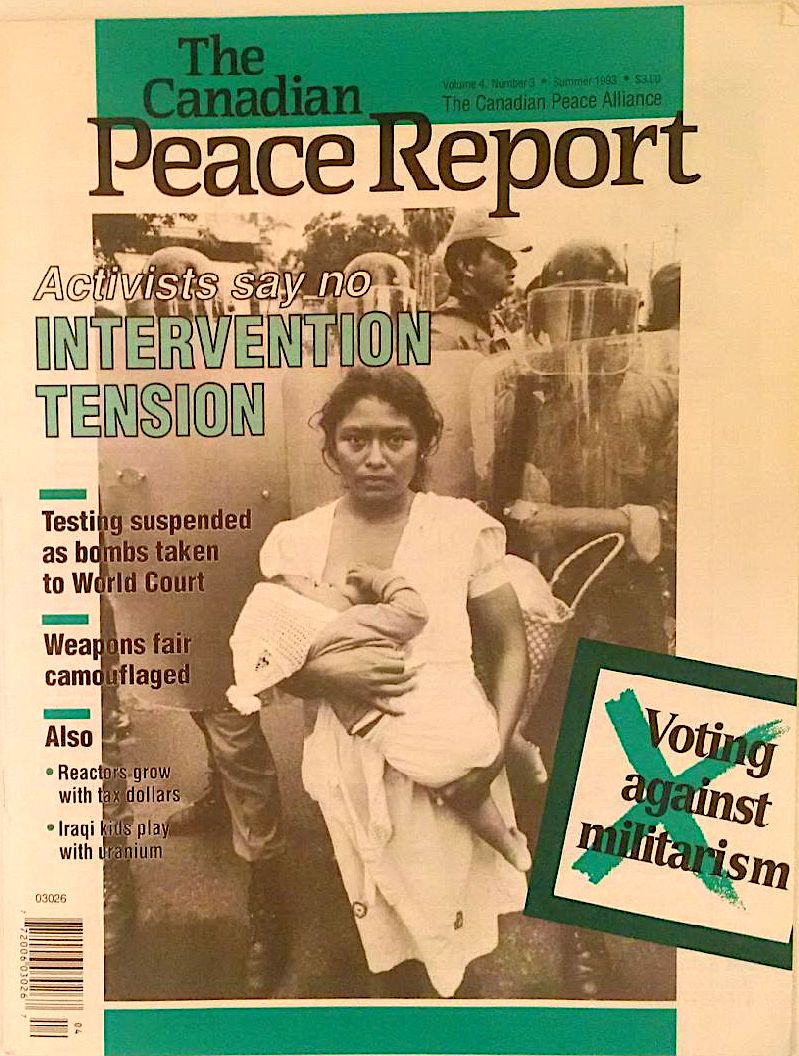
When a federal election is called, peace groups across Canada plan to be heard. They see the defence department’s $11.3-billion yearly budget – amidst cuts to social programs and calls for even more restraint – as ripe for a hot election battle over government priorities.
A recent Gallup poll conducted for the Canadian Peace Alliance found broad support across all political allegiances for cutbacks to military spending. The CPA also wants daily life demilitarized, with duties like search and rescue turned over to civilian agencies.
Local groups are mostly awaiting a date for the election, expected about late October, but national groups are already planning. Some groups will fight the Conservative Party’s backing of the North American Free Trade Agreement (NAFTA), which they fear will lead to further military integration of Canada and the United States.
The Peace Alliance is working on action and information kits targetting military spending versus social needs, and is developing an election logo. It’s also building up to a national action day.
The idea is to stimulate local and regional activity, coordinator Gideon Forman says. “Kits will help member groups organize actions during the election campaign. They will have information on, among other things, the plan to buy deluxe helicopters, military spending in general and the cost of social needs.
“We will give local groups suggestions for local events and assist with media work.”
Project Ploughshares has produced a short booklet of questions to ask candidates, “but not a repeat of the Election Priorities Project” of the 1988 election, says researcher Bill Robinson. The booklet suggests calling for cuts in military spending, cancelling the EH-101, limiting Canada’s participation in military operations, and abolishing nuclear weapons.
Also nationally, the Action Canada Network (to which the Peace Alliance belongs) met with groups from across the country in Winnipeg in mid-June to finalize election plans, which may include a radio ad campaign. National chair Tony Clarke would like local activists to dog the party leaders across the country, as progressive groups did to Ontario’s Liberals during the province’s 1990 election.
“We will definitely make the link between a range of issues and the (Canada-U.S.) Free Trade Agreement and NAFTA, which we have to get rid of,” says Clarke. “We will be working very hard on jobs and arguing for a job strategy.”
Responding to the Gulf War two years ago (Action Canada Dossier #30), Clarke warned that Canada is “tied in closer than we have ever been before to the permanent war economy” of the U.S.. With a quarter of its output related to the military, the U.S. used militaristic diplomacy to justify maintaining defence budgets, he says. The trade agreements’ guarantees of U.S. access to Canadian energy resources confirm that “we are locking ourselves into what can only be described as Fortress North America.”
Maude Barlow of the Council of Canadians, a network ally, denounced the helicopter purchase during the Peace Alliance’s March 8 lobby of Parliament. Soon after, then defence minister Kim Campbell appeared to waver on the number of helicopters to be bought, but succeeded in winning the Tory leadership without it becoming a major issue. However, Liberal leader Jean Chretien promises to cancel the contract.
At CUSO’s national office, Marc Allain says the development agency will work with the CPA around military spending and the ‘copter purchase.
To Peter Davison of the Halifax Peace Action Network, the stakes are clear and the passion to fight the issues simply awaits a polling date.
“Never has the guns-or-butter issue been more prominent in our society,” says Davison. “Conservative economic policies have been collapsing around the globe. We’re seeing desperate restraint and universal trusts being violated – health care, education, pensions.
“It’s bizarre that we can still conceptualize $6 billion for helicopters to fight submarines – an absurd twist away from meeting human needs.”
Terry Gardner says Science for Peace’s mandate bars entering the election fray, but says the group is planning a high-level panel in the fall on NAFTA and militarization of Canadian culture.
“We’re going to be asking candidates in our area for conversion and reduction in military spending,” says J.J. Verigin of the Doukhobour peace and disarmament committe in British Columbia. He says his MP has been supportive of chopping the choppers.
Verigin found fact sheets helpful and says the CPA does a good job of getting out beyond the urban areas. But he would like the Alliance “to propose something that engages the electorate’s intellect as the gut.”
“We have a general intent to intervene in the election, but we’re not quite clear exactly how,” says North Bay Peace Alliance organizer Brennain Lloyd. “We’re considering a regional information package, something like the Election Priorities Project, that our groups could use.”
Being armed with the facts helps reach the public and pins down candidates, Lloyd says. She applauds the CPA’s idea of producing action kits that her group could integrate into its own.
Toronto’s ACT for Disarmament won’t be working specifically on the election, but may participate in actions, says organizer Maggie Helwig. “Groups have certain things they focus on, and certain ways of operating. Other people do better at elections.”
In Montreal, Judith Berlyn of Westmount Initiative for Peace says, “We will be doing locally what has been developed by the Canadian Peace Alliance as a whole – go to all-candidates meetings, get the mike and ask the questions. We will be raising issues. Last time our candidate had never heard of low-level flying.”
Berlyn feels many people, including activists, often think they don’t know enough to speak publicly. But with information kits, “we know more than the candidates do.”
While approving the CPA’s focus on military spending, Berlyn says it would be a mistake to over-emphasize the helicopters. “Everybody has [already] picked up on that; it’s a good concrete example of insane military spending.”
She also finds the public receptive to informative and succinct pamphlets advocating alternatives to a militarized economy. A Coalition to Oppose the Arms Trade pamphlet is a good model, she says.
“It has four concrete proposals of what the government can do to convert military industries – money that now goes to subsidizing the manufacturing of weapons can be turned into conversion subsidies.”










 David South Consulting
You must be logged in to post a comment.