Categories
Archive USAID

US-Mongol Construct 2000 Business Prospectus: Building A New Democracy | 2000

Researcher and Writer: David South

Consultancy: David South Consulting

Publisher and Client: USAID

Published: 2000

Results Review and FY 2002 Resources Request (USAID/Mongolia March 17, 2000): Improving Productivity and Exports: A key to Mongolia’s growth is increasing non-traditional exports. However, with less than ten years of free-market experience, Mongolia has little experience on how to accomplish this objective. In response, USAID began a six-month program in January2000 to: 1) instruct Mongolians on the principles of competitive analysis; 2) establish benchmark data that will help Mongolians to rank their country against others vis-a-vis key competitiveness indicators; 3) create Mongolian-specific case studies to illustrate successful competitive behavior or pinpoint obstacles and constraints; 4) work with business leaders from garment, cashmere, meat, information technology and tourism industries to apply competitiveness tools and focus attention on key priorities for government and private sector action. Over six hundred influential Mongolians from government, private sector and academia are participating in the process. USAID hopes to assist in developing a national action plan for competitiveness in the fall, once a new government is in place.

The Global Bureau’s Global Technology Network (GTN) which develops business linkages between U.S. and Mongolian firms has been active for two years. GTN efforts have fallen short of expectations with only three relatively modest linkages established in 1999. In January 2000, through its relationship with the International Executive Service Corps (IESC), GTN sponsored Mongol Construct 2000, a trade mission to the United States for construction firms. The purpose of the mission was to learn about advanced construction techniques and develop linkages with U.S. firms. In 2000 IESC will expand its assistance to a select group of garment manufacturers, who are attempting to establish non-traditional markets.

Background: This excerpted text is from a business prospectus prepared in 1999 for USAID to promote construction opportunities in Mongolia to the US construction industry. At the time, Mongolia was in the grip of a severe crisis, called one of “the biggest peacetime economic collapses ever”. By 2012, Mongolia was called the “fastest growing economy in the world”. It is proof the foundations for Mongolia’s recovery from crisis were laid in the late 1990s.

“No other Asian country enjoys more political freedom today than Mongolia. And no other Asian country has shown greater commitment to open markets. But Mongolia has received little reward for its efforts.” Fortune Magazine, December 1998

Discover a New Democracy

Mongolians are some of the highest per capita donor recipients in the world: On average US $50 per person. The vast majority of this aid is targeted at infrastructure projects. Mongolia in 2000 is an opportunity waiting for American business. Democratic, with a free market economy, the country offers regulatory freedom, a belief in the private sector setting standards and a pro-Western attitude friendly to American companies. 

Mongolia’s history is marked by the rise and fall of cities, the ebb and flow of political and economic systems. The country has experienced being the largest empire for its time in the 13th century, to being occupied by foreign powers. Economically and socially the country has lived through feudalism, communism and now, capitalism. The one thing that has remained stable throughout this rich history has been the nomadic way of life. Livestock remains to this day a major pillar of the economy and contributes to one of the country’s major foreign currency earners, cashmere wool. 

After over 70 years of communist rule, Mongolians finally turned their backs on communism and robustly embraced free markets and democracy in 1996 with the election of the Democratic Coalition. A gradual opening up of the country had begun under the ruling Mongolian People’s Revolutionary Party after the collapse of the Soviet Union and under pressure from peaceful public demonstrations.  

After the fall of the Soviet Union, the country suffered what many economists have called the largest peacetime economic collapse in the 20th century. 

While it is a fact that Mongolia’s economy is severely underdeveloped, both in terms of infrastructure and diversity, it is also true the country is the freest in Asia. As Fortune Magazine noted in a December, 1998 issue, “No other Asian country enjoys more political freedom today than Mongolia. And no other Asian country has shown greater commitment to open markets. But Mongolia has received little reward for its efforts.” Mongolia, for American business, offers a win-win situation, an opportunity to join in the building of a strong democracy in Asia while tapping the rich resources, both natural and in human capital. American businesses can enjoy a regulatory environment that is more flexible than in the United States, and a government that lets businesses do what they do best: serve the needs of customers and make money. 

Youthful

A Bright Young Future

Demographically, Mongolia is a very young country. A by-product of high birth rate policies during the communist period, 60 per cent of Mongolia’s population are aged between 1 and 24, with 37.6 per cent between the locally accepted definition of youth of 15 to 34. In 1998 the New York Times Magazine called Mongolia “The youngest place on earth”. Even a cursory glance at the streets of the capital, Ulaanbaatar (population 600,000), will reveal a young population taking their fashion and cultural cues from the West, and who hold correspondingly Western aspirations to own homes and start businesses. Mongolia enjoys exceptionally high rates of literacy ( 96 per cent), post-secondary enrolment (65,089 students in 1998) and the urban population quickly embraced Western consumer products as they became available. 

Growing

The Construction and Environmental Services Industry in Mongolia

Today, Mongolia officially has 100 architectural and engineering design companies and over 500 construction companies. Of these, 40 are considered large operations with their own in-house design and engineering outfits, or who have a close relationship with one or more companies that either manufacture or import construction materials. The country is a rich resource for raw materials for the construction industry, but this vast wealth remains under-utilised. According to geological surveys spanning the decades from 1930 to the 1990s, over 200 deposits were discovered that could be tapped for construction materials. 

At the beginning of the 20th Century, there were few permanent standing structures in Mongolia, apart from Buddhist monasteries and royal palaces. At the beginning of the 20th Century most Mongolians lived in the round ger felt tent. It wasn’t until the communist revolution that construction of sedentary dwellings and buildings in the country picked up pace. In 1924, three years after the 1921 revolution, the State Committee for Construction was established (by 1926 it became the Construction Department of the Ministry of Industry), and undertook the large-scale construction of buildings based on European designs. 

From the 1960s the construction industry in Mongolia emerged as the country industrialised. Mongolia received aid from both China and Russia up to the Sino-Soviet dispute, and both countries were the main funders for construction projects. Many buildings in the downtown of the capital were built by the Chinese government.

Up until the election of the Democratic Coalition in 1996, all construction activities were conducted under the direction of the state. Building booms took place in the 1970s and 1980s as the communist government tried to meet the demand for apartments and other facilities. At its peak in 1989, the construction sector made up 10 per cent of the gross national product. With the collapse of the Soviet Union at the end of the 1980s, many building projects in Mongolia ground to a halt as Soviet subsidies were withdrawn.  Across the country it is possible to see the empty shells of apartment buildings, holiday resorts and half-built sports stadiums.

The Mongolian People’s Revolutionary Party, under popular pressure for a change, began to gradually make the shift to free markets and democracy. The first state privatization programme began in 1993 under the direction of international experts. It wasn’t until the election of the Democratic Coalition in 1996 that significant reforms were taken to fully introduce a free market economy. And it wasn’t until 1997 and 1998 that the fruits of these measures started to appear.

The construction industry was fully privatised in 1998, with companies becoming limited or wholly owned entities. There now exists a mix of private and public companies in this sector. All of the companies are in the early stages of learning how to work and prosper in the free market.

The legacy of working under a command economy has left many companies ill-equipped and under-funded, many not operating at full capacity or not at all.

The private sector has shown itself to be capable of initiating real estate development projects, most commonly the building of private apartments, shopping complexes and small hotels.

Weaknesses in management and financing do lead to long delays, poor quality and in some cases, the abandonment of a construction project mid-way.  According to the State Statistical Office, the construction sector shrank from 1991 to 1994. In 1994, activity increased 26 per cent from 1993. Since then the gross national product has averaged growth of 3.3 per cent, but still has not caught up with the rate at the end of the 1980s. 

The environmental services sector has received a significant boost from international donors working in Mongolia. Various donor funded projects are building and renovating facilities using energy-efficient technology. These donors have also conducted training workshops and education campaigns for local construction companies. Being a very cold country, awareness is high over the financial and environmental benefits of energy-efficient techniques. Construction techniques, however, are weak and Mongolia has a long way to go in utilizing these technologies efficiently.  

It is a misnomer to think most Mongolians are wandering nomads. In fact the majority of the population of 2.4 million now live a sedentary lifestyle in small towns or in the big cities of Ulaanbaatar, Erdenet and Darkhan. Under communism these urban centres were economically dependent on state enterprises, many of  which now have either gone bankrupt, idle or have been privatized. There is currently a significant migration to the capital from these economically devastated communities. Officially the government was able to track 6,518 people, mostly between the ages of 18 and 39, moving to the capital in the first half of 1998 – a 60 per cent increase on 1997. Unofficial migration to the capital is believed to be far higher. 

At present a majority of the population still live in ger tents or sub-standard makeshift wooden housing. The construction industry cannot meet the high demand for modern housing, with amenities like running water, toilets and electricity.

“The business atmosphere in Mongolia is inviting and [our] partnership has faced very few obstacles while entering the market. Based on our positive experience here, we plan to continue and expand our presence in the Mongolian marketplace.” Mrs. Bolormaa Reiner, Representative Johnson and Johnson-Mongolia

Foreign Aid

Economic Prospects for the Country

Large donor community

Along with the collapse of the Soviet Union, Mongolia also lost significant economic subsidies, which contributed to the severe crisis of the early 1990s. The World Bank has estimated these subsidies reached a third of Mongolia’s GDP in the late 1980s. Since then international donors have played a key role in helping to restructure the Mongolian economy to adapt to the demands of a market economy.  

Infrastructure has always been a weak point for Mongolia, and it was considered the most isolated and underdeveloped of the former Soviet bloc countries. International donors have placed infrastructure development at the top of their agendas. Since 1997 foreign aid in the form of grants and loans has hovered around US $250 million, with the vast majority of this aid going towards infrastructure development. Priority areas are highways and transportation, power stations and communications. By sector the aid breaks down as follows: 30 per cent to mining, 27 per cent to energy, 19 per cent to transport, eight per cent to communications, five per cent to social security and three per cent to other areas. The donor community and the Mongolian government want to dig the country out of decades of underdevelopment, which currently hampers the budding private sector from becoming more sophisticated. 

These large-scale infrastructure projects offer enormous opportunities for US firms experienced in working in cold-weather conditions. There are also opportunities to develop world class office space for these international donors, something that is currently lacking in Ulaanbaatar.  

Foreign investment to date

Actual large-scale foreign investment to the country has been slow coming and still doesn’t represent a major economic opportunity. The major players in direct foreign investment outside of development aid have been Mongolia’s old neighbours, Russia (20 per cent) and China (33 per cent). This decade the country has attracted US $200 million in foreign investment and registered 840 jointly owned or wholly owned ventures.

New-found affluence

It is estimated that around five per cent of the capital’s population fit into a middle or upper income category. The late 1990s have seen the emergence of a new breed of affluent Mongolians. Many of these affluent Mongolians struck it rich trading in once-unobtainable consumer products or servicing the expanding foreign community. This class of traders have developed a sophisticated taste for all things Western – Mercedes Benz cars, four-by-four jeeps and western fashions. Vehicle registrations have steadily risen since the introduction of a market economy. In 1996 the number of vehicles was 65,020; by 1997 it was 70,088. 

New home owners

In 1998 50,000 families became homeowners as a result of privatization of apartments. All the apartments are of Soviet era and do not meet the aspirations of the growing middle class. Many of these new homeowners immediately set about renovating these apartments, installing modern appliances and furniture. A significant minority is renovating apartments with the intention of selling them on to wealthier Mongolians or foreigners. The high number of renovations and additions to buildings in the capital is also indicative of other things: the economy has changed and existing buildings do not meet the new demands, and that people have money to pay for the renovations. 

Business Opportunities

USAID has identified the following opportunities in the Mongolian construction sector:

– Donor-funded projects: Large-scale infrastructure projects that are funded by loans or grants from international donors, are a safe bet. These projects require management and technical expertise that is often difficult to find locally. This includes projects that require an international tender.  

– Fully funded foreign projects: Any project requiring a building that meets international standards. International companies have little choice when it comes to finding adequate office or retail space.

– Low-cost labor: The Mongolian workforce is highly literate and often speak a second language, usually Russian amongst older workers, and English amongst the young. Unemployment levels are high in Mongolia and workers are keen to get a job. Generally salaries are as follows:

– Manager: US $250

– Accountant: US $200

– Engineer: US $150

– Secretary: US 100

– Driver: US $100

– Qualified worker: US $100

Source: FIFTA

– Donors: Many large-scale projects are directly funded by donor grants or loans and therefore are a low-risk, reliable source of income. At the June, 1999 donors meeting in Ulaanbaatar, US $320 million was pledged, the largest amount in eight years of donor funding. Most of these pledges are targeted at “hard” infrastructure and private sector development. 

– Imports rule: Imported construction materials dominate the marketplace and will continue to do so for the foreseeable future. Many of the materials are poor quality and from China. American companies can attract customers with their obvious advantages in both quality and innovation.

– Large resource base: Mongolia’s large wealth of mineral resources is inefficiently utilized, with many mines and factories working under capacity or not at all. These resources could be tapped to produce construction materials locally for the domestic market, or more lucratively, for the booming Chinese market hungry for resources. 

– Very cold country: Mongolia’s capital, Ulaanbaatar, is the coldest capital in the world. Mongolia’s winters dip below minus 40 Celsius, and for those who live in apartment buildings, this can be a difficult time. Many apartments are inadequately insulated, and dip below zero when the central heating system is disrupted due to poor maintenance. There is an urgent need for high-quality aluminium and plastic windows and doors. Budgets are tight in Mongolia yet many organizations spend vast sums to heat buildings. It has been proven that during the course of the winter heating costs can be reduced from Tg 4,200 (US $4.20) per square metre, to Tg 280 (US $0.28) in an energy efficient dwelling. 

–  Windows are expensive: Mongolia must import all windows and glass products. When the cost of freight is added, windows become an unnecessarily expensive portion of any construction bill. This is a business opportunity for any company who can domestically produce glass products and windows at a cheaper price than imports. A National Code for Insulation of Buildings is being revised and none of the existing windows and doors meet this requirement.

– No chemical industry: While Mongolia exports oil to China for refining, the country does not have a domestic chemical industry, and consequently plastic and rubber is imported for construction purposes. Stone tiles like marble are currently also imported from outside, despite this resource being available in Mongolia.  

– Central heating and water unreliable:  For those who live in apartment buildings, the regular disruptions to both the water and heating supply are not only inconvenient, but also bad for business.  Technology that can by-pass relying on the central system (common to many Soviet-era cities, this system is wasteful and subject to regular breakdowns), is urgently needed. Alternative energy sources like solar power and wind can bring electricity to those who are not on the grid.  

 Free trade zones: The towns of Sukhbaatar (Russian border) and Zamyn-Uud (Chinese border), both served by rail, are the focus of Mongolian government attempts at increasing cross-border trade. At Zamyn-Uud Japan has upgraded the customs house facilities and trans-shipment facility. On the Chinese side, a major trading market has been constructed and a boom is taking place based on trade with Mongolia.  

“Arthur Andersen has had representation in Mongolia since 1993. We have been very active in the development of the accounting and auditing profession in Mongolia. January 1999, Arthur Andersen opened Arthur Andersen Mongolia Audit LLC.” Mr. C. L. Ruddell, Representative Arthur Andersen-Mongolia

What Do Mongolians Say They Need?

In interviews conducted by USAID, Mongolian government officials and construction companies detailed what they felt were the most urgent priorities: 

– Education and training: The vast majority of engineers and managers in the Mongolian construction industry received their training under communism. They were trained to work under a centrally planned economy, and will need to learn how to thrive in a free market situation where there are no guarantees. The Construction Training Institute currently only offers courses to managers and engineers. Its curricula is out-of-date and awareness of modern construction techniques and standards is weak. Exposure to computer-assisted construction methods is urgently required as well as training in foreign languages. 

– Awareness of International Standards: No Mongolian companies can offer state-of-the-art consulting on construction projects. 

– Licensure, apprenticeships and guilds: Standards are very weak in the construction sector and there is not a highly developed mechanism to ensure construction managers, engineers and workers meet a minimum qualification.     

– Being Earthquake-proof: While the National Design Codes and Regulations do stipulate that buildings must meet minimum requirements against earthquakes (Mongolia is located in a seismically active region, and severe earthquakes have happened), most buildings post-1989 fail to meet these requirements. 

– Weak infrastructure: Developing the transportation infrastructure of Mongolia will be key to future improvements in the economy. The rapidly developing Chinese economy offers many opportunities to Mongolia if roads and highways can be upgraded.  

– Better coordination and promotion: Working with FIFTA or the Foreign Investment and Foreign Trade Agency, Mongolian companies seeking foreign investment for projects need to improve their networking and presentation skills.  

Obstacles and Market Risks

Corruption: While Mongolians will tell you corruption has reached all levels of government, it is important to keep in mind it does not come close to the levels of corruption found in other former Communist countries. Foreign businesses do not suffer from harassment or intimidation by criminal gangs. 

Inexperience with the free market: Foreign businesses and travellers to Mongolia do experience difficulties communicating Western business concepts like consumer rights and service. It has to be said that over the past three years this has changed considerably for the better, and continues to improve as Mongolian businesses learn the importance of the axiom “the customer is always right”. 

Differences between Mongolian and US standards: While Mongolia’s regulations and laws are different from those in the US, it is important to keep in mind that the regulatory environment in Mongolia can be much freer in some areas. Also, many of the new laws have been drafted based on US laws and Mongolia’s constitution was written upon the advice of US legal experts. 

Harsh climate: The long cold winters do present problems for some foreign businesses not used to working in cold-weather climates. This is also an area where American companies are at a specific advantage. 

Financial instability: Mongolia has had a number of serious banking crises since the early 1990s. Many private and public banks are insolvent due to bad loans. This can lead to long delays to construction projects and/or non-payment of salaries.   

Contract bidding: Only those contracts that are directly commissioned by the government will be subject to an open bidding. Private sector work is usually not subject to open bidding or design competitions. 

Downtime: Since Mongolia does no international corporate presence in the capital, any technical problems to equipment or software can involve downtime and delays as parts or repairs are sought in China. It is important to take this into consideration when establishing an operation in Mongolia. 

Advantages of Working in Mongolia

– Regulatory freedom

– Private-sector driven

– Market economy taking off

– Democratic

 Privatization of Land: Can I Own Land in Mongolia?

The dual legacies of communism and nomadism have made the issue of private ownership of land in Mongolia a thorny one. The government has passed the necessary legislation to make owning land in urban areas possible. However, inexperience with the concept of owning property and the laws that govern this make buying land risky. It is advisable to get a reliable local partner and to use the services of a law firm that knows the Mongolian situation. Long-term leases are available and might be a good option. 

Mongolian Government 

Financial commitment to date: 

The Ministry of Infrastructure Development has developed projects to encourage the production of construction materials locally. Due to financial constraints these projects have not been implemented. They include projects on cement, glass and paint production, rock processing, lime extraction and road development.

Government plans:

At this time the Mongolian government has not been able to develop a long-term strategy for the development of the construction sector. There are no specific policy incentives directly supporting real estate and housing development. The Ministry of Infrastructure is looking to the private sector to offer direction and guidance. 

Future Opportunities

The Tumen River Project: The eastern portion of Mongolia is included in a major trade zone development project initiated by the United Nations Development Programme. The Tumen River Area Development Programme (TRADP) is focusing foreign investment and infrastructure upgrading on eastern Mongolian, North-East China, the Democratic People’s Republic of Korea and eastern Russia. This region has cumulatively attracted US $961 million from 1991 to 1997, with Mongolia’s second biggest trading partner, China, making significant development gains.  While the Democratic People’s Republic of Korea has been a thorn in the Project’s side, both Mongolia and China are keen to push ahead with improving infrastructure and trade links. It is impossible to ignore the fact that China has made significant gains and that trade links with Mongolia continue to tighten. 

A feasibility study is currently underway on a railway link from Arxan, China to Choibalsan, Mongolia, and possibly on to Ulaanbaatar. As donors begin to fund these projects it would be prudent for American businesses to start building a relationship in the region to take advantage of future contracts. 

Commercial Street 2005: The City of Ulaanbaatar, Mongolia’s capital and commercial centre, has drafted the blue prints for the construction of a modern commercial and business centre for the next millennium. Commercial Street 2005 will offer infrastructure and services that match global standards. The current Soviet-era infrastructure of Ulaanbaatar is an impediment to future growth and is unsuitable for Mongolia’s new market economy. 

The project covers 20 hectares of 1 km length in a historically vibrant part of the city. The city will pay for the engineering and infrastructure works for the complex and local businesses will pay for the construction of secondary buildings. Commercial Street 2005 is looking for foreign investment to participate in the building of a food supermarket, trade and service complex, a twin-towered international trade and service complex, a banking centre, a business centre and renovations to nearby apartment buildings. It is estimated the project will create 10,000 jobs and would cost an estimated US $100 million. 

Darkhan: With a population around 55,000, Darkhan is as-yet an untapped opportunity. Located north of  Ulaanbaatar and close to the border with Russia, Darkhan is linked by a good road and rail. Along with the mining town of Erdenet, Darkhan has a modern infrastructure. Having been trained to work in the former state industries that once dominated the city, the population is well-educated and skilled. Today, coal mining and agriculture are key to the economy. The city is potentially a good stable base for accessing the Russian market.

Getting started

Registering prior to undertaking construction work is relatively simple. The Government Agency for Construction issues three degrees of licenses. The first license is for small projects, the second is for small to medium-sized projects, and the third is for large-scale projects anywhere in Mongolia. As the project develops the company is obligated to notify and allow local building inspectors to enter the site. 

Residency Permits

All foreigners wishing to remain in Mongolia for more than 30 days must apply to the State Centre for Civil Registration and Information for a temporary residency permit or a short-term residency permit. 

Temporary Residency Permit

The applicant must present to the State Centre for Civil Registration a request issued by FIFTA. FIFTA will issue such a request to any agreed foreign investor immediately. Permits are generally issued within a couple of days and are valid for a period of time from three months to one year. A temporary residency permit can be renewed an unlimited number of times. Each renewal will re-validate the permit for a period from three months up to one year, as requested by the investor. 

Short Term Residency Permit

This non-renewable permit is issued to foreigners who plan to spend no more than 90 days in Mongolia. Applicants are required to present a written request from a Mongolian or foreign organization stating the activity in which the person will be engaged and the reason the permit is needed. In case of an exploratory visit by a potential investor, a letter from the home company will suffice. 

Entry Visas

Investors may apply for single-entry and multiple-entry visas at the Foreign Ministry’s Chancellery Building in Ulaanbaatar or at Mongolian diplomatic missions in other countries. 

Single-Entry Visas

A single-entry visa is valid for three months from its date of issuance and entitles the bearer to enter and stay in Mongolia for 30 days. A letter of invitation or applicable work papers are required. This type of visa is issued at the Ulaanbaatar airport or land border-crossing point. 

Multiple-Entry Visa

A multiple-entry visa entitles the bearer to enter and exit Mongolia an unlimited number of times and is valid for a period of six months to one year. For the issuance of this type of visa, an official letter stating the reason for travel and a copy of the certificate of the organization must be submitted by the investor. 

(Source: FIFTA)

Infrastructure facts

Airports – Mongolia has 81 airports, of which 31 can be used year-round. Only eight are paved. 

Roads and highways – Mongolia has 1,531.7 km paved roads.

Railway – Mongolia has 1,750 km of rail track, mostly a north-south line reaching from Russia to China, with spur lines to the copper mining city of Erdenet and the coal mining city of Baganuur. A short line goes from the eastern city of Choibalsan to Russia. 

Registered trucks – 25,473 (1998)

Major infrastructure projects (1997-1999)

USA 

Mongolia energy sector project – US $45,500,000

World Bank

Mongolia coal project – US $35,000,000

Transport rehabilitation project – US $32,313,000 

Asian Development Bank

Telecommunications – US $24,381,000

Power station rehabilitation – US $38,277,000

Ulaanbaatar heat efficiency project – US $29,487,000

Provincial towns basic urban services project – US $7,695,000

Road development – US $22,499,000

Ulaanbaatar airport project – US $37,524,000

Japan

Road construction (1996)  – (Yen) 11,590,000

Rehabilitation of power plant IV (1995) – US $46,000,000

France 

Rehabilitation and extension of UB telephone network – (F Franc) 25,000,000

Germany

Telecommunications – (DM) 10,000,000

South Korea

Thermoelectric power plant in the Gobi desert – US $8,000,000

Upcoming major infrastructure projects

Asian Development Bank 

Improving Ulaanbaatar heat efficiency (until 2002) – US $39,785,000 

Japan

Building of rural schools – US $20,000,000

In 1998 Tg, 208 billion was invested in Mongolia, of which Tg 57.2 billion was on construction/major improvements

Source: State Statistical Bulletin

Construction trends in Mongolia show that in-country production of materials has suffered greatly. 

Building doors and window

Tg 417.8 million in 1989

Tg 2.9 million in 1998 

Bricks (million pieces)

172.8 (1989)

18.9 (1998) 

Cement (in thousand tons)

512.6 (1989)

109 (1998)

On a positive note, sales of furniture went up

Tg 34.7 million in 1989

Tg 185.2 million in 1998
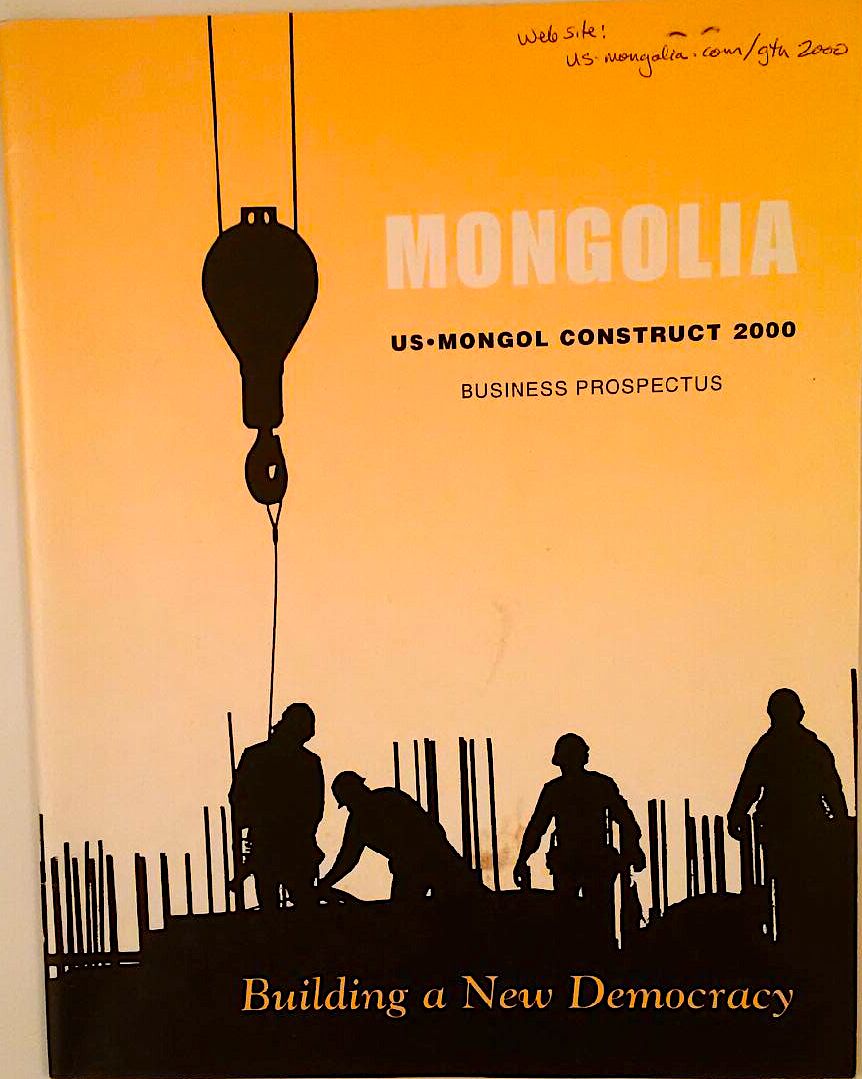
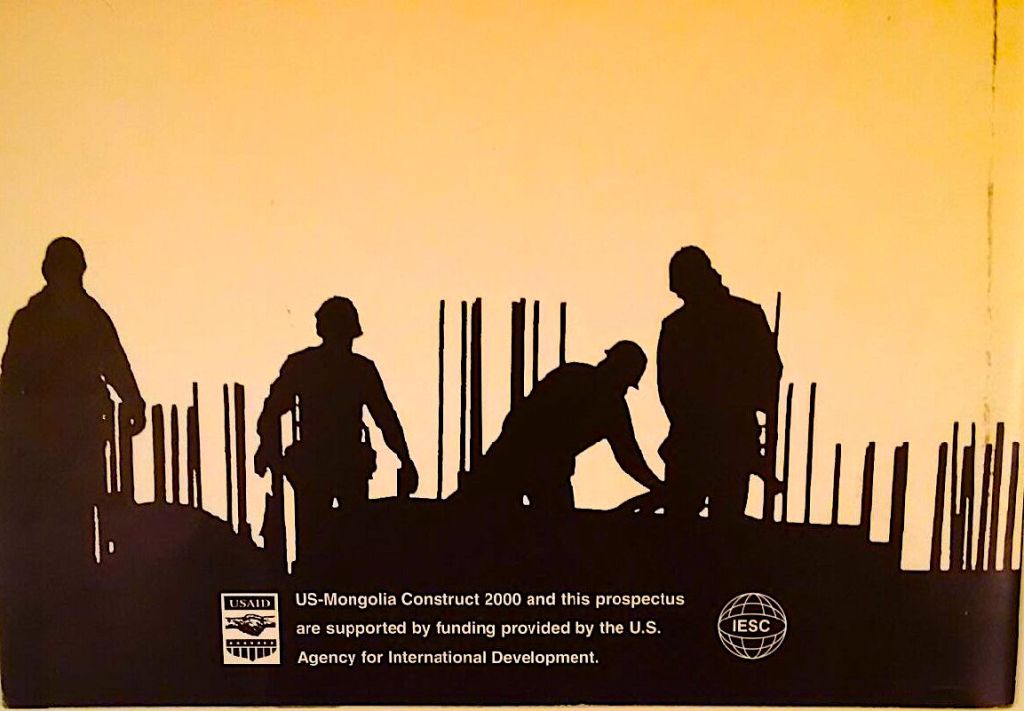
US-Mongol Construct 2000: Building a New Democracy was published by USAID. It helped lay the foundations for a construction boom in the mid-2000s.

Media Coverage:

Construction Business Review: Creating Overseas Market Opportunities for U.S. Companies

“Support for incoming and outgoing trade missions are among the business outreach and support services offered by the U.S. Agency for International Development’s (USAID) Global Technology Network (GTN) program. USAID, in turn, draws heavily on expertise from the International executive Service Corps (IESC) in organizing and implementing these trade missions.

In January 2000, a USAID supported, IESC-assisted, incoming trade mission from Mongolia was instrumental in introducing Mongolian businesses to the American construction industry. Dubbed “U.S.-Mongolian Construct 2000,” the “reverse” trade mission brought representatives from 15 Mongolian construction firms to meet one-on-one with American companies in Dallas, Seattle and Anchorage and Fairbanks, Alaska. The Mongolian trade mission began in Dallas, where the group attended the National Association of Home Builders’ Show (NAHB) – the largest event of its kind in the country. Next, they traveled to Seattle for the Evergreen Gateway Building Products program. In Alaska, the group learned how U.S. construction companies handle building on permafrost and deal with extreme cold weather conditions. According to the U.S. Ambassador to Mongolia, Alphonse F. LaPorta, ‘Mongolia is at the center of a region undergoing substantial infrastructure upgrading, as the market economy takes hold.'”

Update:

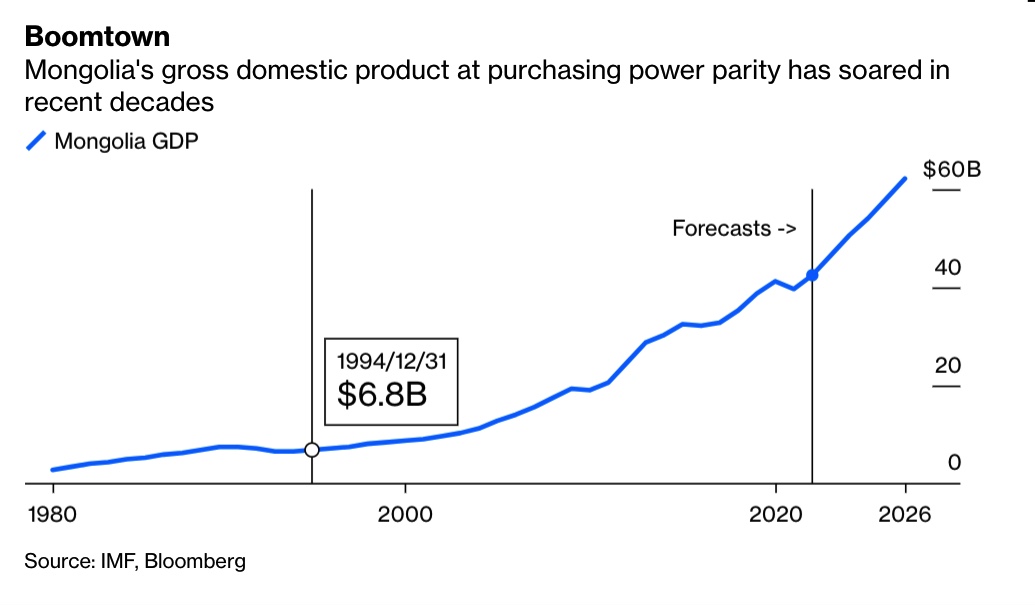
A resources “boomtown” throughout the 2000s. Source: Bloomberg. When I left in 1999, Mongolia’s PPP was US $8.8 bn; today (2021) it is US $42.4 bn.
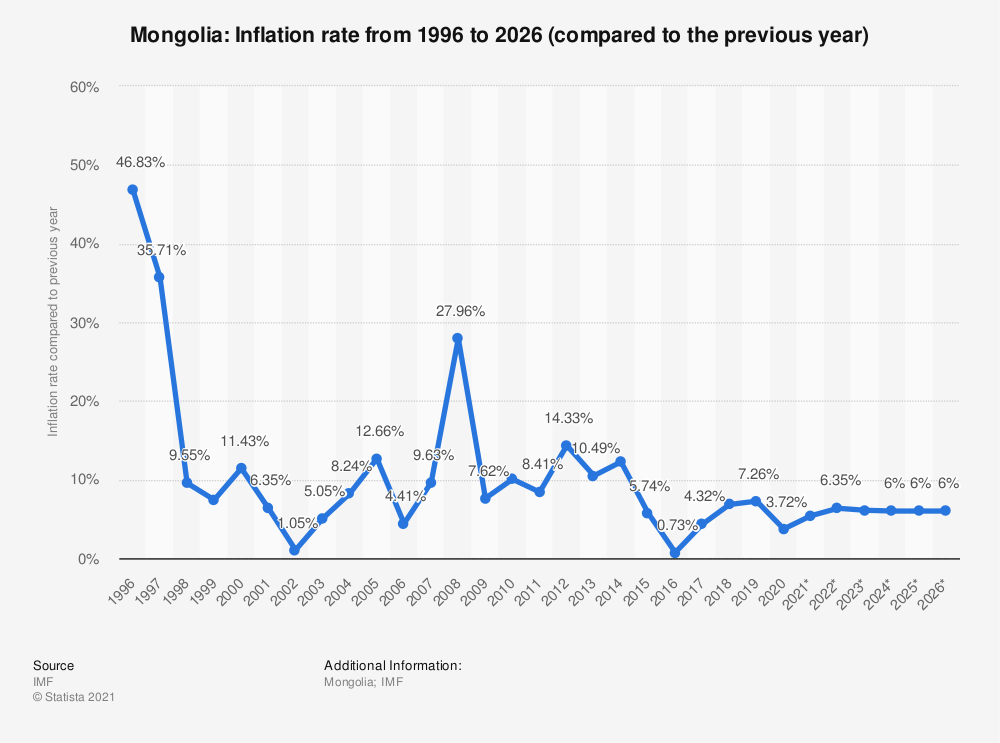
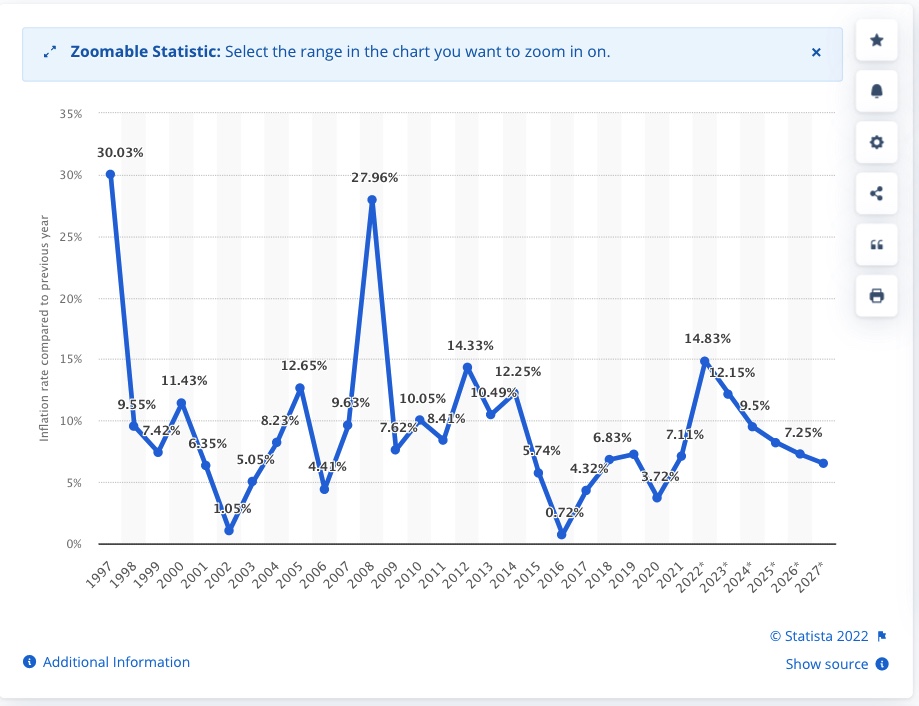
A dramatic decline in inflation paired with political and economic stabilisation allowed Mongolia to enjoy the fruits of the fast-growing economies of the 2000s. Source: Statista.
It doesn’t hurt when your neighbour (China) is experiencing an economic boom as it drives down poverty rates.

https://davidsouthconsulting.org/2021/09/16/case-study-6-international-consulting-1999-2014/

https://davidsouthconsulting.org/2022/02/01/citing-wild-east-the-new-mongolia/

https://davidsouthconsulting.org/2023/02/03/environmental-public-awareness-handbook-case-studies-and-lessons-learned-in-mongolia/

https://davidsouthconsulting.org/2022/05/16/high-impact-communications-in-a-major-crisis-undp-mongolia-1997-1999-18-february-2016/

https://davidsouthconsulting.org/2022/04/04/human-development-report-mongolia-1997/

https://davidsouthconsulting.org/2023/01/09/mongolia-update-1998/

https://davidsouthconsulting.org/2023/02/07/mongolian-rock-and-pop-book-mongolia-sings-its-own-song/

https://davidsouthconsulting.org/2022/11/23/papers/

https://davidsouthconsulting.org/2021/05/14/un-ukraine-web-development-experience-2000/

https://davidsouthconsulting.org/2021/11/16/undp-in-mongolia-the-guide-1997-1999/

https://davidsouthconsulting.org/2020/11/05/wild-east-17-years-later-2000-2017/

“I highly recommend Mr. David South as a communications consultant who gets results.” Brian DaRin, Representative/Director, USAID Investment & Business Development Project, Global Technology Network/ International Executive Service Corps-Mongolia, 23 September 1999

Creative Commons License

This work is licensed under a
Creative Commons Attribution-Noncommercial-No Derivative Works 3.0 License.

ORCID iD: https://orcid.org/0000-0001-5311-1052.

© David South Consulting 2023  

Categories
Archive Blogroll UNDP Mongolia 1997-1999

CASE STUDY 4: UN + UNDP Mongolia | 1997 – 1999

Expertise: Crisis leadership, mission leadership, strategy, communications, web strategy, digital media, crisis recovery, public health, Northeast Asia, UN system.  

Location: Ulaanbaatar, Mongolia 1997 to 1999

UN/UNDP Mongolia Communications Coordinator: David South

Abstract

“The transformation of Mongolia from a largely rural nomadic society of herdsmen to a community dominated by the increasingly ultra-globalized city of Ulan Bator, where almost a third of the population lives, is nothing short of astounding. The New Mongolia: From Gold Rush to Climate Change, Association for Asian Studies, Volume 18:3 (Winter 2013): Central Asia

From 1997 to 1999, I served as the Communications Coordinator (head of communications) for the United Nations (UN)/United Nations Development Programme (UNDP) mission in Mongolia, founding and directing its UNDP Mongolia Communications Office. 

About

The question posed itself from the start of the assignment: In the middle of a major crisis, is it possible to recover quickly while simultaneously growing and modernizing the United Nations mission (this was the dawn of the digital revolution)? It was only possible by teaching and mentoring colleagues, offering leadership, vision, strategy, and practical actions to get there – all with a budget and mandate for two years.

The mission had to tackle in particular, three, severe crises: the country’s turbulent transition from Communism to free markets and democracy, the social and economic crash this caused, and, later in 1997, the Asian Financial Crisis (Pomfret 2000)– all combined with the political instability this exacerbated. Richard Pomfret said in 1994, “In 1991 Mongolia suffered one of the biggest peacetime economic collapses ever (Mongolia’s Economic Reforms: Background, Content and Prospects, Richard Pomfret, University of Adelaide, 1994).” From Curbing Corruption in Asia: A Comparative Study of Six Countries by Jon S. T. Quah: “The combined effect of these three shocks was devastating as ‘Mongolia suffered the most serious peacetime economic collapse any nation has faced during this century’. Indeed, Mongolia’s economic collapse ‘was possibly the greatest of all the (peaceful) formerly'” Communist countries.

A dramatic decline in inflation paired with political and economic stabilisation allowed Mongolia to enjoy the fruits of the fast-growing economies of the 2000s. Source: Statista.

https://www.statista.com/statistics/727562/inflation-rate-in-mongolia/

https://www.statista.com/statistics/727562/inflation-rate-in-mongolia/

During the last 16 years the financial and monetary system of our country saw the worst crisis in 1991-1994, there was a recovery in 1995-1997 and another crisis in 1997-1999. However, it has entered a stable stage since 2000.

Mongolia at the Market
Dedicated to the 60th Anniversary of the School of Economic Studies
, Editors: Chuluundorzh Khashchuluun, Namsrai Batnasan, Ni︠a︡msu̇rėngiĭn Batnasan, P. Luvsandorzh, LIT Verlag, 2012.

From the World Bank: 1997: Stabilization at the heart of policy choices

A resources “boomtown” throughout the 2000s. Source: Bloomberg. When I left in 1999, Mongolia’s PPP was US $8.8 bn; today (2021) it is US $42.4 bn.
Graph from Migration under economic transition and changing climate in Mongolia, Journal of Arid Environments, Volume 185, February 2021. “Urbanization in Mongolia accounted for over 80% of all migration, mostly into the capital city Ulaanbaatar (UB), where nearly 70% of recent population growth was from migration.”
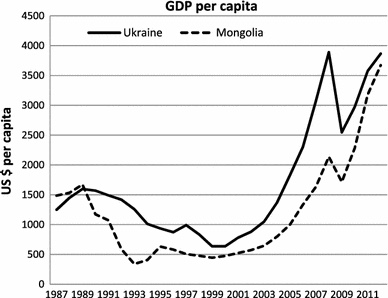
As can be seen in this chart, Mongolia’s economic growth since 2000 has benefited greatly from its proximity to China.
As this chart shows, increasing connectivity had a profound impact on living standards in Ukraine and Mongolia post-2000. The extreme turbulence Mongolia experienced in the 1990s – after the collapse of support mechanisms from the Soviet Union – calmed down as Mongolia integrated with the global economy, especially a booming China. Read about my work in Ukraine here: UN Ukraine Web Development Experience | 2000.
The Economist: “Those free-trading Mongolians” was published Apr 24th 1997. I arrived in May of 1997 to find a country on the cusp of great and turbulent change.

In this role, I pioneered innovative uses of the Internet and digital resources to communicate the UN’s work and Mongolia’s unfolding crises. The UN called this work a “role model” for the wider UN and country offices. A survey of United Nations country office websites in 2000 ranked the UN Mongolia website I launched in 1997 and oversaw for two years (1997-1999), third best in the world, saying: “A UN System site. A very nice, complete, professional site. Lots of information, easily accessible and well laid out. The information is comprehensive and up-to-date. This is a model of what a UNDP CO web site should be.” (http://www.scribd.com/doc/274319690/UNDP-Mongolia-United-Nations-2000-Survey-of-Country-Office-Websites)

“The years 1998 and 1999 have been volatile ones for Mongolia, with revolving door governments, the assassination of a minister, emerging corruption, a banking scandal, in-fighting within the ruling Democratic Coalition, frequent paralysis within the Parliament, and disputes over the Constitution. Economically, the period was unstable and rife with controversies.” Mongolia in 1998 and 1999: Past, Present, and Future at the New Millennium by Sheldon R. Severinghaus, Asian Survey, Vol. 40, No. 1, A Survey of Asia in 1999 (Jan. – Feb., 2000). pp. 130-139 (Publisher: University of California)

As part of a strategic plan to raise awareness of Mongolia’s development challenges and to spur action on meeting them, a Communications Office was established for the UN mission in 1997 – a structure that is commonplace in UN missions today. The Office also led on digital communications, marking many firsts, from the first digital photo and video library, the first online magazine, the first web portal, the first online newsletter, and many other firsts. It gathered numerous stories on resilience in a crisis, and documented in data and storytelling the country’s development challenges, while introducing a transparent way of working and communicating unprecedented for the time (the country was still recovering from the state secrecy of its years under Communism), and led on modernizing communications in the country. Acting as a strategic hub, the Communications Office and its dynamic and talented team, were able to leverage the existing budget to spur action on many fronts, including:

UN/UNDP Mongolia Development Web Portal (www.un-mongolia.mn)

I launched it in 1997 in the middle of a major crisis, and oversaw its expansion and development for two years. A pioneering digital resource, this award-winning United Nations Mongolia development web portal was singled out by UN headquarters in New York as an example of what a country office website should be like. It featured extensive resources in both Mongolian and English and also was home to the bilingual online magazine, Ger – Mongolia’s first web magazine. It can be viewed at www.archive.org and there is more at Wikipedia here: https://en.wikipedia.org/wiki/Ger_(magazine).

Media

Working with journalists and media both within Mongolia and outside, the Communications Office was able to significantly raise awareness of Mongolia and its development challenges. This was reflected in a substantial increase in media coverage of the country and in the numerous books and other publications that emerged post-1997. The book In Their Own Words: Selected Writings by Journalists on Mongolia, 1997-1999 (ISBN 99929-5-043-9) published by UNDP Mongolia archived the stories by theme.  

Ger Magazine

Ger Magazine (the Mongolian word for home and traditional tent dwelling) was published as the country’s first e-magazine in 1998. There were four issues in total from 1998 to 2000. The launch issue was on the theme of youth in the transition. Mongolia was transitioning from Communism to free markets and democracy and this had been both an exhilarating time and a wrenching time for young people. The magazine drew on talented journalists from Mongolia and the handful of international journalists based there to create a mix of content, from stories about life adapting to free markets to stories on various aspects of Mongolian culture and life.

The second issue of the magazine proved particularly effective and inspiring, with its modern life theme and cover story on a thriving Mongolian fashion scene.

Archived issues of the magazine can be found at the Wayback Machine here: https://archive.org/. Just type in the UN Mongolia website address for the years 1997 to 1999: http://www.un-mongolia.mn.

An online survey of the state of Mongolia’s media and its history (www.pressreference.com/Ma-No/Mongolia.html), had this to say: “An interesting variation from some of the other publications available is Ger Magazine (published online with guidance from the United Nations Development Program, UNDP), which is concerned with Mongolian youth in cultural transition. The name of the magazine is meant to be ironic because a ger is the Mongolian word for yurt—a yurt being traditional nomadic housing—but the magazine is about urbanization and globalization of Mongolian youth.”

Blue Sky Bulletin

The Blue Sky Bulletin newsletter was launched in 1997 initially as a simple, photocopied handout. It quickly founds its purpose and its audience, becoming a key way to communicate what was happening in the country and a crucial resource for the global development community, scholars, the media and anyone trying to figure out what was happening in a crazy and chaotic time. It eschewed the typical ‘grip and grin’ content found in many development newsletters and instead offered stories, data and insights useful to anyone seeking to understand Mongolia’s development challenges. The Blue Sky Bulletin was distributed via email and by post and proved to be a popular and oft-cited resource on the country. The quality of its production also paralleled Mongolia’s growing capacity to publish to international standards, as desktop publishing software became available and printers switched to modern print technologies. The Blue Sky Bulletin evolved from a rough, newsprint black and white publication to becoming a glossy, full-colour, bilingual newsletter distributed around Mongolia and the world. 

Archived issues can be found online here:

Blue Sky Bulletin Issue 1

Blue Sky Bulletin Issue 2

Blue Sky Bulletin Issue 3

Blue Sky Bulletin Issue 4 

Blue Sky Bulletin Issue 5

Blue Sky Bulletin Issue 6

Blue Sky Bulletin Issue 7

Blue Sky Bulletin Issue 8

Blue Sky Bulletin Issue 9

Blue Sky Bulletin Issue 10

Publishing

MHDR 1997

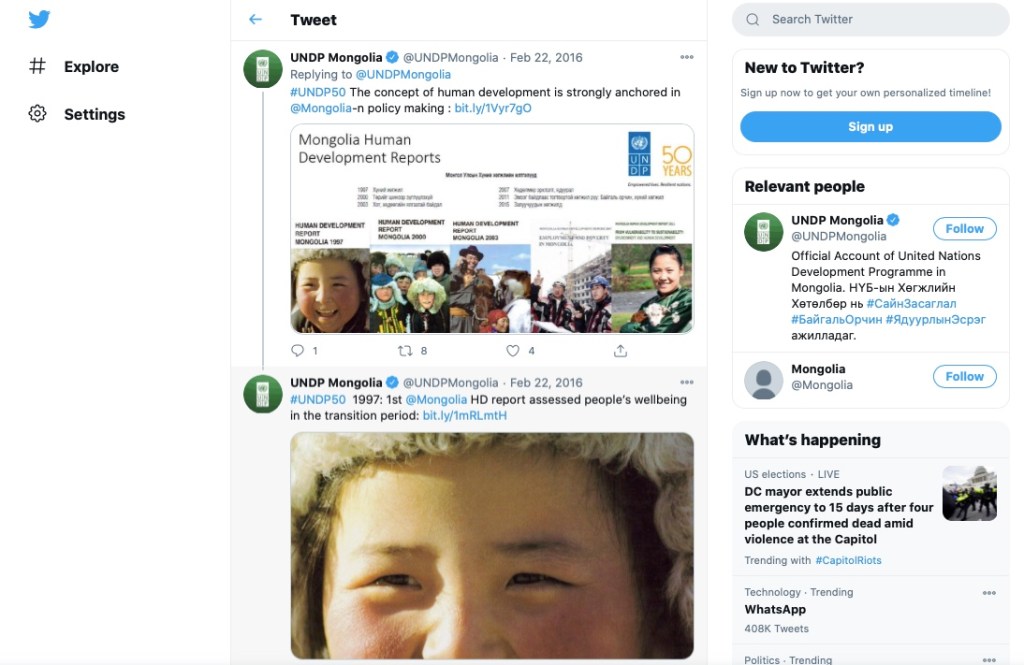
The Mongolian Human Development Report 1997 (MHDR), the country’s first, placed the story of the Mongolian people during the transition years (post-1989) at its heart, using photographs, stories and case studies to detail the bigger narrative at play.

This groundbreaking Mongolian Human Development Report – the country’s first – went beyond just chronicling Mongolia’s state of development in statistics and graphs. Designed, laid out and published in Mongolia, the report broke with the practices of many other international organisations, who would publish outside of Mongolia – denying local companies much-needed work and the opportunity to develop their skills. The report’s costs helped to kick-start a publishing boom in the country and significantly raised standards in design and layout in the Mongolia. The foundations laid down by the project producing the report ushered in a new age in publishing for Mongolia.

The report’s launch was innovative, not only being distributed for free across the country, but also part of a multimedia campaign including television programming, public posters, town hall meetings and a ‘roadshow’ featuring the report’s researchers and writers.

The initial print run of 10,000 copies was doubled as demand for the report increased. To the surprise of many, once hearing about the free report, herders would travel to the capital, Ulaanbaatar, to pick up their copy. The report proved people cared passionately about the development of their country and that development concepts are not to be the secret domain of ‘development practitioners’. The report also became an English language learning tool as readers compared the Mongolian and English-language versions.

You can read the report’s pdf here: http://www.mn.undp.org/content/mongolia/en/home/library/National-Human-Development-Reports/Mongolia-Human-Development-Report-1997.html 

1997 saw the launch of the first human development report for Mongolia.

Mongolian AIDS Bulletin

UNDP acted swiftly to address a breaking HIV/AIDS crisis in 1997, offering a key lesson for others working in public health (the Ebola Crisis and global air pollution crisis both show those lessons have still yet to be fully absorbed).

Assembled by a team of health experts after the Fourth International Congress on AIDS in Asia and the Pacific, the Mongolian AIDS Bulletin was published in 1997 in the middle of an HIV/AIDS crisis. It provided timely information and health resources in the Mongolian language and was distributed across the country.

“Mongolia’s first AIDS Bulletin marked the beginning of the UNDP Response to HIV/AIDS/STDs Project back in the autumn of 1997. Over 5,000 copies of the magazine were distributed across the country, offering accurate information on the HIV/AIDS situation. The project has been pivotal in the formulation of a national information, education and communication (IEC) strategy, bringing together NGOs, donors, UN agencies and the government.”

Source: YouandAids: The HIV/AIDS Portal for Asia Pacific

Green Book

In the Mongolian language, the Mongolian Green Book details effective ways to live in harmony with the environment while achieving development goals. Based on three years’ work in Mongolia – a Northeast Asian nation coping with desertification, mining, and climate change – the book presents tested strategies.  

EPAP Handbook

The Environmental Public Awareness Handbook was published in 1999 and features the case studies and lessons learned by UNDP’s Mongolian Environmental Public Awareness Programme (EPAP). The handbook draws on the close to 100 small environmental projects the Programme oversaw during a two-year period. These projects stretched across Mongolia, and operated in a time of great upheaval and social, economic and environmental distress. The handbook is intended for training purposes and the practice of public participation in environmental protection.

In its 2007 Needs Assessment, the Government of Mongolia found the EPAP projects “had a wide impact on limiting many environmental problems. Successful projects such as the Dutch/UNDP funded Environmental Awareness Project (EPAP), which was actually a multitude of small pilot projects (most costing less than $5,000 each) which taught local populations easily and efficiently different ways of living and working that are low-impact on the environment.”

Mongolia Updates 1997, 1998, 1999

Mongolia Update 1998 detailed how the country was coping with its hyperinflation and the Asian economic crisis.

The mission simultaneously had to deal with the 1997 Asian Crisis (http://en.wikipedia.org/wiki/1997_Asian_Financial_Crisis) and the worst peacetime economic collapse in post-WWII history (http://www.jstor.org/pss/153756).  

Mongolia Update 1998 – Political Changes

1998 proved a tumultuous year for Mongolia. The country’s existing economic crisis caused by the transition from Communism to free markets was made worse by the wider Asian Crisis. The government was destabilised, leading to an often-confusing revolving door of political figures. In order to help readers better understand the political changes in the country, a special edition of Mongolia Update was published that year.  

UNDP Mongolia: The Guide

The Guide, first published in 1997, provided a rolling update on UNDP’s programmes and projects in Mongolia during a turbulent time (1997-1999). The mission simultaneously had to deal with the 1997 Asian Crisis (http://en.wikipedia.org/wiki/1997_Asian_financial_crisis) and the worst peacetime economic collapse in post-WWII history.

Each edition came with short project and context summaries, key staff contacts, and facts and figures on how the country was changing. For the first time, any member of the public could grasp what the UN was up to in the country and be able to contact the project staff. An unusual level of transparency at the time for a UN mission.

Memoranda of Understanding

Three Memoranda of Understanding were negotiated with the Mongolian Government to help focus efforts and aid the attainment of internationally-agreed resolutions. This was affirmed by a series of youth conferences, One World, held in 1998 and 1999.

Strategy and Leadership in a Crisis

The scale and gravity of the crisis that struck Mongolia in the early 1990s was only slowly shaken off by the late 1990s. The economic and social crisis brought on by the collapse of Communism and the ending of subsidies and supports from the Soviet Union, led to a sharp rise in job losses, poverty, hunger, and family and community breakdowns.

The challenge was to find inspiring ways out of the crisis, while building confidence and hope. The sort of challenges confronted by the UNDP Mongolia Communications Office included:

1) A food crisis: agricultural production was down sharply, and the traditional nomadic herding economy, while at peak herd, was failing to get the meat to markets and to a high enough standard to restore export levels to where they once were. As a result, a cross-border trading frenzy became the solution to falling domestic food production and availability.

2) HIV/AIDS/STDs crisis.

3) A major banking crisis.

4) Both the Asian Financial Crisis and the Russia Crisis.

5) An ongoing political crisis and an inability to form stable governments.

UN Annual Reports

Editor and designer. 1998 Report called by Under-Secretary-General Nafis Sadik “a clear, well-written, attractive and colourful report.”

One of many documents from that time held in the United Nations Archives Search Engine. In this case, reporting on Mongolia’s follow-up to global conferences to then-Secretary-General Kofi A. Annan in 1999.
Mongolia’s Follow-Up To The UN Global Conferences (1999) UNDP Mongolia Communications Office, Ulaanbaatar, Mongolia.
Production/Design Supervision: David South, UNDP Communications Coordinator; Proof Reading: N. Oyuntungalag, UNDP Communications Officer/David South (1999).

Timeline 

1997: Arrive in the capital of Mongolia, Ulaanbaatar, to undertake a two-year assignment with the United Nations mission. Quickly get to work founding the UNDP Mongolia Communications Office and pursuing a strategic communications approach with a busy online and offline bilingual publishing programme. Launch award-winning UN Mongolia Development Web Portal (www.un-mongolia.mn). Launch first Human Development Report Mongolia 1997, and a Mongolian AIDS Bulletin during crisis. Assist the Government of Canada to establish the first Honorary Consul in Ulaanbaatar on December 1, 1997 and the Canada Fund Mongolia.

Canada Fund Mongolia

1998: International media tours of the country, launching of Mongolia’s first online magazine, Ger, distribute globally a regular newsletter on Mongolia’s development challenges, Blue Sky Bulletin. Open United Nations Info Shop for the public. Assist the Government of Canada to connect with Canadians working with the United Nations in Mongolia during the first official visit by a Canadian Government Minister.

1999: Launch a string of books documenting insights gleaned from the Mongolia development experience.  

Testimonials

 “Mongolia is not an easy country to live in and David [South] showed a keen ability to adapt in difficult circumstances. He was sensitive to the local habits and cultures and was highly respected by his Mongolian colleagues. … David’s journalism background served him well in his position as Director of the Communications Unit. … A major accomplishment … was the establishment of the UNDP web site. He had the artistic flare, solid writing talent and organizational skills that made this a success. … we greatly appreciated the talents and contributions of David South to the work of UNDP in Mongolia.” Douglas Gardner, UN Resident Coordinator and UNDP Resident Representative Mongolia

Impact 

Micro

  • strategic communications approach including establishing the UN/UNDP Mongolia Communications Office and team and strategic communications plan
  • led on digital transformation, including use of digitial media (photo/video archive) and digital publishing (web site, online magazine and newsletter, etc.)
  • established and ran the United Nations Info Shop – a one-stop resource open to the public with archive of development publications and current periodicals and Internet access
  • began largest bilingual online and offline publishing programme in country – led on publishing and design modernisation
  • laid down the foundations for many UN initiatives in Mongolia that are still underway. Contributed to stabilizing the country in a turbulent time. Mongolia was briefly the fastest-growing economy in the world by 2011
  • championed transparency and access to information and media freedoms
  • oversaw a period in which Transparency International found lower levels of perceived corruption
  • managing editor for country’s first Human Development Report

Macro

  • raised profile of country and its development challenges. Donor pledges rose 
  • 2 international media tours
  • strong relationship with Mongolian and international journalists
  • championed innovators in commnications
  • crisis response: AIDS, economy, political
  • country’s largest website and one of its first. Called “Godfather of the Mongolian web”
  • called a “role model” for the wider UN
  • led on new approach to UN communications in the digital age
  • design-led approach
  • transparent and timely updates
  • negotiated three Memoranda of Understanding (MOUs): youth, food security and nutrition, STDs/HIV/AIDS
  • One World youth conferences

Publications

David South Consulting Summary of Impact

Environmental Public Awareness Handbook: Case Studies and Lessons Learned in Mongolia

Ger Magazine: Modern Life Issue

Ger Magazine: Youth Issue

Human Development Report Mongolia 1997

Mongolian Green Book

Mongolia Update – Coverage of 1998 Political Changes

Mongolia Update 1998

Mongolian AIDS Bulletin

Mongolian Rock and Pop Book

Partnership for Progress: The United Nations Development Programme in Mongolia

UNDP Mongolia Online Development Portal

UNDP in Mongolia: The Guide 

Stories

Freedom of Expression: Introducing Investigative Journalism to Local Media in Mongolia

Lamas Against AIDS

Philippine Conference Tackles Asia’s AIDS Crisis

Starting from Scratch: The Challenge of Transition

UNDP Mongolia Partnership for Progress 1997 to 1999 Key Documents 

A UNDP Success Story: Grassroots Environmental Campaign Mobilizes Thousands in Mongolia

Citations

The response by the UNDP Mongolia Communications Office has been cited in numerous articles, books, publications and stories. It has also contributed to the development of the human development concept and understanding of human resilience in a crisis and innovation in a crisis. 

Book citations include:

Dateline Mongolia: An American Journalist in Nomad’s Land by Michael Kohn, RDR Books, 2006

Modern Mongolia: From Khans to Commissars to Capitalists by Morris Rossabi, University of California Press, 2005

Wild East: Travels in the New Mongolia by Jill Lawless, ECW Press, 2000

Paper citations include: 

Paula L. W. Sabloff (2020) Buying into capitalism: Mongolians’ changing perceptions of capitalism in the transition years, Central Asian Survey, 39:4, 556-577, DOI: 10.1080/02634937.2020.1823819

A more detailed list of citations can be found here: http://www.davidsouthconsulting.com/about/

For research purposes, key documents were compiled together and published online here: https://books.google.ca/books?id=K76jBgAAQBAJ&dq=undp+mongolia+key+documents&source=gbs_navlinks_s

This resource was praised for having: “Very useful references and original materials that documented UNDP Mongolia work. I needed to trace community-based development, and this book provided a valuable source.” Review on Google Books

In 2001, the UN won the Nobel Peace Prize for “their work for a better organized and more peaceful world” and its communications innovations, with work such as that in Mongolia being cited as a contributing factor to the awarding of the Prize.

The Nobel Peace Prize 2001 joint winners.

In 2000, the Millennium Development Goals (MDGs) were launched in a 15-year bid to use a focused approach to development centred around eight goals to accelerate improvements to human development. From 2000 to 2005, consulting work was undertaken in various UN missions (Mongolia, South Africa, Turkmenistan, Ukraine) to communicate the goals and to reshape communications activities around the goals.

Transition and Democracy in Mongolia by Richard Pomfret, Europe-Asia Studies, Vol. 52, No. 1 (Jan., 2000), pp. 149-160, published by Taylor & Francis, Ltd. (http://www.jstor.org/stable/153756?seq=1#page_scan_tab_contents)

The Milk of Kindness flows in a Peculiar Land A Steppe From Nowhere by Leslie Chang, The Asian Wall Street Journal, 15 August 1998

Mongolia prepares for a magazine explosion by Jill Lawless, UB Post, 08-09-98

Other Resources

Letter from Mongolia: Herding instinct by Jill Lawless, The Guardian, 9 June 1999

Connect with me on Devex here: https://www.devex.com/people/david-s-361357

ORCID iD: https://orcid.org/0000-0001-5311-1052.

© David South Consulting 2025

Categories
Archive Blogroll id magazine

State Of Decay: Haiti Turns To Free-Market Economics And The UN To Save Itself

By David South

Id Magazine (Canada), July 11-25, 1996

Port-au-Prince – Brand-new four-by-four jeeps in various shapes and sizes bounce over the moon-like craters of Port-au-Prince’s roads. The presence of so many expensive vehicles in a country unable to feed all its citizens is hard to take, but it is not one of the worst paradoxes of Haiti.

The appalling state of the roads – more like occassional stretches of asphalt to break up the monotony of potholes – is an apt symbol of Haiti, a reminder with every jar of the tailbone of the public squalor of the many and the private wealth of the few. The shiny new jeeps are not a sign of recent good times, but reveal who has all the money in this nation of almost seven million: the tiny Haitian elite, thieves, the United Nations and the multitude of non-governmental aid agencies.

When democratically-elected president Jean-Bertrand Artistide, deposed in a 1991 coup, returned to complete his term in office in 1994, many Haitians hoped that this country would at last begin to shake off centuries of exploitation at the hands of a selfish elite backed by American corporate masters and begin to build a democratic future.

The United Nations mission in Haiti, which includes 700 Canadian troops, is intended to support the country’s fledgling democracy. But Haiti’s future remains uncertain – as does the role the UN will play in shaping it.

Despite negotiating a peaceful and democratic transition last February 7 from Aristide – a firebrand former priest and passionate advocate of Haiti’s poor – to successor Rene Garcia Preval, Haiti hasn’t stopped its economic freefall. Economists predict the country won’t match 1991 earning levels until the next century. Political unrest resulting from opposition to the government’s privatization plans could also spell trouble ahead.

The United Nations presence, due to end June 30, has been extended another five months at the request of the Haitian government. The newly-minted UN Support Mission in Haiti, a military force of 600 UN troops supported by 700 soldiers paid through voluntary contributions, is being assembled. It will replace the current force of 1900.

Lousy loans

Meanwhile, the government of Rene Preval is negotiating with the International Monetary Fund (IMF), the World Bank and the United States to get much-needed loans to help balance the budget. Critics say the world’s banks are trying to lock the poorest country in the Western hemisphere further into crippling debt. The Haitian budget is US $750 million, 60 per cent of which the government hopes to raise from loans.

But there is a condition. Haiti must embark on a structural adjustment programme: widespread firings of the public service, privatization of most of the public sector, loosening of controls over foreign capital, adherance to the ethos of global trading blocks espoused by the North American Free Trade Agreement (NAFTA). Some call this neo-liberalism, others neo-conservatism. Either way, it forces this impoverished country to limit how it can address rebuilding a crumbling infrastructure.

The government’s hands are tied, though, as the conditions were part of the deal to return Aristide to power.

A Canadian public relations company, Gervais-Gagnon-Covington Associates, has been paid US $800,000 by the American government to sell the idea of privatization of Haiti’s handful of idle and near-bankrupt state enterprises.

In order to plunge deep into this Haitian quagmire, I pitch up at the legendary Hotel Oloffson – made famous by novelist Graham Greene in The Comedians – and begin interviewing in the languid atmosphere by the pool.

“Aristide has put Haitians in a giant trap with the IMF plan,” says Jane Regan, who runs an independent news service based in Port-au-Prince. “The US $1 billion in loans will double the national debt.

“Haiti used to be self-sufficient in rice – last year they bought US $56 billion in US rice. The roads are worse now than a year ago. Right now the UN mission is of questionable worth and Canadians are getting taken advantage of.  They have been sent to clean up after the Americans. These are the same neo-liberal economic policies that hurt Canadian workers – just imagine what Haitians are feeling!”

Regan thinks that, so far, the only people to make any money out of this arrangement are businesses and the more than 800 NGOs operating in Haiti. And on that note, the feisty Regan disrobes and plunges into the Hotel’s pool.

According to Kim Ives, a reporter with the Haitian newspaper Haiti Progres, there are a few cracks in the solidarity between Preval and Aristide: “Aristide is hitting out against privatizations. In a two-hour TV interview, he drew a line between himself and Preval.”

One of the few visible signs of change in Haiti is the dusty Octobre 15 road leading from the airport past former president Aristide’s palatial home on its way to the wealthy suburb of Petionville. It is bordered on one side by Camp Maple Leaf, and on the other by dilapidated shanty towns and desperate street vendors.

Cynics point out the road conveniently serves the interests of the elite once again. It offers a direct and more or less pothole-free route from the secluded mansions of Petionville to the airport – a crucial escape route in a politically volatile developing country. In fact, a development of monster homes that would make a Canadian suburbanite blush is going up near the airport to capitalise on this.

Canadian troops

Caught between the Haitian government and its people is the United Nations, including Canada’s troops. Canadian troops form the first line of defence – along with Preval’s personal secuity guards – to defend the National Palace. They accompany the president wherever he goes, 24 hours a day.

Some fear growing resentment among Haitians for government policies will pitch the population against the soldiers.

At Camp Maple Leaf, the home base of Canada’s military contingent in Haiti, the troops are scrambling to adjust to a new mission sanctioned by the United Nations. As of June 30, they must take a back seat to the troubled Haitian police force as it tries to prove that the intensive training provided by police from around the world has paid off.

In the first week of July, the Canadian soldiers of the Royal 22nd Regiment – the famous Vandoos  – receive confusing news about a change in their firing orders or Rules of Engagement. ROEs dictate the tone and behaviour of peacekeepers on a UN mission and, as the experience of Somalia demonstrates, they can be the difference between success and disaster.

As the new mandate starts, the Canadians are first told they will be only able to use deadly force to defend themselves and not Haitians. If a member of the government is assassinated, they must stand by. If a Haitian is clubbed to death before their eyes, they must stand back. It is a qualitative change from their ROEs prior to June 30.

Ottawa military spokesman Captain Conrad Bellehumour says the change is indicative of an evolving mandate. But a military spokesman in Haiti says the old ROEs are now back in force, and Canadians can intervene to save a Haitian’s life.

“Maybe somebody’s been listening to Jean-Luc Picard too much,” quips retired Brigadier-General Jim Hanson, in a reference to TV show Star Trek’s prime directive of non-interference in a culture.

Preval’s police

A large banner hangs over a Port-au-Prince street: “Police + Population = Securite + Paix”. The UN has placed its greatest emphasis on reforming Haiti’s policing and justice system. The Police Nationale d’Haiti (PNH) was formed, and the RCMP and the American Federal Bureau of Investigation (FBI) were asked to provide training. The idea is to break from the past – when the military used policing as an opportunity to terrorize the population – and establish a police force to serve and protect.

But the efforts of the Haitians and their international police advisers have had a mixed success. According to Canadian soldiers, the Haitian police need to be coaxed into conducting routine patrols and have not given up patrolling in large numbers in the back of a pick up truck with rifles at the ready. To be fair, seven police officers have been killed since January, in what many believe is an organized campaign of terror orchestrated by sympathizers of the old dictatorship and drug gangs.

According to Sergeant Serge Martin of the Vandoos, “The PNH use 15 police officers to patrol and don’t talk to anybody.”

“You don’t depend on police to protect you,” claims Regan. “The Haitian government has no control over them. You don’t know if there is going to be a coup tomorrow.”

Jean-Yves Urfie, editor of the pro-democracy Libete newspaper in Port-au-Prince, believes the campaign to kill police goes back to the United States. “I am convinced the coup d’etat was financed by the Republican administration. I believe the Republicans want to destroy things here to show (President) Clinton wasted his time bringing Aristide back.

“The government was forced to incorporate former members of the military into the police force. And it would be terrible if the population develops the impression all cops are bad.”

“They are 10 years away from a viable police force,” concludes Hanson.

A stop at the fourth precinct police station shows just how far things still need to go. At the counter is a lone police officer, sharply turned out in his beige shirt and yellow-striped navy pants, courtesy of the Royal Canadian Mounted Police. But this proves to be a veneer of change. Canadian soldiers ask if everything is alright. They then ask to see tonight’s prisoners. The officer sheepishly leads the troops down a narrow corridor to 9 ‘ by 12 ‘ foot cell stuffed with nine prisoners. It is very hot and the stench from an open drain overflowing with sewage is nauseating.

Outside the Penitencier National in downtown Port-au-Prince, a yellow concrete structure with peeling pain, Haitians lined up to feed the inmates, talk about their frustrations with a justice system that has collapsed. Many complain that only the rich, who can hire lawyers, can enjoy the fruits of democracy. While state-directed beatings and killings have been dramatically reduced, most prisoners rot on remand until they are charged with a crime. Heiner Rosentdahl, the UN representative in Haiti in charge of prison reform, tries to be upbeat. “There have been no changes in conditions in Haiti’s prisons. Treatment of the prisoners is better, though there have been some abuses. We have developed a nation-wide register book of prisoners to help keep track of who is in prison.”

Another mixed blessing, according to Rosendahl, is the new requirement that all prisoners be fed two meal a day. The food is so poor, prisoners have been getting sick.

He is frustrated with the pace of penal reform. “The Haitian prison system hasn’t had a budget since October 1995, because of battles within the parliament,” he says. “The Haitian government didn’t ask for a plan to change this situation despite the minister of justice visiting the prison for the first time.”

According to Rosendahl, it is not the routine killing of thieves by mobs that worries the elite. Nor is it the assassination of police officers, or the untold thousands dying of disease and hunger. The only thing that is beginning to rock their world is a new phenomenon for Haiti: kidnapping and extortion.

Voodoo economics

For such a seriously depressed economy, there is an astonishingly large number of lottery booths – or Borlettes – on Haitian streets. They are so plentiful, they join gas stations as the main landmarks of the streets.

The industrial park which is now home to the remaining American troops stationed in Port-au-Prince, is a good monument to Haiti’s economic problems. Dilapidated and only barely functioning, this facility once supported, directly and indirectly, a large portion of the city’s population. As crummy as the sweatshop jobs were, they provided valuable income for the capital’s poor.

The Haitian economy under Francois Duvalier and his son, Jean-Claude, before the chaos of the late 1980s and 1990s, was based on assembling manufactured goods for the US market. Haiti was the world’s largest producer of baseballs, and ranked as “top three in the assembly of such diverse products as stuffed toys, dolls and apparel, especially brassieres. All told, the impact of international subcontracting was considerable,” according to author Paul Farmer in his book, The Uses of Haiti.

Today, Pierre Joseph, a Haitian-American from New York City, has a new job: he screens the ID cards of Haitian workers as they enter the park. He says there were once over 50 factories operating here; now there are 30.

Evidence of Haiti’s economic collapse is everywhere. On the walls outside the National Palace is scrawled Aba Preval Granhanje – Preval is a liar. Across the wide boulevard in a square are around 75 homeless children. They joke with the Canadian soldiers, especially boyish 2nd Lt. Marc Verret, who looks like a baby in soldiers clothes. The kids beg him for water and money.

In the market area, the piles of garbage, rotting meat and excrement make a muddy devil’s stew. Homeless children sleep on top of the abandoned crates. One small child is curled up in an American flag, asleep.

Desecrating dead

The dead also suffer the indignities of economic ruin. Outside the gates of the Hopital Generale, a man lies dead on a broken trolley in the yard. Others still alive, with limbs missing, are sprawled out on the ground. Chickens and goats roam the grounds. In the back is the main morgue for Port-au-Prince. The odour just 25 feet from the entrance to the morgue is normal for this city strewn with rotting garbage and stewed by a hot sun.

Inside, an overpowering odour like rotten chicken meat is the product of 450 human cadavers. Like rag dolls laid out in a ghoulish toy store, row upon row of children dead from starvation and disease – Haiti’s infant mortality rate is 127 per 1,000 babies born – are stacked almost to the ceiling. There are also adults. Old women, young men badly mutilated for stealing, are strewn out on the dirty concrete floor and on shelves.

There is no refrigeration, and according to military doctor Major Tim Cook, “something really nasty is going to come out of there if they don’t do something.”

Proving peacekeeping

More is at stake in Haiti than the re-building of a politically and economically devastated nation. For Canada’s armed forces, shaken and little stirred by the Somalia scandal, it is an opportunity to make amends. This time around, the peacekeepers are keeping the needs of the local population foremost in their gun sights. When the Vandoos head out on another one of their 24-hour patrols, the atmosphere is friendly and filled with gentle ribbing with the locals. They have the advantage of being able to speak French, a language understood to varying degrees by most of the population.

The approach of the individual soldiers varies widely. On a routine patrol, Alpha Company engaged in good-natured kidding around, with splashing the locals the worst offence. But a day out with Charlie Company, led by Sergeant Serge Martin, proved another story. The two privates assigned to accompany a group of journalists were a couple of operators. The day included a visit to a perfume shop, a trip through the wharf area looking for prostitutes and constant propositioning of the local women.

One Canadian corporal with the Vandoos, Eric Charbonneau, has been trying to make a small difference to the lives of the 400 people living in the community of Cazeau, a shanty town near the international airport. He has started literacy and hygiene lessons and raised money to help the residents build concrete houses to replace the mud dwellings they currently inhabit.

“I was walking along the fence and started to build a relationship with the kids,” he explains. “Some guy approached me and needed some help. It took three weeks to build a relationship. They are too used to white people giving away things for doing nothing. They were surprised when they had to work for it.”

At the gates to Camp Maple Leaf is a spray-painted sign. In Creole, French and English beside a Canadian flag, it says “No More Jobs.” While it could look at home back in Canada, it illustrates how important the presence of soldiers, the United Nations and charities are right now to the economy.

Some observers see the UN presence as part of a slide back into dependency on foreign money, restricting Haiti’s ability to assert itself. But others believe the turn to the international community is Haiti’s last hope of breaking with a past littered with dictatorships and poverty.

According to Captain Roberto Blizzard – an erudite and wise observer of the situation – the base has been stampeded with desperate Haitians looking for work. Blizzard has tried to find work for as many Haitians as he can, even helping them to form a laundry co-operative he hopes will survive long past the Canadians’ stay.

“There is a danger of the Haitian people turning into full-time beggars,” he says with sadness.

Further reading:

Failed States and Institutional Decay: Understanding Instability and Poverty in the Developing World by Natasha M. Ezrow and Erica Frantz, Bloomsbury Academic, 18 July 2013.

Towards a taxonomy of failed states in the New World Order: decaying Somalia, Liberia, Rwanda and Haiti by Jean-Germain Gros, Third World Quarterly, Vol. 17 No. 3 September 1996 Section 5 Page 455

https://davidsouthconsulting.org/2021/10/28/ending-gang-violence-while-cleaning-the-streets-in-haiti/

https://davidsouthconsulting.org/2021/09/01/haiti-earthquake-prompts-tech-aid/

https://davidsouthconsulting.org/2021/01/08/haitian-coffee-becoming-a-hit-with-american-connoisseurs/

https://davidsouthconsulting.org/2021/10/28/milk-co-operatives-help-hungry-haiti/

https://davidsouthconsulting.org/2022/09/23/opinion-canada-is-allowing-u-s-to-dictate-haitis-renewal-more-news-and-opinion-on-what-the-un-soldiers-call-the-haitian-vacation/

https://davidsouthconsulting.org/2021/01/26/u-s-elections-update-clinton-is-using-canada-to-keep-control-of-haiti/

Creative Commons License

This work is licensed under a
Creative Commons Attribution-Noncommercial-No Derivative Works 3.0 License.

ORCID iD: https://orcid.org/0000-0001-5311-1052.

© David South Consulting 2025