Tag: food

  • Food Inflation: Ways to Fight It

    Food Inflation: Ways to Fight It

    By David SouthDevelopment Challenges, South-South Solutions

    SOUTH-SOUTH CASE STUDY

    Food inflation has taken off at the beginning of 2011. As the global economic crisis enters its next phase, both developed and developing countries are experiencing inflation. There are many factors fuelling the rise in prices – inefficient distribution and storage systems, lack of investment in agriculture, devaluing currencies, high demand, natural and man-made disasters, use of food products like corn to make biofuels – but there are also ways to counter the effects of food inflation that have been tried and tested across the South.

    The United Nations Conference on Trade and Development (UNCTAD) says the least developed countries spent US $9 billion on food imports in 2002. By 2008, that amount had risen to US $23 billion. Supachai Panitchpakdi, secretary general of UNCTAD, says “the import dependence has become quite devastating.”

    Worse, more people had less money to buy the food. The number of individuals living in extreme poverty “increased by 3 million per year during the boom years of 2002 and 2007,” reaching 421 million people in 2007.

    For millions of people, it is a matter of life and death that food remains affordable. The poor pay the largest share of their income on food. Raise that cost, and the poor quickly have little money left for other things, like housing, transport, clothing or education.

    Approached as a problem needing a solution, it is possible to deal with a bout of food inflation. Every food crisis has its origins and can be resolved. A staggering amount of food goes to waste every year, and a vast quantity can’t get from the farm to the market in time because of infrastructure problems.

    An Indian refrigerator – the ChotuKool fridge (http://www.godrej.com/godrej/godrej/index.aspx?id=1) – is designed to stay cool for hours without electricity and to use half the power of conventional refrigerators. Priced at US $69, it is targeted at India’s poor – a population of over 456 million, almost half the total Indian population (World Bank).

    Manufactured by Godrej and Boyce and weighing just 7.8 kilograms, it is designed around the stated needs of the poor, who wanted a fridge capable of cooling 5 to 6 bottles of water and 3 to 4 kilograms of vegetables. Portability was crucial as well, since needs to be moved when large family gatherings take place in small rooms.

    As a photo shows (http://innovation.hindustantimes.com/summit-photos/godrej/chotukool-3.php), the fridge looks more like a drinks cooler than the typical large refrigerator. It works by replacing the standard compressor motor found in most fridges with a battery-powered heat exchanger.

    In Ghana, a mobile phone-driven Internet marketplace is helping to improve efficiencies in farming and selling food. Esoko (esoko.com/#lang=en), tracks products including ground nuts, sesame, tomato, maize and white beans. It offers market information from Afghanistan, Benin, Burkina Faso, Cameroon, Cote d’Ivoire, Ghana, Madagascar, Mali, Mozambique, Nigeria, Sudan and Togo.

    India’s e-Choupal is making food distribution more efficient in a country experiencing high inflation. E-Choupal (http://www.echoupal.com) has developed a reputation for both controlling prices and increasing incomes for poor farmers. Started in 2000 by the major Indian company ITC Limited (http://www.itcportal.com), it links farmers to the latest prices for products including soybeans, wheat, coffee and prawns.

    E-Choupal works through computers set up in rural areas and has built one of the largest internet initiatives in rural India, reaching 4 million farmers in 40,000 villages.

    Brazil, over the last 30 years, has transformed itself from a food importer to one of the world’s major food exporters. It made these impressive achievements with few government subsidies. The agricultural success is down to Embrapa (http://www.embrapa.br/english) – short for Empresa Brasileira de Pesquisa Agropecuária, or the Brazilian Agricultural Research Corporation. A public company set up in 1973, it has turned itself into the world’s leading tropical research institution. It breeds new seeds and cattle and has developed innovations from ultra-thin edible wrapping paper for foodstuffs that turns colour when the food goes off to a nano-tech lab creating biodegradable ultra-strong fabrics and wound dressings.

    Another approach can be found with a farmer in Kenya, Zack Matere, who boosted his potato crop by turning to Facebook for help. On his farm in Seregeya, Matere used the internet to find a cure for his ailing potato crop.

    He uses his mobile phone to access the internet at a costs of about US 0.66 cents a day. One example of the kind of intelligence Matere is able to glean from the internet is reports of cartels deceiving farmers by buying potatoes in over-large 130 kg bags instead of 110 kg bags. Matere takes this information, translates it into Swahili and posts it on community notice boards.

    Another fast-growing solution is bringing farming to urban and semi-urban spaces, where the majority of the world’s population now lives.

    Urban farmers can take advantage of their close proximity to consumers, keeping costs down and profits up. They can also solve one of agriculture’s enduring problems – where to find water for irrigation by using existing waste water. Waste water is plentiful in urban environments, where factories usually pump out waste water into streams, rivers and lakes.

    In Accra, Ghana, more than 200,000 people depend on food grown with wastewater. In Pakistan, a full quarter of the grown vegetables use wastewater.

    Family farms are critical to weathering economic crises and ensuring a steady and secure food supply. The International Fund for Agricultural Development (IFAD) (www.ifad.org) called in 2008 for small family farms – which sustain the livelihoods of more than 2 billion people _ to be put at the heart of the global response to high food prices and uncertain food security.

    In Brazil, this call is being answered by a bold initiative to create a “social technology,” combining a house-building programme with diverse family farms.

    This is where the Brazilian farmer’s cooperative Cooperhaf: Cooperativa de Habitacao dos Agricultores Familiares (http://www.cooperhaf.org.br/) steps in.

    “We see the house as the core issue,” said Adriana Paola Paredes Penafiel, a projects adviser with the Cooperhaf. “The farmers can improve their productivity but the starting point is the house.

    “Family farming is very important for the country – 70 percent of food for Brazilians comes from family farming,” said Penafiel. “The government wants to keep people in rural areas.”

    Making farming more appealing is being shown as a great way to get ahead in modern Africa. One woman hopes more people will be attracted to farming and boost the continent’s food security and reduce costly imports.

    Cynthia Mosunmola Umoru’s company, Honeysuckle PTL Ventures (http://www.tootoo.com/d-c3015227-Honeysuckles_Ptl_Ventures/), is based in Lagos, the business capital of Nigeria.

    Leading by example, Umoru has set up a successful and modern agribusiness focusing on high-quality food products using modern packaging and fast delivery. She produces meat products, from seafood like shrimps and prawns to snails, beef, chicken, and birds. Her niche is to deliver the product however the customer wishes: fresh, frozen or processed.

    Radical new food sources are also another option over time. The Food and Agricultural Organization (FAO) has explored insect protein as a contributor to better nutrition, the economics of collecting edible forest insects, methods of harvesting, processing and marketing edible forest insects, and ways of promoting insect eating with snacks, dishes, condiments — even recipes.

    The range of insects that can be tapped for food is huge, and includes beetles, ants, bees, crickets, silk worms, moths, termites, larvae, spiders, tarantulas and scorpions. More than 1,400 insect species are eaten in 90 countries in the South. Entrepreneurs in the South are making insects both palatable and marketable – and in turn profitable. These innovations are adding another income source for farmers and the poor, and supplying another weapon to the battle for global food security.

    Resources

    1) The global movement for slow food, which encourages organic production and appreciation of traditional foods and cooking. Website: www.SlowFood.com

    2) A video story by CNN on Tradenet/Esoko. Website: http://www.youtube.com/watch?v=s6z0ywkHPPQ

    3) Olam: The story of Olam – a global food supply company in ‘agri-products’ that got its start in Nigeria – shows how a Southern brand can grow and go global, and overcome the difficulties of cross-border trade. Website: http://www.olamonline.com/home/home.asp

    4) South African company Eat Your Garden: It provides urban dwellers and food businesses with their own food gardens bursting with juicy and tasty foods whilst at the same time reducing carbon footprints, and creating employment and provide training, helping poverty alleviation. Website: http://www.eatyourgarden.co.za/

    5) Vertical farming, where hothouses are piled one on top of the other, is an option being promoted as a solution to the food needs of urban dwellers. Website: http://www.verticalfarm.com/

    Follow @SouthSouth1

    Slideshare: http://www.slideshare.net/DavidSouth1/development-challengessouthsouthsolutionsnovember2010issue

    Southern Innovator Issue 1: https://books.google.co.uk/books?id=Q1O54YSE2BgC&dq=southern+innovator&source=gbs_navlinks_s

    Southern Innovator Issue 2: https://books.google.co.uk/books?id=Ty0N969dcssC&dq=southern+innovator&source=gbs_navlinks_s

    Southern Innovator Issue 3: https://books.google.co.uk/books?id=AQNt4YmhZagC&dq=southern+innovator&source=gbs_navlinks_s

    Southern Innovator Issue 4: https://books.google.co.uk/books?id=9T_n2tA7l4EC&dq=southern+innovator&source=gbs_navlinks_s

    Southern Innovator Issue 5: https://books.google.co.uk/books?id=6ILdAgAAQBAJ&dq=southern+innovator&source=gbs_navlinks_s

    Creative Commons License

    This work is licensed under a
    Creative Commons Attribution-Noncommercial-No Derivative Works 3.0 License.

    ORCID iD: https://orcid.org/0000-0001-5311-1052.

    © David South Consulting 2024
  • Milk Co-operatives Help Hungry Haiti

    Milk Co-operatives Help Hungry Haiti

    By David SouthDevelopment Challenges, South-South Solutions

    SOUTH-SOUTH CASE STUDY

    The global food crisis has hit the impoverished Caribbean country of Haiti especially hard. Already suffering from decades of food crises brought on by the collapse of domestic farming, the country has become notorious for its people being reduced to eating cakes made of mud to stave off hunger pains. It is the poorest country of Latin America and the Caribbean and one of the poorest in the world.

    Haiti imports some 52 percent of its food, including over 80 percent of its rice. Local food production only covers 43 percent of the country’s demand and food aid supplies only 5 percent of its needs. Of the estimated 9.8 million Haitians, 5.1 million live on less than US $1 a day and 7.6 million on less than US $2 a day. At current prices, one dollar buys only half a meal per day (Source: United Nations Country Team in Haiti).

    Haiti’s problems are made worse by a global food crisis. So-called agflation (agricultural inflation) has seen spiralling food prices around the world, which in turn are causing food shortages, hunger and malnutrition. On international commodity markets, food prices have gone up 54 percent over the last year, with cereal prices soaring 92 percent (FAO – World Food Situation). U.N. Secretary General Ban Ki-moon has called for food production to increase 50 percent by 2030 just to meet rising demand – and right now there are 862 million people worldwide who are undernourished (FAO).

    In Haiti, most agriculture is done on a small scale by about 700,000 family farmers. Few belong to any production association or mechanism to market and distribute their products, and local produce has been pushed out of the market by imports.

    Subsidized U.S. rice began flooding in 30 years ago, becoming so cheap that Haitians began eating it instead of the corn, sweet potatoes, cassava and domestic rice they grew. The U.S. imports drove rice farmers out of business and incited a rural exodus that swelled the slums of the capital, Port-au-Prince. That dependence on imports has caused dangerous food insecurity. Today, the U.S. rice that is the staple of many Haitians’ diet has doubled in price in little more than a year.

    “The problem is that Haiti doesn’t have the land to give every peasant family enough to allow them to make a living,” said Bernard Etheart, head of the National Institute for Agrarian Reform. Etheart estimates that if all arable land was planted, each farmer would have no more than half a hectare, or 1.25 acres.

    A cooperative of dairy farmers is doing its bit to revive domestic production of milk products and reduce the crippling costs of importing milk for Haiti. Importing 85,000 tonnes of milk from Europe and the United States costs Haiti US $40 million a year. A walk through the capital, Port-au-Prince, will reveal how much milk is imported in one form or another: tiny cans of evaporated milk are sold in the street markets, while the wealthy can buy powdered and long-life milk in the air conditioned supermarkets of the upscale neighbourhood of Petionville.

    Dairy production in Haiti was in decline for 20 years until, in 2002, the country ceased to produce any milk at all. The urgent need for milk in Haiti is shown in the average consumption: per child, only 110 ml is consumed per day. In Uruguay, for example, it is 520 ml a day (190 litres per head of population per year).

    Lèt Agogo (Creole for Unlimited Milk) is a cooperative using small-scale farmers to bring milk to the hungry. Founded by the NGO Veterimed six years ago, it now has a network of 13 dairies across the island.

    Lèt Agogo is hoping to get Haiti’s milk production up to 145,000 tons a year from the current 45,000 tons. So far, the product’s single biggest client is the Haitian government. It buys bottles of sterilized milk below cost and distributes them to 130,000 school children in 44 government-funded schools. Dr. Michel Chancy told the Miami Herald that the government would like to expand the distribution to 800 schools.

    “Haiti is a country where we consume a lot of milk,” said Chancy, a veterinarian and one of the visionaries behind Lèt Agogo. “After rice, milk is the second-largest import.”

    At present, Haiti has 500,000 dairy cows out of more than a million head of cattle. The problem came down to marketing and distributing the dairy products. With no structure in place, few farmers bothered milking their animals. But by the end of 2007, 600 farmers had joined the network and 400 producers in dairy product making and grass pasture management. In 2007, they turned 540,000 litres into yoghurt and sterilised milk that can stay on the shelf for six to nine months without refrigeration. Made from sterilized milk, the yogurt comes in 280 ml bottles and sells in stores throughout the country and has a shelf life of nine months.

    The farmers have seen their income almost double, from 4 (US 10 cents) to 8 (US 20 cents) gourdes per litre, from 10 (US 25 cents) to 12 (US 30 cents) gourdes per litre.

    Farmers walk to processing centres with their litres of milk and receive US $2.20 for each US gallon (4.55 litres).

    “The milk is here,” Chancy said, but the lack of roads and electricity in the country pose huge challenges. “The problem is transporting it.”

    Haiti’s president, Rene Preval, has cited Lèt Agogo as an excellent example of how Haiti can recover its domestic food production capability. The scheme won a US $10,000 first prize in the W.K. Kellogg Foundation and Economic Commission for Latin America and the Caribbean Experiences in Social Innovation Award.

    Lèt Agogo believes it will take 100 dairies throughout Haiti’s rugged terrain to truly take over the import market, and would cost US $10 million to set up. ”Normally in five to ten years, a dairy would pay for itself. But you need the investments,” Chancy said.

    “It’s not the production of milk that is important here… It’s accomplishing it together,” said Philippe Mathieu, from Oxfam International in Quebec, Canada, who is working on helping the brand produce cheese, noting that Haiti is at a difficult crossroads with today’s global price hikes. “The goal is to show Haitians there is a way to do things — a way to construct something collectively.

    “Haitian peasants have always taken care of their cattle; tying them, feeding them and giving them water to drink,” Mathieu said. ”The cow has always been their bank book, something they could sell for money during hard times. Now it has become a revenue source for them.”

    Published: August 2008

    Resources

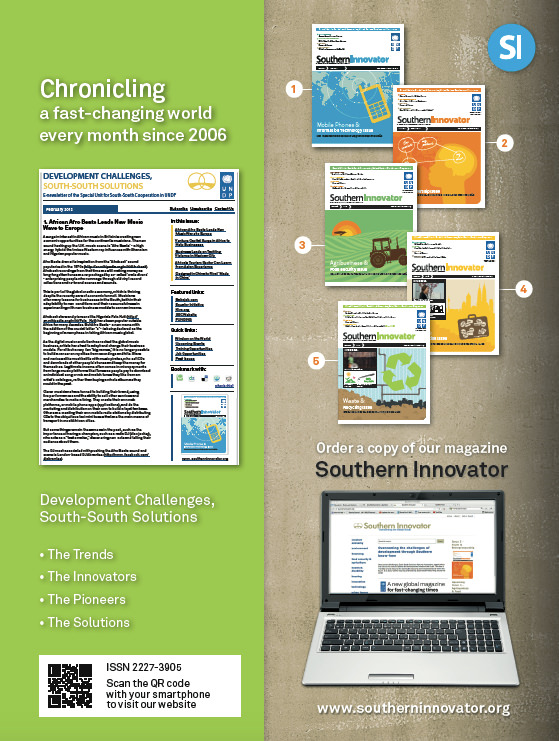
    Development Challenges, South-South Solutions was launched as an e-newsletter in 2006 by UNDP’s South-South Cooperation Unit (now the United Nations Office for South-South Cooperation) based in New York, USA. It led on profiling the rise of the global South as an economic powerhouse and was one of the first regular publications to champion the global South’s innovators, entrepreneurs, and pioneers. It tracked the key trends that are now so profoundly reshaping how development is seen and done. This includes the rapid take-up of mobile phones and information technology in the global South (as profiled in the first issue of magazine Southern Innovator), the move to becoming a majority urban world, a growing global innovator culture, and the plethora of solutions being developed in the global South to tackle its problems and improve living conditions and boost human development. The success of the e-newsletter led to the launch of the magazine Southern Innovator.  

    Follow @SouthSouth1

    Google Books: https://books.google.co.uk/books?id=oEP1Obs4gxYC&dq=development+challenges+august+2008&source=gbs_navlinks_s

    Slideshare: http://www.slideshare.net/DavidSouth1/development-challengessouthsouthsolutionsaugust2008issue

    Southern Innovator Issue 1: https://books.google.co.uk/books?id=Q1O54YSE2BgC&dq=southern+innovator&source=gbs_navlinks_s

    Southern Innovator Issue 2: https://books.google.co.uk/books?id=Ty0N969dcssC&dq=southern+innovator&source=gbs_navlinks_s

    Southern Innovator Issue 3: https://books.google.co.uk/books?id=AQNt4YmhZagC&dq=southern+innovator&source=gbs_navlinks_s

    Southern Innovator Issue 4: https://books.google.co.uk/books?id=9T_n2tA7l4EC&dq=southern+innovator&source=gbs_navlinks_s

    Southern Innovator Issue 5: https://books.google.co.uk/books?id=6ILdAgAAQBAJ&dq=southern+innovator&source=gbs_navlinks_s

    Creative Commons License

    This work is licensed under a
    Creative Commons Attribution-Noncommercial-No Derivative Works 3.0 License.

    ORCID iD: https://orcid.org/0000-0001-5311-1052.

    © David South Consulting 2023

  • Small Fish Farming Opportunity Can Wipe Out Malnutrition

    Small Fish Farming Opportunity Can Wipe Out Malnutrition

    By David SouthDevelopment Challenges, South-South Solutions

    SOUTH-SOUTH CASE STUDY

    Pioneering work to boost diets across the global South is turning to the smallest of fish. While small in size, tiny fish are packed with nutrition when eaten whole, as they are in many cultures. Often these fish come packed with vitamin A, iron, zinc, calcium, protein and essential fats – all necessary elements to eradicate malnutrition and hidden hunger, especially among women and children.

    It is estimated that 684,000 child deaths worldwide could be prevented by increasing access to vitamin A and zinc (WFP).

    Iron deficiency is the most prevalent form of malnutrition worldwide, affecting an estimated 2 billion people. Iron deficiency is impairing the mental development of 40 to 60 per cent of children in developing countries (UNICEF). The World Health Organization says that eradicating iron deficiency can improve national productivity levels by as much as 20 percent.

    Vitamin A deficiency affects approximately 25 per cent of the developing world’s pre-schoolers. It is associated with blindness, susceptibility to disease and higher mortality rates, and leads to the death of approximately 1 to 3 million children each year (UN).

    This devastating evidence shows the need to find effective food solutions to eradicate these nutrient deficiencies. Access to affordable nutrient-rich food is also key to social and political stability. Already, there is serious unrest in many countries around the world because of food-price inflation.

    Finding ways to boost nutritional health that are sustainable, low-cost and do not require substantial use of resources will have the best success in the poorest areas.

    A number of studies suggest one solution may be eating more small fish. In many countries, these species are eaten as part of the diet, but often not in large enough quantities to address hunger and malnutrition. Small fish species are a remarkable food source because they are usually eaten whole, bringing greater nutritional benefits.

    Small fish have a long history in human diets. Anchovies (http://en.wikipedia.org/wiki/Anchovy) are used  in many cuisines, for example.

    A study conducted between 2010 and 2013 in Bangladesh and Cambodia by Dr. Shakuntala Haraksingh Thilsted, Senior Nutrition Adviser to WorldFish (worldfishcenter.org), found that the eating of small fish in both countries gave a significant boost to daily diets and massively improved nutrition and health. The project, called Linking Fisheries and Nutrition: Promoting Innovative Fish Production Technologies in Ponds and Wetlands with Nutrient-dense Small Fish Species, was supported by the International Fund for Agricultural Development.

    People in both countries still currently suffer from undernutrition and micronutrient deficiencies.

    In rural areas of Bangladesh and Cambodia it found 50 to 80 per cent of total fish consumed were small fish. The quantities consumed during each meal were small but they occurred in diets frequently. Typically, they were eaten whole, with the head, viscera (internal organs) and bones consumed. This meant consuming small fish packed a punch, giving the eater a dose of calcium, vitamin A, iron and zinc.

    More specifically, the study found the iron-rich Mekong flying barb (Esomus longimanus) (http://www.iucnredlist.org/details/169546/0) – eaten as part of a meal of rice and sour soup with its head intact in Cambodia – could provide 45 per cent of the daily iron requirement for a woman.

    Malnutrition is also a serious problem in Bangladesh. Half the population lives below the poverty line and diets are poor in delivering necessary vitamins and minerals. This is damaging to peoples’ physical and mental health.

    The study found existing fish aquaculture methods in Bangladesh were inefficient. But new technologies provide an opportunity to increase the quantity of fish harvested and increase household incomes. By using highly efficient low-risk polyculture systems – basically combining small, nutrient-dense fish with high-value fish such as carp or freshwater prawn – it is possible to significantly increase the quantity of fish produced.

    Another one of the new techniques includes increasing pond depth, which conserves broodfish (http://en.wikipedia.org/wiki/Broodstock). Broodfish are the mature fish used for the production of eggs or sperm and are also called spawners.

    The study estimated a production of 10 kilograms per pond per year of fish spread across the 4 million small ponds in Bangladesh has the potential to meet the recommended dietary intake for 6 million children in the country.

    The work in Bangladesh to boost the production of small fish has inspired similar initiatives in Sunderbans, West Bengal, India and in Terai, Nepal. Initiatives in Cambodia and Kenya have also developed meals for young children by combining powdered rice or maize with small fish.

    And in Africa, some are calling for more use of aquaculture as an alternative to dwindling fish sources. For sub-Saharan Africans, fish can make up 22 per cent of the protein in their diet.

    As populations on the continent quickly rise, marine fisheries are beginning to be over-exploited. The Food and Agriculture Organization of the United Nations and WorldFish are calling for an aquaculture revolution on the continent to move away from the old approach of just using ponds located on farms. To make a real impact, both organizations argue, there needs to be a partnership between smallholder farmers and others to build a commercial fish farming sector.

    “Per capita fish supplies in Africa are dwindling,” Malcolm Beveridge, director for aquaculture at WorldFish, one of the 15 CGIAR research centers (Consultative Group on International Agricultural Research) (http://www.cgiar.org/cgiar-consortium/research-centers/), that generate and disseminate knowledge, technologies, and policies for agricultural development. “In Malawi, they fell from 10 kilograms to 6 kilograms per person between 1986 and 2006. Aquaculture has the potential to increase supplies of this affordable nutritious food for poor and vulnerable consumers,” he told The Guardian.

    Published: July 2013

    Resources

    1) Scaling Up Nutrition: Scaling Up Nutrition, or SUN, is a unique movement founded on the principle that all people have a right to food and good nutrition. It unites people – from governments, civil society, the United Nations, donors, businesses and researchers – in a collective effort to improve nutrition. Website: http://scalingupnutrition.org/

    2) The WorldFish Center: WorldFish, a member of the CGIAR Consortium, is an international, non-profit research organization dedicated to reducing poverty and hunger by improving fisheries and aquaculture. Website: http://www.worldfishcenter.org/

    3) Bangladesh Shrimp and Fish Foundation: Bangladesh Shrimp and Fish Foundation (BSFF) is a non-profit private research and advocacy organization created through a USAID project. Website: http://www.shrimpfoundation.org/

    4) Aquaculture for the Poor in Cambodia – Lessons Learned: The project was implemented by the WorldFish Center with financial support from the Ministry of Foreign Affairs (Government of Japan). Website: http://www.worldfishcenter.org/resource_centre/WF_2769.pdf

    5) Global Aquatics: The website design is a bit dated but it is packed with the basics on aquaculture. Website: http://growfish.com/

    6) Practical Action: Extensive resources are available on aquaculture and farming fish, including experience and techniques from the global South. Website: http://practicalaction.org/farming-fish-and-aquaculture

    7) Preserving fish safely: Tips on the top ways to preserve fish from the University of Minnesota. Website: http://www1.extension.umn.edu/food/food-safety/preserving/meat-fish/preserving-fish-safely/

    8) Preserving food techniques: Many inventive ways to preserve food, from wild game to fish to vegetables and fruits. Website: http://www.thenewsurvivalist.com/food_preservation_techniques.html

    9) Ugandan fish sausages enterprise: A pioneering business started by a young businesswoman. Website: http://katifarms.org/

    https://davidsouthconsulting.org/2022/11/21/agribusiness-food-security/

    https://davidsouthconsulting.org/2021/06/04/an-innovators-big-chicken-agenda-for-africa/

    https://davidsouthconsulting.org/2022/02/10/food-inflation-ways-to-fight-it/

    https://davidsouthconsulting.org/2021/03/05/southern-innovator-issue-3/

    https://davidsouthconsulting.org/2021/09/16/ugandan-fish-sausages-transform-female-fortunes/

    Development Challenges, South-South Solutions was launched as an e-newsletter in 2006 by UNDP’s South-South Cooperation Unit (now the United Nations Office for South-South Cooperation) based in New York, USA. It led on profiling the rise of the global South as an economic powerhouse and was one of the first regular publications to champion the global South’s innovators, entrepreneurs, and pioneers. It tracked the key trends that are now so profoundly reshaping how development is seen and done. This includes the rapid take-up of mobile phones and information technology in the global South (as profiled in the first issue of magazine Southern Innovator), the move to becoming a majority urban world, a growing global innovator culture, and the plethora of solutions being developed in the global South to tackle its problems and improve living conditions and boost human development. The success of the e-newsletter led to the launch of the magazine Southern Innovator.  

    Follow @SouthSouth1

    Google Books: https://books.google.co.uk/books?id=D_A1VeiJWycC&dq=development+challenges+november+2012&source=gbs_navlinks_s

    Slideshare: http://www.slideshare.net/DavidSouth1/development-challenges-november-2012-issue

    Southern Innovator Issue 1: https://books.google.co.uk/books?id=Q1O54YSE2BgC&dq=southern+innovator&source=gbs_navlinks_s

    Southern Innovator Issue 2: https://books.google.co.uk/books?id=Ty0N969dcssC&dq=southern+innovator&source=gbs_navlinks_s

    Southern Innovator Issue 3: https://books.google.co.uk/books?id=AQNt4YmhZagC&dq=southern+innovator&source=gbs_navlinks_s

    Southern Innovator Issue 4: https://books.google.co.uk/books?id=9T_n2tA7l4EC&dq=southern+innovator&source=gbs_navlinks_s

    Southern Innovator Issue 5: https://books.google.co.uk/books?id=6ILdAgAAQBAJ&dq=southern+innovator&source=gbs_navlinks_s

    This work is licensed under a Creative Commons Attribution 4.0 International License.

    ORCID iD: https://orcid.org/0000-0001-5311-1052.

    © David South Consulting 2023


  • An Innovator’s ‘Big Chicken Agenda’ for Africa

    An Innovator’s ‘Big Chicken Agenda’ for Africa

    By David SouthDevelopment Challenges, South-South Solutions

    SOUTH-SOUTH CASE STUDY

    Increasing the quantity and quality of food in Africa will be critical to improving the continent’s human development. And a key element in giving Africa a more secure food supply will be boosting science and knowledge on the continent and making sure it is focused on Africa’s needs and situation.

    One pioneering scientist is looking to the humble chicken to tackle two big problems in Africa: food security and household incomes. By pumping up the weight and productivity of African chickens, she hopes to eradicate hunger and boost household incomes.

    Kenyan scientist Sheila Ommeh (http://www.awardfellowships.org/participants/success-stories/108-sheilaommeh.html ) is showing how local knowledge can give farmers the edge when it comes to improving Africa’s animal stock. An animal geneticist, she is trying to create a disease-resistant African chicken that can also produce plenty of eggs.

    Her pioneering work is about trailblazing “a big chicken agenda in Africa,” she explained to TrustLaw, a global hub for free legal assistance and information on good governance and women’s rights.  She grew up in an area – Mount Elgon in western Kenya – where raising chickens was the primary source of both income and food. Her family raised chickens and the income from this helped to pay for her schooling.

    Raising chickens is common in rural Kenya, and many of the people doing it are women.

    Based on her experience, she saw how virulent diseases kill chicken flocks and destroy family incomes and disrupt lives – diseases like Newcastle (http://www.avianbiotech.com/diseases/newcastle.htm) and Gumboro (gumboro.com).

    She works at the International Livestock Research Institute (ilri.org) based in Nairobi, Kenya. The ILRI “works at the crossroads of livestock and poverty, bringing high-quality science and capacity-building to bear on poverty reduction and sustainable development” and conducts research in Africa, South and Southeast Asia and China.

    “I’m really passionate about giving back to the community an improved chicken that will really help their lives,” she explains.

    Another project she is working on is the development of a drought-tolerant chicken. This chicken could prove very helpful in parts of Africa suffering from drought and hunger, like in the Horn of Africa.

    Women are considered to be the majority producers of food in Africa yet just one in four people working in agricultural research in Africa is a woman, according to TrustLaw.

    Ommeh has a PhD in chicken genetics and is a staunch believer in seeking out solutions to Africa’s problems within Africa: “In my view = it’s about time Africa looked for solutions in Africa for Africa,” she told a group of British Members of Parliament.

    She will continue her research by looking at native African chickens. She is worried indigenous African chickens are being wiped out by cross-breeding and the introduction into the continent of exotic breeds, which are making African chickens more susceptible to viruses.

    Her goal is to produce a disease-resistant breed of chicken weighing four kilograms and laying 250 eggs a year. This would be a big increase on current average weights, and a trebling of the yield.

    “Definitely the incomes of these households will increase and that will (create) a rippling effect that will trickle up … And we hope that in 10 to 15 years the poverty issue in Africa will not be so serious,” Ommeh said.

    “Chicken is a small livestock but I believe it has the capacity to have a big impact.”

    For female scientists working in agriculture, African Women in Agricultural Research and Development (AWARD) (http://awardfellowships.org/) is seeking researchers looking to boost their technical and leadership skills. It is hoped that supporting more women researchers will have the effect of turning research priorities towards the needs of smallholder farmers, who make up the majority of  farmers in Africa.

    Published: May 2012

    Resources

    1) Artificial chicken: The contest to create artificial chicken meat offers a US $1 million prize. Website: http://www.guardian.co.uk/science/2012/jan/21/artificial-chicken-food-prize

    2) Poultry Hub: “Poultry Hub can help you learn more about the amazing world of poultry and your place in it. Poultry is one of the world’s most technically advanced agricultural industries, offering rewarding career paths to talented young people in hundreds of countries.” The Hub includes the excellent “anatomy of the chicken” learning resource. Website: http://www.poultryhub.org/organisations/rural-industries-research-anddevelopment-corporation-rirdc-chicken-meat-program/

    3) Poultry Research Centre: From the University of Alberta, the website offers resources and contacts on poultry sciences. Website: http://www.poultryresearchcentre.com/

    4) Chickens: Basic information on chickens and their origins. Website: http://www.encyclopedia.com/topic/Chicken.aspx

    https://davidsouthconsulting.org/2022/11/21/africa/

    https://davidsouthconsulting.org/2022/11/21/agribusiness-food-security/

    https://davidsouthconsulting.org/2022/09/27/avoiding-wasting-food-and-human-potential-with-icts/

    https://davidsouthconsulting.org/2022/08/14/brazil-preserves-family-farms-keeping-food-local/

    https://davidsouthconsulting.org/2022/10/10/cheap-farming-kit-hopes-to-help-more-become-farmers/

    https://davidsouthconsulting.org/2020/04/25/china-pushing-frontiers-of-medical-research/

    https://davidsouthconsulting.org/2021/03/08/the-dawn-of-the-genetics-revolution-2001-2003/

    https://davidsouthconsulting.org/2021/03/04/food-diplomacy-next-front-for-souths-nations/

    https://davidsouthconsulting.org/2022/02/10/food-inflation-ways-to-fight-it/

    https://davidsouthconsulting.org/2022/10/14/indias-modernizing-food-economy-unleashing-new-opportunities/

    https://davidsouthconsulting.org/2022/11/01/indonesian-food-company-helps-itself-by-making-farmers-more-efficient/

    https://davidsouthconsulting.org/2022/05/04/insects-can-help-in-food-crisis/

    https://davidsouthconsulting.org/2022/10/14/staple-foods-are-becoming-more-secure-in-the-south/

    https://davidsouthconsulting.org/2021/03/20/texting-for-cheaper-marketplace-food-with-sokotext/

    https://davidsouthconsulting.org/2022/11/11/urban-farming-to-tackle-global-food-crisis/

    https://davidsouthconsulting.org/2022/10/10/us-1-trillion-opportunity-for-africas-agribusinesses-says-report/

    https://davidsouthconsulting.org/2022/10/18/woman-wants-african-farming-to-be-cool/

    Development Challenges, South-South Solutions was launched as an e-newsletter in 2006 by UNDP’s South-South Cooperation Unit (now the United Nations Office for South-South Cooperation) based in New York, USA. It led on profiling the rise of the global South as an economic powerhouse and was one of the first regular publications to champion the global South’s innovators, entrepreneurs, and pioneers. It tracked the key trends that are now so profoundly reshaping how development is seen and done. This includes the rapid take-up of mobile phones and information technology in the global South (as profiled in the first issue of magazine Southern Innovator), the move to becoming a majority urban world, a growing global innovator culture, and the plethora of solutions being developed in the global South to tackle its problems and improve living conditions and boost human development. The success of the e-newsletter led to the launch of the magazine Southern Innovator.

    https://davidsouthconsulting.org/2021/03/05/southern-innovator-issue-1/

    Creative Commons License

    This work is licensed under a
    Creative Commons Attribution-Noncommercial-No Derivative Works 3.0 License.

    ORCID iD: https://orcid.org/0000-0001-5311-1052.

    © David South Consulting 2021