Tag: food security

  • Web 2.0 to the Rescue! Using Web and Text to Beat Shortages in Africa

    Web 2.0 to the Rescue! Using Web and Text to Beat Shortages in Africa

    By David SouthDevelopment Challenges, South-South Solutions

    SOUTH-SOUTH CASE STUDY

    The beep-beep of a received text on a mobile phone is now becoming a much-needed lifeline to Africans. Zimbabweans, who continue to struggle every day with inflation that has shot to 3,731 percent (Zimbabwe Central Statistical Office), have usd African ingenuity and 21st century technology to survive another day.

    New website services have become a literal lifeline for millions suffering from economic and social hardships. At least four new web-based services have stepped in to link expatriate Zimbabweans working outside the country with their relatives back home. All share a common service: people can log into the websites and shop and select what they like to purchase or transfer to their relativs. Once a purchase has been made, a message is sent by mobile phone text to Zimbabwe, either transferring money credits or credits for fuel, food or medical services.

    Mukuru.com is the most elaborate and ambitious of the services, and is expanding across Africa (currently in Zimbabwe and South Africa, it is expanding to Kenya, Malawi and Zambia). Started in 2006, it now boasts 8,000 customers and is averaging 1,200 orders per month, ranging from money transfers to fuel and digital satellite television subscriptions. A voucher number sent by mobile phone also allows the recipient to swap a PIN (personal identification) number for coupons redeemable at certain garages.

    One of the great advantages of this new technology is its ability to give real-time updates and tracking throughout the transaction. Senders are informed about every stage of the transaction, right up until the gas is gushing into the car’s tank.

    “Basically anybody who is able to work will do their best to support family back home,” said Mukuru’s UK-based Nix Davies. “Mukuru’s birth is the result of our inability to sit back and watch, as well as the desperate need to help those back home. The power of an instant SMS being able to provide value to its recipient is inspiring.

    “Launching Mukuru.com has not been without its hurdles,” continues Davies. “Promoting a brand with one foot in the first world and having to deal with third world inconsistencies is always challenging.” Mukuru also has plans to expand into travel, freight, mail (letters are printed out and sent within Zimbabwe), and music to help local musicians.

    Over at another website, Zimbuyer.com, expatriate Zimbabweans can buy groceries for their relatives at home and make sure that the money is not spent on the wrong thing.
    “They’re a lot of people who left Zimbabwe and, for example, have left their children over there,” a spokesman told the BBC’s website. “But sometimes the money they have sent home for the care of the children is diverted into other things. With our service, people buy the stuff – and we deliver them to the recipients so they know what they’re buying.”

    Zimbuyer’s website is similar to food shopping websites in developed countries. Prices are listed in British pounds, but the food items are Zimbabwean staples like sadza maize, Cashel Valley Baked Beans and Ingrame Camphor Cream – all delivered to people living in Harare, Chitungwiza and Bulawayo.Zimbuyer’s most popular products are cooking oil and sugar, while “power generators are proving popular because the electricity always goes off nearly every day.”

    Another service is Zimland.com, which has a network of 52 supermarkets nationwide. As it starkly boasts on its website, it gives Zimbabweans abroad “a quick and efficient way of ensuring their families do not starve in Zimbabwe.”

    The Zimland Superstore offers a variety of hampers of food and essentials for families, from the Madirativhange to the Mafidhlongo to the Hotch Potch Delux, and boys and girls ‘Back to School’ hampers.

    Yet another service has taken on the problem of paying for medical and health services. Beepee Medical Services allows Zimbabweans to pay for doctors’ appointments, prescription drugs and surgery for relatives.

    Launched in September 2006 by Dr Brighton Chireka and his wife Prisca, a nurse, the business is small but growing.

    “Mostly we’re running it as a service to help people,” said Dr Chireka, adding he gets about two consultation bookings a day (US $30 an appointment). “It should be able to pay for itself… We’ve employed people who are working full-time in Zimbabwe. This side (the UK), it’s on a part-time basis to answer the calls.”

    Please visit the following link for more information:

    An up-to-date report from The Economist magazine on the country situation in Zimbabwe: www.economist.com

    Published: November 2008

    https://davidsouthconsulting.org/2022/10/14/anti-bribery-website-in-india-inspires-others/

    https://davidsouthconsulting.org/2022/06/24/dabbawallahs-use-web-and-text-to-make-lunch-on-time/

    https://davidsouthconsulting.org/2022/03/07/david-south-consulting-ranked-in-the-top-10-million-websites/

    https://davidsouthconsulting.org/2021/05/25/ger-mongolias-first-web-magazine-and-a-pioneering-web-project-for-the-united-nations-12-january-2016/

    https://davidsouthconsulting.org/2022/06/25/shoes-with-sole-ethiopian-web-success-story/

    https://davidsouthconsulting.org/2022/10/21/social-networking-websites-a-way-out-of-poverty/

    https://davidsouthconsulting.org/2021/05/14/un-ukraine-web-development-experience-2000/

    https://davidsouthconsulting.org/2022/11/18/web-2-0-networking-to-eradicate-poverty/

    Creative Commons License

    This work is licensed under a
    Creative Commons Attribution-Noncommercial-No Derivative Works 3.0 License.

    ORCID iD: https://orcid.org/0000-0001-5311-1052.

    © David South Consulting 2023

  • Picking Money from the Baobab Tree 

    Picking Money from the Baobab Tree 

    By David South, Development Challenges, South-South Solutions

    SOUTH-SOUTH CASE STUDY

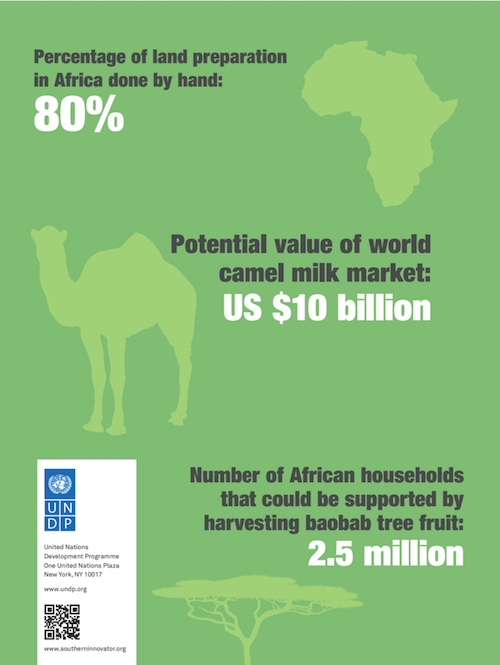
    The fruit of the highly revered African baobab tree is being seen as a great new opportunity for the poor, after a recent decision by the European Commission to allow its importation. According to one study, gathering the fruit has the potential to earn an extra US $1 billion a year for Africa, and bring work and income to 2.5 million households, most of them African bush dwellers (Britain’s Natural Resources Institute).

    The fruit of the African baobab tree is mostly collected in the wild from the ancient trees, which can live for 500 years, with some as old as 5,000 years. The baobob enjoys the veneration and respect traditionally accorded to age in Africa, and features in many stories and myths.

    The fruit is seen as highly nutritious and a new taste option for the European market. This could be a major potential boost to Africa; the European Union is the world’s biggest trader, accounting for 20 percent of global imports and exports, and a major trading partner of most African countries. South Africa alone exports Euro 20.9 billion a year to Europe (2007).

    But serious concerns have been raised about how the harvesting of the fruit will be done, and under what conditions. Getting this right is critical if the sustainability of the fruit is to be maintained, local populations are to benefit, and local use of this food source — eaten by both people and animals — does not suffer.

    European food and drink companies are looking to use the fruit of the tree to flavour a large range of products, from cereal to drinks.

    Baobab fruit is valued for its alleged medicinal properties in treating fevers and diarrhoea, and as a calcium supplement.

    “The potential is huge … We’re quite confident that it’s going to represent significant returns for rural producers,” Dr. Lucy Welford, marketing manager of PhytoTrade Africa, a trade organisation that campaigns for the sustainable use of African natural products, told Reuters.

    “I’d say it’s somewhere between grapefruit and tamarind as a kind of flavour,” said Welford, who expects baobab fruit to be used at first to flavour smoothies and cereal bars. It could also be used in juices, ice-creams and jams or bakery products.

    PhytoTrade works with South African firm Afriplex, which supplies baobab fruit pulp and extracts.

    A refreshing juice made from baobab fruit pulp, known as “bouye” is widely served.

    “The tart flavour, the interesting vitamin and nutrition profile and the sexy story that goes with it — that it’s wild harvested from a very lovely tree — these things add value to the existing products,” said marketing economist Ben Bennet, who wrote the 2007 Natural Resources Institute’s report.

    In the baobab forests around Tandene village in Senegal, local farmers said they looked forward to earning much more from the trees. Prices for a kilo of baobab fruit varied between 40 US cents and a dollar, they said.

    “If people know (that European consumers will buy the product) then they’ll look after the trees better and feed them less to their animals,” said farmer Alassane Sy.

    Chido Makunike, an active commentator on food and agricultural issues in Africa, raises some serious concerns about how this is handled. “Being a non-cultivated forest product, who ‘owns’ the baobab fruit? Can anybody just take a truck into the forest, collect the fruit and export it? Obviously the sudden dramatic change in the economic importance of the baobab will open up many questions that will need regulation.”

    He worries the fruit will just be exported in its raw form, and processed into products in Europe – leaving Africa and Africans the ones who benefit least economically.

    “Yet baobab is a dry, not-easily perishable, easy to process fruit,” he said. “It would not be difficult to have the smoothies and cereal bars that are being contemplated for its use made in Africa and exported as finished product, producing many downstream benefits and keeping more of the wealth to be generated within the continent.”

    Published: October 2008

    Resources

    • The Chamber of Commerce for Switzerland is specially targeting trade deals with Africa and its entrepreneurs. Website: www.swisscham-africa.ch
    • Food Safety – From the Farm to the Fork is the European Commission’s guidelines on food safety and how to prepare food for import into the European Community. Website: http://ec.europa.eu/food/international/trade/index_en.htm
    • EMN Europe is a company that organises all logistics for importing goods into Europe, including making sure all legal requirements are met.
      Website: www.eurotradeconcept.nl
    • The Baobab Fruit Company Senegal has been producing organic baobab products for the nutrition and cosmetics industries.
      Website: http://www.baobabfruitco.com/
    • The Fairtrade Labelling Organization sets the standards for fair-trade and is the place to go to receive official certification.
      Website: www.fairtrade.org.uk
    • Just Food is a web portal packed with the latest news on the global food industry and packed with events and special briefings to fill entrepreneurs in on the difficult issues and constantly shifting market demands. Websitehttp://www.just-food.com
    Creative Commons License

    This work is licensed under a
    Creative Commons Attribution-Noncommercial-No Derivative Works 3.0 License.

    ORCID iD: https://orcid.org/0000-0001-5311-1052.

    © David South Consulting 2022

  • Carbon Credits Can Benefit African Farmers Thanks to New System

    Carbon Credits Can Benefit African Farmers Thanks to New System

    By David SouthDevelopment Challenges, South-South Solutions

    SOUTH-SOUTH CASE STUDY

    The global carbon credit trading schemes emanating from the Kyoto Protocol are now creating a multi-billion dollar market – the European carbon market was worth €14.6 billion in 2006 – and represents one of the fastest growing business opportunities in the world. Being green has finally come of age. Yet all the benefits of this are largely bypassing Africa despite more than 70 percent of the continent’s inhabitants earning a living off the land.

    The World Agroforestry Centre – whose mission is to advance the science and practice of agroforestry to transform the lives and landscapes of the rural poor in developing countries – in partnership with Michigan State University has developed a method using satellite imagery and infrared sensing that measures carbon storage in African farmland. They have completed a pilot programme in western Kenya and are ready to encourage poor farmers to plant trees as soon as the European Union allows carbon credits under the Kyoto Protocol to be awarded for this kind of scheme. Further pilot projects will be rolled out in 2007 in partnership with CARE International and the WWF.

    But European Union policies on carbon credits are holding back this significant opportunity to enhance African livelihoods. Europe’s Emissions Trading Scheme (ETS) is at present not willing to recognize the new method of verifying carbon storage in farmland. The ETS is the largest multi-country, multi-sector greenhouse gas emission trading scheme in the world. The issue of carbon storage, or carbon “sinks” as they are known, is very controversial in the world of Kyoto agreement implementation. Non-government organizations that advocate for forests and indigenous people have worked hard to exclude the use of forestry credits to offset fossil fuel burning, arguing that forestry offsets to date have been for big monoculture plantations of fast-growing eucalyptus or pine trees. It is claimed they are net carbon emitters over their lifetimes and also cause additional environmental and social problems.

    But the World Agroforestry Centre’s approach is very different from a monoculture plantation. Their scheme is to help rural Africans to integrate more trees into their agricultural production systems, with benefits besides storing carbon. They argue that the right kinds of trees can increase the productivity and resilience of the land. Trees provide food, fuel, fertilizer, and medicine – medicinal trees are the main source of medication for 80 percent of Africa’s population.

    Louis Verchon, the lead scientist for climate change at the World Agroforestry Centre, believes that if the EU would put in place a new scheme to credit farmers who capture carbon in their land, “millions of dollars in carbon credits could begin flowing to the world’s rural poor.” At present, Verchon says two-thirds of the carbon credit business is being captured by Asian countries who are mostly offering industrial solutions. “Africa has something to offer on this – it can’t compete with the likes of South Korea on industrial solutions, but it has plenty of land.”

    In order to make the scheme work, two things will need to be improved: Africa’s institutional weakness and the paucity of qualified carbon credit verifiers. A network of verifiers would be required to inspect farm sites and make the calculations required to allocate carbon credits to poor farmers. At present, there are no qualified African-born verifiers in Africa according to Verchon.

    The WAC are working with WWF and CARE to build up NGO capacity and start demonstration projects to prove it can work – two pilot projects are already up and running in Kenya. They are also automating much of the process by building a web portal.

    Verchon says the WAC “are in it for the long-haul and we will see this grow over the next ten years.”

    Published: January 2007

    Resources

    • More on emissions trading: Click here
    • Kenya’s Greenbelt Movement: Founded by Nobel Peace Prize winner Wangari Maathai, it provides income and sustenance to millions of people in Kenya through the planting of trees.
    Creative Commons License


    This work is licensed under a
    Creative Commons Attribution-Noncommercial-No Derivative Works 3.0 License.

    ORCID iD: https://orcid.org/0000-0001-5311-1052.

    © David South Consulting 2023
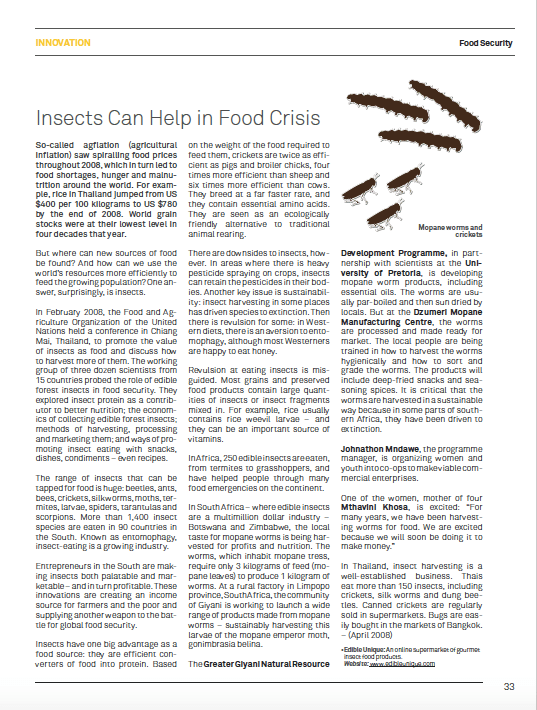
  • Insects Can Help in Food Crisis

    Insects Can Help in Food Crisis

    By David SouthDevelopment Challenges, South-South Solutions

    SOUTH-SOUTH CASE STUDY

    For many years it was a given that the world’s problem was not a lack of food, but that it was unfairly shared. But as the switch to biofuels gathers pace, farmland is being diverted away from growing food for people, to food for fuel. On top of this, growing prosperity in many countries in the South has boosted demand for better quality food, including grain-devouring meat diets – it takes 10 kilograms of grain to get one kilogram of meat from a cow. The crisis has deeply alarmed the UN’s World Food Programme and the World Bank. In the economic battle for food, the poor are the most vulnerable.

    So-called agflation (agricultural inflation) has seen spiraling food prices, which in turn are causing food shortages, hunger and malnutrition around the world. For example, rice in Thailand has jumped from US $400 per 100 kilograms in January, to US $760. World grain stocks are at their lowest level in four decades.

    But where can new sources of food be found? And what would be a more efficient use of the world’s resources to feed the growing population? One answer, surprisingly, is insects.

    In February this year the UN’s Food and Agriculture Organization held a conference in Chiang Mai, Thailand to devour the dietary value of insects as food and discuss how to harvest more of them. The working group of three dozen scientists from 15 countries probed the role of edible forest insects in food security. They explored insect protein as a contributor to better nutrition, the economics of collecting edible forest insects, methods of harvesting, processing and marketing edible forest insects, and ways of promoting insect eating with snacks, dishes, condiments — even recipes.

    The range of insects that can be tapped for food is huge: beetles, ants, bees, crickets, silk worms, moths, termites, larvae, spiders, tarantulas and scorpions. More than 1,400 insect species are eaten in 90 countries in the South. Known as entomophagy, insect eating is a growing industry. Entrepreneurs in the South are making insects both palatable and marketable – and in turn profitable. These innovations are adding another income source for farmers and the poor, and supplying another weapon to the battle for global food security.

    Insects have one big advantage as a food source: they are efficient converters of food into protein. Based on the weight of the food required to feed them, crickets are twice as efficient as pigs and broiler chicks, four times more efficient than sheep and six times more efficient than cows. They breed at a far faster rate, and they contain essential amino acids. They are seen as an ecologically friendly alternative to traditional animal rearing.

    There are downsides to insects, however. In areas where there is heavy pesticide spraying on crops, insects can retain the pesticides in their bodies. Another key issue is sustainability: insect harvesting in some places has driven species to extinction. Then there is revulsion for some: in Western diets, there is an aversion to entomophagy, although most Westerners are happy to eat honey.

    Revulsion at eating of insects is misguided. Most grains and preserved food products contain large quantities of insects or insect fragments mixed in. For example, rice usually contains rice weevil larvae – and they can be an important source of vitamins.

    In Africa, 250 edible insects are eaten, from termites to grasshoppers, and have helped people through many food emergencies on the continent.

    In South Africa — where edible insects are a multimillion dollar industry — Botswana and Zimbabwe, the local taste for mopane worms is being harvested for profits and nutrition. The worms, which inhabit mopane tress, require only three kilograms of feed (mopane leaves) to produce one kilogram of worms. At a rural factory in Limpopo province, South Africa, the community of Giyani is working to launch a wide range of products made from mopane worms – sustainably harvesting this larvae of the mopane emperor moth, gonimbrasia belina.

    The Greater Giyani Natural Resources Development Programme in partnership with scientists at the University of Pretoria, is developing mopane worm products, including essential oils. The worms are usually par-boiled and then sun dried by locals. But at the Dzumeri Mopane Manufacturing Centre, the worms are processed and made ready for market. The local people are being trained in how to harvest the worms hygienically, and how to sort and grade the worms. The products will include deep-fried snacks and seasoning spices. It is critical the worms are harvested in a sustainable way, because in some parts of southern Africa, they have been driven to extinction.

    Johnathon Mndawe, the programme manager, is organizing women and youth into co-ops to make viable commercial enterprises. “We expect the product to hit supermarket shelves in 2009,” said Morewane Mampuru, coordinator for the Centre for Scientific and Industrial Research, another partner.

    One of the women, mother of four Mthavini Khosa, is excited: “For many years, we have been harvesting worms for food. We are excited because we will soon be doing it to make money.”

    In Thailand, insect harvesting is a well-established business. Thais eat more than 150 insects, including crickets, silk worms and dung beetles. Canned crickets are regularly sold in supermarkets. Bugs are easily bought in the markets of Bangkok.

    Online vendor Thailand Unique, based in Udon Thani, sells and markets a wide range of edible insects. They include edible scorpions, preserved giant water bugs, roasted grasshoppers, edible big crickets, bamboo worms, crushed giant bug paste, and introducing this year, Bug Snackz and Scorpion Thai Green Curry. There is even a ‘Bug Sample Pack’, containing a mix of seven edible insects and arachnids, all slow roasted for easy snacking.

    Another important centre for insect harvesting is Latin America. In Venezuala, the Pemon Indians eat fire ants during the rainy season.

    In Colombia, so-called “fatass ant” or “hormiga culona” is eaten like popcorn in movie theatres. Some believe it is a defence against cancer, or a natural aphrodisiac. Eating the ants or culona, has been happening right back to the ancient Guane Indians.

    In Santander province, farmers are exporting the ants for sale, some being dipped in Belgian chocolate and sold as a luxury food in London’s Harrods and Fortnum and Mason department stores. The abundant ant population brings in US $11 a pound (kilogram conversion) for the farmers, a doubling in price since 2000.

    Farmers in the artist colony of Barichara harvest the ants – though concerns have been raised that they have been over-harvesting the population. Restaurants in the area offer ant-based spreads for bread and an ant-flavored lamb sauce.

    “It’s an age-old dilemma for the farmer — should I kill it or eat it?” said Andres Santamaria to CBS News, who was given a $40,000 grant from Santander’s government to develop an environmentally sustainable, export-oriented programme for breeding the ants.

    In Tijuana, Mexico, ancient Aztec, pre-Colombian insect meals are on offer at this restaurant, joining a global trend. Cien Anios (“100 Years”), specialises in pre-Colombian, Aztec insect recipes. It is proof there is money in preparing insects for food. Typical dishes include garlicky ant eggs and cactus worms in butter.

    Published: April 2008

    Resources

    • A network for insect collectors: Website: www.insect.net
    • Sunrise Land Shrimp: A do-it-yourself guide to raising and harvesting insects for food, with important information on health and hygiene: Website: www.slshrimp.com
    • Edible Unique: An online supermarket of gourmet insect food products. Website: www.edibleunique.com

    https://davidsouthconsulting.org/2022/11/18/farmers-weather-fertilizer-crisis-by-going-organic/

    https://davidsouthconsulting.org/2022/11/11/urban-farming-to-tackle-global-food-crisis/

    Tijuana‘s Cien Años was the original inspiration for this story. As one of the first stories to draw attention to the insects-for-food market, it contributed to a growing awareness of this exciting food source. I had a delicious all-insect meal there in 2002.

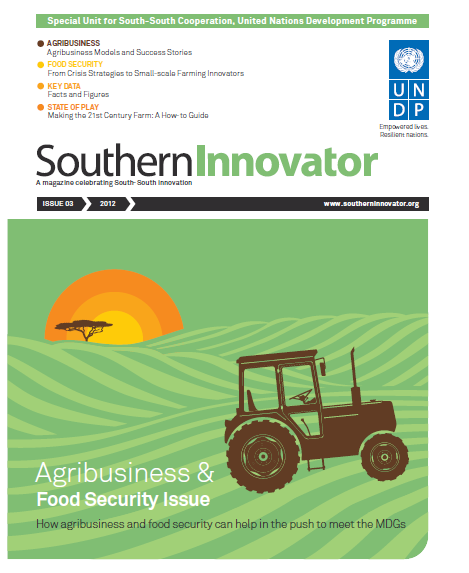
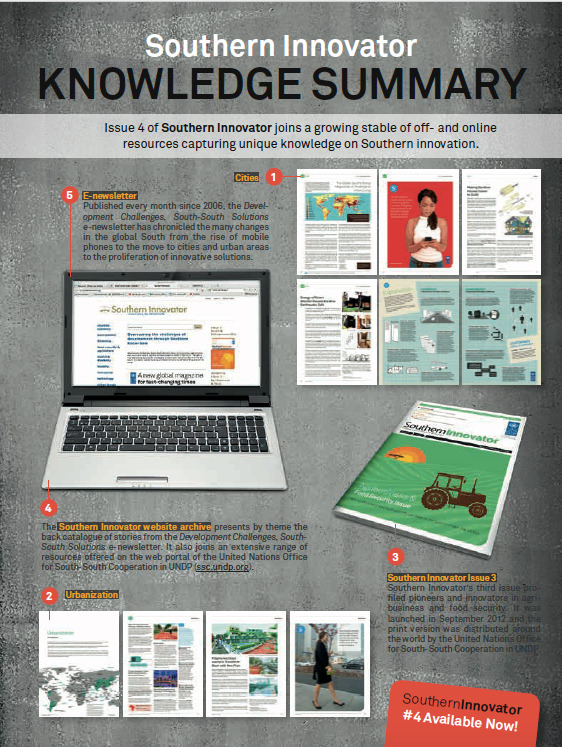
    https://davidsouthconsulting.org/2021/03/05/southern-innovator-issue-3/

    Creative Commons License

    This work is licensed under a
    Creative Commons Attribution-Noncommercial-No Derivative Works 3.0 License.

    ORCID iD: https://orcid.org/0000-0001-5311-1052.

    © David South Consulting 2022