Categories
Archive Development Challenges, South-South Solutions Newsletters

Cheap Farming Kit Hopes to Help More Become Farmers

By David SouthDevelopment Challenges, South-South Solutions

SOUTH-SOUTH CASE STUDY

Food security is key to economic growth and human development. A secure and affordable food supply means people can meet their nutrition needs and direct their resources to improving other aspects of their lives, such as housing, clothing, health services or education.

One solution hopes to boost productivity for small-scale farmers and make agriculture a more attractive income source to the young and poor, by making it possible to grow food year-round. Kenyan social enterprise Amiran Kenya is selling the Amiran Foundation Kit (amirankenya.com), a simple-to-use greenhouse farming kit. As well as helping people grow both food and their agricultural business, Amiran Kenya hopes young people will also buy the kits at a discount and then sell them for a profit to others.

The technology to grow food year-round is already available, but it is generally expensive to set up. This cost is usually prohibitive to the poor and young: two groups who could really benefit from the income. And if young people in Africa learn the basics of farming, in time they could expand and develop into agribusinesses and benefit from the growing food demand on the continent.

Africa, a continent undergoing significant economic change, has yet to fully realize its potential as a producer of agricultural products to feed itself and the world. Africa currently has a labour-intensive but very inefficient agriculture system. While many Africans either make their living in agriculture or engage in subsistence farming for survival, much of Africa’s farming is inefficient and fails to make the most of the continent’s rich resources and potential.

At present, agriculture, farmers and agribusinesses make up almost 50 per cent of Africa’s economic activity, and the continent’s food system is worth an estimated US $313 billion a year (World Bank). A World Bank report, Growing Africa: Unlocking the Potential of Agribusiness (http://siteresources.worldbank.org/INTAFRICA/Resources/africa-agribusiness-report-2013.pdf), argues that Africa could have a trillion-dollar agriculture market by 2030.

While large-scale agribusinesses are increasing in Africa, it is still reliant on small-scale farmers to meet the daily food needs of most of the population.

“The time has come for making African agriculture and agribusiness a catalyst for ending poverty,” said Makhtar Diop, World Bank Vice President for Africa. The continent needs to “boost its high growth rates, create more jobs, significantly reduce poverty, and grow enough cheap, nutritious food to feed its families, export its surplus crops, while safeguarding the continent’s environment.”

Any country that has to import food will be vulnerable to currency fluctuations and the inflation in prices this can cause. A country that has many options for food, and reduces its dependency on imported food resources, will have greater resilience when crisis strikes.

Greenhouses are a great way to expand the growing season, avoiding ups and downs in temperature. But they can be expensive to set up – something the kit hopes to resolve. A typical greenhouse kit will cost a Kenyan an estimated 10 times more than the Amiran Foundation Kit, which retails at Sh 14,500 (US $168).

The package includes a drip-feed kit, a 250 liter water tank, a one liter sprayer, instructional growing guides, fertilizer, agro chemicals and high-quality seeds. Crops that can be grown include cabbage, watermelon, kale and spinach. The drip kit is highly durable and can last eight years, according to its manufacturer.

The kit is being marketed as a “kick starter for the small scale farmers who want to adopt agribusiness” as their method for growing food.

“The farmers will have a chance to start small and grow bit by bit until they are able to afford the modern greenhouses which will set the ball rolling for them to enjoy the benefits of modern agribusiness,” Yariv Kedar, Amiran Kenya’s Deputy Director, explains on the company’s website.

The plan is to draw more people into agriculture by showing they do not need to be prisoners of weather patterns. Larger agribusiness enterprises already have the resources to benefit from technology such as greenhouses and avoid the worst effects of the weather.

By transcending fickle weather patterns, it is possible to reduce the risk of crop failure and the resulting financial damage – one reason people shy away from farming.

Amiran’s philosophy behind the kit is simple: knowledge and know-how matched with high-quality inputs that do not harm the environment. The idea is to introduce people to the concept of agribusiness, no matter how small their land size. Amiran estimates that by investing Sh 14,500 (US $168), a person could make Sh 25,000 (US $290) per season – making back in a season the initial investment cost.

Urban farmers and home gardeners are among those who can benefit, along with small-scale farmers in arid and semi-arid areas of Kenya.

Kedar said the kit’s drip pipes, which deliver water directly to the root of the plant, ensure that “every drop counts” and save between 30 to 60 per cent of water compared to other methods of irrigation.

“Using the Amiran Foundation Kit, farmers are now able to grow all year round and experience high yields while still conserving the scarce resource, water,” he said.

Published: March 2014

Resources

1) World Vegetable Center: The World Vegetable Center is the world’s leading international non-profit research and development institute committed to alleviating poverty and malnutrition in developing countries through vegetable research and development. Website: http://www.avrdc.org

2) Songhai Centre: a Benin-based NGO that is a training, production, research, and development centre in sustainable agriculture. Website: http://www.songhai.org/english

3) Marketing African Leafy Vegetables: Challenges and Opportunities in the Kenyan Context by Kennedy M. Shiundu and Ruth. K. Oniang. Website: http://www.ajfand.net/Issue15/PDFs/8%20Shiundu-IPGR2_8.pdf

4) African Alliance for Capital Expansion: A management consultancy focused on private sector development and agribusiness in West Africa. Website: http://www.africanace.com/v3

Development Challenges, South-South Solutions was launched as an e-newsletter in 2006 by UNDP’s South-South Cooperation Unit (now the United Nations Office for South-South Cooperation) based in New York, USA. It led on profiling the rise of the global South as an economic powerhouse and was one of the first regular publications to champion the global South’s innovators, entrepreneurs, and pioneers. It tracked the key trends that are now so profoundly reshaping how development is seen and done. This includes the rapid take-up of mobile phones and information technology in the global South (as profiled in the first issue of magazine Southern Innovator), the move to becoming a majority urban world, a growing global innovator culture, and the plethora of solutions being developed in the global South to tackle its problems and improve living conditions and boost human development. The success of the e-newsletter led to the launch of the magazine Southern Innovator. 

Creative Commons License

This work is licensed under a
Creative Commons Attribution-Noncommercial-No Derivative Works 3.0 License.

ORCID iD: https://orcid.org/0000-0001-5311-1052.

© David South Consulting 2023

Categories
Archive Development Challenges, South-South Solutions Newsletters Southern Innovator magazine

Cool Food for the Poor

By David SouthDevelopment Challenges, South-South Solutions

SOUTH-SOUTH CASE STUDY

A whole wave of high-tech, innovative products are now being developed and marketed for the world’s poor. These products are designed to raise the quality of life of poor people and treat them as a market with real needs, rather than a mass of people to be ignored.

One of the major challenges of the 21st century is finding ways to make these products affordable for the poor – bringing significant development gains in health and quality of life – without increasing the burden on the world’s environment. In India, this vast new market is rapidly coming alive, with new marketing channels reaching deep into the country’s slums and aided by a lively media scene turning people on to new products.

India is turning its large number of well-trained engineers and product designers to the task of making relevant products for the country’s millions of rural poor.

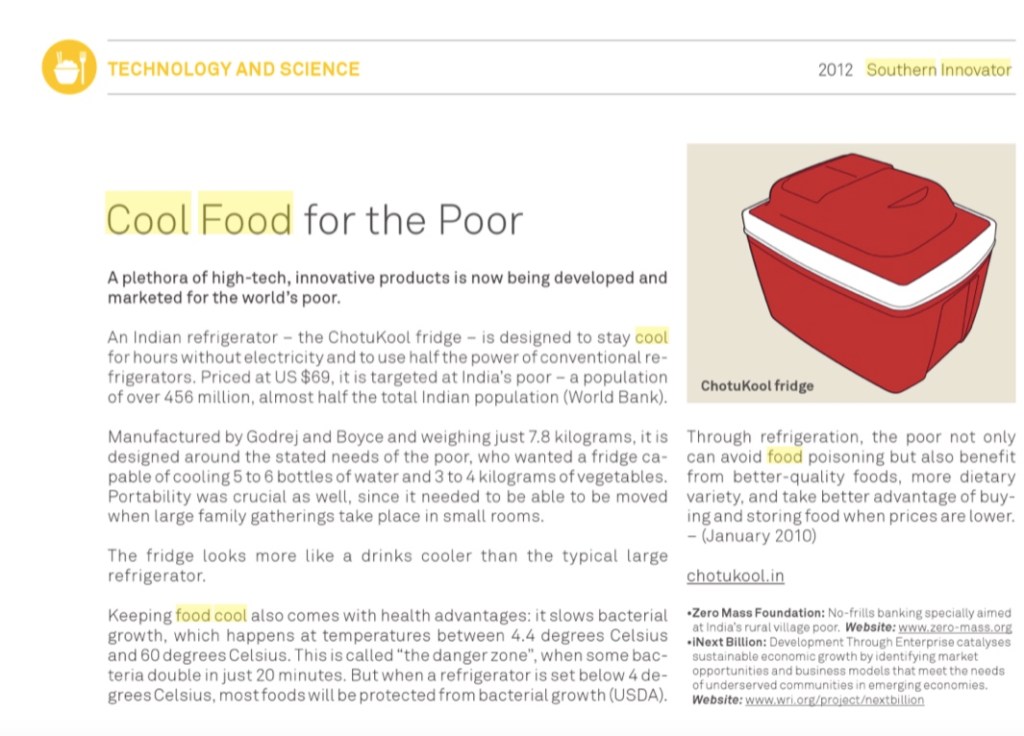
An Indian refrigerator – the ChotuKool fridge (http://www.new.godrej.com/godrej/godrej/index.aspx?id=1) – is designed to stay cool for hours without electricity and to use half the power of conventional refrigerators. Priced at US $69, it is targeted at India’s poor – a population of over 456 million, almost half the total Indian population (World Bank).

Manufactured by Godrej and Boyce and weighing just 7.8 kilograms, it is designed around the stated needs of the poor, who wanted a fridge capable of cooling 5 to 6 bottles of water and 3 to 4 kilograms of vegetables. Portability was crucial as well, since it needed to be moved when large family gatherings take place in small rooms.

As a video shows (http://www.youtube.com/watch?v=dtCRlynp0bM), the fridge looks more like a drinks cooler than the typical large refrigerator. It works by replacing the standard compressor motor found in most fridges with a battery-powered heat exchanger.

A group of village women was involved in the design process from the beginning. The fridges are being distributed by a microfinance group.

While people in developed countries take it for granted they will have both a refrigerator and a steady supply of electricity, the world’s poor have few options for keeping food cool.

There is a strong economic advantage to refrigeration: many farmers have to throw away vegetables or sell at high discounts because they are quickly spoiling in the heat. By refrigerating, they can keep them fresh and get the higher price. For somebody living on less than US $2 a day, this is a big economic boost.

Keeping food cool also comes with health advantages: it slows bacterial (http://en.wikipedia.org/wiki/Bacteria) growth, which happens at temperatures between 4.4 degrees Celsius and 60 degrees Celsius. This is called ‘the danger zone’, when some bacteria double in just 20 minutes. But when a refrigerator is set below 4 degrees Celsius, most foods will be protected from bacteria growth (USDA).

Through refrigeration, the poor not only can avoid food poisoning, but also benefit from better quality foods, more dietary variety, and better take advantage of buying and storing food when prices are lower. For example, eggs in a refrigerator can last for up to five weeks. Fresh fish can be stored unfrozen for up to two days.

The quality of life improvements from refrigeration are obvious. But with conventional refrigerators costly and dependent on a steady supply of electricity, the poor will not buy them.

An Indian government survey in 2007/08 found daily pay in rural areas ranged from 45 rupees a day (US $1) to 110 rupees a day (US $2.40). This means the ChotuKool fridge costs between one and two month’s wages for a rural worker.

Some argue even the cost of the ChotuKool is still too prohibitive to many poor people. And there are other initiatives out there to offer low-tech solutions to cooling food.

In Nigeria, grassroots inventor Mohammed Bah Abba has designed a cooler called the Zeer (http://practicalaction.org/?id=zeerpots). It works like this: two ceramic earthenware pots of different sizes are arranged one inside the other. The space between the pots is filled with wet sand and kept moist. The user then places their drinks or vegetables inside and covers with a damp cloth. As the water from the moist sand evaporates (http://en.wikipedia.org/wiki/Evaporation), the air inside the centre pot is cooled several degrees, enough to preserve some foods and drinks.

Another Indian innovation is also targeting the rural poor consumer: a water filter. Called the Swach water purifier (http://www.tata.com/article.aspx?artid=TtOdcdNuSRk=), it is aimed at households and stands just less than 1 metre (just over 3 feet) in height. The filter is designed to do bulk water purification and is the result of 10 years’ research. It is aimed at the one billion people in the world who do not have access to clean water. It will sell for 1,000 rupees (US $21.50).

It is very slick and modern in design, with a mix of white and clear plastic, resembling the commonly used Brita (http://www.brita.net/) water filters found in many homes. It works by using ash from rice milling to filter out bacteria. The ash is impregnated with silver particles to kill germs that cause diarrhoea, cholera and typhoid. It is able to purify 3,000 litres of water before the cartridge needs to be replaced.

It is manufactured by the Indian industrial giant Tata.

“It was the pressing need of people trapped by the effects of natural disasters such as the (2004 Indian Ocean) tsunami that saw the deployment of one of the earliest versions of this product,” said Tata vice chairman S. Ramadorai. “A key part was the insight that a natural material like rice husk can be processed to significantly reduce water-borne germs and odours when impure water is passed through it.”

Published: January 2010

Resources

1) Indian Firms Shift Focus to the Poor: An article in the Wall Street Journal on this new trend. Website: http://online.wsj.com/article/SB125598988906795035.html?mod=relevancy

2) Zero Mass Foundation: No-frills banking specially aimed at India’s rural village poor. Website: http://www.zero-mass.org/

3) iNext Billion: Development Through Enterprise catalyzes sustainable economic growth by identifying market opportunities and business models that meet the needs of underserved communities in emerging economies. Website: http://www.wri.org/project/nextbillion

Development Challenges, South-South Solutions was launched as an e-newsletter in 2006 by UNDP’s South-South Cooperation Unit (now the United Nations Office for South-South Cooperation) based in New York, USA. It led on profiling the rise of the global South as an economic powerhouse and was one of the first regular publications to champion the global South’s innovators, entrepreneurs, and pioneers. It tracked the key trends that are now so profoundly reshaping how development is seen and done. This includes the rapid take-up of mobile phones and information technology in the global South (as profiled in the first issue of magazine Southern Innovator), the move to becoming a majority urban world, a growing global innovator culture, and the plethora of solutions being developed in the global South to tackle its problems and improve living conditions and boost human development. The success of the e-newsletter led to the launch of the magazine Southern Innovator.  
Creative Commons License

This work is licensed under a
Creative Commons Attribution-Noncommercial-No Derivative Works 3.0 License.

ORCID iD: https://orcid.org/0000-0001-5311-1052.

© David South Consulting 2023

Categories
Archive Development Challenges, South-South Solutions Newsletters Southern Innovator magazine

Avoiding Wasting Food and Human Potential with ICTs

By David SouthDevelopment Challenges, South-South Solutions

SOUTH-SOUTH CASE STUDY

Creative use of information technology in the South is helping to address two very different kinds of waste – of food and of human and community potential.

In Ghana, a mobile phone-driven Internet marketplace is helping to improve efficiencies in farming and selling food. Another initiative is addressing the crisis in India’s villages by drawing on the diaspora of former villagers now living in urban environments around the world.

Finding ways to efficiently trade food is crucial to keeping hunger at bay and meeting the needs of growing populations. In a report earlier this year, the UN’s Environment Programme (UNEP) found that more than half of the world’s food is wasted or discarded.

“There is evidence … that the world could feed the entire projected population growth alone by becoming more efficient,” said Achim Steiner, UNEP Executive Director, at the launch of The Environmental Food Crisis: The Environment’s Role in Averting Future Food Crises.

Ghana is a country that has already gained a reputation as an IT leader in West Africa (www.ghanaictawards.com). Now a clever technology based in the capital, Accra, is using mobile phones to connect farmers and agricultural businesses and associations to the marketplace. By using SMS (http://en.wikipedia.org/wiki/SMS) text messages, information from the field is gathered and collated. This can include tracking what is happening on the farm, how crops are surviving the weather, and the status of food inventories day-by-day. All the data is collected by the TradeNet website and displayed with prices and deadlines for buyers and sellers to get in touch with each other. This reduces the time and cost involved in gathering updates from thousands of people across the country.

Launched in 2007, the service recently won the Information Communication Technology innovations contest by the World Summit Award (WAS) (http://www.wsis-award.org/about/index.wbp) of the United Nations’ World Summit on Information Society (WSIS).

TradeNet is currently collating market data from 13 countries and proclaims itself the largest SMS-based market information service on the continent of Africa. It has more than 12,000 registered users and covers 500 individual markets.

The service’s full name is TradeNet: Market Information on your Mobile (http://www.tradenet.biz/?lang=en), and it tracks products like ground nuts, sesame, tomato, maize and white beans. It offers market information from Afghanistan , Benin , Burkina Faso , Cameroon , Cote d’Ivoire , Ghana , Madagascar , Mali , Mozambique , Nigeria , Sudan and Togo.

Founded by its chief executive officer Mark Davies, TradeNet is run out of the internet start-up incubator Busy Lab (http://www.busylab.com/) in Accra. Busy Lab specializes in building mobile web solutions for companies and projects involved in rural media and computing.

While in India, villages are in crisis: As India’s economy has boomed, its small towns and villages have withered. Home to the majority of the country’s population, they are suffering declining populations and high suicide rates. India’s urban slums are where people are going; they are growing 250 percent faster than the country’s population. Yet so many people share some past connection with the country’s 260,000 ailing villages.

And while the world has become a majority urban place, it is acknowledged the future for the environment and agriculture rests in the health of villages.

The social media website Mana Vuru (www.manavuru.com) seeks to connect people living in cities with the villages they were born in, or where their families came from. It is about restoring the broken connection with the village in order to enhance their future development.

As Mana Vuru declares: “Villages form the backbone of our economy. True progress, growth and prosperity can only be realized when villages become self-sustainable.”

The site points out that “most villages are suffering from crippling infrastructure and some even lack the basic amenities like electricity and fresh water. We believe that every person who migrated to greener pastures and attained success and wealth should feel some sort of moral responsibility and do their bit for their respective villages.”

A project of the Palette School of Multimedia (http://www.palettemultimedia.com/) in Hyderabad – one of India’s technology hubs – the site lets former village dwellers register and start meeting and connecting with fellow members of the diaspora. Together they can network to help the village address its development challenges.

Published: August 2009

Resources

1) A video story by CNN on Tradenet. Website: http://www.youtube.com/watch?v=s6z0ywkHPPQ

2) BOP Source is a platform for companies and individuals at the BOP (bottom of the pyramid) to directly communicate, ultimately fostering close working relationships, and for NGOs and companies to dialogue and form mutually valuable public-private partnerships that serve the BOP.
Website: http://bopsource.ning.com/

3) Afriville is a Web 2.0 service and an African Caribbean social network. Afriville is a community website along the lines of the famous MySpace. Users are free to message and post profiles. The difference is that the user is able to choose how closed or open the networks are. The site features a state of the art music management system which allows African and Caribbean artists to get straight in touch with their fans.
Website: www.afriville.com

4) Business Action for Africa: Business Action for Africa is an international network of businesses and business organisations from Africa and elsewhere, coming together in support of three objectives: to positively influence policies for growth and poverty reduction, to promote a more balanced view of Africa, and to develop and showcase good business practice in Africa
Website: www.businessactionforafrica.org

5) Model Village India: An innovative concept to rejuvenate India’s villages and build economies and self-reliance. Website: http://www.modelvillageindia.org.in/index1.html

Development Challenges, South-South Solutions was launched as an e-newsletter in 2006 by UNDP’s South-South Cooperation Unit (now the United Nations Office for South-South Cooperation) based in New York, USA. It led on profiling the rise of the global South as an economic powerhouse and was one of the first regular publications to champion the global South’s innovators, entrepreneurs, and pioneers. It tracked the key trends that are now so profoundly reshaping how development is seen and done. This includes the rapid take-up of mobile phones and information technology in the global South (as profiled in the first issue of magazine Southern Innovator), the move to becoming a majority urban world, a growing global innovator culture, and the plethora of solutions being developed in the global South to tackle its problems and improve living conditions and boost human development. The success of the e-newsletter led to the launch of the magazine Southern Innovator.  

Creative Commons License

This work is licensed under a
Creative Commons Attribution-Noncommercial-No Derivative Works 3.0 License.

ORCID iD: https://orcid.org/0000-0001-5311-1052.

© David South Consulting 2023

Categories
Archive Development Challenges, South-South Solutions Newsletters Southern Innovator magazine

Brazil Preserves Family Farms and Keeps Food Local and Healthy 

By David SouthDevelopment Challenges, South-South Solutions

(Havana, Cuba), November 2008

SOUTH-SOUTH CASE STUDY

Today’s global food crisis sparked by a toxic mix of events – high oil and commodity prices, food scarcity, growing populations, and environmental catastrophes – has woken many up to the urgent need to secure food supplies and help those who grow the world’s food. More and more countries are turning to local and small farms – or family farms – to offer food security when times get rough.

Right now there are more than 862 million undernourished people around the world (FAO), and U.N. Secretary- General Ban Ki-moon has called for food production to increase 50 percent by 2030 just to meet rising demand. Three-quarters of the world’s poorest people living on less than US $1 a day live in rural areas in developing countries and 85 percent of the world’s farms are of less than two hectares in size.

There has long been a tension between those who believe in very large farms, agribusiness and mono-crops (http://en.wikipedia.org/wiki/Mono-cropping), and those who believe in having a large number of smaller farms with a wide variety of crops and animals.

Family farming has been seen as doomed for a long time. In the 19th century, figures like philosopher Karl Marx believed they would be split into capitalist farms and proletarian labour. Most modern economists regard family farming as an archaic way to grow food, destined to give way to agribusiness. Most family farms refute this, saying family farmers have been able to operate with success in both developed and developing countries.

And small farms have endured. The livelihoods of more than 2 billion people depend on the 450 million smallholder farms across the world. With their families, they account for a third of the world’s population.

Family farms are critical to weathering economic crises and ensuring a steady and secure food supply. The International Fund for Agricultural Development (IFAD) (www.ifad.org) called earlier this year for small family farms to be put at the heart of the global response to high food prices and to improve food security. And in Brazil, this call is being answered by a bold initiative to create what they call a “social technology”, combining a house building programme with diverse family farms.

Brazil is currently buying up unused land and distributing it to people making land claims, including Brazil’s Landless Workers Movement (http://www.mstbrazil.org). When they receive land, family farmers often find there is no house on the land, or just a very basic dwelling.

This is where the Brazilian farmer’s cooperative Cooperhaf: Cooperativa de Habitacao dos Agricultores Familiares (http://www.cooperhaf.org.br/), steps in. It has put together what it calls a “social technology” combining housing and farm diversification to support family farmers.

“We see the house as the core issue,” said Adriana Paola Paredes Penafiel, a projects adviser with the Cooperhaf. “The farmers can improve their productivity but the starting point is the house.

“Family farming is very important for the country – 70 percent of food for Brazilians comes from family farming,” said Penafiel. “The government wants to keep people in rural areas.”

Started in 2001 by a federation of farmers unions, the Cooperhaf works in 14 Brazilian states with family farmers.

“Family farmers had to organize themselves to deal with housing,” said Penafiel. “The cooperative was formed to mediate between farmers and the government. The farmers have a right in the law to a house.

“We promote diversification to make farmers less vulnerable: if they lose a crop in macro farming, they lose everything. We encourage diversification and self-consumption to guarantee the family has food everyday. We help to set up a garden.”

The concept is simple: a good quality home acts as an anchor to the family farm, making them more productive as farmers. The farmers receive up to 6,000 reals (US $2,290) for a house, and can choose designs from a portfolio of options from the Cooperhaf.

As in other countries, the Cooperhaf and other coops encourage markets and certification programmes to promote family farmed food and raise awareness. Penafiel says promoting the fact that the food is family farmed is critical: to the consumer it is healthier, fresher and contains fewer chemicals than imported produce.

“We sell a livelihood not a product. If you get to know the product, you are more conscious of what you eat.”

In the US, there are almost 2 million farms, 80 percent of which are small farms, a large percentage family-owned. More and more of these farmers are now selling their products directly to the public.

In the UK, family farms are on course to provide 10 percent of the country’s food and drink and be worth £15 billion a year.

“If we forget them, we actually may get a situation where, while meeting the world’s immediate supply targets, we wind up with an even greater imbalance in the global supply system and greater food insecurity,” said IFAD President Lennart Båge.

“Most agri business is for export,” said Penafiel. “If we don’t have food in the country, food for poor communities would not be available. This enables farmers to be more autonomous, not having to buy fertilizers and equipment and take on too much debt. That approach is not sustainable as we saw with the so-called Green Revolution.”

Published: December 2008

https://davidsouthconsulting.org/2020/12/14/african-farming-wisdom-now-scientifically-proven/

https://davidsouthconsulting.org/2022/11/16/brazils-agricultural-success-teaches-south-how-to-grow/

https://davidsouthconsulting.org/2022/10/10/cheap-farming-kit-hopes-to-help-more-become-farmers/

https://davidsouthconsulting.org/2022/11/18/farmers-weather-fertilizer-crisis-by-going-organic/

https://davidsouthconsulting.org/2022/11/01/indonesian-food-company-helps-itself-by-making-farmers-more-efficient/

https://davidsouthconsulting.org/2022/11/23/kenyan-farmer-uses-internet-to-boost-potato-farm/

https://davidsouthconsulting.org/2021/11/09/pocket-friendly-solution-to-help-farmers-go-organic/

https://davidsouthconsulting.org/2021/09/16/small-fish-farming-opportunity-can-wipe-out-malnutrition/

https://davidsouthconsulting.org/2022/11/11/urban-farming-to-tackle-global-food-crisis/

https://davidsouthconsulting.org/2022/10/18/woman-wants-african-farming-to-be-cool/

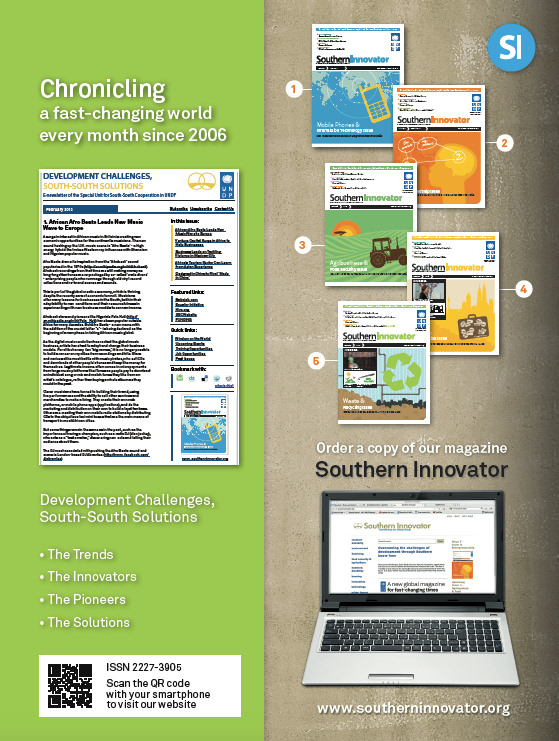
Development Challenges, South-South Solutions was launched as an e-newsletter in 2006 by UNDP’s South-South Cooperation Unit (now the United Nations Office for South-South Cooperation) based in New York, USA. It led on profiling the rise of the global South as an economic powerhouse and was one of the first regular publications to champion the global South’s innovators, entrepreneurs, and pioneers. It tracked the key trends that are now so profoundly reshaping how development is seen and done. This includes the rapid take-up of mobile phones and information technology in the global South (as profiled in the first issue of magazine Southern Innovator), the move to becoming a majority urban world, a growing global innovator culture, and the plethora of solutions being developed in the global South to tackle its problems and improve living conditions and boost human development. The success of the e-newsletter led to the launch of the magazine Southern Innovator.  
Follow @SouthSouth1

Google Books: https://books.google.co.uk/books?id=YtEgTdyZioUC&dq=development+challenges+december+2008&source=gbs_navlinks_s

Slideshare: http://www.slideshare.net/DavidSouth1/development-challengessouthsouthsolutionsdecember2008issue

Southern Innovator Issue 1: https://books.google.co.uk/books?id=Q1O54YSE2BgC&dq=southern+innovator&source=gbs_navlinks_s

Southern Innovator Issue 2: https://books.google.co.uk/books?id=Ty0N969dcssC&dq=southern+innovator&source=gbs_navlinks_s

Southern Innovator Issue 3: https://books.google.co.uk/books?id=AQNt4YmhZagC&dq=southern+innovator&source=gbs_navlinks_s

Southern Innovator Issue 4: https://books.google.co.uk/books?id=9T_n2tA7l4EC&dq=southern+innovator&source=gbs_navlinks_s

Southern Innovator Issue 5: https://books.google.co.uk/books?id=6ILdAgAAQBAJ&dq=southern+innovator&source=gbs_navlinks_s

https://davidsouthconsulting.org/2021/03/05/southern-innovator-issue-3/

Creative Commons License
This work is licensed under a
Creative Commons Attribution-Noncommercial-No Derivative Works 3.0 License.

ORCID iD: https://orcid.org/0000-0001-5311-1052.

© David South Consulting 2023