Tag: finance

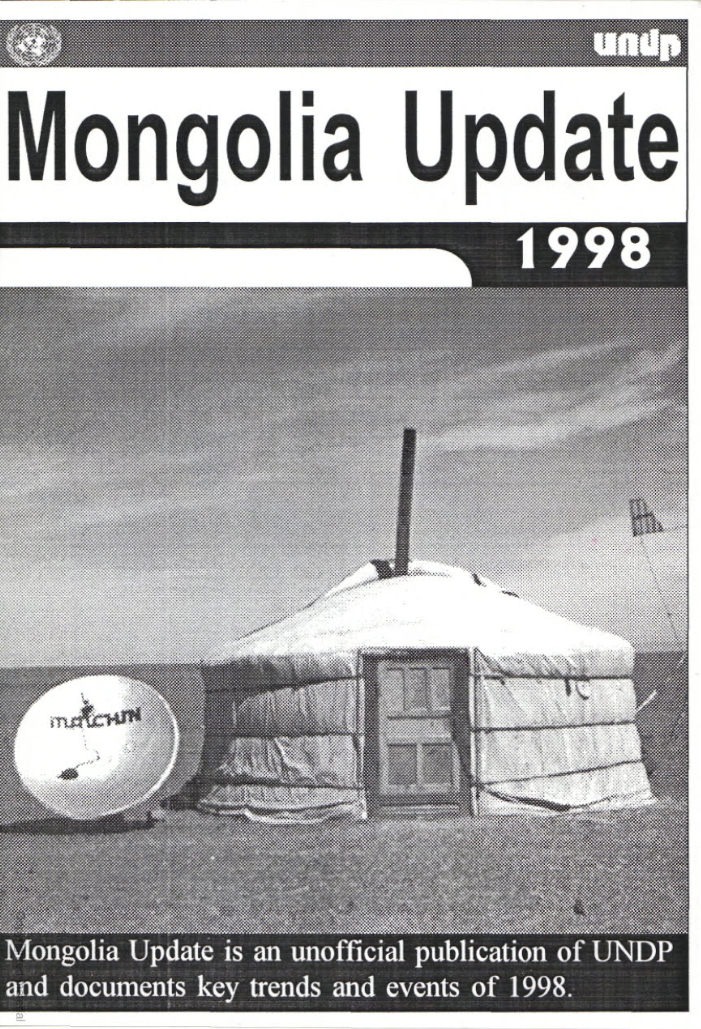
  • Mongolia Update | April 1997

    Mongolia Update | April 1997

    Publisher: UNDP Mongolia Communications Office

    Published: April 1997

    This is an unofficial publication of UNDP. Views presented in this document do not necessarily reflect those of UNDP. Mongolia Update is provided as service to those who are interested in the rapid changes taking place in today’s Mongolia.

    General Update

    Economic and Social Update

    Partnership for Progress Update

    New Initiatives

    I.General Update

    Presidential Elections

    This is the third time during a twelve month period that Mongols are going to cast their vote. This May 18 they will make a decision on who will be the second president of the country. There are currently 1.2 million citizens of Mongolia eligible to vote to elect the new president. 30 regional election committees have been set up in the 21 aimags and nine districts of the city of Ulaanbaatar. Three presidential nominees were officially recognized by the general election committee and have received their certificates. The three include the incumbent president P. Ochirbat who promises to concentrate on implementing demands of the society and population, J. Gombojav prioritizing restoration of discipline and order, poverty alleviation and unemployment, and N. Bagabandi stressing the issue of social justice.

    Spring Session of the Parliament

    The spring session of the Parliament commenced on April 5. Out of more than 90 bills awaiting parliamentary approval, 27 draft laws have been included in the session agenda. These include such important legislation as the package of laws on taxation, amendments to the law on the constitutional court (Tsets) and among others a number of laws related to social issues, on land privatization, media, foreign military presence and transit.

    During the four months of the Fall session, the Parliament approved 18 laws, introduced amendments to 34 laws and issued 47 resolutions. Among the laws passed were packages on housing privatization, social protection and the law on NGOs.

    Spring Fires

    The 386 spring fires of last year took the lives of 25 people and injured 61 others, affected 10.2 million hectares of land, 175 dwellings and 7,690 livestock. The total damage was estimated at MNT1,129.4 billion, including MNT1,128.4 billion in ecological and economic damage, MNT589 million in damage to the private and public property, and MNT372.1 million in direct expenditures for fire fighting.

    As for this year, to date in April , a total of 51 forest fires have been registered in the country. Currently only three fires in Huvsgul, Hentii and Bulgan provinces are still being fought. The commission issued an instruction to strengthen monitoring of contained fires that still are going underneath the earth’s surface and can break out at any time. The commission regularly receives photos from a US satellite and this helps spot fires at a stage early enough to alert and mobilize local communities.

    II.Economic and Social Update

    Inflation Developments

    Mongolia seems to be different from its Asian neighbors in that while in those countries the Lunar New Year means a shopping rush and sales, in Mongolia it is quite the opposite. In Mongolia small traders dictate the prices in a country highly dependent on imports of basic necessities. It is not surprising that traders who supply almost 60-70 per cent of imported foodstuffs want to squeeze as much money as possible out of thier customers. The state customs tax inspection reported that the volume of imports grew three fold over the weeks preceding the Lunar New Year.

    The consumer index grew up by 8.1% since last December, and 2.3% as of March. Prices on meat, milk, milk products, home utilities, clothing and footwear have increased. Economists attribute the price hike to the soaring exchange rate of the Togrog vis-a-vis the US Dollar. Since the beginning of the year, the average inflation rate was up 2.7%.

    In accordance with the March report of the State Statistical Office, average household income in the country in February was MNT60.8 thousand. On average, compared to the same period in 1995, household income increased by 14.1%. The average monthly monetary expenditures per household was MNT60.8 thousand. The composition of household expenditure in the capital city includes food expenses up to 55% compared to the same period in 1996. In rural areas expenses for food stuffs comprise 47.4% as compared to the same period in 1996. Food expenditure was mostly for purchasing flour, flour products, meat and meat products. In Ulaanbaatar the change in consumption is due to a small shift towards payments for services such as public transport. As for the rural areas, this shift can be attributed to non- food expenses such as investment in private production, services and purchases of clothing and fabrics.

    Exchange Rate Developments

    16 per cent devaluation of the national currency during two weeks of March, following the Lunar New Year celebrations, was possibly due to the distrust people have towards the banks and a desire to convert their savings into hard currency. The parallel market rate reached MNT960 vis-a-vis the US Dollar. The Bank of Mongolia did not intervene in the process attributing the situation to a surge in demand for hard currency following the long winter months of slow trading. Every spring there is a short period, when the exchange rate surges but not as high as this year. This year, during the first three weeks of March, the rate went up by 8 percent compared to 6% in 1994, 7% in 1995 and 2% in 1997. Last year the central bank spent $ 73 million to maintain the exchange rate at MNT 640.

    As of the end of March, official statistics showed a 19.7% increase in the exchange rate of the Togrog vis-a-vis the US Dollar against the beginning of 1997 and some 69.7% increase when compared to the same period last year.

    Monetary and Banking Developments

    The Debt Collection Service, established last September, is working on returning to the banks coffers MNT28 billion in debts considered bad and resulting from the issue of MNT17.4 billion in credits in cities and MNT8.2 billion in credits in rural areas over the last few years, without proper examination of the lenders’ financial credibility.

    The Service collected more than MNT700 million within four months of 1996 and plans to bring back another MNT10 billion this year. Recently the department started applying indirect pressure by publishing the names of individuals and companies heavily indebted to banks. Eventually, the plans are to sell the debt papers on the securities market.

    The Bank of Mongolia reported that at the end of February, total money supply reached MNT114.5 billion, that is 10.8% less than that reported at the beginning of the year and about 12% more than during the same period in 1996.

    In March savings increased by 6.4%. This was connected with a 19.4% or MNT4.7 billion increase in foreign currency savings. Individual savings dropped by 1.5% against February but the account balances of economic entities increased by 4%.

    Fiscal Developments

    For 1997, state budget revenues are projected at MNT158 billion and expenditure at MNT184 billion, with a deficit standing at MNT26 billion. It is planned that the deficit be maintained at 3.9% of the GDP with further curbing by MNT6 billion from the MNT30 billion deficit registered in 1996. The parliament added MNT16.4 billion to the banking sector reform and endorsed the government to issue MNT15 billion in government bonds to cover the state budget deficit. The finance minister announced that much attention will be given for promotion of small producers and promised, that foreign investment will be given more favorable conditions.

    At the end of February, state budget revenues reached MNT28.8 billion, expenditures MNT29 billion with the budget deficit standing at MNT0.2 billion.

    Projections for state budget revenues for the first two months of the year have been exceeded by MNT1.4 billion, or 6.2%. This resulted from actions taken by the Government during the last half of 1996 to ameliorate debt and tax collection, reforms in public administration and reduction of subsidies to economic entities to improve the structure of budget expenditures and stronger monitoring of state budget revenues and expenditures.

    Projections for state budget expenditure for the first two months of the year have not been reached with a shortfall of MNT4.7 billion, or 16.5%. This is explained, in part, by the shortfall in privatization earnings of MNT1.4 billion.

    The new package of nine laws on taxation was submitted for consideration in the Spring session of the Parliament. The Prime Minister emphasized the significance of the new tax reforms that would have a mid and long term positive impact on economic recovery and a healthy business environment providing assistance to manufacturers and consumers.

    Amendments were made to the income tax law of economic entities and organizations. The reason for making the amendment, according to the National Taxation Board, was that there are currently 30 thousand economic entities operating in the country out of which only 8 thousand actually pay income taxes. The income tax law on economic entities stipulates for a 15% tax on income up to MNT100 million and 40% for those with an income above MNT100 million. Medium-sized companies will receive better incentives under the new taxation system now being discussed by Parliament. In general, taxes will be reduced through expanding the taxpayers base. The present system of corporate taxation results in some companies underreporting their profits and evading taxes. The study revealed that only 71 large companies contribute 85 percent of the tax revenue.

    Excise taxes on alcohol, alcoholic beverages, and tobacco have been increased two-fold. This would have the long term effect of promotion of indigenous industries and reducing low quality imports. Excise tax law changes include excise on petrol, diesel fuel and imported cars. It is estimated that by imposing excise tax on imported vehicles more than MNT1100 million will be generated for the state budget.

    Regarding customs duties, all except duties on spirits, alcohol, tobacco, oil products will be eliminated effective May 1. There is currently MNT17,475 in revenue to the state budget from this source. The issue of offsetting the revenue lost as a result of the elimination of customs duties requires addressing through a nearly 30% saving of expenditures of the state budget.

    The Parliament set a 10% tax on annual incomes of between MNT0-576,000, a 20% income tax for incomes between MNT576,001-1.152 million, 40% tax for those with an annual income of more than MNT1,152,001. The percentage of income tax in rural areas, especially among herders with private livestock, will vary depending on the amount of income and the market price of the animal products. People with less than 150 head of livestock, old age pensioners and low- income families will be exempt from income tax.

    Nationwide Inventory of State Assets

    In mid- February, the State Property Committee launched a nationwide inventory of state assets. All state- owned assets across the country were registered anew and assessed. The main purpose of this exercise was to come up with a clear picture of state property thus facilitating the Government ‘s decision as to what is to be passed to local Government jurisdiction. A total of MNT 110 million was initially planned to be used for the inventory. For the first time a comprehensive computer database will be set up with all property and assets categorized under type, location and value.

    Industrial and Real Sector Activities

    Construction Sector

    The rise in construction activities of about 31.4% compared to the same period last year during the first three months of 1997, can be attributed to construction work done by joint Mongolian and foreign units. The number of incomplete buildings, most of them public, reached 321 due to a shortage of state budget investment in the sector. In 1993, the government had to halt construction and conserve 114 building and offer another 186 for sale. This did not bring the desired results. Now the government bears the burden of MNT30 million every year in maintenance costs of these incomplete structures. Since the MNT30 billion funding necessary to complete the construction is unavailable, they are slotted for sale to the private sector.

    Gross industrial production

    In the first three months of the year, industrial output declined by 4.8% and totaled MNT44.1 billion. A survey revealed that shortage of cash poses a major problem for about 60% of enterprises while 27.1% named high interest rates on bank credits. Another 13% of enterprises have problems with procuring raw materials and supplies.

    Production levels in the mining sector, including coal, metal ore and quarrying of stone. And in the manufacturing of beverages, wood and wood products, metal products and power increased. However, decreases in the production of such industrial products as forestry products, meat and meat products, and tanning and dressing of leather, were evident.

    The private sector accounted for 46% of the total industrial output.

    Agriculture

    The Ministry of Agriculture is concerned about the potential shortage of seeds for grain farming in 1997. Though the country’s capacity to store seed reserves is 50 thousand tons, for the last few years only 5 to 8 thousand tons of seed were kept because of a shortage of money to finance reserve stocks . This year only 5 thousand tons of seed were reserved, but, according to preliminary estimates, for the 1997 sowing season the requirement will be 70 thousand tons of grain seeds to cultivate an area of 350 thousand hectares.

    Although the Ministry of Agriculture and Industry planned to cultivate more than 320,000 hectares of land this year, only 270,000 will be sown. The problem of grain seeds was solved to a degree with 6,800 tons of seeds coming from the state special reserve. A shortage of funds did not allow the agriculture companies to procure spare parts and only 70% of machinery is ready for spring work. Out of MNT 3.3 billion necessary for the sowing season, the agricultural farms plan to invest MNT 1 billion on their own, with another one billion coming from the flour mills as credits. The government refrained from issuing credits as before, and limited tax reduction on revenues by 50 percent. Despite the government appeal, commercial banks came up with only about MNT 300 million in credits.

    Responding to the Government’s request for assistance in emergency seed supply for the 1997 growing season, through its Emergency Production of High Quality Elite Seed and New Variety Testing project UNDP will assist Mongolia’s private sector farmers by i) re-starting the multiplication of high quality wheat seed by private enterprises on a pilot scale, and ii) testing new high quality wheat varieties under Mongolian’s agro-ecological conditions. This project will be a critical lead-in to future interventions by donor agencies and the private sector. The Special Relief Operations Service (TCOR), FAO, have fielded a seed specialist and a procurement officer to Kazakhstan to check and procure 200 tons of elite wheat seed. At the same time, new high yield wheat varieties are being procured in countries with overlapping agro-ecological conditions. Six new varieties of wheat seed are being shipped from Mexico and others from Canada.

    Foreign Trade Developments

    The total reported trade volume in the first three months of 1996 reached US$ 149.7 million showing a decrease of 21.7% over the same period in 1996. Exports totaled US$79 million and imports US$70.7 million. Exports were down by 20.9%, and imports down by 22.7%.

    The decrease in exports was caused by the fact that overall volume and prices for exported goods fell. Both price and volume changes affected such main export commodities as copper concentrate, fluorite spar concentrate, scoured goat down and hides. In the first quarter of 1997, the average border price of these commodities, which represent 71.3 % of export goods, was down by 14.5 % against the same period last year. This has led to a loss of US$11.6 million in export earnings in the first quarter, or US$12.2 as compared to the same period in 1996.

    The decrease in imports can be attributed to the fall in imports of main commodities such as fuel, oil and metal products.

    Exports to other countries, except the neighboring, increased. Imports from developed countries increased by 9.1 points against the same period last year, while imports from other countries decreased.

    Some 47.3 % of exports went to Switzerland, one of the top export destinations in 1996, 19.2 % to China, 10.9 % to Russia, 5.1 % to UK, 4.9 % to Italy. 39.7 % of imports were from Russia, the bulk of this volume being petroleum products, 8.3 % from the United States, 6.8 % from China, 5.1 % from Denmark and 4.1 % from Japan.

    Privatization

    The third attempt to privatize the 35-year old State Department Store (SDS) at the opening price of MNT3.4 billion is at standstill due to lack of bidders.

    The law on housing privatization was passed in mid-October 1996 and seeks to privatize more than two million square meters or MNT256 billion worth of state-owned apartments and was supposed to go into effect from January 1, 1997. However, it was vetoed by the President who considered that the law needed a further review due to contradictions with the Housing and other laws. The Law was finally passed in February this year. Under the Law, MNT260 billion worth 4,300,000 square meters of state-owned housing will be transferred into private ownership free of charge. Presently about 2.3 million people live in state-owned apartments. The above Law has provisions for exemption from privatization charges for female pensioners over 55 and male pensioners over 60, the rightful children-owners and orphans, individuals receiving allowances for disabilities, families having over 4 children aged 16 and below, low income single mothers with over 4 children aged 16 and below. The basic cost for a square meter was determined by the Parliament to be MNT150,000 (equivalent of approx. $190). Privatization of housing will start as soon as the government approves about 10 procedures prepared by the Ministry of Infrastructure Development. Most of privatized housing is concentrated in the capital city, and the condition and market value of about 60,000 flats will be assessed by experts.

    More residents of the capital city prefer to live in their own houses. Last year alone, 1,800 families out of 2,400, who moved into new houses, have become the owners of private cottages with 56,000 square meters of total living space. In 1996, more than 20,000 applications for a land patch permit were sent to the city council and twice more are expected this year. Presently, nearly 60% of the city’s 580,000 population live in ghers, a traditional felt-walled dwelling.

    In the course of privatization in 1991 – 1992, about 270 state owned farms and cooperatives were split into 2,000 smaller private units short of funds and equipment necessary to maintain cultivation at 450,000 hectares of arable land. Last week the government approved the auction of seven major agriculture companies and the trade the state owned shares of another 45 shareholding companies. Given the persisting decline of agriculture production and the deep crisis in the sector, the government faces the necessity to undertake resolute steps to solve the problems.

    Social Issues

    Unemployment

    Official statistics quote 57.5 thousand unemployed people registered at labor exchanges as of the end February. This figure is 11.1 thousand more than that in the same period of 1996.

    Poverty

    Official statistics show that the number of poor in the country is 446 thousand comprising some 103.5 thousand households. The poverty level is thus 19.4% of the population. The statistics are based on calculations of average monthly income per member of the household and vary from the 1995 survey conducted with the IBRD during which the calculations were made on the basis of average monthly consumption per member of household. Out of the total poor, nationwide there are 61,8 thousand people who are neither employed nor in school.

    The minimum subsistence level has been revised nine times since 1991. The last revision was made in February this year and included stipulations for regions of Mongolia. The poverty line now stands at MNT10,400 for Ulaanbaatar, MNT10,380 for Orkhon-Uul and Darkhan-Uul, MNT9,720 for the Western region, MNT 9,420 for the Middle region, MNT9,340 for the Gobi region, and MNT9,250 for the Eastern region. Another revision of the minimum subsistence level and minimum hourly wage is pending discussion at the Spring session of the Parliament to reflect correctly the inflation rate.

    The provisional committee against poverty representing about a dozen NGOs started a hunger strike on April 1 demanding to address the problem of aggravating poverty. On April 10, the Prime Minister met with the protesters and explained that the government inherited the problem of more than 103,000 pensioners and 87,000 unemployed and has not been able to address their problem within the few months in office. He instructed the Minister ofHealth and Welfare, as well as the City Mayor to see how to help them. The mayor promised the strikers jobs, bank loans and land to grow vegetables. As a result of this, the hunger strike was called off.

    Health

    The salaries of 32,000 health sector employees will be raised in the next three months irrespective of the civil servants’ fixed salary system. This decision follows the nationwide, 18,000 strong warning strike of the health sector employees held on February 28. Figures are quoted that presently 80% of doctors and nurses live in poverty.

    The newly amended law on health insurance became effective on April 1 evoking different reactions from patients, who are now to be charged for medical treatment. Payment for several categories of medical services, including MNT 1,100 for an ambulance call, MNT 3,000 for a blood test, and about MNT 10,000 for comprehensive medical examinations, as well as MNT 2,500 for each day in hospital for those without health insurance, were introduced.

    Since the adoption of the new law, the number of patients undergoing medical treatment decreased and vulnerable groups were most affected by this change. Upon popular demand, the Ministry of Health and Social Welfare is amending two attachments to the law on health insurance which state the costs of medical services.

    Work time reduction

    The 340,000 strong army of civil servants may switch into five working days a week schedule, if the parliament agrees with it at its spring session. The government had approved in principle the respective draft law and submitted it to the Ikh Hural. Under the bill, work time should not exceed 40 hours a week and annual holidays will be curtailed from 24 to 15 days. The government plans to introduce the shift without additional expenses from the state budget.

    III. Partnership for Progress Update – UNDP Activities in Mongolia

    The United Nations Development Programme has been a supporter of Mongolia’s development efforts since the 1970s. A new five year cycle entitled the Partnership for Progress which covers the period from 1997 to 2001 has began. The UNDP activities support the Mongolian Government’s Programme of Action (November, 1996), with its priority on economic growth under difficult transition conditions.

    The impact of Mongolia’s dramatic transition process in the 1990s makes economic growth a precondition for solving problems, especially those related to poverty. The successful implementation of the different parts of the Government’s Programme of Action is expected to generate growth. There are favorable conditions for Mongolia’s economic growth, including considerable natural resources, a literate human resource base, and growth oriented Government policies. However, significant obstacles exist including a limited infrastructure, growing poverty, a weak banking system, harsh climatic conditions and a vast territory.

    UNDP’s contribution to growth with equity will be three-fold. First, UNDP interventions will fully support the Government’s Programme to stimulate equitable economic growth. Second, UNDP, through its partnership role in the national poverty programme and natural resource management, will help the Government deal with various issues of people centered sustainable development. Third, UNDP will contribute significantly to the national capacity to formulate policy and to implement programmes which support sustainable human development by concentrating on strengthening governance capacities of the national government, local authorities and civil society.

    The UNDP supported activities attempt to bring together a multitude of partners in support of sustainable human development: Government authorities at the national and local level, civil society and NGOs, UNDP and the UN System, academia and the private sector, and bilateral and multilateral donors. The design of the Partnership for Progress combines global thinking with local actions to achieve and improve the well- being of the Mongolian people.

    In March, the Country Cooperation Framework 1997- 2001 for Mongolia was approved by UNDP Headquarters.

    Poverty Alleviation

    The composition of the National Poverty Alleviation Committee (NPAC) was revised to include the Prime Minister as the Chair of the NPAC, the Minister of Health and Social Protection as the Deputy Chair of the NPAC, and the Minister of Education, State Secretaries of the Ministries of Finance, Agriculture and Industry, Infrastructure Development, and Department heads of two Departments of the Ministry of Health and Social Protection, as members of the NPAC.

    The Targeted Assistance Fund (TAF) under the National Poverty Alleviation Programme is designed to provide in-kind assistance to the poorest members of society to help them meet their basic needs. TAF financial resources of $128,000 were distributed through Aimag Poverty Alleviation Councils (APACs)/District Poverty Alleviation Councils (DPACs). Since January 1997, a total of 523 projects were funded from the Local Development Fund which and Women’s Development Fund focused on health, education, vulnerable group income generation, and public works.

    Provision of Energy Efficient Social Services

    UNDP is giving importance to introducing and expanding renewable energy in the social infrastructure sector as relevant to the National Poverty Alleviation Programme and other social development activities. A project titled Provision of Energy Efficient Social Services was signed by the Government and UNDP in April. Within the framework of this project, 100 community centers will be constructed or refurbished, using the straw-bale technique, during the next 3 years. The project will have a direct impact on the health and education of a large number of children, women, new borns and clinic users in general. The demonstration concepts to be used can have large scale replication, reducing the energy needs and improving the living conditions of the poorest segments of the Mongolian population as well as providing unemployed people with skills for improved income.

    Poverty Newsletter

    The first issue of the Cheerful Poor, the latest arrival to the print media, has hit the news stand in April. The bi-weekly newspaper is being published by the National Poverty Alleviation Programme. The newspaper will inform the general public of the progress of the NPAP, statistics, job vacancies and other information for unemployed.

    Environment

    The new edition of the Mongolia Red Data Book on endangered and threatened species of Mongolia is being prepared with the direct involvement of the Mongolia Biodiversity Project. The Red Data Book will include globally and/or nationally endangered threatened plants and animals with maps and pictures showing their distribution. The National Fund for Endangered species and the British Government are contributing US$ 4,500 and £ 10,000 respectively for the printing of the book.

    A new grant from UNDP to the Environmental Public Awareness Programme will support public awareness projects proposed by national NGOs. It will allow the Programme to run more training workshops for project personnel and to travel throughout the country to monitor communities and NGOs, rural projects. The UNDP grant supplements the initial allocation from the Government of the Netherlands.

    Governance and Economic Transition

    Following the recommendations of the evaluation mission that took place in October 1996 the Government of Mongolia has by Prime Minister’s decree decentralized projects under the programme to Ministries.

    UNDP is presently in the process of designing the next three years projects that will support the government’s policies on good governance and successful economic transition. Among the many new proposals are the following: 1) project in support of Democracy and Local Self Governance, which will play an important role in consolidating UNDP’s support to aimag, soum and bagh communities; 2) project on support to Journalism, which through the Mongolian Press Institute will support a lively and professional national public debate; 3) second phase of the project on creation of a Public Management Information system, which will result in expansion by July 1997 of the established network between Prime Minister’s Office, Parliament Secretariat, President’s Office, Ministry of Finance, State Statistical Office and Tuv Aimag Center; 4) “Think Tank” project design, which will provide the highest political level with a financial support to quick national and international advice and research on relevant political responses to the complex economic and political transition process Mongolia is undertaking.

    HIV/AIDS/STD

    While Mongolia has been fortunate enough to have remained relatively free from HIV/AIDS in the past, changing economic conditions and associated lifestyles make Mongolia increasingly vulnerable to the ever growing worldwide HIV/AIDS pandemic.

    The United Nations system in Mongolia, at the request of the Government, has recently completed a two week assessment of the STDs and HIV/AIDS situation in the country, making recommendations and suggestions for national programmes and future international support and technical assistance. The challenge, as spelled out in their report “Working Together for a Safer World” is to develop an expanded national response involving all sectors of society, building upon the lessons learned during nearly two decades of working with the AIDS epidemic. The UNAIDS team, composed of representatives of UNICEF, UNDP, WHO and public health officials from Thailand and Vietnam, recommended four strategic activities for Mongolia:

    • establish effective national HIV/AIDS/STD policies and programme structures,
    • including strategic planning and coordination;
    • develop population targeted and pre-tested HIV/AIDS and STD information, education, and communication activities which facilitate safer behavior;
    • ensure the availability and promote the use of high quality condoms and
    • improve the quality of STD prevention and care.

    Aid Coordination

    The Government of Mongolia addressed the issue of aid coordination through the establishment of an Aid Coordination Unit (ACU) under the Prime Minister’s Office in September 1996. The Government’s Programme of Action stipulates that foreign grants and loans should be acquired from as many sources as possible with the aim of providing for the national and economic security of Mongolia and reducing the burden on the state budget.

    A draft law on amendments to the law on government was submitted for the consideration of the Spring session of the Parliament. The draft envisages the transfer of the coordination function of foreign aid, currently under the Ministry of External Relations, to the Ministry of Finance. Thus, the Ministry of Finance will have under its wing, issues pertaining to both loans and aid.

    A mission of an expert in external cooperation coordination is in town. The expert is working on a project proposal for assisting capacity building in aid coordination which will include the formulation of a resource mobilization strategy and technical assistance strategy.

    IV. New Initiatives

    Regional Economic Development

    The current territorial and administrative structure hinders steady development nationwide. To redressthis situation, the government has elaborated a new project on territorial zones of the country that envisages five major regions across Mongolia to facilitate adequate conditions for sustainable development of these areas. The project, already submitted to the Parliament, proposes to make Hovd, Uliastai, Arvaiheer, Ulaanbaatar and Choibalsan the centers of these zones taking into account the history of the nation’s development, specifics of demography, land, livestock, pastures, farming, mineral resources and other criteria. It also suggests having 18 aimags instead of the present 21, 91 groups of urban settlements and 334 soums. According to its classifications, cities should have a population of no less than 250 thousand, big towns some 50-250 thousand people, while settlements with a population of 30-50 thousand will be named small towns. The rest will be considered as urban and rural villages. The forecast for 2010 is that there will be one city, four big towns, 16 small towns, 43 urban and 312 rural villages in Mongolia.

    Foreign Direct Investment Forum, June 4-5

    During the Foreign Direct Investment Forum, co- sponsored by the Government and the World Bank, domestic and foreign businessmen and investors discussed joint exploration for oil, gold and zinc resources of the country.

    A trade fair will be sponsored by the Government and the World Bank to promote foreign investment and is expected to attract over 100 foreign firms and manufacturers.

    The government Foreign Investment Board expects MNT 160 billion investment this year. Last year, 180 companies and business entities from 28 countries applied to set up joint ventures in this country pledging a total of $39 million, in investment. Presently 20,000 Mongolians are employed in about 400 joint ventures.

    During the FDI Round Table meeting in October 1996, the government committed itself to following up on its recommendations and introducing changes to the Foreign Investment law adopted in 1993.

    Micro Credit Development

    Priority number one of the new Government, which came into power after the June elections 1996, is to increase employment and opportunities in order to develop sustainable economic growth. One of the potential opportunities for achieving this is the creation of micro credit facilities which in a country like Mongolia, with a small population and vast territory, could be later replicated at nationwide level. However, the current situation in the commercial banking sector does not allow for the development of such new credit facilities. The deep crisis situation that has occurred in the sphere of banking has made the resolution of the banking sector problem one of the burning issues of the economy. A number of commercial banks have fallen into deep financial crisis and effectively stopped playing the role of financial mediators in the economy.

    The Micro Credit Summit, held this February in Washington D.C., was attended by five participants from Mongolia. The purpose of the Summit was to launch a global movement to reach 100 million of the world’s poorest families, especially the women of those families, with credit for self- employment and other financial and business services, by the year 2005. Mongolia was included in the list of recipients of $ 21 billion to be allocated for 100 million impoverished people in developing countries. Heads and high level officials from 112 countries attended the Summit to discuss the future of microfinancing schemes in addressing development and poverty issues.

    Mongolia’s participants to the Summit are unanimous in their desire to convene a National Micro Credit Summit/ Workshop in late June to discuss and make policy recommendations for the development of micro credit in the country.

    The Ministry of Finance approved 120 small projects to be financed from the Soum Development Fund set up last year by the government. Up to MNT 5 million will be allocated from the fund to boost local economies in the country’s 334 soums (principalities). So far, 72 soums submitted 288 projects ranging from a shoe repair shop to a flour mill.

    Others

    UNICEF approved an $ 8.25 million budget for its operations in Mongolia. Under the Master Plan of Operations for 1997 – 2001, mother and child health protection, vaccination of children and the promotion of local community initiatives will be emphasized. UNICEF started its operations in Mongolia in 1984 and is an active promoter of child health protection issues.

    The World Bank announced a $35 million open tender for the modernization of the Baganuur coal mine. Caterpillar of USA, Comatsu of Japan and Volvo of Sweden are bidding for the right to supply bulldozers and heavy trucks. Japan recently allocated $48 million for the Shivee Ovoo coal mine modernization as well. When both projects are completed by the year 2005, the two mines will double their production to 10 million tons of coal a year.

    The Asian Development Bank signed an agreement with the Mongolian government on $60 million credits for 1997. About $40 million will be spent on modernization of the capital city heating and energy network and $15 million for the health sector reform. The remaining $5 million will be for the development of public service facilities in the Western provinces. Over the last years, AsDB has provided Mongolia with a total of 314 million in credits and another $ 31 million in technical assistance.

    The UNESCO Mass Communication Development Commission approved a $27,000 grant to the Press Institute of Mongolia to purchase a broadcasting studio. Set up a year ago with $1.2 million grant from the Danish government, the Mongolian Press Institute has received over last few months $30,000 from the UNDP to start an independent news agency based on Internet resources and another grant from the Soros Foundation to open a journalism school. As well as organizing seminars and courses, the Institute has opened a press conference center for Mongolian journalists. Another UNDP project focussing on training journalists in strategies to address their changing role will begin in mid 1997.

    The European Union plans to spend total of $19.5 million in technical assistance for Mongolia in the next three years. An additional $183,000 aid from the EU will be provided to alleviate the consequences of multiple fires last spring.

    A US$ 18 million road construction project to be financed under an agreement between the Ministry of Infrastructure Development and Arab Development Foundation of Kuwait is to be launched soon. A contractor to build an 180 km road between the second and third largest cities, Darhan and Erdenet, will be chosen from among the international companies short listed to bid.

    The first step towards unifying the efforts of more than 600 non-government organizations was made in April. About 20 NGOs including the Women’s Federation, Red Cross, Center for Children and Center Against Domestic Violence, agreed to set up a club named “Crossroads”, which will coordinate the activities of the member organizations, supply information and organize training. This center will serve as a focal point of joint actions. The club is a non-partisan body and will help influence the decision makers. Over the last few years, NGOs have flourished in this country with more than 600 of them registered at the Ministry of Justice. Last fall, Parliament approved the law on NGOs, which provides more incentives for public organizations.

    Solar Eclipse

    As astronomers had predicted, at 8.45, Sunday morning of March 9, one third of Mongolia sank into darkness as the sun disk went black for two minutes. Only the sounds of dogs barking and the banging of pots could be heard as people tried to scare away the Rahu Monster which, according to legends, swallows the sun. Long expected and speculated this natural phenomena did not stir much public attention and the capital city residents took it very quietly. More than 2,000 visitors were expected to view the solar eclipse from the Mongolian steppes. However, the number of foreign observers was a little over 1,000.

    Creative Commons License

    This work is licensed under a
    Creative Commons Attribution-Noncommercial-No Derivative Works 3.0 License.

    ORCID iD:https://orcid.org/0000-0001-5311-1052.

    © David South Consulting 2026

  • Cash Machines for the Poor

    Cash Machines for the Poor

    By David SouthDevelopment Challenges, South-South Solutions

    SOUTH-SOUTH CASE STUDY

    Access to basic banking services for the poor is weak at the best of times. Many are openly discriminated against as a ‘bad risk’ by banks, and denied the sort of banking services middle and higher income people take for granted. Yet it is a myth that the poor do not have money or do not wish to save and invest for their future or for business.

    The so-called Bottom of the Pyramid (BOP) – the four billion people around the world who live on less than US $2 a day – are being targeted by a wide range of businesses. Indian business consultant and professor CK Prahalad, the man who coined the term BOP, has gone so far as to claim this is a market potentially worth US $13 trillion, while the World Resources Institute puts it at US $5 trillion in its report, The Next 4 Billion.

    And contrary to popular perception, the poor do have buying power, as has been documented by Massachusetts Institute of Technology (MIT) professors Abhijit Banerjee and Esther Duflo in their paper “The Economic Lives of the Poor”. Surveying 13 countries, they found those living on less than a dollar a day, the very poor, actually spent 1/3 of their household income on things other than food, including tobacco, alcohol, weddings, funerals, religious festivals, radios and TVs. The researchers also found that the poor increasingly used their spending power to seek out private sector options when the public sector failed to provide adequate services.

    India, where 63 percent of the BoP market is rural and 304.11 million people are illiterate (Human Development Report), makes for a particularly tricky market to reach with bank machines: the average transaction is just 100 rupees (£1.25).

    But a Madras-based company has come up with the Gramateller – a low-cost, blue-and-white bank machine custom-designed for the poor and illiterate. Vortex received funding of 2 million rupees (US $48,000) from an investment company, Aavishkar, that specializes in micro-venture capital — small sums for new business ideas. The advantage of micro-venture capital funding is its longer payback time: a young company does not get driven out of business by having to pay back the cash before the idea has been realized. Normally, venture capital helps a business to grow quickly but the venture capitalist wants to see an immediate profit on the investment.

    Vortex’s chief executive officer, V.Vijay Babu, said: “The idea was conceived by Prof. Jhunjhunwala of IITM (Indian Institute of Technology Madras) in the course of an exploratory project focused on using ICT to deliver modern banking services to rural India.”

    “It was found that branch-based banking is too expensive to be extended to remote rural locations where the volume and size of transactions are small. Using conventional ATMs (automatic teller machines) as a channel posed many difficulties because these ATMs were not built to operate in [illiterate] environments. Hence the need for developing an ATM specific to this context.”

    Costing just a 10th as much to build as an ordinary cash machine, Gramateller has a fingerprint scanner for the illiterate, and is able to accept dirty and crumpled bank notes. Vortex came up with an ingenious solution to do this, said Babu: “Vortex developed a beltless dispenser design that in many ways mimics the way a human teller would pick and count notes.”

    Vortex hopes to massively expand access to cash machines: at present, India has just 30,000 machines, or one for every 43,000 people (the US has a machine for every 1,000 people). These machines are being piloted with India’s biggest private bank, ICICI, and they have garnered interest from Indonesian banks as well.

    “We are running pilots for two leading banks with about 10 ATMs,” said Babu. “Though it is still early, the initial response has been very encouraging – rural users find fingerprint authentication intuitive and simple and the ATM convenient and easy to use. A few users also gave feedback that our ATMs look less intimidating, maybe because it is placed in a non-air conditioned room with easy access and also is different in shape from a typical ATM.”

    Furthermore the cash machines have taken a beating to see if they are robust enough for rural India: “The ATMs were tested for extended operating cycles under the harshest of environments that would prevail in the rural context — using soiled currencies, operating in non-air conditioned and dusty environments, subjecting the machine to typical fluctuations in line voltages and power outages. User-acceptance was tested by enlisting the participation of rural and semi-urban people to carry out test transactions.”

    As for thieves getting their hands on the cash before the poor, Vortex maintains the machines will not become the victim of thieves: each machine will only carry a fifth of the money of city-dwelling bank machines.

    Elsewhere in the South, a South African research and analysis company BMI-TechKnowledge (http://www.bmi-t.co.za/) in its latest report identifies a boom in banking services across Africa. In particular, South Africa, Botswana, Namibia, Angola, Mauritius, Tanzania, Kenya, Ghana, Nigeria, Egypt and Morocco – all have seen surges in profit and services as a result of improving banking regulations and political conditions. Maybe future markets for the Gramateller to reach Africa’s poor lie ahead?

    Published: August 2008

    Resources

    • Unleashing India’s Innovation: Toward Sustainable and Inclusive Growth, a report by the World Bank.
      Website: web.worldbank.org
    • xigi.net (pronounced ‘ziggy’ as in zeitgeist) is a space for making connections and gathering intelligence within the capital market that invests in good. It’s a social network, tool provider, and online platform for tracking the nature and amount of investment activity in this emerging market also referred to as blended value investing. xigi’s goal is to help this international emerging market to grow through market formation activities that guide and educate a growing wave of new money, while connecting it to the emergent entrepreneurs and deals on the internet.
      Website: http://www.xigi.net/
    • The new report Global Savings, Assets and Financial Inclusion by the Citi Foundation is packed with innovative approaches that are allowing the BoP (bottom of the pyramid) to use their income to build assets and more sustainable livelihoods.
      Website: http://www.newamerica.net
    • NextBillion.net: Hosted by the World Resources Institute, it identifies sustainable business models that address the needs of the world’s poorest citizens.
      Websites: http://www.nextbillion.net/ and World Resources Insitute

    Development Challenges, South-South Solutions was launched as an e-newsletter in 2006 by UNDP’s South-South Cooperation Unit (now the United Nations Office for South-South Cooperation) based in New York, USA. It led on profiling the rise of the global South as an economic powerhouse and was one of the first regular publications to champion the global South’s innovators, entrepreneurs, and pioneers. It tracked the key trends that are now so profoundly reshaping how development is seen and done. This includes the rapid take-up of mobile phones and information technology in the global South (as profiled in the first issue of magazine Southern Innovator), the move to becoming a majority urban world, a growing global innovator culture, and the plethora of solutions being developed in the global South to tackle its problems and improve living conditions and boost human development. The success of the e-newsletter led to the launch of the magazine Southern Innovator. 

    Creative Commons License

    This work is licensed under a
    Creative Commons Attribution-Noncommercial-No Derivative Works 3.0 License.

    ORCID iD: https://orcid.org/0000-0001-5311-1052.

    © David South Consulting 2023

  • The Sweet Smell Of Failure: The World Bank And The Persistence Of Poverty

    The Sweet Smell Of Failure: The World Bank And The Persistence Of Poverty

    Paper delivered to the School of Politics and Government, Birkbeck College, University of London, London, UK, 2000

    “… aid is no longer charity. It has become intrinsic to the maintenance of the international capitalist economy … (Fieldhouse 1999).”

    By David South

    In January 1949, US President Harry Truman set forth a challenge for the remainder of the 20th Century: the wealthy nations must aid the poorer ones to become wealthier and more democratic: in short, to become like the United States (Starke 2001: 143). The means of accomplishing this was to be international development, and its tool, foreign aid.

    Decades later, this dream was being described as a nightmare. One of the most articulate proponents of the aid-is-waste thesis is Graham Hancock. His Lords of Poverty comes down unequivocally on the side of failure. Hancock argues that aid “is a waste of time and money, that its results are fundamentally bad, and that – far from being increased – it should be stopped forthwith before more damage is done (Hancock 1996: 189).”

    Hancock originally wrote those words in 1989. Subsequently, a decade has past where international development organizations have attempted to prove the success of development in a wider context of the collapse of the Soviet Union, a crippling economic crisis in Asia and the former Soviet Union, and dizzying changes in information technologies. In addressing the proposition that “by the end of the 20th century, ‘development’ had failed”, it is important to clarify the underlying intentions of interntional development and whi the true actors are, and the interaction of politics and economy.

    This paper will focus on one actor, the World Bank, which has seen itself as the principal international development organization for the past 55 years. I argue that the World Bank has been very successful at building a dependence on development institutions, itself in particular, but has failed at development as it has defined it: the elimination of poverty. The four main power structures underpinning the world economy described by Susan Strange – security, production, financial, and knowledge (Strange 2000: 43-119) – are each addressed by the World Bank’s programmes to varying degrees of success. It is the World Bank’s interaction with these power structures that have been a source of both stability and instability in the past 55 years.

    I have chosen the World Bank because, as Hancock notes, it is

    The pace-setter of Development Incorporated … the fact is that all official aid agencies, whether bilateral or multilateral, co-operate very closely with it, imitate its policies and its sectoral priorities and, to a large extent, share what might be called its ‘philosophy of development’. (Hancock 1996: 57)

    I conclude that international development is now entering a new phase spurred on by the economic crisis affecting many developing nations after 1997, and not facing its destruction, in spite of rowdy protests around the world. The Asian Crisis provoked an increase in development spending, while simultaneously significantly raising awareness of international development institutions. At the beginning of the 21st century, the rise of the non-governmental organization as a key actor in development is strongly pronounced.

    The fact that NGOs and private consulting companies are becoming the principal delivery mechanisms for development projects demonstrates a global lack of faith in government-run agencies and a belief in neo-liberal assertions that the private sector can do a better job.

    1. Development: pernicious or persistent? 

    The word development needs to be pulled apart. Its endurance as a concept comes down to its ability to mean many things to many people. It is a loaded word, which upon closer inspection, becomes befuddingly vague and as slippery as an oil-soaked eel.

    Development as defined by President Truman at the start of the development period of the 20th century meant “nothing less than freeing a people from want, war, and tyranny, a definition it is hard to improve on even today (Starke 2000: 153).”

    Dictionary definitions of development take in ideas of growth, progress and evolution. As Hancock noted in Lords of Poverty, “underdevelped” countries “must in some sense be stunted and backward; ‘developed countries’, by contrast, are fully grown and advanced (Hancock 1996: 41).” Hancock bristles at the moralistic notion that particular countries may need to develop; in this he would probably have clashed with Marx, as Fieldhouse notes: “much as he hated capitalism, Marx saw it as a necessary agency for creating what we now call development in India and, by inference, most parts of the Third World (Fieldhouse 1999: 44).”

    A refinement of this definition is one offered by the World Bank’s president in the 1980s, Barber Conable. Development offers measures “to promote economic growth” and “combat poverty”; those are the “fundamental tasks of world development” with the World Bank being the “world’s principal development agency” (Hancock 1996: 41).

    More recently, in answer to heated criticism from donor nations and powerful NGO lobbies, the World Bank has adopted a more urgent tone on poverty. “Poverty reduction is the most urgent task facing our world today. The World Bank’s mission is to reduce poverty and improve living standards through sustainable growth and investment in people (World Bank 2000).”

    Assessing development according to the World Bank’s definition of development, with its focus on eliminating poverty, it is very hard to say this has been a success, as I show further on.

    2. Failure thesis: why the World Bank is a flawed poverty-fighter

    The notion that development has failed has its critics on both the left and the right. On the right, development is seen as state welfare, bailing out countries that need to get their own houses in order. On the left, development has been seen, variously as a tool of the wealthy states to control the poorer states, a means to prop up corrupt but friendly elites, environmentally destructive, and a subsidy system for multinationals. Marxists have straddled the contradictions of criticising the effects of development while also chastising the wealthy West for not doing enough for the developing nations.

    Since 1990 World Bank cumulative lending has totalled US $162,789.3 million (World Bank Annual Report 2000). Since its inception, global aid has risen from US $1.8 billion a year in the 1950s, to US $6 billion in the 1960s, to US $60 billion in the 1980s, to where it currently stands at US $129.2 billion (World Development Indicators Database). The Bank disburses US $25 billion a year (World Bank). Vast amounts of money is flowing back to the West in the form of payments on debts nearly totalling US $3 trillion (Starke 2000: 153).

    In fact, the World Bank through its lending wings, the International Bank for Reconstruction and Development (IBRD) and the International Development Agency (IDA), embodies an inherant contradiction: it has shown itself to be unable to decouple its mandate to recover funds from what might be the wiser strategy. As the Bank puts it, “while the country must “own” its vision and program, the Bank must “own” and be accountable to shareholders for its diagnosis and the program it supports (World Bank).”

    Over the development epoch, loans were accepted by countries that have shown themselves to be incapable of repayment, leading to the debt crisis today. While this crippling debt has been accumulated, the world has come no closer to eradicating poverty.

    A brief look at the figures shows the scale of the challenge. Development policies have not been able to come to grips with escalating population rates in developing nations. During the period of development, the population of the regions with the lowest rates of development have risen rapidly. As Strange notes:

    World population doubled between 1950 and 1984, rising rapidly from 2.5 billion to over 4.5 billion and topping 5 billion by the end of the decade… Numbers have increased most dramatically in the three ‘developing’ regions of Latin America, South Asia and Africa … (Strange 2000: 82)

    Aid on the macro scale is also unequally divided, with the 10 countries that two-thirds of the world’s poor live in receiving less than a third of overseas development aid (Raffer and Singer 1996). And when it arrives in a country very little of it gets into the hands of the poor. Some generously claim that 20 per cent of aid reaches the poor (Raffer and Singer 1996), while Hancock maintains even less wends its way to the poorest.

    According to the United Nations Development Programme, more than 1.3 billion people live on just US $1 a day; and 2.8 billion live on US $2 a day – nearly half the world’s population (UNDP). This number has remained unchanged since 1990 (Starke 2000: 4). In fact, in sub-Saharan Africa, South Asia and the former communist countries, “the number living in poverty is substantially higher than the figures recorded a decade ago (Starke 2000: 4).” The most noted trend is the diffusion of poverty and its more pronounced ability to sit side-by-side with an economic boom in developing – and developed – countries, fuelled by increased investment, especially in the areas of information technology and telecommunications.

    The World Bank has set the target date of 2015 to cut extreme poverty by half. It remains highly dubious as to how the World Bank has any better idea of how to do this than it did in the first 55 years of development theory and practice. Theories have been misguided in the past, as Fieldhouse reminds us:

    Central to all post-1950 attitudes to Third World development was the belief that the primary need was capital investment. The defining feature of underdevelopment was thought to be lack of sufficient capital to pay the cost of overcoming the perceived ‘structural’ obstacles to development. A short shopping list of what were then believed to be the necessary measures would include the following: first, the improvement of infrastructure – communications, power and water supplies, urban facilities and hospitals; secondly, education to raise the general level of literacy and to generate skilled workers at all levels, from the highest posts in government and industry, which was believed to be the basis of western affluence and must therefore become that of the Third World. (Fieldhouse 1999: 226)

    It has been a period noted by a belief that development could be accelerated, and that the conditions necessary for development were understood and all that was necessary was capital and will.

    In fact international development, when it has intended to eliminate poverty, has been unable to detatch itself from what can only be called the whirlpool effect, or the core-periphery debate: a tendency for wealth and power to be dragged into the centre, like a whirlpool: to wealthier nations, wealthy elites, capital cities. While aid is ostensibly about countering this trend, it fails miserably at doing it. The continent that requires the most aid, Africa, receives the least – in the 1990s the World Bank lent Africa a total of US $1,872.8 million (World Bank). It lent Latin America and the Caribbean US $51,520.8 million (World Bank). If, as Truman said, development is about helping those suffering from want, war and famine, then Africa is being ill served.

    Looking at the evidence, it shows that aid follows the same pattern as private investment, seeking out success stories, rather than the poor, who by definition are society’s losers. It is an established fact that most trade flows and foreign direct investment is between the wealthy countries (Hirst and Thompson 2000: 2). The percentage of world trade captured by the developing countries has dropped from 50 per cent in the 19th century to 22 per cent (Hoogvelt 1997: 14). It is this tendency that builds into international development a peripherising effect that leaves billions on the outside of development and wealth acquisition – and draws the criticism that development has failed at its principal aim, as the World Bank puts it, to reduce poverty.

    3.  Security/production

    Strange has noted where power lies in the modern world. Those who can influence or determine the structures of power will wield enormous influence over economic and political relations. The World Bank is an institution that has had a profound effect on the power structures of the world economy, with positive and negative consequences.

    Security is the “provision of security by some human beings for others (Strange 2000: 45).” Strange focuses on the state as the primary provider of this security in the current international political system. She also broadens this definition to include “security from slow death by starvation, and security from disease, from disablement, or from all sorts of other hazards – from bankruptcy to unemployment (Strange 2000: 47).” And she attributes most conflict to disagreements over authority.

    One of the biggest challenges now facing developing states is that of authority over their affairs. It is a two-pronged challenge, from outside and from within, as much of development aid now targets NGOs and civil society.

    It is arguable that the World Bank’s greatest contribution to a state is its advice on governance, legislation and anti-corruption. While the World Bank is not tasked with a specific security mandate, it does play a significant role in supporting the viability of nation states, and offers up an off-the-shelf range of authoritative institutions that nation states are advised to take up. Through Structural Adjustment Loans (SAL) and their equivalents, countries are persuaded to adopt these measures or face losing the lifeline of funds.

    These policies also dovetail with global concerns for security and stability, in terms of the absence of conflict and also in terms of predictability. Other governments will feel more comfortable dealing with philosophies and institutions that ring of familiarity. But how susccessful has the World Bank been?

    Evidence has shown that the SAL loans and their package of reforms were destabilizing and inherently contradictory. As Hoogvelt illuminates:

    they sought to denationalize the economies themselves by imposing various forms of deregulation, liberalisation and privatisation, indeed the dismantling of the public sector … At the ideological level it made the bailiffs walk a tightrope between, on the one hand re-affirming the notions of national sovereignty and national economy, while at the same time, and on the other hand, confining development economics and any hint of Keynesian notions of national economic management to the dustbins of history. They had to uphold the state and destroy it at the same time! (Hoogvelt 1997: 167)

    The results have actually jeopardised security within Africa, and according to Robert Kaplan, the chaos on that continent will wreck havoc outside Africa as well (Kaplan 1994). Security is probably the World Bank’s greatest failure in the four global power structures. Hoogvelt concludes that its legacy in Africa is particularly disturbing:

    In many African countries, the imposition of the neo-liberal orthodoxy, including privatisation of the public sector, the emasculation of the state apparatus and the insistence on electoral reform, has directly contributed to the descent into anarchy and civil wars. (Hoogvelt 1997: 175)

    Production as Strange states it, is “the sum of all arrangements determining what is produced, by whom and for whom, by what method and on what terms (Strange 2000: 64).” Production is a bright spot for the World Bank, in that conventional economic statistics have shown a growth in production (even after the 1997 Asian crisis), fuelled by increasing investments in telecommunications, information technologies and greater investment in public utilities (Hirst and Thompson). The World Bank has also an extensive history funding infrastructure projects critical to the functioning of a modern economy, including roads, dams, airports, and ports. There is an extensive literature on the corruption and inefficiency of many of these projects, but at a minimum infrastructure was built.

    The World Bank has been “able to profoundly affect the organisation of production and trade in the periphery to the benefit of the core world capitalist system (Hoogvelt 1997: 166).”

    During the World Bank’s tenure, foreign direct investment has gradually increased for these states, but because of an intensification of trade between the wealthy nations, the global distribution of GNP has,

    changed little over the 1970s and 1980s, and indeed became more unequal rather than less after the 1970s. What all this shows goes against the sentiment that benefits will ‘trickle down’ to the less well-off nations and regions as investment and trade are allowed to follow strictly market signals. (Hirst and Thompson 1999: 71)

    At a minimum, links have been built and could be the basis of a re-alignment of the world economic order under fairer terms. Hoogvelt notes the links are unquestionably tight:

    Structural adjustment has helped to tie the physical economic resources of the African region more tightly into servicing the global system, while at the same time oiling the financial machinery by which wealth can be transported out of Africa and into the global system. (Hoogvelt 1997: 171)

    4.  Financial/knowledge

    Strange calls financial power the ability to “create credit”. It “implies the power to allow or to deny other people the possibility of spending today and paying back tomorrow, the power to let them excercise purchasing power and thus influence markets for production, and also the power to manage or mismanage the currency in which credit is denominated (Strange 2000: 90).”

    The World Bank’s vast lending capabilities, as shown earlier, means the Bank literally has the power to switch the lights on or off in a country’s economy. It has also been in the forefront of creating today’s “casino” economy, as Strange calls it, the 24/7 financial markets. It has served the interests of the core economies in this arrangement, as Hoogvelt elaborates:

    In a world economy dominated by global financial markets, by money careening around the globe at a frenetic pace, the principal national economic objective of the core countries has to be, and indeed has become, one of maintaining the competitive strength of their currency vis-a-vis each other, fighting domestic inflation that threatens this competitive strength, and trying to catch as much as possible of the careening capital flows into the net of their domestic currency areas. (Hoogvelt 1997: 165)

    As Fieldhouse reminds us, “In the later twentieth century, in fact, the World Bank and the IMF were the main proponents of free trade and other related principles in the less-developed world. They thus filled the same role as Britain had done a century earlier (Fieldhouse 1999: 20).”

    After World War II, it became apparent the world financial system was not going to be able to function with a hands-off United States. The Marshall Plan in Europe established the precendent of significant loans to aid countries to economically “recover”. As these two influential World Bank economists wrote, it was partly about creating conditions amenable to investors’ interests: “Thus, basic fiscal and monetary discipline, including a properly managed exchange rate, helps establish the credibility of economic policy that gives entrepreneurs the confidence to invest (Stiglitz and Squire 2000: 386).”

    And they confirm the whirlpool effect: “Entrepreneurs will not invest in countries where the policy regime is unstable – investors require a degree of certainty (Stiglitz and Squire 2000: 386).”

    The World Bank since 1996 has called itself the “Knowledge Bank”, because “We live in a global knowledge economy where knowledge, learning communities, and information and communications technologies are the engines for social and economic development (World Bank).”

    In many respects, the World Bank has defined development as most people understand it. As Hancock reminds us, “Consciously or unconsciously we view many critical global problems through lenses provided by the aid industry (Hancock 1996: xiv).” Knowledge and intelligence-gathering is key in an age dominated by information. As Clark notes of development organizations,

    The ‘software’ of their trade – ideas, research, empowerment, and networking – are rapidly becoming more important than their ‘hardware’ – the time-bound, geographically fixed projects, such as wells and clinics. In this new age, information and influence are the dominant currencies rather than dollars and pounds. (Clark 1992: 193)

    The vast volume of statistics and reporting produced by the Bank on the global economy is valuable and it is frequently used as a source even by its critics. This quite possibly is the Bank’s greatest success. The Bank’s focus on information technologies is also valuable and it is aiding developing countries around the world to gain access to the internet for example. Keohane notes that information by its very existence can generate greater cooperation between states:

    Informaton, as well as power, is a significant systemic variable in world politics. International systems containing institutions that generate a great deal of high-quality information and make it available on a reasonably even basis to the major actors are likely to experience more cooperation than systems that do not contain such institutions … (Keohane 1984: 245)

    Conclusion

    Like a chameleon, the political and economic actors in development change their appearance according to evolving conditions. I have argued in this paper that the fundamental needs – a desire for markets, global interconnectivity and political control – ensure the World Bank’s role in international development remains principle to the day-to-day lives of developing countries. It is also a fact that development organizations such as the World Bank have amassed a wealth of knowledge and expertise that binds donor nations to them, though this is being supplanted by NGOs as they in turn create a dependency between themselves and the World Bank.

    The World Bank’s greatest success has been the perpetuation of the development industry and its role vis-a-vis the global power structures. It is particularly remarkable that development aid has been so robust for such a lengthy time, and points to the key needs in the power structure that it fulfils. However, the World Bank has failed to significantly reduce poverty in the world, and since it defines development as principally poverty reduction, its form of development has failed.

    Development aid in and of itself is a highly successful formula, as attested by the boom currently experienced by NGOs. The trend towards these new actors is well advanced, as The Economist noted: “NGOs have become the most important constituency for the activities of development aid agencies (The Economist 2000: January 27).”

    Even more compelling, “Between 1990 and 1994, the proportion of the European Union’s relief aid channelled through NGOs rose from 47% to 67%. The Red Cross reckons that NGOs now disburse more money than the World Bank (The Economist 2000: January 27).”

    Unfortunately, there seems to be little evidence that any organization working in development will be out of a job by 2015. In the meantime, the poor remain peripheral actors in a play staged for the benefit of those who are not poor. As Fieldhouse notes:

    Thus aid is no longer charity. It has become intrinsic to the maintenance of the international capitalist economy, a system by which western governments directly or through multilateral agencies, mobilize debtors so that they can continue to meet their obligations to both public and private creditors. (Fieldhouse 1999: 253)

    More Papers

    Pax Chaotica: A Re-evaluation of Post-WWII Economic and Political Order

    In The Interests Of The Exploited?: The Role Of Development Pressure Groups In The UK

    A Steppe Back?: Economic Liberalisation And Poverty Reduction In Mongolia

    ORCID iD: https://orcid.org/0000-0001-5311-1052.

    © David South Consulting 2017

  • Man Out Of Time: The World Once Turned On The Ideas Of This Guelph Grad, But Does The Economist John Kenneth Galbraith Know The Way Forward?

    Man Out Of Time: The World Once Turned On The Ideas Of This Guelph Grad, But Does The Economist John Kenneth Galbraith Know The Way Forward?

    By David South

    Id Magazine (Canada), January 23 to February 5, 1997

    John Kenneth Galbraith was photographed by David South at the University of Toronto.

    It was with hungry enthusiasm that I rushed to hear the great liberal economist John Kenneth Galbraith speak. It was with enormous disappointment that I found a genius emptied of solutions to the current political battles in today’s Ontario.

    For those unfamiliar with Galbraith, think of him as a hybrid of the liberalism of former prime minister Pierre Trudeau and the manner of Jimmy Stewart. Now 88, the former Guelph agricultural economist became a servant of the US government just as president Franklin Roosevelt was beginning to introduce the New Deal – today’s rusting welfare state – as a solution to the cruel hardships imposed on Americans as a result of the Great Depression. Galbraith rode out the Second World War in a senior government position as Roosevelt’s price-control czar. He later advised Democratic presidents John F. Kennedy and Lyndon Johnson, before seeing his influence in American economic thought wane under Ronald Reagan’s Republicans.

    Galbraith has long followed the ideas of British economist John Maynard Keynes, who believed goverments should keep money tight in good times, but should spend their way out of bad times to avoid undue hardship. Galbraith also made the plight of the poor one of the pillars of his economic theory, and criticized the unnecessary appetites and demands created by the goliath American advertizing industry. He has supported wage and price controls and once, in the 1930s, even wanted to join the American Communist Party.

    Last week, Galbraith breezed into Toronto with his ivy league roadshow. Speaking to a stodgy crowd of liberals (and Liberals, including former prime minister Pierre Trudeau and failed Ontario leadership candidate Gerrard Kennedy) at the University of Toronto, Galbraith was at an institution that comes as close as Canada gets to his current stomping ground, Harvard.

    Symbolically, Galbraith couldn’t have visited Ontario at a better time. The Conservative government of Mike Harris is in the middle of an ambitious campaign to reverse everything that Galbraith has stood for: budget deficits to avoid depressions; social programmes to prevent poverty; taxes on the rich to fund those programmes; government policy subservient to public good. Harris oozes contempt out of every pore for the pillars of Galbraith’s thinking. In fact Ontario, once the bedrock of Canadian liberalism, is now joining Alberta in dismantling the welfare state.

    A graduate of the University of Guelph when it was still the Ontario Agricultural School, Galbraith took his bitter memories of farming in southern Ontario to the University of California, Berkeley and subsequently to the Roosevelt government.

    In his day, Galbraith was amongst a rare species of mainstream economists that earned respect from the once-abundant Marxists who cluttered universities. Not that the Marxists liked his compromises and complicity with the American government, or his assertions that he could save capitalism. But they thought he softened up the system for some body blows to be delivered by the workers’ revolution.

    I am a member of a generation that grew up on government largesse, well-funded public schools, family allowance, university grants, and make-work progammes. But we have seen a lot of that eroded over the past eight years, during a period of high unemployment not seen since the Depression. It was time to see if this titan of liberal thought had something new to say.

    Galbraith’s talk had two main points: the market economy is the best system going; he supports a guaranted minimum salary to prevent poverty. Other than that, Galbraith’s speech was a rehash of the same ideas he has been mulling over for the past 50-plus years. It could be called Liberalism 101.

    His speech was peppered with euphamisms like the “socially concerned.” Perhaps he was pulling his punches so as not to offend the “distinguished” audience. The most exciting moments displayed his dry wit: “In the United States , the war against the poor having now been won,” or “We, the socially concerned, do not seek the euthanasia of the rentier class.”

    He struck out against annual balanced budgets because they have been used as an excuse in the US to cut off benefits to the poor. He also slammed the globalization-uber-alles philosophy that sees welfare policies as uncompetitive – a sentiment that doesn’t seem to be in vogue these days with liberals. Last week, Prime Minister Jean Chretien told the South Koreans they need to remove jobs-for-life provisions to join the global marketplace.

    His ideas and his approach to communicating those ideas come from a special historical time. A time when governments under pressure from trade unions and the far-left and right political parties decided to make capitalism a little friendlier. But they needed advisers who could speak the language of the elite. Eloquent, confident, pragmatic – advisers who felt comfortable in the courts of the democratic government. They didn’t want hot-headed union guys or hectoring left-wing demagogues.

    Galbraith takes credit for civilizing capitalism and ensuring its survival: “It would not have survived had it not been for our successful civilizing efforts. We, the socially concerned, are the custodians of the political tradition and action that saved classical capitalism from itself. We are frequently told to give credit where credit is due. Let us accept it when it is ours.”

    Galbriath’s economic theories have always been grounded by morality, preferring to avoid being a servant to flow charts. It is his most insightful side. When many fear to speak in broad terms about current economic problems, where many fear to make connections, Galbraith has pieced the complex puzzle together, much to the frustration of those who believe capitalism should be left unfettered. It is his worthiest legacy.

    The Galbraith Interview

    You point out it is reforms that have given capitalism a new lease on life. What policies would alleviate the worst aspects of today’s capitalism?

    We still have the oldest problem. (That is) to eliminate the cruelties that are inherent in the system. In the United States, and I imagine also in Canada, we still have the terrible problems of the urban poor, of the people who do not make it. I see one of the central tasks of our time is to do two things: to provide a safety net so that in a modern rich society we don’t let people starve, and that we provide the means for escape from urban poverty.

    How would you elliminate poverty?

    No novelty about that. Two things are absolutely essential. One, that there be a basic safety net. That we accept in a modern society that there has to be a level of income below which people are not allowed to go. I do not join this attack on welfare, this notion the poor should be allowed to starve. Another thing is a strong educational system, which allows people to escape from poverty in the next generation. Those are the two absolute essentials.

    Should government just concentrate on ending poverty and abandon universal programmes like public health care?

    You can always have a conversation that separates itself from the reality. I think in Canada if some politician or some political group wanted to repeal the health system, they would soon find themselves in considerable disfavour. If they were committed to allowing the poor to starve, they would get a reputation for cruelty that no civilized society would tolerate. And if they started saving money on the schools, as some already have, we would find out how absolutely essential good education is for economic and social well-being. So we have a difference between what is possible in oratory and what is possible in reality … When the axing comes, it is a good deal less popular than it is in the previous rhetoric.

    Who do you think, within or outside political movements, represents the socially concerned today?

    I don’t speak generally on this. There is in all countries a substantial voting and politically expressive group. In the United States it is the political left, in Britain it is the Labour Party, in France it is the socialists, in Germany the social democrats. They are broadly committed to the welfare state and I think will remain so.

    Would you include the Liberal Party in Canada amongst those?

    I would include a substantial part of the Liberal Party in the United States. The Liberal Party in Canada, like the Democrats in the United States, have a double orientation, on one hand to the welfare state and on the other hand a more centrist attitude. Both parties have an internal problem to resolve.

    Do you think they have lost interest in the welfare state?

    To some extent I regret that. We must take some responsibility for human suffering and human well-being.

    You don’t see that with the Democrat Party?

    I prefer it to the Republicans.

    Are some of these policies like welfare reform in the US making it harder for the poor?

    I was not in favour of welfare reform.

    I grew up in a very poor household but was able to go to the University of Toronto because of various government policies. In fact, they have kept me from destitution. You have written about a culture of contentment that prevents further social reforms. Will it whither?

    Those of us who have been associated with the welfare state have made a lot of people comfortable, happy and conservative. We have undermined our own political influence by our success.

    Do you think current levels of high unemployment and economic stagnation might erode that contentment?

    No, if we suffer another recession there will be a desperate effort to have the government do something about it. The present conservatism is an aspect of good times. We had it in the 1980s under Reagan.

    Are we still in good times?

    We still have a lot of people who have a problem. We should have sympathy.

    Do you see any political parties in Canada who defend the welfare state?

    I’ve lived all my life in the the United States and I’ve always avoided coming back to give Canada advice. As I said in my lecture, anybody who does that should have stayed in Canada for his own lifetime. Let Canadians look after their affairs in Canada.

    You said the socially concerned don’t seek income equality. I guess that is where you split with socialists?

    I accept the inevitable, that people are going to be different in aspirations, ability and luck and probably different in parentage. All of this is going to mean differences in income.

    Citations

    Political Governance of Capitalism: A Reassessment Beyond the Global Crisis by Helmut WillkeGerhard Willke, Edward Elgar, 2012

    https://davidsouthconsulting.org/2021/07/20/case-study-3-id-magazine-1996-1997-2/

    https://davidsouthconsulting.org/2022/11/16/canadian-magazines-newspapers-1990s/

    This work is licensed under a Creative Commons Attribution 4.0 International License.

    ORCID iD: https://orcid.org/0000-0001-5311-1052.

    © David South Consulting 2023