Categories
Archive Development Challenges, South-South Solutions Newsletters

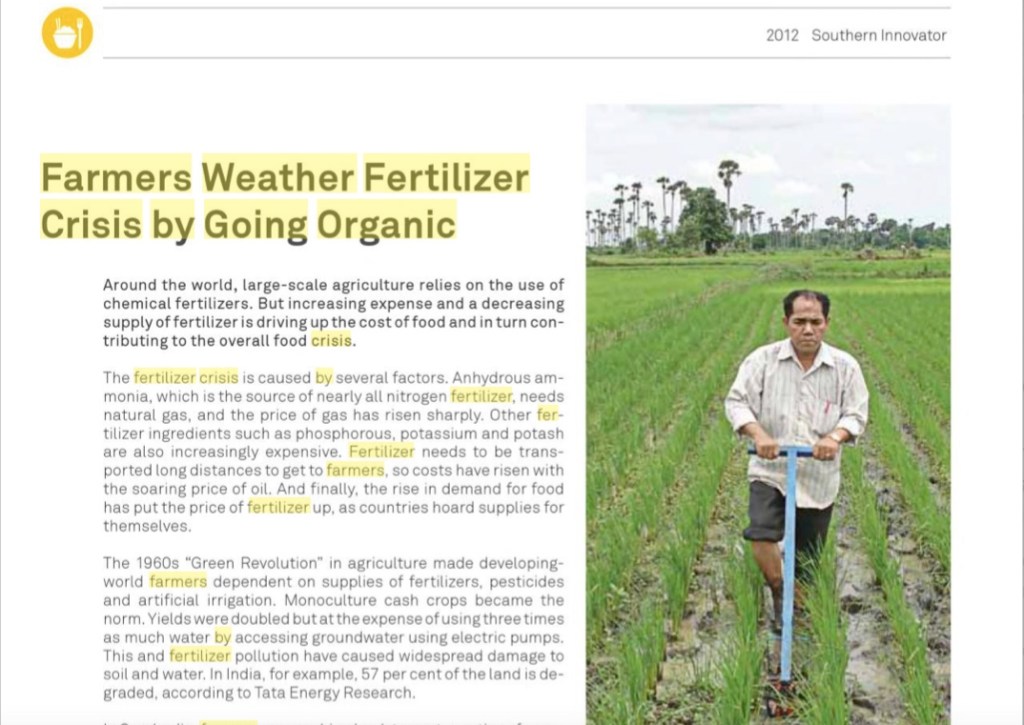
Farmers Weather Fertilizer Crisis by Going Organic

By David SouthDevelopment Challenges, South-South Solutions

SOUTH-SOUTH CASE STUDY

Around the world, large-scale agriculture relies on the use of chemical fertilizers. But increasing expense and decreasing supply of fertilizer is driving up the cost of food, and in turn contributing to the overall food crisis.

According to a soon-to-be-released UN report, prices have shot up and will stay high for at least three years. Prices have almost doubled and in some cases risen by 500 percent over 15 months.

The fertilizer crisis is caused by several factors. Anhydrous ammonia, which is the source of nearly all nitrogen fertilizer, needs natural gas, and the price of gas has risen sharply. Other fertilizer ingredients like phosphorous, potassium and potash are also increasingly expensive. Fertilizer needs to be transported long distances to get to farmers, so costs have risen with the soaring price of oil. And finally, the rise in demand for food has put the price of fertilizer up, as countries hoard supplies for themselves.

The 1960s ‘Green Revolution’ in agriculture made developing-world farmers dependent on supplies of fertilizers, pesticides and artificial irrigation. Monoculture cash crops became the norm. Yields were doubled, but at the expense of using three times as much water by accessing groundwater using electric pumps. This and fertilizer pollution has caused widespread damage to soil and water. In India, for example, 57 per cent of the land is degraded, according to Tata Energy Research.

In Cambodia, farmers are reaching back to past practices for answers to the fertilizer crisis. One is to go organic. Taking this approach has many health and environmental advantages – and, best of all for farmers, it keeps costs down.

Khim Siphay, a Cambodian farmer, has found he gets bigger crops of rice and vegetables while paying a lot less for fertilizers.

“Using pesticide or fertilizers kills important insects, and causes the soil to become polluted,” he told Reuters. “I use compost and it helps keep the soil good from one year to another. All of my family members help make the compost.”

The push to organic methods for Cambodia’s 13 million people relying on agriculture for a living comes from a non-governmental organization, the Cambodian Center for Study and Development in Agriculture (CEDAC). It has successfully moved to organic methods, starting from just a handful of 28 farmers in 2000, to the current 60,000 – and received an endorsement from the Cambodian Ministry of Agriculture.

CEDAC says farms using the organic methods have been able to increase rice yields per hectare, while the seeds needed have fallen by 70 to 80 percent. By using a “System of Rice Intensification”, the mostly small-scale farmers are able to get more out of the land, with less labour. Add to that the fact that organic rice gets a premium price on world markets, and the result for the farmers has been a rise in income from US $58 to US $172 per hectare.

“The important point of organic farming is that farmers don’t need to spend money on fertilizers and pesticide so they spend less money on farming,” said CEDAC official Yang Saing Koma.

“They can sell the produce for a higher price. Also they can avoid being infected by pesticides and they will be healthier. It is also good for the environment,” he said.

Rice and other produce can be used to feed chickens to produce organic poultry and eggs – another bonus for farmers looking to raise the value of their produce.

“I started doing organic farming outside my rice paddy, but then I noticed production was double, so in the next season, I decided to grow organically on all of my land,” said farmer Ros Meo. “I spend less money now and I can grow more and I am not sick as I was before, my health is now good.”

Going organic in Cambodia is something that is becoming more attractive to the country’s growing middle class, and the government hopes the country will gain a reputation as an organic producer.

Another approach to cheap fertilizer comes from Caracas, Venezuala. Marjetica Potrc, an artist and architect who works closely with impoverished communities, has come up with a “dry toilet” which collects human waste and converts it to fertilizer.

Developed after spending six months in the barrios of Caracas, the dry, ecologically safe toilet was built on the upper part of La Vega barrio, a district in the city without access to the municipal water grid. It is a place where about half the population receives water from municipal authorities no more than two days a week.

Published: March 2014

Resources

  • South African company Eat Your Garden: It provides urban dwellers and food businesses with their own food gardens bursting with juicy and tasty foods whilst at the same time reducing carbon footprints, and creating employment and provide training, helping poverty alleviation.
    Website: http://www.eatyourgarden.co.za/
  • Soil Association: The organization that establishes the standards necessary for food to be called organically grown.
    Website: http://www.soilassociation.org/
  • Patrick Kamzitu, a farmer in Malawi, on the impact of fertilizer prices:
    Website: www.guardian.co.uk/environment

https://davidsouthconsulting.org/2022/11/21/agribusiness-food-security/

https://davidsouthconsulting.org/2022/11/11/building-an-interactive-radio-network-for-farmers-in-nigeria/

https://davidsouthconsulting.org/2022/05/30/carbon-credits-can-benefit-african-farmers-thanks-to-new-system/

https://davidsouthconsulting.org/2022/10/10/cheap-farming-kit-hopes-to-help-more-become-farmers/

https://davidsouthconsulting.org/2022/11/01/indonesian-food-company-helps-itself-by-making-farmers-more-efficient/

https://davidsouthconsulting.org/2022/11/23/kenyan-farmer-uses-internet-to-boost-potato-farm/

https://davidsouthconsulting.org/2022/10/21/a-new-african-beer-helps-smallholder-farmers/

https://davidsouthconsulting.org/2021/11/09/pocket-friendly-solution-to-help-farmers-go-organic/

https://davidsouthconsulting.org/2022/10/26/perfume-of-peace-helps-farmers-switch-from-drug-trade/

https://davidsouthconsulting.org/2022/11/23/putting-worms-to-work/

https://davidsouthconsulting.org/2022/10/17/small-scale-farmers-can-fight-malaria-battle/

https://davidsouthconsulting.org/2021/03/05/southern-innovator-issue-3/

https://davidsouthconsulting.org/2021/03/05/southern-innovator-issue-5/

https://davidsouthconsulting.org/2022/02/10/urban-farmers-gain-from-waste-water/

Development Challenges, South-South Solutions was launched as an e-newsletter in 2006 by UNDP’s South-South Cooperation Unit (now the United Nations Office for South-South Cooperation) based in New York, USA. It led on profiling the rise of the global South as an economic powerhouse and was one of the first regular publications to champion the global South’s innovators, entrepreneurs, and pioneers. It tracked the key trends that are now so profoundly reshaping how development is seen and done. This includes the rapid take-up of mobile phones and information technology in the global South (as profiled in the first issue of magazine Southern Innovator), the move to becoming a majority urban world, a growing global innovator culture, and the plethora of solutions being developed in the global South to tackle its problems and improve living conditions and boost human development. The success of the e-newsletter led to the launch of the magazine Southern Innovator.

Creative Commons License

This work is licensed under a
Creative Commons Attribution-Noncommercial-No Derivative Works 3.0 License.

ORCID iD: https://orcid.org/0000-0001-5311-1052.

© David South Consulting 2023

Categories
Archive Development Challenges, South-South Solutions Newsletters

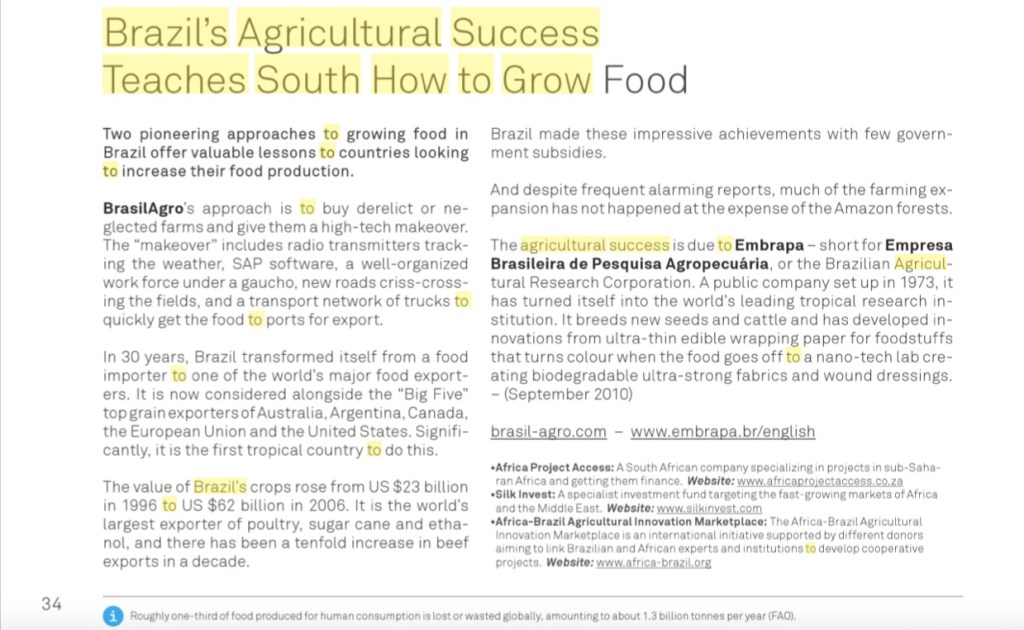
Brazil’s Agricultural Success Teaches South How to Grow

By David SouthDevelopment Challenges, South-South Solutions

SOUTH-SOUTH CASE STUDY

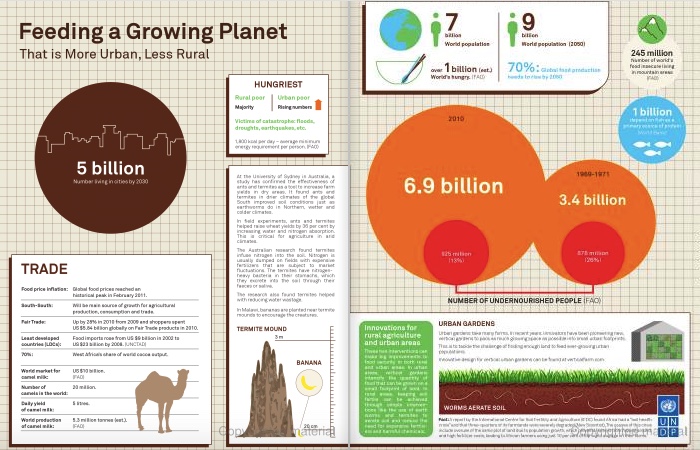
Inflation, environmental stresses and population and economic growth are testing the world’s food supply systems. There is a strong need to boost yields and improve the quality of food.

Between now and 2050 the world’s population will rise from 7 billion to 9 billion. Urban populations will probably double and incomes will rise. City dwellers tend to eat more meat and this will boost demand.

The UN’s Food and Agriculture Organization (FAO) reckons grain output will have to rise by around half but meat output will have to double by 2050 to meet demand.

Two pioneering approaches to growing food in Brazil offer valuable lessons to countries looking to increase their food production.

One is taking place in Bahia state in north-eastern Brazil. On Brazil’s cerrado (savannah) (http://en.wikipedia.org/wiki/Cerrado), enormous farms grow cotton, soybeans and maize. One of them, Jatoba farm, has 24,000 hectares of land: vastly larger than comparable farms in the United States.

On the Cremaq farm in the north of the country in Piaui state, a transformation has taken place. Once a failed cashew farm, it is now a highly modern operation. Owned by BrasilAgro, it is benefiting from clever agricultural innovation that gets results.

BrasilAgro’s approach is to buy derelict or neglected farms and give them a high-tech makeover. The ‘makeover’ includes radio transmitters tracking the weather, SAP software (http://en.wikipedia.org/wiki/SAP_AG), a well-organized work force under a gaucho (http://en.wikipedia.org/wiki/Gaucho), new roads criss-crossing the fields, and a transport network of trucks to quickly get the food to ports for export. Piaui is an isolated place with few services: it can take half a day to get to a health clinic. Dependence on state welfare payments for survival is the norm for many residents.

Brazil, over 30 years, transformed itself from a food importer to one of the world’s major food exporters. It is now considered alongside the ‘Big Five’ top grain exporters of America, Canada, Australia, Argentina and the European Union. Importantly, it is the first tropical nation to do this.

The value of Brazil’s crops rose from US $23 billion in 1996, to US $62 bn in 2006. It is the world’s largest exporter of poultry, sugar cane and ethanol, and there has been a tenfold increase in beef exports in a decade.

Brazil made these impressive achievements with few government subsidies. According to the Organization for Economic Co-operation and Development (OECD), state support accounted for just 5.7 percent of total farm income in Brazil from 2005-07. In the US it was 12 percent, while the OECD average is 26 percent and the level in the European Union is 29 percent.

And despite frequent alarming reports, much of the farming expansion has not happened at the expense of the Amazon forests.

The agricultural success is down to Embrapa (http://www.embrapa.br/english) – short for Empresa Brasileira de Pesquisa Agropecuária, or the Brazilian Agricultural Research Corporation. A public company set up in 1973, it has turned itself into the world’s leading tropical research institution. It breeds new seeds and cattle and has developed innovations from ultra-thin edible wrapping paper for foodstuffs that turns colour when the food goes off to a nano-tech lab creating biodegradable ultra-strong fabrics and wound dressings.

Its biggest achievement has been turning the vast expanses of the cerrado green for agriculture. Norman Borlaug, an American plant scientist often called the father of the Green Revolution, told the New York Times that “nobody thought these soils were ever going to be productive.” They seemed too acidic and too poor in nutrients.

Embrapa uses what its scientists call a “system approach”: all the interventions work together. Improving the soil and developing new tropical soybeans were both needed for farming the cerrado. The two together also made possible the changes in farm techniques which have boosted yields further.

Many believe this approach can be applied to Africa as well. There are several reasons to think it can. Brazilian land is like Africa’s: tropical and nutrient-poor. The big difference is that the cerrado gets a decent amount of rain and most of Africa’s savannah does not (the exception is the swathe of southern Africa between Angola and Mozambique).

Another approach that Brazil has been pioneering is making small, family farms sustainable and productive for the 21st century.

There has long been a tension between those who believe in very large farms, agribusiness and mono-crops (http://en.wikipedia.org/wiki/Mono-cropping), and those who believe in having a large number of smaller farms with a wide variety of crops and animals.

But small farms have endured. The livelihoods of more than 2 billion people depend on the 450 million smallholder farms across the world. With their families, they account for a third of the world’s population.

Family farms are critical to weathering economic crises and ensuring a steady and secure food supply. The International Fund for Agricultural Development (IFAD) (www.ifad.org)called in 2008 for small family farms to be put at the heart of the global response to high food prices and uncertain food security.

In Brazil, this call is being answered by a bold initiative to create what is termed a “social technology”, combining a house building programme with diverse family farms.

The Brazilian farmers’ cooperative Cooperhaf: Cooperativa de Habitacao dos Agricultores Familiares (http://www.cooperhaf.org.br) – a World Habitat Awards winner – combines housing and farm diversification to support family farmers.

“Family farming is very important for the country – 70 percent of food for Brazilians comes from family farming,” said Adriana Paola Paredes Penafiel, a projects adviser with the Cooperhaf. “The government wants to keep people in rural areas.”

“We see the house as the core issue,” she continued.  “The farmers can improve their productivity but the starting point is the house.”

Started in 2001 by a federation of farmers unions, the Cooperhaf works in 14 Brazilian states with family farmers. In Brazil farmers have a right to a house in the law and the cooperative was formed to make sure this happened.

“We promote diversification to make farmers less vulnerable: if they lose a crop in macro farming, they lose everything. We encourage diversification and self-consumption to guarantee the family has food everyday. We help to set up a garden.”

The concept is simple: a good quality home acts as an anchor to the family farm, making them more productive as farmers. The farmers receive up to 6,000 reais (US $2,290) for a house, and can choose designs from a portfolio of options from the Cooperhaf.

As in other countries, the Cooperhaf and other co-ops encourage markets and certification programmes to promote family farmed food and raise awareness. Penafiel says promoting the fact that the food is family farmed is critical: to the consumer it is healthier, fresher and contains fewer chemicals than imported produce.

“Most agri business is for export,” said Penafiel. “If we don’t have food in the country, food for poor communities would not be available. This enables farmers to be more autonomous, not having to buy fertilizers and equipment and take on too much debt. That approach is not sustainable as we saw with the so-called Green Revolution.”

Published: September 2010

Resources

  • Africa Project Access: A South African company specializing in projects in sub-Saharan Africa and getting them finance. Website:http://www.africaprojectaccess.co.za/
  • Silk Invest: A specialist investment fund targeting the fast-growing markets of Africa and the Middle East. Website:http://www.silkinvest.com/
  • Olam: A global food supply company in ‘agri-products’ that got its start in Nigeria  and shows how a Southern brand can grow and go global and overcome the difficulties of cross-border trade. Website: www.olamonline.com

Development Challenges, South-South Solutions was launched as an e-newsletter in 2006 by UNDP’s South-South Cooperation Unit (now the United Nations Office for South-South Cooperation) based in New York, USA. It led on profiling the rise of the global South as an economic powerhouse and was one of the first regular publications to champion the global South’s innovators, entrepreneurs, and pioneers. It tracked the key trends that are now so profoundly reshaping how development is seen and done. This includes the rapid take-up of mobile phones and information technology in the global South (as profiled in the first issue of magazine Southern Innovator), the move to becoming a majority urban world, a growing global innovator culture, and the plethora of solutions being developed in the global South to tackle its problems and improve living conditions and boost human development. The success of the e-newsletter led to the launch of the magazine Southern Innovator. 

Creative Commons License

This work is licensed under a
Creative Commons Attribution-Noncommercial-No Derivative Works 3.0 License.

ORCID iD: https://orcid.org/0000-0001-5311-1052.

© David South Consulting 2022

Categories
Archive Development Challenges, South-South Solutions Newsletters Southern Innovator magazine

Turning Human Waste to Fertilizer: An African Solution

By David SouthDevelopment Challenges, South-South Solutions

SOUTH-SOUTH CASE STUDY

While South Africa has been free of the racist Apartheid regime since the mid-1990s, the expected boost to living standards for the majority black population has not been as widespread and as quick as many had expected.

One important aspect of lifting living standards is making sure the entire population has access to adequate sanitation and hygiene services. Another is making sure they have access to adequate and healthy food sources. A bright idea based on intensive research is meeting both goals in an innovative way.

According to the Council for Scientific and Industrial Research (http://www.csir.co.za/), some 11 million South Africans have received access to basic sanitation services since 1994 – but 13.3 million still lacked basic sanitation services by 2008.

The Water Research Commission (WRC) (http://www.wrc.org.za/) believes there is a crisis with South Africa’s toilet pit latrines, which are quickly filling up past their original design capacity. WRC’s solution is to turn the human faeces or faecal sludge deposited in pit latrines into fertilizer for farming and agriculture. The Water Research Commission is advocating using the fertilizer either for fruit trees or for trees that will be turned to income sources like paper and fuel.

The WRC’s project and series of experiments are called “What happens when pit latrines get full?”

“Only one third of municipalities have a budget to maintain on-site sanitation,” WRC researcher and scientist David Still told Inter Press Service (IPS). “If pits fill up, all the hard work that was done to address the sanitation backlog will be wasted. Why not use faecal sludge to address the growing problem of food insecurity by planting fruit trees? Or use the sludge to cultivate trees for fuel or paper production?”

Human faecal sludge contains a variety of nutrients, such as nitrogen, phosphates and potassium. The WRC estimates the average person excretes enough human faecal sludge per year to fertilize 300 to 400 square metres of crops.

The big reason people are reluctant to use human waste as fertilizer is because of the pathogens it contains. Spreading this on edible crops is dangerous and it is also a risk to groundwater when it leaches in to the soil.

The WRC conducted research on two sites: Umlazi and Karkloof, both in KwaZulu-Natal, South Africa. They used property owned by the South African Paper and Pulp Industry (SAPPI) and the local municipality.

The first step in the experiments was to bury the sludge in pits and plant crops on top of it. The pathogens were contained using this method and in time died off.

The test trenches were 0.75 metres in depth and filled with different quantities of sludge. Two control sites did not use faecal sludge. The scientists found the sites where the human waste was used saw plant growth and volume increase by “as much as 80 per cent.”

They then tested for pathogens in the soil. This included looking for the eggs of the large roundworm (http://www.nhs.uk/conditions/Roundworm/Pages/Introduction.aspx), a parasite whose presence would be harmful to humans. The site was tested over a period of 30 months, but none could be found.

Tests for microbes at the Umlazi site also found none. The plants were found to have healthy dark green leaves and the trees grew larger with the sludge present.

Researchers also monitored the groundwater around the sites. They found in flat ground and sandy soil there was no impact. In the site with sloping and shallow soil, small increases in nitrate were observed in the groundwater after rainfall.

They concluded the best place to apply this technique is in places that are flat and where the soil is deep.

One local resident, Lindiwe Khoza, was selected to be part of the test. Citrus and peach trees were planted on top of the buried sludge.

She told IPS: “The fruit grows much faster and it seems to be tastier and juicier than fruit bought at supermarkets. We now enjoy fruit from our own garden.”

WRC’s clever solution to these twin problems could help make life much more pleasant in communities still grappling with poor hygiene services, while dramatically improving the health of crops and their yields.

Published: July 2012

Resources

1) World Bank guide to pit latrines. Website:http://water.worldbank.org/shwresource-guide/infrastructure/menu-technical-options/pit-latrines

2) A video on how to construct a ventilated pit latrine. Website: http://www.youtube.com/watch?v=n4yfAyhiV74

3) A Practical Guide for Building a Simple Pit Latrine: How to Build Your Latrine and Use It Hygienically, for the Dignity, Health, and Well Being of Your Family. Website: http://www.crsprogramquality.org/publications/2011/9/13/a-practical-guide-forbuilding-a-simple-pit-latrine-how-to-b.html

4) The Control of Pathogens from Human Waste and their Aquatic Vectors by L. E. Obeng. Website: http://www.jstor.org/discover/10.2307/4312882?uid=3738032&uid=2129&uid=2&uid=70&uid=4&sid=21100919752851

Development Challenges, South-South Solutions was launched as an e-newsletter in 2006 by UNDP’s South-South Cooperation Unit (now the United Nations Office for South-South Cooperation) based in New York, USA. It led on profiling the rise of the global South as an economic powerhouse and was one of the first regular publications to champion the global South’s innovators, entrepreneurs, and pioneers. It tracked the key trends that are now so profoundly reshaping how development is seen and done. This includes the rapid take-up of mobile phones and information technology in the global South (as profiled in the first issue of magazine Southern Innovator), the move to becoming a majority urban world, a growing global innovator culture, and the plethora of solutions being developed in the global South to tackle its problems and improve living conditions and boost human development. The success of the e-newsletter led to the launch of the magazine Southern Innovator.  

Follow @SouthSouth1

Google Books: https://books.google.co.uk/books?id=9fRcAwAAQBAJ&dq=development+challenges+july+2012&source=gbs_navlinks_s

Slideshare: http://www.slideshare.net/DavidSouth1/development-challenges-july-2012-issue

Southern Innovator Issue 1: https://books.google.co.uk/books?id=Q1O54YSE2BgC&dq=southern+innovator&source=gbs_navlinks_s

Southern Innovator Issue 2: https://books.google.co.uk/books?id=Ty0N969dcssC&dq=southern+innovator&source=gbs_navlinks_s

Southern Innovator Issue 3: https://books.google.co.uk/books?id=AQNt4YmhZagC&dq=southern+innovator&source=gbs_navlinks_s

Southern Innovator Issue 4: https://books.google.co.uk/books?id=9T_n2tA7l4EC&dq=southern+innovator&source=gbs_navlinks_s

Southern Innovator Issue 5: https://books.google.co.uk/books?id=6ILdAgAAQBAJ&dq=southern+innovator&source=gbs_navlinks_s

Creative Commons License

This work is licensed under a
Creative Commons Attribution-Noncommercial-No Derivative Works 3.0 License.

ORCID iD: https://orcid.org/0000-0001-5311-1052.

© David South Consulting 2023