Categories
Archive Development Challenges, South-South Solutions Newsletters

Thai Organic Supermarkets Seek to Improve Health

By David SouthDevelopment Challenges, South-South Solutions

SOUTH-SOUTH CASE STUDY

A Thai business is working hard to expand access to organic food in the country. It sees this as part of a wider campaign to improve health in the country – and its success has caught the attention of the government, which wants to turn Thailand into a global health destination.

The Lemon Farm chain run by Suwanna Langnamsank (http://www.lemonfarm.com/lmf/) was started 13 years ago and has grown to nine organic supermarkets in the capital, Bangkok. Lemon Farm works with 200 organic farms in Thailand and employs 160 people.

Organic food (http://en.wikipedia.org/wiki/Organic_food) – grown without chemicals and artificial fertilizers and not irradiated or subjected to other tampering – is believed by many to be healthier because it avoids the harmful effects of accumulating chemicals. It is also thought to be richer in vitamins and minerals because of the use of non-chemical fertilizers on the soil.

Lemon Farm sells made-in-Thailand organic vegetables and fruit, natural gift sets, soap and tea. There are also macrobiotic cafes in the supermarkets called Be Organic.  A macrobiotic diet avoids foods containing toxins (http://www.cancerresearchuk.org/cancer-help/about-cancer/treatment/complementary-alternative/therapies/macrobiotic-diet).

The supermarkets use eye-pleasing modern design to set themselves apart from more conventional supermarkets.

According to Lemon Farm’s website, it is a social enterprise and practices fair trade. It is using market-driven solutions to increase the availability of healthy food in the country. It seeks to support small-scale farmers and champion change in farming methods, encouraging a move away from dependence on harmful chemicals that damage human health and the environment and promoting “agricultural and economic self-sufficiency”.

The macrobiotic restaurant operates to six values, among them using fresh vegetables and only using produce from associated farms. The restaurants do not use added sugar, they cook using a pressure cooker, and use natural ingredients such as sea salt, ginger, fermented soy sauce and natural miso. They do not use any artificial preservatives or flavour enhancers such as monosodium glutamate (MSG), a common practice in Asian cooking.

Lemon Farm’s success as an organic food pioneer has caught the attention of the Thai government. The Ministry of Commerce (http://www2.moc.go.th/main.php?filename=index_design4_en) has contracted Lemon Farm to join its campaign to offer organic food in schools and hospitals.

By promoting organic food, the government is hoping to boost farmers’ incomes while improving health in the country and bolstering the country’s thriving medical services industry serving foreign patients.

“We need to promote healthy food and a healthy environment,” Piramol Charoenpao, deputy permanent secretary at the Ministry of Commerce, told Monocle magazine. “Thailand is a medical hub. The idea is to have retreat-style hospitals serving organic food. We’re increasing organic food production and educating people about it.”

Thailand has already built a good reputation with its medical and health services. More than 1.6 million non-Thais are treated in Thai hospitals annually, with an estimated 500,000 travelling specifically for medical treatment (The Guardian).

Former Thai Prime Minister Thaksin Shinawatra mooted the idea of making the country an international leader in medical tourism in 2003. It is expected providing medical services to overseas patients will make the country US $3.3 billion by 2015 (The Guardian).
 
It is hoped that offering organic food in hospitals and health facilities will boost the attractiveness and effectiveness of using health services in Thailand.

Medical tourism is considered one of the fastest-growing sectors in the world. Estimates place it as a market worth US $100 billion. Three countries that compete in this market by offering medical services in the English language include India, Singapore and Thailand. They compete by offering services comparable to wealthier countries but at considerably less cost.

Lemon Farm says it is on a mission to develop the marketplace for organic food in Thailand by educating consumers and producing “innovative natural food”.  It looks like it has already made a big impact.

Published: February 2013

Resources

1) Whole Foods Market: The world’s leader in natural and organic foods, with more than 340 stores in North America and the United Kingdom. Website: wholefoodsmarket.com

2) Conscious Capitalism: A book by Co-CEO of Whole Foods Market, John Mackey. Website:http://consciouscapitalism.org/resources/538

3) Live Plan: A step-by-step online resource for creating a business plan for an organic supermarket. Website:http://www.bplans.com/organic_food_store_business_plan/company_summary_fc.php

4) Start your own: Health food store: Advice and business tips on starting a health food store. Website:http://www.startups.co.uk/health-food-store.html

Southern Innovator logo

London Edit

31 July 2013

Google Books: https://books.google.co.uk/books?id=hvRcAwAAQBAJ&dq=development+challenges+february+2013&source=gbs_navlinks_s

Slideshare: http://www.slideshare.net/DavidSouth1/development-challenges-february-2013-issue

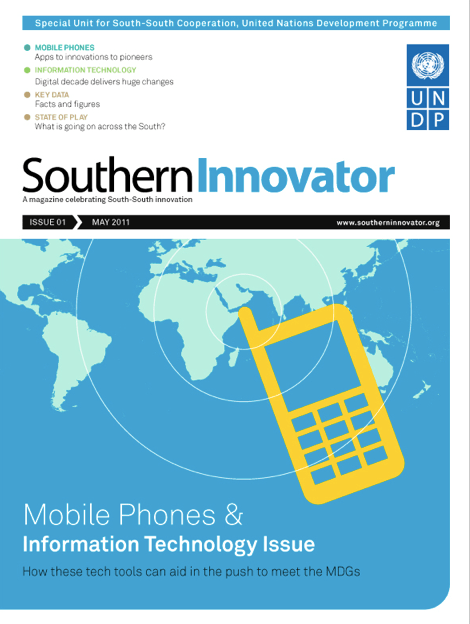
Southern Innovator Issue 1: https://books.google.co.uk/books?id=Q1O54YSE2BgC&dq=southern+innovator&source=gbs_navlinks_s
Southern Innovator Issue 2:https://books.google.co.uk/books?id=Ty0N969dcssC&dq=southern+innovator&source=gbs_navlinks_s

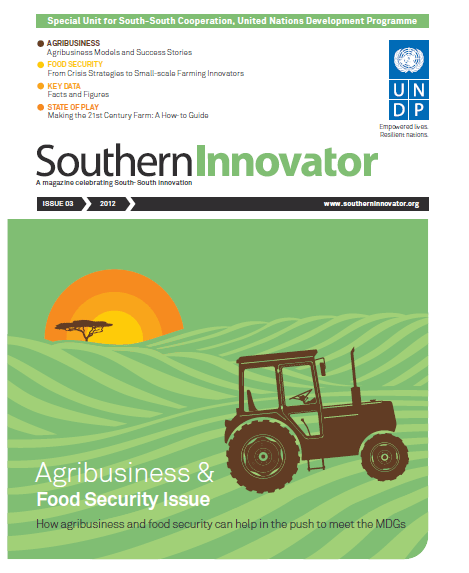
Southern Innovator Issue 3:https://books.google.co.uk/books?id=AQNt4YmhZagC&dq=southern+innovator&source=gbs_navlinks_s
Southern Innovator Issue 4: https://books.google.co.uk/books?id=9T_n2tA7l4EC&dq=southern+innovator&source=gbs_navlinks_s

Southern Innovator Issue 5:https://books.google.co.uk/books?id=6ILdAgAAQBAJ&dq=southern+innovator&source=gbs_navlinks_s


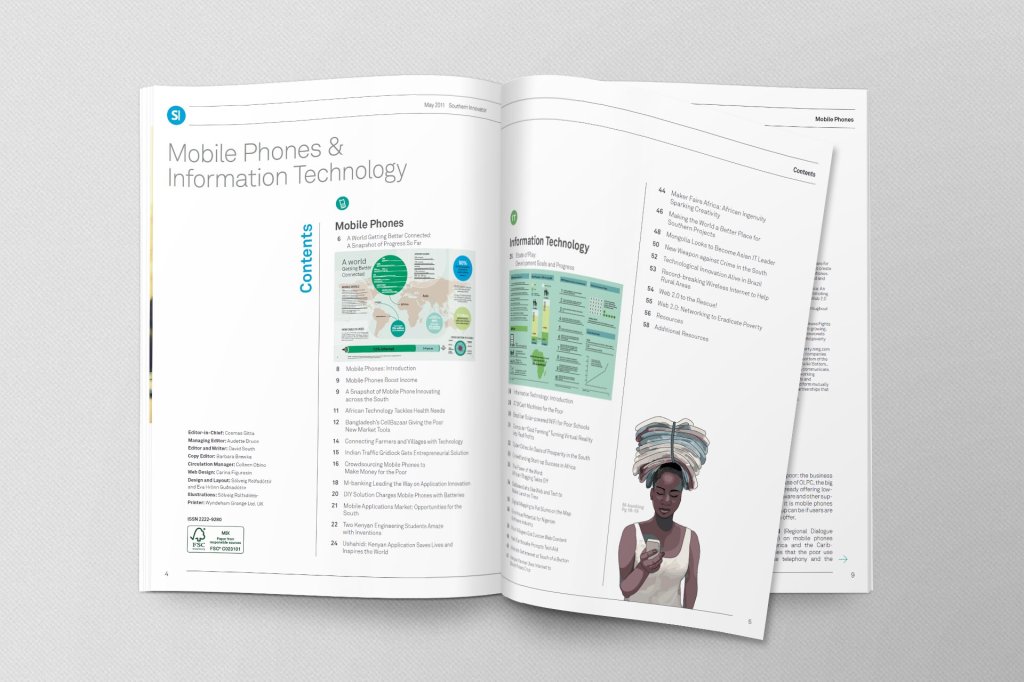
Development Challenges, South-South Solutions was launched as an e-newsletter in 2006 by UNDP’s South-South Cooperation Unit (now the United Nations Office for South-South Cooperation) based in New York, USA. It led on profiling the rise of the global South as an economic powerhouse and was one of the first regular publications to champion the global South’s innovators, entrepreneurs, and pioneers. It tracked the key trends that are now so profoundly reshaping how development is seen and done. This includes the rapid take-up of mobile phones and information technology in the global South (as profiled in the first issue of magazine Southern Innovator), the move to becoming a majority urban world, a growing global innovator culture, and the plethora of solutions being developed in the global South to tackle its problems and improve living conditions and boost human development. The success of the e-newsletter led to the launch of the magazine Southern Innovator. 

Creative Commons License

This work is licensed under a
Creative Commons Attribution-Noncommercial-No Derivative Works 3.0 License.

ORCID iD: https://orcid.org/0000-0001-5311-1052.

© David South Consulting 2022
Categories
Archive Development Challenges, South-South Solutions Newsletters

New Apps Make Driving and Travelling in Egypt Easier, Safer

By David SouthDevelopment Challenges, South-South Solutions

SOUTH-SOUTH CASE STUDY

Mobile phones are ubiquitous across the global South. They have spawned whole new business opportunities and changed the way people solve problems and find solutions.

Sub-Saharan Africa is now home to approximately 650 million mobile phone subscribers, more than the United States and the European Union (World Bank).  A recent World Bank report estimated mobile phones led directly to the creation of 5 million jobs in Africa in 2012, contributing to seven per cent of Africa’s gross domestic product (GDP).

Mobile phones have also led to contests and challenges, set up to spark further innovation in this area and spur the development of so-called “apps”, or applications, to run on these electronic devices.

These prizes encourage and reward useful innovation that directly tackles the problems and challenges of the South.

In Cairo, Egypt – a city notorious for some of the worst traffic congestion in the world – many have been trying to find smart solutions to the gridlock. The World Bank says in its Cairo Traffic Congestion Study that the annual cost of congestion in Cairo is estimated at up to US $8 billion. This is four per cent of Egypt’s gross domestic product (GDP) – four times the impact on national GDP experienced by other comparable large cities. The study found that at least 1,000 Cairo residents die each year in traffic-related accidents, more than half of them pedestrians. And rapid growth in the city is making it ever-harder to get on top of the problem.

Rising traffic congestion is a problem around the world. In the United States, traffic jumped 236 per cent as the population grew by 20 per cent between 1982 and 2001 (IBM).

The IBM Commuter Pain Study conducted in 2011, ranking the emotional and economic toll of commuting in 20 international cities, found that the commute in Beijing is four times more painful than the commute in Los Angeles or New York, and seven times more painful than the commute in Stockholm.

Commuter pain leads to productivity loss as people lose time stuck in traffic and fuel is wasted as engines idle in traffic jams – not to mention damage to the environment from the increased pollution.

According to the World Business Council for Sustainable Development, 95 per cent of congestion growth in the coming years will be in developing countries. Even in developed countries like the United States, in 2000, the average driver experienced 27 hours of delays (up seven hours from 1980) (MIT Press). This ballooned to 136 hours in Los Angeles.

Developing countries are seeing vehicle numbers rise by between 10 and 30 per cent per year (World Bank). In economic hotspots, growth is even faster.

The Cairo Transport App Challenge (https://www.facebook.com/CairoTransportAppChallenge) is a contest aimed at taming the city’s traffic chaos. It is hosted by the Technology Innovation Entrepreneurship Center (TIEC) (http://www.tiec.gov.eg/en-us/Pages/default.aspx) and is organized by the World Bank in collaboration with others.

The contest’s press release says it aims to connect transport and urban development experts with volunteer technology communities to build “applications to address pressing transport challenges in Cairo through leveraging the new information and communication technologies (ICT) – such as mobile phones, smartphones and GPS-enabled devices – as well as the talent of Egyptian software developers and innovators.”

The first winner of the US $3,000 in prize money is a mobile phone app that helps drivers get help on the road and with car maintenance.

Users can use the Belya app to find the best routes, and to get help if their vehicle breaks down. The app is essentially a portable virtual car mechanic. It uses Global Positioning System (GPS) technology to locate service centres, which are then contacted when somebody needs help. The app gives details to the repair shop on what is wrong, the date and time.

“It is also linked to the General Traffic Administration, to provide quick and regular updates of the traffic situation,” according to a statement from Egypt’s Ministry of Communications and Information Technology, which awarded the prize.

The content’s second prize was won by E-mokhalfa (http://www.emokhalfa.com/emokhalfa/),which helps communities create safer roads by using peer pressure to make drivers behave better. Third place went to the app called “Where is my bus?” (https://twitter.com/AutobeesyFeen). It helps passengers find bus stations, routes, journey times and all mass transport options on their mobile phones.

Published: February 2013

Resources

1) A guide to making mobile phone apps: Here are some resources to building your own phone app online or through a provider. Website:http://www.brandignity.com/2011/03/building-mobile-iphone-phone-app-onlin/

2) Android: Android is the world’s most popular mobile platform. Website: android.com

3) Arab Republic of Egypt, Ministry of Communications and Information Technology. Website: http://www.mcit.gov.eg/

4) IBM Smart Traffic: IBM Intelligent Transportation, a compliment to the Intelligent Operations Center for Smarter Cities, enables advanced analysis of the many factors that make up traffic flow, and gives planners and responders a comprehensive look at the state of their city’s roadways on ground level. Website:http://www.ibm.com/smarterplanet/eg/en/traffic_congestion/ideas/index.html

5) Southern Innovator Magazine Issue 1: Mobile Phones and Information Technology. Website:http://www.scribd.com/doc/95410448/Southern-Innovator-Magazine-Issue-1-Mobile-Phones-and-Information-Technology

Southern Innovator logo

London Edit

31 July 2013

Development Challenges, South-South Solutions was launched as an e-newsletter in 2006 by UNDP’s South-South Cooperation Unit (now the United Nations Office for South-South Cooperation) based in New York, USA. It led on profiling the rise of the global South as an economic powerhouse and was one of the first regular publications to champion the global South’s innovators, entrepreneurs, and pioneers. It tracked the key trends that are now so profoundly reshaping how development is seen and done. This includes the rapid take-up of mobile phones and information technology in the global South (as profiled in the first issue of magazine Southern Innovator), the move to becoming a majority urban world, a growing global innovator culture, and the plethora of solutions being developed in the global South to tackle its problems and improve living conditions and boost human development. The success of the e-newsletter led to the launch of the magazine Southern Innovator. 

Creative Commons License

This work is licensed under a
Creative Commons Attribution-Noncommercial-No Derivative Works 3.0 License.

ORCID iD: https://orcid.org/0000-0001-5311-1052.

© David South Consulting 2023

Categories
Archive Development Challenges, South-South Solutions Newsletters Southern Innovator magazine

Global South Experiencing Transportation Revolution

By David SouthDevelopment Challenges, South-South Solutions

SOUTH-SOUTH CASE STUDY

Away from the news headlines, a quiet revolution has been taking place in public transportation across the global South. As cities have expanded and grown, they have also been putting in place public transport systems to help people get around and get to work.

One proven, efficient way to move large numbers of people quickly through dense urban areas is to use underground subway or metro systems. Subway systems have a profound effect on local economies and wealth creation. They allow people to quickly cover distances that may once have meant hours stuck in traffic. Once people can move around a city quickly and over large distances, they can change how they work, shop, enjoy themselves. It allows people living in poor outlying neighbourhoods to travel to jobs in the city centre, improving their income prospects.

As many countries in the global South have enjoyed healthy growth rates despite the global economic crisis, and with the global financial system being flooded with stimulus funds to spur growth, the resources have become available to invest in expensive and long-term public transport solutions such as metro systems. Another factor is the scale of urbanization in the global South, which is driving governments to turn to new solutions that will help in avoiding the mistakes made in the past.

The world’s first urban underground railway system was built in 19th-century London, England. It was the product of a country that had been experiencing rapid, large-scale industrialization and urbanization unseen before in human history. Since then, the now 150-year-old London Underground (http://www.tfl.gov.uk/modalpages/2625.aspx) has acted as the arteries coursing through the city’s economic body, criss-crossing the city and delivering millions of people to work and play every day. It is now impossible to imagine Britain’s economy functioning without this efficiency tool.

Now, as the global South engages in the greatest urbanization project in human history, more cities are turning to underground metro systems to keep people, and the economy, moving. Lessons have been learned from the first generation of global South cities, which expanded rapidly in the 1960s, 1970s and 1980s. Many became quickly clogged in traffic and cloaked in pollution, and saw economic opportunity and social mobility slowed down as a consequence.

Three of the biggest metro systems in the world are now in China – Beijing, Shanghai and Guangzhou (The Economist). Beijing (http://www.explorebj.com/metro/) has a metro system stretching 442 kilometres and is used every day by 5.97 million people. By 2020, Beijing is hoping to boast 1,000 kilometres of metro network in the city. In Shanghai (http://www.shmetro.com/EnglishPage/EnglishPage.jsp), the 423 kilometre metro system carries 5.16 million people every day, while Guangzhou (http://www.gzmtr.com/en/) carries 4.49 million people a day.

From the 1960s, the building of metros increased around the world. More than 190 cities now have metro systems. In China, Suzhou (http://www.livingsu.com/guide_detail.asp?id=7), Kunming (http://www.urbanrail.net/as/cn/kunming/kunming.htm) and Hangzhou (http://www.urbanrail.net/as/cn/hang/hangzhou.htm) opened metro systems in 2012. Elsewhere in the global South, Lima in Peru and Algiers (http://www.metroalger-dz.com/) in Algeria recently acquired new metro systems. This means Africa now has two cities with metro systems – Algiers and Cairo in Egypt.

In India, Bangalore opened a metro system two years ago and Mumbai is close to finishing its metro. Bhopal and Jaipur also plan to build metros. In Brazil, the metros in Sao Paulo and Rio de Janeiro are being expanded and new systems are being built in Salvador and Cuiaba. In the Gulf states of the Middle East, Dubai (http://dubaimetro.eu/) opened a system in 2009 and Mecca (http://meccametro.com/) in Saudi Arabia in 2010. Abu Dhabi, Doha, Riyadh and Kuwait City are also working on building metro systems.

Paraguay’s capital, Asuncion, is working on one, as is Kathmandu in Nepal. Jakarta in Indonesia has attempted to build an underground metro several times and is now trying to getting one built.

But how are many of these countries funding this splurge on metro systems? According to Roland Berger Strategy Consultants (rolandberger.co.uk), global government stimulus programmes to fight the current financial crisis have increased available funding for rail systems. There are also increased resources available for transport solutions that avoid the high pollution rates that come with automobiles.

According to Mass Transit Magazine, China is using domestic consumption and increasing urbanization to spur economic growth and is hoping to increase investment in metro systems in the country by 10 per cent per year.

The target is to spend 280 billion yuan to 290 billion yuan (US $44.91 to US $46.51 billion) on metro systems in 2013, up from 260 billion yuan in 2012.

The knock-on economic boost will be felt by domestic businesses as trains and train systems are purchased. It is estimated sales of Chinese-made trains will go from 10.9 billion yuan in 2012 to 28 billion yuan by 2017.

All this new building will expand the country’s metro lines by 846 kilometres in 24 cities.

Ten Chinese cities are expecting soon to receive permission to begin work on building new metro systems: Xian, Tianjin, Chongqing, Chengdu, Hangzhou, Ningbo, Kunming, Tsingdao, Wuxi and Dongguan.

In 2013, 12 Chinese cities will complete new metro systems including Harbin, Changsha, Ningbo and Zhengzhou.

If this trend continues and expands, then the future cities of the global South could be modern, urban places that raise living standards, while avoiding damaging human health with environmental pollution and over-crowding and social exclusion.

Published: February 2013

Resources

1) Life Guangzhou: Guangzhou Awarded World’s Best Metro System. Website: http://tinyurl.com/ajdcsur

2) Inhabitat: Parisian Building Taps Metro System as a Heat Source.
Website: http://inhabitat.com/body-heat-from-paris-metro-to-heat-residential-building/

3) Digital Construction: Top Ten Metro Systems: Design and efficiency in the world of mass transit. Website:http://www.constructiondigital.com/top_ten/top-10-business/top-ten-metro-systems

4) Six of the world’s best metro systems – in pictures: A look at six metro systems around the world, from the archaeological treasures on display in Athens to the spectacular halls of Moscow’s underground system via continental Europe’s oldest network. Website:http://www.guardian.co.uk/travel/gallery/2013/jan/09/six-worlds-best-metro-systems

Development Challenges, South-South Solutions was launched as an e-newsletter in 2006 by UNDP’s South-South Cooperation Unit (now the United Nations Office for South-South Cooperation) based in New York, USA. It led on profiling the rise of the global South as an economic powerhouse and was one of the first regular publications to champion the global South’s innovators, entrepreneurs, and pioneers. It tracked the key trends that are now so profoundly reshaping how development is seen and done. This includes the rapid take-up of mobile phones and information technology in the global South (as profiled in the first issue of magazine Southern Innovator), the move to becoming a majority urban world, a growing global innovator culture, and the plethora of solutions being developed in the global South to tackle its problems and improve living conditions and boost human development. The success of the e-newsletter led to the launch of the magazine Southern Innovator. 

Creative Commons License

This work is licensed under a
Creative Commons Attribution-Noncommercial-No Derivative Works 3.0 License.

ORCID iD: https://orcid.org/0000-0001-5311-1052.

© David South Consulting 2022

Categories
Archive Development Challenges, South-South Solutions Newsletters

Global South’s Middle Class is Increasing Prosperity

By David SouthDevelopment Challenges, South-South Solutions

SOUTH-SOUTH CASE STUDY

The global middle class is on the rise – and this is creating both challenges and opportunities. As poverty rates have come down across the global South, many countries have seen a rise in the proportion of their population categorized as “middle class”. Globally, being middle class is defined as a person able to consume between US $4 a day and US $13 a day (ILO).

According to the Organization for Economic Cooperation and Development (OECD), most of this growth will be in Asia and the region will soon make up 66 per cent of the world’s middle class. Historical experience shows that members of the middle class quickly become absorbed in spending their accumulated capital on housing, equipment, industry and business, health and education. In countries with a growing middle class, policy makers need to show a strong interest in creating stable economic conditions to encourage this expanding consumption and domestic demand, the OECD advises.

Growth of the world’s middle class took off after 2001, with an additional 400 million workers joining this group. The McKinsey group of consultants found the total number reached 2 billion in a dozen “emerging nations” in 2010, collectively spending US $6.9 trillion every year (McKinsey).

Forecasters predict a further increase in the middle class across the global South will bring with it a surge in consumption (a combination of spending and demand). Areas being highlighted by various studies and reports include China’s small and mid-size cities, other areas of East Asia and Africa.

Middle class spending in these dozen emerging nations could reach US $20 trillion during the next decade – twice the amount of consumption occurring in the United States right now (McKinsey).

The result is a re-shaping of populations, with growing numbers of people now neither rich nor desperately poor, but landing in the middle of the income distribution.

And local competitors in the global South are fighting hard for these consumers on their own turf.

The Hangzhou Wahaha (http://en.wahaha.com.cn/) beverage maker in China has been able to compete against multinationals such as Coca-Cola and PepsiCo, according to McKinsey. It has turned itself into a US $5.2 billion business using a multi-pronged strategy: targeting rural areas, catering to local needs, keeping costs low and positioning itself as the patriotic choice.

And this change is also occurring in Africa, where a growing middle class is fuelling sales of refrigerators, television sets, mobile phones, motors and automobiles across the continent, according to the OECD. In Ghana, for example, car and motorcycle ownership has risen by 81 per cent since 2006.

According to the African Development Bank (AfDB), Africa’s middle class has reached 34 per cent of the population, or 350 million people. In 1980, it was 126 million people, or 27 per cent of the population.

Countries with the largest middle classes in Africa include Tunisia and Morocco, while Liberia and Burundi have the smallest number of people in the middle class.

The economic growth that is fuelling this middle-class surge is coming from a combination of increasing investment in the services sector, the tapping of the natural resource sector and better economic policies in the past two decades. Africa’s middle class is driving growth in the private sector and boosting demand for goods and services, most often also provided by the private sector.

“The liberalization of African economies has resulted in improved efficiencies and led to a rapid growth in the service sector, which has spurred the growth of the middle class,” Lawrence Bategeka, a principal researcher at the Uganda-based Economic Policy Research Centre, told The East African newspaper.

How important the middle class is to increasing consumption levels can be seen in the cases of Brazil and South Korea.

According to the OECD, both countries had similar income levels and growth rates in the 1960s. But by the 1980s, high income inequality in Brazil capped the middle class at 29 per cent of the population. In South Korea in the 1980s, the middle class population reached 53 per cent. This larger middle class population enabled South Korea to switch from an export-driven growth strategy to domestic consumption.

While Brazil wasn’t able to do this at the time, it has since made impressive gains in reducing poverty – from 40 per cent of the population in 2001 to 25 per cent in 2009. This has seen the middle class grow to 52 per cent of the population and boosted domestic consumption.

While a rising middle class in the global South is good news for improving human development and living standards, the OECD found much of the new middle class was vulnerable and could easily slip out of that category. They also often lacked enough income to purchase more expensive durable goods such as automobiles (OECD Yearbook 2012).

The success of this fragile but growing middle class will be key to how well the global economy fares in the coming years.

A new report by the UN’s International Labour Organization (ILO) argues that the global South’s growing middle classes are just the thing to spur growth across the wider world economy.

“Over time, this emerging middle-class could give a much needed push to more balanced global growth by boosting consumption, particularly in poorer parts of the developing world,” said Steven Kapsos, one of the authors of the report.

In Indonesia, an example of the economic impact of the middle class trend in action can be seen in the surging life insurance business.

Association of Indonesian Life Insurance Companies (AAJI) chairman Hendrisman Rahim believes the growing middle class are potential customers for the country’s thriving life insurance industry.

“They are the ones who have the need to be insured and can afford to purchase a policy. Extremely rich people are financially capable [of buying], but may not have the need. Extremely poor people have the need, but require financial assistance to be insured,” he said to the Jakarta Post.

As the Indonesian middle class increases, the life insurance industry is expecting to see revenue rise by 30 per cent in 2013.

Published: February 2013

Resources

1) The $10 Trillion Dollar Prize by Michael J. Silverstein. Website: amazon.com

2) The Middle of the Pyramid: Dynamics of the Middle Class in Africa. Website: http://www.afdb.org/en/blogs/afdb-championing-inclusive-growth-across-africa/post/the-african-consumer-market-8901/

3) McKinsey Quarterly: Capturing the world’s emerging middle class. Website:http://www.mckinseyquarterly.com/Capturing_the_worlds_emerging_middle_class_2639

4) OECD Observer: An emerging middle class by Mario Pezzini. Website:http://www.oecdobserver.org/news/fullstory.php/aid/3681/An_emerging_middle_class.html

Southern Innovator logo

London Edit

31 July 2013

Development Challenges, South-South Solutions was launched as an e-newsletter in 2006 by UNDP’s South-South Cooperation Unit (now the United Nations Office for South-South Cooperation) based in New York, USA. It led on profiling the rise of the global South as an economic powerhouse and was one of the first regular publications to champion the global South’s innovators, entrepreneurs, and pioneers. It tracked the key trends that are now so profoundly reshaping how development is seen and done. This includes the rapid take-up of mobile phones and information technology in the global South (as profiled in the first issue of magazine Southern Innovator), the move to becoming a majority urban world, a growing global innovator culture, and the plethora of solutions being developed in the global South to tackle its problems and improve living conditions and boost human development. The success of the e-newsletter led to the launch of the magazine Southern Innovator. 

Creative Commons License

This work is licensed under a
Creative Commons Attribution-Noncommercial-No Derivative Works 3.0 License.

ORCID iD: https://orcid.org/0000-0001-5311-1052.

© David South Consulting 2023