

By David South, Development Challenges, South-South Solutions

Roads in many parts of Africa are rough at best, and hostile to vehicles designed with smooth, flat highways in mind. Even in countries like South Africa, where modern highways are common, a quick turn off the smooth highway to visit many communities will mean tackling makeshift dirt roads. In these conditions, buses imported from Western Europe are at a disadvantage when they hit the bone-jarring reality of potholed roads.
In the West African country of Ivory Coast, a manufacturer has decided to tackle the problem head on by designing and manufacturing a long-distance passenger bus just for African conditions.
The engineering arm of the national transport company, Sotra (http://www.sotra.ci/sotraindustries.php) (http://www.sotra.ci/index.php?rub=act), decided it could save money and create a bus better suited to African conditions.
“We want the transfer of technology in Africa,” Mamadou Coulibaly, Sotra Industries director, told the BBC. “And we want to build our own buses with our specification.
“In Europe the technology is very sophisticated with lots of electronic devices. In Africa we don’t need this.
“We just need robust buses because our roads are not very well done like in Europe. This is an African design for Africa.”
The African bus has fewer seats than European ones, and it can pack 100 people inside. It is a successful formula that has now attracted orders from other African countries.
Three buses are already in operation and more are in the works on a production line. They are designed and made in the largest city, Abidjan, building on an existing chassis and engine base made by European truck company Iveco. Sotra plans to build 300 buses a year in three models: coach, urban and tourist.
“I think it’s a good thing,” Isaac Gueu, an Abidjan accountant, told the BBC. “It’ll help students to move about in more comfort.”
Not only is the accomplishment impressive as an example of made-in-Africa manufacturing, but it was also completed while the country was going through a civil war and political crisis.
Sotra is an experienced manufacturer, and built its reputation with reliable boat-buses (http://tinyurl.com/bot6fv) that ply the country’s lagoons.
Africa’s roads lag behind the rest of the world: In 1997, Africa (excluding South Africa) had 171,000 kilometres of paved roads — about 18 percent less than Poland, a country roughly the size of Zimbabwe. As efforts to complete the trans-African highways continue (http://en.wikipedia.org/wiki/Trans-African_Highway_network), the quality of existing roads is deteriorating. In 1992 about 17 percent of sub-Saharan Africa’s primary roads were paved, but by 1998 the figure had fallen to 12 percent (World Bank). More than 80 percent of unpaved roads are only in fair condition and 85 per cent of rural feeder roads are in poor condition and cannot be used during the wet season. In Ethiopia, 70 percent of the population has no access to all-weather roads.
Africa also has an appalling road accident rate, mainly attributed to the use of minibuses and other makeshift buses. Each year the number of road deaths and disabilities due to road accidents rises. It is estimated if things carry on as they are, the number of yearly traffic deaths across the continent will reach 144,000 by 2020, a 144 percent increase on today’s deaths.
A properly designed bus is a safer option than trying to pack passengers into a tippy minibus.
On top of making road passenger travel safer and more comfortable, Sofra is creating jobs in Africa and reducing dependence on imports. Beholden to importing sophisticated goods from outside the continent, Africa’s wealth is spent to the benefit of others, and at the expense of high-value jobs at home.
Coulibaly is confident Sotra will reach its goal.
“We have been to school in Europe and we think that we are able today to build our own buses; there are no special difficulties,” he said.
In Nigeria, Innoson Vehicle Manufacturing Company Limited (INNOVEMCO) (http://innosongroup.com/ ) is, in collaboration with Chinese manufacturers, building a huge auto plant in Nnewi (http://en.wikipedia.org/wiki/Nnewi) where a wide range of commercial and utility vehicles will be produced for the Nigerian market and some countries in West Africa.
Published: February 2009
Resources
- Africar: A South African company making four-wheel drive vehicles. Websites: http://www.africarautomobiles.co.za/africar-home.htm
- AfriGadget is a website dedicated to showcasing African ingenuity. A team of bloggers and readers contribute their pictures, videos and stories from around the continent. The stories of innovation are inspiring. It is a testament to Africans bending the little they have to their will, using creativity to overcome life’s challenges. Website: http://www.afrigadget.com/

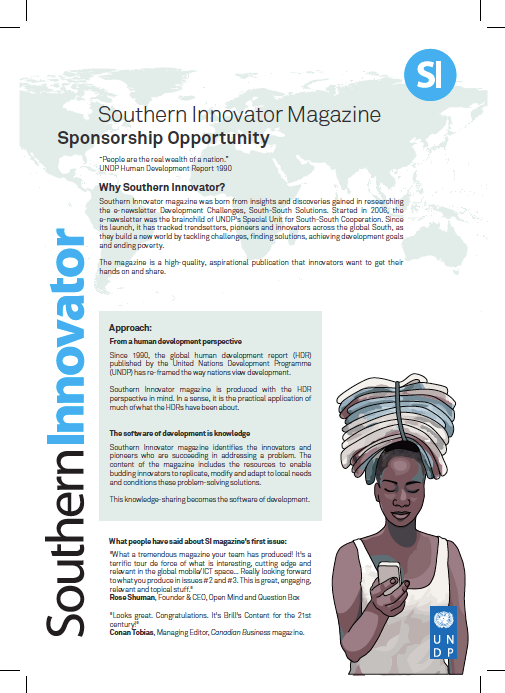
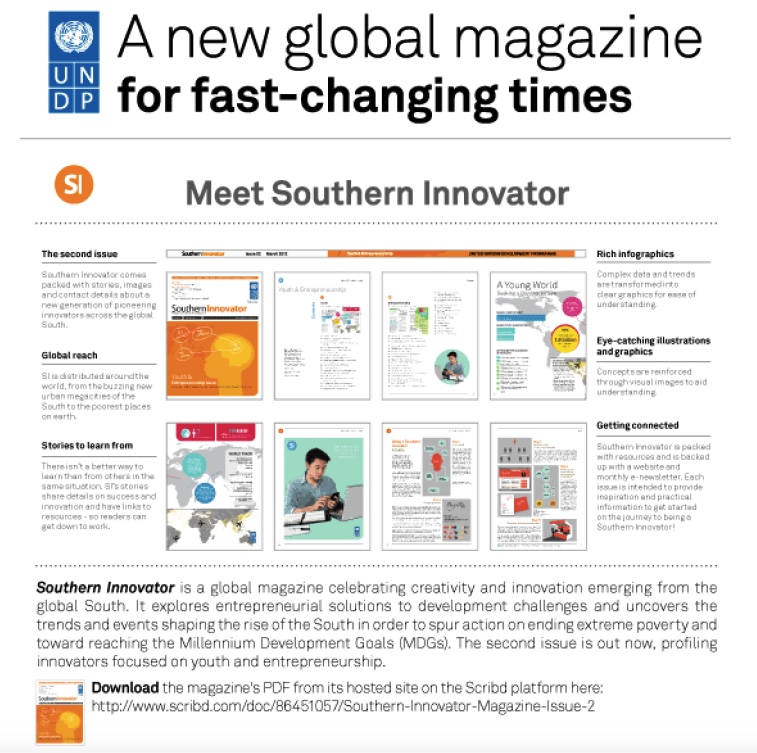
Development Challenges, South-South Solutions was launched as an e-newsletter in 2006 by UNDP’s South-South Cooperation Unit (now the United Nations Office for South-South Cooperation) based in New York, USA. It led on profiling the rise of the global South as an economic powerhouse and was one of the first regular publications to champion the global South’s innovators, entrepreneurs, and pioneers. It tracked the key trends that are now so profoundly reshaping how development is seen and done. This includes the rapid take-up of mobile phones and information technology in the global South (as profiled in the first issue of magazine Southern Innovator), the move to becoming a majority urban world, a growing global innovator culture, and the plethora of solutions being developed in the global South to tackle its problems and improve living conditions and boost human development. The success of the e-newsletter led to the launch of the magazine Southern Innovator.


This work is licensed under a
Creative Commons Attribution-Noncommercial-No Derivative Works 3.0 License.
ORCID iD: https://orcid.org/0000-0001-5311-1052.
© David South Consulting 2022




 David South Consulting
You must be logged in to post a comment.