Categories
Ger Magazine UNDP Mongolia 1997-1999

The real Mongolian gets the nod from Western fashion designers

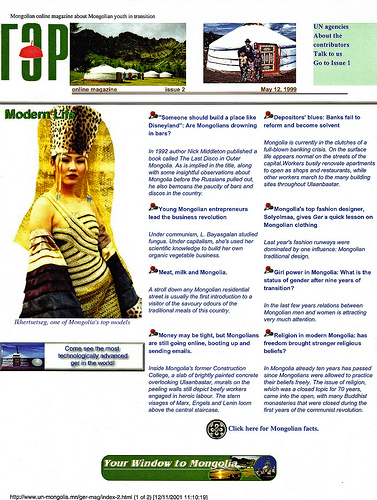
Mongolia’s top fashion designer, Solyolmaa, gives Ger a quick lesson on Mongolian clothing

Interview by A. Delgermaa, Ger Magazine, Modern Life, Issue 2, May 12, 1999

Last year’s fashion runways were dominated by one influence: Mongolian traditional design. If a designer wanted to show they were boldly embracing natural fibres and furs, then the refrain ” my show is all Mongolian” would be proudly boasted to the media. The country has become a synonym for sartorial flare and rugged beauty. It also doesn’t hurt that one of Mongolia’s top exports, cashmere wool, is in vogue, from Japan to Europe to the United States. After years of being isolated from the west under the umbrella of the Soviet Union, Mongolian fashion is proudly strutting the catwalks of the world.

Her square glasses reminiscent of Yves Saint Laurent (ysl.com), Mongolia’s top designer, Soyolmaa, talked to Ger about the ubiquitous nature of traditional clothes in the late 1990s. “There are few countries who still wear the national costume these days. Mongolia is one of them,” she says sitting regally in the studio of her home, surrounded by models draped in dresses for her latest collection: a tribute to the style and attitude of Mongolia’s ancient queens. 

“Because the design of Mongolian national clothes is highly developed, no further changes are needed.” As head of the Mongolian National Designers’ Union, she has spent many years trying to find ways to improve the national costume to “no effect” she adds.

Busy tailors come and go, checking designs. The studio is crowded with four tailors and the models (not to mention this reporter). Two clients patiently wait in the hallway to see her. In a country where the soldiers and police wear uniforms designed by Pierre Cardin, it is no surprise Mongolians aren’t slouches when it comes to clothes. While budgets may be tight and the shops far from world standard, people still find a way to dress with flair.

It is still common to see the traditional del – a cloak of either wool, leather or silk – worn by men and women of all ages, even in the capital. As herders are quick to say, the del serves many practical purposes. It is padding for long rides on the steppe, it is a makeshift tent in bad weather, it is a warm blanket, and for women, a nod to modesty when nature calls on the open steppe. While it is standard wear for older generations, younger urban Mongolians turn to the del on special occasions like school graduation ceremonies.

Last year collections by Christian Dior (Dior.com), Chanel (chanel.com), UNGARO and Pierre Cardin (pierrecardin.com) all paid homage to Mongolian design, typically characterized by variations on the del cloak, flamboyant displays of fur and knee-high boots.

“Asian styles are now having a big impact on world fashion design,” continues Soyolmaa. 

“It is because Asian clothes offer pure, simple patterns with eye-catching colours and adornments. There is a trend towards purism in the fashion world. They like high collars, askew lapels, loose sleeves and nudarga (long sleeves). The bright colors of Asia are showing up throughout Western design. You can see the askew lapel and high collar and bright colors from Christian Dior to Chanel.”

The Mongolian national costume is a classic example of purism. The pattern is very simple, with no separate sleeves or shoulder parts, and very economical with little waste of cloth.

And why did this style evolve over the generations? Soyolmaa has a simple answer: “It is because of the harsh weather of Mongolia.” The askew lapel doesn’t let wind pierce the body, nudarga or long sleeves don’t make arms cold in the minus 30 to 40 degrees Celsius winters. Winter dels have fur interiors, using wolf, fox, sheep or lamb’s wool. From ancient times to now, Mongolian men wear wolf fur coats in winter when guarding horses at night.

There are about a hundred styles of hat. Loovuus, made of fox fur with a cloth top, is a common hat in winter. The back part is open. “Fox fur is very dense. Without an open back one feels too hot and it causes high blood pressure and a headache,” according to Soyolmaa. The extraordinary design of boots with pointed toes is suitable for riding a horse while leaving enough dead air space to keep the toes warm.

Soyolmaa takes difference with those who claim “Fashion sense ends in Mongolia.” “It might because they have nothing to compare it with. But now that fashion shows are available on cable TV, Mongolians are learning how to compare Mongolian fashion and models with the global standard.” For Soyolmaa, as it is the time for Asian fashion, it is also the time for Asian models. 

“Irina Pantieva, the world’s top model is Mongolian. She is from the Buriat Republic (a province of Russia directly north of Mongolia and populated by a large number of people of Mongolian heritage).” She says Mongolian models are ready to take on the world.

To the soothing sounds of Enigma, Mongolia’s top models parade Soyolmaa’s tributes to Mongolian queens in early May at the Las Vegas Entertainment Centre, a former communist-era cinema. Long silk dresses are complemented with furs and enormous hats, at times evoking Cleopatra, at other times something from a Dr. Seus cartoon, some hats reaching a meter high. Judging by the audience’s reaction and the quality of Soyolmaa’s creations, the time has come for Mongolian designers to take centre stage on the world fashion scene.

Creative Commons License

This work is licensed under a
Creative Commons Attribution-Noncommercial-No Derivative Works 3.0 License.

ORCID iD: https://orcid.org/0000-0001-5311-1052.

© David South Consulting 2024

Categories
Ger Magazine UNDP Mongolia 1997-1999

Cashmere is king but Mongolia still struggles to reap the benefit

By A. Delgermaa, Ger Magazine, Modern Life, Issue 2, May 12, 1999

A Mongolian cashmere designer once opined that Mongolians are lucky that most goats in the country are capable of producing fine cashmere. And while Chinese cashmere dominates the marketplace, Mongolian cashmere is by far the purest and finest.

About 30 cashmere companies contributes tens of millions of dollars a year to the country’s wealth (though nobody is quite sure how much because most cashmere sales go unreported to the government). But the revenue isn’t what it used to be due to problems in the domestic industry and a drop in the world price. Z. Ayur, chief secretariat of the Gobi company, thinks it doesn’t have to be that way.

“Unfortunately we lose half of our raw cashmere to China,” he says.”

“The Chinese buy cashmere at a high price, not depending on the quality. This means national manufacturers lack raw cashmere to process into garments.”

He thinks raw cashmere exports should be banned or subject to a duty of 100 to 150 per cent. Mongolia’s weak infrastructure plays a part as well. It is cheaper for herders to travel to the Chinese border with cashmere than to bring it to the capital, Ulaanbaatar. Often when they are at the border with China, they are subjected to some hard bargaining by Chinese brokers, who exploit the fact herders can’t afford to walk away empty handed. 

Cashmere has always been considered a luxury and expensive. But in the past two years it has lost its fusty image as only for old people. Trendy designs have attracted a vast market of younger cashmere consumers. “I guess in the past it was dear and expensive and designs weren’t very appealing to the younger set,” thinks Gerelmaa, the chief designer of Gobi company. 

The Gobi company is one of the few state enterprises left over from the socialist period that still makes money (and is due for privatization this year – a prime pick for foreign investors). 

In 1972 the United Nations funded projects to experiment with starting a cashmere garment industry in Mongolia. This innovative thinking led to a joint Japanese-Mongolian venture in 1981 to start the first cashmere manufacturer, Gobi. These days it still produces one third of the country’s cashmere products. 

Mongolian Wool and Cashmere Federation head Tsendmaa is optimistic about the drop in the world market price.” It will soon go back up again,” she says with confidence. “The reserve of cashmere in the world will run out soon. What happened with the drop in prices is typical of any industry when it overproduces.” What worries her most is the flood of Mongolian cashmere going to China, where Chinese workers process and knit the garments and reap the job benefits.

While cashmere is still known for its use in classic turtle, crew and v-neck jumpers, things have changed. “Before we mostly exported classic styles in off-white, brown, grey, black, bark, blue or dark red to Japan or Germany,” continues Tsendmaa. “Now Americans order more fashionable cashmere for the young. The designs of short jumpers that expose bare chests and waists are cheap to produce (less material) and suitable for young fashions.” 

Italian, French or Belgian customers are fussier and demand greater variety in designs. These countries determine the vogue for cashmere wear and use the most high tech knitting technology.

Contemporary cashmere fashion in France or Italy can combine fur or silk. Colours have also been revamped, with the young going for light blue, light pink, snow white, off-white and light green. Italians and Americans like metal grey with rose or pink. Mixing up the colours in sporty stripes and lines is also popular.

Cashmere is very practical, warm and light. “It is not suitable for the office,” says Gerelmaa.” Cashmere wear is more suitable to wear for a night out or just for hanging out. But of course it is not for sport!” 

Fashionable Mongolian cashmere is becoming a strong competitor to Chinese, Italian, Scottish or American cashmere. “The raw material is pure and the design is more fashionable.”

And a happy Gerelmaa likes the sound the cash register makes in Japan: “In Japan classic Mongolian style is sold for more than US $1,200 in the Takashimaya Store, in GINZA.”

Now if more of that kind of hard cash found its way back to Mongolia, the country would definitely be better off. 

Creative Commons License

This work is licensed under a
Creative Commons Attribution-Noncommercial-No Derivative Works 3.0 License.

ORCID iD: https://orcid.org/0000-0001-5311-1052.

© David South Consulting 2024

Categories
Ger Magazine UNDP Mongolia 1997-1999

Mongolians call them mannequins, but this model has something to say and a good head on her shoulders

Interview by A. Delgermaa, Ger Magazine, Modern Life, Issue 2, May 12, 1999

It could be said that there is no girl who does not dream of becoming a model. Many Mongolian girls, particularly Ulaanbaatar city girls, are flocking to attend courses in modelling in the last few years. Some say models are mushrooming in Mongolia, a country known for its fresh-faced people and robust physiques. 

Ger interviewed S. Ikhertsetseg, one of the twin top models of Mongolia.

When did you first appear on the fashion stage?

“When we were 15 we played piano for the state concert on International Women’s Day on March 8. The ( Best Fashion) company was in trouble and they did not have anyone to wear some leather fashions for the show in the concert. It was fortuitous that we were asked to be the models. We kept it secret from our parents until we received a prize from Mongolia’s top fashion show, Goyol (or beauty) , in 1988. That was a year after the state concert. Being a fashion model was not considered so desirable as it is now. We were busy studying at music school and our parents did not know what we were doing.”

What do you think of today’s models?

“In the early days of fashion shows in Mongolia in the 1980s, we did not have many competitors. These days there are many beautiful Mongolian models we have to compete with, but only a few are very good. If someone is lucky, they have the potential to compete at the world level. Personally, I don’t like models who are too trained by courses.”

Do you think becoming famous is pure luck?

“Of course it is luck. But that doesn’t mean it isn’t a lot of hard work. You must send photos to agencies, and then only then, will someone see your photo – that is luck.”

What about design and fashion in Mongolia? Are Mongolians fashion sensitive?

“I can not say Mongolians are sensitive to fashion. I think our designers should work harder. Design is not a dress or a suit. It is everything, the whole cornucopia of details. I do not think we are going to compete with Europe, which has a long history of making clothing, rich in colors or designs. There is a big difference between fashion in the West and in Mongolia.”

Mongolia has a lively free press who sometimes step over the line when it comes to gossip and scandal reporting. These so-called “yellow” newspapers have damaged many people’s reputations. This had also happened to you. Some newspapers called the two of you the Barbie girls in Beijing, earning a lot of money.

“Yes, they did say those bad things. We replied to them.”

Was it before the court?

“No, that is a personal question.”

What was the result?

“The newspapers didn’t do that again.”

What do you do now?

“Both of us keep up the fashion work and also teach piano. Music is our profession and love. We founded the Association of Models of Mongolia to protect their rights and strengthen their position in the society.”

Creative Commons License

This work is licensed under a
Creative Commons Attribution-Noncommercial-No Derivative Works 3.0 License.

ORCID iD: https://orcid.org/0000-0001-5311-1052.

© David South Consulting 2024
Categories
Archive Development Challenges, South-South Solutions Newsletters

African Culture as Big Business

By David SouthDevelopment Challenges, South-South Solutions

SOUTH-SOUTH CASE STUDY

In the last decade the world’s creative industries (including crafts, fashion and design) have gained greater respect for being the spark that drives economic development and entrepreneurship. They are seen as fast growers and good job creators, and importantly, the lynch pin in cultural identity and cultural diversity. UNESCO, through its Global Alliance for Cultural Diversity, has been in the forefront of helping African countries re-shape their policies to take this into consideration. The promotion of cultural industries also has been incorporated into the New Partnership for Africa’s Development (NEPAD).

The global clothing industry is estimated to be worth US $900 billion a year. Culture and creativity are big businesses: according to UNESCO, in 2002 the UK exported US $8.5 billion in cultural goods, the United States US $7.6 billion, and China US $5.2 billion. The UK’s Burberry fashion label alone made £157 million in 2006.

This is good news for Africa’s growing fashion industry, which is finally getting the attention and respect it deserves. Entrepreneurs are tapping into this awareness as a great way to make money. Well-known Nigerian fashion designer Alphadi says the continent’s fashion industry is “giving Africa a chance to show its true self, its solidarity, its huge generosity and its greatness.”

Africa’s fashion entrepreneurs are showing more and more confidence and striding with pride across catwalks around the world. And despite the problems faced by black models – as highlighted by supermodel Naomi Campbell in her recent press conference in Kenya – some African models have a growing international profile: these include Alek Wek from southern Sudan, and Waris Dirie from Somalia. Campbell has said she plans to set up a modelling agency in Kenya to increase opportunities.

Just as African music has fans around the world, the continent’s growing fashion scene is gaining fans and more attention. From Hollywood stars to European catwalks, African fashion designers and apparel makers are feeding the industry’s hunger for novelty and new ideas.

African entrepreneurs, from village craftsmen to ambitious and creative urbanites, are finding ways to cash in on this rising awareness.

The rising stars of South Africa were on full display at this August’s Cape Town Fashion Week. David Tlale, who produces glamorous haute couture creations, places community empowerment in his hometown of Johannesburg at the centre of his business. Tlale was joined by rising stars Thabani Mavundla, Thula Sindi, and Craig Jacobs.

Creator and founder of the Fundudzi label of Johannesburg, Jacobs presented a couture collection at Paris Fashion Week in July. A former TV presenter-turned-fashion designer, Jacobs sees a renewed pride in African creativity and a new dialogue about Africa’s place in the world. His motto is: “Africa reworked…Africa re-inspired… Africa renewed”.

Established in 2004, his clothing company for women strives to be socially and environmentally responsible: “Fundudzi is also an eco-conscious label, utilizing materials such as organic cottons, soy and bamboo as well as cashmere produced in Africa which is not harmful to the environment,” he said. “The message which we want to resonate with the rest of the world is that Africa has always been organic.”

“Our label has grown out of the desire to help change the perception of our home, Africa, by presenting clothing designed and created here which can compete on the world stage.”

Jacob benefited from support from various organizations in South Africa to get his business plans sorted out. The country’s tourism body has focused on fashion with its C’est Couture campaign. But he has also struggled with the complexities of exporting his designs and navigating global customs regulations.

“There has been a lot of interest internationally in our collection, but I am not sure what the rules and regulations are … We need an over-riding body to help assist us young entrepreneurs. My experience in Paris, in July, has been that we do have something new and fresh to say in fashion, and we can produce at the same standard as the rest of the world.

There was validation of that. But we as Africans need to follow our own signature, look internally to come up with inspiration, and show that to the rest of the world. “The global village environment, and the access that technologies such as the Internet have provided, means that we can tune into the same stimuli in terms of trends and fashion directions to ensure that we are on par with the rest of the planet. I do believe that the world, bored with the same trends they have been exposed to for so long, are looking for a new guard of inspiration – and we need to empower ourselves with the right tools to answer that call.

“Our positioning is quite simple – our label is dedicated to creating jobs in Africa, thereby reducing our dependency on aid in securing our future …I wanted to create a label which is rooted in Africa, which tells African stories, but which is not tradition or museum curio – rather, intelligent pieces which can fit seamlessly into the global firmament of fashion. The label is focused on redressing the prejudices about the “dark continent” – each collection is designed as a travelogue, informing the world about the rich tapestry of life in Africa.”

Another hub of dynamism in the African fashion scene is Nairobi, Kenya. Kikoromeo connects its catwalk fashion designs with the principle of community development. The label uses mostly Kenyan materials – cotton, silk and wool – and works with local artisans, including women’s groups. Its bags are woven with Kenyan Sisal by Machakos women’s groups, and the beadwork is done by Maasai women’s groups.

Anna Trezbinski of Nairobi, who is popular in Hollywood and has contracts to provide items to top designers like Paul Smith, employs 800 people – mostly Masai women in her workshop in the Great Rift Valley.

This new wave of African fashion designers is proving that anyone with talent, a website and a fan base can puncture the bubble of the European and New York catwalks and make a splash.

“Africa is a haven of inspiration,” says the Tanzanian-born, Nairobi-based designer and collector Lisa Christofferson, who has clothed Ralph Fiennes, Rachel Weiss and Jane Seymour. “Africa for many years now has been the flavour of fashion,” she says. “It has really opened the door for us.”

She believes the internet has expanded her business and her brand. It gives clients and boutiques around the world the ability to import her hand-painted, African-inspired cashmere sweaters, bedspreads and throws. Many are ceremonial cloths of the Kuba Kingdom in Congo.

Another designer based in Kenya, Annabelle Thom, believes changes in the last seven years are responsible: access to TV and film, music channels and a burgeoning middle class with money. “People care more about fashion and if you look around in Nairobi, the average person is beautifully dressed – people are spending money on themselves,” she said.

Ethiopia has also been identified as a bubbling fashion hot spot for its indigenous raw cotton and potential to produce other natural fibres. Ethiopian designer Guenet Fresenbet launched Ethiopia’s first fashion magazine, Gigi, to help take the lead.

Published: October 2007

Resources

  • Afromix: Great links to African fashion designers and fashion events and media.
  • Kikoromeo: Based in Nairobi, Kenya Kikoromeo’s founder and principal apparel designer trained in Rome and Milan and has been in production in Kenya since 1997.
  • South Africa’s leading fashion weeks: Johannesburg Fashion Week or Capetown Fashion Week
  • A video about Kenya’s fashion boom: Click here to view.
  • Uzuri: Premier International African Inspired Fashion Magazine: A quarterly magazine founded in 2005 and based in Texas, it is dedicated to highlighting high fashion in Africa.
  • Dobizo: An excellent website with all the resources necessary for a budding entrepreneur to get started in the fashion business, from step-by-step guides to common mistakes and how to choose a logo.
  • Fashion Nigeria: Newly launched Nigerian fashion magazine.

Development Challenges, South-South Solutions was launched as an e-newsletter in 2006 by UNDP’s South-South Cooperation Unit (now the United Nations Office for South-South Cooperation) based in New York, USA. It led on profiling the rise of the global South as an economic powerhouse and was one of the first regular publications to champion the global South’s innovators, entrepreneurs, and pioneers. It tracked the key trends that are now so profoundly reshaping how development is seen and done. This includes the rapid take-up of mobile phones and information technology in the global South (as profiled in the first issue of magazine Southern Innovator), the move to becoming a majority urban world, a growing global innovator culture, and the plethora of solutions being developed in the global South to tackle its problems and improve living conditions and boost human development. The success of the e-newsletter led to the launch of the magazine Southern Innovator.

Creative Commons License

This work is licensed under a
Creative Commons Attribution-Noncommercial-No Derivative Works 3.0 License.

ORCID iD: https://orcid.org/0000-0001-5311-1052.

© David South Consulting 2022