
By David South, Development Challenges, South-South Solutions

Food security is key to economic growth and human development. A secure and affordable food supply means people can meet their nutrition needs and direct their resources to improving other aspects of their lives, such as housing, clothing, health services or education.
One solution hopes to boost productivity for small-scale farmers and make agriculture a more attractive income source to the young and poor, by making it possible to grow food year-round. Kenyan social enterprise Amiran Kenya is selling the Amiran Foundation Kit (amirankenya.com), a simple-to-use greenhouse farming kit. As well as helping people grow both food and their agricultural business, Amiran Kenya hopes young people will also buy the kits at a discount and then sell them for a profit to others.
The technology to grow food year-round is already available, but it is generally expensive to set up. This cost is usually prohibitive to the poor and young: two groups who could really benefit from the income. And if young people in Africa learn the basics of farming, in time they could expand and develop into agribusinesses and benefit from the growing food demand on the continent.
Africa, a continent undergoing significant economic change, has yet to fully realize its potential as a producer of agricultural products to feed itself and the world. Africa currently has a labour-intensive but very inefficient agriculture system. While many Africans either make their living in agriculture or engage in subsistence farming for survival, much of Africa’s farming is inefficient and fails to make the most of the continent’s rich resources and potential.
At present, agriculture, farmers and agribusinesses make up almost 50 per cent of Africa’s economic activity, and the continent’s food system is worth an estimated US $313 billion a year (World Bank). A World Bank report, Growing Africa: Unlocking the Potential of Agribusiness (http://siteresources.worldbank.org/INTAFRICA/Resources/africa-agribusiness-report-2013.pdf), argues that Africa could have a trillion-dollar agriculture market by 2030.
While large-scale agribusinesses are increasing in Africa, it is still reliant on small-scale farmers to meet the daily food needs of most of the population.
“The time has come for making African agriculture and agribusiness a catalyst for ending poverty,” said Makhtar Diop, World Bank Vice President for Africa. The continent needs to “boost its high growth rates, create more jobs, significantly reduce poverty, and grow enough cheap, nutritious food to feed its families, export its surplus crops, while safeguarding the continent’s environment.”
Any country that has to import food will be vulnerable to currency fluctuations and the inflation in prices this can cause. A country that has many options for food, and reduces its dependency on imported food resources, will have greater resilience when crisis strikes.
Greenhouses are a great way to expand the growing season, avoiding ups and downs in temperature. But they can be expensive to set up – something the kit hopes to resolve. A typical greenhouse kit will cost a Kenyan an estimated 10 times more than the Amiran Foundation Kit, which retails at Sh 14,500 (US $168).
The package includes a drip-feed kit, a 250 liter water tank, a one liter sprayer, instructional growing guides, fertilizer, agro chemicals and high-quality seeds. Crops that can be grown include cabbage, watermelon, kale and spinach. The drip kit is highly durable and can last eight years, according to its manufacturer.
The kit is being marketed as a “kick starter for the small scale farmers who want to adopt agribusiness” as their method for growing food.
“The farmers will have a chance to start small and grow bit by bit until they are able to afford the modern greenhouses which will set the ball rolling for them to enjoy the benefits of modern agribusiness,” Yariv Kedar, Amiran Kenya’s Deputy Director, explains on the company’s website.
The plan is to draw more people into agriculture by showing they do not need to be prisoners of weather patterns. Larger agribusiness enterprises already have the resources to benefit from technology such as greenhouses and avoid the worst effects of the weather.
By transcending fickle weather patterns, it is possible to reduce the risk of crop failure and the resulting financial damage – one reason people shy away from farming.
Amiran’s philosophy behind the kit is simple: knowledge and know-how matched with high-quality inputs that do not harm the environment. The idea is to introduce people to the concept of agribusiness, no matter how small their land size. Amiran estimates that by investing Sh 14,500 (US $168), a person could make Sh 25,000 (US $290) per season – making back in a season the initial investment cost.
Urban farmers and home gardeners are among those who can benefit, along with small-scale farmers in arid and semi-arid areas of Kenya.
Kedar said the kit’s drip pipes, which deliver water directly to the root of the plant, ensure that “every drop counts” and save between 30 to 60 per cent of water compared to other methods of irrigation.
“Using the Amiran Foundation Kit, farmers are now able to grow all year round and experience high yields while still conserving the scarce resource, water,” he said.
Published: March 2014
Resources
1) World Vegetable Center: The World Vegetable Center is the world’s leading international non-profit research and development institute committed to alleviating poverty and malnutrition in developing countries through vegetable research and development. Website: http://www.avrdc.org
2) Songhai Centre: a Benin-based NGO that is a training, production, research, and development centre in sustainable agriculture. Website: http://www.songhai.org/english
3) Marketing African Leafy Vegetables: Challenges and Opportunities in the Kenyan Context by Kennedy M. Shiundu and Ruth. K. Oniang. Website: http://www.ajfand.net/Issue15/PDFs/8%20Shiundu-IPGR2_8.pdf
4) African Alliance for Capital Expansion: A management consultancy focused on private sector development and agribusiness in West Africa. Website: http://www.africanace.com/v3

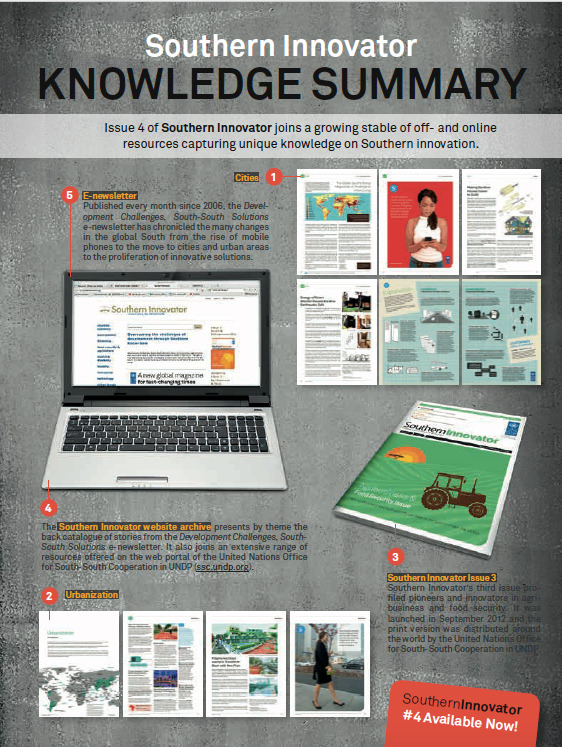
Development Challenges, South-South Solutions was launched as an e-newsletter in 2006 by UNDP’s South-South Cooperation Unit (now the United Nations Office for South-South Cooperation) based in New York, USA. It led on profiling the rise of the global South as an economic powerhouse and was one of the first regular publications to champion the global South’s innovators, entrepreneurs, and pioneers. It tracked the key trends that are now so profoundly reshaping how development is seen and done. This includes the rapid take-up of mobile phones and information technology in the global South (as profiled in the first issue of magazine Southern Innovator), the move to becoming a majority urban world, a growing global innovator culture, and the plethora of solutions being developed in the global South to tackle its problems and improve living conditions and boost human development. The success of the e-newsletter led to the launch of the magazine Southern Innovator.




This work is licensed under a
Creative Commons Attribution-Noncommercial-No Derivative Works 3.0 License.
ORCID iD: https://orcid.org/0000-0001-5311-1052.
© David South Consulting 2023
 David South Consulting
You must be logged in to post a comment.