Tag: farming

  • US $1 Trillion Opportunity for Africa’s Agribusinesses Says Report

    US $1 Trillion Opportunity for Africa’s Agribusinesses Says Report

    By David SouthDevelopment Challenges, South-South Solutions

    SOUTH-SOUTH CASE STUDY

    As the world’s population continues to grow – surpassing 9 billion people by 2050, the United Nations estimates – and more and more people move to urban areas, producing enough food to feed this population will be one of the biggest economic challenges and opportunities in the global South.

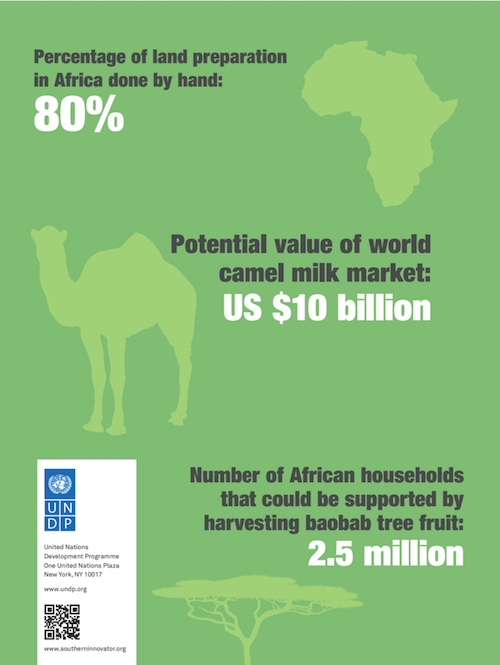
    Africa, a continent undergoing significant economic change, has yet to fully realize its potential as a producer of agricultural products to feed itself and the world. Africa currently has a labour-intensive but very inefficient agriculture system. While many Africans either make their living in agriculture or engage in subsistence farming for survival, much of the continent’s farming is inefficient and fails to make the most of the continent’s rich resources and potential.

    A new World Bank report, Growing Africa: Unlocking the Potential of Agribusiness (http://siteresources.worldbank.org/INTAFRICA/Resources/africa-agribusiness-report-2013.pdf), argues that Africa could have a trillion-dollar agriculture market by 2030.

    What will need to change to make this happen? African farms will need greater access to capital, as well as more investment in infrastructure and better irrigation. All of these elements will need to dramatically improve if Africa is going to compete effectively in global markets.

    The report urges greater cooperation between governments and agribusinesses, farmers and consumers and for all parties to recognize that the continent is being rapidly urbanized, changing the way food is grown, sourced and distributed.

    It says Africa’s farmers and agribusinesses require more capital, steady supplies of electricity, better technology and irrigated land. All these resources then need to be applied to the growing of high-value, nutritious foods.

    At present, agriculture, farmers and agribusinesses make up almost 50 per cent of Africa’s economic activity, and the continent’s food system is worth an estimated US $313 billion a year (World Bank). But the report believes this could triple if governments and business leaders adopted radically different policies.

    “The time has come for making African agriculture and agribusiness a catalyst for ending poverty,” said Makhtar Diop, the World Bank Vice President for Africa. “We cannot overstate the importance of agriculture to Africa’s determination to maintain and boost its high growth rates, create more jobs, significantly reduce poverty, and grow enough cheap, nutritious food to feed its families, export its surplus crops, while safeguarding the continent’s environment.”

    The report addresses the problems African agriculture is currently experiencing: slow yield growth for major food crops, slowing research spending, degraded land, water scarcity, and climate change. It looks at solutions to allow Africa to tackle these problems and seize the opportunity to significantly increase its food and agricultural exports.  Africa can more than meet its own needs and meet the world’s needs too, the report argues.

    But what can be done? At present, 50 per cent of the world’s uncultivated land suitable for growing food resides in Africa. This works out to 450 million hectares of land that is neither forested, protected nor densely populated – all could be available for growing food.

    The report also found Africa is using just 2 per cent of its renewable water resources while the rest of the world averages 5 per cent. African harvests currently do not yield anything close to what is possible. Another weakness is waste from post-harvest losses, averaging 15 to 20 per cent for cereals, and even more for perishable foods, because of poor storage and farm infrastructure.

    Areas the report recommends farmers and agribusinesses should focus on include fast-growing markets for rice, maize, soybeans, sugar, palm oil, biofuel and feedstock. In sub-Saharan Africa, the focus should be on rice, feed grains, poultry, dairy, vegetable oils, horticulture and processed foods for the domestic market. And there are also good examples to follow by studying the ways Latin America and Southeast Asia used world markets to boost income and profits.

    Agribusiness enterprises looking to purchase more land to expand the number of hectares under cultivation are urged to act ethically and not to threaten existing people’s livelihoods or violate local users’ rights. This includes consulting with locals and paying fair market price for land bought.

    Rice is one crop that needs attention. Significant quantities of rice are imported and consumed in Africa. Half the rice eaten is imported, costing around US $3.5 billion a year (World Bank). Big importers include Ghana and Senegal – both countries singled out in the report for needing to improve their domestic rice production and quality.

    Another food staple needing attention is maize (corn). A daily food staple for many Africans, it takes up 14 per cent of crop lands on the continent. While most Zambians get half their calories from maize, Zambia is currently unable to export maize at a cost comparable to market leader Thailand – Zambian maize costs one-third more. Zambia was singled out as needing to raise yields, reduce costs, and remove disincentives for the private sector in markets and trade.

    “Improving Africa’s agriculture and agribusiness sectors means higher incomes and more jobs. It also allows Africa to compete globally. Today, Brazil, Indonesia and Thailand each export more food products than all of sub-Saharan Africa combined.  This must change,” said Jamal Saghir, the World Bank’s Director for Sustainable Development in the Africa Region.

    How to make the most of this opportunity?

    One innovative idea coming out of Africa comes from the mega-brewer SABMiller (sabmiller.com). As a sign of confidence in the continent’s growing economies, the brewer has pledged to slash its beer prices and use more African-grown grains – a boost to local farmers – and to start a campaign of opening new breweries for the next three years. Countries targeted include Ghana, Nigeria, Mozambique and Zambia.

    “African farmers and businesses must be empowered through good policies, increased public and private investments and strong public-private partnerships,” according to Gaiv Tata, World Bank director for Financial and Private Sector Development in Africa.  “A strong agribusiness sector is vital for Africa’s economic future.”

    Published: May 2013

    Resources

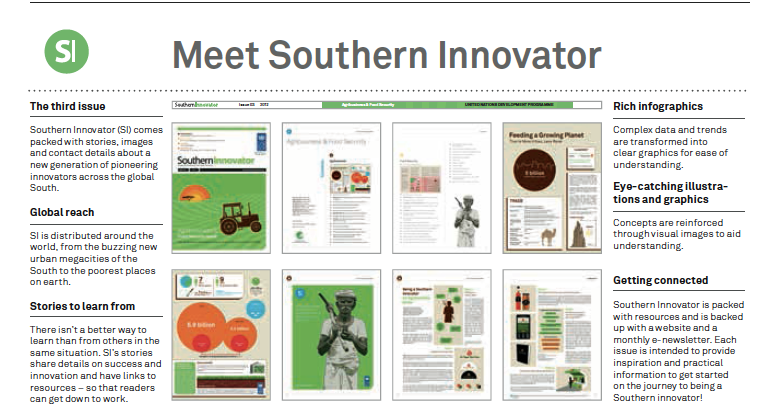
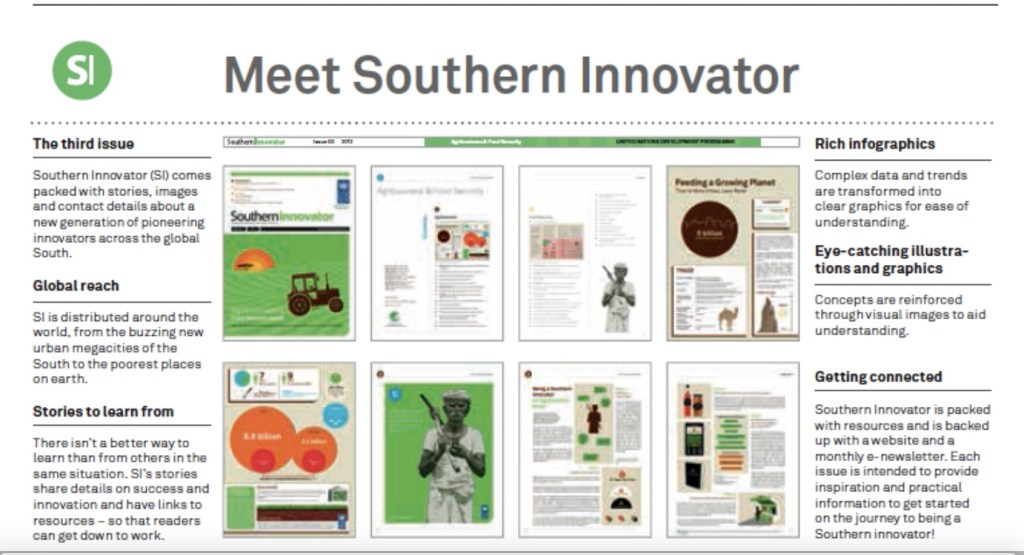
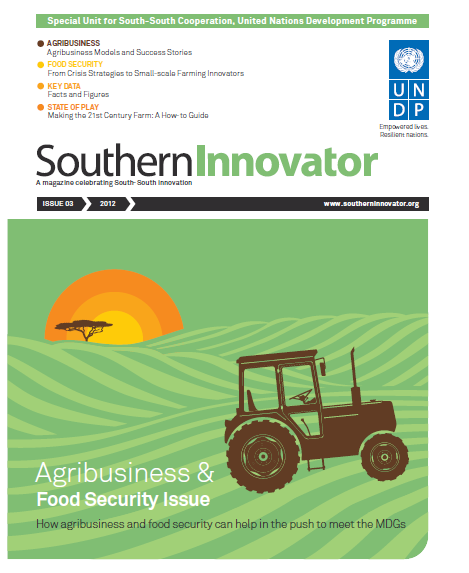
    1) Southern Innovator Magazine Issue 3: Agribusiness and Food Security: Southern Innovator’s third issue finds innovators transforming agribusiness and boosting food security. Website: http://www.scribd.com/doc/106055665/Southern-Innovator-Magazine-Issue-3-Agribusiness-and-Food-Security

    2) The New Harvest: Agricultural Innovation in Africa by Calestous Juma. Website: http://belfercenter.ksg.harvard.edu/publication/20504/new_harvest.html

    3) Growing Africa: Unlocking the Potential of Agribusiness. Website: http://siteresources.worldbank.org/INTAFRICA/Resources/africa-agribusiness-report-2013.pdf

    4) Edible Insects: future prospects for food and feed security, Publisher: FAO. Website: http://www.un.org/apps/news/story.asp?NewsID=44886

    5) Six-legged livestock: edible insect farming, collecting and marketing in Thailand, Publisher: FAO. Website: http://www.fao.org/asiapacific/rap/home/news/detail/en/?news_uid=176061

    Southern Innovator logo

    London Edit

    31 July 2013

    https://davidsouthconsulting.org/2020/12/14/african-farming-wisdom-now-scientifically-proven/

    https://davidsouthconsulting.org/2022/11/21/agribusiness-food-security/

    https://davidsouthconsulting.org/2022/08/14/brazil-preserves-family-farms-keeping-food-local/

    https://davidsouthconsulting.org/2022/10/10/cheap-farming-kit-hopes-to-help-more-become-farmers/

    https://davidsouthconsulting.org/2022/02/10/food-inflation-ways-to-fight-it/

    https://davidsouthconsulting.org/2021/03/04/growing-a-southern-brand-to-global-success-the-olam-story/

    https://davidsouthconsulting.org/2022/10/14/indias-modernizing-food-economy-unleashing-new-opportunities/

    https://davidsouthconsulting.org/2022/05/04/insects-can-help-in-food-crisis/

    https://davidsouthconsulting.org/2022/10/31/new-kenyan-services-to-innovate-mobile-health-and-farming/

    https://davidsouthconsulting.org/2022/11/23/putting-worms-to-work/

    https://davidsouthconsulting.org/2021/09/16/small-fish-farming-opportunity-can-wipe-out-malnutrition/

    https://davidsouthconsulting.org/2021/03/05/southern-innovator-issue-3/

    https://davidsouthconsulting.org/2022/10/14/staple-foods-are-becoming-more-secure-in-the-south/

    https://davidsouthconsulting.org/2021/03/20/texting-for-cheaper-marketplace-food-with-sokotext/

    https://davidsouthconsulting.org/2022/11/11/urban-farming-to-tackle-global-food-crisis/

    https://davidsouthconsulting.org/2022/10/18/woman-wants-african-farming-to-be-cool/

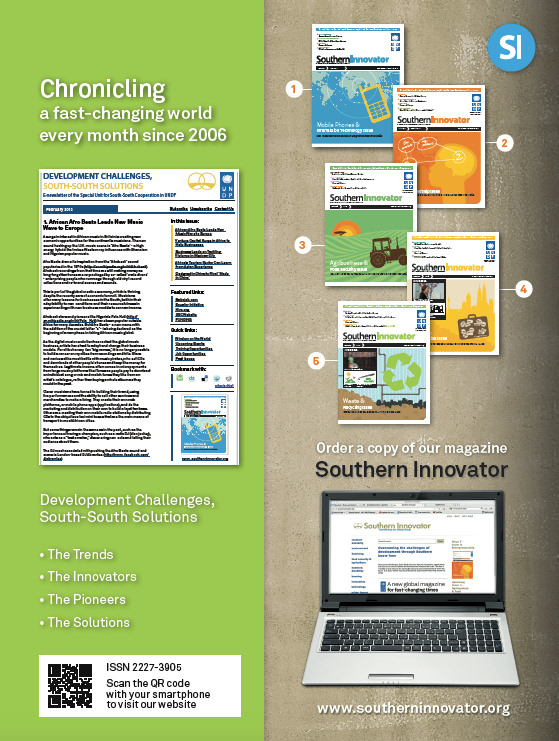
    Development Challenges, South-South Solutions was launched as an e-newsletter in 2006 by UNDP’s South-South Cooperation Unit (now the United Nations Office for South-South Cooperation) based in New York, USA. It led on profiling the rise of the global South as an economic powerhouse and was one of the first regular publications to champion the global South’s innovators, entrepreneurs, and pioneers. It tracked the key trends that are now so profoundly reshaping how development is seen and done. This includes the rapid take-up of mobile phones and information technology in the global South (as profiled in the first issue of magazine Southern Innovator), the move to becoming a majority urban world, a growing global innovator culture, and the plethora of solutions being developed in the global South to tackle its problems and improve living conditions and boost human development. The success of the e-newsletter led to the launch of the magazine Southern Innovator. 

    Creative Commons License

    This work is licensed under a
    Creative Commons Attribution-Noncommercial-No Derivative Works 3.0 License.

    ORCID iD: https://orcid.org/0000-0001-5311-1052.

    © David South Consulting 2023

  • Cheap Farming Kit Hopes to Help More Become Farmers

    Cheap Farming Kit Hopes to Help More Become Farmers

    By David SouthDevelopment Challenges, South-South Solutions

    SOUTH-SOUTH CASE STUDY

    Food security is key to economic growth and human development. A secure and affordable food supply means people can meet their nutrition needs and direct their resources to improving other aspects of their lives, such as housing, clothing, health services or education.

    One solution hopes to boost productivity for small-scale farmers and make agriculture a more attractive income source to the young and poor, by making it possible to grow food year-round. Kenyan social enterprise Amiran Kenya is selling the Amiran Foundation Kit (amirankenya.com), a simple-to-use greenhouse farming kit. As well as helping people grow both food and their agricultural business, Amiran Kenya hopes young people will also buy the kits at a discount and then sell them for a profit to others.

    The technology to grow food year-round is already available, but it is generally expensive to set up. This cost is usually prohibitive to the poor and young: two groups who could really benefit from the income. And if young people in Africa learn the basics of farming, in time they could expand and develop into agribusinesses and benefit from the growing food demand on the continent.

    Africa, a continent undergoing significant economic change, has yet to fully realize its potential as a producer of agricultural products to feed itself and the world. Africa currently has a labour-intensive but very inefficient agriculture system. While many Africans either make their living in agriculture or engage in subsistence farming for survival, much of Africa’s farming is inefficient and fails to make the most of the continent’s rich resources and potential.

    At present, agriculture, farmers and agribusinesses make up almost 50 per cent of Africa’s economic activity, and the continent’s food system is worth an estimated US $313 billion a year (World Bank). A World Bank report, Growing Africa: Unlocking the Potential of Agribusiness (http://siteresources.worldbank.org/INTAFRICA/Resources/africa-agribusiness-report-2013.pdf), argues that Africa could have a trillion-dollar agriculture market by 2030.

    While large-scale agribusinesses are increasing in Africa, it is still reliant on small-scale farmers to meet the daily food needs of most of the population.

    “The time has come for making African agriculture and agribusiness a catalyst for ending poverty,” said Makhtar Diop, World Bank Vice President for Africa. The continent needs to “boost its high growth rates, create more jobs, significantly reduce poverty, and grow enough cheap, nutritious food to feed its families, export its surplus crops, while safeguarding the continent’s environment.”

    Any country that has to import food will be vulnerable to currency fluctuations and the inflation in prices this can cause. A country that has many options for food, and reduces its dependency on imported food resources, will have greater resilience when crisis strikes.

    Greenhouses are a great way to expand the growing season, avoiding ups and downs in temperature. But they can be expensive to set up – something the kit hopes to resolve. A typical greenhouse kit will cost a Kenyan an estimated 10 times more than the Amiran Foundation Kit, which retails at Sh 14,500 (US $168).

    The package includes a drip-feed kit, a 250 liter water tank, a one liter sprayer, instructional growing guides, fertilizer, agro chemicals and high-quality seeds. Crops that can be grown include cabbage, watermelon, kale and spinach. The drip kit is highly durable and can last eight years, according to its manufacturer.

    The kit is being marketed as a “kick starter for the small scale farmers who want to adopt agribusiness” as their method for growing food.

    “The farmers will have a chance to start small and grow bit by bit until they are able to afford the modern greenhouses which will set the ball rolling for them to enjoy the benefits of modern agribusiness,” Yariv Kedar, Amiran Kenya’s Deputy Director, explains on the company’s website.

    The plan is to draw more people into agriculture by showing they do not need to be prisoners of weather patterns. Larger agribusiness enterprises already have the resources to benefit from technology such as greenhouses and avoid the worst effects of the weather.

    By transcending fickle weather patterns, it is possible to reduce the risk of crop failure and the resulting financial damage – one reason people shy away from farming.

    Amiran’s philosophy behind the kit is simple: knowledge and know-how matched with high-quality inputs that do not harm the environment. The idea is to introduce people to the concept of agribusiness, no matter how small their land size. Amiran estimates that by investing Sh 14,500 (US $168), a person could make Sh 25,000 (US $290) per season – making back in a season the initial investment cost.

    Urban farmers and home gardeners are among those who can benefit, along with small-scale farmers in arid and semi-arid areas of Kenya.

    Kedar said the kit’s drip pipes, which deliver water directly to the root of the plant, ensure that “every drop counts” and save between 30 to 60 per cent of water compared to other methods of irrigation.

    “Using the Amiran Foundation Kit, farmers are now able to grow all year round and experience high yields while still conserving the scarce resource, water,” he said.

    Published: March 2014

    Resources

    1) World Vegetable Center: The World Vegetable Center is the world’s leading international non-profit research and development institute committed to alleviating poverty and malnutrition in developing countries through vegetable research and development. Website: http://www.avrdc.org

    2) Songhai Centre: a Benin-based NGO that is a training, production, research, and development centre in sustainable agriculture. Website: http://www.songhai.org/english

    3) Marketing African Leafy Vegetables: Challenges and Opportunities in the Kenyan Context by Kennedy M. Shiundu and Ruth. K. Oniang. Website: http://www.ajfand.net/Issue15/PDFs/8%20Shiundu-IPGR2_8.pdf

    4) African Alliance for Capital Expansion: A management consultancy focused on private sector development and agribusiness in West Africa. Website: http://www.africanace.com/v3

    Development Challenges, South-South Solutions was launched as an e-newsletter in 2006 by UNDP’s South-South Cooperation Unit (now the United Nations Office for South-South Cooperation) based in New York, USA. It led on profiling the rise of the global South as an economic powerhouse and was one of the first regular publications to champion the global South’s innovators, entrepreneurs, and pioneers. It tracked the key trends that are now so profoundly reshaping how development is seen and done. This includes the rapid take-up of mobile phones and information technology in the global South (as profiled in the first issue of magazine Southern Innovator), the move to becoming a majority urban world, a growing global innovator culture, and the plethora of solutions being developed in the global South to tackle its problems and improve living conditions and boost human development. The success of the e-newsletter led to the launch of the magazine Southern Innovator. 
    Creative Commons License

    This work is licensed under a
    Creative Commons Attribution-Noncommercial-No Derivative Works 3.0 License.

    ORCID iD: https://orcid.org/0000-0001-5311-1052.

    © David South Consulting 2023

  • Urban Farmers Gain from Waste Water

    Urban Farmers Gain from Waste Water

    By David SouthDevelopment Challenges, South-South Solutions

    SOUTH-SOUTH CASE STUDY

    The global food crisis continues to fuel food price inflation and send many into hunger and despair. Around the world, solutions are being sought to the urgent need for more food and cheaper food. U.N. Secretary General Ban Ki-moon has called for food production to increase 50 percent by 2030 just to meet rising demand – and right now there are 862 million people undernourished (FAO).

    One fast-growing solution is bringing farming to urban and semi-urban spaces, where the majority of the world’s population now lives.

    Urban farmers can take advantage of their close proximity to consumers, keeping costs down and profits up. They can also solve one of agriculture’s enduring problems – where to find water for irrigation by using existing waste water. Waste water is plentiful in urban environments, where factories usually pump out waste water into streams, rivers and lakes.

    The amount of urban farmed agriculture is still small, about 10 percent of the world’s agricultural production, but is a potential growth area if handled well. In 53 cities surveyed by the International Water Management Institute, 1.1 million farmers – some 200 million worldwide – are now using recycled or waste water to irrigate their crops.

    In Accra, Ghana, more than 200,000 people depend on food grown with wastewater. In Pakistan, a full quarter of the grown vegetables use wastewater.

    The use of waste water comes with its ups and downs. While the World Health Organization rightfully points out that waste water can be a source of disease and pollution, cities also face a dilemma: diverting fresh water to irrigate crops means less for people to drink. Out of the 53 cities surveyed by the International Water Management Institute, 85 percent dumped their raw sewage and wastewater into streams and lakes. With this in mind, the WHO has altered its stance on wastewater, and now supports its use for irrigating farmland as long as all efforts are made to treat wastewater and that people are warned to thoroughly wash food before eating it.

    Pay Drechsel, who heads the IWMI’s research division based in Accra, Ghana, studying safe and productive use of low-quality water, says sophisticated systems to use waste water have developed in Vietnam, China and India, “where this practice has been going on for centuries.”

    “People know how to avoid health risks, like thorough cooking of vegetables,” he said. “In Vietnam and China, waste from households (fecal waste, solid waste and wastewater from household use) have always been effectively recycled in ‘closed systems’ at a household level where the waste/nutrients are recycled into the food chain and so return for human consumption.”

    Drechsel cites examples like Calcutta, where a large wetland is being used for treating and recycling wastewater for beneficial uses such as fish farming. In Northern Ghana, fecal sludge from septic tanks is spread on fields that are later used to grow cereals.

    “The risk for the consumer is extremely low, a waste product is productively recycled, the farmer has a good harvest and the city gets rid of their waste,” Drechsel said. “A multiple win-win situation.

    “Depending on the local situations such models can be widely used, provided they are documented and the risk factors are controlled,” he added.

    Farmers use various methods to reduce the risk of contamination, including drip irrigation where the water does not touch the crop.

    The risks for both farmers and consumer can be managed with the right protocols. For farmers, Drechsel recommends wearing of rubber boots and careful hand washing to avoid skin diseases. He points out that these farmers usually make more money than those who do not use waste water, and thus can afford the extra cost of precautionary measures, like de-worming tablets. They can quickly get out of poverty by using this water.

    For consumers, the risk is from diarrhoea, typhus or cholera if raw food is eaten unwashed or poorly washed. The best solution is to turn to the WHO’s guidelines and proven local practices and tested techniques developed by researchers.

    “Here more awareness creation on invisible risks through pathogens is needed. Perception studies in West Africa showed that nearly all households wash vegetables but they target visible dirt. Thus, the methods used are not effective. Best would be therefore a combination of risk reducing interventions from farm to fork, as none alone is 100 percent efficient. This is also what the new WHO guidelines promote: a flexible approach, reducing in each country the health risks as far as it is possible and feasible.”

    Drechsel sees an opportunity for water treatment plants to seize: “What is missing so far is a ‘design for reuse.’ If treatment plants would be designed to serve farmers they could be less sophisticated and easier to maintain. Farmers could be involved in this, maybe a win-win situation.

    “The environment benefits too. Spreading wastewater over fields, and allowing it to leach back through the soil into local waterways, turns out to be a reasonable way to purify it. The process filters out all the organic contaminants, and much of the nitrogen and phosphates that would otherwise contribute to algal blooms and dead zones further downstream. It is certainly preferable to dumping wastewater straight into the nearest big river or lake.”

    Published: September 2008

    Resources

    • Vertical farming, where hothouses are piled one on top of the other, is an option being promoted as a solution to the food needs of urban dwellers.
      Website: http://www.verticalfarm.com/
    • Extensive photographs of vertical farm project concepts by Chris Jacobs in cooperation with the grandfather of skyscraper farm concepts: Dr. Dickson Despommier of Columbia University. His ideal: all-in-one eco-towers would actually produce more energy, water (via condensation/purification) and food than their occupants would consume. His mission: to gather architects, engineers, economists and urban planners to develop a sustainable and high-tech wonder of ecological engineering.
      Website: weburbanist.com
    • Urban Gardening News, a news service providing a review of daily news targeting everyone involved in planning & practicing alternative farming in cities. Great updates on how things are progressing across the South.
      Website: http://www.urbanagriculture-news.com

    Follow @SouthSouth1

    Slideshare: http://www.slideshare.net/DavidSouth1/development-challengessouthsouthsolutionsnovember2010issue

    Southern Innovator Issue 1: https://books.google.co.uk/books?id=Q1O54YSE2BgC&dq=southern+innovator&source=gbs_navlinks_s

    Southern Innovator Issue 2: https://books.google.co.uk/books?id=Ty0N969dcssC&dq=southern+innovator&source=gbs_navlinks_s

    Southern Innovator Issue 3: https://books.google.co.uk/books?id=AQNt4YmhZagC&dq=southern+innovator&source=gbs_navlinks_s

    Southern Innovator Issue 4: https://books.google.co.uk/books?id=9T_n2tA7l4EC&dq=southern+innovator&source=gbs_navlinks_s

    Southern Innovator Issue 5: https://books.google.co.uk/books?id=6ILdAgAAQBAJ&dq=southern+innovator&source=gbs_navlinks_s

    Creative Commons License

    This work is licensed under a
    Creative Commons Attribution-Noncommercial-No Derivative Works 3.0 License.

    ORCID iD: https://orcid.org/0000-0001-5311-1052.

    © David South Consulting 2023

  • Civet Cat Coffee Brews Filipino Opportunity

    Civet Cat Coffee Brews Filipino Opportunity

    By David SouthDevelopment Challenges, South-South Solutions

    SOUTH-SOUTH CASE STUDY

    In the Philippines, one animal’s call of nature has become a business opportunity.

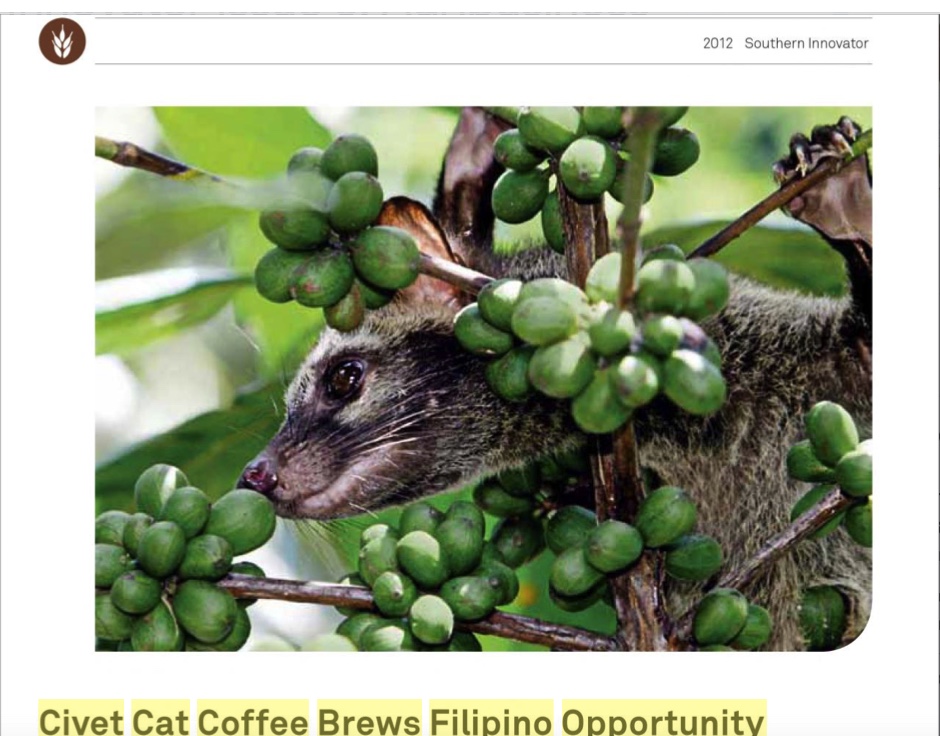
    The civet cat, a member of the mongoose family, ingests the fruit of coffee plants, and expels the beans. This has created an unexpected by-product – a prized beverage for the world’s savvy coffee drinkers seeking the next taste sensation. The partially digested coffee beans are gathered from the faeces of the cat and used to make a much-coveted, smooth-flavoured cup of coffee.

    It is a good example of how value can be added to a product, in this case coffee beans, producing a substantially higher income. The coffee is startlingly expensive: 50 grams cost US $70, 100 grams US $90, and 1 kilogram is a whopping US $870. The coffee is a blend of Arabica, Liberica and Exelsa beans, all of which have passed through the civet cats.

    The highly prized coffee is driving a growing market for these rare beans around the world. But as demand rises, it becomes clear it is a market needing quality control and ethical practices.

    One business that is trying to do this is Coffee Alamid (www.arengga.com), based in Las Pinas in the Philippines. It bills the coffee as the “World’s Rarest Brew. The Philippines’ Pride.”

    Coffee Alamid’s founders, Basil and Vie Reyes, call themselves “coffee entrepreneurs” who started in the business from scratch.

    “When we started Cafe Alamid, we were not even coffee drinkers,” they explain on the company’s website. “We didn’t know anything about coffee at all!”

    Experienced in making Arengga vinegar (http://www.arengga.com/index.php/arengga-pinnata-its-not-just-a-vinegar.mpc), they discovered the civet cats that lived among the sugar palm trees used for making the vinegar. They did some research and were inspired by the Kopi Luwak, the Indonesian variety of civet cat coffee and wondered why they couldn’t do the same thing in the Philippines.

    They consulted with the local forest-dwellers of Indang, Cavite and Batangas, who confirmed they gathered the civet cat droppings to make into coffee, part for personal consumption, with the rest sold in local markets. Gathering the civet droppings provides an income to the forest residents, who collect an average of one kilogram a day.

    Some were sceptical of the idea: why bother with such a time-consuming product? But the Reyeses were inspired by the success of civet coffee in Indonesia and it inspired them to try it in the Philippines. They see themselves as “enlightened entrepreneurs” who believe in marrying business with social development.

    The coffee is made from the wild civet cat droppings harvested from the forest floors of mountains in Malarayat, Lipa, Batangas and Mount Matutum, General Santos and South Cotabato in the Philippines. The beans are roasted and exported to Japan, Taiwan, Korea, Australia, the United States and Italy. The company produces between 1 and 1.5 tons of beans a year.

    A proud moment for the business was becoming the first Filipino firm to participate in the Tea and Coffee World Cup in Geneva, Switzerland in 2007.

    The brand’s name, Alamid, is the local name for the civet cat (Paradoxorus Philippinensis). It belongs to the mongoose family and forages for food at night, eating the ripest and sweetest coffee cherries during the coffee season.

    By morning the civet cats excrete the undigested beans. While inside the cat’s stomach, enzymes and stomach acids go to work on the beans, altering their structure. The beans ‘ferment’ in the cat’s stomach, a process that has been analyzed by Dr. Massimo Marcone, a scientist from Canada’s University of Guelph.

    Marcone traveled to Ethiopia and Indonesia in 2003 to collect the rare coffee beans. He found the beans’ taste – described as “earthy, musty, syrupy, smooth and rich with jungle and chocolate undertones” – was due to the lack of protein in the bean.

    “The civet beans are lower in total protein, indicating that during digestion, proteins are being broken down and are also leaked out of the bean,” Marcone told the Luwak Kopi website. “Since proteins are what make coffee bitter during the roasting process, the lower levels of proteins decrease the bitterness of Kopi Luwak coffee.”

    “Civet beans are typically extensively washed under running water after collection, which dislodges bacteria,” he said.

    Marcone published his research into the beans in the paper “Composition and properties of Indonesian palm civet coffee (Kopi Luwak) and Ethiopian civet coffee.” (http://www.sciencedirect.com/science/article/pii/S0963996904001309)

    The beans are greenish-brown when they come out in the cat faeces. Marcone found the process in the civet cat removes some of the caffeine, giving a strong cup of coffee less kick; this also makes the flavour smoother.

    Supply is tight and this has led to some people forging the coffee or using unethical practices to get their hands on the beans. It is a business that needs to be run in an ethical way to ensure the rich profits are shared with everyone involved.

    Marcone warns against imitations. “About 42 percent of all the kopi luwaks that are presently on sale are either adulterated or complete fakes, unfortunately,” he told the Los Angeles Times.

    Coffee Alamid’s parent company, Bote Central, started as a family-owned company in 2002, with the idea of using agro-forestry products to create sustainable livelihoods and help preserve the environment. It wanted to introduce Fair Trade principles to the Philippines coffee industry.

    Structurally, the company uses community roasting business units (CRBU) across the Philippines, in particular the countryside, to improve the way coffee is sold and make it more profitable for local economies. There are currently 12 such units, and more are planned. The company has put together a guide book on best practice for harvesting Arabica coffee beans based on their first-hand experience. It also explains how they maintain quality control (http://www.scribd.com/doc/19991462/Production-Guide-for-Arabica-Coffee-by-Bote-Central-Inc-Maker-of-Coffee-Alamid).

    The company deals directly with farmers to avoid middlemen gouging profits, and tries to use technology to make the business more efficient and sustainable.

    To keep quality improving, the company has also produced a manual on how to grow and harvest Arabica coffee beans. It is designed to tackle the practical realities of coffee production and show how to improve current methods to produce a better-quality bean. This is critical for the overall business as competition is fierce and quality has to constantly be improved.

    Coffee Alamid has successfully positioned itself as a high-end, high-cost product. It is sold by Japan Airlines and by department stores in Japan and specialty coffee shops around the world.

    Civet cat coffee continues to develop new fans. In Britain, the Birmingham-based Urban Coffee Company (http://www.urbancoffee.co.uk) has started selling the coffee.

    ‘It’s actually really nice,” sales manager Mark Bridgens told the Daily Mail newspaper. “It has a unique, soft taste. I’d definitely buy a cup of it, it’s very different.”

    Published: June 2011

    Resources

    1)Fair Trade Foundation: Fairtrade is about better prices, decent working conditions, local sustainability, and fair terms of trade for farmers and workers in the developing world. Website: http://www.fairtrade.org.uk/

    2) The red dot logo stands for belonging to the best in design and business. The red dot is an internationally recognized quality label for excellent design that is aimed at all those who would like to improve their business activities with the help of design. Website: http://www.red-dot.de

    3) Small businesses looking to develop their brand can find plenty of free advice and resources here. Website: www.brandingstrategyinsider.com

    4) Brandchannel: The world’s only online exchange about branding, packed with resources, debates and contacts to help businesses intelligently build their brand. Website: www.brandchannel.com

    Development Challenges, South-South Solutions was launched as an e-newsletter in 2006 by UNDP’s South-South Cooperation Unit (now the United Nations Office for South-South Cooperation) based in New York, USA. It led on profiling the rise of the global South as an economic powerhouse and was one of the first regular publications to champion the global South’s innovators, entrepreneurs, and pioneers. It tracked the key trends that are now so profoundly reshaping how development is seen and done. This includes the rapid take-up of mobile phones and information technology in the global South (as profiled in the first issue of magazine Southern Innovator), the move to becoming a majority urban world, a growing global innovator culture, and the plethora of solutions being developed in the global South to tackle its problems and improve living conditions and boost human development. The success of the e-newsletter led to the launch of the magazine Southern Innovator.  

    Follow @SouthSouth1

    Google Books: https://books.google.co.uk/books?id=JIKYBgAAQBAJ&dq=development+challenges+june+2011&source=gbs_navlinks_s

    Slideshare: http://www.slideshare.net/DavidSouth1/development-challengessouthsouthsolutionsjune2011issue

    Southern Innovator Issue 1: https://books.google.co.uk/books?id=Q1O54YSE2BgC&dq=southern+innovator&source=gbs_navlinks_s

    Southern Innovator Issue 2: https://books.google.co.uk/books?id=Ty0N969dcssC&dq=southern+innovator&source=gbs_navlinks_s

    Southern Innovator Issue 3: https://books.google.co.uk/books?id=AQNt4YmhZagC&dq=southern+innovator&source=gbs_navlinks_s

    Southern Innovator Issue 4: https://books.google.co.uk/books?id=9T_n2tA7l4EC&dq=southern+innovator&source=gbs_navlinks_s

    Southern Innovator Issue 5: https://books.google.co.uk/books?id=6ILdAgAAQBAJ&dq=southern+innovator&source=gbs_navlinks_s

    Creative Commons License

    This work is licensed under a
    Creative Commons Attribution-Noncommercial-No Derivative Works 3.0 License.

    ORCID iD: https://orcid.org/0000-0001-5311-1052.

    © David South Consulting 2023