Domarkaite, Marija (2013) “European Union’s Support Programmes to African Cinema: Outcomes to Their Practices,” Universidade de Lisboa Faculdade de Letras, 2013.
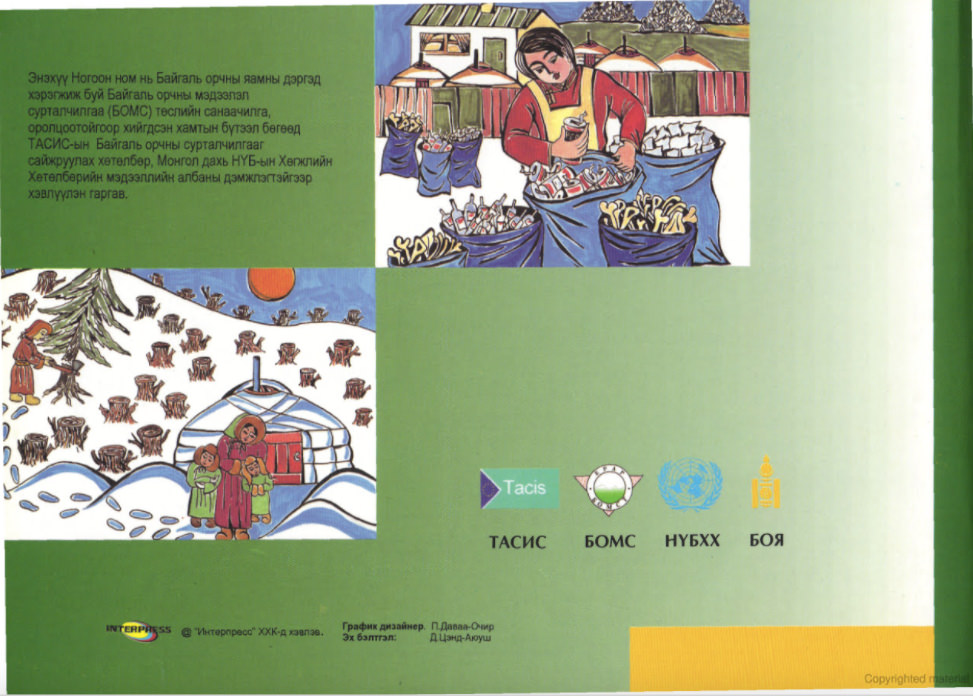
The Environmental Public Awareness Handbook: Case Studies and Lessons Learned in Mongolia was published in 1999 by the UNDP Mongolia Communications Office. The EPAP Handbook and the Mongolian Green Book were funded by the European Union’s TACIS programme.
Ferguson and his Mongolian colleagues had spent two years mobilizing Mongolians across the country to take practical steps to address the country’s environmental problems as part of the Environmental Public Awareness Programme (EPAP). Few people had as much first-hand knowledge of the country and its environmental challenges as they did.
In its 2007 Needs Assessment, the Government of Mongolia found the EPAP projects “had a wide impact on limiting many environmental problems. Successful projects such as the Dutch/UNDP funded Environmental Awareness Project (EPAP), which was actually a multitude of small pilot projects (most costing less than [US] $5,000 each) which taught local populations easily and efficiently different ways of living and working that are low-impact on the environment.”
Robert Ferguson’s The Devil and the Disappearing Sea: Or, How I Tried to Stop the World’s Worst Ecological Catastrophe (Publisher: Raincoast Books, 2004).
The controversial Nordic Satellite Distribution consortium is in danger of collapsing because of a row between two of its three big shareholders.
The row, between Swedish programmer Kinnevik and Norwegian telephone company Telenor, threatens the chances of the consortium coming up with a restructuring that will win acceptance from European Commission competition officials.
NSD has been trying to turn the 1 degree West orbital position – home to the Thor and TV Sat-2 satellites – into Scandinavia’s “hot bird” position. But Kinnevik also plans to take a substantial slice of capacity on the Swedish Space Corporation’s planned digital satellite Sirius-2, at 5 degrees East. Telenor is furious.
It is demanding that Kinnevik drop the plan and also give up its existing transponders at the 5 degrees East position, on the Tele-X and Sirius-1 satellites. Kinnevik already plans to give up its Astra transponders, to the relief of Telenor.
Kinnevik is buying capacity on the rival system simply as a way of hedging its bets. Sirius-2, with 16 transponders offering a mix of digital and analogue channels for the Scandinavian market, could become a powerful satellite and Kinnevik is worried that a strong rival service might be developed on it. The company is thought to be negotiating for six of the 16 transponders (another 16 transponders are aimed at the rest of Europe).
Per Bendix, chairman of the NSD, said that the group could continue without Kinnevik, although it would be difficult to find another company with such large pockets.
He downplayed the rows between the shareholders: “Of course, there are tensions between Kinnevik and Telenor. You can’t imagine a process like this, a complicated business deal, without some frictions which create some warmth. None of the partners can stop this initiative, it has gained too much momentum.”
TeleDanmark, the third member of NSD, has tried to play a mediating role between Telenor and Kinnevik.
One source close to the consortium said: “Kinnevik is definitely interested in investigating other satellite operators for the digital future. The company is known for doing exactly as it pleases, which clashes with Telenor which is trying to get 1 degree West into shape.”
Kinnevik and Telenor have clashed repeatedly over Kinnevik’s refusal to give up the 5 degrees East position, where it transmits five channels on Sirius. The issue has been exacerbated for Telenor by the fact that the mostly unencrypted Sirius/Tele-X package has achieved a better penetration than the encrypted Thor package.
The two companies have also been at loggerheads over the restructuring of the consortium, forced upon it by the European Commission.
Last July, competition commissioner Karel Van Miert ruled that NSD, which was planned as a vertically-integrated company providing programming, subscriber management and satellite capacity, was anti-competitive.
He ruled that NSD would “create or strengthen a permanent dominant position as a result of which effective competition would be significantly impeded” in the Nordic market for satellite broadcasting. It would dominate the provision of satellite transponders in Scandinavia, cable television in Denmark and direct-to-home pay-television distribution.
Bendix, with the backing of Telenor, has been trying to broaden the shareholder base by bringing in other Scandinavian programmers. But Kinnevik opposes the move because it does not think that it will meet Brussels’ concerns. It also does not want to play second fiddle to other programmers.
The shareholders have looked at other options, including one of splitting NSD into separate companies covering transponder-leasing, subscriber management and programming. The companies could have different ownership. Pele Tornberg, Kinnevik’s deputy managing director, would not say what alternative plan Kinnevik is proposing.
NSD has until next month to present Brussels with a revised shareholding structure.
Helsinki Media, the Finnish broadcaster, has rejected an approach to rejoin NSD, which it left in 1994 in a row over Kinnevik’s influence. President Tabio Kallioja said that the company maintained its view that NSD gave Kinnevik a stranglehold on the allocation of satellite capacity to other programmers. He added that Helsinki Media was interested in the plans for digital satellite television being developed by NetHold and by Telia Media, owned by the Swedish PTT, Telia.
In the Mongolian language, the book details effective ways to live in harmony with the environment while achieving development goals. Based on three years’ work in Mongolia – a Northeast Asian nation coping with desertification, mining, and climate change – the book presents tested strategies.















 David South Consulting
You must be logged in to post a comment.