Domarkaite, Marija (2013) “European Union’s Support Programmes to African Cinema: Outcomes to Their Practices,” Universidade de Lisboa Faculdade de Letras, 2013.
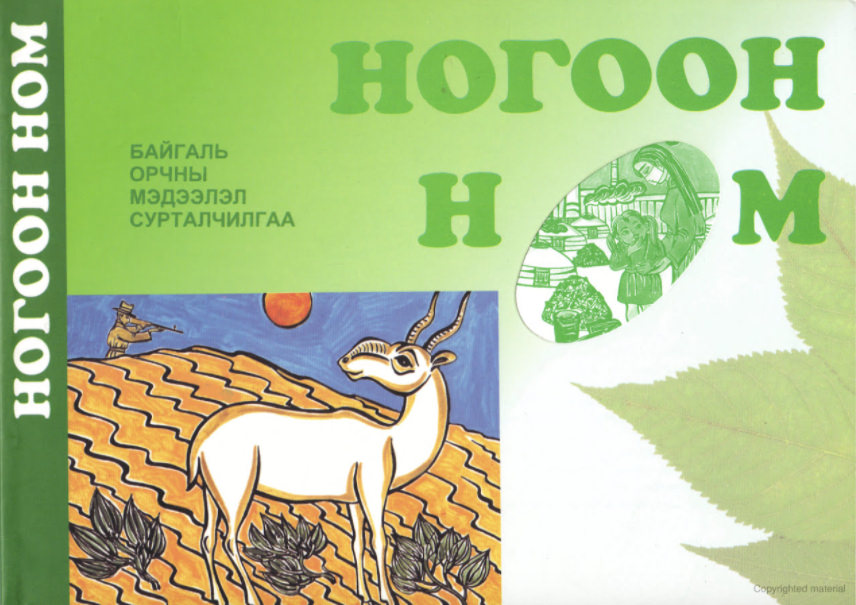
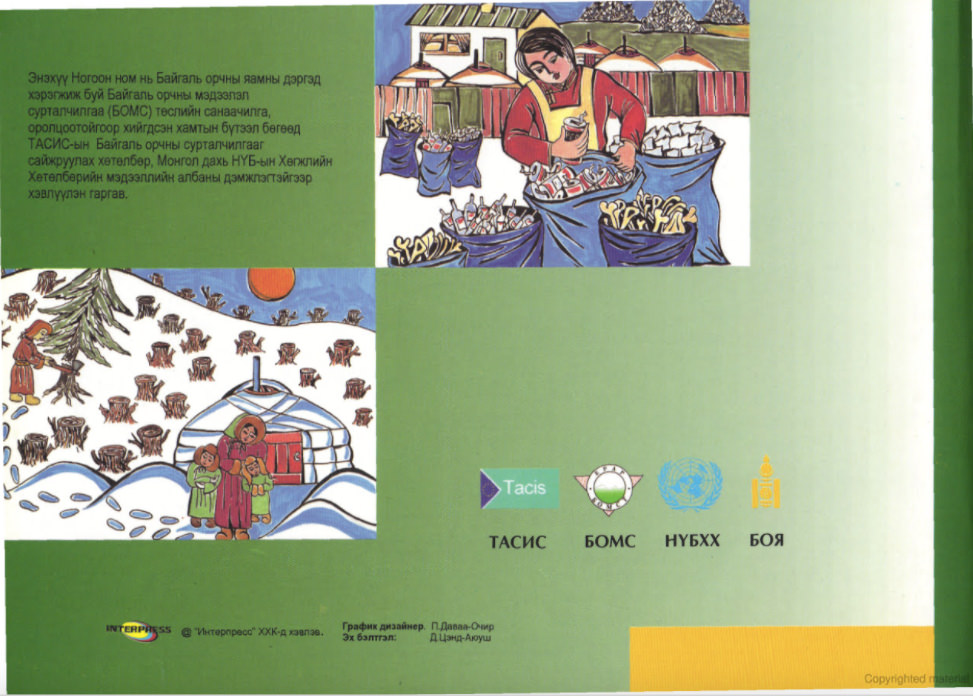
The Environmental Public Awareness Handbook: Case Studies and Lessons Learned in Mongolia was published in 1999 by the UNDP Mongolia Communications Office. The EPAP Handbook and the Mongolian Green Book were funded by the European Union’s TACIS programme.
Ferguson and his Mongolian colleagues had spent two years mobilizing Mongolians across the country to take practical steps to address the country’s environmental problems as part of the Environmental Public Awareness Programme (EPAP). Few people had as much first-hand knowledge of the country and its environmental challenges as they did.
In its 2007 Needs Assessment, the Government of Mongolia found the EPAP projects “had a wide impact on limiting many environmental problems. Successful projects such as the Dutch/UNDP funded Environmental Awareness Project (EPAP), which was actually a multitude of small pilot projects (most costing less than [US] $5,000 each) which taught local populations easily and efficiently different ways of living and working that are low-impact on the environment.”
Robert Ferguson’s The Devil and the Disappearing Sea: Or, How I Tried to Stop the World’s Worst Ecological Catastrophe (Publisher: Raincoast Books, 2004).
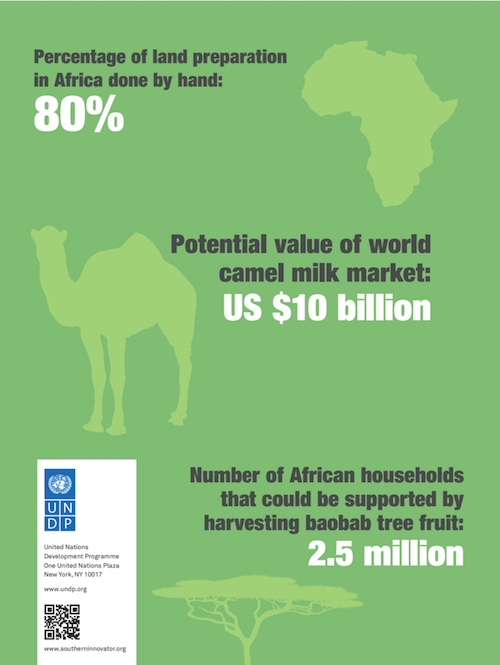
The fruit of the highly revered African baobab tree is being seen as a great new opportunity for the poor, after a recent decision by the European Commission to allow its importation. According to one study, gathering the fruit has the potential to earn an extra US $1 billion a year for Africa, and bring work and income to 2.5 million households, most of them African bush dwellers (Britain’s Natural Resources Institute).
The fruit of the African baobab tree is mostly collected in the wild from the ancient trees, which can live for 500 years, with some as old as 5,000 years. The baobob enjoys the veneration and respect traditionally accorded to age in Africa, and features in many stories and myths.
The fruit is seen as highly nutritious and a new taste option for the European market. This could be a major potential boost to Africa; the European Union is the world’s biggest trader, accounting for 20 percent of global imports and exports, and a major trading partner of most African countries. South Africa alone exports Euro 20.9 billion a year to Europe (2007).
But serious concerns have been raised about how the harvesting of the fruit will be done, and under what conditions. Getting this right is critical if the sustainability of the fruit is to be maintained, local populations are to benefit, and local use of this food source — eaten by both people and animals — does not suffer.
European food and drink companies are looking to use the fruit of the tree to flavour a large range of products, from cereal to drinks.
Baobab fruit is valued for its alleged medicinal properties in treating fevers and diarrhoea, and as a calcium supplement.
“The potential is huge … We’re quite confident that it’s going to represent significant returns for rural producers,” Dr. Lucy Welford, marketing manager of PhytoTrade Africa, a trade organisation that campaigns for the sustainable use of African natural products, told Reuters.
“I’d say it’s somewhere between grapefruit and tamarind as a kind of flavour,” said Welford, who expects baobab fruit to be used at first to flavour smoothies and cereal bars. It could also be used in juices, ice-creams and jams or bakery products.
PhytoTrade works with South African firm Afriplex, which supplies baobab fruit pulp and extracts.
A refreshing juice made from baobab fruit pulp, known as “bouye” is widely served.
“The tart flavour, the interesting vitamin and nutrition profile and the sexy story that goes with it — that it’s wild harvested from a very lovely tree — these things add value to the existing products,” said marketing economist Ben Bennet, who wrote the 2007 Natural Resources Institute’s report.
In the baobab forests around Tandene village in Senegal, local farmers said they looked forward to earning much more from the trees. Prices for a kilo of baobab fruit varied between 40 US cents and a dollar, they said.
“If people know (that European consumers will buy the product) then they’ll look after the trees better and feed them less to their animals,” said farmer Alassane Sy.
Chido Makunike, an active commentator on food and agricultural issues in Africa, raises some serious concerns about how this is handled. “Being a non-cultivated forest product, who ‘owns’ the baobab fruit? Can anybody just take a truck into the forest, collect the fruit and export it? Obviously the sudden dramatic change in the economic importance of the baobab will open up many questions that will need regulation.”
He worries the fruit will just be exported in its raw form, and processed into products in Europe – leaving Africa and Africans the ones who benefit least economically.
“Yet baobab is a dry, not-easily perishable, easy to process fruit,” he said. “It would not be difficult to have the smoothies and cereal bars that are being contemplated for its use made in Africa and exported as finished product, producing many downstream benefits and keeping more of the wealth to be generated within the continent.”
Published: October 2008
Resources
The Chamber of Commerce for Switzerland is specially targeting trade deals with Africa and its entrepreneurs. Website: www.swisscham-africa.ch
EMN Europe is a company that organises all logistics for importing goods into Europe, including making sure all legal requirements are met. Website: www.eurotradeconcept.nl
The Baobab Fruit Company Senegal has been producing organic baobab products for the nutrition and cosmetics industries. Website:http://www.baobabfruitco.com/
The Fairtrade Labelling Organization sets the standards for fair-trade and is the place to go to receive official certification. Website:www.fairtrade.org.uk
Just Food is a web portal packed with the latest news on the global food industry and packed with events and special briefings to fill entrepreneurs in on the difficult issues and constantly shifting market demands. Website: http://www.just-food.com
The controversial Nordic Satellite Distribution consortium is in danger of collapsing because of a row between two of its three big shareholders.
The row, between Swedish programmer Kinnevik and Norwegian telephone company Telenor, threatens the chances of the consortium coming up with a restructuring that will win acceptance from European Commission competition officials.
NSD has been trying to turn the 1 degree West orbital position – home to the Thor and TV Sat-2 satellites – into Scandinavia’s “hot bird” position. But Kinnevik also plans to take a substantial slice of capacity on the Swedish Space Corporation’s planned digital satellite Sirius-2, at 5 degrees East. Telenor is furious.
It is demanding that Kinnevik drop the plan and also give up its existing transponders at the 5 degrees East position, on the Tele-X and Sirius-1 satellites. Kinnevik already plans to give up its Astra transponders, to the relief of Telenor.
Kinnevik is buying capacity on the rival system simply as a way of hedging its bets. Sirius-2, with 16 transponders offering a mix of digital and analogue channels for the Scandinavian market, could become a powerful satellite and Kinnevik is worried that a strong rival service might be developed on it. The company is thought to be negotiating for six of the 16 transponders (another 16 transponders are aimed at the rest of Europe).
Per Bendix, chairman of the NSD, said that the group could continue without Kinnevik, although it would be difficult to find another company with such large pockets.
He downplayed the rows between the shareholders: “Of course, there are tensions between Kinnevik and Telenor. You can’t imagine a process like this, a complicated business deal, without some frictions which create some warmth. None of the partners can stop this initiative, it has gained too much momentum.”
TeleDanmark, the third member of NSD, has tried to play a mediating role between Telenor and Kinnevik.
One source close to the consortium said: “Kinnevik is definitely interested in investigating other satellite operators for the digital future. The company is known for doing exactly as it pleases, which clashes with Telenor which is trying to get 1 degree West into shape.”
Kinnevik and Telenor have clashed repeatedly over Kinnevik’s refusal to give up the 5 degrees East position, where it transmits five channels on Sirius. The issue has been exacerbated for Telenor by the fact that the mostly unencrypted Sirius/Tele-X package has achieved a better penetration than the encrypted Thor package.
The two companies have also been at loggerheads over the restructuring of the consortium, forced upon it by the European Commission.
Last July, competition commissioner Karel Van Miert ruled that NSD, which was planned as a vertically-integrated company providing programming, subscriber management and satellite capacity, was anti-competitive.
He ruled that NSD would “create or strengthen a permanent dominant position as a result of which effective competition would be significantly impeded” in the Nordic market for satellite broadcasting. It would dominate the provision of satellite transponders in Scandinavia, cable television in Denmark and direct-to-home pay-television distribution.
Bendix, with the backing of Telenor, has been trying to broaden the shareholder base by bringing in other Scandinavian programmers. But Kinnevik opposes the move because it does not think that it will meet Brussels’ concerns. It also does not want to play second fiddle to other programmers.
The shareholders have looked at other options, including one of splitting NSD into separate companies covering transponder-leasing, subscriber management and programming. The companies could have different ownership. Pele Tornberg, Kinnevik’s deputy managing director, would not say what alternative plan Kinnevik is proposing.
NSD has until next month to present Brussels with a revised shareholding structure.
Helsinki Media, the Finnish broadcaster, has rejected an approach to rejoin NSD, which it left in 1994 in a row over Kinnevik’s influence. President Tabio Kallioja said that the company maintained its view that NSD gave Kinnevik a stranglehold on the allocation of satellite capacity to other programmers. He added that Helsinki Media was interested in the plans for digital satellite television being developed by NetHold and by Telia Media, owned by the Swedish PTT, Telia.









 David South Consulting
You must be logged in to post a comment.