Categories
Archive Development Challenges, South-South Solutions Newsletters Southern Innovator magazine

Shoes with Sole: Ethiopian Web Success Story

By David SouthDevelopment Challenges, South-South Solutions

SOUTH-SOUTH CASE STUDY

Ethiopia’s bustling capital, Addis Ababa, is experiencing a building and business boom. Foreign investors and Ethiopia’s entrepreneurial and widespread global diaspora are investing again in the country. But Ethiopia still relies for most of its foreign currency wealth on exports of unprocessed coffee beans and leather hides — a model that leaves the bulk of the profits made outside of Ethiopia.

But one shoe company provides an example of a home-grown business that is finding success in the international marketplace, while repatriating most of the profits for its goods back to Ethiopia, creating jobs and local wealth.

Ethiopia’s economy is mostly dependent on agriculture, which accounts for 60 percent of exports and 80 percent of employment (CIA World Factbook). The country has a tiny private sector and high youth unemployment. It is difficult to find funding for small businesses. Yet, because of the high population growth, the country needs to create more jobs.

The Economist magazine has forecast Ethiopia’s economy will grow by 7 percent in 2010, becoming the fifth fastest growing economy in the world, and on course to surpass Kenya to become East Africa’s biggest economy. While this sounds impressive, the country has to run hard to create enough jobs to meet its growing population and still faces significant food security problems.

One company, soleRebels, is combining a clever twist on a local tradition – recycling rubber from old truck tires into shoes, locally known as selate shoes – with sophisticated design concepts and high quality craftsmanship to make a global footwear hit.

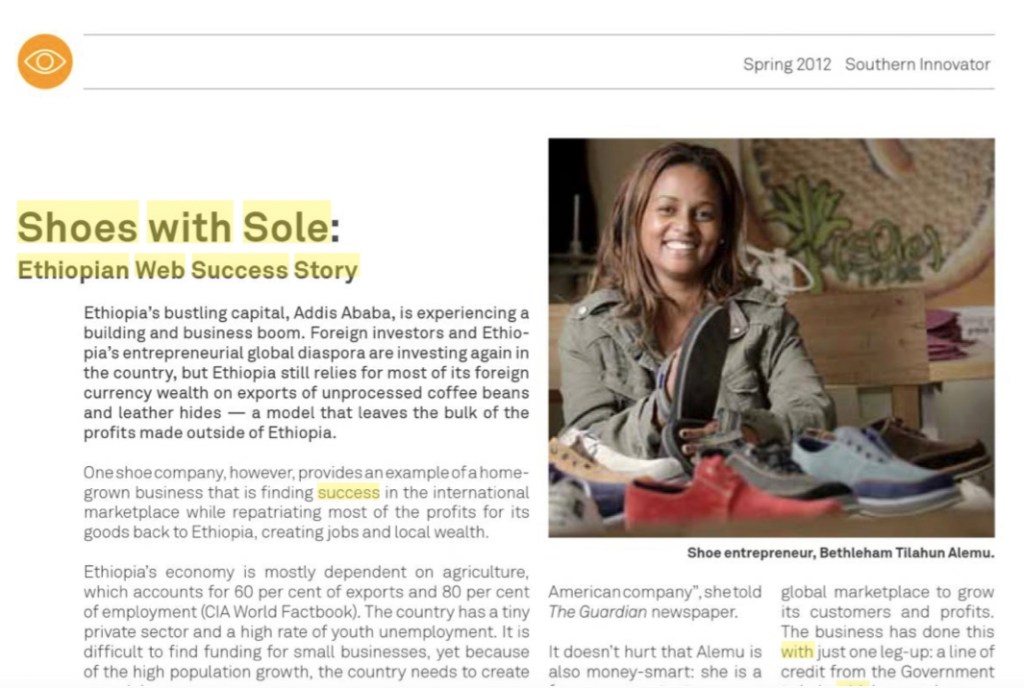
Co-founder and managing director Bethleham Tilahun Alemu, a 30-year-old African web-vending entrepreneur, has turned this local craft into a global fashion design hit by adding colourful cotton and leather uppers to the tire shoes. The recycled rubber shoes come in many styles: from handmade flip-flops to boat shoes, loafers, and athletic trainers resembling the popular American sports shoe, Converse (http://www.converse.com/).

SoleRebels’ (http://solerebelsfootwear.weebly.com/index.html) shoe factory is on the outskirts of Addis Ababa in the historic village of Zenabework. Despite its location, it is reaching the international markets through online retailers like Amazon.com. Shipments take between three and five days to arrive in the United States.

And the secret to this small start-up’s success? Apart from great shoes and funky design, Alemu puts it down to this: “We are sitting in Addis Ababa but acting like an American company,” she told The Guardian newspaper.

It doesn’t hurt that Alemu is also money-smart: she is a former accountant.

Started five years ago, soleRebels now employs 45 full-time staff making 500 pairs of shoes a day. The shoes cost between US $33 and US $64. They are also being sold in Japan and the United Kingdom on Amazon’s shoe-selling website, http://www.javari.co.uk.

In 2010, Alemu hopes soleRebels will make US $481,000. But soleRebels has an even more ambitious goal: to become “the Timberland or Sketchers of Africa.”

Timberland (http://www.timberland.com/home/index.jsp), an American shoe and boot maker, has been a pioneer in high-quality leather footwear, breaking new ground in adopting green manufacturing processes and exploiting the power of the web by allowing customers to customise their footwear.

SoleRebels has cleverly exploited the advantages of the global marketplace to grow its customers and profits. The business has done this with just one leg-up: a line of credit from the government to help with large orders. With 6.2 million people out of a population of 80 million needing food aid, Ethiopia is still highly dependent on international aid. But Alemu is showing there is a way to build a sustainable successful business.

Inspiration for Alemu came about when she was thinking what Ethiopian product could be produced in a sustainable way. She remembered the sandals worn in the country.

“Recycling is a way of life here – you don’t throw things away that you can use again and again,” she said. “I wanted to build on that idea.”

Ethiopian shoe makers have had a difficult time in recent years, trying to compete with cheaper Chinese imports. But rather than just trying to come up with a shoe that was even cheaper than the Chinese ones, soleRebels decided to build a business selling shoes to the more lucrative export market.

Alemu reasoned that good design would attract a higher price. She did research on the internet to find out which designs worked well and what were the latest trends in footwear.

This research formed the basis of her range of shoes, which have catchy names like Class Act or Gruuv Thong. The sandals and flip-flops are either cotton-covered or leather covered. The Urban Runner shoe sells best and is inspired by the Converse All Star sneaker.

SoleRebels has a regular supplier of old truck tires and inner tubes and has women weave and dye the cotton, jute and hemp uppers for the shoes. Almost all materials are locally sourced. Old army uniforms are cannibalized for their camouflage pattern.

SoleRebels has also been canny in seeking Fair Trade certification (http://www.fairtrade.org.uk) to help with marketing and selling the shoes.

To increase the market for the shoes, Alemu bombarded American retailers with emails and shoe samples to pique their interest. Because of the U.S. African Growth and Opportunity Act (http://www.agoa.gov), soleRebels’ shoes can be imported into the United States duty-free: a big price advantage in the U.S. marketplace which has helped grab the interest of retailers like Whole Foods and Urban Outfitters.

This interest soon snowballed, and people were placing orders through the soleRebels website (http://solerebelsfootwear.weebly.com/index.html). Orders come by courier from Ethiopia in about a week to the United States.

With all this interest building, Amazon, the leviathan online retailer, decided to become a customer for the shoes. Online retailing has been a huge boost to the growth of soleRebels. According to Alemu, it has enabled the company “to understand the market needs and demands in real time” — a huge advantage to a start-up company far away from its markets.

There is another advantage to using the web to grow a business: it has enabled soleRebels to take greater control of the whole process. The company negotiates directly with retailers, handling orders and credit collection, and this makes sure most of the profits of the business return to Ethiopia.

Making soleRebels quickly profitable has been a benefit to its workers. Starters at the company make US $1.92 a day, while experienced shoe-makers earn US $11 a day (a good wage in Ethiopia).

“In Ethiopia we have become used to taking money from the West, to always getting help,” Alemu told the Guardian. “That does not make for a sustainable economy. We need to solve our own problems.” And what does success enable them to do? SoleRebels are now building a solar-powered factory to replace their current workshop. And there is a steely pride in the firm’s success: “People buy soleRebels because they are good, not just because they are green or from Ethiopia,” Alemu said. “Our product speaks for itself.”

Published: January 2010

Resources

1) The online service CafePress is a specially designed one-stop shop that lets entrepreneurs upload their designs, and then sell them via their online payment and worldwide shipping service. Website: http://www.cafepress.com/cp/info/sell/

2) Once inspired to get into the global fashion business, check out this business website for all the latest news, jobs and events. Website: http://us.fashionmag.com/news/index.php

3) iFashion: This web portal run from South Africa has all the latest business news on fashion in Africa and profiles of up-and-coming designers. Website: http://www.ifashion.co.za/index.php?option=com_frontpage&Itemid=1

4) The red dot logo stands for belonging to the best in design and business. The red dot is an internationally recognised quality label for excellent design that is aimed at all those who would like to improve their business activities with the help of design. Website: http://www.red-dot.de

5) Dutch Design in Development: As a matchmaker, DDiD puts together European clients, Dutch designers and small and medium-sized enterprises in developing countries. The designers share their knowledge of European consumer tastes, product development, design and quality standards. Website: http://www.ddid.nl

6) ShopAfrica53: Pledging in its motto to reach “every African nook and cranny,” ShopAfrica53is an online shopping portal similar to famous brands like Amazon or eBay, but focused entirely on giving African traders the ability to sell across the continent and to the world online. Website: http://www.shopafrica53.com/

7) Havianas: A Brazilian global fashion success with its rubber flip flops. Website: http://www.havaianas.com/

8) Arise Africa Fashion Week: The place to be seen and to see. Website: http://www.africanfashioninternational.com/africaFashionWeek/

As featured in Southern Innovator Issue 2: Youth and Entrepreneurship. Designed and laid out in Iceland using 100% renewable energy.

https://davidsouthconsulting.org/2022/11/19/african-culture-as-big-business/

https://davidsouthconsulting.org/2021/02/09/african-fashions-growing-global-marketplace-profile/

https://davidsouthconsulting.org/2021/01/05/afropolitan-african-fashion-scene-bursting-with-energy/

https://davidsouthconsulting.org/2021/01/25/creating-green-fashion-in-china/

https://davidsouthconsulting.org/2022/10/09/fashion-closes-gap-between-catwalk-and-crafts/

https://davidsouthconsulting.org/2022/11/17/fashion-recycling-how-southern-designers-are-re-using-and-making-money/

https://davidsouthconsulting.org/2022/11/16/favela-fashion-brings-women-work/

https://davidsouthconsulting.org/2022/10/24/made-in-africa-fashion-brand-pioneers-aim-for-global-success/

https://davidsouthconsulting.org/2022/06/27/new-swimwear-for-plus-size-women-in-brazil/

https://davidsouthconsulting.org/2021/10/04/putting-quality-and-design-at-the-centre-of-chinese-fashion/

https://davidsouthconsulting.org/2020/11/24/too-black/

Creative Commons License

This work is licensed under a
Creative Commons Attribution-Noncommercial-No Derivative Works 3.0 License.

ORCID iD: https://orcid.org/0000-0001-5311-1052.

© David South Consulting 2023

Categories
Archive

Profile of African Innovators Continues to Rise

By David South, Development Challenges, South-South Solutions

SOUTH-SOUTH CASE STUDY

A mix of developments is proving that African innovators no longer need to see themselves as lone operators working in isolation. Awareness of the continent’s talent has never been higher and is grabbing attention from the world’s media. In turn, more and more resources are being made available – from funding opportunities to get-togethers where innovators can meet like-minded people, to ego-boosting praise that helps raise profiles and attract investors.

This summer saw the launch of a new publication called African Innovator Magazine (africaninnovatormagazine.com). It is a good example of how perceptions have switched to recognizing that the continent is awash with innovators who have a lot to say.

Billing itself as “Technology insights for Africa’s decision makers,” African Innovator interviews business leaders on the continent about how they are driving innovation within their organizations.

Launched at a dinner on July 31 in Johannesburg, South Africa (http://www.flickr.com/photos/innovationdinner/sets/72157630881776882/), the quarterly magazine – with its glossy production values, high-quality photographs and design – is a reflection of how far the information technology business has come in Africa. The first issue asks “What is Innovation?” and features a broad range of African technology innovators, from Nigerian tablet personal computer maker Saheed Adepoju (http://enciphergroup.com/about/) to one of the world’s best-known technology innovators, South African-born Elon Musk (http://elonmusk.com/).

Publisher Abby Wakama told IT News Africa that the magazine would initially be distributed in South Africa, with plans to expand into Kenya and Nigeria.

“Our aim is to grow the reader base and branch out into new regions,” Wakama said. “The vision is to be the premier voice of Africa’s larger ICT community, covering issues that impact on commerce, trade, industry and the lives of everybody who uses IT.

“Readers do have a choice of publications that talk about ICT that cover technology and products. But there are very few that have an inside track into innovation in Africa. There are not many publications that discuss how technology is making an impact in the lives of Africans.”

For innovators strapped for cash to take their ideas forward, there are several new Africa-based funding sources to turn to.

In East Africa, the Rwanda Innovation Endowment Fund (RIEF) (http://www.mineduc.gov.rw/spip.php?article21) is a collaboration between the Government of Rwanda and the United Nations. The Fund aims to promote research and development (R&D) of “innovative market-oriented products and processes in priority areas of the economy” to increase the country’s wealth and economic competiveness.

For Africans as a whole, there is The Innovation Prize for Africa (IPA) (http://innovationprizeforafrica.org), an initiative of the United Nations Economic Commission for Africa (ECA) and the African Innovation Foundation (AIF) (africaninnovation.org). The prize hopes to place African innovators and entrepreneurs at the heart of the development agenda. It will be awarded to innovators who develop new products, increase efficiency or find ways to do things better and save money in Africa.

Africa Review, published by the Nation Media Group in Kenya, is “a digital news platform” providing “smart insights on African news and to examine important social and political trends in the continent.” It recently came up with a list of 20 East African “bold young innovators to watch”.

The 20 were selected because all of them are working on mobile phone applications and are creating “life-changing mobile apps in health care, education, finance and agriculture.”

They include:

  • Jamila Abass from Kenya, the founder and chief executive officer (CEO) for M-Farm (http://mfarm.co.ke/about), which is helping farmers get real-time retail prices for their products.
  • Tanzania’s Erric Mutta, founder and CEO of Problem Solved Ltd, set up the MiniShop mobile phone application for small businesses to make accounting and inventory control easier and more transparent – in turn making it easier to access credit.
  • Jessie Gakwandi Benimana runs Rwandan company Sail Ltd (http://sailltd.com/) and the Get-It application (http://www.youtube.com/watch?v=vU8SCfyzf9Q), which helps people to find restaurants in the capital Kigali.
  • Everyone knows Africans like to tell stories, and Victor Miclovich from Uganda is helping them to do this online. His StorySpaces (storyspaces.net) website “builds on the age-old African tradition of storytelling” for the digital age.
  • Tanzania’s Eric Lwambura is using technology to save lives during pregnancy. He is founder of Crystal Interactive Systems (CIS) (http://www.crystal-int.com/), which has developed a mobile phone-based application to assist doctors to detect problems during labour. It is designed for health centres that can’t afford more expensive and sophisticated equipment.
  • Kariuki Gathitu from Kenya who founded Zege Technologies (http://zegetech.com/home/), is working on innovative ways to transfer money. His latest development is M-Payer, helping small businesses manage their payments.

Read more about the East African technology innovators here: http://www.africareview.com/Special+Reports/-/979182/1513900/-/xpmsurz/-/index.html

Resources

1) Southern Innovator: Browse the back issues of Southern Innovator magazine. Website: http://www.scribd.com/SouthernInnovator

2) Innovative Africa: The New Face of Africa: Essays on the Rise of Africa’s Innovation Age by Will Mutua and Mbwana Ally, Publisher: Afrinnovator.  Website:http://book.afrinnovator.com/

3) The Coming Prosperity by Philip Auerswald, Publisher: Oxford University Press.  Website: http://auerswald.org/

Creative Commons License

This work is licensed under a
Creative Commons Attribution-Noncommercial-No Derivative Works 3.0 License.

ORCID iD: https://orcid.org/0000-0001-5311-1052.

© David South Consulting 2022

Categories
Archive Blogroll Development Challenges, South-South Solutions Newsletters Southern Innovator magazine

All-in-One Solar Kiosk Business Solution for Africa

By David SouthDevelopment Challenges, South-South Solutions

SOUTH-SOUTH CASE STUDY

Kiosks are ubiquitous throughout commercial areas in the global South. These highly efficient little business outlets enable small-scale entrepreneurs to sell necessary products without the expense of renting and running a shop.

While they are a great solution for entrepreneurs and customers alike, they often lack connection to municipal services such as electricity and water. That means kiosk owners need to use batteries or a generator if they need a refrigerator to cool food and drink – an expensive proposition.

A new product launched this year in Addis Ababa, Ethiopia offers a solution.

Created by a team of German architects, the Solarkiosk (solarkiosk.eu) is an autonomous business unit designed for remote, off-grid areas. With solar panels across the top of the kiosk, it generates its own electricity and is basically a mini solar power plant. Inside, it is just like a conventional kiosk, with display shelves for products and a counter in the front with a flap – which can feature advertising and messages – that can be opened up for business and locked shut when the kiosk is closed.

The kiosk captures solar energy and the electricity generated can be used to run a computer, lights or a refrigerator. That makes the Solarkiosk capable of offering a wide range of services needing electricity, from Internet access to car-battery charging and mobile phone recharging – a now essential service as mobile phone use explodes across Africa.

The first kiosk was prototyped in November 2011 and the makers incorporated their first subsidiary, Solarkiosk Solutions PLC, in Addis Ababa, Ethiopia in March 2012.

According to Solarkiosk 1.5 billion people worldwide have no regular supply of electricity – 800 million of them in Africa. The makers of Solarkiosk consider this a huge market and hope to make the most of it.

The kiosk comes in a kit form ready for assembly. The kit is designed to be easy to transport and is light enough and compact enough to be transported on the back of a donkey, its makers claim.

Solarkiosk operators receive training in running and managing a kiosk. They learn about solar technology and how to maintain the kiosks and run a sustainable business. Once the operators are trained and up and running, they typically hire others to help with running the kiosk and offer the services at convenient times for the customers. The Solarkiosk then, potentially, becomes an income and employment generator for the local community.

The kiosk is designed to be durable, secure and difficult to tamper with from the outside. The kiosks have been designed to suit many environments and requirements. There is a basic platform that can be added to or expanded depending on local needs and a series of models depending on the customer’s needs. Cleverly, the largest kiosk model is powerful enough to provide electricity to telecom towers. This has proven attractive to mobile telephone companies who can power a telecom tower and make money from running the kiosk as well.

The Solarkiosk is especially useful for countries near the equator where nights are long (12 hours) and the kiosk can help people get light to read, study and work.

Solarkiosk is targeting off-grid customers who are using up to 40 per cent of their household income on electricity substitutes. According to Solarkiosk, people in off-grid households collectively spend more every year (US $30 billion) lighting their homes – using candles for example – than do all the people living in electricity grid connected countries (US $20 billion).

Solar technology is becoming more affordable at the same time as demand in developing countries for electricity and the products powered by electricity is on the rise. Mobile phones are now essential tools for doing business and staying connected – and all of them need to be kept charged up.

Solarkiosk believes it can save the average off-grid household US $10 per month, while each kiosk could supply solar electricity services to between 200 and 5,000 households.

For now, Solarkiosk is available in Ethiopia. It is based in Berlin, Germany and receives money from the German government. The kiosks themselves were designed and built by Graft Architects (http://www.graftlab.com).

Published: November 2012

Resources

1) How to maintain a solar panel. Website: http://www.ehow.com/how_2005490_maintain-solar-panel.html

2) How to start a kiosk business. Website: http://www.entrepreneur.com/article/63012

3) Kiosk Innova: A Turkish pioneer of hi-tech kiosks for retail services. Website: http://www.kioskinnova.com/english

Southern Innovator was designed and laid out in Iceland using 100% renewable energy, much of which is from geothermal sources. 
Creative Commons License

This work is licensed under a
Creative Commons Attribution-Noncommercial-No Derivative Works 3.0 License.

ORCID iD: https://orcid.org/0000-0001-5311-1052.

© David South Consulting 2023

Categories
Archive Blogroll Development Challenges, South-South Solutions Newsletters Southern Innovator magazine

Ethiopia and Djibouti Join Push to Tap Geothermal Sources for Green Energy

By David SouthDevelopment Challenges, South-South Solutions

SOUTH-SOUTH CASE STUDY

Ethiopia and Djibouti are the latest global South countries to make a significant commitment to developing geothermal energy – a green energy source that draws on the heat below the earth’s surface (http://en.wikipedia.org/wiki/Geothermal_energy) – to meet future development goals.

Ambitiously, Ethiopia also hopes to build Africa’s largest geothermal power plant.

It joins Kenya, which in 2012, announced projects to expand its geothermal capacity further. Currently, Kenya is Africa’s largest geothermal producer and has geothermal resources concentrated near a giant volcanic crater in the Great Rift Valley with 14 fields reaching from Lake Magadi to Lake Turkana. There are also low temperature fields in Homa Hills and Massa Mukwe (http://www.gdc.co.ke/index.php?option=com_content&view=article&id=191&Itemid=163). Around 1,400 steam holes are being drilled.

Cooperating with Reykjavik Geothermal (rg.is), a US-Icelandic private developer, Ethiopia will spend US $4 billion to build a 1,000 megawatt geothermal plant at Corbetti (http://www.volcano.si.edu/volcano.cfm?vn=221290). It is expected to be ready in eight to 10 years. The country wants to be carbon neutral by 2025.

Drilling will need to go down as deep as 3 kilometers to tap the source. This is expensive and a technological challenge, thus the need for international expertise. The country hopes to develop this source of energy and then export electricity to neighboring African countries.

Another plant, Aluto Langano 7, is being built 201 kilometers south of Addis Ababa, the capital, by a partnership between the Japanese government, Ethiopia and the World Bank.

Ethiopia has enormous potential for geothermal energy, according to a paper in the journal Geothermics: “Ethiopia holds an enormous capacity to generate geothermal energy in the volcano-tectonically active zones of the East African Rift System (http://www.sciencedirect.com/science/article/pii/S0375650513000023).”

At present, 70 per cent of people in sub-Saharan Africa, some 600 million, are without a domestic electricity supply (USAID). Electricity and other sources of energy are required if living standards are to be raised for millions of the world’s poor. The danger of this, however, is to the planet if the energy comes from polluting sources.

In March 2013 the World Bank announced a significant push to increase development of geothermal resources around the world, and in particular in energy-hungry, fast-developing countries.

“Geothermal energy could be a triple win for developing countries: clean, reliable, locally produced power,” the bank says. “And once it is up and running, it is cheap and virtually endless.”

The bank joined forces with Iceland to make a pledge to secure US $500 million in financing to get geothermal projects up and running. The announcement was made at the Iceland Geothermal Conference (http://geothermalconference.is/) in Reykjavík, the Icelandic capital.

Few countries have such easy access to geothermal energy as Iceland, with its plentiful volcanoes, geysers and hot springs bursting through the surface. But it is there, under the ground, and through the Global Geothermal Development Plan (GGDP), it is hoped this plentiful energy source will become the norm for countries around the world.

The World Bank believes at least 40 countries can get into geothermal on a significant scale with the correct investment. Many developing world regions are rich in geothermal resources, including East Africa, Southeast Asia, Central America, and the Andean region.

Just 11 gigawatts of geothermal capacity is currently being tapped in the world. Nuclear power, for example, generates 370 gigawatts a year (2012) (EIA). What has held back many countries has been the high upfront costs involved in getting projects going. A site must be found, drilled and tested to see if it is viable.

The GGDP plan is to raise US $500 million from donors and others to fund geothermal exploration and development. The GGDP will identify promising sites and then acquire funding to pay for drilling to identify commercially viable projects.

The World Bank has increased financing for geothermal development from US $73 million in 2007 to US $336 million in 2012. It comprises 10 per cent of the Bank’s renewable energy lending.

The Icelandic International Development Agency (iceida.is) signed a partnership in September 2013 with the government of Ethiopia to undergo geothermal surface exploration and to build Ethiopia’s capacity to develop this energy source. The World Bank estimates that Ethiopia has the potential to generate 5,000 megawatts (MW) of energy from geothermal sources.

The Geological Survey of Ethiopia (GSE) and the Ethiopian Electric Power Corporation (EEPCO) will undertake exploration at sites in Tendaho Alalobeda and Aluto Langano.

It fits in with a wider push by Ethiopia to develop its renewable energy resources. The country is also increasing investment in hydro-electric power.

The Ethiopia project is part of the wider World Bank-Iceland compact to develop global geothermal energy capacity. It is the second such arrangement, with the first already underway in Rwanda.

Djibouti is also moving into geothermal, with a new agreement with the World Bank to develop a site at Lake Assal. The World Bank will provide US $6 million to evaluate its commercial potential. Djibouti tried to develop its geothermal resources privately but was not successful.

Overall, geothermal power has the potential to help reduce Djibouti’s electricity production costs by 70 per cent, boost access to electricity for the population and alleviate the country’s energy dependency. The country hopes to have 100 per cent green energy by 2020.

Joining forces on helping boost geothermal in Africa is USAID’s Power Africa fund, which is providing US $7 billion in financial support and loan guarantees for energy projects.

Apart from generating electricity, what else can this powerful resource do? Countries such as Iceland now use hot geothermal water to heat homes and provide domestic hot water. Iceland also has an extensive network of swimming pools and spas in each town. The Blue Lagoon (bluelagoon.com) is a good example of how geothermal power generation can have lots of side benefits. The giant, steamy blue-colored lagoon is the consequence of an accident in 1976 at the nearby geothermal power plant; it’s now a spa and one of the country’s main tourist attractions.

The geothermal-heated pools and spas play a key role in keeping the cold north Atlantic country healthy – Iceland ranked number one on the UNDP human development index in 2007 – and provide a recreational source even in the depths of winter.

Published: December 2013

Resources

1) Iceland Review: A great way to learn about life on an island powered by geothermal energy. Website: icelandreview.com

2) Nordic Development Fund: The Nordic Development Fund (NDF) is the joint development finance institution of the five Nordic countries. The objective of NDF’s operations is to facilitate climate change investments in low-income countries. Website: ndf.fi

3) Icelandic International Development Agency (ICEIDA): The Icelandic International Development Agency (ICEIDA) is an autonomous agency under the Ministry of Foreign Affairs and is responsible for the implementation of official Icelandic bilateral development cooperation.  It follows the Icelandic government’s Act on Development Cooperation No 121/2008, which is in keeping with the UN Millennium Development Goals and other international commitments, such as the Monterrey Consensus on Financing for Development and the Paris Declaration on Aid Effectiveness. Website: iceida.is

4) Geothermal Exploration Project, NDF: The main objective of the Geothermal Exploration Project is to assist countries in East Africa to enhance geothermal knowledge and capacity in order to enable further actions on geothermal energy development in the respective countries. The project could extend to 13 countries in the East Africa Rift Valley: Burundi, Comoros, Djibouti, DR Congo, Eritrea, Ethiopia, Kenya, Malawi, Mozambique, Rwanda, Tanzania, Uganda and Zambia. Website: http://www.iceida.is/iceida-projects/nr/1488

5) Power Africa: Power Africa – an initiative to double the number of people with access to power in sub-Saharan Africa. Power Africa will achieve this goal by unlocking the substantial wind, solar, hydropower, natural gas, and geothermal resources in the region to enhance energy security, decrease poverty, and advance economic growth. Website: http://www.usaid.gov/powerafrica

6) Geological Survey of Ethiopia: The GSE has been generating , collecting  and managing geoinformation of the country for the last 4 decades. Website: http://www.gse.gov.et/index.php

7) Home geothermal: A feature from Popular Mechanics on how geothermal can work in the home. Website: http://www.popularmechanics.com/science/energy/hydropowergeothermal/4331401

Like geothermal energy? Then we think you will like our Southern Innovator Magazine. Designed and laid out in Iceland using 100% renewable energy (much of which is geothermal). 


This work is licensed under a Creative Commons Attribution 4.0 International License.

ORCID iD: https://orcid.org/0000-0001-5311-1052.

© David South Consulting 2023