Tag: entrepreneurs

  • Ghana: Oil-rich City Sparks Entrepreneurs and Debate

    Ghana: Oil-rich City Sparks Entrepreneurs and Debate

    By David SouthDevelopment Challenges, South-South Solutions

    SOUTH-SOUTH CASE STUDY

    Commodity booms can seem like the answer to a poor nation’s prayers, a way to fulfil all their development dreams and goals. The reality, however, is far more complex. More often than not, the discovery of resources sparks a mad scramble for profits and patronage, as politicians and politically connected elites carve out their slice of the new resource boom before anyone else.

    The twin cities of Sekondi-Takoradi (http://en.wikipedia.org/wiki/Sekondi-Takoradi) in the Western Region of Ghana are now experiencing an oil boom. Ghana’s oil production went online in December 2010 and the government is hoping it will double the country’s growth rate.

    Large supplies of oil were found off the coast in 2007, transforming Takoradi from a sleepy, rundown port city into the hub for the oil boom.

    Local man Peter Abitty told the BBC he was renting out an eight-bedroom house for US $5,000 a month. The house overlooks the sea and comes with banana and coconut trees.

    “Tenants that come here can take the coconuts for free! We don’t charge anything,” Abitty said.

    He put the strong interest in the house down to a simple fact: “It’s out there: oil, oil, oil.”

    People’s hopes are being raised in Ghana’s case because it has built a reputation as a better-governed country than other African petro states like Nigeria and Angola.

    But others argue that price increases caused by the boom are destroying local businesses. A report on the Ghana Oil news website found popular local businesses suffering. One example it gave was the Unicorn Internet Café, an employer of local youth, which shut down in 2010 because of high rents.

    It found businesses have shut down in the following sectors: timber, sawmilling, super markets, mobile phone shops, boutiques and trading shops. But it also found many new businesses opening up, including banks, insurance companies and hotels.

    The challenge facing Ghana is to ensure oil brings a long-term change to a higher value business environment and economy, rather than just an unequal and temporary boom.

    Another challenge is to connect the many youth leaving education in the city with the jobs and opportunities being created by the oil industry. The twin cities are a regional educational centre with a lot of technical colleges and secondary schools.

    To counter these concerns, a Regional Coordinating Council is promising to place the growth of small and medium enterprises at the centre of regional development.

    The dreams and promises for Takoradi are very ambitious. “In five years time, I see Takoradi becoming one of the modern cities of the world,”  Alfred Fafali Adagbedu, the owner of Seaweld Engineering (www.seaweldghana.com), a new local company set up to service the oil sector, told the BBC.

    “I can imagine skyscrapers, six-lane highways and malls.”

    “The transport industry is going to improve, because workers on the rig are going to need to be transported. Agriculture is going to see a boom because all those people on the rig will need to be fed.

    “Even market women are going to see more business, because a lot of workers are going to have very fat paychecks. Everyone in this city is going to gain in business.”

    How far Takoradi has to travel to come close to meeting these dreams and expectations can be seen in its current state. The railway station has a train with laundry hanging from it because it hasn’t moved in years, reported the BBC. People are living in the sleeping car of the train.

    But the typical signs of a boom are all visible: traffic jams, booked hotels, rising rents and prices, and it is already hurting people on fixed salaries.

    Local authorities have plans to demolish rundown parts of the city and rebuild with modern office environments for the new businesses resulting from the oil economy.

    An estimated US $1 billion a year in revenue will go to the Ghanaian government and local authorities want 10 percent of this to be ring-fenced for regional development.

    “Many resources are coming from the western region. From years back, gold is here, timber is here, diamonds are here,” said Nana Kofi Abuna V, one of the few female chiefs in the area.

    “But when they share the cake up there, they leave out the western region. This time, if there is oil and gas in the region we should benefit more than everybody else.”

    But Adagbedu at Seaweld Ghana believes Ghana will see real improvements.

    “I’m very sure we will avoid the mistakes,” he said. “Ghana is a democracy, everyone is watching, so there is going to be a lot of improvement here.”

    And to help in keeping these promises, the BBC will continue to return to Sekondi-Takoradi to track its changes and see how things improve.

    Published: September 2011

    Resources

    1) BarCamp Takoradi: BarCamp is an international network of user-generated conferences (or unconferences). They are open, participatory workshop-events, the content of which is provided by participants. Website:http://twitter.com/#!/barcamptakoradi

    2) Ghana Ports and Harbours Authority: The Authority overlooks the Takoradi port. Website:http://www.ghanaports.gov.gh/GPHA/takoradi/index.html

    3) Friends of the Nation (FON): The NGO serves as a catalyst towards increased action for sustainable natural resource management and health environment in the Takoradi region. Website: http://www.fonghana.20m.com/aboutus1.htm

    4) Takoradi City: A website packed with information and photos on the city. Website:http://www.takoradicity.com/pages/sections.php?siteid=takoradicity&mid=39

    Development Challenges, South-South Solutions was launched as an e-newsletter in 2006 by UNDP’s South-South Cooperation Unit (now the United Nations Office for South-South Cooperation) based in New York, USA. It led on profiling the rise of the global South as an economic powerhouse and was one of the first regular publications to champion the global South’s innovators, entrepreneurs, and pioneers. It tracked the key trends that are now so profoundly reshaping how development is seen and done. This includes the rapid take-up of mobile phones and information technology in the global South (as profiled in the first issue of magazine Southern Innovator), the move to becoming a majority urban world, a growing global innovator culture, and the plethora of solutions being developed in the global South to tackle its problems and improve living conditions and boost human development. The success of the e-newsletter led to the launch of the magazine Southern Innovator. 

    Creative Commons License

    This work is licensed under a
    Creative Commons Attribution-Noncommercial-No Derivative Works 3.0 License.

    ORCID iD: https://orcid.org/0000-0001-5311-1052.

    © David South Consulting 2023

  • Venture Capital Surge in Africa to Help Businesses

    Venture Capital Surge in Africa to Help Businesses

    By David SouthDevelopment Challenges, South-South Solutions

    SOUTH-SOUTH CASE STUDY

    Africa’s potential economic powerhouse lies in its small and medium enterprises (SMEs). Foreign direct investment (FDI) into Africa ebbs and flows based on the state of the global economy – and most of it is directed towards large enterprises and multinational companies.

    Finding ways to support grassroots SMEs has the potential to truly build in sustainable prosperity for the continent and construct stable middle class jobs.

    But building a continent-wide network of investors, and directing that investment at the grassroots business entrepreneurs who employ the majority of Africans, is not easy.

    Foreign direct investment to Africa rose fivefold from 2000, peaking at US $72 billion in 2008 (African Economic Outlook). A surge in raw material prices fed this boom. FDI is, however, unevenly distributed and much of it goes to extractive industries like mining and oil and gas in a handful of countries. When the global economic crisis hit, FDI inflows to African countries fell by 20 per cent, to US $59 billion in 2009.

    Venture Capital for Africa: Connecting Entrepreneurs and Investors (http://vc4africa.biz), is a free service trying to nurture the SME sector and help entrepreneurs overcome the challenges of funding start-ups in Africa. Members are expected to contribute, collaborate and show their seriousness, bringing resources or their ideas and enthusiasm.

    It has a detailed website with a mix of resources available. People can register and connect with others, check out venture ideas and the most popular ones in the past day to month, read about featured entrepreneurs, register as an investor looking for investees, and meet-up with others in their city. This includes expatriate communities in places like Oslo, Norway.

    VC4Africa believes its mission is to champion entrepreneurship, and particularly SMEs, as the main driver of Africa’s economic growth. These businesses provide the majority of the continent’s employment and income. And as it says on its website, they offer “hope for a better future.” It is estimated SMEs contribute two thirds of national income for many African countries and are a major source of middle class jobs.

    VC4Africa believes “that the most meaningful impact will still come from grass roots level i.e. entrepreneurs bold enough to start potentially great companies. It aims to connect these individuals with the additional network,knowledge and capital they need to realize their potential.”

    VC4Africa started from a group on the social media and connecting platform Linkedin in 2008. It claims to be the largest online community “dedicated to entrepreneurs and investors building companies on the continent.” It is a free service and was founded by “serial entrepreneurs” Bill Zimmerman, formerly of Microsoft in the USA, and Ben White, founding member of AfriLabs (afrilabs.com), a network of technology incubators. Both have extensive experience founding and investing in technology initiatives in Africa.

    VC4Africa is sponsored by a long list of well-known names in supporting African entrepreneurs: Acumen Fund (acumenfund.org), Afribiz (afribiz.info), AfricaNews.com, How We Made It In Africa.com, iHub Nairobi (ihub.co.ke), and others.

    Consulting firm McKinsey (mckinsey.com) believes Africa’s more than 1 billion citizens should be seen as consumers and says the continent’s growing number of middle-income consumers now outstrips India’s. It boldly claims consumer spending will reach US $1.4 trillion in Africa by 2020, up from US $860 billion in 2008. Ventures that target these consumers could do very well indeed.

    The future is looking good for the venture capital model if VC4Africa continues with its successes. Two of VC4Africa’s ventures – BongoLive and Njorku – were hailed by Forbes Africa magazine in February 2012 as top start-ups in Africa.

    Founded in 2010, BongoLive is a mobile and SMS services company in Tanzania. Njorku, founded in 2011, is a Cameroonian career and recruitment services platform focused on Africa.

    A long and impressive list of African ventures is being supported by the VC4Africa network. Not all will succeed, and they are in very different stages of development, from embryonic to established. The failure rate for start-ups anywhere is always high. But this doesn’t have to be a bad thing. What tends to happen from experience in other countries is this: a buzz is generated as like-minded people gather around a tech scene. They feed off each others’ideas and when one idea dies, it is often feasted on – like a lion on a wildebeest – and becomes the meal for another start-up. Or, the idea is taken on board by a more established outfit.

    The dynamic around tech start-ups can seem strange to more traditional business cultures. Tech start-ups tend to be more forgiving of failure and more willing to see all their labour as part of a bigger thing. It is accepted that some ideas will fly, and others will die. It is not a culture heavily laden with the shame that can be associated with more traditional business failures.

    Some of the ventures supported by VC4Africa include:

    MXit – Founded in 2003, MXit was one of the first Mobile Instant messaging services in the world and in Africa, and has a user base of about 45 million. (South Africa)

    Dropifi – Founded in 2011, Dropifi helps businesses better respond to incoming messages via their websites, and also includes analytics for website owners. (Ghana)

    FloCash – Founded in 2010, FloCash allows anyone with an email address and mobile number to send and receive money across Africa simply and easily. (UK)

    Bandeka – Founded in 2011, Bandeka is an exclusive social network for building relationships/dating. (Ghana and Nigeria)

    Motribe – Founded in 2011, Motribe is a mobile platform enabling users, brands, agencies and publishers across the world to build and manage their own mobile social communities. (South Africa)

    Hummba – Founded in 2011, Hummba is a social and travel networking website that lets users download free audio travel guides and share travel experiences directly from mobile phones.

    10Layer – Founded in 2011, 10Layer is a CMS (content management) system targeted specifically at newsrooms. (South Africa)

    Published: February 2012

    Resources

    1) African Venture Capital Association is a not-for-profit entity founded to promote, develop and stimulate private equity and venture capital in Africa. AVCA is committed to promoting high ethical standards of business conduct and professional competence in the private equity and venture capital industries. Website: avcanet.com

    2) Venture Capital Investment for SMEs: Africa Report explores what venture capitalists look for in African businesses.Website: http://www.africareport.com/latest-business-news/2010/10/22/venture-capital-investment-for-smes

    3) New book: Africa’s Future: Darkness to Destiny: How the past is shaping Africa’s economic evolution by Duncan Clarke.Website: http://www.amazon.co.uk/Africas-Future-Darkness-economic-evolution/dp/1846685699

    4) The Co-Creation Hub Nigeria, a technology innovations center in Lagos, is working to start 30 profitable social tech ventures in the next two years. “The thinking behind CcHub is that the techies should not believe that they can just stay in a corner and create solutions for the market”, says Bosun Tijani, CEO of CcHub Nigeria. “You need to engage the market in the creation process and that is where co-creation comes into play.” Website: cchubnigeria.com

    https://davidsouthconsulting.org/2022/11/21/africa/

    https://davidsouthconsulting.org/2022/10/20/african-hotel-boom-bringing-in-new-investment-and-creating-jobs/

    https://davidsouthconsulting.org/2021/05/18/african-innovation-helps-make-banking-transactions-safer/

    https://davidsouthconsulting.org/2022/10/05/african-innovation-eco-system-taking-shape/

    https://davidsouthconsulting.org/2022/10/26/africas-consumer-market-in-spotlight-for-2011/

    https://davidsouthconsulting.org/2022/10/04/the-brck-kenyan-developed-solution-to-boost-internet-access/

    https://davidsouthconsulting.org/2022/10/25/business-as-a-tool-to-do-good/

    https://davidsouthconsulting.org/2020/10/19/buying-into-capitalism/

    https://davidsouthconsulting.org/2022/10/14/cash-machines-for-the-poor/

    https://davidsouthconsulting.org/2022/10/10/crowdfunding-technology-start-up-success-in-africa/

    https://davidsouthconsulting.org/2020/12/15/development-challenges-south-south-solutions-newsletter-2011-2014-2/

    https://davidsouthconsulting.org/2022/11/17/diaspora-bonds-to-help-build-up-infrastructure/

    https://davidsouthconsulting.org/2017/10/18/innovation-agenda-and-timeline-2007-2015/

    https://davidsouthconsulting.org/regions/

    https://davidsouthconsulting.org/2022/10/19/safe-healthcare-is-good-business-and-good-health/

    https://davidsouthconsulting.org/2022/10/26/shopping-and-flying-in-africas-boom-towns/

    https://davidsouthconsulting.org/2021/03/05/southern-innovator-issue-2/

    https://davidsouthconsulting.org/2021/02/04/us-450-million-pledged-for-green-economy-investments-at-kenyan-gssd-expo/

    Development Challenges, South-South Solutions was launched as an e-newsletter in 2006 by UNDP’s South-South Cooperation Unit (now the United Nations Office for South-South Cooperation) based in New York, USA. It led on profiling the rise of the global South as an economic powerhouse and was one of the first regular publications to champion the global South’s innovators, entrepreneurs, and pioneers. It tracked the key trends that are now so profoundly reshaping how development is seen and done. This includes the rapid take-up of mobile phones and information technology in the global South (as profiled in the first issue of magazine Southern Innovator), the move to becoming a majority urban world, a growing global innovator culture, and the plethora of solutions being developed in the global South to tackle its problems and improve living conditions and boost human development. The success of the e-newsletter led to the launch of the magazine Southern Innovator. 

    Creative Commons License

    This work is licensed under a
    Creative Commons Attribution-Noncommercial-No Derivative Works 3.0 License.

    ORCID iD: https://orcid.org/0000-0001-5311-1052.

    © David South Consulting 2023

  • Grassroots Entrepreneurs Now Have Many Ways to Fund their Enterprises

    Grassroots Entrepreneurs Now Have Many Ways to Fund their Enterprises

    By David SouthDevelopment Challenges, South-South Solutions

    SOUTH-SOUTH CASE STUDY


    In the past, African entrepreneurs were extremely limited in the options for funding their plans. They had to rely on often ineffective national banks or local networks based on political, tribal or family connections to secure funding for enterprises. That has now changed, and there is an explosion in new thinking on business start-ups and how best to help grassroots entrepreneurs.

    Concepts such as socially responsible investing, social enterprises and fair trade have opened up new frontiers for business development. All focus on the so-called triple bottom line: people, planet, profit. Economist Milton Friedman’s refrain that the only social responsibility of business was to increase profits, is being proven wrong. Some even go as far as to say social enterprise is the model for the 21st century.

    “There’s lots of money to be made here,” said James Baderman of What If, an innovation company in the UK that employs 300 people and devotes 10 percent of its profits to helping social enterprises develop and grow. “There are huge opportunities; just look at the double-digit growth in fair trade and organic goods over the past decade. Consumers are increasingly making choices based on the ethical nature of products.”

    Many in the social enterprise movement believe breaking the cycle of poverty and economic stagnation requires more than charity; it requires the creation of sustainable businesses that will pay local taxes and employ local people. They have also adopted and adapted the techniques used by multinational companies to improve the desirability of their products. A key part of these new socially responsible businesses is branding and marketing.

    In Kenya, the UK’s Traidcraft (www.traidcraft.co.uk) – an organization that fights poverty through a wide range of trade-related activities combining a development charity with a trading company – is working with the Kenya Organic Agriculture Network to develop markets for Kenyan herbs, spices and related products in local and international markets. These include gums, resins (e.g. frankincense), herbs such as coriander, oregano, garlic and lemon grass; spices such as paprika, chillies, rosemary, lemon balm, and essential oils such as pepper tree oil, sinoni oil, and megalocapus oil – all grown in marginalised, arid areas.In another development focused on Kenya – but applicable across Africa – is being led by the UK-based Mark Leonard Trust (http://markleonard.net/). Called the Mainstreaming African Crafts project, it seeks to boost demand for Kenyan craft products in the UK market. It will build demand by focusing on growth areas (such as baskets, jewellery, leather), emphasizing the distinctiveness of African craft products and support product development in line with identified market trends. The aim is to launch a branded Kenyan product range at an international trade fair in 2008.

    Along with improving the branding and marketing of social enterprises and fair trade businesses, funding options are becoming more varied. One new source of funding for budding social entrepreneurs is the William James Foundation’s 4th Annual Socially Responsible Business Plan Competition. It awards winners who develop business plans that blend people, planet and profit together with over US $40,000 in cash and expert advice to make sure it is spent well. Past winners have included business ventures as varied as an Afghan company that sends SMS text messages on security alerts, to others making hand-made organic clothing and portable vaccine packs for remote areas.

    “We’re at a tipping point wherein the entrepreneur who builds in long-term values of sustainability is the one who will be successful,” said Ian Fisk, executive director of the William James Foundation and a long-time sustainable business activist through Net Impact (http://www.netimpact.org/index.cfm). “Most of what people think of as environmental and social activism in business is simply long-term thinking about energy costs and human resources. There are thousands of good ideas out there. The foundation wants to find those that are attached to solid business plans and help them succeed.”

    The success of this approach has also attracted the attention of multinational companies like the oil company Shell. At the Shell Foundation (www.shellfoundation.org), they look at all the enterprises they support from a hardnosed, business perspective. Rather than seeing a producer who needs to produce, they look first at the market and the consumer, and then work backwards to get the producer to make the appropriate products that will sell. “No micro-enterprise is sustainable unless there is a viable route to market,” said Sharna Jarvis, Programme Manager for the Shell Foundation. “The problem with the standard model for micro-finance is that it begins with the producer, not the consumer. It is all about what someone wants to make – there is not enough emphasis on whether anyone will buy it.”

    A new internet search engine has also been launched that is seeking a new way to create a steady flow of funds to nonprofit enterprises working to reduce poverty. Called GoodSearch (www.GoodSearch.com), it plows 50 percent of its advertising revenue (about a penny a search) back into nonprofits selected by its users. Powered by the well-known portal Yahoo!, if for example 1,000 supporters just searched twice a day, it would raise US $7,300 a year for an organization.

    Published: February 2007

    Resources

    • The Fairtrade Foundation (FTF) helps farmers and other producers to earn a decent living and obtain good healthcare and education. Fair Trade Resource Network: http://fairtraderesource.org/about.html
    • Unltd (pronounced Unlimited), a charity supporting social entrepreneurs: www.unltd.org.ukExcellent resource to link with branded social enterprises and all the resources required to get started: www.socialenterprise.org.uk
    • Equitrade helps businesses in poor countries to develop finished or part-finished products to sell in rich countries: www.equitrade.org
    • The 4th Annual Socially Responsible Business Plan Competition is open to for-profit business (or business ideas) with at least one member who is a current student or has graduated within the past five years.
    • For more information contact: www.williamjamesfoundation.org or email ian.fisk@williamjamesfoundation.org.

    https://davidsouthconsulting.org/2021/02/04/cuban-entrepreneurs-embracing-changes-to-economy/

    https://davidsouthconsulting.org/2022/10/09/entrepreneurs-use-mobiles-and-it-to-tackle-indian-traffic-gridlock/

    https://davidsouthconsulting.org/2022/10/20/ghana-oil-rich-city-sparks-entrepreneurs-and-debate/

    https://davidsouthconsulting.org/2022/11/11/havanas-restaurant-boom-augers-in-new-age-of-entrepreneurs/

    https://davidsouthconsulting.org/2022/11/15/indonesia-best-for-entrepreneurs/

    https://davidsouthconsulting.org/2020/12/20/mobile-phones-engineering-souths-next-generation-of-entrepreneurs/

    https://davidsouthconsulting.org/2020/12/17/mongolias-musical-entrepreneurs-led-way-out-of-crisis-2018/

    https://davidsouthconsulting.org/2021/02/11/turning-street-children-into-entrepreneurs/

    Development Challenges, South-South Solutions was launched as an e-newsletter in 2006 by UNDP’s South-South Cooperation Unit (now the United Nations Office for South-South Cooperation) based in New York, USA. It led on profiling the rise of the global South as an economic powerhouse and was one of the first regular publications to champion the global South’s innovators, entrepreneurs, and pioneers. It tracked the key trends that are now so profoundly reshaping how development is seen and done. This includes the rapid take-up of mobile phones and information technology in the global South (as profiled in the first issue of magazine Southern Innovator), the move to becoming a majority urban world, a growing global innovator culture, and the plethora of solutions being developed in the global South to tackle its problems and improve living conditions and boost human development. The success of the e-newsletter led to the launch of the magazine Southern Innovator.  

    https://davidsouthconsulting.org/2021/03/05/southern-innovator-issue-2/

    Creative Commons License

    This work is licensed under a
    Creative Commons Attribution-Noncommercial-No Derivative Works 3.0 License.

    ORCID iD: https://orcid.org/0000-0001-5311-1052.

    © David South Consulting 2023

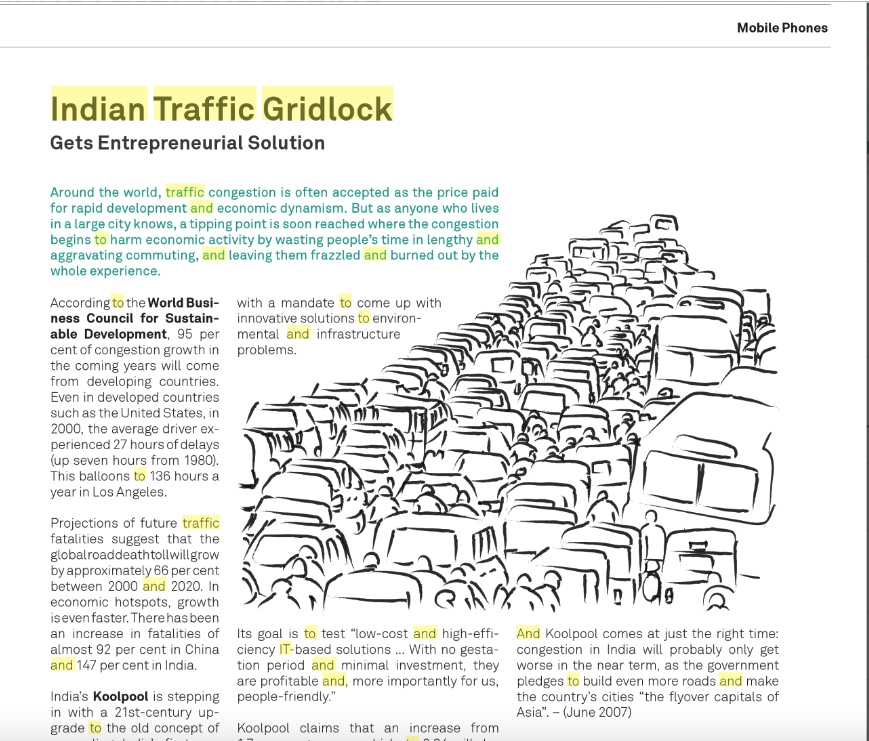
  • Entrepreneurs Use Mobiles and IT to Tackle Indian Traffic Gridlock

    Entrepreneurs Use Mobiles and IT to Tackle Indian Traffic Gridlock

    By David SouthDevelopment Challenges, South-South Solutions

    SOUTH-SOUTH CASE STUDY

    Around the world, traffic congestion is often accepted as the price paid for rapid development and economic dynamism. But as anyone who lives in a large city knows, a tipping point is soon reached where the congestion begins to harm economic activity by wasting people’s time in lengthy and aggravating commuting, and leaving them frazzled and burned out by the whole experience. According to the World Business Council for Sustainable Development, 95 percent of congestion growth in the coming years will come from developing countries. Even in developed countries like the United States, in 2000, the average driver experienced 27 hours of delays (up seven hours from 1980) (MIT Press). This balloons to 136 hours in Los Angeles.

    Developing countries are growing their vehicle numbers by between 10 and 30 percent per year (World Bank). In economic hotspots, growth is even faster. In India, the cities of Delhi, Mumbai, Kolkata and Bangalore account for five percent of the nation’s population but have 14 percent of the total registered vehicles. In the Islamic Republic of Iran, Kenya, Mexico and Chile, 50 percent of cars are in the capital cities (www.peopleandplanet.net).

    India’s Koolpool is stepping in with a 21st century upgrade to the old concept of carpooling. India’s first carpooling service (in which drivers share rides to reduce congestion and save money) uses the power of the country’s mobile phone network to link up people by SMS (short message service) text. Already launched in Mumbai, it is being rolled out in other cities as well.

    Koolpool surveyed Indian drivers and found that the average car only had two passengers. Koolpool is an idea from the Mumbai Environmental Social Network (MESN), a registered charity with the mandate to come up with innovative solutions to environmental and infrastructure problems. Its goal is to prove “low-cost and high efficiency IT-based solutions are the way of the future. With no gestation period and minimal investment, they are profitable and more importantly for us, people friendly.” Koolpool claims that an increase from 1.7 passengers per vehicle to 2.04 will decrease travel time and pollution levels by 25 percent. It also claims to be the first carpooling service to combine SMS text messaging and IT.

    Ride-givers send a text message to Koolpool just before going down a major road. Koolpool then sends a list of ride seekers on the route, their membership identifications, the designated stopping point for pick-up, number of riders and login time. If there are no ride givers on that route, then ride seekers are pooled together to get a taxi and share the costs. Members of Koolpool pay an annual membership fee and exchange credits by mobile phone between ride seekers and ride givers, which are then redeemed at gas stations for petrol.

    And Koopool comes at just the right time: congestion in India will probably only get worse in the near term, as the government pledges to build even more roads and make the country’s cities “the flyover capital of Asia”.

    In Kolkata, says Sudarsanam Padam, former director of the Central Institute of Road Transport in the city of Pune, the average speed during peak hours in the central business district (CBD) area is as low as seven km/hr. Bangalore currently has average speeds of about 13-15 km/hr in its CBD, but this is expected to go down to three to eight km/hr in the next 15 years, according to the city’s police traffic commissioner, M N Reddi.

    Published: June 2007

    Resources

    • Mobility 2001: World Mobility at the End of the Twentieth Century and its Sustainability published by the World Business Council for Sustainable Development.
    • Another Indian car pooling business allows people to post requests for rides on an internet bulletin board, Car Sales India.
    • Another solution to traffic congestion has been the motorcycle taxi. Beginning in Thailand, motorcycle taxis can now be found in Cambodia, India and the UK. Read more at here.
    • SENSEable City: A project at the Massachusetts Institute of Technology’s SENSEable City Laboratory to use the new generation of sensors and hand-held electronics to change how cities are understood and navigated. This includes creating real-time maps of cities that can then be used to help with avoiding traffic congestion and other problems.
    • Read more about India’s traffic congestion problem by India’s only science and environment biweekly online newsletter, Down to Earth.

    Development Challenges, South-South Solutions was launched as an e-newsletter in 2006 by UNDP’s South-South Cooperation Unit (now the United Nations Office for South-South Cooperation) based in New York, USA. It led on profiling the rise of the global South as an economic powerhouse and was one of the first regular publications to champion the global South’s innovators, entrepreneurs, and pioneers. It tracked the key trends that are now so profoundly reshaping how development is seen and done. This includes the rapid take-up of mobile phones and information technology in the global South (as profiled in the first issue of magazine Southern Innovator), the move to becoming a majority urban world, a growing global innovator culture, and the plethora of solutions being developed in the global South to tackle its problems and improve living conditions and boost human development. The success of the e-newsletter led to the launch of the magazine Southern Innovator.  

    Creative Commons License

    This work is licensed under a
    Creative Commons Attribution-Noncommercial-No Derivative Works 3.0 License.

    ORCID iD: https://orcid.org/0000-0001-5311-1052.

    © David South Consulting 2022