Categories
Archive data Development Challenges, South-South Solutions Newsletters Southern Innovator magazine

Radical Drone Solution To Woeful Infrastructure In Poor Countries

By David SouthDevelopment Challenges, South-South Solutions

SOUTH-SOUTH CASE STUDY

Drones – unpiloted aircraft, formally called Unmanned Aerial Vehicles (UAV) or Unmanned Aircraft Systems (UAS) – have long been used for military purposes. The U.S. military claims to have 7,500 drones – a massive growth from just 50 a decade ago – and has used them for surveillance and combat in conflicts from Afghanistan to Iraq.

Drones can cost anywhere between a few thousand and millions of dollars depending on their size and sophistication. Some weigh as little as half a kilogram, and the largest can reach 18,000 kilograms (19 tons).

It is estimated 40 countries around the world are working on drones in one capacity or another.

Military drones come with ominous-sounding names such as Predator, Fire Scout, Global Hawk and Hunter. But many pioneers and innovators are setting out to prove drones can be a technology of peace and development and not just of fear and war.

YouTube provides many examples of drones being tested out as a delivery method. SF Express (http://www.sf-express.com/cn/en/product_service/product_intro/airline_delivery.html), a courier service in Dongguang, China has tried delivering parcels by drone. It is using a drone with eight rotor blades, called an octocopter (http://www.steadidrone.eu/octocopter-ei8ht/).

In Shanghai, the InCake bakery has used drones to deliver cakes (http://www.youtube.com/watch?v=fXwgwSkujOY). The service was brought to a halt after complaints from citizens, worried the drone would crash into someone.

The American pizza chain Domino’s has been testing drones for delivering pizza in the United Kingdom (http://www.youtube.com/watch?v=ZDXuGQRpvs4). A British company has used drones to deliver sushi to restaurant tables in London (http://www.youtube.com/watch?v=WV0yQYXLU34).

These may prove to be novelty experiments – or the early days of a revolution. Time will tell.

But serious thinking about drones is taking place in the area of development.

One pioneering company thinks it has a solution for two big problems common to many developing countries: the chaos, congestion and crowding that clog urban areas; and the poor or non-existent infrastructure in rural areas. Both problems make it expensive and time-consuming to move goods around.

A billion people in the world do not have access to all-weather roads, says the World Bank. Some roads are being upgraded in parts of sub-Saharan Africa but many are in worse shape than they were decades ago. Modern infrastructure is expensive to build, and the funds to do it often must be borrowed.

A startup called Matternet thinks it has the solution to getting around this problem in Africa, and in rapidly growing cities of the global South. It believes drones can come to the rescue where infrastructure is poor or non-existent, and save valuable wealth that can be diverted to real improvements in human development, or used to reduce congestion in crowded urban areas.

The Matternet (http://matternet.us/) is billed as “the next paradigm for transportation.” Matternet is offering a system and a concept for deploying drones as a scalable solution to overcome the problem of poor transportation networks in developing countries.

The artist’s vision on Matternet’s website shows drones buzzing their way through an urban high-rise landscape as they go about their business.

The Matternet drone design has two wings with three fans in each wing to allow it to take off and land vertically as well as flying in a straight line. There is a 10 litre space for packages and a rechargeable battery at the bottom of the drone. The drones can fly at 40 kilometres an hour, at an altitude of up to 121 metres and are guided by GPS (Global Positioning System) (http://en.wikipedia.org/wiki/Global_Positioning_System).

The drone moves in and out of a ground-station landing pod, where it is recharged, picks up new packages to deliver, and connects electronically to receive instructions. An entry and exit slot sits on top of the pod while there is a place at ground level for people to pop in packages for delivery.

Each vehicle costs US $1,000 and can last 10 years, the makers claim. Matternet believes the drones could transport 2 kilograms over 10 kilometres for just 24 US cents a trip.

Matternet’s Andreas Raptopoulos (https://www.solveforx.com/moonshots/physical-transport) hopes to push Africa away from simply upgrading its infrastructure along the lines of what is already in existence in developed countries. It is estimated it will take Africa another 50 years to have an infrastructure equal to North America. But why wait so long? Why not, he argues, just use drones or UAVs to knit a transport infrastructure criss-crossing the continent delivering goods and services to people?

Radical drone advocates like Matternet are very ambitious. They believe drones are to infrastructure what mobile phones have been to telecommunications: an advanced, 21st-century technology that enables countries to leapfrog ahead of old-school 20th century infrastructure and connect people up for much less cost and effort.

Imagine a city in the global South 15 years from now: canyons of high-rise buildings stretch from the central business district out to the suburbs where apartment towers replace office buildings. And whooshing through these canyons will be the drones carrying everything from takeaway food to medical supplies to the latest fashion items.

Anywhere in Africa can currently contact Matternet to arrange a trial of the technology (http://matternet.us/get-matternet/). The concept had field trials in the Dominican Republic and Haiti in the Caribbean. A large field test trial is being arranged for Lesotho, where the drones will help with delivering supplies to clinics serving patients with HIV/AIDS. The 47 clinics are spread out over a 138 square kilometre area and will be served by 50 ground stations and 150 drones at a cost of US $900,000. In comparison, building 2 kilometres of a single lane road would cost US $1 million.

Matternet is based in Palo Alto, California and founded by partners Andreas Raptopoulos, Paola Santana, Dimitar Pachlov and Darlene Damm.

It was conceived at the Singularity University (http://singularityu.org/) whose mission is to educate, inspire and empower leaders to apply exponential technologies to address humanity’s grand challenges.

By David South, Development Challenges, South-South Solutions

Published: October 2013

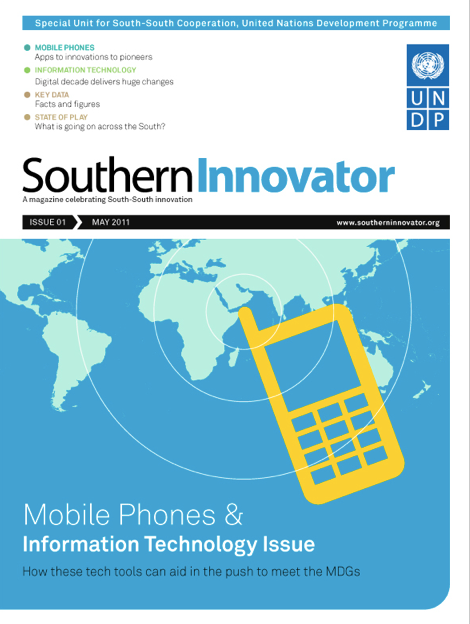
Development Challenges, South-South Solutions was launched as an e-newsletter in 2006 by UNDP’s South-South Cooperation Unit (now the United Nations Office for South-South Cooperation) based in New York, USA. It led on profiling the rise of the global South as an economic powerhouse and was one of the first regular publications to champion the global South’s innovators, entrepreneurs, and pioneers. It tracked the key trends that are now so profoundly reshaping how development is seen and done. This includes the rapid take-up of mobile phones and information technology in the global South (as profiled in the first issue of magazine Southern Innovator), the move to becoming a majority urban world, a growing global innovator culture, and the plethora of solutions being developed in the global South to tackle its problems and improve living conditions and boost human development. The success of the e-newsletter led to the launch of the magazine Southern Innovator.  

Other stories from Development Challenges, South-South Solutions:

African Digital Laser Breakthrough Promises Future Innovation

China Looking to Lead on Robot Innovation

Digital Mapping to put Slums on the Map

New Weapon Against Crime in the South

Follow @SouthSouth1

Google Books: https://books.google.co.uk/books?id=I_hcAwAAQBAJ&dq=development+challenges+october+2013&source=gbs_navlinks_s

Slideshare: http://www.slideshare.net/DavidSouth1/development-challenges-october-2013-issue

Southern Innovator Issue 1: https://books.google.co.uk/books?id=Q1O54YSE2BgC&dq=southern+innovator&source=gbs_navlinks_s

Southern Innovator Issue 2: https://books.google.co.uk/books?id=Ty0N969dcssC&dq=southern+innovator&source=gbs_navlinks_s

Southern Innovator Issue 3: https://books.google.co.uk/books?id=AQNt4YmhZagC&dq=southern+innovator&source=gbs_navlinks_s

Southern Innovator Issue 4: https://books.google.co.uk/books?id=9T_n2tA7l4EC&dq=southern+innovator&source=gbs_navlinks_s

Southern Innovator Issue 5: https://books.google.co.uk/books?id=6ILdAgAAQBAJ&dq=southern+innovator&source=gbs_navlinks_s

Creative Commons License
This work is licensed under a
Creative Commons Attribution-Noncommercial-No Derivative Works 3.0 License.

ORCID iD: https://orcid.org/0000-0001-5311-1052.

© David South Consulting 2023

Categories
Archive Blogroll Southern Innovator magazine United Nations Development Programme United Nations Office for South-South Cooperation

Southern Innovator Issue 5

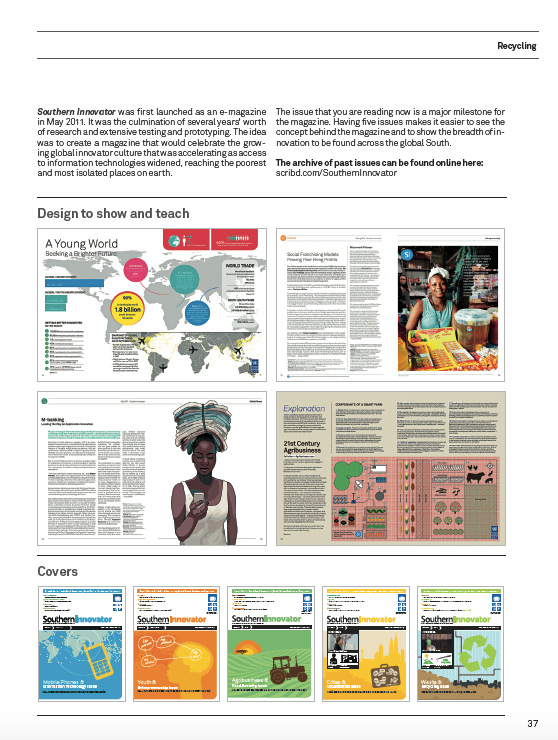
Launched in May 2011, the new global magazine Southern Innovator (ISSN 2222-9280) is about the people across the global South shaping our new world, eradicating poverty and working towards the achievement of the Millennium Development Goals (MDGs). 

Team | Southern Innovator Phase 1 Development (2010 – 2015)

They are the innovators.

Follow the magazine on Twitter @SouthSouth1. 

Southern Innovator Issue 1

Southern Innovator Issue 2

Southern Innovator Issue 3

Southern Innovator Issue 4

Southern Innovator Issue 5

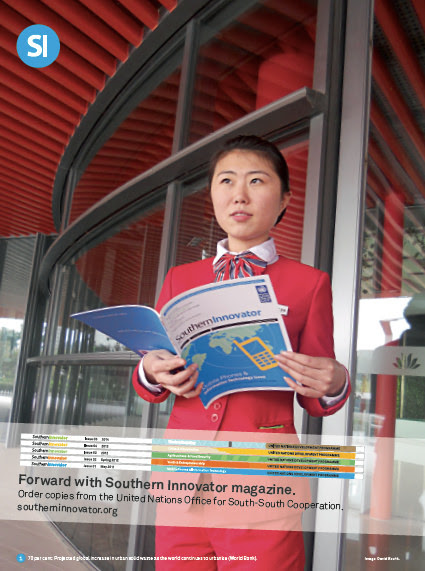
If you would like hard copies of the magazine for distribution, then please contact the United Nations Office for South-South Cooperation (UNOSSC)(https://www.unsouthsouth.org/2014/12/25/southern-innovator-magazine/).

Citations

Recasting ‘truisms’ of low carbon technology cooperation through innovation systems: insights from the developing world by Alexandra Mallet, Innovation and Development, Volume 5, 2015 – Issue 2: Low-Carbon Innovation and Development

https://davidsouthconsulting.org/2021/07/30/disrupted-whatever-happened-to-southern-innovator-issue-6/

https://davidsouthconsulting.org/2021/07/30/issue-6-will-launch-in-autumn-2014-get-on-board-28-july-2014/

https://davidsouthconsulting.org/2021/12/20/press-release-1-southern-innovator/

https://davidsouthconsulting.org/2021/12/20/press-release-2-southern-innovator/

https://davidsouthconsulting.org/2021/12/20/press-release-3-southern-innovator/

https://davidsouthconsulting.org/2021/03/05/southern-innovator-issue-1/

https://davidsouthconsulting.org/2021/03/05/southern-innovator-issue-2/

https://davidsouthconsulting.org/2021/03/05/southern-innovator-issue-3/

https://davidsouthconsulting.org/2021/03/05/southern-innovator-issue-4/

https://davidsouthconsulting.org/southern-innovator-scale-up-fundraiser/

ORCID iD: https://orcid.org/0000-0001-5311-1052.

© David South Consulting 2023

Categories
Archive Blogroll Development Challenges, South-South Solutions Newsletters Southern Innovator magazine

Geothermal Energy to Boost Global South’s Development

By David SouthDevelopment Challenges, South-South Solutions

SOUTH-SOUTH CASE STUDY

The geothermal heat produced by the earth’s molten core is a resource receiving more and more attention across the global South. Properly harnessed, geothermal energy (http://en.wikipedia.org/wiki/Geothermal_energy) offers a low-cost, non-polluting source of power and hot water that does not harm the environment or contribute to climate change (http://en.wikipedia.org/wiki/Climate_change).

The country that has made the most of this resource is the Scandinavian island nation of Iceland (http://www.visiticeland.com/), one of the world’s most volcanically active places.

The country was once one of the poorest in Europe, dependent on fishing as its main income source. But by 2007-2008, Iceland was ranked as having the highest level of human development in the world.

One of the contributors to this impressive improvement in human development is the tapping of the country’s geothermal energy reserves (http://www.geothermal.is/).

According to the Geothermal Energy Association (GEA), “Iceland is widely considered the success story of the geothermal community. The country of just over 300,000 people is now fully powered by renewable forms of energy, with 17 per cent of electricity and 87 per cent of heating needs provided by geothermal energy.”

Worldwide, geothermal energy supplies power to 24 countries, producing enough electricity to meet the needs of 60 million people (GEA).

The Philippines generates 23 per cent of its electricity from geothermal energy, and is the world’s second biggest producer behind the U.S.  Geothermal energy is also helping provide power in Indonesia, Guatemala, Costa Rica and Mexico.

Energy is critical to advances in human development. Electricity enables the introduction of lighting in homes, the use of washing machines and other modern appliances and of communications tools such as computers and televisions.

Geothermally heated water can be used to heat homes, provide hot water for bathing, heat swimming pools and bathing places and power electricity turbines. Industry can benefit from the low-cost energy, giving a boost to economic development.

And, crucially, it does not harm the natural environment like conventional energy sources such as coal, gas or nuclear power with its legacy of radioactive waste.

While not all countries are as well positioned as volcanically active Iceland or the Philippines, many can find a way to tap this natural resource.

Interest in this power source is increasing in Central and South America, whose energy consumption is forecast to increase by 72 per cent by 2035 (International Energy Outlook 2011).

South America currently relies heavily on hydro-electric power, but this is proving insufficient to meet the growing demand (http://www.esmap.org/esmap/node/1136). A World Bank study says “Latin American and Caribbean countries could boost region-wide electricity supply by 30 percent by 2030 by diversifying the energy mix to include hydropower, natural gas, and renewable energy” (ESMAP).

The report estimates the region has the potential to generate 300 terawatts of geothermal energy per year, roughly equivalent to the output of fifty 1,000-megawatt power plants or the emission of 210 million metric tons of carbon greenhouse gases (ARPA).

The areas best placed to tap this resource are located along the Pacific Rim from Mexico to Chile, and in parts of the Caribbean.

The 2012 Geothermal International Market Overview Report by the Geothermal Energy Association (GEA) (http://www.geo-energy.org/reports.aspx) found Argentina, Chile and Peru are moving ahead with plans.

In Argentina, Earth Heat Resources (http://www.earthheat.com.au/) is developing geothermal energy in the volcanic Copahue region in partnership with Xtrata Pachon SA (http://www.xstratacopper.com/EN/Operations/Pages/ElPachon.aspx).

Because of government support and legislation, there are now 83 geothermal exploration concessions under review in Chile, according to Renewable Energy World.com.

The Renewable Energy Center (http://www.ecpamericas.org/initiatives/?id=23) has been established in Chile and is the fruit of a partnership between the US Department of Energy (DOE) and the Chilean National Energy Commission. It is being used to gather data on global best practices and techniques to be adapted for use in Chile, and hopes to become a knowledge source for the region. A law is also in place to oblige power utilities with a capacity above 200 megawatts (MW) to have 10 per cent of their energy come from renewable sources.

Central America has already enthusiastically embraced geothermal resources, according to the report by the GEA.

Currently, El Salvador and Costa Rica derive 24 per cent (204 MW) and 12 per cent (163 MW) of their electricity production from geothermal energy. Nicaragua and Guatemala are also generating a portion of their electricity from geothermal energy.

And Central America has still more geothermal potential it can tap. Estimates place this between 3,000 megawatts and 13,000 megawatts at 50 identified geothermal sites.

Published: October 2012

Resources

1) Geothermal Basic from the Geothermal Energy Association. Website: http://www.geo-energy.org/currentUse.aspx

2) Geothermal information for children. Website: http://www.eia.gov/kids/energy.cfm?page=geothermal_home-basics

3) Geoexchange: A website connecting contractors, manufacturers , drilling contractors, ground loop installers, engineers, designers, distributors, architects, builders, utilities, training, financing, software and suppliers. Website: http://www.geoexchange.org/

4) Iceland Geothermal: Icelandic geothermal cluster mapping, geothermal energy consumption. Website: http://www.icelandgeothermal.is/index.php/e-samstarfsverkefni/data-collection.html

5) Iceland Geothermal Conference 2013: An international conference on geothermal will be held 5-8 March 2013 at Harpa Conference Centre in Reykjavik, Iceland and is hosted by the Iceland Geothermal initiative. Website:http://geothermalconference.is/

https://davidsouthconsulting.org/2021/02/01/ethiopia-and-djibouti-join-push-to-tap-geothermal-sources-for-green-energy/

https://davidsouthconsulting.org/2022/03/20/global-south-eco-cities-show-how-the-future-can-be/

https://davidsouthconsulting.org/2021/02/01/kenya-turns-to-geothermal-energy-for-electricity-and-growth/

https://davidsouthconsulting.org/2021/03/05/southern-innovator-issue-5/

https://davidsouthconsulting.org/2022/11/01/southern-innovator-magazine-2010-2014/

https://davidsouthconsulting.org/2021/09/07/10-years-ago/

https://davidsouthconsulting.org/2021/10/28/2012-development-challenges-south-south-solutions/

Creative Commons License

This work is licensed under a
Creative Commons Attribution-Noncommercial-No Derivative Works 3.0 License.

ORCID iD: https://orcid.org/0000-0001-5311-1052.

© David South Consulting 2023

Categories
Archive Blogroll Development Challenges, South-South Solutions Newsletters Southern Innovator magazine

Kenya Turns to Geothermal Energy for Electricity and Growth

By David SouthDevelopment Challenges, South-South Solutions

SOUTH-SOUTH CASE STUDY

In an effort to diversify its power supply and meet growing electricity demand, Kenya is looking to increase its use of geothermal energy sources (http://en.wikipedia.org/wiki/Geothermal_electricity). Tapping the abundant heat and steam that lurks underground to drive electric power plants offers a sustainable and long-term source of low-cost energy.

Kenya currently gets most of its electricity from hydroelectric projects. This is great until there is a drought, which there now is. With water resources low, the country has had to turn to fossil fuels to power electricity generators. This means relying on imported diesel, which is both expensive and polluting. It is also not generating enough electricity to keep up with demand.

Electricity blackouts have become common in the country and this is harming economic development. This is a particularly damaging setback in a country that has, in the last five years, gained a deserved reputation for its technological advances in mobile phone applications and Internet services – all needing reliable supplies of electricity.

Kenya is Africa’s largest geothermal producer and has geothermal resources concentrated near a giant volcanic crater in the Great Rift Valley with 14 fields reaching from Lake Magadi to Lake Turkana. There are also low temperature fields in Homa Hills and Massa Mukwe (http://www.gdc.co.ke/index.php?option=com_content&view=article&id=191&Itemid=163).

Kenya is expecting its gross domestic product (GDP) to grow by 10 per cent from 2012 onwards. The country hopes to become a middle income country by 2030.

Around 1,400 steam wells will be drilled by companies to meet these goals.

There are also many spin-off opportunities from tapping geothermal heat sources. These include using the steam heat for greenhouses growing plants, for cooling and heating buildings, and for drying and pasteurising foods.

Kenya is currently building a 52-megawatt (MW) geothermal project with funding from the United States government. It is also receiving US$149 million funding from the African Development Bank Group (AfDB) to build the Menengai Geothermal Development Project. This plant will be able to generate 400 megawatts of renewable electricity from the Menengai geothermal sources in the steam field located 180 kilometres northwest of the capital, Nairobi (http://www.gdc.co.ke/index.php?option=com_content&view=category&layout=blog&id=49&Itemid=137).

Speaking at a press conference this month, Gabriel Negatu, AfDB’s Regional Director, said he sees geothermal technology as an important driver of Kenya’s green growth ambition.

“Geothermal generation yields energy that is clean, affordable, reliable and scalable,” he said.

The Geothermal Development Company (GDC) (gdc.co.ke) is a state-owned company in Kenya and recently declared it had tapped steam with a well in the Menengai steam field. GDC started surface exploration in 2009 and has been using two drilling rigs to look for geothermal steam.

The Menengai Geothermal Development Project is slated to be completed by 2016 and will boost the country’s geothermal capability by 20 per cent. It is estimated to be able to power the electricity needs of 500,000 Kenyan households and power the needs of 300,000 small businesses.

Geothermal as a source of energy and electricity can help a country make big development gains. The best example is the Northern European island nation of Iceland. According to Orkustofnun (nea.is/geothermal), Iceland’s National Energy Authority, the country is a successful example of how a small, poor nation (Iceland was one of Europe’s poorest countries in the 20th century), shook off its dependence on burning peat and importing coal for its energy use. By 2007, Iceland was listed in the global Human Development Report as the country with the highest level of human development in the world. And one aspect of this success was the country’s ability to tap its renewable energy resources. Around 84 per cent of the country’s primary energy use comes from renewable resources, and 66 per cent of this is geothermal.

It is estimated Kenya could generate 7,000 megawatts of geothermal power and the Kenyan government is looking to increase the nation’s geothermal capacity from the current 198 MW to 1,700 MW by 2020 and 5,530 MW by 2031.

Published: March 2012

Resources

1) Home geothermal: A feature from Popular Mechanics on how geothermal can work in the home. Website: http://www.popularmechanics.com/science/energy/hydropowergeothermal/4331401

2) Geothermal Energy Systems: A South African company specialising in setting up geothermal systems for customers. Website: http://www.africanecosystems.co.za/about%20us.html

3) Geothermal Education Office: The basic on tapping this energy source and how it works. Website: http://geothermal.marin.org/pwrheat.html

4) Menengai Geothermal Development Project: A detailed explanation of the project. Website: http://www.climateinvestmentfunds.org/cif/sites/climateinvestmentfunds.org/files/SREP%205%20Kenya%20Project.pdf

Southern Innovator was designed and laid out in Iceland using 100% renewable energy, much of which comes from geothermal sources. 
Creative Commons License

This work is licensed under a
Creative Commons Attribution-Noncommercial-No Derivative Works 3.0 License.

ORCID iD: https://orcid.org/0000-0001-5311-1052.

© David South Consulting 2023