Tag: economic crisis

  • Global South Eco-cities Show How the Future Can Be

    Global South Eco-cities Show How the Future Can Be

    By David SouthDevelopment Challenges, South-South Solutions

    SOUTH-SOUTH CASE STUDY

    The world is currently undergoing a high-stress transition on a scale not seen since the great industrial revolution that swept Europe in the 19th and 20th centuries. Today’s urban and industrial transition involves many more people and is taking place on a greater proportion of the planet. With rapid urbanization comes a demand for middle class lifestyles, with their high-energy usage and high consumption of raw materials.

    This is stretching the planet’s resources to breaking point. And as many have pointed out, if the world’s population is to continue past today’s 7 billion to reach 9 billion and beyond, new ways of living are urgently required. Radical thinking will be necessary to match the contradictory goals of raising global living standards for the world’s poor with pressured resources and environmental conditions.

    But there are innovative projects already under development to build a new generation of 21st-century cities that use less energy while offering their inhabitants a modern, high quality of life. Two examples are in China and the Middle East.

    Both projects are seen as a way to earn income and establish viable business models to build the eco-cities of the future. Each project is seeking to develop the expertise and intellectual capacity to build functioning eco-cities elsewhere. In the case of the Masdar City project in the United Arab Emirates, international businesses are being encouraged to set up in Masdar City and to develop technologies that can be sold to other countries and cities – in short, to create a green technology hub akin to California’s hi-technology hub ‘Silicon Valley’. Masdar City is also being built in stages as investors are found to help with funding. Both projects hope to prove there is money to be made in being green and sustainable.

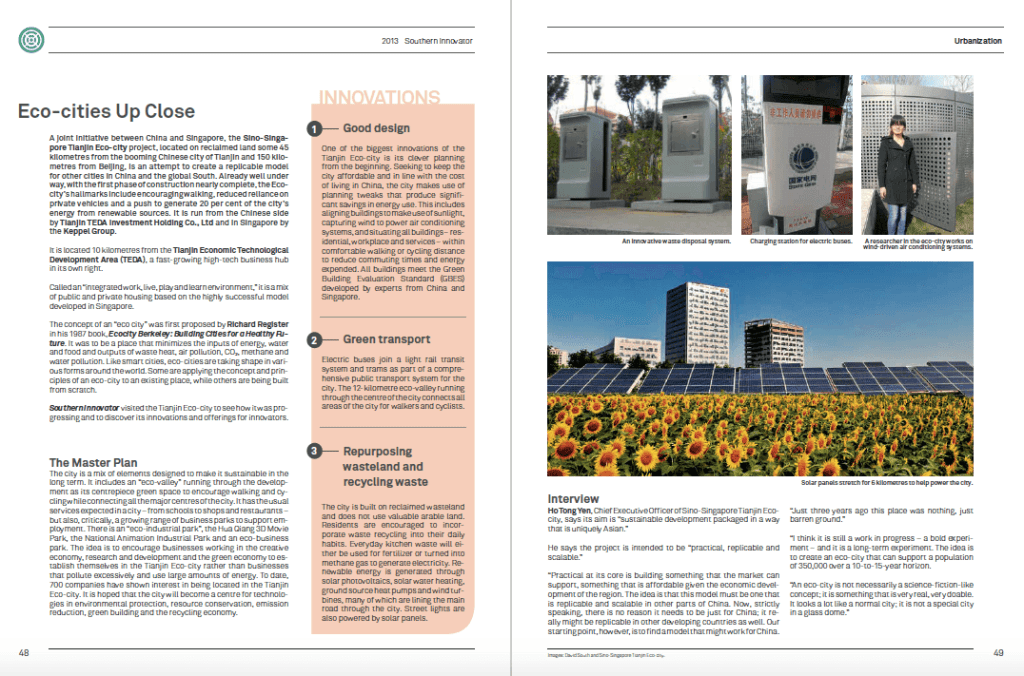
    The Tianjin Eco-city (tianjinecocity.gov.sg) project is a joint venture between China and Singapore to build a 30 square kilometre city to house 350,000 residents.

    Tianjin (http://en.wikipedia.org/wiki/Tianjin) is a large industrial city southeast of China’s capital, Beijing. It is a place that wears the effects of its industrial expansion on the outside. Air pollution is significant and the city has a grimy layer of soot on most outdoor infrastructure.

    China has received a fair bit of criticism for its polluted cities as the country has rapidly modernized in the past two decades. This sprint to be one of the world’s top economic powers has come at a cost to the environment. In this respect, China is not unusual or alone. Industrialization can be brutal and polluting, as Europe found out during its earlier industrial revolution.

    But China is recognizing this can’t go on forever and is already piloting many initiatives to forge a more sustainable future and bring development and high living standards back in line with what the environment can handle.

    Sino-Singapore Tianjin Eco-city is the second large-scale collaboration between the Chinese government and Singapore. The first was the Suzhou Industrial Park (http://www.sipac.gov.cn/english/).The Tianjin project came up in 2007 as both countries contemplated the challenges of rapid urbanization and sustainable development.

    The project’s vision, according to its website, is to be “a thriving city which is socially harmonious, environmentally-friendly and resource-efficient – a model for sustainable development.”

    The philosophy behind the project is to find a way of living that is in harmony, with the environment, society and the economy. It is also about creating something that could be replicated elsewhere and be scaled up to a larger size.

    The city is being built 40 kilometres from Tianjin centre and 150 kilometres from Beijing. It is located in the Tianjin Binhai New Area, considered one of the fastest growing places in China.

    Construction is well underway and can be followed on the project’s website (http://www.tianjinecocity.gov.sg/gal.htm). It will be completed in 2020.

    This year, the commercial street was completed and is ready for residents to move in.

    Residents will be encouraged to avoid motorized transport and to either use public transport or people-powered transport such as bicycles and walking.

    An eco-valley runs down the centre of the city and is meant to be a place for pedestrians and cyclists to enjoy.

    The basic building block of the Eco-city – its version of a city block – is called the Eco Cell. Each Eco Cell measures 400 metres by 400 metres, a comfortable walking distance. Four Eco Cells make a neighbourhood. Several Eco Neighbourhoods make an Eco District and there are four Eco Districts in the Eco-city. It is a structure with two ideas in mind: to keep development always on a walkable, human scale and also to provide a formula for scaling up the size of the Eco-city as the number of residents increases.

    It is a logical approach and seeks to address one of the most common problems with conventional cities: sprawling and unmanageable growth that quickly loses sight of human need.

    Agreement was also reached on the standards that should be achieved for a wide variety of criteria, from air and water quality to vegetation, green building standards, and how much public space there should be per person.

    An ambitious project in the United Arab Emirates is trying to become both the world’s top centre for eco cities and a living research centre for renewable energy. Masdar City (http://www.masdarcity.ae/en/)is planned to be a city for 40,000 people. It is billed as a high-density, pedestrian-friendly development where current and future renewable energy and clean technologies will be “marketed, researched, developed, tested and implemented.”

    The city hopes to become home to hundreds of businesses, a research university and technology clusters.

    This version of an eco-city is being built in three layers in the desert, 17 kilometres from the Emirati capital Abu Dhabi. The goal is to make a city with zero carbon emissions, powered entirely by renewable energy. It is an ambitious goal but there are examples in the world of cities that use significant renewable energy for their power, such as Reykjavik, Iceland in Northern Europe, which draws much of its energy from renewables and geothermal sources.

    Masdar City is designed by world-famous British architect Norman Foster (fosterandpartners.com) and will be 6.5 square kilometres in size.

    The design is highly innovative. The city will be erected on 6 metre high stilts to increase air circulation and reduce the heat coming from the desert floor. The city will be built on three levels or decks, to make a complete separation between transport and residential and public spaces.

    The lowest deck will have a transportation system based on Personal Rapid Transport Pods. These look like insect eyes and are automated, controlled by touch screens, using magnetic sensors for propulsion. On top of this transport network will be the pedestrian streets, with businesses, shops and homes. No vehicles will be allowed there, and people will only be able to use bicycles or Segway (segway.com) people movers to get around. An overhead light railway system will run through the city centre, all the way to Abu Dhabi City.

    “By layering the city, we can make the transport system super-efficient and the street level a much better experience,” Gerard Evenden, senior partner at Foster + Partners, told The Sunday Times. “There will be no car pollution, it will be safer and have more open spaces. Nobody has attempted anything like this.”

    Masdar City is being built in stages as funding comes, with the goal of completion by 2016. It hopes to achieve its aspiration to be the most technologically advanced and environmentally friendly city in the world. As for water supplies in the desert, there is a plan: dew collected in the night and morning and a solar-powered desalination plant turning salt water into drinking water.

    Electricity will come from a variety of sources. Solar panels will be on every roof and double as shade on alleyways. Non-organic waste will be recycled, while organic waste will be turned into fuel for power plants. Dirty water will be cleaned and then used to irrigate green spaces. Because of the design, the planners hope the city will just use a quarter of the energy of a conventional city.

    To keep the city smart and the project on top of developments in renewable energy, the Masdar Institute of Science and Technology (http://www.masdar.ac.ae/) will specialize in renewable energy technology.

    The cost for the city was pegged at US $22 billion in 2009.

    The chief executive of Masdar – Abu Dhabi’s renewable-energy company – is Sultan Al Jaber. He sees the city as a beacon to show the way for the rest of the Emirate to convert from a highly inefficient consumer of energy to a pioneer in green technology.

    “The problem with the renewable-energy industry is that it is too fragmented,” he told The Sunday Times. “This is where the idea for Masdar City came from. We said, ‘Let’s bring it all together within the same boundaries, like the Silicon Valley model (in California, USA).’”

    The project needs to gather much of its funding as it progresses. The United Nations’ Clean Development Mechanism (http://cdm.unfccc.int/) is helping with financing. Companies can earn carbon credits if they help fund a low-carbon scheme in the global South. The sultan is ambitious and sees this as a “blueprint for the cities of the future.” It has been able to bring on board General Electric (GE) and the Massachusetts Institute of Technology (MIT) to sponsor the university.

    It is possible to visit Masdar City and take a tour (http://www.masdarcity.ae/en/105/visit-masdar-city/) and it is also possible to view online what has been built so far (http://www.masdarcity.ae/en/32/built-environment/).

    Published: June 2012

    Resources

    1) Center for Innovation, Testing and Evaluation (CITE): Located in Texas, USA, CITE is a fully functioning city with no residents to test new technologies before they are rolled out in real cities. Website: http://www.pegasusglobalholdings.com/test-center.html

    2) Digital Cities of the Future: In Digital Cities, people will arrive just in time for their public transportation as exact information is provided to their device. The Citizen-Centric Cities (CCC) is a new paradigm, allowing governments and municipalities to introduce new policies. Website: http://eit.ictlabs.eu/action-lines/digital-cities-of-the-future/

    3) Eco-city Administrative Committee: Website: http://www.eco-city.gov.cn/

    4) Sino-Singapore Tianjin Eco-city, Investment and Development Co., Ltd. Website: tianjineco-city.com

    5) ‘The Future Build’ initiative, a new green building materials portal from Masdar City. Website: thefuturebuild.com

    6) UNHABITAT: The United Nations Human Settlements Programme is the UN agency mandated to promote socially and environmentally sustainable towns and cities with the goal of providing adequate shelter for all. Website: http://www.unhabitat.org

    Creative Commons License

    This work is licensed under a
    Creative Commons Attribution-Noncommercial-No Derivative Works 3.0 License.

    ORCID iD: https://orcid.org/0000-0001-5311-1052.

    © David South Consulting 2022
  • Food Inflation: Ways to Fight It

    Food Inflation: Ways to Fight It

    By David SouthDevelopment Challenges, South-South Solutions

    SOUTH-SOUTH CASE STUDY

    Food inflation has taken off at the beginning of 2011. As the global economic crisis enters its next phase, both developed and developing countries are experiencing inflation. There are many factors fuelling the rise in prices – inefficient distribution and storage systems, lack of investment in agriculture, devaluing currencies, high demand, natural and man-made disasters, use of food products like corn to make biofuels – but there are also ways to counter the effects of food inflation that have been tried and tested across the South.

    The United Nations Conference on Trade and Development (UNCTAD) says the least developed countries spent US $9 billion on food imports in 2002. By 2008, that amount had risen to US $23 billion. Supachai Panitchpakdi, secretary general of UNCTAD, says “the import dependence has become quite devastating.”

    Worse, more people had less money to buy the food. The number of individuals living in extreme poverty “increased by 3 million per year during the boom years of 2002 and 2007,” reaching 421 million people in 2007.

    For millions of people, it is a matter of life and death that food remains affordable. The poor pay the largest share of their income on food. Raise that cost, and the poor quickly have little money left for other things, like housing, transport, clothing or education.

    Approached as a problem needing a solution, it is possible to deal with a bout of food inflation. Every food crisis has its origins and can be resolved. A staggering amount of food goes to waste every year, and a vast quantity can’t get from the farm to the market in time because of infrastructure problems.

    An Indian refrigerator – the ChotuKool fridge (http://www.godrej.com/godrej/godrej/index.aspx?id=1) – is designed to stay cool for hours without electricity and to use half the power of conventional refrigerators. Priced at US $69, it is targeted at India’s poor – a population of over 456 million, almost half the total Indian population (World Bank).

    Manufactured by Godrej and Boyce and weighing just 7.8 kilograms, it is designed around the stated needs of the poor, who wanted a fridge capable of cooling 5 to 6 bottles of water and 3 to 4 kilograms of vegetables. Portability was crucial as well, since needs to be moved when large family gatherings take place in small rooms.

    As a photo shows (http://innovation.hindustantimes.com/summit-photos/godrej/chotukool-3.php), the fridge looks more like a drinks cooler than the typical large refrigerator. It works by replacing the standard compressor motor found in most fridges with a battery-powered heat exchanger.

    In Ghana, a mobile phone-driven Internet marketplace is helping to improve efficiencies in farming and selling food. Esoko (esoko.com/#lang=en), tracks products including ground nuts, sesame, tomato, maize and white beans. It offers market information from Afghanistan, Benin, Burkina Faso, Cameroon, Cote d’Ivoire, Ghana, Madagascar, Mali, Mozambique, Nigeria, Sudan and Togo.

    India’s e-Choupal is making food distribution more efficient in a country experiencing high inflation. E-Choupal (http://www.echoupal.com) has developed a reputation for both controlling prices and increasing incomes for poor farmers. Started in 2000 by the major Indian company ITC Limited (http://www.itcportal.com), it links farmers to the latest prices for products including soybeans, wheat, coffee and prawns.

    E-Choupal works through computers set up in rural areas and has built one of the largest internet initiatives in rural India, reaching 4 million farmers in 40,000 villages.

    Brazil, over the last 30 years, has transformed itself from a food importer to one of the world’s major food exporters. It made these impressive achievements with few government subsidies. The agricultural success is down to Embrapa (http://www.embrapa.br/english) – short for Empresa Brasileira de Pesquisa Agropecuária, or the Brazilian Agricultural Research Corporation. A public company set up in 1973, it has turned itself into the world’s leading tropical research institution. It breeds new seeds and cattle and has developed innovations from ultra-thin edible wrapping paper for foodstuffs that turns colour when the food goes off to a nano-tech lab creating biodegradable ultra-strong fabrics and wound dressings.

    Another approach can be found with a farmer in Kenya, Zack Matere, who boosted his potato crop by turning to Facebook for help. On his farm in Seregeya, Matere used the internet to find a cure for his ailing potato crop.

    He uses his mobile phone to access the internet at a costs of about US 0.66 cents a day. One example of the kind of intelligence Matere is able to glean from the internet is reports of cartels deceiving farmers by buying potatoes in over-large 130 kg bags instead of 110 kg bags. Matere takes this information, translates it into Swahili and posts it on community notice boards.

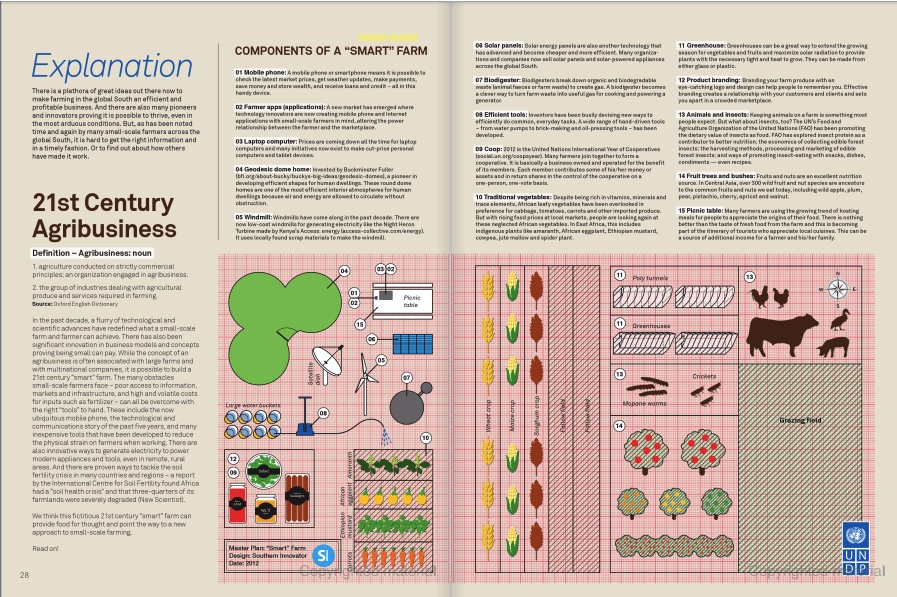
    Another fast-growing solution is bringing farming to urban and semi-urban spaces, where the majority of the world’s population now lives.

    Urban farmers can take advantage of their close proximity to consumers, keeping costs down and profits up. They can also solve one of agriculture’s enduring problems – where to find water for irrigation by using existing waste water. Waste water is plentiful in urban environments, where factories usually pump out waste water into streams, rivers and lakes.

    In Accra, Ghana, more than 200,000 people depend on food grown with wastewater. In Pakistan, a full quarter of the grown vegetables use wastewater.

    Family farms are critical to weathering economic crises and ensuring a steady and secure food supply. The International Fund for Agricultural Development (IFAD) (www.ifad.org) called in 2008 for small family farms – which sustain the livelihoods of more than 2 billion people _ to be put at the heart of the global response to high food prices and uncertain food security.

    In Brazil, this call is being answered by a bold initiative to create a “social technology,” combining a house-building programme with diverse family farms.

    This is where the Brazilian farmer’s cooperative Cooperhaf: Cooperativa de Habitacao dos Agricultores Familiares (http://www.cooperhaf.org.br/) steps in.

    “We see the house as the core issue,” said Adriana Paola Paredes Penafiel, a projects adviser with the Cooperhaf. “The farmers can improve their productivity but the starting point is the house.

    “Family farming is very important for the country – 70 percent of food for Brazilians comes from family farming,” said Penafiel. “The government wants to keep people in rural areas.”

    Making farming more appealing is being shown as a great way to get ahead in modern Africa. One woman hopes more people will be attracted to farming and boost the continent’s food security and reduce costly imports.

    Cynthia Mosunmola Umoru’s company, Honeysuckle PTL Ventures (http://www.tootoo.com/d-c3015227-Honeysuckles_Ptl_Ventures/), is based in Lagos, the business capital of Nigeria.

    Leading by example, Umoru has set up a successful and modern agribusiness focusing on high-quality food products using modern packaging and fast delivery. She produces meat products, from seafood like shrimps and prawns to snails, beef, chicken, and birds. Her niche is to deliver the product however the customer wishes: fresh, frozen or processed.

    Radical new food sources are also another option over time. The Food and Agricultural Organization (FAO) has explored insect protein as a contributor to better nutrition, the economics of collecting edible forest insects, methods of harvesting, processing and marketing edible forest insects, and ways of promoting insect eating with snacks, dishes, condiments — even recipes.

    The range of insects that can be tapped for food is huge, and includes beetles, ants, bees, crickets, silk worms, moths, termites, larvae, spiders, tarantulas and scorpions. More than 1,400 insect species are eaten in 90 countries in the South. Entrepreneurs in the South are making insects both palatable and marketable – and in turn profitable. These innovations are adding another income source for farmers and the poor, and supplying another weapon to the battle for global food security.

    Resources

    1) The global movement for slow food, which encourages organic production and appreciation of traditional foods and cooking. Website: www.SlowFood.com

    2) A video story by CNN on Tradenet/Esoko. Website: http://www.youtube.com/watch?v=s6z0ywkHPPQ

    3) Olam: The story of Olam – a global food supply company in ‘agri-products’ that got its start in Nigeria – shows how a Southern brand can grow and go global, and overcome the difficulties of cross-border trade. Website: http://www.olamonline.com/home/home.asp

    4) South African company Eat Your Garden: It provides urban dwellers and food businesses with their own food gardens bursting with juicy and tasty foods whilst at the same time reducing carbon footprints, and creating employment and provide training, helping poverty alleviation. Website: http://www.eatyourgarden.co.za/

    5) Vertical farming, where hothouses are piled one on top of the other, is an option being promoted as a solution to the food needs of urban dwellers. Website: http://www.verticalfarm.com/

    Follow @SouthSouth1

    Slideshare: http://www.slideshare.net/DavidSouth1/development-challengessouthsouthsolutionsnovember2010issue

    Southern Innovator Issue 1: https://books.google.co.uk/books?id=Q1O54YSE2BgC&dq=southern+innovator&source=gbs_navlinks_s

    Southern Innovator Issue 2: https://books.google.co.uk/books?id=Ty0N969dcssC&dq=southern+innovator&source=gbs_navlinks_s

    Southern Innovator Issue 3: https://books.google.co.uk/books?id=AQNt4YmhZagC&dq=southern+innovator&source=gbs_navlinks_s

    Southern Innovator Issue 4: https://books.google.co.uk/books?id=9T_n2tA7l4EC&dq=southern+innovator&source=gbs_navlinks_s

    Southern Innovator Issue 5: https://books.google.co.uk/books?id=6ILdAgAAQBAJ&dq=southern+innovator&source=gbs_navlinks_s

    Creative Commons License

    This work is licensed under a
    Creative Commons Attribution-Noncommercial-No Derivative Works 3.0 License.

    ORCID iD: https://orcid.org/0000-0001-5311-1052.

    © David South Consulting 2024

  • UNDP In Mongolia: The Guide | 1997 – 1999

    UNDP In Mongolia: The Guide | 1997 – 1999

    Editor: David South

    Researcher and Writer: Jill Lawless

    Publisher: UNDP Mongolia Communications Office

    Published: Between 1997 and 1999

    Background: This is the original text from the brochure UNDP in Mongolia: The Guide first published in 1997. It, for the first time, provided a rolling update on what the United Nations was doing in Mongolia, offering key contacts and data to help advance human development in the country. It introduced transparency to the UN’s work in the country and made it easier to hold programme and project staff to account.

    Mongolia – Population

    With an area of more than 1.5 million square kilometres and a population of 2.38 million as of October 1997, Mongolia has a population density of only 1.5 people per square kilometre, one of the lowest in the world. The country has a relatively low growth rate of 1.6 per cent (1995), down from 2.5 per cent in 1989. At this rate, Mongolia’s population will reach 2.5 million by the year 2000.

    Despite the popular image of Mongolians as nomadic herders, it is an increasingly urbanized country – 51.9 per cent of the population is urban, 48.1 per cent rural. More than one quarter of Mongolians live in the capital city, Ulaanbaatar. The other major urban centres are Darhan (pop. 90,000) and Erdenet (pop. 65,000 ).

    The country is divided into 21 aimags (provinces), plus the autonomous capital region. The aimags are:

    In the centre: Tuv, Uvurhangai, Arhangai

    In the north: Bulgan, Selenge, Hovsgul, Zavhan, Darhan-Uul, Orhon

    In the east: Hentii, Dornod, Suhbaatar

    In the west: Hovd, Uvs, Bayan-Olgii, Gov-Altai

    In the south: Dundgov, Dornogov, Omnogov, Bayanhongor, Gobisumber

    The People:

    About 86 per cent of the country’s population are Kalkh Mongols. Another 7 per cent are Turkic in origin, mostly Kazakhs living in the western aimags of Bayan-Olgii and Hovd. The rest belong to a wide variety of ethnic groups, including the Buryat, Dariganga, Bayad, Zakchin and Uriankhai. Mongolia’s smallest ethnic group is the Tsaatan, about 200 of whom live as reindeer herders in the far north of the country. 

    During the communist period, Mongolia was home to tens of thousands of Russians. Few remain. 

    More than 4 million Mongols live outside Mongolia, in Russia and the Chinese province of Inner Mongolia.

    Human Development:

    – Mongolia’s per capita GDP is U.S. $359 (1995). But this fails to take into account the cashless subsistence and barter economy widespread in rural areas.

    – Poverty, though widespread, is difficult to tabulate. 1996 government figures put the poverty rate at 19.2 per cent – 19.8 per cent for rural areas, 18.7 for urban areas. But State Statistical Office figures for October 1997 indicate 36.8 per cent of urban residents and 27.5 per cent of rural Mongolians live below the poverty line. 

    – Omnogov, Gobisumber, Hovsgol, Ovorhangai and Bayanhongor are the aimags with the highest poverty rates.

    – The average monthly household income in September 1997 was 58,516.7 tugrugs (U.S. $73). Average expenditure was 58,124.8 tugrugs. In 1995, 48 per cent of household expenditure went on food. In poor households, the figure was 64 per cent.

    Social Data:

    Life expectancy: 63.8 years (1995)

    Infant mortality rate: 40 per 1000 

    Under five mortality rate: 56.4 per 1000 

    Maternal mortality rate: 185.2 per 100,000 (1995)

    One-year-old immunization rate: tuberculosis 94.4 per cent, measles 85.2 per cent (1995)

    Access to safe drinking water: rural 89.9 per cent, urban 46.1 per cent (1995)

    Access to sanitation: 74 per cent (1995)

    Adult literacy rate:

     men 97.5 per cent,

     women 96.3 per cent 

    Primary school net enrollment: 93.4 per cent

    Secondary school net enrollment: 56.9 per cent 

    Physicians: 26 per 10,000

    Hospital beds: 9.9 per 1000

    Daily calorie intake: 2278.2

    Data 1996 unless otherwise indicated. Sources: State Statistical Office, Human Development Report Mongolia 1997

    Mongolia – Economy

    An Economy in Transition:

    After 70 years of centrally planned economy, Mongolia is embracing free-market principles with a vengeance. Economic liberalization began under the Mongolian People’s Revolutionary Party government in the early 1990s. The Democratic Coalition government, elected in June 1996, has vowed sweeping economic changes, including  privatization of state assets, liberalization of trade and promotion of foreign investment.

    The foreign investment law now encourages foreign investment in the form of share purchases, joint ventures and wholly foreign-owned concerns. Mining companies are given significant tax holidays. In May, 1997 parliament abolished customs duties expect on alcohol, tobacco and oil products.

    All of this has been a shock to Mongolia and Mongolians. The country’s GDP shrank by a third in the early 1990s, though it has slowly recovered since. Inflation topped 300 per cent in 1993, but was brought down to below 50 per cent by 1997. The tugrug fell from 40 to U.S. $1 in 1991 to 800 to the dollar in 1997. Unemployment officially stands at 6.5 per cent – unofficial estimates are much higher.

    The government’s ambitious privatization scheme has stalled; manufacturing and exports are down; imports are up. Adding to the problems is the fact that world prices for Mongolia’s major export items – copper and cashmere – have fallen.

    The state retains at least 50 per cent ownership of the nation’s flagship enterprises, including the national airline, MIAT, the Gobi cashmere company and the power stations.

    Mongolia has a resource-based economy, exporting mostly raw materials and importing mostly processed goods. The top exports are mineral products, textiles, base minerals, hides, skins and furs and animals and animal products. The major imports include petroleum products, industrial equipment and consumer goods.

    Mongolia’s major trading partners are its two neighbours, China and Russia, though Korea and Japan are becoming more important – and the number-one export destination is Switzerland. 

    Sidebar: The rural economy

    Half of Mongolia’s population is rural, and herding remains the backbone of the Mongolian economy. Agriculture accounts for 30 per cent of the nation’s GDP. The number of herding households grew during the economic turmoil of the early 1990s, and now stands at more than 170,000; there are 30 million head of livestock in Mongolia. Herders produce meat, skins and furs; more and more herders are investing in cashmere goats, a substantial money-earner. 

    Cultivation of crops, on the other hand, is limited. Before 1990, Mongolia was self-sufficient in cereals and even exported to the Soviet Union. But the sector suffered badly in the early 1990s. The 1997 harvest was 239,000 tonnes, 56 per cent of 1991-95 levels and only 40 per cent of pre-1990 harvests. Mongolia must now import 40 per cent of its cereal needs, a factor that contributes to a vulnerable food-security situation. Cultivation of vegetables is up, but remains minor – only 31,000 tonnes in 1997.

    Sidebar: Rich in resources

    Mongolia is resource-rich. This vast territory contains 15 per cent of the world’s supply of fluorspar and significant deposits of copper, molybdenum, iron, phosphates, tin, nickel, zinc, tungsten and gold, as well as at least 100 billion tonnes of coal.

    Copper is the nation’s number one export. 

    Minerals account for more than a third of Mongolia’s GDP and earn half of its hard currency. Gold production is increasing.

    Mongolia also contains significant reserves of oil, which could transform the economy. But infrastructure and transportation limitations mean that commercial extraction is limited. The completion of a pipeline to China could change all this.

    Economic Data:

    Exchange rate: $1 = Tg 808 (Nov 1997)

    GDP: Tg 185.5 billion (1996)

    GDP per capita: Tg 228,605 (1996)

    Inflation: 325 per cent (1992), 53 per cent (1996)

    State budget expenditure: Tg 203.6 billion (Jan-Oct 1997)

    State budget revenue: Tg 176 billion (Jan-Oct 1997)

    Foreign aid (1991-97): U.S. 478 million

    Official external debt: Tg 522 billion (Oct 97)

    Industrial output: Tg 270.6 billion (Jan-Oct 97)

    Exports: $334.2 million (Jan-Oct 97)

    Imports: $343.3 million (Jan-Oct 97)

    Workforce: employed: 791,800, unemployed 65,700 (Oct 97)

    Source: State Statistical Office 

    Mongolia – Politics

    Seven decades of communist rule in Mongolia began to crumble in 1990, when the collapse of the old Eastern Bloc brought the first pro-democracy demonstrations. The ruling Mongolian People’s Revolutionary Party, which had already initiated a Mongolian version of glasnost, permitted the nation’s first multiparty elections in July, 1990. 

    Superior organization helped the MPRP win both the 1990 and 1992 elections (taking 71 of 76 parliamentary seats in the latter), but reform picked up speed. In 1992, the country adopted a new Constitution that enshrined human rights, private ownership and a state structure based on separation of power between legislative and judicial branches.

    In the June 1996 election, major opposition groups united to form the Democratic Coalition, made up of the National Democratic Party, the Social Democratic Party, the Believers’ Party and the Green Party. Somewhat to its own surprise, the Coalition won a healthy 50 of 76 seats in the State Ikh Hural, or parliament. The composition of the Hural is now: National Democrats 35, Social Democrats 15, MPRP 25, Mongolian Traditional United Party 1.

    In addition to their economic reforms, the Democrats have carried out radical restructuring of government, slashing the number of Ministries from 14 to 9.

    The government has a healthy majority, but tensions sometimes emerge between the coalition partners. Mongolia’s transition to democracy has been remarkably peaceful, and the young democracy is robust – there are now more than 20 political parties in the country. 

    But economic hardship has caused resentments. In the 1997 Presidential election, voters elected N. Bagabandi, the candidate of the MPRP. In the fall of 1997, the government had to face demonstrations from students and pensioners and an opposition campaign that led to a confidence vote in parliament — a vote the government easily survived. 

    Political structure:

    Mongolia has a parliamentary system of government, with a 76-seat legislature called the State Ikh Hural. The President, directly elected for a four-year term, is second in authority to the legislature, but he appoints judges and has the power of veto (which can be overturned by a 2/3 vote in parliament).

    Chronology:

    1911 collapse of Manchu Qing Dynasty; Mongolia declares its independence

    1919 China invades Mongolia

    1921 with Soviet help, Mongolia gains final independence from China

    1924 Mongolian People’s Republic declared

    1990 pro-democracy protests; Constitution amended; first multiparty elections

    1992 second multiparty elections; new Constitution adopted

    1996 Democratic Coalition elected as Mongolia’s first non-communist government, headed by Prime Minister Enkhsaikhan

    1997 N. Bagabandi from the MPRP elected President

    Voter turnout: 

    1996 elections: 92.2 per cent

    1996 local Hural: 64.0 per cent

    1997 presidential: 85.1 per cent

    Mongolia – Society and Culture

    Mongolia has a unique and durable traditional culture, centred around the herding lifestyle. Herders remain semi-nomadic, moving their animals with the seasons as they have for centuries

    Many urban Mongolians retain strong links to the land, both literal and sentimental, and the country’s performing and visual arts often celebrate the landscape and the animals — especially horses — that are central to Mongolian life. Mongolia has several distinctive musical instruments and styles, including the morin khuur (horsehead fiddle), the long song (urtyn duu) and the throat-singing style known as khoomi.

    After seven decades of communism, Mongolians are once again celebrating their traditional culture, and embracing the image and legacy of the most famous Mongolian of all time – Chinggis Khan, who in the 13th century initiated the Mongol Empire, the greatest land empire the world has ever known. He gives his name to everything from a brand of vodka to a luxury hotel, and centres for academic Chinggis research have been set up.

    In sports, Mongolians favour the “three manly sports” — wrestling, archery and horse racing — that form the core of the annual festival known as Naadam. Mongolian wrestlers have won a number of medals at international competitions and are even entering the field of Japanese Sumo.

    The 1990s have seen a flowering of freedom of expression. Mongolia has an extraordinary 525 newspapers and a wide range of magazines, while the first private radio and television stations have been established. 

    Religion:

    Mongolians have been Buddhists since the 16th century, when the Mongolian king, Altan Khan, was converted by Tibetan lamas. In the pre-revolutionary period, Mongolia was ruled by a series of Living Buddhas, or Jebtzun Damba. The eighth, and last, Jebtzun Damba was removed after the communist takeover.

    Traditionally, monasteries were centres both of learning and of power. It’s estimated Mongolia had 100,000 monks, or lamas, in 1921 — one third of the male population. In the 1930s, this power became the focus of a ruthless series of purges that reached a climax in 1937. Most of the country’s monasteries were destroyed, and as many as 17,000 monks were killed.

    Today, Mongolia is once again embracing its Buddhist heritage. Monasteries are being restored, and are once again crowded with worshippers. The Dalai Lama is an enormously popular figure and has visited the country several times.

    For many Mongolians, Buddhism is flavoured with traces of Shamanism, an even more ancient spirituality.

    Mongolia also has a significant Muslim community — about 6 per cent of the population. These are mostly ethnic Kazakhs living in the far west of the country. The opening-up of the country has led to an influx of Christian missionaries, and this remains a source of some tension and debate.

    A Young Country:

    Mongolia is a remarkably young country — more than 60 per cent of the population is below the age of 30, and 40 per cent of Mongolians are younger than 16. This young generation, with its embrace of Western styles and ideas, is changing the complexion of the country. Western pop music and North American sports like basketball have a huge following among Mongolia’s youth. So, too, do homegrown artists like the pop groups Nikiton and Spike and the singer Saraa. 

    Social Data:

    Television sets: 6.2 per 100 (1995)

    Newspapers: 2 per 100 (1995)

    Number of telephones: 82,800

    Marriage: 10.9 per 1000 over 18

    Divorce: 0.7 per 1000 over 18

    Number of pensioners: 287,200

    Crimes reported: 20,454 (Jan-Oct 97)

    As percentage of same period in 1996: 114.4 per cent

    Data 1996 unless indicated. Sources: State Statistical Office, Human Development Report Mongolia 1997

    More from Jill Lawless:

    Read a story by Jill in The Guardian (9 June 1999): Letter from Mongolia | Herding instinct 

    Read a World Health Organization (WHO) report on substance abuse and alcohol consumption (WHO Global Status Report on Alcohol 2004) citing Jill here: https://www.who.int/substance_abuse/publications/en/mongolia.pdf?ua=1 

    Further Reading:

    Modern Mongolia: From Khans to Commissars to Capitalists

    The Mongolian Economy: A Manual of Applied Economics for a Country in Transition

    The transition to a market economy: Mongolia 1990-1998

    Wild East: Travels in the New Mongolia

    This work is licensed under a Creative Commons Attribution 4.0 International License.

    ORCID iD: https://orcid.org/0000-0001-5311-1052.

    © David South Consulting 2018  

  • South-South Trade Helping Countries During Economic Crisis

    South-South Trade Helping Countries During Economic Crisis

    By David SouthDevelopment Challenges, South-South Solutions

    SOUTH-SOUTH CASE STUDY

    Weathering the global economic crisis is testing the stability of countries across the global South. But many countries are finding South-South trade and catering to their domestic middle classes can lift incomes and maintain growth rates despite the global turmoil.

    A decade of boom in global markets as they became more integrated has brought rising incomes and created growing economies in the so-called emerging markets of the global South. Finance and investment from developed countries flowed into the global South and helped bolster growing economies, boosting incomes and bringing millions of people into the middle classes. But since the start of the global economic crisis in 2008, more and more countries in the global South have experienced turmoil, chaos and crisis.

    The export-driven model that had served many Asian countries well – creating products for developed Western markets – is being tested by high unemployment in developed economies and declining purchasing power for the Western middle classes. Two trends that have grown in the past 10 years may offer a solution to this economic crisis. One is to build on the growth in South-South trade, and the other is to tap the growing middle classes of the global South by expanding the products and services available to them and further improving their quality of life.

    It is well established that one of the key elements to securing sustainable prosperity is a thriving middle class. Middle classes in many countries in the global South are still classified as vulnerable – at risk of returning to poverty if the economy experiences a short-term crisis. Their resilience to an economic downturn needs to be strengthened, and this can be done by improving the quality of products and services available to them.

    Building this market can also strengthen domestic job growth and help reduce a country’s dependence on imports.

    One country facing up to this challenge is Indonesia. The New York Times recently reported that ports in Indonesia and other resource-exporting countries are quiet, as China’s demand for resources slows.

    But while export markets are experiencing a slowdown, investment is going into Indonesia’s agricultural food-processing industry. Agricultural multinational Cargill (cargill.com) is building a cocoa-bean processing plant in the country, and the PT. Suprama (suprama.co.id/en/) instant-noodle factory is running at full capacity to meet the needs of the country’s growing middle class.

    Many countries have experienced significant inflows of investment money as a result of stimulus measures led by the United States Federal Reserve (http://www.federalreserve.gov/faqs/about_12594.htm) to counter the economic contraction caused by the global economic crisis. This money, however, is uncertain and can just as easily disappear as it leaves to chase the next opportunity. Wise countries take measures to avoid being dependent on this fickle and fast investment funding.

    Unlike in the Asian Crisis of 1997-1998 (http://en.wikipedia.org/wiki/1997_Asian_financial_crisis), many emerging-market countries now have large foreign currency reserves and robust stock markets. They have also built up their middle classes and increased consumption. Trade links with other countries in the global South have grown enormously since the late 1990s. For example, the trade between China and Africa, as announced by Chinese President Xi Jinping (http://en.wikipedia.org/wiki/Xi_Jinping) in early 2014, has surpassed US $200 billion for the first time, turning China into Africa’s largest trading partner

    The relationship between trade and poverty reduction, the case of China.

    Despite a raging global crisis, in many emerging economies domestic spending is holding up and, in some cases, has never been stronger.

    China now plays a key role in maintaining global economic demand. According to the global bank HSBC, Chinese growth adds “twice as many dollars to annual global demand as growth in the United States economy and far more than the economies of the European Union.”

    An article in The New York Times (http://www.nytimes.com/2014/02/13/business/emerging-markets-in-asia-in-a-delicate-limbo.html?_r=0) suggested that global South countries can benefit from these trends by becoming an alternative to China’s “own increasingly high-cost producers of coal, aluminum, and other minerals” – as well as of clothing, shoes and electronics.

    China is also in the process of altering its economy, from being the low-wage workshop of the world to an increasingly high-tech, high-value economy with growing science, technology and innovation sectors buoyed by heavy investment in research and development, for example China’s Xi’an Hi-tech Industries Development Zone (xdz.com). As China changes, other countries can step in and replace the industries that no longer find China an affordable place to manufacture their goods.

    As an example, the Indonesian vice minister of trade, Bayu Krisnamurthi, announced that the Foxconn Technology Group of Taiwan (foxconn.com), which makes components and assembles devices for the popular Apple (apple.com) computer brand, is looking to set up a large factory in Indonesia.

    “The other brands will come in their footsteps,” Krisnamurthi told The New York Times.

    Other countries are bucking the crisis trend and using greater freedom to boost economic growth.

    Cuba has been able to bounce back with free-market reforms. The Caribbean island has had its ups and downs economically since its revolution in the late 1950s. After the revolution, the country had several decades of impressive human development gains and built up enviable education and health care systems. But with the collapse of the Soviet Union in the early 1990s, the country lost its trade relationships and subsidies and was pitched into a major economic crisis.

    During the Cold War, the USSR hoovered up almost all of Cuba’s exports of sugar, nickel and citrus fruit, and sold Cuba two-thirds of its food and 98 per cent of its fuel.

    What was termed the “special period” after the collapse of the Soviet Union saw petrol become scarce. Many had to turn to cycling and walking to get around. Factories closed and food production declined.

    One estimate by Hal Klepak of the Royal Military College of Canada, reported in The Observer newspaper, found the economy collapsed by 50 per cent in the five years to 1993.

    Since then, Cuba has endured significant austerity and has struggled to regain its trade relationships and restore economic growth. Tourism has played a key role in keeping the country going.

    And since 2008, various economic reforms have started to shift the economy away from over-dependence on the state and towards a more mixed market model.

    Its capital, Havana, is a UNESCO world heritage site and is a popular tourist destination with one of the best-preserved former Spanish colonial architecture in the Caribbean.

    When President Raul Castro took over from his brother Fidel, he began to slowly experiment with reforms to test how much market freedom could boost the economy and increase incomes. This has included allowing paladares, or privately-run restaurants, which are now flourishing and benefiting from the steady flow of tourists to the island.

    The state now allows people to set up as independent traders in 200 occupations. Some have established entertainment businesses such as paint balling, others are running bars, or bookshops. It is now possible to easily change money in Havana and to find accommodation in private homes. Cash machines are spreading throughout the capital and more and more businesses will accept credit cards.

    Registered businesspeople rose from 157,000 in October 2011 to more than 442,000 in 2013.

    By being flexible, it is possible to discover new ways to grow economies and increase incomes, even in hard times. And increasing South-South trade is the way to go.

    Published: June 2014

    Resources

    1) The China Africa Project: The China Africa Project is a multimedia resource dedicated to exploring every aspect of China’s growing engagement with Africa. Website: chinaafricaproject.com

    2) China’s trade and investment in Africa: Resources to contribute to more informed investment and trade policies and decision making in sectors and locations where China is emerging as a major player. Website: http://www.cifor.org/china-africa/home.html

    Made-in-China.com: With the continuous and explosive growth of Chinese exports, trade and the number of internet users, Focus Technology launched its online trade platform, Made-in-China.com. Made-in-China.com provides the most complete, accurate and up-to-date information on Chinese products and Chinese suppliers available anywhere on the web. Nowadays, Made-in-China.com is a world-leading B2B portal, specializing in bridging the gap between global buyers and quality Chinese suppliers. Website: made-in-china.com

    4) Southern Innovator Issue 2: Youth and Entrepreneurship: Called “Graphically beautiful & informative”, Issue 2 features entrepreneurial solutions for escaping poverty relevant to youth. Website: http://books.google.co.uk/books?id=Ty0N969dcssC&dq=southern+innovator+issue+2&source=gbs_navlinks_s

    Development Challenges, South-South Solutions was launched as an e-newsletter in 2006 by UNDP’s South-South Cooperation Unit (now the United Nations Office for South-South Cooperation) based in New York, USA. It led on profiling the rise of the global South as an economic powerhouse and was one of the first regular publications to champion the global South’s innovators, entrepreneurs, and pioneers. It tracked the key trends that are now so profoundly reshaping how development is seen and done. This includes the rapid take-up of mobile phones and information technology in the global South (as profiled in the first issue of magazine Southern Innovator), the move to becoming a majority urban world, a growing global innovator culture, and the plethora of solutions being developed in the global South to tackle its problems and improve living conditions and boost human development. The success of the e-newsletter led to the launch of the magazine Southern Innovator.  

    Follow @SouthSouth1

    Google Books: https://books.google.co.uk/books?id=m5GYBgAAQBAJ&dq=development+challenges+may+2012&source=gbs_navlinks_s

    Slideshare: http://www.slideshare.net/DavidSouth1/development-challengessouthsouthsolutionsmay2012issue

    Southern Innovator Issue 1: https://books.google.co.uk/books?id=Q1O54YSE2BgC&dq=southern+innovator&source=gbs_navlinks_s

    Southern Innovator Issue 2: https://books.google.co.uk/books?id=Ty0N969dcssC&dq=southern+innovator&source=gbs_navlinks_s

    Southern Innovator Issue 3: https://books.google.co.uk/books?id=AQNt4YmhZagC&dq=southern+innovator&source=gbs_navlinks_s

    Southern Innovator Issue 4: https://books.google.co.uk/books?id=9T_n2tA7l4EC&dq=southern+innovator&source=gbs_navlinks_s

    Southern Innovator Issue 5: https://books.google.co.uk/books?id=6ILdAgAAQBAJ&dq=southern+innovator&source=gbs_navlinks_s

    China has been a member of the WTO (World Trade Organization) since 11 December 2001.
    Creative Commons License

    This work is licensed under a
    Creative Commons Attribution-Noncommercial-No Derivative Works 3.0 License.

    ORCID iD: https://orcid.org/0000-0001-5311-1052.

    © David South Consulting 2023