
By David South, Development Challenges, South-South Solutions

The clever combining of tourism and long-standing beekeeping skills has revived a local craft and is also helping to preserve the ecology of Morocco.
Beekeeping, or apiculture (http://en.wikipedia.org/wiki/Beekeeping), has two clear benefits. Bee products, including honey, beeswax, propolis, pollen and royal jelly can be a valuable source of income. The other benefit is the critical role bees play in the ecology by pollinating flowers and plants as they go about their daily business.
Bees are at risk around the world, as reports of the dying-off of bees from colony collapse disorder (http://en.wikipedia.org/wiki/Colony_collapse_disorder) raise concerns about the impact on the earth’s ecology and plant life should bees disappear.
North Africa and the Middle East are considered the cradle of beekeeping, with records showing beekeeping going back to 2400 BC in Egypt. According to “A review of beekeeping in Arab countries” by Moustafa H. Hussein, “The total number of honey bee colonies in Arab countries is approximately 42 million, the total number of beekeepers is 321,700”.
In the paper “The Future of Bees and Honey Production in Arab Countries” by Moustafa A. EL-Shehawy, Egypt has the largest number of bee colonies in Arab countries (48 per cent), with Algeria in second place and Morocco with 9 per cent of the bee colonies.
Support for beekeeping comes from the Arab Beekeepers Union (http://abu.saudibi.com/index.php?page_id=115), which was established in 1994 with the aim to improve “the beekeeping profession all over the Arab World”, according to its website, and the Arab Apicultural Congress, first launched in 1996.
Beekeeping has significant potential for further development, many argue, and can be a great source of income and sustainable livelihoods for communities with a long history of beekeeping.
In Morocco, one solution to preserve beekeeping as a skill and source of income is to turn beekeeping into a tourist destination and event, which has the dual aim of boosting a local food product and reviving a traditional craft and skill.
The Berber heartland of the Agadir region is an area with a reputation for beauty, filled with waterfalls and mountains – and plentiful flowers, which attract bees. As a result, the area is home to the proud local specialty of honey, as well as for its argan nuts and oil, almonds, palm, juniper and olive production.
Now a “Honey Road” route for tourists, combined with community honey festivals, is helping preserve local skills and give a boost to this long-standing economic activity.
Beekeeping is a centuries old skill for the Berber people of North Africa. Berbers (http://en.wikipedia.org/wiki/Berber_people) are spread out across North Africa and were traditionally nomadic herders. Most now live in Morocco and Algeria, but Berbers can also be found in Tunisia, Libya, Mauritania, Mali and Niger.
Starting at the beginning of May, a honey festival takes place in the Moroccan village of Imouzzer des Ida Outanane (http://en.wikipedia.org/wiki/Imouzzer_Ida_Ou_Tanane), 60 kilometres from Agadir.
The honey festival brings together the region’s beekeepers. Tourists can sample honey and prizes are offered based on the quality of the product. It is part of the “Honey Road” route that tourists are encouraged to journey along.
The villagers share responsibility for the care of the bees. Demonstrations take place showing the basics of honey production and the keeping of queen bees.
A few kilometres away on the Honey Road is the village of Izourki Oufella, which produces honey perfumed with thyme and lavender.
The Honey Road runs a triangular pattern south and west of Marrakech between Argana, Oued Tinkert, Asif Tamraght, Agadir and Imouzzer. Argana is reputed to have the “largest and oldest collective beehive in the world” (http://www.morocco.com/blog/tantalizing-tastes-of-the-honey-festival).
Abdelhakim Sabri, owner of Auberge Zolado (aubergezolado.com) – a hilltop hotel with a restaurant and spa – is located in Agadir on the Honey Road.
Sabri works to preserve local culture. “Rural beekeepers struggle, so we’re introducing visitors to apiculturists like Ahmed – and Morocco’s finest honey,” he told High Life magazine.
Ahmed is a Berber beekeeper. He builds cylindrical hives for the bees by rolling sheets of woven reed and then caking them in earth. When the earth has dried, the bees quickly make it their home.
The region’s honey is prized for its distinctive flavour, infused with the aroma of herbs such as thyme, or flowers such as lavender, orange blossom or cactus. A mixture is made of honey, argan oil and almonds and is usually given to couples on their honeymoon.
“Different flowers bloom during different periods, so honey changes through the year,” said Sabri.
It sounds like the Honey Road is worth regular visits to sample the honey as it changes with the seasons!
Published: April 2013
Resources
1) A documentary on the Honey Route from Morocco’s travel promotion agency. Website: http://www.visitmorocco.com/index.php/eng/content/view/full/3975
2) Apinews: Latest apiculture news. Website: http://www.apinews.com/en/
3) Saudi Beekeeping Industry: An association to coordinate efforts to promote and support apiculture. Website: http://www.saudibi.com/?page_id=115
4) Laboratory of Apiculture and Social Insects (LASI): The Laboratory of Apiculture and Social Insects (LASI) at the University of Sussex is the largest research group in the UK studying honey bees and other social insects. Website: http://www.sussex.ac.uk/lasi/
5) Apimondia 2013: This year’s International Apicultural Congress will take place in Kiev, Ukraine from 29 September to 4 October 2013. Website: http://apimondia2013.org.ua/en/
6) International Bee Research Association: Founded in 1949, the International Bee Research Association (IBRA) is a not for profit organisation. It collects, collates and disseminates information on all species of bees. It is a publishing house, producing a varied and extensive selection of bee publications. Website: http://www.ibra.org.uk/

London Edit
31 July 2013

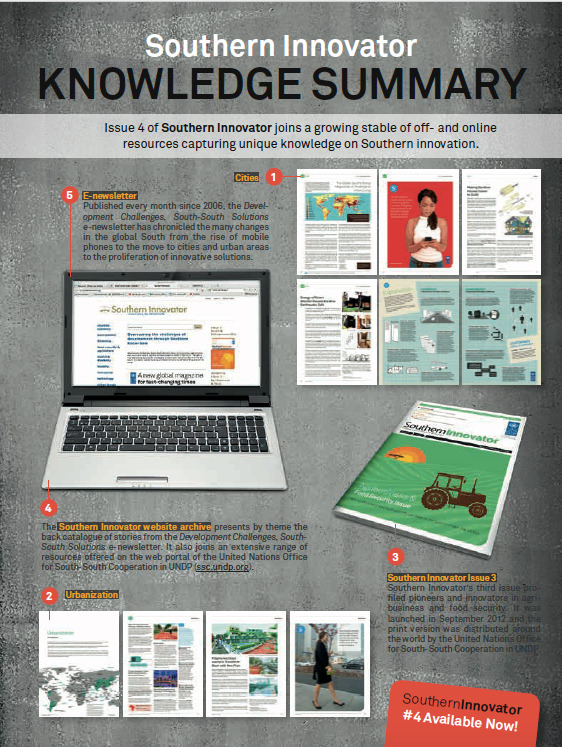
Development Challenges, South-South Solutions was launched as an e-newsletter in 2006 by UNDP’s South-South Cooperation Unit (now the United Nations Office for South-South Cooperation) based in New York, USA. It led on profiling the rise of the global South as an economic powerhouse and was one of the first regular publications to champion the global South’s innovators, entrepreneurs, and pioneers. It tracked the key trends that are now so profoundly reshaping how development is seen and done. This includes the rapid take-up of mobile phones and information technology in the global South (as profiled in the first issue of magazine Southern Innovator), the move to becoming a majority urban world, a growing global innovator culture, and the plethora of solutions being developed in the global South to tackle its problems and improve living conditions and boost human development. The success of the e-newsletter led to the launch of the magazine Southern Innovator.



This work is licensed under a
Creative Commons Attribution-Noncommercial-No Derivative Works 3.0 License.
ORCID iD: https://orcid.org/0000-0001-5311-1052.
© David South Consulting 2022



 David South Consulting
You must be logged in to post a comment.