Categories
Archive data Development Challenges, South-South Solutions Newsletters Southern Innovator magazine

Radical Drone Solution To Woeful Infrastructure In Poor Countries

By David SouthDevelopment Challenges, South-South Solutions

SOUTH-SOUTH CASE STUDY

Drones – unpiloted aircraft, formally called Unmanned Aerial Vehicles (UAV) or Unmanned Aircraft Systems (UAS) – have long been used for military purposes. The U.S. military claims to have 7,500 drones – a massive growth from just 50 a decade ago – and has used them for surveillance and combat in conflicts from Afghanistan to Iraq.

Drones can cost anywhere between a few thousand and millions of dollars depending on their size and sophistication. Some weigh as little as half a kilogram, and the largest can reach 18,000 kilograms (19 tons).

It is estimated 40 countries around the world are working on drones in one capacity or another.

Military drones come with ominous-sounding names such as Predator, Fire Scout, Global Hawk and Hunter. But many pioneers and innovators are setting out to prove drones can be a technology of peace and development and not just of fear and war.

YouTube provides many examples of drones being tested out as a delivery method. SF Express (http://www.sf-express.com/cn/en/product_service/product_intro/airline_delivery.html), a courier service in Dongguang, China has tried delivering parcels by drone. It is using a drone with eight rotor blades, called an octocopter (http://www.steadidrone.eu/octocopter-ei8ht/).

In Shanghai, the InCake bakery has used drones to deliver cakes (http://www.youtube.com/watch?v=fXwgwSkujOY). The service was brought to a halt after complaints from citizens, worried the drone would crash into someone.

The American pizza chain Domino’s has been testing drones for delivering pizza in the United Kingdom (http://www.youtube.com/watch?v=ZDXuGQRpvs4). A British company has used drones to deliver sushi to restaurant tables in London (http://www.youtube.com/watch?v=WV0yQYXLU34).

These may prove to be novelty experiments – or the early days of a revolution. Time will tell.

But serious thinking about drones is taking place in the area of development.

One pioneering company thinks it has a solution for two big problems common to many developing countries: the chaos, congestion and crowding that clog urban areas; and the poor or non-existent infrastructure in rural areas. Both problems make it expensive and time-consuming to move goods around.

A billion people in the world do not have access to all-weather roads, says the World Bank. Some roads are being upgraded in parts of sub-Saharan Africa but many are in worse shape than they were decades ago. Modern infrastructure is expensive to build, and the funds to do it often must be borrowed.

A startup called Matternet thinks it has the solution to getting around this problem in Africa, and in rapidly growing cities of the global South. It believes drones can come to the rescue where infrastructure is poor or non-existent, and save valuable wealth that can be diverted to real improvements in human development, or used to reduce congestion in crowded urban areas.

The Matternet (http://matternet.us/) is billed as “the next paradigm for transportation.” Matternet is offering a system and a concept for deploying drones as a scalable solution to overcome the problem of poor transportation networks in developing countries.

The artist’s vision on Matternet’s website shows drones buzzing their way through an urban high-rise landscape as they go about their business.

The Matternet drone design has two wings with three fans in each wing to allow it to take off and land vertically as well as flying in a straight line. There is a 10 litre space for packages and a rechargeable battery at the bottom of the drone. The drones can fly at 40 kilometres an hour, at an altitude of up to 121 metres and are guided by GPS (Global Positioning System) (http://en.wikipedia.org/wiki/Global_Positioning_System).

The drone moves in and out of a ground-station landing pod, where it is recharged, picks up new packages to deliver, and connects electronically to receive instructions. An entry and exit slot sits on top of the pod while there is a place at ground level for people to pop in packages for delivery.

Each vehicle costs US $1,000 and can last 10 years, the makers claim. Matternet believes the drones could transport 2 kilograms over 10 kilometres for just 24 US cents a trip.

Matternet’s Andreas Raptopoulos (https://www.solveforx.com/moonshots/physical-transport) hopes to push Africa away from simply upgrading its infrastructure along the lines of what is already in existence in developed countries. It is estimated it will take Africa another 50 years to have an infrastructure equal to North America. But why wait so long? Why not, he argues, just use drones or UAVs to knit a transport infrastructure criss-crossing the continent delivering goods and services to people?

Radical drone advocates like Matternet are very ambitious. They believe drones are to infrastructure what mobile phones have been to telecommunications: an advanced, 21st-century technology that enables countries to leapfrog ahead of old-school 20th century infrastructure and connect people up for much less cost and effort.

Imagine a city in the global South 15 years from now: canyons of high-rise buildings stretch from the central business district out to the suburbs where apartment towers replace office buildings. And whooshing through these canyons will be the drones carrying everything from takeaway food to medical supplies to the latest fashion items.

Anywhere in Africa can currently contact Matternet to arrange a trial of the technology (http://matternet.us/get-matternet/). The concept had field trials in the Dominican Republic and Haiti in the Caribbean. A large field test trial is being arranged for Lesotho, where the drones will help with delivering supplies to clinics serving patients with HIV/AIDS. The 47 clinics are spread out over a 138 square kilometre area and will be served by 50 ground stations and 150 drones at a cost of US $900,000. In comparison, building 2 kilometres of a single lane road would cost US $1 million.

Matternet is based in Palo Alto, California and founded by partners Andreas Raptopoulos, Paola Santana, Dimitar Pachlov and Darlene Damm.

It was conceived at the Singularity University (http://singularityu.org/) whose mission is to educate, inspire and empower leaders to apply exponential technologies to address humanity’s grand challenges.

By David South, Development Challenges, South-South Solutions

Published: October 2013

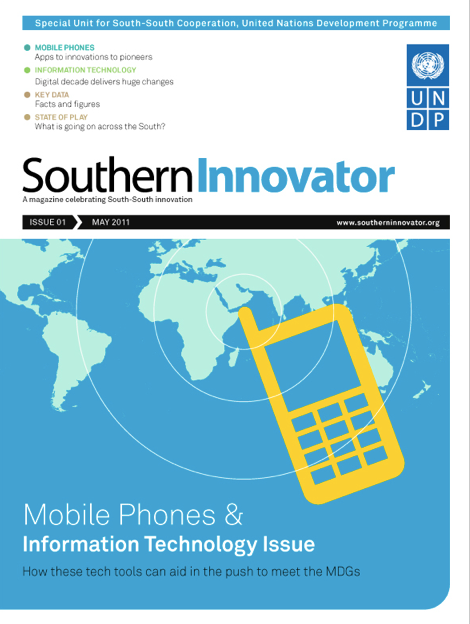
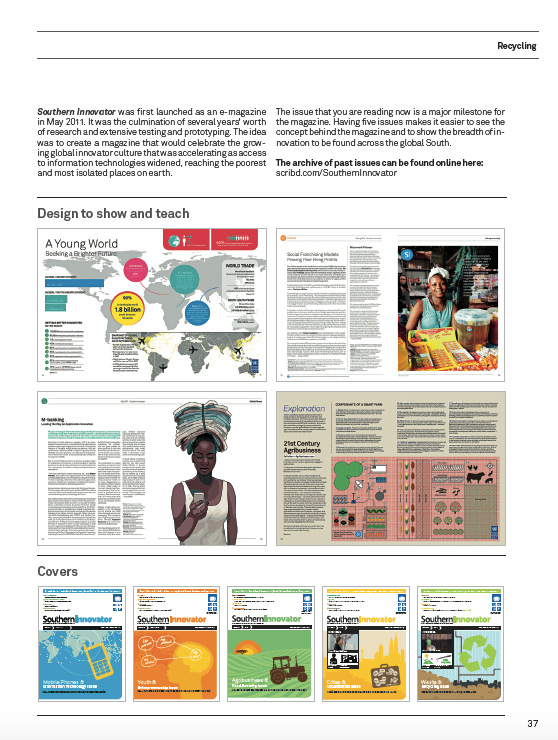
Development Challenges, South-South Solutions was launched as an e-newsletter in 2006 by UNDP’s South-South Cooperation Unit (now the United Nations Office for South-South Cooperation) based in New York, USA. It led on profiling the rise of the global South as an economic powerhouse and was one of the first regular publications to champion the global South’s innovators, entrepreneurs, and pioneers. It tracked the key trends that are now so profoundly reshaping how development is seen and done. This includes the rapid take-up of mobile phones and information technology in the global South (as profiled in the first issue of magazine Southern Innovator), the move to becoming a majority urban world, a growing global innovator culture, and the plethora of solutions being developed in the global South to tackle its problems and improve living conditions and boost human development. The success of the e-newsletter led to the launch of the magazine Southern Innovator.  

Other stories from Development Challenges, South-South Solutions:

African Digital Laser Breakthrough Promises Future Innovation

China Looking to Lead on Robot Innovation

Digital Mapping to put Slums on the Map

New Weapon Against Crime in the South

Follow @SouthSouth1

Google Books: https://books.google.co.uk/books?id=I_hcAwAAQBAJ&dq=development+challenges+october+2013&source=gbs_navlinks_s

Slideshare: http://www.slideshare.net/DavidSouth1/development-challenges-october-2013-issue

Southern Innovator Issue 1: https://books.google.co.uk/books?id=Q1O54YSE2BgC&dq=southern+innovator&source=gbs_navlinks_s

Southern Innovator Issue 2: https://books.google.co.uk/books?id=Ty0N969dcssC&dq=southern+innovator&source=gbs_navlinks_s

Southern Innovator Issue 3: https://books.google.co.uk/books?id=AQNt4YmhZagC&dq=southern+innovator&source=gbs_navlinks_s

Southern Innovator Issue 4: https://books.google.co.uk/books?id=9T_n2tA7l4EC&dq=southern+innovator&source=gbs_navlinks_s

Southern Innovator Issue 5: https://books.google.co.uk/books?id=6ILdAgAAQBAJ&dq=southern+innovator&source=gbs_navlinks_s

Creative Commons License
This work is licensed under a
Creative Commons Attribution-Noncommercial-No Derivative Works 3.0 License.

ORCID iD: https://orcid.org/0000-0001-5311-1052.

© David South Consulting 2023

Categories
Archive Blogroll Now Magazine

Does the UN know what it’s doing?

By David South

Now Magazine (Toronto, Canada), July 22-28, 1993

The United Nations’ bloody hunt for elusive Mogadishu warlord general Mohamed Farah Aideed has many observers wondering whether the world body is making up the rules as it goes along.

Some critics, such as George Cram of the Canadian Council for International Cooperation, an influential umbrella group for Canadian non-governmental organizations of NGOs, question if the obsession with Aideed isn’t just burying the UN in a deeper image problem with the Third World.

Critics point to the fallout of growing resentment from the July 12 attack on Aideed’s compound – killing more than 70 civilians – boding ill for a peaceful reconstruction of Somali society.

The fact that among those killed within the compound were clan elders who were negotiating a peace has upset Somalis even more, says Cram, a Horn of Africa researcher.

“The UN has lost its credibility, its moral authority, lost its blue-beret neutrality,” says Cram bluntly.

The degree to which Aideed should be the main focus of current UN actions has some relief agencies scratching their heads. Aideed has become Somalian bogey man number one with UNOSOM’s (United Nations Operations in Somalia) head, US Admiral Johnathon Howe. He has placed a $25,000 price on Aideed for an arrest.

“I don’t recall the UN ever going out and actually attempting to arrest individuals – they certainly haven’t done it in other conflict zones,” says reverend David Hardy of Saskatoon-based Lutheran Relief, who has organized relief flights into Somalia.

Cambodian example

He cites the example of Cambodia, where the UN brokered a controversial peace with those purveyors of the genocidal killing fields, the Khmer Rouge, in order to secure free elections.

David Isenverg of the Center for Defense Information, a liberal Washington-based think tank, worries that doggedly going after Aideed while ignoring the other factions will paint the UN as siding with one faction over another.

“The protracted effect is to turn the US and UN into partisans to the conflict.”

Hardy believes Aideed, who is adept at seeing which way the wind blows, has inflated his stature as an opponent of the UN as foreign invader.

Then there are other criticisms. Some observers wonder whether the UN is too proud or too blind, or simply oblivious when it comes to seeking advice from the locals it went in to protect.

Even Canada, while supporting the UN’s military effort since Aideed “is obstructing relief supplies,” believes that national reconciliation should be a main focus, says external affairs spokesperson Rodney Moore.

He says Canada continues to urge the UN to move quickly on national reconciliation, bringing together women’s groups, clan elders and other non-warlord groups.

“One of the areas where the UN operation went wrong is the tendency to deal with the ‘superpowers’ of Somalia while ignoring groups like women’s collectives,” says World Visions’ Philip Maher, who has just returned from Somalia.

“Part of the problem is misunderstanding,” Maher says. “The UN hasn’t done a great job of telling Somalis what they are doing.”

Many point to the peaceful north, where the as yet internationally unrecognized Somaliland offers a successful model, combining women’s groups and elders to wrest control.

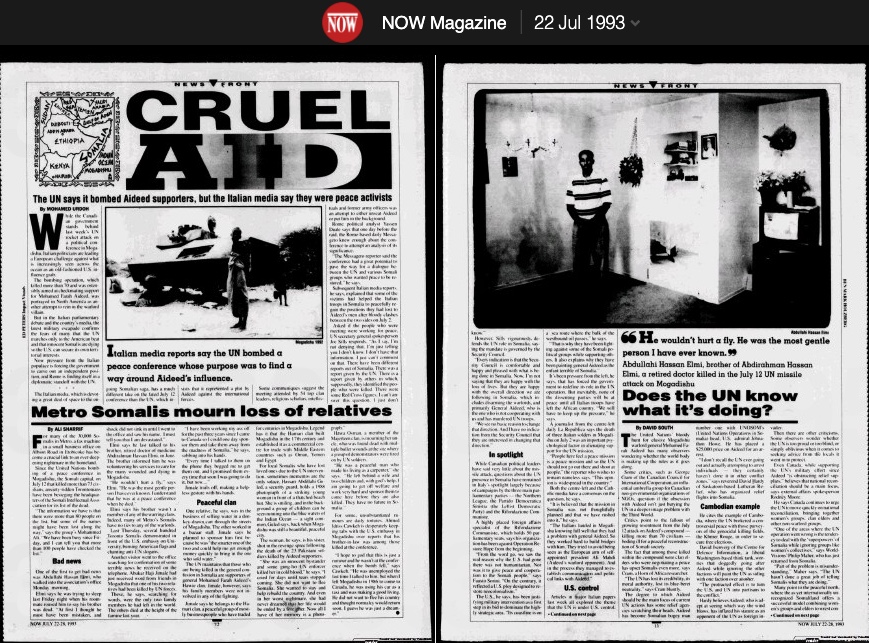
“Does the UN know what it’s doing?”: Now Magazine, July 1993. This incident was the basis of the 2001 film Black Hawk Down. 

More on this story here: Somali Killings Reveal Ugly Side Of Elite Regiment

More investigative journalism here: 

Peaceniks Questioning Air-Raid Strategy In Bosnia

Study Says Jetliner Air Quality Poses Health Risks: CUPE Takes On Airline Industry With Findings Of Survey

https://davidsouthconsulting.org/2020/04/22/state-of-decay-haiti-turns-to-free-market-economics-and-the-un-to-save-itself/

https://davidsouthconsulting.org/2021/02/18/what-is-the-un-doing-with-your-data/

Creative Commons License

This work is licensed under a
Creative Commons Attribution-Noncommercial-No Derivative Works 3.0 License.

ORCID iD: https://orcid.org/0000-0001-5311-1052.

© David South Consulting 2023

Categories
Archive Blogroll Now Magazine

Somali Killings Reveal Ugly Side Of Elite Regiment

By David South

Now Magazine (Toronto, Canada), May 6-12, 1993

Canada is touted around the world for its commitment to the ideals of peacekeeping. But something went seriously wrong with the Canadian Airborne Regiment at Belet Huen in Somalia.

Since the revelation of the March 16 shooting death of Somali civilian Shidane Omar Aroni at the hands of members of the regiment, three more killings of civilians by Canadian troops have come to light. Two of the deaths, including Aroni’s, are being investigated internally by the military, while others are subject to a government-ordered inquiry.

Military watchers say the problem permeating the Canadian Armed Forces’ approach to peacekeeping goes beyond the inappropriate behaviour of a few gung-ho members of the airborne.

Warning ignored

They say the department of national defence has ignored the warnings of the United Nations and its own internal papers regarding the ever more complex duties of international peacemaking and peacekeeping. The Canadian forces and other coaltion partners, they say, are playing with fire in Somalia by neglecting to prepare troops with the skills they need in negotiation, conflict resolution and cultural sensitivity.

And they point out that the assigning of peacekeeping duties to the Canadian airborne – an elite force with a fearsome reputation – illuminates everything that is wrong with the current approach.

“The opposition is calling for the airborne to be dismantled, but they are prepared for high-intensity combat,” says defence consultant Peter Langille. “It’s just a dumb decision – somebody used them for the wrong thing.”

“The opposition is calling for the airborne to be dismantled, but they are prepared for high-intensity combat,” says defence consultant Peter Langille. “It’s just a dumb decision – somebody used them for the wrong thing.”

If Canadian personnel were properly trained, the incidents at Belet Huen would not have happened, says Gideon Forman of the Canadian Peace Alliance.

“Peacekeeping is a special skill that requires courses in non-violent conflict resolution and negotiation. A peacekeeping training centre – which the Canadian Forces pooh-pooh – would be very useful.”

Indeed, the unfolding of the horrifying drama in Belet Huen posed acutely difficult problems for army personnel. It took a small-town journalist on a press junket intended to show off the work of the airborne to force the army to go public with the death of Aroni.

Jim Day of the Pembroke Observer, located near the airborne’s home base at CFB Petawawa, spotted a commotion over the attempted suicide of master corporal Clayton Matchee, one of the soldiers arrested in the death.

It wasn’t until March 31, two weeks after an internal military investigation had begun, that the military admitted to the investigation.

Day says watching the troops in Somalia made it clear there was a mismatch between the personnel and the mission.

“They are trained for a combative role. They’re considered the cream of the crop, very tough physically. They want to use their training, as opposed to being trained for combat in rugged exercises and then ending up handing out water.

“What hit me quite strongly down in the camp was how they spent their leisure time. I watched them set up a spider fight. They had such intensity – they were watching these two spiders devour each other for 20 or 25 minutes, coaching them along, pumping their arms in the air and rooting and screaming.”

Creates aggression

Observers who know the regiment say the training is meant to create extremely aggressive behaviour while reinforcing elite status. Through “jump school” – three weeks of punishing training where subjects drop from planes – soldiers experience exhilarating highs and terrifying lows.

Anecdotes abound about the secretive and violent behaviour of the regiment.

“There’s a good deal of resentment,” says Dave Henderson, who puts together a weekly news infomercial called Base Petawawa Journal for Ottawa’s CHRO TV. “A lot of the other soldiers on the base shun them. Their nickname in some quarters is ‘stillborne.’

“I know from people in other military outfits that when you go up against the airborne, there is a fear factor,” says Langille, whose company Common Security Consultants, has lobbied the government to change peacekeeping training.

“In exercises where the airborne take over a base or something, if they catch you, they bet the shit out of you. It’s not surprising they got carried away in an ugly environment.”

Frustrating pace

Nor is it strange that the regiment chafed at the pace of the Somalian daily round. “The soldiers believe the Somalis are very slow in their ways,” says Day. “They’re used to ‘boom, boom.’ Whatever it is they do, even if it’s building a trench or putting up a fence, they are very quick about it.”

But the military argues that the best preparation for peacemaking and peacekeeping duties is the general combat training every soldier receives.

“The best peacekeeper is a well-trained soldier,” says veteran peacekeeper colonel Sean Henry of the Conference of Defence Associations.

“When you look at the make-up of the coalition force in Somalia, you find that just about every other nation has contributed either airborne troops or special troops, simply because they wanted a well-trained unit at short notice.”

“When you look at the make-up of the coalition force in Somalia, you find that just about every other nation has contributed either airborne troops or special troops, simply because they wanted a well-trained unit at short notice.”

Henry thinks those who argue for peacekeeping training are missing the essence of the armed forces’ mandate. “It’s counter-productive. You might as well forget about the armed forces and sign up a bunch of social workers.”

Does the UN know what it’s doing?

Now Magazine (Toronto, Canada), July 22-28, 1993. This incident was the basis of the 2001 film Black Hawk Down. 

By David South

Now Magazine (Toronto, Canada), July 22-28, 1993

The United Nations’ bloody hunt for elusive Mogadishu warlord general Mohamed Farah Aideed has many observers wondering whether the world body is making up the rules as it goes along.

Some critics, such as George Cram of the Canadian Council for International Cooperation, an influential umbrella group for Canadian non-governmental organizations of NGOs, question if the obsession with Aideed isn’t just burying the UN in a deeper image problem with the Third World.

Critics point to the fallout of growing resentment from the July 12 attack on Aideed’s compound – killing more than 70 civilians – boding ill for a peaceful reconstruction of Somali society.

The fact that among those killed within the compound were clan elders who were negotiating a peace has upset Somalis even more, says Cram, a Horn of Africa researcher.

“The UN has lost its credibility, its moral authority, lost its blue-beret neutrality,” says Cram bluntly.

The degree to which Aideed should be the main focus of current UN actions has some relief agencies scratching their heads. Aideed has become Somalian bogey man number one with UNOSOM’s (United Nations Operations in Somalia) head, US Admiral Johnathon Howe. He has placed a $25,000 price on Aideed for an arrest.

“I don’t recall the UN ever going out and actually attempting to arrest individuals – they certainly haven’t done it in other conflict zones,” says reverend David Hardy of Saskatoon-based Lutheran Relief, who has organized relief flights into Somalia.

Cambodian example

He cites the example of Cambodia, where the UN brokered a controversial peace with those purveyors of the genocidal killing fields, the Khmer Rouge, in order to secure free elections.

David Isenverg of the Center for Defense Information, a liberal Washington-based think tank, worries that doggedly going after Aideed while ignoring the other factions will paint the UN as siding with one faction over another.

“The protracted effect is to turn the US and UN into partisans to the conflict.”

Hardy believes Aideed, who is adept at seeing which way the wind blows, has inflated his stature as an opponent of the UN as foreign invader.

Then there are other criticisms. Some observers wonder whether the UN is too proud or too blind, or simple oblivious when it comes to seeking advice from the locals it went in to protect.

Even Canada, while supporting the UN’s military effort since Aideed “is obstructing relief supplies,” believes that national reconciliation should be a main focus, says external affairs spokesperson Rodney Moore.

He says Canada continues to urge the UN to move quickly on national reconciliation, bringing together women’s groups, clan elders and other non-warlord groups.

“One of the areas where the UN operation went wrong is the tendency to deal with the ‘superpowers’ of Somalia while ignoring groups like women’s collectives,” says World Visions’ Philip Maher, who has just returned from Somalia.

“Part of the problem is misunderstanding,” Maher says. “The UN hasn’t done a great job of telling Somalis what they are doing.”

Many point to the peaceful north, where the as yet internationally unrecognized Somaliland offers a successful model, combining women’s groups and elders to wrest control.

Update: War crimes: former minister reveals why Canada disbanded its special airborne force after scandal: The drastic step was judged the best way to fix systemic problems after an affair similar to allegations against Australian forces in Afghanistan (Wed 2 Dec 2020)

Further reading: 

Canada evolves from peacekeeper to war-fighter by A. Walter Dorn, The Toronto Star, Dec. 21, 2013

IS CANADA A NATION OF WARRIORS OR PEACEKEEPERS? HOW TO REFOCUS ON UNITED NATIONS PEACE OPERATIONS by Maj M.C.C. Lafortune, Canadian Forces College, 2016-2017

Law in Times of Crisis: Emergency Powers in Theory and Practice by Oren Gross and Fionnuala Ní Aoláin  (2006)

Manitoba Law Journal: The New Emergencies Act: Four Times the War Measures Act, 1991 CanLIIDocs 129

Doug Ford declared a state of emergency. Should Justin Trudeau do the same? 

October 1970 by Louis Hamelin (Publisher: House of Anansi, 2013). “October 1970 is a thrilling fictional account of the events that shaped one of the most volatile moments in recent history.”

Trudeau’s Darkest Hour: War Measures in Time of Peace, October 1970 Editors: Guy Bouthillier, Édouard Cloutier (2010)

Warrior Nation: Rebranding Canada in an Age of Anxiety by Ian McKayJamie Swift (2012)

Warriors Or Peacekeepers? Building Military Cultural Competence, Editors: Kjetil EnstadPaula Holmes-Eber (2020)

Canadian Peacekeeping Is Under the Gun by Craig Turner, Los Angeles Times, Aug. 1, 1996

My journalism:

1992

Top Reporters Offer Military Media Handling Tips

1993

Continental Drift And Military Complexities

Somali Killings Reveal Ugly Side Of Elite Regiment

Does the UN know what it’s doing?

Peaceniks Questioning Air-Raid Strategy In Bosnia

1996

State Of Decay: Haiti Turns To Free-Market Economics And The UN To Save Itself

U.S. Elections Update: Clinton is using Canada to keep control of Haiti

Creative Commons License

This work is licensed under a
Creative Commons Attribution-Noncommercial-No Derivative Works 3.0 License.

ORCID iD: https://orcid.org/0000-0001-5311-1052.

© David South Consulting 2023