Tag: diseases

  • Pay for Pee Keeps Indian Town Clean

    Pay for Pee Keeps Indian Town Clean

    By David SouthDevelopment Challenges, South-South Solutions

    SOUTH-SOUTH CASE STUDY

    The task is huge: 2.6 billion people, or 41 percent of the world’s population, is without access to basic sanitation. As a result, most have to make do and defecate or urinate wherever they can. In crowded urban areas, the result is an unpleasant source of disease and filth that fouls living spaces and sickens or kills many people.

    In Indian cities, between one-quarter and one-half of the population, mostly slum-dwellers, has inadequate or no provision for sanitation.

    Many government-built communal toilet blocks are in a sad state. They are overburdened by queues of people that can stretch a mile-long in the mornings. They can also be too expensive for many slum dwellers. Often government-built toilet blocks are in disrepair after just three months, and people return to defecating in the streets.

    In 2008, the International Year of Sanitation (http://esa.un.org/iys/), more than 330 million people in India do not have access to proper sanitation facilities. And in the case of the remote town of Musiri in Tamil Nadu state, many residents relieve themselves on river banks, leading to infectious diseases like diarrhoea.

    But an ingenious scheme is keeping streets clean and people relieved. Rather than viewing human waste as an expensive problem and annoyance, poor residents are being paid up to a dollar a month to use public toilets. By paying people to use the toilets, the government avoids having to run campaigns to get people to change their habits.

    “In fact, many of us started using toilets for urination only after the ecosan (ecological sanitation) toilets were constructed in the area,” S. Rajasekaran, a truck cleaner, to The Times of India.

    The urine is being collected to be used as a crop fertilizer by the state’s agricultural university (http://www.tnau.ac.in/ ). About 150 residents use the eco-sanitation toilet daily. It is designed to collect faeces as well: it too is used as fertilizer.

    “We’re motivating people to know the value of their urine,” Marathi Subburaman, who came up with the novel idea, told CNN. “The urine that is collected goes into fields for paddy crops, and of course the faeces becomes good compost in a matter of months.”

    Subburaman’s non-profit Society for Community Organization and People’s Education (SCOPE) has teamed up with Tamil Nadui Agricultural University and are studying how much urine is needed to fertilize a field.

    “Next year, we can install urine banks so we can sell the urine to farmers,” he said.

    The locals are given cards and each trip is recorded. At the end of the month, the cards are handed in and the money collected.

    The average amount paid out is based on the assumption most people need to go twice a day.

    If some get cheeky and try to make more money from pretending they need to go to the toilet, there is a solution: “If they ask to go three, four times a day, then something’s wrong,” Subburaman said. “We ask them to go to a doctor.”

    Another successful model is the Indian NGO SPARC (Society for Promotion of Area Resource Centres) (http://www.sparcindia.org/). SPARC is an Indian NGO established in Mumbai in 1984 that began working with women pavement dwellers.

    It has been designing and building toilet blocks in Indian cities, bringing access to toilets and washing facilities to hundreds of thousands of poor urban Indians. It has built toilet blocks for 400,000 people in eight Indian cities. It trains community groups to build, manage and maintain the toilet blocks. It has also proven that local groups can take on the management and costs of providing toilet facilities.

    Resources

    • World Toilet Organization: The global non-profit organization committed to improving toilet and sanitation conditions. Website: http://www.worldtoilet.org
    • World Toilet College: Established in 2005, the World Toilet College (WTC) started as a social enterprise, with the belief that there is a need for an independent world body to ensure the best practices and standards in toilet design, cleanliness, and sanitation technologies are adopted and disseminated through training. Website: http://www.worldtoilet.org/ourwork3.asp
    • Official website for the 2008 International Year of Sanitation. Website: http://esa.un.org/iys/
    • Waste has expert knowledge on domestic solid and liquid waste management and sanitation issues. Its website offers a comparison of designs and methods for toilets. Website: http://www.ecosan.nl/page/353

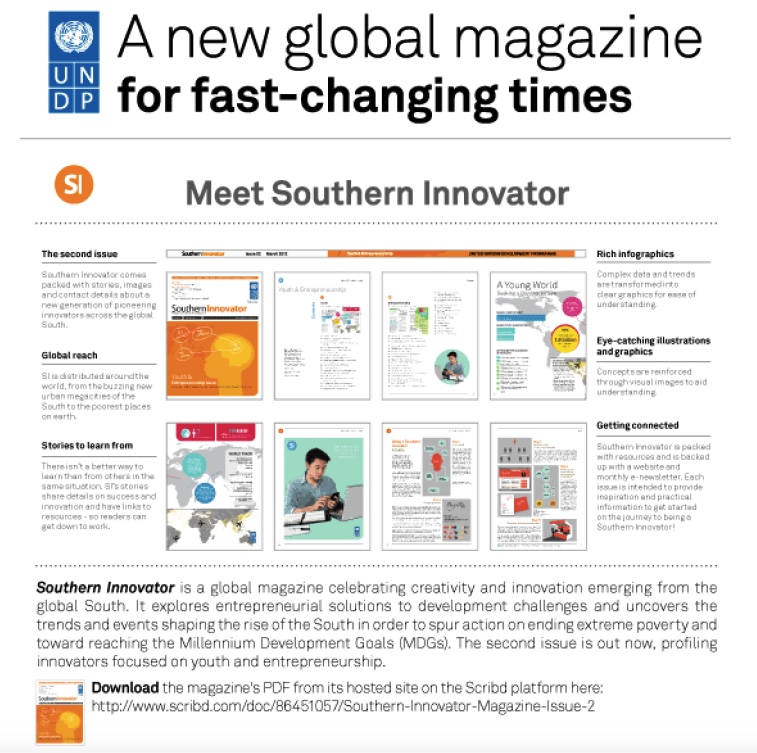
    Development Challenges, South-South Solutions was launched as an e-newsletter in 2006 by UNDP’s South-South Cooperation Unit (now the United Nations Office for South-South Cooperation) based in New York, USA. It led on profiling the rise of the global South as an economic powerhouse and was one of the first regular publications to champion the global South’s innovators, entrepreneurs, and pioneers. It tracked the key trends that are now so profoundly reshaping how development is seen and done. This includes the rapid take-up of mobile phones and information technology in the global South (as profiled in the first issue of magazine Southern Innovator), the move to becoming a majority urban world, a growing global innovator culture, and the plethora of solutions being developed in the global South to tackle its problems and improve living conditions and boost human development. The success of the e-newsletter led to the launch of the magazine Southern Innovator.  

    Follow @SouthSouth1

    Google Books: https://books.google.co.uk/books?id=m5GYBgAAQBAJ&dq=development+challenges+may+2012&source=gbs_navlinks_s

    Slideshare: http://www.slideshare.net/DavidSouth1/development-challengessouthsouthsolutionsmay2012issue

    Southern Innovator Issue 1: https://books.google.co.uk/books?id=Q1O54YSE2BgC&dq=southern+innovator&source=gbs_navlinks_s

    Southern Innovator Issue 2: https://books.google.co.uk/books?id=Ty0N969dcssC&dq=southern+innovator&source=gbs_navlinks_s

    Southern Innovator Issue 3: https://books.google.co.uk/books?id=AQNt4YmhZagC&dq=southern+innovator&source=gbs_navlinks_s

    Southern Innovator Issue 4: https://books.google.co.uk/books?id=9T_n2tA7l4EC&dq=southern+innovator&source=gbs_navlinks_s

    Southern Innovator Issue 5: https://books.google.co.uk/books?id=6ILdAgAAQBAJ&dq=southern+innovator&source=gbs_navlinks_s
    https://davidsouthconsulting.org/2022/10/18/indian-initiatives-to-make-travel-safer-for-women/

    https://davidsouthconsulting.org/2022/10/25/indian-toilet-pioneer-champions-good-ideas/

    https://davidsouthconsulting.org/2022/10/18/indians-fighting-inflation-with-technology/

    https://davidsouthconsulting.org/2022/11/18/toilet-malls-make-going-better/

    Creative Commons License

    This work is licensed under a
    Creative Commons Attribution-Noncommercial-No Derivative Works 3.0 License.

    ORCID iD: https://orcid.org/0000-0001-5311-1052.

    © David South Consulting 2023

  • Cheap Paper Microscope to Boost Fight Against Diseases

    Cheap Paper Microscope to Boost Fight Against Diseases

    By David SouthDevelopment Challenges, South-South Solutions

    SOUTH-SOUTH CASE STUDY

    To tackle diseases in the developing world, the most important first step is diagnosis. Without effective diagnosis, it is difficult to go to the next steps of either treatment or cure. While much attention is given to the high costs involved in treating and curing ailments, screening for diagnosis is also expensive, especially if it involves lots of people. Anything that can reduce the cost of diagnosis will free up resources to expand the number of people who can be checked, and help eradicate contagious diseases.

    One innovation is an inexpensive microscope that could allow diagnosing diseases such as malaria to be done on a much larger scale. Called the Foldscope (foldscope.com), it is made from paper, comes in a variety of bright colors and resembles the cardboard, three-dimensional cut-and-keep models regularly found in children’s books and magazines.

    Foldscope’s designs are developed on a computer and then printed. Foldscopes are made from thick paper, glue, a switch, a battery and a light-emitting diode (LED) (http://en.wikipedia.org/wiki/Light-emitting_diode).

    Inspired by the ancient Japanese paper-folding craft of Origami (http://en.wikipedia.org/wiki/Origami), Foldscope’s makers at the Prakash Lab at Stanford University (http://www.stanford.edu/~manup/) are trying to create “scientific tools that can scale up to match problems in global health and science education”, according to their website.

    The Foldscope can be put together in less than 10 minutes (http://www.youtube.com/watch?v=rphTSmb-Ux4) using a pair of scissors, packing tape and tweezers.

    Once assembled, a user places a standard glass microscope slide in the Foldscope, turns on the LED light and uses their thumbs to guide the lens to view the slide.

    Each Foldscope can magnify up to 2000 times with a sub-micron resolution of 800 nm. The battery can last up to 50 hours on a single button-cell battery and requires no further external power. Its makers claim it can survive being stepped on or dropped from a three-storey building.
    It can perform a wide variety of microscopy techniques.

    Its makers hope to manufacture billions of Foldscopes a year by exploiting the cheapness of the material and the simplicity of construction.

    A beta test called “Ten Thousand Microscopes” will enlist 10,000 people to test the Foldscope in the field. Participants will contribute to helping write a field manual for the Foldscope prior to mass manufacturing. The Foldscope costs just US $0.50 to make for the basic model and US $1 for a higher-magnification version.

    Field tests are taking place in the United States, Uganda and India.

    Foldscope is designed to be used where more sophisticated lab analysis is not possible or affordable. It can also be an educational tool to give students experience in hands-on microscopy, or build awareness in the general population of how infectious diseases are spread by unseen lifeforms.

    Foldscope’s makers hope their creation will help diagnose common but devastating diseases including Plasmodium falciparum (malaria), Trypanosome cruzi (Chagas disease), Giradia lamblia (giardiasis), Leishmania donovani (leishmaniasis), Dirofilaria immitis (filariasis), Human Sickle Cell (sickle-cell anaemia), E. Coli and Bacillus and Pine strobilus.

    The quantity of people that need to be checked for diseases is vast and means, in countries where incomes and resources are low, it just isn’t possible to undertake diagnostic services using conventional methods.

    “There is definitely a huge gap between where we are and where we want to be,” Stanford School of Medicine Assistant Professor for Bioengineering Manu Prakash explained on the university’s website.

    “When you do get it (malaria), there is this simple-minded thing ‘forget diagnostics, let’s just get that tablet’ – and that’s what happens in most of the world. But the problem is there is many different strains, there are many different medications, you could potentially make the problem even worse by not realizing that you have malaria. And at the same time, the people who get a severe case – they are not detected at all.

    “What is that one thing that you could almost distribute for free that starts to match the specificity of what detection requires? For malaria, the standard is to be able to image, and sit on a microscope and essentially go through slides.

    “What we found as a challenge, if you truly want to scale, you should be really testing more than a billion people every year: that’s a billion tests a year. Any platform that you can imagine needs to scale to those numbers to make an impact.

    “One of these things that have been shown over and over again – if you can put (in place) an infrastructure to fight malaria that is scalable and sustainable, then you get retraction of malaria in different regions.”

    Published: April 2014

    Resources

    1) World Health Organization: Facts on malaria from the WHO. Website: http://www.who.int/topics/malaria/en/

    2) WHO: Ten Facts on Malaria: About 3.4 billion people – half of the world’s population – are at risk of malaria. In 2012, there were about 207 million malaria cases (with an uncertainty range of 135 million to 287 million) and an estimated 627,000 malaria deaths (with an uncertainty range of 473,000 to 789,000). Website: http://www.who.int/features/factfiles/malaria/en/

    3) Instructables: How to build a US $10 stand to turn a smartphone into a digital microsope. Website: http://www.instructables.com/id/10-Smartphone-to-digital-microscope-conversion/

    4) Microscope adapter app for smartphones:  iPhone, Android, Blackberry or any Smartphone, with an attachment and an app, can be turned into a microscope. Website: http://internetmedicine.com/iphone-microscope/

    5) Stanford University: Stanford University, located between San Francisco and San Jose in the heart of California’s Silicon Valley, is one of the world’s leading teaching and research universities. Website: stanford.edu

    6) MaRS: Located in Toronto, Canada, MaRS is where science, technology and social entrepreneurs get the help they need. Where all kinds of people meet to spark new ideas. And where a global reputation for innovation is being earned, one success story at a time. Website: marsdd.com

    7) Universal smartphone to microscope and telescope adapter/mount: The SkyLight is a universal smartphone-to-microscope adapter. Website: http://www.amazon.com/Universal-Smart-Microscope-Telescope-Adapter/dp/B00GF3Q3CK

    Development Challenges, South-South Solutions was launched as an e-newsletter in 2006 by UNDP’s South-South Cooperation Unit (now the United Nations Office for South-South Cooperation) based in New York, USA. It led on profiling the rise of the global South as an economic powerhouse and was one of the first regular publications to champion the global South’s innovators, entrepreneurs, and pioneers. It tracked the key trends that are now so profoundly reshaping how development is seen and done. This includes the rapid take-up of mobile phones and information technology in the global South (as profiled in the first issue of magazine Southern Innovator), the move to becoming a majority urban world, a growing global innovator culture, and the plethora of solutions being developed in the global South to tackle its problems and improve living conditions and boost human development. The success of the e-newsletter led to the launch of the magazine Southern Innovator.

    Creative Commons License

    This work is licensed under a
    Creative Commons Attribution-Noncommercial-No Derivative Works 3.0 License.

    ORCID iD: https://orcid.org/0000-0001-5311-1052.

    © David South Consulting 2022