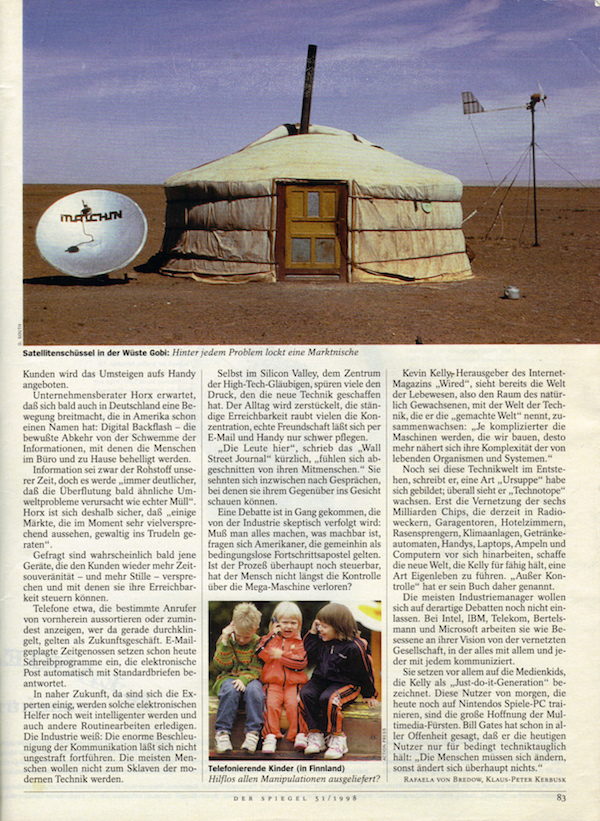
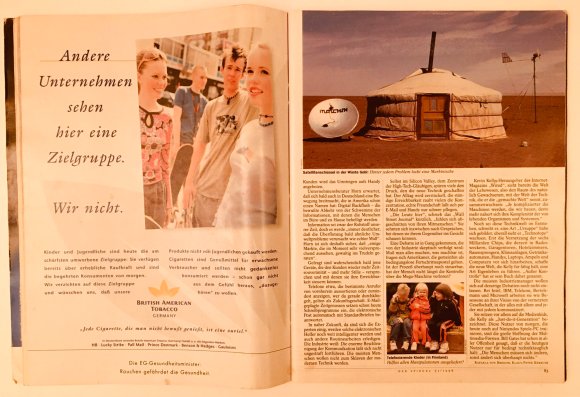
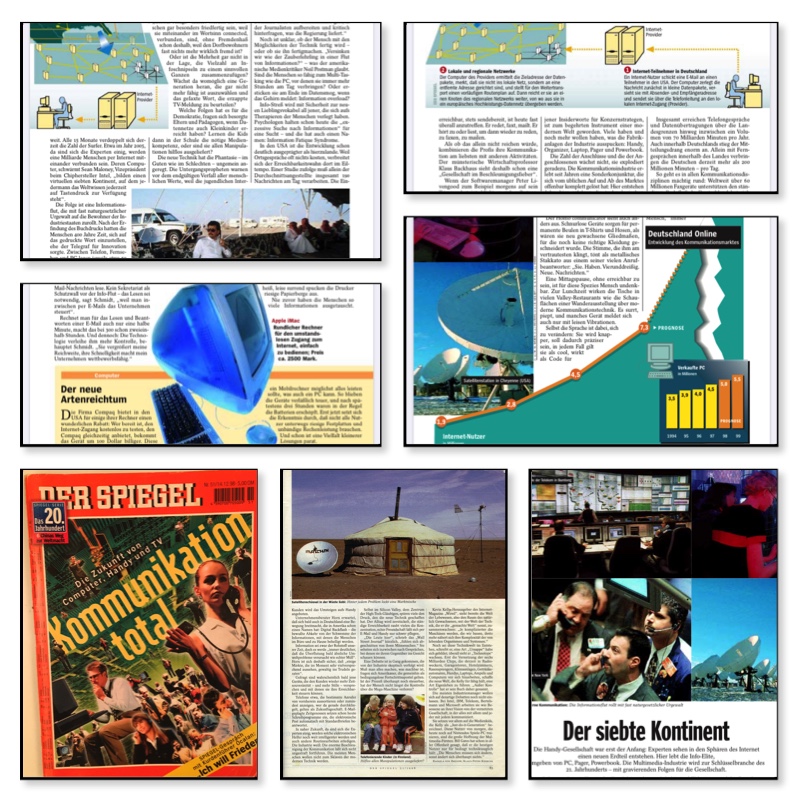
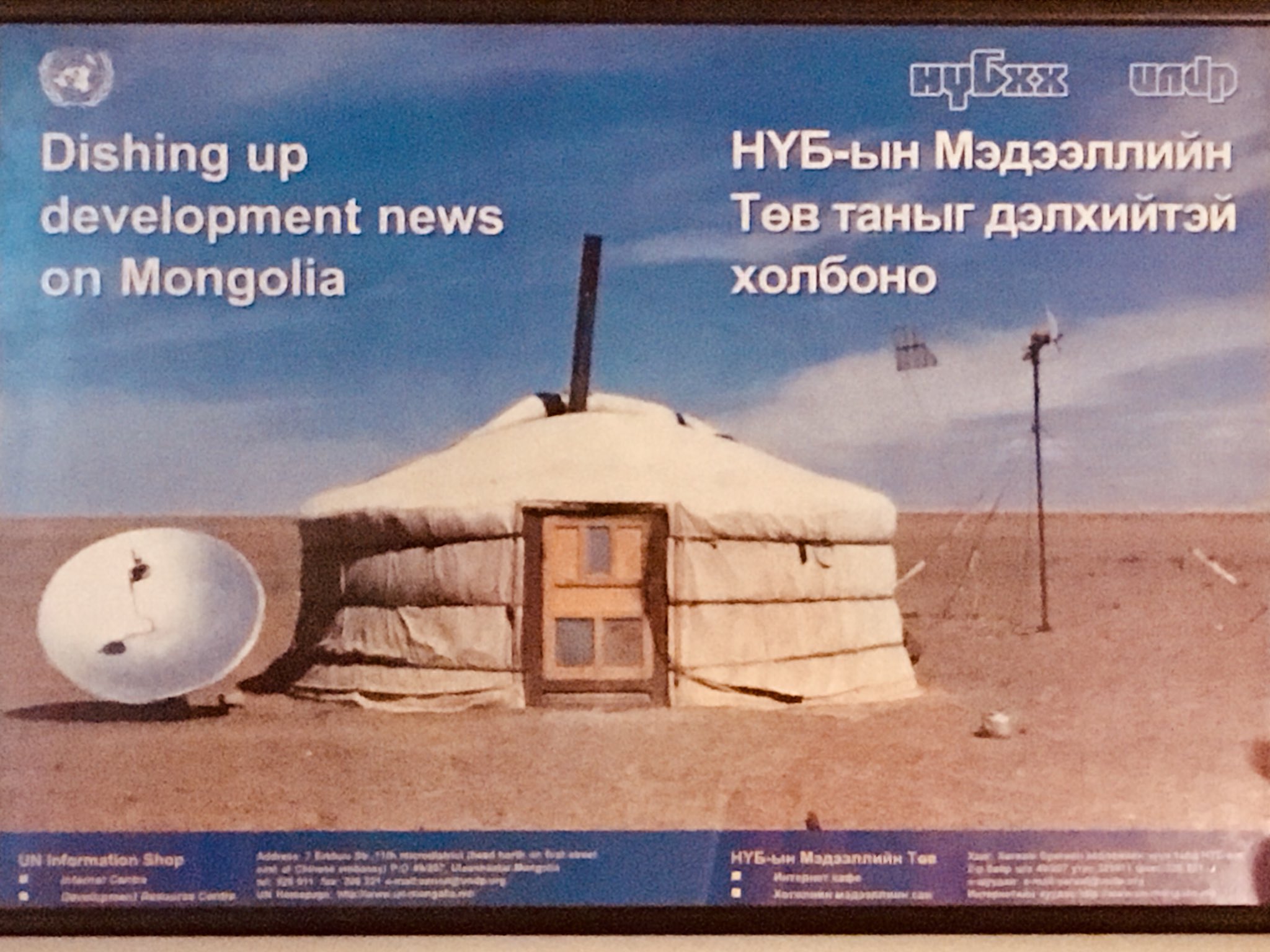
In 1998 Der Spiegel’s “Kommunikation total” issue profiled the global connectivity revolution underway and being accelerated by the Internet boom of the late 1990s. It chose my picture of a satellite dish and a ger in the Gobi Desert to symbolise this historic event.
Scroll through a PDF of the story (my photo is on the last page).
“Die Handy-Gesellschaft war erst der Anfang: Experten sehen in den Sphären des Internet einen neuen Erdteil entstehen. Hier lebt die Info-Elite, umgeben von PC, Pager, Powerbook. Die Multimedia-Industrie wird zur Schlüsselbranche des 21. Jahrhunderts – mit gravierenden Folgen für die Gesellschaft.”
English translation: “Total communication: the seventh continent – The cell phone society was just the beginning: Experts see a new continent emerging in the spheres of the Internet. The information elite live here, surrounded by PCs, pagers and power books. The multimedia industry is becoming the key industry of the 21st century – with serious consequences for society.” (http://t-off.khd-research.net/Spiegel/10.html). Original copy of magazine (above) from 1998. From The Turns of Translation Studies: New Paradigms Or Shifting Viewpoints? By Mary Snell-Hornby · 2006.
Der Spiegel is a German weekly news magazine and is one of Europe’s largest publications of its kind. It chose my photo taken in the Gobi Desert for its profile of the Internet revolution in 1998.
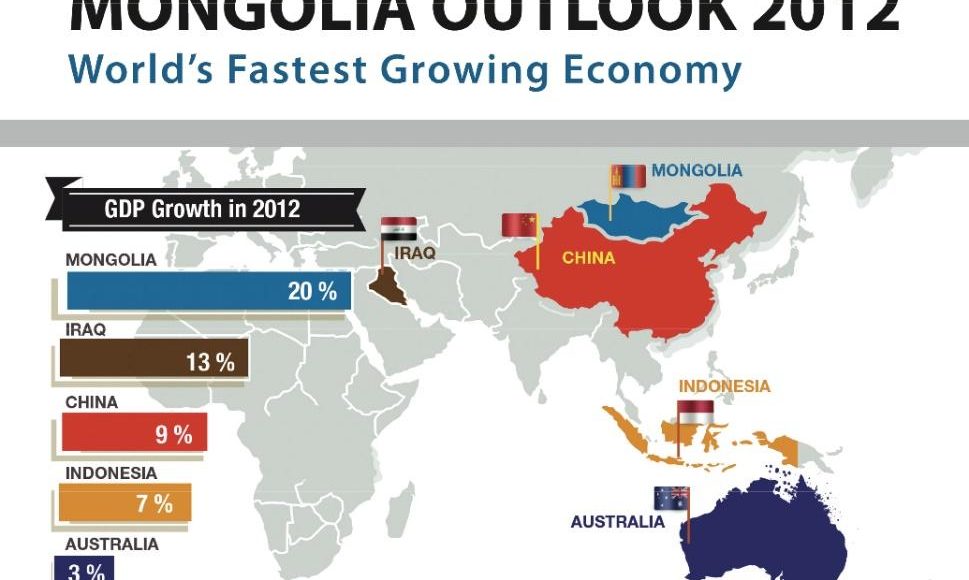
The world has changed considerably since then; and so has Mongolia. The digital revolution has rolled across the planet, the attacks of 9/11 unleashed a wave of violence and wars, and Mongolia even became the fastest-growing economy in the world a few years ago (2012). But back when this book was researched, Mongolia was just coming out of decades of isolation within the Soviet orbit under Communism, and the country experienced in the 1990s “one of the biggest peacetime economic collapses ever” (Mongolia’s Economic Reforms: Background, Content and Prospects, Richard Pomfret, University of Adelaide, 1994).
Two trends came together at the end of the 1990s and the start of the 2000s: the digital revolution and the mapping of the human genome. Both have given birth to whole new industries. Read more here: The Dawn Of The Genetics Revolution | 2001 – 2003
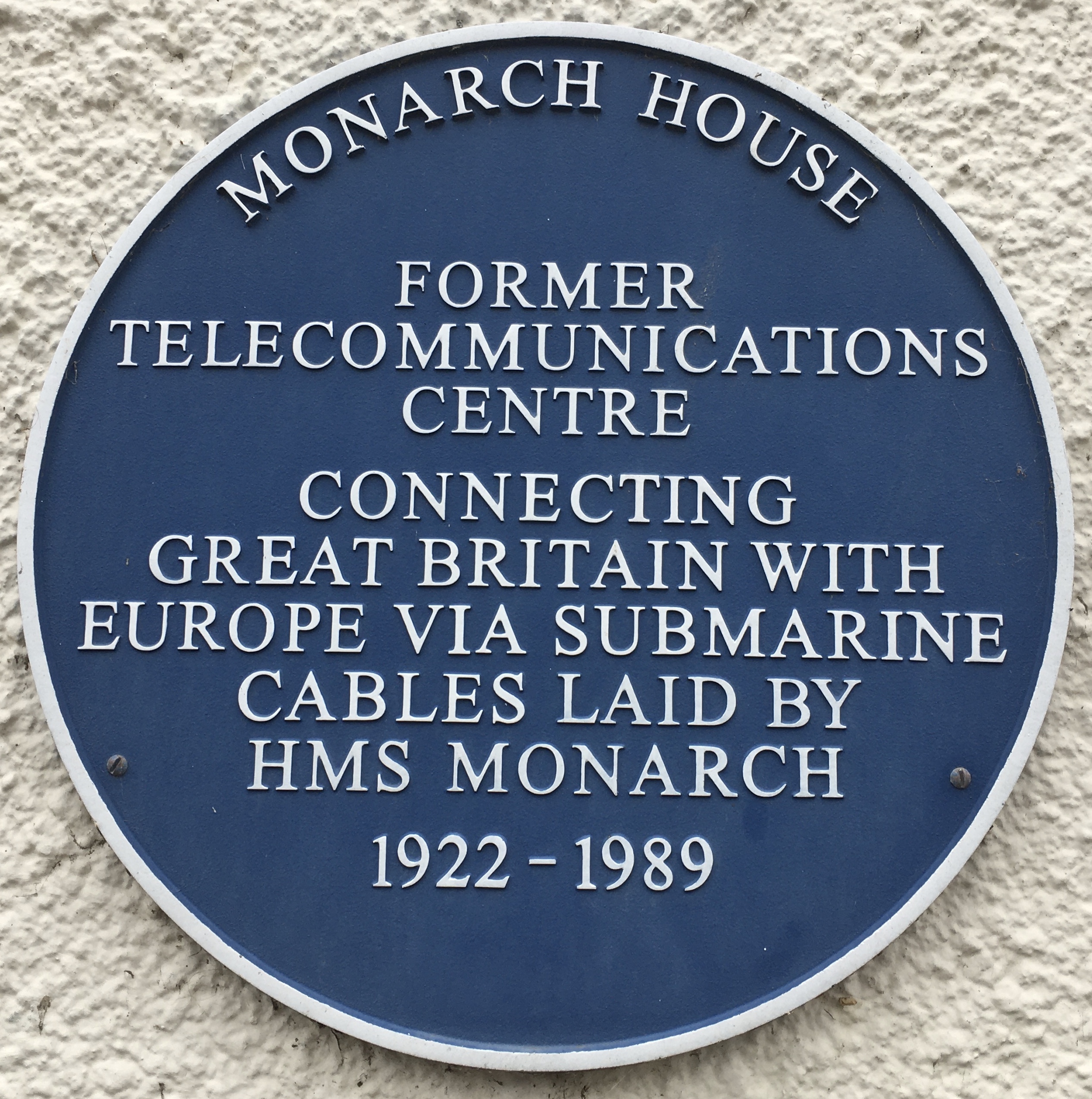
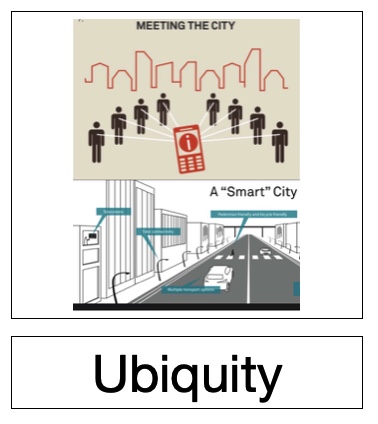
By the 1990s, cables (like above) were being joined by satellites to advance the global connectivity revolution. By the 2000s, cables (copper and fibre optic) and satellites were joined by mobile and smart phones, to deliver “kommunikation total”.
If you allow another country to gain access to really critical data about your society, over time that will erode your sovereignty, you no longer have control over that data.
MI6 chief Richard Moore to BBC News (30 November 2021).
Data. The United Nations (UN) has always gathered data and published it. But since the advent of the digital revolution, data collection has taken on new forms. It is now gathered 24/7 and sits in databases – or on somebody’s smartphone. It flows in, and flows out. Some call it a ‘data deluge’. Since 2000, despite various initiatives (irritating ‘cookies’ warnings before you can interact with a web page, or the more legalistic General Data Protection Regulation (GDPR) – a regulation in EU law on data protection and privacy in the European Union and the European Economic Area) data has become incontinent: it leaks out everywhere.
An orgy of cross-border data collection and harvesting has only increased in its intensity in the past 20 years. And the UN and other international organisations have played their part.
But what most of us do not want to think about is this: that data is power and when it is parsed and sifted by algorithms and AI (artificial intelligence), it allows the entity doing this to engage in event-shaping. How much of our lives is being shaped by digital ‘voodoo dolls’ in a cyber centre somewhere?
And, as the head of the UK’s MI6 intelligence service says, “over time that will erode your sovereignty, you no longer have control over that data.” In short, you’ve been hacked.
“Cyber-security experts have unveiled one of the biggest computer hacking campaigns to date, releasing a list of 72 organisations whose networks were attacked over a five-year period. Victims include the UN and several governments.
REUTERS – Security experts have discovered the biggest series of cyber attacks to date, involving the infiltration of the networks of 72 organizations including the United Nations, governments and companies around the world. …
In the case of the United Nations, the hackers broke into the computer system of its secretariat in Geneva in 2008, hid there for nearly two years, and quietly combed through reams of secret data, according to McAfee.”
“Personal information leaked in sensitive contexts can spark violence, discrimination, exclusionary policies. Yet my NGO shares confidential data freely.”
“If there are no consequences for the [UN] agencies for failures like these … there will be more breaches.”
“About this investigation: While researching cybersecurity last November, we came across a confidential report about the UN. Networks and databases had been severely compromised – and almost no one we spoke to had heard about it. This article about that attack adds to The New Humanitarian’s previous coverage on humanitarian data. We look at how the UN got hacked and how it handled this breach, raising questions about the UN’s responsibilities in data protection and its diplomatic privileges.“
“In summer 2019, hackers broke into over 40 (and possibly more) UN servers in offices in Geneva and Vienna and downloaded “sensitive data that could have far-reaching repercussions for staff, individuals, and organizations communicating with and doing business with the UN,” The New Humanitarian reported on Wednesday.”
“Oz Alashe, CEO of CybSafe, says that the unintentional disclosure of this cyber attack on such an important institution last year is concerning.
“This delay, and the fact that the UN did not report this attack to any governing authority – or even their own staff – may have put victims at unnecessary risk. Not only were staff passwords stolen, system controls and security firewalls were compromised too which could have led to the critical confidential reports falling into criminal hands,” he pointed out.
This attack could end up undermining trust in the UN – trust that they are able to keep sensitive information safe and trust that they will notify affected individuals when they fail.”
“I am very honoured to join you today in this inauguration ceremony of the Regional Hub for Big Data in China, in support of the United Nations Global Platform. The inauguration of this Regional Hub is most important, and timely.
The demand for data, especially during the COVID-19 pandemic, is greater than ever. Governments are in need of detailed data on the spread of the virus and its impacts on society. Under these challenging circumstances, statistical institutes have had to respond urgently to the demand for data, and to present innovative solutions. Consequently, in these times of need, the statistical community is now able to effectively use Big Data and advanced technologies.
For example, census data – together with detailed geospatial information – can help identify the most vulnerable populations during the pandemic. And, real-time data on the position and movement of ships, for example, can estimate the volume of cargo being transported, and thus help produce estimates on the state of the economy. These real-time shipping data are available as a global data set on the United Nations Global Platform, and can be accessed by the whole statistical community.”
“Around 2013, U.S. intelligence began noticing an alarming pattern: Undercover CIA personnel, flying into countries in Africa and Europe for sensitive work, were being rapidly and successfully identified by Chinese intelligence, according to three former U.S. officials. The surveillance by Chinese operatives began in some cases as soon as the CIA officers had cleared passport control. Sometimes, the surveillance was so overt that U.S. intelligence officials speculated that the Chinese wanted the U.S. side to know they had identified the CIA operatives, disrupting their missions; other times, however, it was much more subtle and only detected through U.S. spy agencies’ own sophisticated technical countersurveillance capabilities.”
A United Nations research institute is being set up in China that will amass and analyze huge amounts of data from around the world on sustainable development goals. Chinese researchers are expressing the need for data in order to analyze human behavior.
“China’s influence is undoubtedly growing in the United Nations, with four of the 15 specialized agencies of the intergovernmental organization being led by Chinese nationals. Beijing seized the “absence” of the United States, accelerated by the Trump administration’s disdain for the U.N., to extend its tentacles to unexpected places.
A plan to set up the first U.N. big data research institute is underway in Hangzhou, Zhejiang Province, China. Officially, it would facilitate U.N. operations by amassing and analyzing huge amounts of data from around the world on sustainable development goals (SDGs) to tackle global issues such as starvation and climate change.
One cause for concern is that Chinese researchers are expressing the need for data in order to analyze human behavior. The United States, which is wary of any data leaks to China, is raising alarms against the plan. In an October 7, 2020, article inThe Wall Street Journal,Hudson Institute fellow Claudia Rosett warned that the plan would enable China to collect data from U.N. member states and set the standards for data collection.”
“The data privacy and security of Rohingya refugees in Bangladesh has reportedly been jeopardised by the UN Refugee Agency. In an exposé published on 15 June by Human Rights Watch (HRW), UNHCR stands accused of improperly collecting the Rohingya’s biometric information and later sharing it with the Myanmar government without the Rohingya’s consent. Refugees said they had been told to register to receive aid, but the risks of sharing their biometrics had not been discussed, and the possibility this information would be shared with Myanmar was not mentioned.
The potential harm of sharing information with a regime that has a long history of manipulating registration systems to exclude and marginalise Rohingya populations is obvious. That biometrics are involved makes it worse. Unlike names or other personal information, biometrics are sticky – it’s not something you can change or escape.”
“People in Afghanistan are fearful of the Taliban accessing personal information captured and stored by aid agencies including biometric data which could be used to identify individuals. Experts have raised concern that approaches used by security firms and United Nations development agencies could prove problematic for refugees and vulnerable groups, reports the Thomson Reuters Foundation, the charitable trust of Thomson Reuters.
The Intercept reported that equipment used by the U.S. army for biometric collection has already been seized by the Taliban. Biometric data on Afghans who assisted the U.S. were widely collected, making anybody identified vulnerable to persecution from the Taliban.
Sources told the Intercept that there was little planning for such an event, while the U.S. Army plans to continue to spend another $11 million on biometrics capture equipment including 95 more devices.
The UNHCR has been using biometrics in the region since 2002 when it tested iris recognition technology on Afghan refugees in the Pakistani city of Peshawar. Aid agencies praise biometric technology’s anti fraud and contactless capabilities.”
“Hackers breached the United Nations’ computer networks earlier this year and made off with a trove of data that could be used to target agencies within the intergovernmental organization.
The hackers’ method for gaining access to the UN network appears to be unsophisticated: They likely got in using the stolen username and password of a UN employee purchased off the dark web.”
“Organizations like the UN are a high-value target for cyber-espionage activity,” Resecurity Chief Executive Officer Gene Yoo said. “The actor conducted the intrusion with the goal of compromising large numbers of users within the UN network for further long-term intelligence gathering.”
“A spokesperson for the United Nations has confirmed that the organization was breached by hackers in early 2021, and that attacks tied to that breach on various branches of the UN are ongoing. The data breach appears to stem from an employee login that was sold on the dark web. The attackers used this entry point to move farther into the UN’s networks and conducted reconnaissance between April and August. Information gleaned from this activity appears to have been put to use in further attacks, with attempts made on at least 53 accounts.”
UN data breach creates long-term havoc for organization
“The UN has a unique need for cutting-edge cybersecurity given that it is one of the world’s prime targets for hackers, and that it fields regular attacks from advanced operators. Many of these go unrecorded, but the organization has weathered some high-profile attacks in recent years.”
At some of the world’s most sensitive spots, authorities have installed security screening devices made by a single Chinese company with deep ties to China’s military and the highest levels of the ruling Communist Party
China has barely scratched the surface of its potential to carry out a “people’s war” on global public opinion.
“China’s propaganda machine also has over 1 million journalists and reporters tasked with the mission to “tell China’s story well.” Armed with AI and bots, China’s huge internet army could hobble global social media platforms with a large-scale flooding attack to win the CCP’s public opinion war.”
New York – The United Nations Development Programme (UNDP) recently experienced a cyber-attack, in which local IT infrastructure in UN City, Copenhagen was targeted.
On March 27, UNDP received a threat intelligence notification that a data-extortion actor had stolen data which included certain human resources and procurement information.
Actions were immediately taken to identify a potential source and contain the affected server as well as to determine the specifics of the exposed data and who was impacted.
UNDP is currently conducting a thorough assessment of the nature and scope of the cyber-attack, and we have maintained ongoing communication with those affected by the breach so they can take steps to protect their personal information from misuse. Additionally, we are continuing efforts to contact other stakeholders, including informing our partners across the UN system.
UNDP takes this incident extremely seriously and we reiterate our dedication to data security. We are committed to continue working to detect and minimize the risk of cyber-attacks.
Foreign states are targeting British universities in order to undermine national security, MI5 has warned.
Vice-chancellors from 24 leading universities were briefed on the threat by the security services and the government on Thursday.
They were warned cutting-edge research could be targeted by states to boost their own militaries and economies.
The deputy prime minister has announced a consultation on measures to protect UK universities.
There has been no direct reference to any one state, but Parliament’s intelligence and security committee warned last year that China could be gaining undue influence in British academic research.
“Unique Identity for All”: Biometric identity is being rolled out across the planet. HSB is one of the many players in this fast-growing data collection sector. Companies such as HSB collect data on behalf of international organisations.Facial recognition AI software triangulates facial features to produce a recognition match.This story is from 1992 and is a rare glimpse into Canada’s data sharing agreements with the US and other countries.
“Based on the cases he investigated over a period of six years, award-winning Dutch journalist Huib Modderkolk takes the reader on a tour of the corridors and back doors of the globalised digital world. He reconstructs British-American espionage operations and reveals how the power relationships between countries enable intelligence services to share and withhold data from each other.”
“Surveillance Capitalism: A new phase in economic history in which private companies and governments track your every move with the goal of predicting and controlling your behaviour. Under surveillance capitalism you are not the customer or even the product: you are the raw material.”
“In a wide-ranging interview ahead of his first major public speech since taking on the role as head of MI6, Mr Moore:
warned China has the capability to “harvest data from around the world” and uses money to “get people on the hook” …
“Speaking about the threat posed by China, Mr Moore described its use of “debt traps and data traps”.
He said Beijing is “trying to use influence through its economic policies to try and sometimes, I think, get people on the hook”.
Explaining the “data trap”, he said: “If you allow another country to gain access to really critical data about your society, over time that will erode your sovereignty, you no longer have control over that data.
“That’s something which, I think, in the UK we are very alive to and we’ve taken measures to defend against.”
Harnessing the power of design to improve products and the way they are manufactured is a critical component of successful economic development. And the high export value of designing and making “computer equipment, office equipment, telecommunication equipment, electric circuit equipment, and valves and transistors” was flagged up as a priority for developing nations back in 2005 at a meeting looking for “New and Dynamic Sectors of World Trade” (UNCTAD).
One country taking up this challenge is China. It now boasts twice as many Internet users as the United States, and is the main global maker of computers and consumer electronics, from toys to games consoles to digital everything.
China is also on course to become the world’s largest market for Internet commerce and computing.
The centre of gravity is very much moving China’s way: One study of 769 firms investing in 2,203 Chinese companies by Stanford University in California, found “the same firms that were successful in Silicon Valley … have transplanted their expertise to China,” according to Marguerite Gong Hancock in The New York Times.
But the country wants to move from ‘Made in China’ to ‘Designed in China’. This is critical because the majority of the profits to be made are actually in the designing, patenting and marketing of products. Manufacturing, as has been shown in the recent media controversy over the products made by Apple (apple.com), is not the main profit centre.
Apple employs 43,000 people in the United States and 20,000 overseas. But through its network of sub-contractors, the number employed overseas in Asia, Europe and elsewhere is around 700,000 (The New York Times). This includes around 200,000 assembly jobs in China. These workers can make US $17 a day or less.
Apple makes hundreds of dollars in profit for each of its iPhones. Apple can do this because it is the designer of the phones and holds the copyright, and it is the branded company that has built up its reputation and developed a highly sophisticated marketing and distribution network around the world. Through clever use of design, Apple created products that look distinctive in the marketplace. And those are the factors that determine the ability to make this profit. As has been noted, it isn’t just cheap wages that keep Apple’s profits high.
Getting consumers to desire and buy your products is a challenge for any company. Design plays a major part in understanding the unique demands of countries and markets, and what people find appealing or repellent.
A product that has both a successful design and is produced efficiently will generate a good profit.
The classic example from the past is Japan. Devastated during World War II, Japan set about re-building its manufacturing prowess from scratch. It brought in American innovators to introduce new concepts in manufacturing.
Japan’s openness to the new ways enabled it to re-fashion its manufacturing industries to exporting to the developed Western nations, in particular the United States. At first, quality control was an issue and Japan was mocked for making cheap quality trinkets, toys, automobiles and motorcycles. But it quickly changed from this to a reputation for making quality, affordable products and moving quickly into the burgeoning micro-electronics and consumer products markets. It also was a pioneer in computer gaming and entertainment.
The recent achievements in supercomputing in China are pointing to where things can go. China has developed the Sunway Bluelight MPP supercomputer (http://en.wikipedia.org/wiki/ShenWei). It is able to do a quadrillion calculations per second: making the Sunway Bluelight one of the 20 fastest supercomputers in the world. It was built with a Chinese-made microprocessor, and importantly, uses lower amounts of power than other supercomputers.
The clever bit is the ratio of computing power to wattage used. Energy-efficient computing is critical if computers are to make the jump to the next level in processing power.
All these trends coming together hint at big changes in the coming years.
In the past two decades, the electronics sector has enabled a number of developing countries to improve trade performance, in particular East and Southeast Asian nations.
Improving education is critical to the growth strategy. Improving education, like encouraging the pursuit of engineering as a profession, as China has done – it now has more than half a million estimated graduates, the most in the world – means new skills and ideas are coming to the industry (engineeringinchina.net).
But this is not enough. New ideas are essentially a creative process and this needs connections to business and the ability to experiment and play with ideas. Start-up incubators have proven a successful way to do this.
Thailand is a good example: Around US $4.5 billion was invested in the country’s electronics industry between 1986 and 2001. This created 300,000 jobs. The sector became so important it made up a third of the country’s exports.
Realizing that much of the work was assembly manufacturing, the government set up the Thailand IC Design Incubator (http://www.nectec.or.th/rd/electronics/be204-45/be204-45.php) to work on hard disk drive development and move up the value chain.
“In 1978, I saw workers stringing together computer memories with sewing needles,” Patrick J. McGovern explained to The New York Times. McGovern is the founder of the International Data Group, which invests in Chinese enterprises.
“Now innovation is accelerating, and in the future, patents on smartphones and tablets will be originated by the Chinese people.”
In the past, China was not able to make significant progress on this development for two main reasons. The first is copyright piracy and theft of intellectual property rights. During China’s economic rise, this theft was rampant and the country developed a reputation for being home to a vast marketplace of knock-offs of major Western brands. And the second reason was the heavy hand of the government, which scared off many entrepreneurs.
But China is re-structuring its industries to focus on innovation. In 2011, China surpassed South Korea and Europe in total patents and was in a neck and neck race with Japan and the United States. As fuel for the innovation rocket,venture capital is critical. And China is now the world’s second largest venture capital market, with the total jumping from US $2.2 billion in 2005 to US $7.6 billion in 2011.
It is this journey up the manufacturing ‘value chain’ that many countries look to with admiration and jealousy. And the secret to being able to move up this value chain is design – savvy product design combined with savvy design of manufacturing methods to continually drive down costs and drive up quality. How long until China has its own Apple and not just an Apple knock-off (http://www.bbc.co.uk/news/technology-14503724)?
Published: February 2012
Resources
1) Red Dot: The red dot logo stands for belonging to the best in design and business. The red dot is an internationally recognised quality label for excellent design that is aimed at all those who would like to improve their business activities with the help of design.Website: http://www.red-dot.de
2) Dutch Design in Development: DDiD is the agency for eco design, sustainable production and fair trade. They work with Dutch importers and designers and connect them to local producers in developing countries and emerging markets. Together products are made that are both profitable and socially and environmentally sustainable. Website: http://www.ddid.nl/english/index.html
3) C3: C3 offers product design and product engineering services in Shanghai, China. Their strong point is managing innovative design processes from scratch (market research) until production: a one shop service: Website: chinacreativecompany.com
4) Dahua: Zhejiang Dahua Technology Co., Ltd. is a partially state-owned publicly traded company based in Hangzhou which sells video surveillance products and services. Leading video surveillance product and solution provider in IP camera, NVR, HD cctv camera, Analog, PTZ and other vertical solutions. Website: https://www.dahuasecurity.com/uk
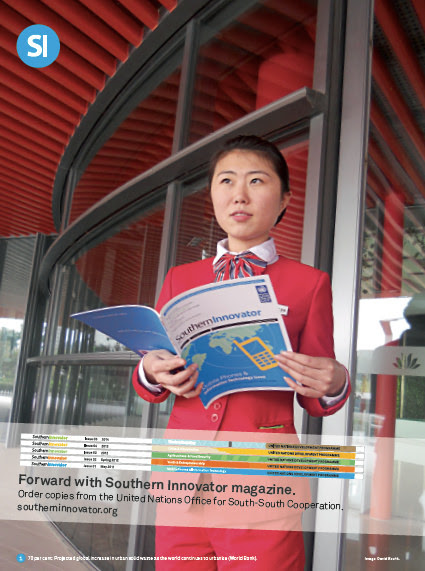
Development Challenges, South-South Solutions was launched as an e-newsletter in 2006 by UNDP’s South-South Cooperation Unit (now the United Nations Office for South-South Cooperation) based in New York, USA. It led on profiling the rise of the global South as an economic powerhouse and was one of the first regular publications to champion the global South’s innovators, entrepreneurs, and pioneers. It tracked the key trends that are now so profoundly reshaping how development is seen and done. This includes the rapid take-up of mobile phones and information technology in the global South (as profiled in the first issue of magazine Southern Innovator), the move to becoming a majority urban world, a growing global innovator culture, and the plethora of solutions being developed in the global South to tackle its problems and improve living conditions and boost human development. The success of the e-newsletter led to the launch of the magazine Southern Innovator.
Expertise: Crisis leadership, mission leadership, strategy, communications, web strategy, digital media, crisis recovery, public health, Northeast Asia, UN system.
Location: Ulaanbaatar, Mongolia 1997 to 1999
UN/UNDP Mongolia Communications Coordinator:David South
The question posed itself from the start of the assignment: In the middle of a major crisis, is it possible to recover quickly while simultaneously growing and modernizing the United Nations mission (this was the dawn of the digital revolution)? It was only possible by teaching and mentoring colleagues, offering leadership, vision, strategy, and practical actions to get there – all with a budget and mandate for two years.
The mission had to tackle in particular, three, severe crises: the country’s turbulent transition from Communism to free markets and democracy, the social and economic crash this caused, and, later in 1997, the Asian Financial Crisis (Pomfret 2000)* – all combined with the political instability this exacerbated. Richard Pomfret said in 1994, “In 1991 Mongolia suffered one of the biggest peacetime economic collapses ever (Mongolia’s Economic Reforms: Background, Content and Prospects, Richard Pomfret, University of Adelaide, 1994).” From Curbing Corruption in Asia: A Comparative Study of Six Countries by Jon S. T. Quah: “The combined effect of these three shocks was devastating as ‘Mongolia suffered the most serious peacetime economic collapse any nation has faced during this century’. Indeed, Mongolia’s economic collapse ‘was possibly the greatest of all the (peaceful) formerly’” Communist countries.
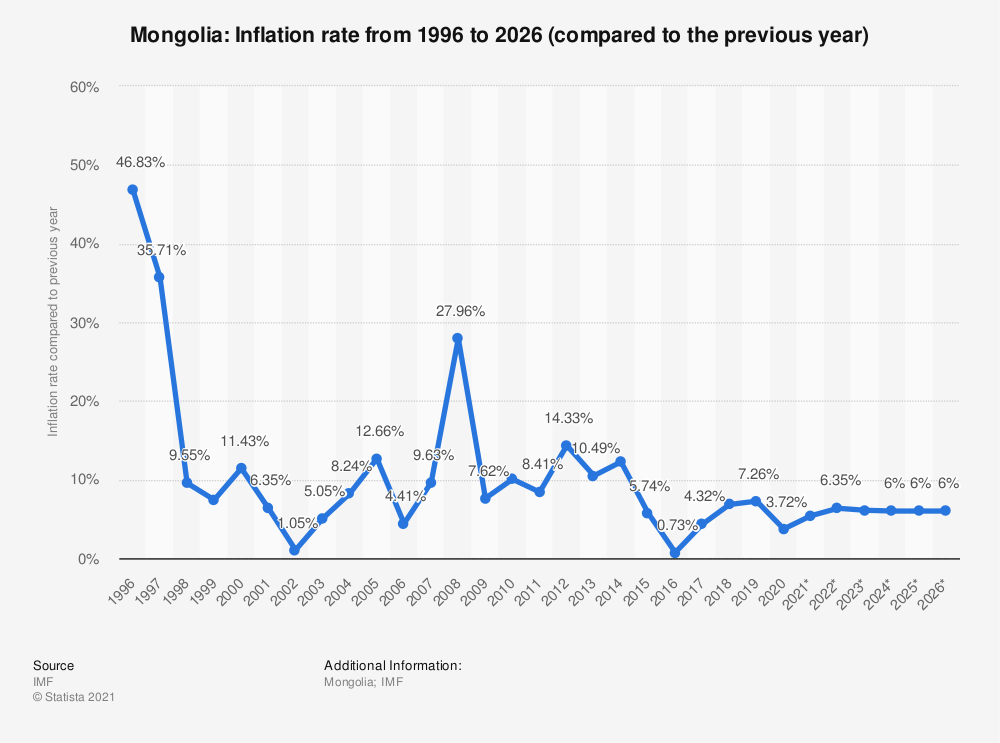
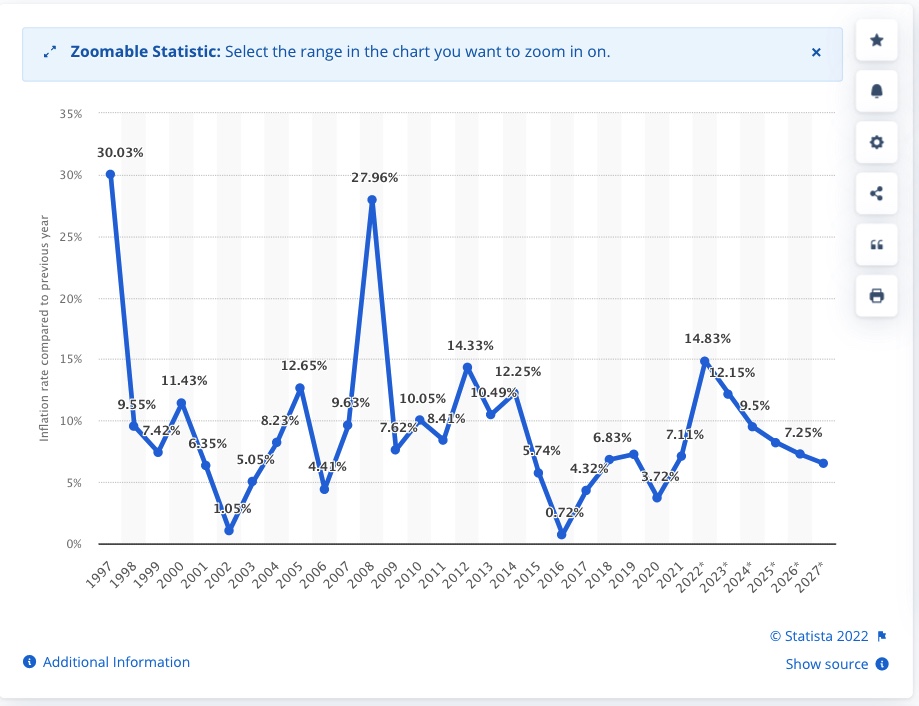
A dramatic decline in inflation paired with political and economic stabilisation allowed Mongolia to enjoy the fruits of the fast-growing economies of the 2000s. Source: Statista.
During the last 16 years the financial and monetary system of our country saw the worst crisis in 1991-1994, there was a recovery in 1995-1997 and another crisis in 1997-1999. However, it has entered a stable stage since 2000.
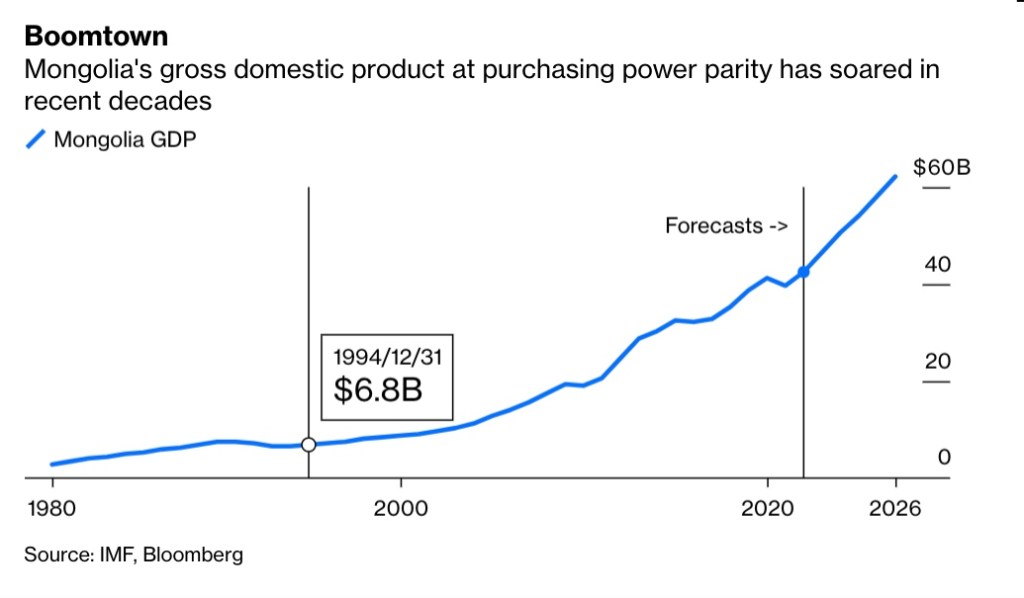
A resources “boomtown” throughout the 2000s. Source: Bloomberg. When I left in 1999, Mongolia’s PPP was US $8.8 bn; today (2021) it is US $42.4 bn. Graph from Migration under economic transition and changing climate in Mongolia, Journal of Arid Environments, Volume 185, February 2021. “Urbanization in Mongolia accounted for over 80% of all migration, mostly into the capital city Ulaanbaatar (UB), where nearly 70% of recent population growth was from migration.” As can be seen in this chart, Mongolia’s economic growth since 2000 has benefited greatly from its proximity to China.
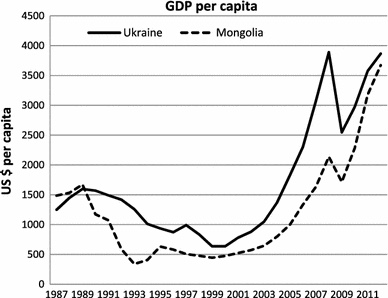
As this chart shows, increasing connectivity had a profound impact on living standards in Ukraine and Mongolia post-2000. The extreme turbulence Mongolia experienced in the 1990s – after the collapse of support mechanisms from the Soviet Union – calmed down as Mongolia integrated with the global economy, especially a booming China. Read about my work in Ukraine here: UN Ukraine Web Development Experience | 2000.
The Economist: “Those free-trading Mongolians” was published Apr 24th 1997. I arrived in May of 1997 to find a country on the cusp of great and turbulent change.
In this role, I pioneered innovative uses of the Internet and digital resources to communicate the UN’s work and Mongolia’s unfolding crises. The UN called this work a “role model” for the wider UN and country offices. A survey of United Nations country office websites in 2000 ranked the UN Mongolia website I launched in 1997 and oversaw for two years (1997-1999), third best in the world, saying: “A UN System site. A very nice, complete, professional site. Lots of information, easily accessible and well laid out. The information is comprehensive and up-to-date. This is a model of what a UNDP CO web site should be.” (http://www.scribd.com/doc/274319690/UNDP-Mongolia-United-Nations-2000-Survey-of-Country-Office-Websites)
“The years 1998 and 1999 have been volatile ones for Mongolia, with revolving door governments, the assassination of a minister, emerging corruption, a banking scandal, in-fighting within the ruling Democratic Coalition, frequent paralysis within the Parliament, and disputes over the Constitution. Economically, the period was unstable and rife with controversies.” Mongolia in 1998 and 1999: Past, Present, and Future at the New Millennium by Sheldon R. Severinghaus, Asian Survey, Vol. 40, No. 1, A Survey of Asia in 1999 (Jan. – Feb., 2000). pp. 130-139 (Publisher: University of California)
As part of a strategic plan to raise awareness of Mongolia’s development challenges and to spur action on meeting them, a Communications Office was established for the UN mission in 1997 – a structure that is commonplace in UN missions today. The Office also led on digital communications, marking many firsts, from the first digital photo and video library, the first online magazine, the first web portal, the first online newsletter, and many other firsts. It gathered numerous stories on resilience in a crisis, and documented in data and storytelling the country’s development challenges, while introducing a transparent way of working and communicating unprecedented for the time (the country was still recovering from the state secrecy of its years under Communism), and led on modernizing communications in the country. Acting as a strategic hub, the Communications Office and its dynamic and talented team, were able to leverage the existing budget to spur action on many fronts, including:
I launched it in 1997 in the middle of a major crisis, and oversaw its expansion and development for two years. A pioneering digital resource, this award-winning United Nations Mongolia development web portal was singled out by UN headquarters in New York as an example of what a country office website should be like. It featured extensive resources in both Mongolian and English and also was home to the bilingual online magazine, Ger – Mongolia’s first web magazine. It can be viewed at www.archive.org and there is more at Wikipedia here: https://en.wikipedia.org/wiki/Ger_(magazine).
Media
Working with journalists and media both within Mongolia and outside, the Communications Office was able to significantly raise awareness of Mongolia and its development challenges. This was reflected in a substantial increase in media coverage of the country and in the numerous books and other publications that emerged post-1997. The book In Their Own Words: Selected Writings by Journalists on Mongolia, 1997-1999 (ISBN 99929-5-043-9) published by UNDP Mongolia archived the stories by theme.
Ger Magazine
Ger Magazine (the Mongolian word for home and traditional tent dwelling) was published as the country’s first e-magazine in 1998. There were four issues in total from 1998 to 2000. The launch issue was on the theme of youth in the transition. Mongolia was transitioning from Communism to free markets and democracy and this had been both an exhilarating time and a wrenching time for young people. The magazine drew on talented journalists from Mongolia and the handful of international journalists based there to create a mix of content, from stories about life adapting to free markets to stories on various aspects of Mongolian culture and life.
The second issue of the magazine proved particularly effective and inspiring, with its modern life theme and cover story on a thriving Mongolian fashion scene.
Archived issues of the magazine can be found at the Wayback Machine here: https://archive.org/. Just type in the UN Mongolia website address for the years 1997 to 1999: http://www.un-mongolia.mn.
An online survey of the state of Mongolia’s media and its history (www.pressreference.com/Ma-No/Mongolia.html), had this to say: “An interesting variation from some of the other publications available is Ger Magazine (published online with guidance from the United Nations Development Program, UNDP), which is concerned with Mongolian youth in cultural transition. The name of the magazine is meant to be ironic because a ger is the Mongolian word for yurt—a yurt being traditional nomadic housing—but the magazine is about urbanization and globalization of Mongolian youth.”
Blue Sky Bulletin
The Blue Sky Bulletin newsletter was launched in 1997 initially as a simple, photocopied handout. It quickly founds its purpose and its audience, becoming a key way to communicate what was happening in the country and a crucial resource for the global development community, scholars, the media and anyone trying to figure out what was happening in a crazy and chaotic time. It eschewed the typical ‘grip and grin’ content found in many development newsletters and instead offered stories, data and insights useful to anyone seeking to understand Mongolia’s development challenges. The Blue Sky Bulletin was distributed via email and by post and proved to be a popular and oft-cited resource on the country. The quality of its production also paralleled Mongolia’s growing capacity to publish to international standards, as desktop publishing software became available and printers switched to modern print technologies. The Blue Sky Bulletin evolved from a rough, newsprint black and white publication to becoming a glossy, full-colour, bilingual newsletter distributed around Mongolia and the world.
The Mongolian Human Development Report 1997 (MHDR), the country’s first, placed the story of the Mongolian people during the transition years (post-1989) at its heart, using photographs, stories and case studies to detail the bigger narrative at play.
This groundbreaking Mongolian Human Development Report – the country’s first – went beyond just chronicling Mongolia’s state of development in statistics and graphs. Designed, laid out and published in Mongolia, the report broke with the practices of many other international organisations, who would publish outside of Mongolia – denying local companies much-needed work and the opportunity to develop their skills. The report’s costs helped to kick-start a publishing boom in the country and significantly raised standards in design and layout in the Mongolia. The foundations laid down by the project producing the report ushered in a new age in publishing for Mongolia.
The report’s launch was innovative, not only being distributed for free across the country, but also part of a multimedia campaign including television programming, public posters, town hall meetings and a ‘roadshow’ featuring the report’s researchers and writers.
The initial print run of 10,000 copies was doubled as demand for the report increased. To the surprise of many, once hearing about the free report, herders would travel to the capital, Ulaanbaatar, to pick up their copy. The report proved people cared passionately about the development of their country and that development concepts are not to be the secret domain of ‘development practitioners’. The report also became an English language learning tool as readers compared the Mongolian and English-language versions.
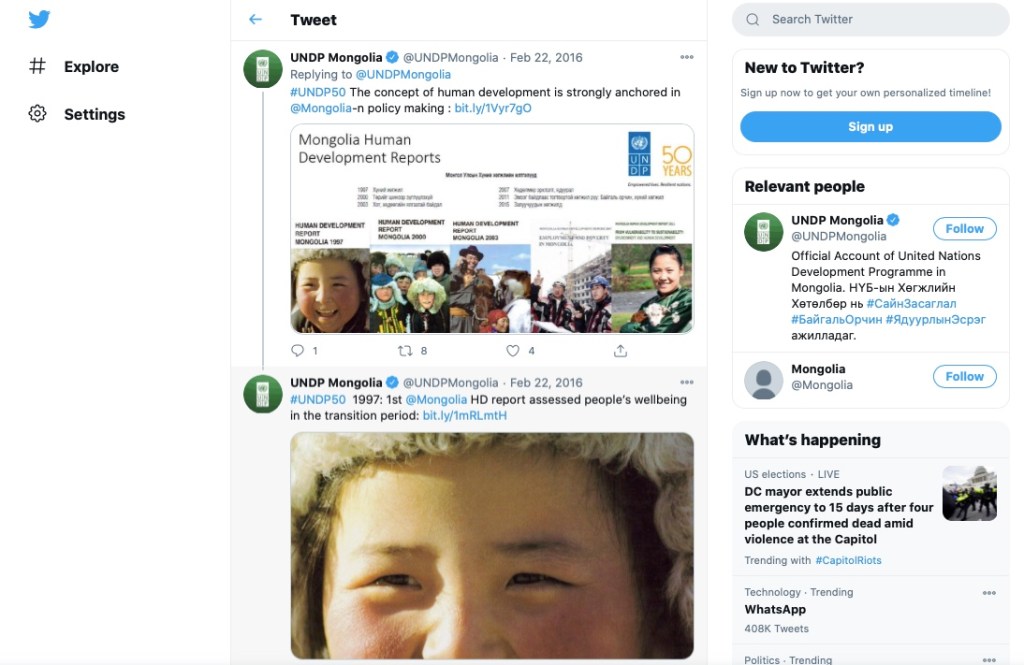
1997 saw the launch of the first human development report for Mongolia.
Mongolian AIDS Bulletin
UNDP acted swiftly to address a breaking HIV/AIDS crisis in 1997, offering a key lesson for others working in public health (the Ebola Crisis and global air pollution crisis both show those lessons have still yet to be fully absorbed).
Assembled by a team of health experts after the Fourth International Congress on AIDS in Asia and the Pacific, the Mongolian AIDS Bulletin was published in 1997 in the middle of an HIV/AIDS crisis. It provided timely information and health resources in the Mongolian language and was distributed across the country.
“Mongolia’s first AIDS Bulletin marked the beginning of the UNDP Response to HIV/AIDS/STDs Project back in the autumn of 1997. Over 5,000 copies of the magazine were distributed across the country, offering accurate information on the HIV/AIDS situation. The project has been pivotal in the formulation of a national information, education and communication (IEC) strategy, bringing together NGOs, donors, UN agencies and the government.”
Source: YouandAids: The HIV/AIDS Portal for Asia Pacific
Green Book
In the Mongolian language, the Mongolian Green Book details effective ways to live in harmony with the environment while achieving development goals. Based on three years’ work in Mongolia – a Northeast Asian nation coping with desertification, mining, and climate change – the book presents tested strategies.
EPAP Handbook
The Environmental Public Awareness Handbook was published in 1999 and features the case studies and lessons learned by UNDP’s Mongolian Environmental Public Awareness Programme (EPAP). The handbook draws on the close to 100 small environmental projects the Programme oversaw during a two-year period. These projects stretched across Mongolia, and operated in a time of great upheaval and social, economic and environmental distress. The handbook is intended for training purposes and the practice of public participation in environmental protection.
In its 2007 Needs Assessment, the Government of Mongolia found the EPAP projects “had a wide impact on limiting many environmental problems. Successful projects such as the Dutch/UNDP funded Environmental Awareness Project (EPAP), which was actually a multitude of small pilot projects (most costing less than $5,000 each) which taught local populations easily and efficiently different ways of living and working that are low-impact on the environment.”
Mongolia Updates 1997, 1998, 1999
Mongolia Update 1998 detailed how the country was coping with its hyperinflation and the Asian economic crisis.
1998 proved a tumultuous year for Mongolia. The country’s existing economic crisis caused by the transition from Communism to free markets was made worse by the wider Asian Crisis. The government was destabilised, leading to an often-confusing revolving door of political figures. In order to help readers better understand the political changes in the country, a special edition of Mongolia Update was published that year.
UNDP Mongolia: The Guide
The Guide, first published in 1997, provided a rolling update on UNDP’s programmes and projects in Mongolia during a turbulent time (1997-1999). The mission simultaneously had to deal with the 1997 Asian Crisis (http://en.wikipedia.org/wiki/1997_Asian_financial_crisis) and the worst peacetime economic collapse in post-WWII history.
Each edition came with short project and context summaries, key staff contacts, and facts and figures on how the country was changing. For the first time, any member of the public could grasp what the UN was up to in the country and be able to contact the project staff. An unusual level of transparency at the time for a UN mission.
Memoranda of Understanding
Three Memoranda of Understanding were negotiated with the Mongolian Government to help focus efforts and aid the attainment of internationally-agreed resolutions. This was affirmed by a series of youth conferences, One World, held in 1998 and 1999.
Strategy and Leadership in a Crisis
The scale and gravity of the crisis that struck Mongolia in the early 1990s was only slowly shaken off by the late 1990s. The economic and social crisis brought on by the collapse of Communism and the ending of subsidies and supports from the Soviet Union, led to a sharp rise in job losses, poverty, hunger, and family and community breakdowns.
The challenge was to find inspiring ways out of the crisis, while building confidence and hope. The sort of challenges confronted by the UNDP Mongolia Communications Office included:
1) A food crisis: agricultural production was down sharply, and the traditional nomadic herding economy, while at peak herd, was failing to get the meat to markets and to a high enough standard to restore export levels to where they once were. As a result, a cross-border trading frenzy became the solution to falling domestic food production and availability.
2) HIV/AIDS/STDs crisis.
3) A major banking crisis.
4) Both the Asian Financial Crisis and the Russia Crisis.
5) An ongoing political crisis and an inability to form stable governments.
UN Annual Reports
Editor and designer. 1998 Report called by Under-Secretary-General Nafis Sadik “a clear, well-written, attractive and colourful report.”
One of many documents from that time held in the United Nations Archives Search Engine. In this case, reporting on Mongolia’s follow-up to global conferences to then-Secretary-General Kofi A. Annan in 1999.
Mongolia’s Follow-Up To The UN Global Conferences (1999) UNDP Mongolia Communications Office, Ulaanbaatar, Mongolia.
Production/Design Supervision: David South, UNDP Communications Coordinator; Proof Reading: N. Oyuntungalag, UNDP Communications Officer/David South (1999).
1998: International media tours of the country, launching of Mongolia’s first online magazine, Ger, distribute globally a regular newsletter on Mongolia’s development challenges, Blue Sky Bulletin. Open United Nations Info Shop for the public. Assist the Government of Canada to connect with Canadians working with the United Nations in Mongolia during the first official visit by a Canadian Government Minister.
1999: Launch a string of books documenting insights gleaned from the Mongolia development experience.
Testimonials
“Mongolia is not an easy country to live in and David [South] showed a keen ability to adapt in difficult circumstances. He was sensitive to the local habits and cultures and was highly respected by his Mongolian colleagues. … David’s journalism background served him well in his position as Director of the Communications Unit. … A major accomplishment … was the establishment of the UNDP web site. He had the artistic flare, solid writing talent and organizational skills that made this a success. … we greatly appreciated the talents and contributions of David South to the work of UNDP in Mongolia.” Douglas Gardner, UN Resident Coordinator and UNDP Resident Representative Mongolia
Impact
Micro
strategic communications approach including establishing the UN/UNDP Mongolia Communications Office and team and strategic communications plan
led on digital transformation, including use of digitial media (photo/video archive) and digital publishing (web site, online magazine and newsletter, etc.)
established and ran the United Nations Info Shop – a one-stop resource open to the public with archive of development publications and current periodicals and Internet access
began largest bilingual online and offline publishing programme in country – led on publishing and design modernisation
laid down the foundations for many UN initiatives in Mongolia that are still underway. Contributed to stabilizing the country in a turbulent time. Mongolia was briefly the fastest-growing economy in the world by 2011
championed transparency and access to information and media freedoms
oversaw a period in which Transparency International found lower levels of perceived corruption
managing editor for country’s first Human Development Report
Macro
raised profile of country and its development challenges. Donor pledges rose
2 international media tours
strong relationship with Mongolian and international journalists
championed innovators in commnications
crisis response: AIDS, economy, political
country’s largest website and one of its first. Called “Godfather of the Mongolian web”
called a “role model” for the wider UN
led on new approach to UN communications in the digital age
design-led approach
transparent and timely updates
negotiated three Memoranda of Understanding (MOUs): youth, food security and nutrition, STDs/HIV/AIDS
The response by the UNDP Mongolia Communications Office has been cited in numerous articles, books, publications and stories. It has also contributed to the development of the human development concept and understanding of human resilience in a crisis and innovation in a crisis.
This resource was praised for having: “Very useful references and original materials that documented UNDP Mongolia work. I needed to trace community-based development, and this book provided a valuable source.” Review on Google Books
In 2001, the UN won the Nobel Peace Prize for “their work for a better organized and more peaceful world” and its communications innovations, with work such as that in Mongolia being cited as a contributing factor to the awarding of the Prize.
The Nobel Peace Prize 2001 joint winners.
In 2000, the Millennium Development Goals (MDGs) were launched in a 15-year bid to use a focused approach to development centred around eight goals to accelerate improvements to human development. From 2000 to 2005, consulting work was undertaken in various UN missions (Mongolia, South Africa, Turkmenistan, Ukraine) to communicate the goals and to reshape communications activities around the goals.


















 David South Consulting
You must be logged in to post a comment.