Categories
Archive Development Challenges, South-South Solutions Newsletters

Mobile Applications Market: Opportunities for South

By David SouthDevelopment Challenges, South-South Solutions

SOUTH-SOUTH CASE STUDY

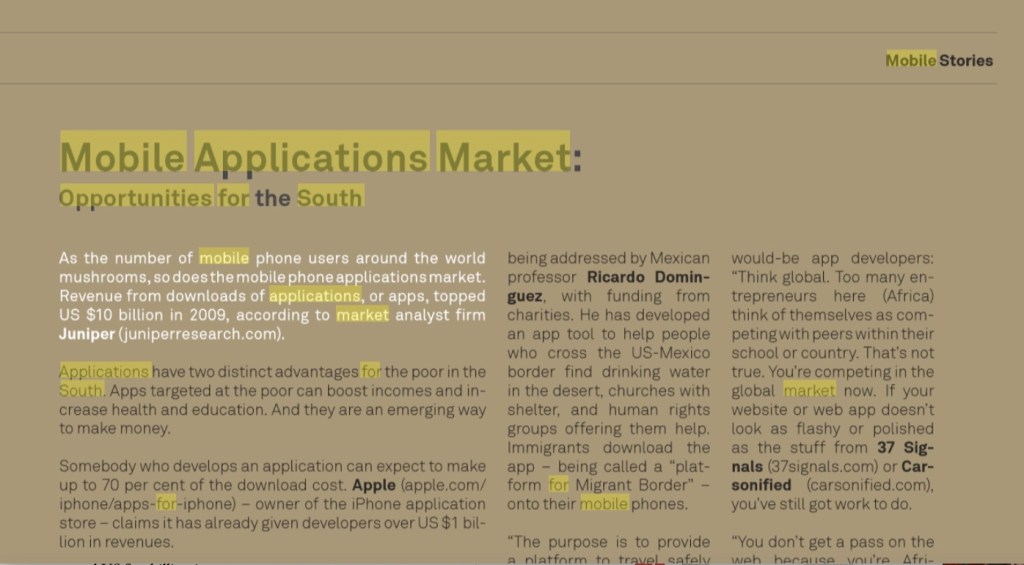
As the number of mobile phone users around the world mushrooms, so does the mobile phone applications market. Revenue from downloads of applications, or apps, topped US $10 billion in 2009, according to market analyst firm Juniper (http://juniperresearch.com).

Applications have two distinct advantages for the poor in the South. Apps targeted at the poor can boost incomes and increase health and education. And they are an emerging way to make money.

Somebody who develops an application can expect to make up to 70 percent of the download cost. Apple (http://www.apple.com/iphone/apps-for-iphone) – owner of the iPhone application store – claims it has already given developers over US $1 billion in revenues.

It is a growing industry. The market-leading Apple App Store now boasts more than 225,000 applications for download and sale. It says they have been downloaded an impressive 5 billion times.

Android Market (http://www.android.com/market/#app=com.com2us.HG), run by the search engine Google, has more than 60,000 apps on offer. GetJar (www.getjar.com), an independent mobile phone application store from Sweden, says it has 72,000 apps available and has had 1 billion downloads.

Now that the apps economy has been running for a couple years, it is possible to divine what increases a developer’s success. Some believe the apps marketplace mimics the dynamics of the music business, rather than the traditional software business.

GetJar chief executive Ilja Laurs told the Economist that it takes as long to write an app as a song. Apps on average cost about the same as a music download: US $1.90. And just like the pop music charts, a few become big hits but most never make it. Apps are also a quick hit: even after becoming successful they can quickly fade back to obscurity again. In short, they are fad and trend driven and are very much about the moment and a current need.

That means they are wide open to newcomers from the South.

With mobile phones now the main channel for information in East Africa, for example, and mobile penetration exceeding 40 percent of the population there, vast markets have opened for apps. East Africa has more than 120 million citizens, with a large majority living in rural areas: many needing poverty-fighting apps to change their lives.

Various new applications show the creative thinking already coming out of the South. South Africa’s Afridoctor (www.afridoctor.com) is Africa’s first personal mobile health clinic. Users submit photos of ailments and receive advice from a panel of professionals, or use the mapping feature to find doctors, clinics and all health industry related services nearby. The emergency feature notifies next of kin of your distress and location. Features include symptom checkers, first-aid information, health calculators and quizzes. Afridoctor hopes to make health care affordable and accessible to Africans. It is made by 24.com (http://store.ovi.com/publisher/24.com), South Africa’s largest digital brands group.

In Mexico, the tragedy of migrants dying as they try to cross the border to the United States is being addressed by Mexican professor Ricardo Dominguez, with funding from charities. He has developed an app tool to help people who cross the US-Mexico border find drinking water in the desert, churches with shelter, and human right groups offering them help. Immigrants download the app – being called a “platform for Migrant Border” – onto their mobile phones.

“The purpose is to provide a platform to travel safely through the desert,” said Dominguez, who led the design team.

App action has heated up in India, where Spice Mobiles (http://www.spiceglobal.com/SpiceMobiles/SpiceMobiles.aspx) – a wing of the Spice Group – is launching an application store with 250 content providers. India’s Bharti Airtel launched its first home-grown mobile application store in February of this year – Airtel App Central (http://www.airtel.in/apps). It clocked up over 13 million downloads in four months.

India’s Reliance Communications (http://www.rcom.co.in/Rcom/personal/home/index.html) also launched an application called Socially. It has been designed to enable users to follow the recent activity of friends, and also allows the user to update their status on different social networks like Facebook, Twitter and LinkedIn through a single client.

Jon Gosier, from Appfrica Labs (http://appfrica.net/blog) – behind the highly successful crisis crowdsourcing Ushahidi application (http://www.ushahidi.com) – explained the thinking behind apps in Africa:

“Our goal is to show the world that Africa is capable of solving some of its own problems,” he told CP-Africa.com. “Too often Africans aren’t even considered as a resource when discussing how to improve their own quality of life.”

He has the following advice for would-be app developers: “Think global. Too many entrepreneurs here (Africa) think of themselves as competing with peers within their school or country. That’s not true. You’re competing in the global market now. If your website or web app doesn’t look as flashy or polished as the stuff from 37 Signals (www.37signals.com) or Carsonified (www.carsonified.com), you’ve still got work to do.

“You don’t get a pass on the web because you’re African. You get the challenge of working harder.”

NEW: Apps4Africa Competition: Apps 4 Africa is a regional competition with the goal of promoting local technology entrepreneurs as they build tools to serve the needs of NGOs and the local community. This unprecedented partnership meshes civil society with developers and designers to create technical solutions to local challenges. The competition will ask civil society and citizens throughout the region to submit local community challenges on issues like transparency and better governance, health, education and more where technology can be a part of the solution. The burgeoning ranks of innovative techies in the region will then use this list of community challenges as the basis of their work, thus creating “an app for that.” Website:www.apps4africa.org

Published: August 2010

Deadline: August 31, 2010

Resources

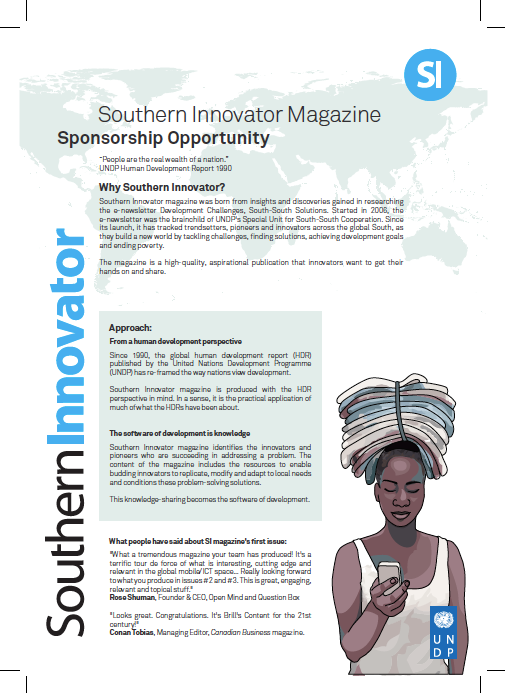
Development Challenges, South-South Solutions was launched as an e-newsletter in 2006 by UNDP’s South-South Cooperation Unit (now the United Nations Office for South-South Cooperation) based in New York, USA. It led on profiling the rise of the global South as an economic powerhouse and was one of the first regular publications to champion the global South’s innovators, entrepreneurs, and pioneers. It tracked the key trends that are now so profoundly reshaping how development is seen and done. This includes the rapid take-up of mobile phones and information technology in the global South (as profiled in the first issue of magazine Southern Innovator), the move to becoming a majority urban world, a growing global innovator culture, and the plethora of solutions being developed in the global South to tackle its problems and improve living conditions and boost human development. The success of the e-newsletter led to the launch of the magazine Southern Innovator.  

Creative Commons License

This work is licensed under a
Creative Commons Attribution-Noncommercial-No Derivative Works 3.0 License.

ORCID iD: https://orcid.org/0000-0001-5311-1052.

© David South Consulting 2022

Categories
Archive Development Challenges, South-South Solutions Newsletters

Cheap Indian Tablet Seeks to Bridge Digital Divide

By David SouthDevelopment Challenges, South-South Solutions

SOUTH-SOUTH CASE STUDY

India has had many false starts in innovating in information technology. While the country and its talented army of software engineers have a global reputation for innovation, the fits and starts that have accompanied attempts to create new hardware and devices have drawn a range of emotions, from amusement to frustration.

India faces an urgent problem: the country is falling behind others in the global South in access to the Internet. Based on 2009 data, there are 5.1 Internet users for every 100 Indians. This compares poorly with Brazil at 39.2 per 100 and China at 28.5.

The challenge is to find inexpensive devices that allow people to access the Internet through mobile phone networks. With 37 percent of India’s 1.21 billion people living below the official poverty line – and some estimates placing the number at up to 77 percent – cheap devices are urgently needed to reach the poor. A study developed by the Oxford Poverty and Human Development Initiative (OPHI),  found eight Indian states account for more poor people than the 26 poorest African countries combined. The Indian states had 421 million “poor” people, compared to 410 million poor in the poorest African countries, it concluded.

The World Bank recently criticised India for lacklustre results in addressing poverty levels.

Five years ago, the Indian government launched a competitive search for an inexpensive device for the masses. The government has been supporting the development of these devices through its National Mission on Education through Information and Communication Technology (Sakshat) (http://www.sakshat.ac.in). It aims to link 25,000 colleges and 400 universities in India in an e-learning program.

The motivation behind these attempts is a good one: to try and find an affordable device to bridge the digital divide (http://en.wikipedia.org/wiki/Digital_divide) and reach the majority of the population living on less than US $2 a day.

But the search has had mixed results.

Low points included a failed attempt to make a rival to the One Laptop Per Child (http://www.onelaptop.org) computer from MIT (Massachusetts Institute for Technology) with an Indian version selling for US $10. What was offered instead in 2009 was a device with no screen or keyboard, requiring an additional laptop and paper to access its stored files. It was also made in Taiwan, rather than India.

Another first stab at making a US $35 tablet computer was launched in 2010 with much fanfare, but by January 2011 the Indian government had dropped manufacturers HCL Technologies for failing to honour its 600 million rupee (US $13 million) contract.

What these first steps show is the complexity of hardware development and how challenging it is to get the user experience right for customers while keeping the price affordable.

But India recently relaunched what it is calling the world’s cheapest tablet computer, selling for US $35. It is called Aakash (http://www.akashslate.com) (http://www.aakashcomputer.co.in), meaning “sky” in the Sanskrit language, and is being sold as an e-learning tool to bridge the digital divide in the country.

The utility of tablets (http://en.wikipedia.org/wiki/Tablet_personal_computer) and e-readers (http://en.wikipedia.org/wiki/Comparison_of_e-book_readers) for people in the global South is clear: they can enable people to bypass the lack of local library facilities to store vast personal archives of books. This is a powerful educational tool: imagine a village doctor with easy access to thousands of medical texts and papers, or a child preparing for university exams no longer having to worry they can find study texts. It also is a cost-effective way to publish in many local languages and break the stranglehold English-language publishing has had on delivering e-books.

Aakash will be sold for US $35 to educational institutions and marketed for private sale for US $61 under the UbiSlate brand name (http://www.ubisurfer.com). It is also hoped the tablet can be sold in the UK and the USA.

Jointly developed by engineers in India, Canada and the UK, it will be assembled at DataWind’s manufacturing plant in Hyderabad, India (http://datawind.com/products.html). Datawind also makes other low-cost, portable devices like the PocketSurfer3 (http://www.pocketsurfer.co.uk).

The project is run by two Indian-born Canadians, DataWind chief executive officer Suneet Singh Tuli and his brother Raja Singh Tuli.

Based in Montreal, Canada, DataWind bills itself as “a leading developer of wireless web access products and services.”

Suneet Singh Tuli wants to sell 1 million tablets a month. The first 100,000 tablets are being bought by the Indian government and then sold to university students.

The Aakash uses the Google Android operating system (http://www.android.com) and has a WiFi capability, 17.78 centimetre wide screen, two USB ports (http://en.wikipedia.org/wiki/USB) and battery that can last three hours. It can stream high-definition videos, read e-books and run Microsoft Windows Office applications.

The components in the device are a mix, including parts DataWind has designed itself to save costs.

“This is not a one-time opportunity,” Suneet Singh Tuli told the Toronto Star newspaper. “There are 2½ to 3 million students entering university every year, as well as 80 million students in Grades 9 to 12, and the government is very serious about making mobile products available to this age group.

“I could tell you a romantic story about two Indian brothers who arrive in Montreal to get a great Canadian education, become citizens, and then go back to India to bring Internet to the masses,” says Tuli.

“But the reality is, this is all about profit – my investors and board wouldn’t want it any other way.”

To compare, the Amazon Kindle Fire device (http://www.amazon.com/Kindle-Fire-Color/dp/B0051VVOB2), which launched recently, sells for US $199 and has fewer features.

“The rich have access to the digital world; the poor and ordinary have been excluded. Aakash will end that digital divide,” Kapil Sibal, India’s education minister told the Financial Times.

India’s initiatives are heating up competition with the One Laptop Per Child project set up by MIT professor Nicholas Negroponte (http://one.laptop.org). The colourful OLPC laptop sells for around US $200, and 2 million have been distributed to Latin America, Africa elsewhere.

While many companies and entrepreneurs are developing products for the poor and the bottom of the pyramid (BOP) markets, it is still a difficult thing to get right. A big issue is aspiration: consumers are still attracted to products they perceive as aspirational and quality, despite a higher price.

“(Aakash) might suffer the Nano syndrome,” Shashi Bhusan, technology analyst at brokerage Prabhudas Lilladher, told the Financial Times, referring to the cheap made-in-India car that failed to catch on (http://tatanano.inservices.tatamotors.com/tatamotors). “It is always difficult to predict the market’s reaction to a product, but what we have learnt from the Nano is that people don’t want to buy the ‘car-like’ product, they want the real thing … I feel the same will probably happen with this ‘laptop-like’ product.”

And others strongly disagree that gadgets can transcend the deep-seated social problems that need radical change.

“It is charity of a very superficial nature,” said George Mathew, director of Delhi’s Institute of Social Sciences. “It has nothing to do with the structure and permanency of our society and our system – you have to work for systemic change.”

Earlier this year an Indian company produced a rival to Amazon’s Kindle (http://www.amazon.co.uk/Kindle-Store/b?ie=UTF8&node=341677031). The Wink (http://www.thewinkstore.com/ereader/index) is designed to accommodate 15 common Indian languages, comes in an eye-catching design and is complemented by a sleek website stuffed with e-books ready for download. The entire package is very well-thought-out and marketed.

The Wink was developed and built by EC Media International and retails, according to its website, for Rs 8,999 (US $200). It looks similar to the Kindle, but where the Kindle is grey the Wink is white. This Indian rival has some impressive capabilities: it can not only support 15 Indian languages, it can also access an online library of more than 200,000 book titles. They range from arts and entertainment to biography, newspapers and science topics. There is also a large archive of free books for download.

But it has come in for criticism for its price, which some say is far too high for the Indian market.

As has been shown by the information technology experience in other countries, it is constant innovation and trial and error which will eventually create successes. But with persistence, this is one space to keep watching.

Published: October 2011

Resources

1) How to build your own personal computer: This guide helps to demystify computing hardware and shows how to build a computer at home. Website: http://www.buildeasypc.com/

2) Hardware design and architecture: An archive of free e-books on all aspects of computer hardware and architecture design. An outstanding resource to get anyone started in computer engineering. Website: http://www.e-booksdirectory.com/listing.php?category=38

3) Jonathan Ive is the man behind the highly successful and user-friendly modern design that has turned the Apple computer brand into such a global success story. He provides tips on how to design usable computer hardware and shares the secrets of his success. Website: http://www.wired.com/culture/design/news/2003/06/59381

Development Challenges, South-South Solutions was launched as an e-newsletter in 2006 by UNDP’s South-South Cooperation Unit (now the United Nations Office for South-South Cooperation) based in New York, USA. It led on profiling the rise of the global South as an economic powerhouse and was one of the first regular publications to champion the global South’s innovators, entrepreneurs, and pioneers. It tracked the key trends that are now so profoundly reshaping how development is seen and done. This includes the rapid take-up of mobile phones and information technology in the global South (as profiled in the first issue of magazine Southern Innovator), the move to becoming a majority urban world, a growing global innovator culture, and the plethora of solutions being developed in the global South to tackle its problems and improve living conditions and boost human development. The success of the e-newsletter led to the launch of the magazine Southern Innovator.  
Creative Commons License

This work is licensed under a
Creative Commons Attribution-Noncommercial-No Derivative Works 3.0 License

ORCID iD: https://orcid.org/0000-0001-5311-1052.

© David South Consulting 2023

Categories
Archive data Development Challenges, South-South Solutions Newsletters digital ID

India 2.0: Can the Country Make the Move to the Next Level?

By David SouthDevelopment Challenges, South-South Solutions

SOUTH-SOUTH CASE STUDY

With the global economic crisis threatening to cause turmoil in the emerging markets of the global South, it is becoming clear that what worked for the past two decades may not work for the next two.

For India, the legacy issues of poverty still need to be addressed, and the country’s impressive information technology (IT) industry – which has driven so much of India’s growth – will face stiff competition from other countries in the global South. Some argue that if the IT industry hopes to keep growing and contributing to India’s wealth, things will need to change.

Unlike China, where heavy investment in infrastructure and a strong link between government and the private sector has driven the impressive manufacturing boom in the country, in India the government has de-regulated and taken a back seat, leaving the private sector and entrepreneurs to drive the change and do the innovation.

Many believe various areas need urgent attention if India is to continue to enjoy good growth rates in the coming years. Areas in need of attention include infrastructure, healthcare and education (thesmartceo.in), in particular the knowledge to work in the information technology industry of the 21st century.

One of the founders of Indian outsourcing success Infosys (infosys.com), executive co-chairman Senapathy Gopalakrishnan, told Britain’s Telegraph newspaper, “So many people’s lives have been changed by IT in India.

“People from the middle class and lower middle class have become global employees and have the opportunity to work with some of the best companies in the world. But the challenge for India is that this industry can only create so many jobs. IT is not going to solve the unemployment problem in India.”

But the coming next wave of change in information technology is an opportunity to be seized to reduce unemployment if enough people are educated to handle it.

According to Gopalakrishnan: “I strongly believe, and it’s backed up by data, that there is a shortage of computer professionals everywhere in the world, including India. The application of computers is growing dramatically and will continue to grow dramatically over the next 20 to 30 years. We have to train and create the workforce necessary to grow this industry.”

Various media stories have called this next phase India 2.0. If India 1.0 was the highly successful information technology outsourcing industry developed in the late 1980s, through the 1990s and 2000s, then India 2.0 is the next wave of IT innovation being driven by Big Data, automation, robotics, smart technologies and the so-called “Internet of things.”

Big Data is defined as the large amounts of digital data continually generated by the global population. The speed and frequency with which data is produced and collected – by an increasing number of sources – is responsible for today’s data deluge (UN Global Pulse). It is estimated that available digital data will increase by 40 per cent every year. Just think of all those mobile phones people have, constantly gathering data.

Processing this data and finding innovative ways to use it will create many of the new IT jobs of the future.

“We are living in a world which is boundary-less when it comes to information, and where there is nowhere to hide,” continues Gopalakrishnan, “If you have a cellphone, somebody can find out exactly where you are. Through social networks you’re sharing everything about yourself. You are leaving trails every single moment of your life. Theoretically, in the future you’ll only have to walk through the door at Infosys and we’ll know who you are and everything about you.”

Unlike in the late 1980s, when India was the pioneer in IT outsourcing for large multinational companies and governments, competition is fierce across the global South. The mobile-phone revolution and the spread of the Internet have exponentially increased the number of well-educated people in the global South who could potentially work in IT. China, the Philippines, Kenya, Nigeria and Ghana are just some of the countries heavily involved in this area.

If India fails to meet the India 2.0 challenge, it risks seeing its successful companies and entrepreneurs leaving to work their magic elsewhere in Asia and the new frontiers of Africa, just as many of its best and brightest of the recent past became pioneers and innovators in California’s Silicon Valley.

India’s IT sector contributed 1.2 per cent to the country’s gross domestic product (GDP) in 1998; by 2012, this was 7.5 per cent (Telegraph). The IT industry employs 2.5 million people in India, and a further 6.5 million people indirectly. IT makes up 20 per cent of India’s exports and, according to the National Association of Software and Services Companies (nasscom.in), the industry has revenue of US $100 billion.

India is now the IT and outsourcing hub for more than 120 of the Fortune 500 companies in the United States.

Out of India’s 3.5 million graduates every year, 500,000 are in engineering – a large pool of educated potential IT workers. India produces the world’s third largest group of engineers and scientists, and the second largest group of doctors.

IT has become a route that catapults bright Indian youth into 21st-century businesses and science parks and to the corporations of the world.

One visible example of the prosperity brought by IT services in India is the booming technology sector based in the city of Bangalore (also called Bengaluru) (http://en.wikipedia.org/wiki/Bangalore).

Reflective of the contradictions of India, Bangalore has 10 per cent of its workforce now working in IT, but also 20 per cent of its population living in urban slums.

The nearby Electronics City (elcia.in) is considered “India’s own silicon valley and home to some of the best known global companies.”

To date, aspects of India 2.0 are already taking shape.

One company is called Crayon Data (crayondata.com). It uses Big Data and analytics to help companies better understand their customers and increase sales and deliver more personal choices.
Edubridge (http://acumen.org/investment/edubridge/) is helping to bridge the gap for rural youth with varied education backgrounds and long-term jobs. Edubridge trains youth for the real needs of employers to increase the chances they will get a job. This includes jobs in the IT business process outsourcing sector and banking and financial services.

Infosys is working on innovations for the so-called “Internet of things,” in which smart technologies connect everyday items to the grid and allow for intelligent management of resources and energy use. Infosys is developing sophisticated software using something called semantic analytics – which analyses web content (http://en.wikipedia.org/wiki/Semantic_analytics) – to sort through social media and the Internet to track customer responses to products.

Elsewhere, former Infosys Chief Executive Nanden Nilekani is involved in a Big Data innovation to address the problem of social and economic exclusion of India’s poor. Called Aadhaar (http://uidai.gov.in/), the government-run scheme is gathering biometric data on every Indian to build the world’s largest biometric database. After being enrolled and having fingerprints and iris scans taken, each individual is given a 12-digit identification number. So far 340 million people have been registered with the scheme, and it is hoped 600 million will be registered by the end of 2014.

The idea is to use a combination of access to mobile phones and these unique ID numbers to widen access to all sorts of products and services to poor Indians, including bank accounts for the millions who do not have one. Many people, lacking any identity or official acknowledgment they exist, were prevented from engaging with the formal economy and formal institutions. Being able to save money is a crucial first step for getting out of poverty and it is hoped information technology will play an important role in achieving this.

Published: March 2014

Resources

1) India 2.0 by Mick Brown. Website: http://s.telegraph.co.uk/graphics/india2.0/part-one#top

2) Electronic City Bangalore: Regional information portal for Electronic City, an industrial technology hub located in Bangalore South, India. This portal is becoming the most favourite haunt of ECitizens living and/or working in Electronic City. Website: http://www.electronic-city.in/

3) Electronics City Industries Association: Welcome to the Electronics City, India’s own silicon valley and home to some of the best known global companies. Located in Bangalore, the Electronics City was conceived way back in the mid-1970?s as an Industrial Estate exclusively for Electronics Industries. Today the industrial estate boasts is an oasis of large, medium and small industries spanning software services, hardware; high end telecommunications; manufacture of indigenous components; electronic musical instruments, just  to name a few. Website: elcia.in

4) Godrej E-City: Situated in Electronic city and connected through NICE road and the elevated expressway, Godrej E-City brings your workplace and other major conveniences within your immediate reach. Your travel times become shorter and hassle-free. You have more time for your family and yourself. It’s time to move closer to happiness. Website: https://www.godrejproperties.com/godrejecity/overview

5) Infosys: Infosys is a global leader in consulting, technology and outsourcing solutions. As a proven partner focused on building tomorrow’s enterprise, Infosys enables clients in more than 30 countries to outperform the competition and stay ahead of the innovation curve. Website: http://www.infosys.com/pages/index.aspx

6) Tech Hub Bangalore: partnering with the UK India Business Council to establish TechHub in Bangalore.TechHub is a community and workspace for technology entrepreneurs with 1000’s of members, building the most exciting startups in Europe. We have physical community spaces in London, Manchester, Bucharest, Swansea and Riga and have members from over 50 countries.The Bangalore site will be part of a wider scheme in partnership with other British firms such as Rolls Royce, ADS, Bangalore Cambridge Innovation Network, BAe and PA Consulting with the aim of forging stronger links between the UK and India. Website: http://www.techhub.com/blog/techhub-expands-to-bangalore/

https://davidsouthconsulting.org/2022/09/29/cheap-indian-tablet-seeks-to-bridge-digital-divide/

https://davidsouthconsulting.org/2022/02/17/digital-mapping-to-put-slums-on-the-map/

https://davidsouthconsulting.org/2022/10/09/entrepreneurs-use-mobiles-and-it-to-tackle-indian-traffic-gridlock/

https://davidsouthconsulting.org/2022/10/20/the-e-reader-battle-reaches-india/

https://davidsouthconsulting.org/2022/10/25/indian-city-slum-areas-become-newly-desirable-places-to-live/

https://davidsouthconsulting.org/2021/03/04/indian-id-project-is-foundation-for-future-economic-progress/

https://davidsouthconsulting.org/2022/11/01/indian-newspapers-thrive-with-economy/

https://davidsouthconsulting.org/2022/10/18/indians-fighting-inflation-with-technology/

https://davidsouthconsulting.org/2022/10/06/indian-solar-power-pack-powers-villages/

https://davidsouthconsulting.org/2021/03/31/new-weapon-against-crime-in-the-south/

Development Challenges, South-South Solutions was launched as an e-newsletter in 2006 by UNDP’s South-South Cooperation Unit (now the United Nations Office for South-South Cooperation) based in New York, USA. It led on profiling the rise of the global South as an economic powerhouse and was one of the first regular publications to champion the global South’s innovators, entrepreneurs, and pioneers. It tracked the key trends that are now so profoundly reshaping how development is seen and done. This includes the rapid take-up of mobile phones and information technology in the global South (as profiled in the first issue of magazine Southern Innovator), the move to becoming a majority urban world, a growing global innovator culture, and the plethora of solutions being developed in the global South to tackle its problems and improve living conditions and boost human development. The success of the e-newsletter led to the launch of the magazine Southern Innovator.  

https://davidsouthconsulting.org/2021/03/05/southern-innovator-issue-1/

Creative Commons License

This work is licensed under a
Creative Commons Attribution-Noncommercial-No Derivative Works 3.0 License.

ORCID iD: https://orcid.org/0000-0001-5311-1052.

© David South Consulting 2022

Categories
Archive Blogroll Southern Innovator magazine

Finding Southern Innovator Magazine | 2022

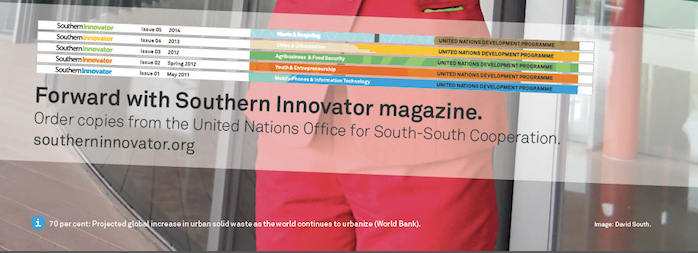
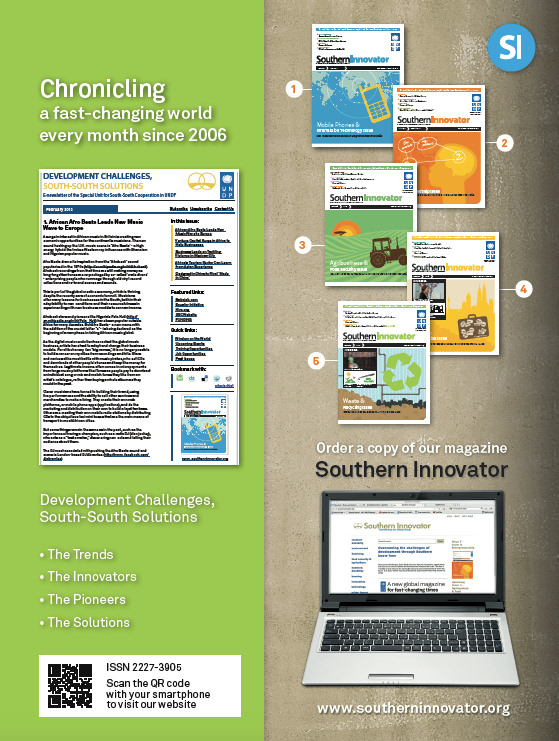
An ad promoting the magazine’s fourth issue is below:

Team | Southern Innovator Phase 1 Development (2010 – 2015)

Southern Innovator can be read online here:

ISSN: 2222-9280

Website of the United Nations Office for South-South Cooperation (UNOSSC): https://unsouthsouth.org/2014/12/25/southern-innovator-magazine/

Scribd

Issue 1: http://www.scribd.com/doc/57980406/Southern-Innovator-Issue-1

Issue 2: http://www.scribd.com/doc/86451057/Southern-Innovator-Magazine-Issue-2

Issue 3: http://www.scribd.com/doc/106055665/Southern-Innovator-Magazine-Issue-3-Agribusiness-and-Food-Security

Issue 4: http://www.scribd.com/doc/128283953/Southern-Innovator-Magazine-Issue-4

Issue 5:  http://www.scribd.com/doc/207579744/Southern-Innovator-Magazine-Issue-5-Waste-and-Recycling

Google Books

Issue 1: https://books.google.co.uk/books?id=Q1O54YSE2BgC&dq=southern+innovator&source=gbs_navlinks_s

Issue 2: https://books.google.co.uk/books?id=Ty0N969dcssC&dq=southern+innovator&source=gbs_navlinks_s

Issue 3: https://books.google.co.uk/books?id=AQNt4YmhZagC&dq=southern+innovator&source=gbs_navlinks_s

Issue 4: https://books.google.co.uk/books?id=9T_n2tA7l4EC&dq=southern+innovator&source=gbs_navlinks_s

Issue 5: https://books.google.co.uk/books?id=6ILdAgAAQBAJ&dq=southern+innovator&source=gbs_navlinks_s

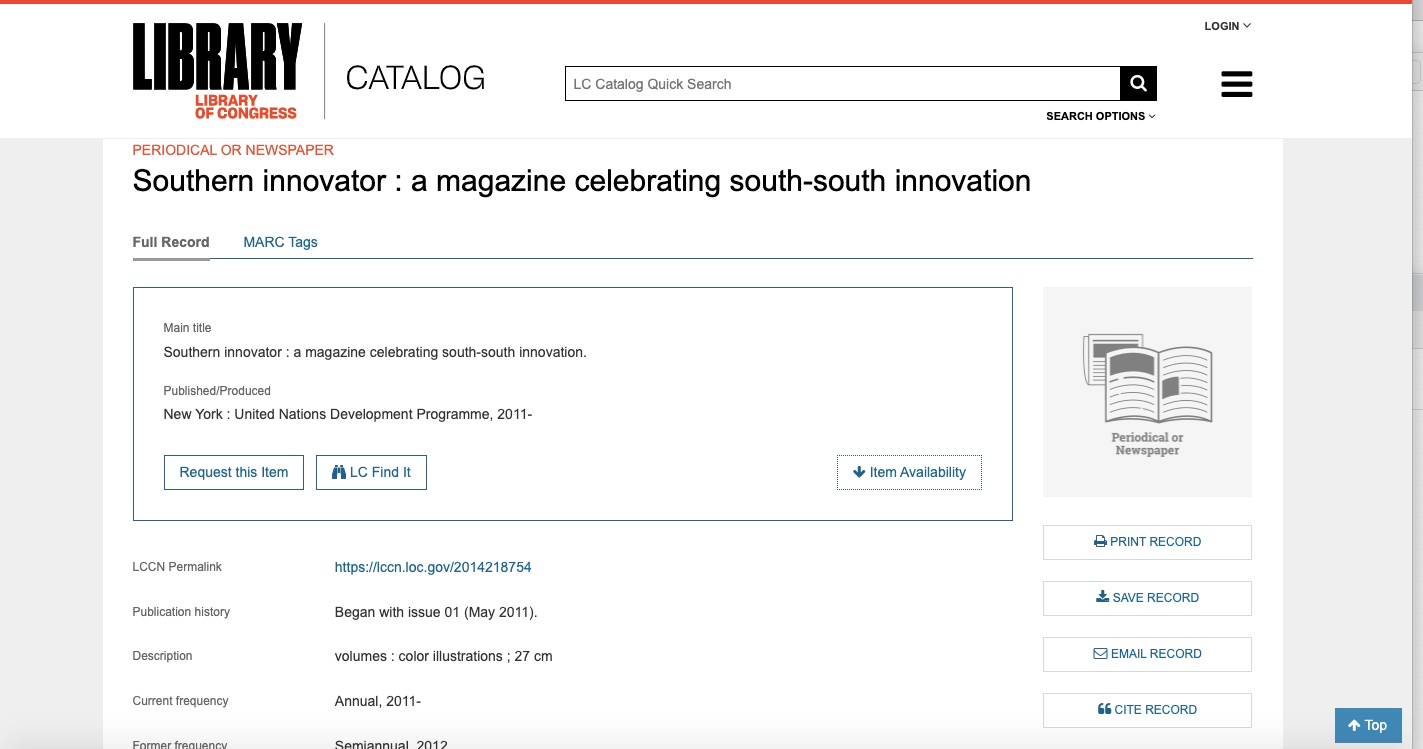
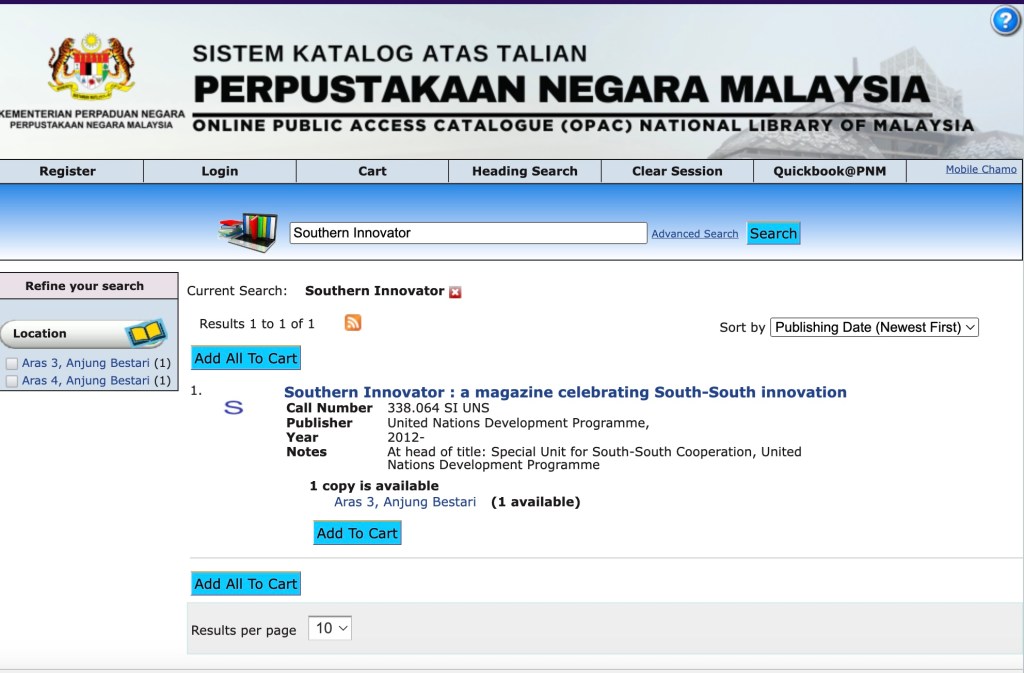
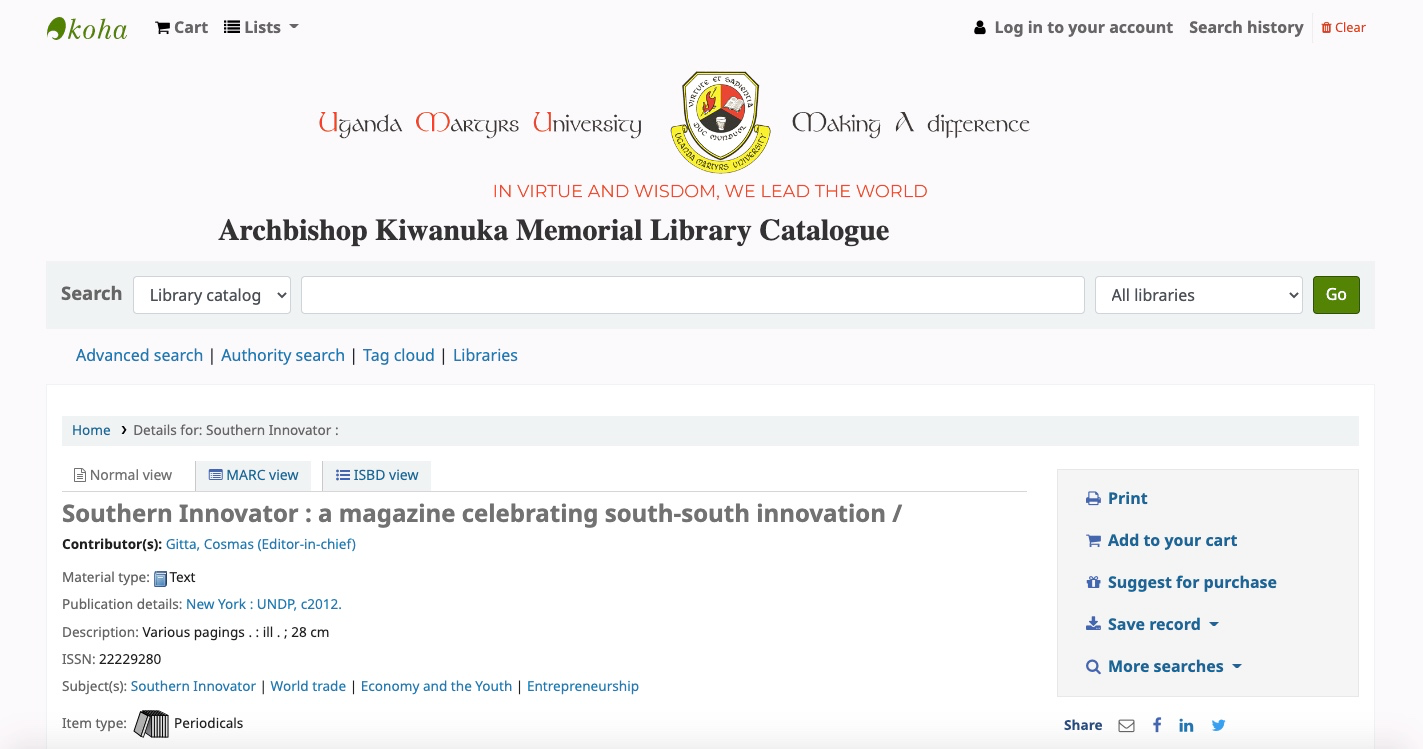
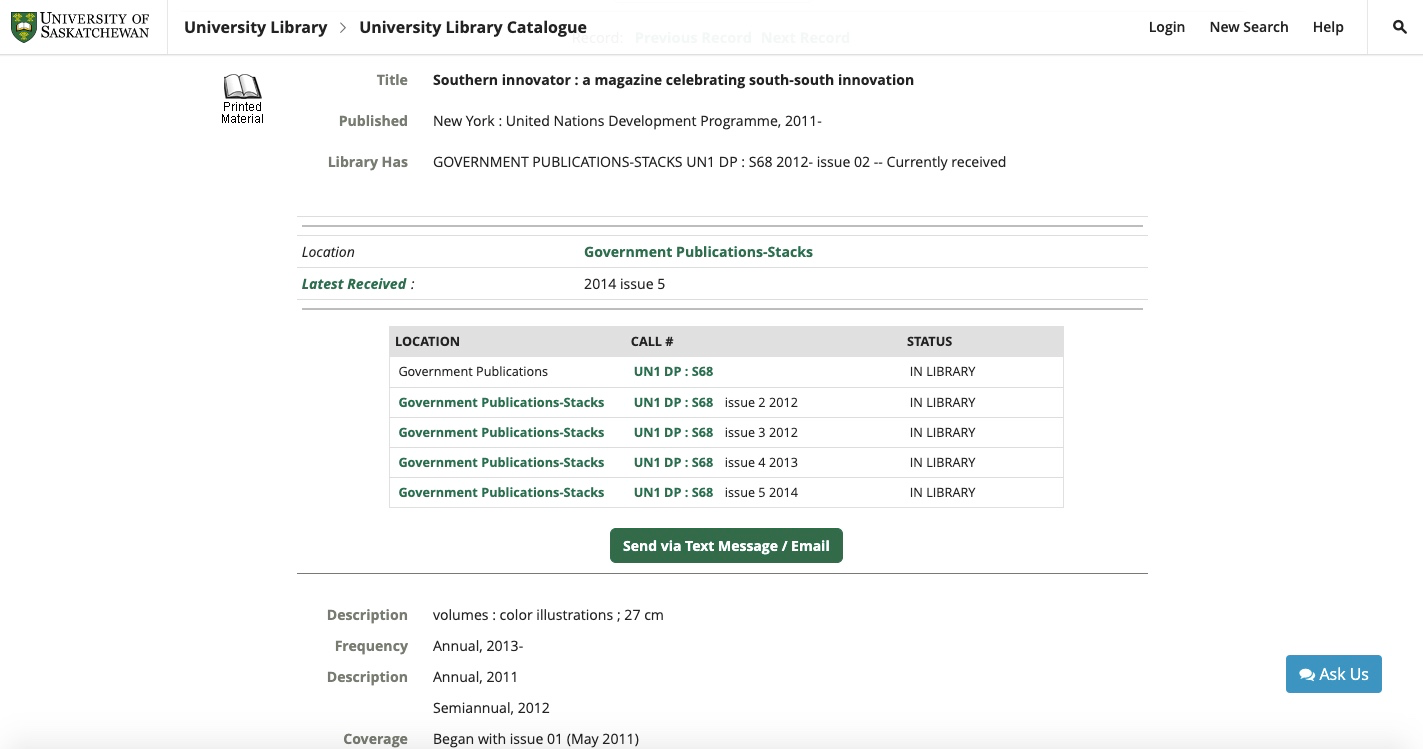
Southern Innovator is held in the library collections below:

Biblioteca de la Asamblea Legislativa de El Salvador: https://biblioteca.asamblea.gob.sv/101180_southerninnovator-a-magazine-celebrating-south-south-innovation-may-2011?q=

Biblioteca Nationala a Republicii Moldova: http://cc.sibimol.bnrm.md/opac/bibliographic_view/399949;jsessionid=C516885A73E277718AE64598E869BC70

British Library: https://bll01.primo.exlibrisgroup.com/discovery/fulldisplay?docid=alma990158672410100000&context=L&vid=44BL_INST:BLL01&lang=en&search_scope=BL_Available&adaptor=Local%20Search%20Engine&tab=BL_Available&query=any,contains,Southern%20Innovator&offset=0

Central Michigan University Libraries: https://cmich.primo.exlibrisgroup.com/discovery/fulldisplay?docid=alma991015822649303781&context=L&vid=01CMICH_INST:01CMICH&lang=en&search_scope=UNIVERSITY_CI&adaptor=Local%20Search%20Engine&tab=Everything&query=any,contains,Southern%20Innovator&offset=0

Centre multimédia sur l’environnement et le développement Dakar, Senegal: http://enda-cremed.org/bpd/opac_css/index.php?lvl=serie_see&id=674

Library of Congress: http://catalog.loc.gov/vwebv/holdingsInfo?searchId=15784&recCount=25&recPointer=0&bibId=17462965

Louisiana State University, LSU Libraries: https://lsu.ent.sirsi.net/client/en_US/lsu/search/detailnonmodal/ent:$002f$002fSD_LSU$002f0$002fSD_LSU:7935129/ada?qu=southern+innovator&d=ent%3A%2F%2FSD_LSU%2F0%2FSD_LSU%3A7935129%7ESD_LSU%7E0&te=SD_LSU

Malaysian Academic Library Union: https://malcat.uum.edu.my/kip/Record/ukm.b15483824

National Library of Malaysia: https://opac.pnm.gov.my/search/query?term_1=Southern+Innovator&theme=PNM2

Toronto Public Library: http://vc4kb8yf3q.search.serialssolutions.com/?V=1.0&N=100&L=VC4KB8YF3Q&S=AC_T_B&C=southern+innovator

Uganda Martyrs University: https://catalogue.umu.ac.ug/cgi-bin/koha/opac-detail.pl?biblionumber=33335

United Nations Library Geneva: Issues 2, 4, 5: Click ‘Get It’: 

Issue 1: https://tinyurl.com/3s22f236

University of Birmingham: https://birmingham-primo.hosted.exlibrisgroup.com/primo-explore/fulldisplay?docid=44BIR_ALMA_DS51193861790004871&context=L&vid=44BIR_VU1&lang=en_US&search_scope=CSCOP_44BIR_DEEP&adaptor=Local%20Search%20Engine&tab=local&query=any,contains,Southern%20Innovator&offset=0

The University of British Columbia: https://webcat.library.ubc.ca/vwebv/holdingsInfo?searchId=168763&recCount=100&recPointer=1&bibId=6682400

Universitat de Valencia: http://xv9lx6cm3j.search.serialssolutions.com/?V=1.0&L=XV9LX6CM3J&S=JCs&C=JC_018470248&T=marc

Universiti Teknologi Malaysia Libraries: http://ent.library.utm.my/client/en_AU/main/search/detailnonmodal/ent:$002f$002fSD_ILS$002f820$002fSD_ILS:820407/ada?qu=Youth&rw=1200&ic=true&ps=300

University of Cape Town Libraries (print copies destroyed in 2021 fire): https://tinyurl.com/2p8fnv6f

University of Liverpool: https://liverpool.primo.exlibrisgroup.com/discovery/fulldisplay?docid=alma991023308133807351&context=L&vid=44LIV_INST:44LIV_INST&lang=en&search_scope=MyInst_and_CI&adaptor=Local%20Search%20Engine&tab=Everything&query=any,contains,Southern%20Innovator&offset=0

University of Saskatchewan: http://sundog.usask.ca/search/t?SEARCH=southern+innovator&sortdropdown=-&searchscope=8

University of Zambia Online Public Access Catalogue

Washington State University: https://searchit.libraries.wsu.edu/discovery/fulldisplay?docid=alma99900557958601842&context=L&vid=01ALLIANCE_WSU:WSU&lang=en&search_scope=WSU_everything&adaptor=Local%20Search%20Engine&tab=default_tab&query=any,contains,Southern%20Innovator&offset=0

If you would like hard copies of the magazine for distribution, then please contact the United Nations Office for South-South Cooperation: Website: http://ssc.undp.org/content/ssc.html. If you would like to either sponsor an issue of Southern Innovator or place an advertisement in the magazine, then please contact southerninnovator@yahoo.co.uk. This is a great opportunity to reach millions around the world and to connect with the pioneers and innovators shaping this new world. With Issue 5 tackling the timely theme of Waste and Recycling, this is the moment to get on board and help support SI. With global urbanization levels continuing to rise, fresh thinking of the kind found in Southern Innovator‘s fifth issue is urgently required.

Follow @SouthSouth1

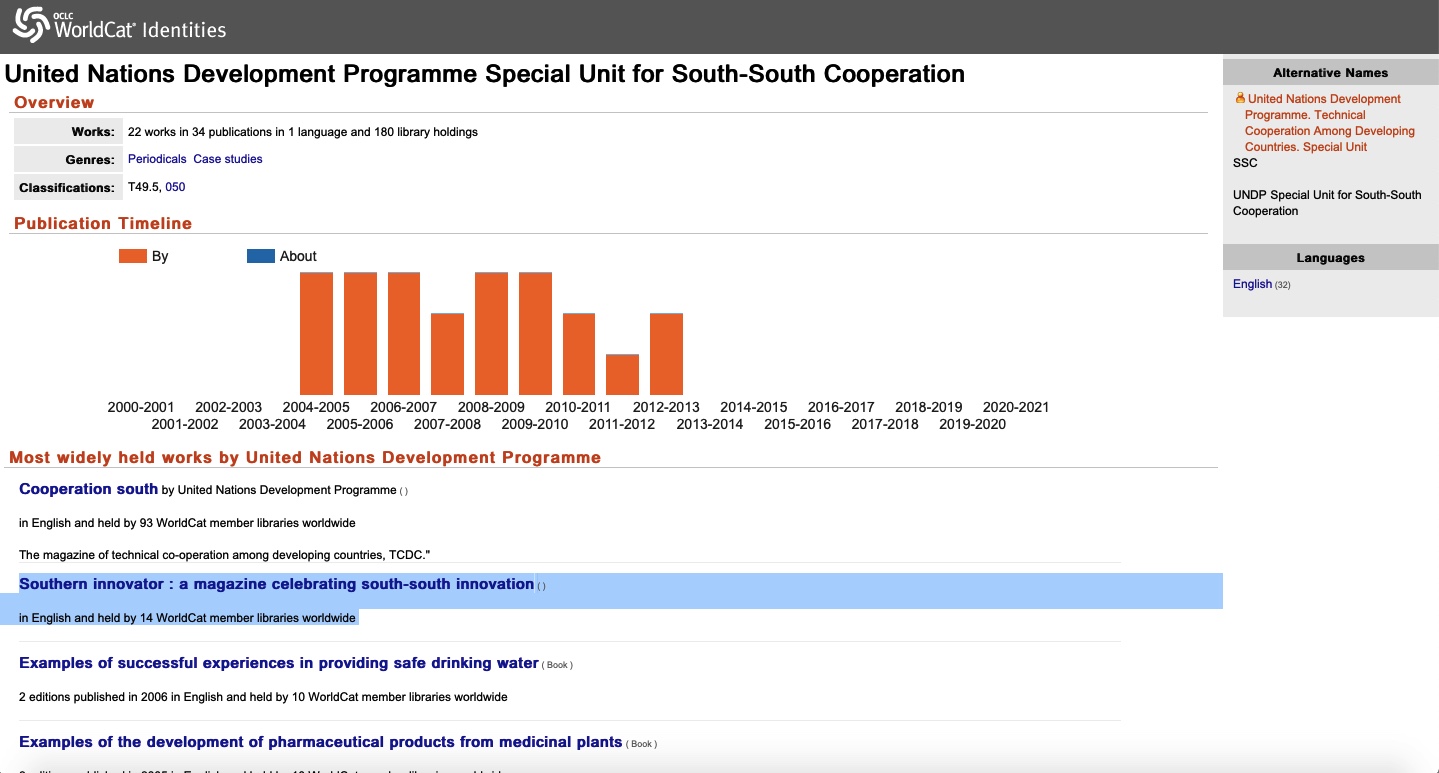
https://www.worldcat.org/title/southern-innovator-a-magazine-celebrating-south-south-innovation/oclc/1127120816?referer=list_view

https://davidsouthconsulting.org/southern-innovator-scale-up-fundraiser/

Creative Commons License

This work is licensed under a
Creative Commons Attribution-Noncommercial-No Derivative Works 3.0 License.

ORCID iD: https://orcid.org/0000-0001-5311-1052.

© David South Consulting 2024