A pioneering technology social enterprise has found a way to connect people around the world to the new digital economy, transforming their lives and providing long-term employment opportunities. It is closing the digital divide in a very practical way, teaching new skills and, most importantly, providing income to the poor and vulnerable.
The San Francisco, USA-based non-profit social enterprise Samasource (samasource.org) uses what it calls microwork – a virtual assembly line of small tasks broken down from a larger project so they can be completed over the Internet – to outsource work to its network of workers around the world.
The tasks in this virtual piecework range from writing to transcribing to organizing online content.
The company organizes the projects using its own online work distribution system connecting workers around the world to the SamaHub in San Francisco. Most of the workers are women, youth and refugees. When they complete their task, it is sent back to the SamaHub in San Francisco where the staff check it and assure its quality. Once approved and completed, the project is returned to the client.
The company was founded in 2008 and draws on experts in “distributed work, economic development, and outsourcing.”
The microwork is divided into three areas: content services, data enrichment and transcription.
Content services can include writing descriptions for online business listings, organizing large databases on information or creating brief descriptions of existing content to make it easier for search engines to find it. “Data enrichment” tackles the vast quantity of information on the Internet that needs to be kept up to date and reliable. It also includes ‘tagging’, where text or images on the Internet need to have appropriate ‘tags’ or labels. And finally, transcription services include digitizing paper documents like receipts or books or transcribing audio and video files for the web.
All these tasks are labour intensive and require high attention to detail. And they are critical to any online business’s success if it wants a reputation for accuracy and consistency.
Samasource is optimistic about its future potential because of the sheer size of the market for business process outsourcing: estimated to be worth over US $100 billion. What Samasource does, called ‘impact sourcing’ – outsourcing to people in the developing world living in poor or remote communities – is a market worth US $5 billion, according to Samasource’s website.
It differs from conventional business process outsourcing in a number of respects, including the educational background of the workers. Most conventional outsourcing goes to college graduates in cities in India, China and the Philippines. Impact outsourcing is done by people with at most a high school education.
The digital economy needs these workers to handle the many millions of detailed tasks required to link together information. It is easy to take this for granted because it is hidden from view, but it is what enables the Internet to function and businesses to thrive. Samasource provides outsourcing services including content moderation and data entry to clients like LinkedIn, Intuit and the US State Department.
“We bring dignified, computer-based work to women, youth, and refugees living in poverty,” said Samasource’s founder and chief executive officer, Leila Janah.
Janah has a background in development studies and formerly worked for the World Bank. This experience convinced her that much foreign aid was failing to target what poor people are really looking for: a job that pays well.
Samasource sees what it does as work, and not handouts.
It also believes it is changing perspectives, proving people from the poorest places on earth can become trustworthy, hard-working knowledge workers.
The Internet is a unique medium because it transcends borders and smooths contact between people with varying linguistic, cultural and educational capabilities.
“The Internet reduces the friction of collaboration across all of these centres and time zones, and with a highly distributed workforce,” said Janah.
Samasource claims to have paid out US $1 million in wages to more than 1,500 workers around the world. Ambitiously, it wants to expand this to reach some of the 144 million youth between 16 and 24 living on less than US $2 a day.
Youth are a particular focus for Samasource. Samasource targets young people who are literate and have received an education but still can’t get a job.
As for the many women employed by Samasource, they were either unemployed or earning poverty-level wages doing precarious work in low-level manufacturing and not building their skills.
Samasource currently has 16 partnerships in Haiti, India, Pakistan, Kenya, Uganda and South Africa. Criteria to work with Samasource includes being in a high-poverty region. Another criteria is for most of the money earned to stay within the region where the work is done and adhere to the standards laid down by Samasource.
Samasource’s success means it has attracted further funding. In December 2011, it was given a US $1.5 million grant from Google.org – the Google.com search engine’s charity. It has also raised US $5 million from non-profit investors, including the Ford Foundation, the Rockefeller Foundation and the eBay Foundation. The challenge for the Samasource model will be to prove, with this new funding, that it can scale its operations to pay out more to its workers than it is taking in to meet its operating costs.
Microwork is turning out to be big work indeed!
Published: January 2012
Development Challenges, South-South Solutions was launched as an e-newsletter in 2006 by UNDP’s South-South Cooperation Unit (now the United Nations Office for South-South Cooperation) based in New York, USA. It led on profiling the rise of the global South as an economic powerhouse and was one of the first regular publications to champion the global South’s innovators, entrepreneurs, and pioneers. It tracked the key trends that are now so profoundly reshaping how development is seen and done. This includes the rapid take-up of mobile phones and information technology in the global South (as profiled in the first issue of magazine Southern Innovator), the move to becoming a majority urban world, a growing global innovator culture, and the plethora of solutions being developed in the global South to tackle its problems and improve living conditions and boost human development. The success of the e-newsletter led to the launch of the magazine Southern Innovator.
Like this story? Here is a dirty secret: this website is packed with stories about global South innovators. We spent 7 years researching and documenting these stories around the world. We interviewed the innovators to learn from them and we visited them to see how they did it. Why not use the Search bar at the top and tap in a topic and see what stories come up? As for my work, I have been involved with start-ups and media ventures since the early 1990s. In the years since I have learned a great deal about innovation and digital and have shared these insights in the stories on this website as well as in the 5 issues of Southern Innovator magazine. So, stick around and read some more!
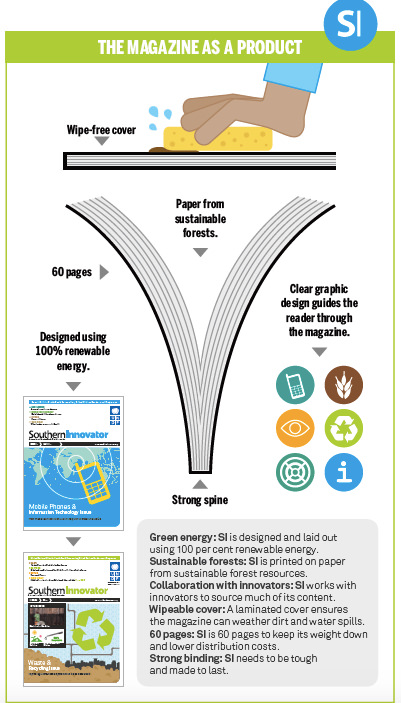
While Southern Innovator’s digital presence has been key to its success and global reach, the hard copy of the magazine was designed with special features. The magazine neded to be robust and able to stand a fair bit of abuse and hard wear. It needed to be easy to read in low light conditions. And it needed to look sharp and eye-catching to reach as wide an audience as possible.
Expertise: Innovation, innovators, human development, South-South development, United Nations, policy and policy innovation, South-South cooperation, South-South trade, global trends, strategy, online content, global memes, Internet, mobile phones, information technology, global South, resilience strategies, crisis response.
Locations: London, UK and New York, U.S.A. 2007 to 2016
Since the start of 2007, global international development and media consultancy David South Consulting (DSC)/David South International (DSI) has been working with the UNDP-associated United Nations Office for South-South Cooperation (UNOSSC) (formerly the Special Unit for South-South Cooperation) to raise the profile of South-South cooperation and the global South in global development through its innovators, as well as influencing the switch to an innovation-led approach to how development is delivered at the United Nations and at the country level. Based in London, UK and with a design studio in Reykjavik, Iceland, DSC/DSI did this with two highly influential media: the monthly e-newsletter Development Challenges, South-South Solutions, and its sister magazine Southern Innovator.
About
With the global economic crisis unfolding in 2007, we asked “what would inspire people?” What is going on in the global South that would improve human development under these circumstances and make people more resilient?
In 2007, discussing the global South, or solutions from the South, had a far lower profile in international development, the media and with the general public. Being one of the first sources to regularly chronicle the 21st-century world emerging from the crisis, the two publications (e-newsletter Development Challenges, South-South Solutions and its sister magazine Southern Innovator) were able to open up a space for greater coverage of the global South, while drawing attention to a new generation of development innovators.
“Great economic and business reporting! Very helpful for us.” Africa Renewal, Africa Section, Strategic Communications Division, United Nations Department of Public Information
“I just went over your June newsletter. It’s very well done and far reaching. Congratulations!” Violette Ruppanner, Director, 3D -> Trade – Human Rights – Equitable Economy, Geneva, Switzerland
“Just to let you know I enjoyed the newsletter a lot – it was interesting to learn about things going on that I would never otherwise find out about, and also the listing of future conferences and events proved very useful.” Ian Sanderson, Deloitte, Geneva, Switzerland
“Congratulations on another great newsletter that’s packed with fascinating information! I really enjoy getting it each month.” Whitney Harrelson, Making Cents, Washington D.C.
By adopting a strategy to exploit developments in online and digital media (and the space opened up by the global economic crisis), the reach of the e-newsletter and magazine was far greater than would have been possible just a year prior, back in 2006. This proved useful for reaching the growing number of people in the global South who were being digitally connected either through mobile phones or the Internet, or both.
The e-newsletter was not only distributed every month to subscribers, it was also simultaneously posted online in many platforms to reach as wide an audience as possible. It was kept simple in its design so as to be easy to access by readers with low bandwidth or high data costs. It exploited new online services to reach an as wide as possible audience.
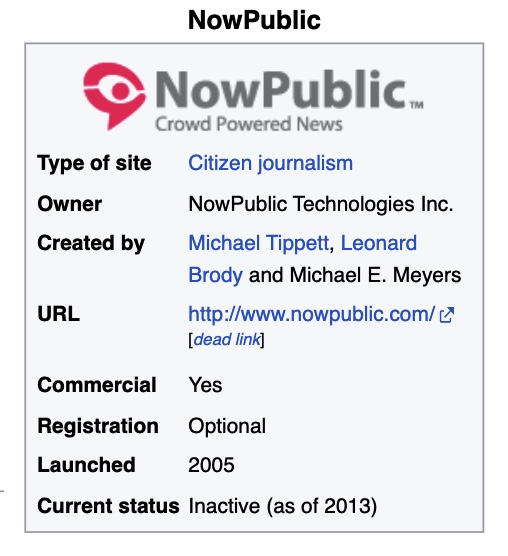
As an example, the arrival of ‘crowd-powered’ media in 2007 allowed for posting of stories to a global audience to test responses and reactions in real time. An experiment from 2008 to 2010 on the innovative Vancouver, Canada-based NowPublic platform proved very effective in developing the right tone for the stories. Many of these stories have been cited in publications and online (please see below for citations).
With 201 Development Challenges, South-South Solutions stories posted on the NowPublic platform, a total of 336,289 views by 2012 had occurred, according to the NowPublic counter.
Various websites offering publishing and archiving services (Scribd for example) meant it was easy to access the stories from any place, device or platform, bypassing firewalls and censors – a very serious concern in many countries of the global South. And social media such as Twitter made it easy to spread the word to the right people.
The two publications proved influential on a number of fronts, being early to draw attention to the following: the rising use of mobile phones and information technology in development, the world becoming an urban place, innovative food solutions including the nascent insect food sector (now a big thing), altering perspectives on what is possible in Africa, the use of data science to innovate development, and tracking the growing number of technology hubs and the fast-growing start-up culture in the global South. The publications were cited for shaping the new strategic direction adopted by the United Nations Development Programme (UNDP) (the UN’s leading development organisation) and its first youth strategy, and the development of the Sustainable Development Goals (SDGs). As the world’s first global innovator magazine, Southern Innovator’s design had to be appropriate for a diverse audience. It has drawn praise for being both “beautiful” and “inspiring”, while its use of sharp, modern graphic design and infographics inspired others in the UN to up their game when it comes to design.
Today, there are many sources for sharing stories on solutions from the global South; in fact, it could be called ‘cool’. South-South cooperation and innovation have now become the key methodology for the UN’s delivery of its programmes and projects. In 2015, China pledged US $2 billion to “support South-South cooperation” and called for the international community to “deepen South-South and tripartite cooperation”. In development parlance, they have been “Mainstreaming South-South and Triangular Cooperation” in their plans.
The current policy vogue for innovation in developing and developed countries can trace its roots back to some of the early work done by these two publications (and which was further amplified by the annual Global South-South Development Expo, which often would feature innovators from the two publications, spreading the innovation message around the world). Both publications had set out to inspire and “champion a global 21st century innovator culture”. And they have done this, as can be seen from concrete evidence and anecdotal responses from individuals and organizations alike.
Crucial to success has been integrity. As was disclosed in arrests made by the Federal Bureau of Investigation (FBI) in October 2015, a news service claiming to be associated with the United Nations (South-South News) had not followed either the letter or the spirit of the UN’s Global Compact. It had received substantial funding from a Macau casino owner featured in a 2010 investigation by International Risk Ltd., which found he “is characterized in the media as a ‘Macau Crime Lord’ and a kingpin of the international slave prostitution trade”. To date, a number of his co-conspirators have been found guilty of various charges and sentenced. He was convicted 28 July 2017 on six counts “for his role in a scheme to bribe United Nations ambassadors to obtain support to build a conference center in Macau that would host, among other events, the annual United Nations Global South-South Development Expo“. He used the news service as a “conduit for bribery and money laundering” at the United Nations, according to the FBI, something admitted to by the various co-conspirators in court and under oath. Read more on this case here: http://www.reuters.com/article/us-un-corruption-idUSKCN0XH2DL. And the conviction here: Chairman of a Macau Real Estate Development Company Convicted on All Counts for Role in Scheme to Bribe United Nations Ambassadors to Build a Multi-Billion Dollar Conference Center
The case of South-South News points to the dangers of cutting corners and the importance of approach and methodology; to not just mouth support for the UN Global Compact but to embrace its letter and spirit as well. As can be seen from this particular case, the reputational damage can be severe if the wrong strategy is pursued. Clients need to be very aware of whom they are working with and conduct due diligence for service provider credentials and also investigate the credentials of potential donors and funders.
Southern Innovator needed to be true to its ethos of championing genuine innovation that improves human development in the global South. It had to be free to pursue its search without interference.
To avoid censorship and interference, its editorial operations were based in London, UK and its design studio was based in Reykjavik, Iceland (a high-ranking country in the World Press Freedom rankings and a former top place holder in the UNDP Human Development Index). Using a women-led design studio, it developed a design vision that could communicate across borders using clear graphic design and high-quality images. For example, when it launched in 2011, infographics were rare in development publications and at the UN; now they are commonplace. It also tried to be as a ‘green’ as possible. The studio was powered on 100 per cent renewable energy (in particular, geothermal energy); the hard copy of the magazine is printed on paper from renewable forests.
To date, five issues of Southern Innovator have been published on key themes identified by the United Nations: mobile phones and information technology, youth and entrepreneurship, agribusiness and food security, cities and urbanization and waste and recycling.
All of the issues collate and explain the trends, innovations and innovators for a large, global audience spanning many countries and regions.
Timeline
2007: David South Consulting begins work on the e-newsletter Development Challenges, South-South Solutions for the Special Unit for South-South Cooperation at the United Nations.
2009: Adjust e-newsletter content based on reader responses. Begin posting content on Twitter platform.
2010: Begin development of initial concepts for innovator magazine and assemble creative team with Icelandic graphic designer and illustrator Solveig Rolfsdottir and graphic designer Eva Hronn Gudnadottir.
2011: Attend Global South-South Development Expo in Rome, Italy. Launch first issue of Southern Innovator magazine on mobile phones and information technology. It is called “a terrific tour de force of what is interesting, cutting edge and relevant in the global mobile/ICT space…”. Launch www.southerninnovator.org website and social media including Twitter account @SouthSouth1.
2012: Attend Global South-South Development Expo in Vienna, Austria. Launch issues 2 (youth and entrepreneurship) and 3 (agribusiness and food security) of Southern Innovator magazine. Called a “Beautiful, inspiring magazine from UNDP on South-South innovation.”
2013: Attend Global South-South Development Expo in Nairobi, Kenya. Launch issue 4 of Southern Innovator magazine (cities and urbanization). Called “fantastic, great content and a beautiful design!” and “Always inspiring.”.
2014: Attend Global South-South Development Expo in Washington, D.C., U.S.A. Launch issue 5 of Southern Innovator magazine (waste and recycling). The Twitter account @SouthSouth1 called “ one of the best sources out there for news and info on #solutions to #SouthSouth challenges.” Final issues of e-newsletter Development Challenges, South-South Solutions published.
Testimonials
“The e-newsletter Development Challenges, South-South Solutions proved to be a timely and prescient resource on the fast-changing global South, tracking the rise of an innovator culture driven by the rapid adoption of mobile phones and information technology …
“In 2010, work began on the development of the world’s first magazine dedicated to the 21st-century innovator culture of the global South. My goal was to create a magazine that would reach across countries and cultures, meet the UN’s standards, and inspire action. Southern Innovator was the result. Mr. [David] South played a vital role in the magazine’s development from its early conception, through its various design prototypes, to its final global launch and distribution.
“Both the e-newsletter and magazine raised the profile of South-South cooperation and have been cited by readers for inspiring innovators, academics, policy makers and development practitioners in the United Nations and beyond.
“I highly recommend Mr. [David] South as a thoughtful, insightful, analytical, creative and very amicable person who has the unique ability to not only grasp complex problems but also to formulate a vision and strategy that gets things done. … ” Cosmas Gitta, Former Assistant Director, Policy and United Nations Affairs at United Nations Office for South-South Cooperation (UNOSSC) in UNDP
“I think you [David South] and the designer [Solveig Rolfsdottir] do great work and I enjoy Southern Innovator very much!” Ines Tofalo, Programme Specialist, United Nations Office for South-South Cooperation
Southern Innovator Issue 5
“@SouthSouth1 is one of the best sources out there for news and info on #solutions to #SouthSouth challenges.” Adam Rogers, Assistant Director, Regional Representative, Europe, United Nations Office for South-South Cooperation (UNOSSC)
“Btw, I really enjoyed reading them, impressive work & a great resource. Looking forward to Issue 6. My best wishes to you & your team at SI.”
“The magazine looks fantastic, great content and a beautiful design!”
Southern Innovator Issue 2
“Thank you David – Your insight into the issues facing us a[s] [a] “global Village” is made real in the detail of your article – 10 out of 10 from the moladi team.” Moladi, South Africa (http://www.moladi.net/index.htm)
Southern Innovator Issue 1
“What a tremendous magazine your team has produced! It’s a terrific tour de force of what is interesting, cutting edge and relevant in the global mobile/ICT space… Really looking forward to what you produce in issues #2 and #3. This is great, engaging, relevant and topical stuff.” Rose Shuman, Founder & CEO, Open Mind and Question Box
“Looks great. Congratulations. It’s Brill’s Content for the 21st century!” Conan Tobias, Managing Editor, Canadian Business
What they are saying about SI on Twitter: From @CapacityPlus Nice job RT @ActevisCGroup: RT @UNDP: Great looking informative @SouthSouth1 mag on South-South Innovation; @UNDP Great looking informative @SouthSouth1 mag on South-South Innovation; @JeannineLemaireGraphically beautiful & informative @UNDP Southern Innovator mag on South-South Innov.
“Beautiful, inspiring magazine from UNDP on South-South innovation. Heart is pumping adrenaline and admiration just reading it”
Impact
Micro
developed content for highly influential UN e-newsletter Development Challenges, South-South Solutions from 2007 to 2014. The monthly briefing is distributed across the UN and to subscribers
developed and launched world’s first global innovator magazine for the United Nations, Southern Innovator
contacted and networked with innovators around the world to raise the profile of their work
attended global events to champion power of 21st century global innovator culture. Visited United Nations agency headquarters around the world to share the innovator message and distribute the publications
cited as a key resource on trends in the global South
Macro
significantly raised profile of global South innovators and 21st century global innovator culture
cited as contributor to new strategic plans for UNDP and its switch to an innovation and South-South focus
In November/December 2000 I worked in Kyiv/Kiev, Ukraine for the United Nations mission on the strategic re-launch of the mission website as a portal, whilst also advising the UN Resident Coordinator/UNDP Resident Representative Douglas Gardner on communications strategy. It was an extraordinary experience on many levels. It was a time when the Internet was fast evolving and required quick thinking and an ability to innovate; it was also a key moment in Ukraine’s history.
According to Olena Nikolayenko in Youth Movements and Elections in Eastern Europe (Cambridge University Press, 2017), “Gongadze’s murder in September 2000 engendered the Ukraine without Kuchma Movement. The website Maidan (http://maidanua .org) was initially set up by civic activists to provide extensive coverage of the movement’s activities.”
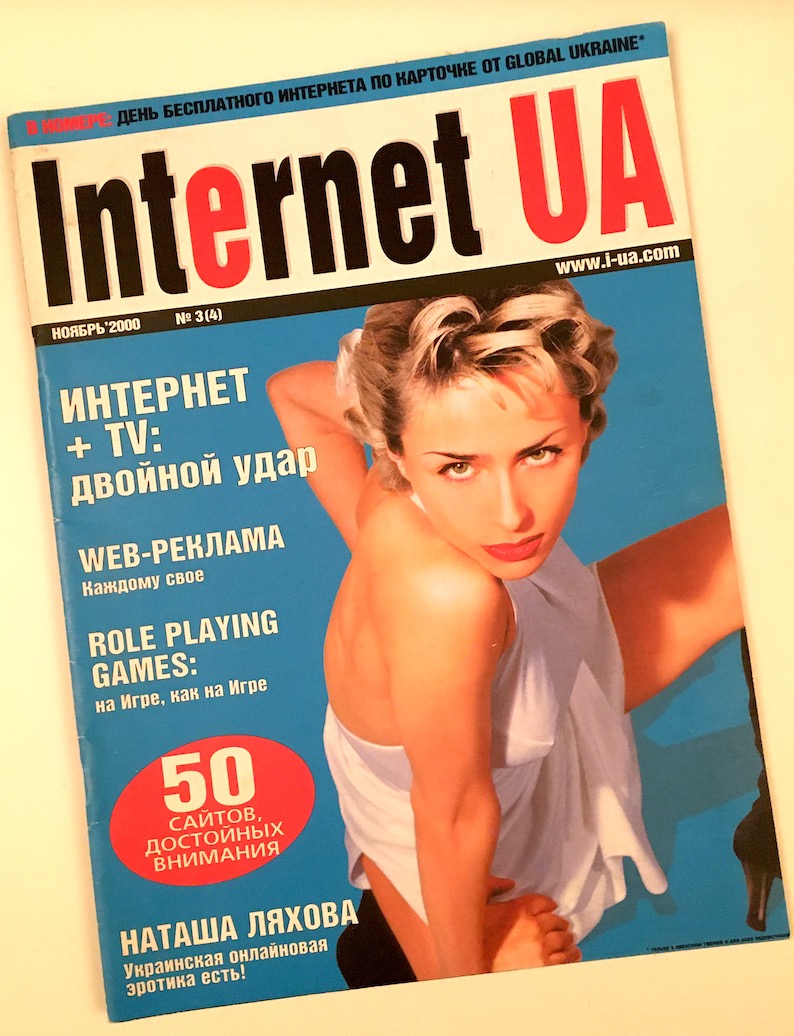
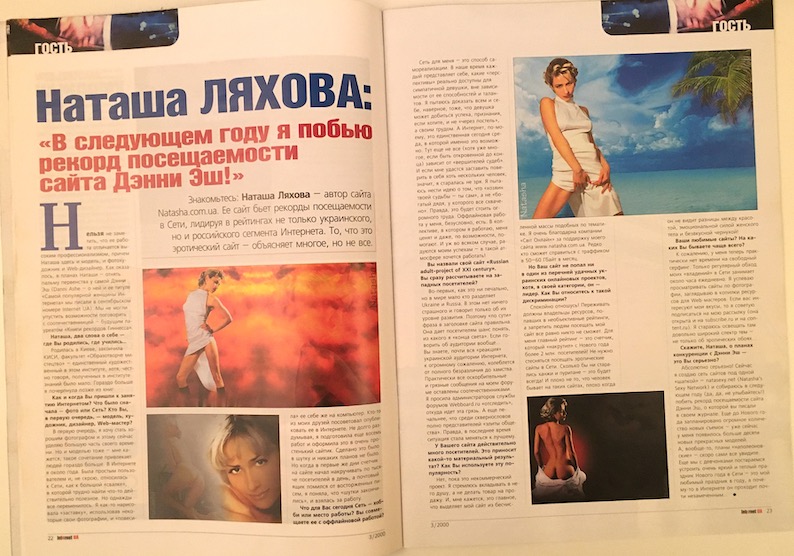
But despite those dangers and clear threats from the government of the time, there was a flourishing and inventive Internet and digital economy. The magazine Internet UA (whose editor I enjoyed meeting) gave a great overview of the scene in Ukraine and its creativity. Just as now, the creation of Internet stars who can exploit the medium (in this case sexy videos: a very large online market today) was driving viewers and subscribers. But there was also a vibrant online news media, blogging, commerce and gaming presence as well.
Internet UA magazine: Sex sells and the sex industry has always had pioneers seeking new ways to get eyeballs for their content. The Internet from its early days has been driven by the search for nude pictures and sex videos. In this cover feature, “Internet + TV: Double Impact”. That content mix has become the foundation of websites such as Pornhub etc.
According to ain.ua, the Ukrainian digital economy today is ” … ‘local’ only just figuratively speaking. Ukrainian startups are initially focused on international markets. Product companies are included into international industry ratings. Outsourcing works with clients from all over the world. Global players enter Ukrainian market, opening R&D offices, acquiring and investing into local companies. There are no boundaries.”
A magazine feature on ‘Natasha’s’ Internet content offering.
It is easy to take digital freedoms for granted now but there was great resistance at the time and, unlike today, many governments were openly hostile to digital technology, online communications and e-commerce.
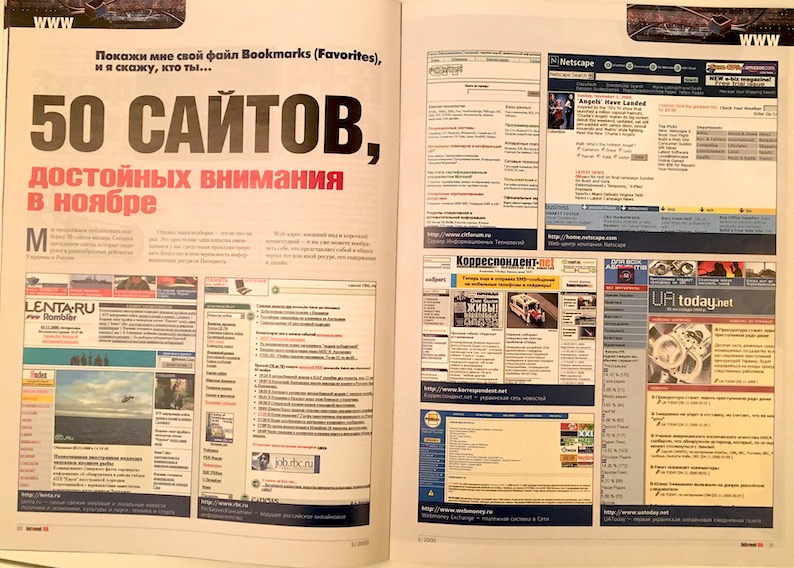
50 websites to bookmark in 2000.
The UN itself was evolving and embracing the communications and design revolution being driven by digital change. This was the first “dot.com” boom, which had begun in 1997. I had played a key role in pioneering online content for Mongolia (1997-1999) and could bring this experience to Ukraine. In particular, I launched an award-winning web portal for the UN Mongolia mission in 1997 (www.un-mongolia.mn) and also the country’s first web magazine, Ger.
The UN Ukraine brief involved creating content that was accessible to users with low bandwidth, dial-up connections (few had mobile phones in 2000). I had been building new media experience throughout the 1990s, tracking the cable and satellite TV and mobile/Internet revolutions for the Financial Times as a journalist, as well as launching websites for various media clients.
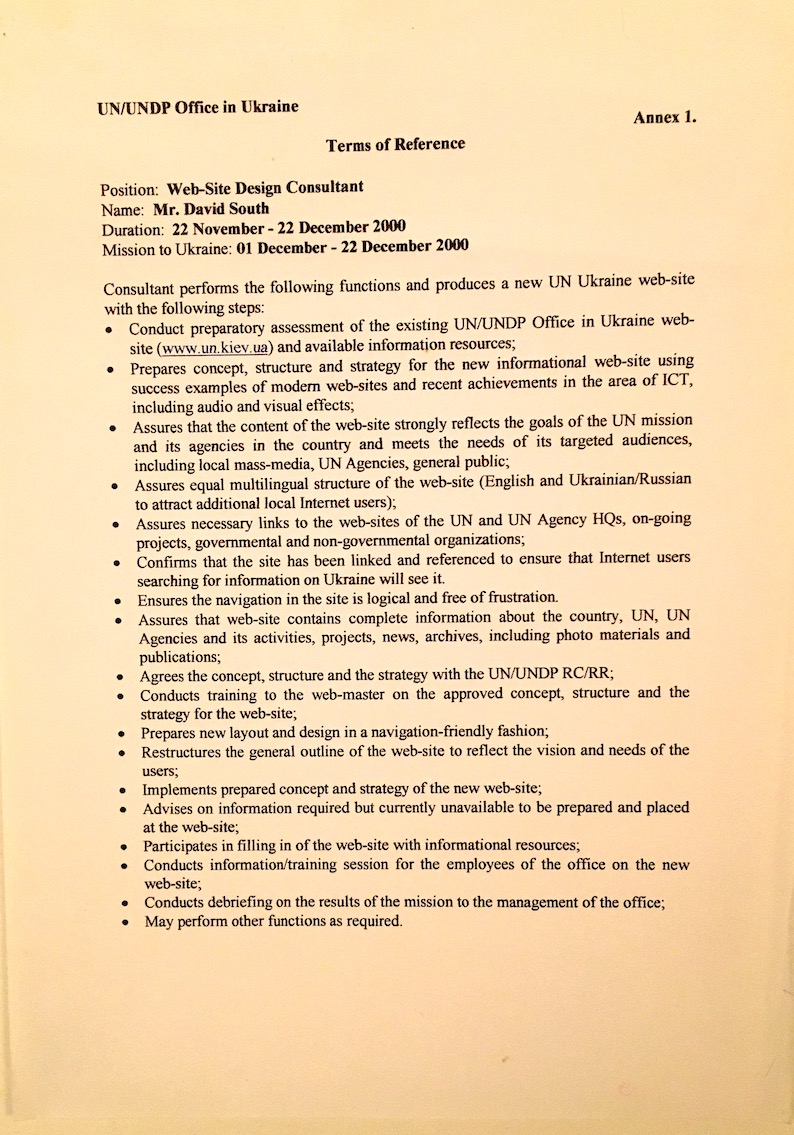
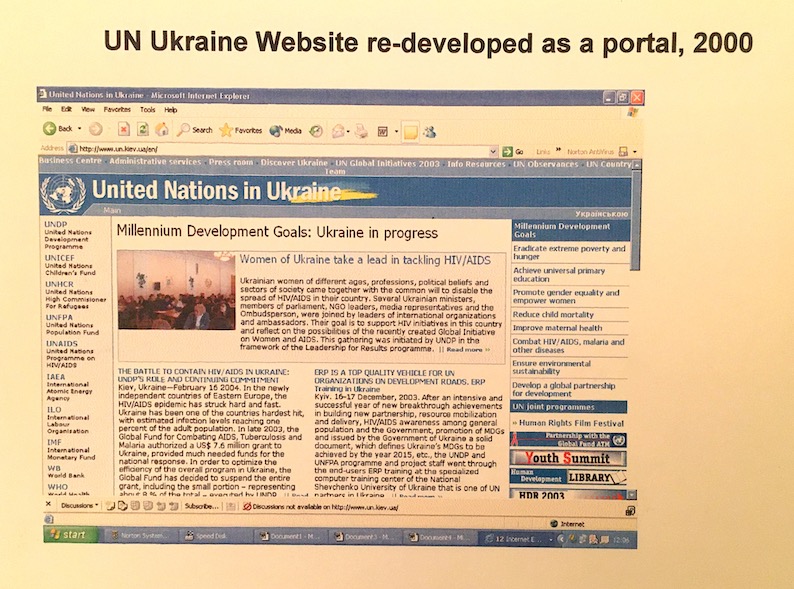
The Terms of Reference for the UN/UNDP Ukraine assignment.The assignment business card.The UN/UNDP Ukraine website before launch as a portal.The first iteration of the new UN Ukraine portal.
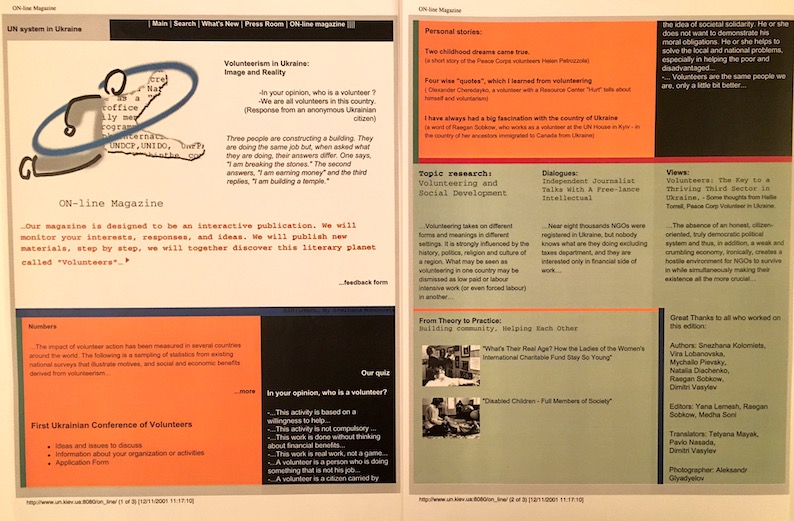
Key content created and launched on the UN Ukraine portal included critical information on the HIV/AIDS crisis in Ukraine, UN Ukraine’s first online magazine to explore perceptions of volunteering and NGOs in the post-communist period, and content preparing for the visit of the UN Secretary-General Kofi Annan, by showing how Ukraine was engaging with global development priorities, for example the eight Millennium Development Goals (MDGs), and bringing together UN agencies and entities into a cohesive web and “One UN” experience.
The first UN Ukraine online magazine.Bringing together UN agencies and entities into a cohesive web and “One UN” experience.
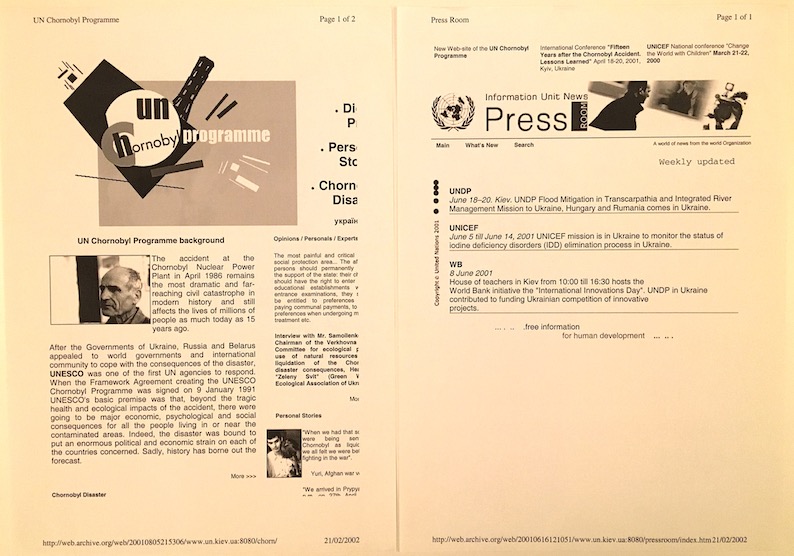
One highlight of this assignment was working with the “UN Chornobyl Programme” to develop its web content. This included visiting Pripyat (https://en.wikipedia.org/wiki/Pripyat),an abandoned city because of the Chernobyl Nuclear Power Plant disaster in 1986. I have visited many abandoned and “secret” cities and towns in the course of working with the United Nations but this particular visit had the added dimension of an environmental and human health disaster hanging over it (and as a former healthcare worker at Canada’s top cancer hospital and research institute, I couldn’t forget the impact of high radiation levels on the body).
UN Chornobyl Programme website in development, 2000.UN agencies in Ukraine. UNDP in Ukraine.
The power of the Internet and the digital economy to engage people, especially the young, despite living in a country with significant political repression of free speech and even physical intimidation and murder, stuck with me. This work also contributed to laying the foundations for Ukraine’s growing freedoms and greater engagement with Europe.
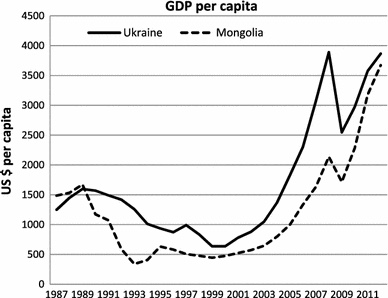
As this chart shows, increasing connectivity had a profound impact on living standards in Ukraine and Mongolia post-2000. The extreme turbulence Mongolia experienced in the 1990s – after the collapse of support mechanisms from the Soviet Union – calmed down as Mongolia integrated with the global economy, especially a booming China.
Good ideas are plentiful, but how to fund life-improving projects has always been a thorny issue. Judging how effective a project is can also be fraught with debate and contention. Over the past two decades, the number of NGOs in the global South has exploded (http://lboro.ac.uk/gawc/rb/rb144.html). The best of them offer the local knowledge and understanding required to make development gains. But unlike NGOs in the North, many lack the powerful fundraising capabilities of the big global NGO brands.
An exciting new initiative based in Germany, but already featuring hundreds of projects from across the South, is using the power of the internet to directly connect projects and donors.
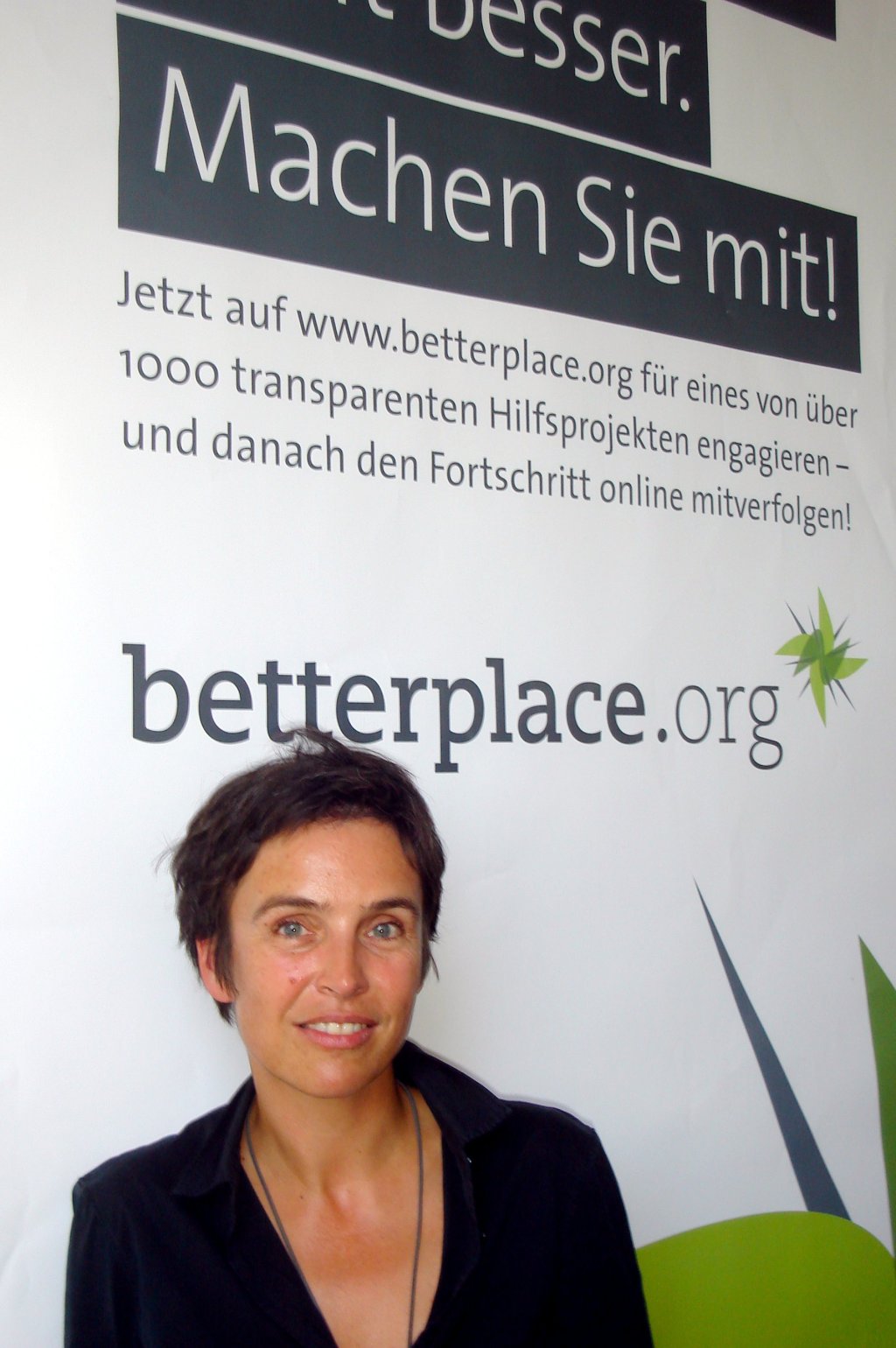
Joana Breidenbach, an anthropologist, author and co-founder of betterplace.org (www.betterplace.org), says NGOs are emerging in India and other countries of the South to challenge the big Northern global NGOs.
“Why wouldn’t you want to donate to these Southern NGOs? There are more entrepreneurs and local approaches which are better.
“Betterplace gives local institutions a platform to express themselves.”
Started in 2007, betterplace is an online marketplace for projects to raise funds. It is free, and it passes on 100 percent of the money raised on the platform to the projects. The foundation that runs betterplace supports its overheads by offering additional services that people can pay for if they wish. It works in a way similar to the online marketplace eBay (http://www.ebay.com): NGOs post their project, set up an account, blog about their achievements and successes and needs, and receive donations direct to their bank account when they come in.
Breidenbach points out up to a third of any NGO’s income is spent on fundraising. In Germany, that represents more than Euro 1.3 billion out of over Euro 4 billion in private donations – money that could have gone directly into the hands of the people needing help.
With betterplace, donators can surf through the projects and pick the one they want. Already, more than 100 large corporations trawl through betterplace seeking projects to fund to meet their corporate social responsibility (CSR) obligations (http://en.wikipedia.org/wiki/Corporate_social_responsibility).
“I find it very exciting to introduce a good and innovative NGO to a corporate sponsor,” Breidenbach said.
Breidenbach says betterplace’s ultimate goal is “to transfer the donation market online.” It hopes to change the rules in donation and charity in the same way blogs and the search engine Google changed the way people publish and search for information.
“This provides better transparency, feedback,” Breidenbach said. “Now (with betterplace) donors and organizations can cut out the middlemen. A lot of established organizations do not like this too much.”
Over the past decade, new concepts like social entrepreneurs and venture philanthropy have emerged to straddle the delicate line between social good and private profit. Betterplace joins this wave of new thinking about how to do development better.
In the 20 months since betterplace went online more than 1,500 projects have joined. They are now averaging between 20 to 35 new projects joining every week.
Betterplace is a simple open-plan office on the top floor of a Berlin warehouse beside the city’s Spree river. The small team (http://www.betterplace.org/about_us/team) work on laptop computers. A blackboard on the wall details in bright colours a running tally of the projects that have joined.
Breidenbach gives the example of a mother in Cameroon who is using betterplace to raise the school fees for her children. The mother blogs about the children’s progress and has been able to raise the fees for a year and a half.
“People are now directly connected to somebody in need.”
“Right now the functionality (of the website) does not allow people getting in contact publicly and we want to enable this knowledge transfer in 2010. If you want to build a well in Cameroon then you could search for the best technology and to contact other people who are doing similar projects to learn from them.”
Success on betterplace is by no means certain. “The experience of the project managers has been as varied as development work is – some have done really well, raising thousands of Euros over the website – others have received no funding at all,” Breidenbach said.
But betterplace provides tools to give the projects the best chance possible. “Projects can present their work, breaking it down in a transparent way (in order to let supporters know exactly what is needed for their realization), there are sound payment processes in place and project managers can give feedback through their project blog, supporters can download project widgets etc., all supplied free of charge.”
Breidenbach has other tips for making betterplace work for a project: post details in English when creating a profile, break down the project into much smaller, low-cost goals (few people are willing to make large donations) – this also has the advantage of receiving payments straight away when they are small. Tell a good story about the project, and try and use actual testimonials from the people affected. Blog and update regularly with photos and videos to keep people engaged. Also avoid copying and pasting text from a previous grant application.
“We have the numbers to show that projects which give regular feedback and have a lively web of trust receive more donations than others, which are not very active.”
“Don’t think you can just go on to betterplace and the money starts rolling in,” said Breidenbach.
The betterplace platform places all projects seeking funds on the same level, allowing individuals and small NGOs to compete equally with the big, branded global NGOs with their websites and sophisticated fundraising operations.
“All the big NGOs have their own websites,” continues Breidenbach. “But it is the small initiatives that often don’t have a website or know how to use Pay Pal etc. (http://www.paypal.com). We are very useful for smaller NGOs.”
“Another big advantage is that we are a real marketplace: whatever your interests (as a potential donor), you will find a project tackling this issue on the platform.”
But what about fraud and people seeing betterplace as a coin-making machine rather than a way to make the world a better place?
“We have a feeling for dodgy projects. We check the IP address. We have a number of trust mechanisms in place (and are currently working on enlarging them). Thus projects on betterplace can create trust through their good name … But we also include something which I would call network-trust: In our web of trust different kinds of stakeholders of an organization or a project have a voice and can publicly state what they think of it. Thus beneficiaries of a project can say if the project has done them good or has been counterproductive, people who have visited the project on the ground can describe what they have seen etc. … we hope to give a much denser and more varied impression of social work and give donors (a terribly badly informed group of people), the basis for a much more informed choice.
“If a contributor to a project is dissatisfied with the project’s outcome … she can either directly contact the project manager via betterplace, or openly voice her concern on the project page for other potential donors to see her views.”
For now, betterplace is still only useful to people who have access to the internet and have a bank account (necessary for the money transfers). But in the future betterplace hopes to have mobile phone interactivity and more features to expand who they can reach.
“We are also re-working our site to make it more intuitive and easier to use for people without computer skills,” Breidenbach said. “In the pipeline is also a knowledge backbone, enabling people to access knowhow about development and social innovation issues and exchange views and experiences. This will be very useful for projects in the South as so many people are working on the same issues without knowing about it. They could learn a lot from each other, without the “help” of the north.”
With internet broadband in Africa set to take off, according to the report Africa Connect: Undersea Cables to Drive an African Broadband Boom (http://www.pyr.com/downloads.htm?id=5&sc=PR090309_INSAME1.6), even more people will soon be able to make the most of initiatives like betterplace.
Published: September 2009
Resources
1) CSR Wire: This is a news service with all the latest news, reports and events and where companies announce their CSR (corporate social responsibility) programmes and how much they are contributing. A great resource for any NGO looking to make a targeted appeal for funds. Website:http://www.csrwire.com/
2) Alibaba: Alibaba.com is an online marketplace started in China but is now global. It allows businesses from all over the world to trade with each other, make deals and find funding. Website:http://www.alibaba.com/
Development Challenges, South-South Solutions was launched as an e-newsletter in 2006 by UNDP’s South-South Cooperation Unit (now the United Nations Office for South-South Cooperation) based in New York, USA. It led on profiling the rise of the global South as an economic powerhouse and was one of the first regular publications to champion the global South’s innovators, entrepreneurs, and pioneers. It tracked the key trends that are now so profoundly reshaping how development is seen and done. This includes the rapid take-up of mobile phones and information technology in the global South (as profiled in the first issue of magazine Southern Innovator), the move to becoming a majority urban world, a growing global innovator culture, and the plethora of solutions being developed in the global South to tackle its problems and improve living conditions and boost human development. The success of the e-newsletter led to the launch of the magazine Southern Innovator.
“A few weeks ago, David South, Development consultant and author of UNDP’s Development Challenges, South-South Solutions Newsletter, came by the betterplace office to take a look at our work. When I asked him how he had come about betterplace.org, he answered: he found me on twitter! So much for the twitter-scepticts. Read the article about how we can Make the World a Better Place for Southern Projects. (As the UNDP always publishes the newsletter on its South to South Website only months later, here is the link via David South’s blog).”
















 David South Consulting
You must be logged in to post a comment.