Categories
Archive

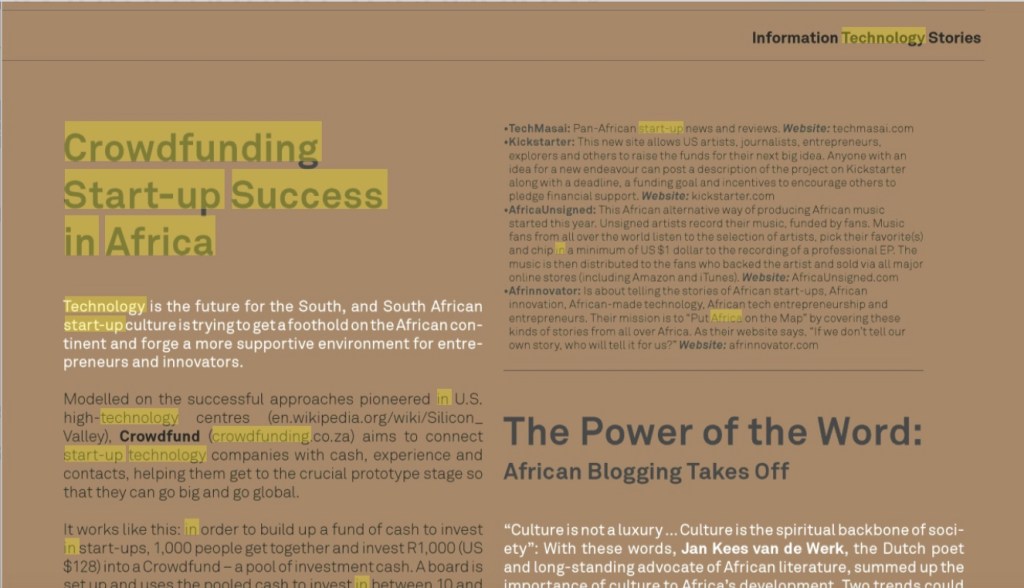
Crowdfunding Technology Start-up Success in Africa

By David SouthDevelopment Challenges, South-South Solutions

SOUTH-SOUTH CASE STUDY

Technology is the future for the South, and South African start-up culture is trying to get a foothold on the African continent and forge a more supportive environment for entrepreneurs and innovators.

Modelled on the successful approaches pioneered in U.S. high-technology centres like California’s Silicon Valley (http://en.wikipedia.org/wiki/Silicon_Valley) , Crowdfund (http://www.crowdfunding.co.za) aims to connect start-up technology companies with cash, experience and contacts, helping them get to the crucial prototype stage so that they can go big and go global.

It works like this: in order to build up a fund of cash to invest in start-ups, 1,000 people get together and invest R1,000 (US $128) into a Crowdfund – a pool of investment cash. A board is set up and uses the pooled cash to invest in between 10 and 20 of the best start-up ideas submitted. The ideas are funded and developed into working prototypes in return for a stake in the business. Once the working prototype is up and running, traditional venture capitalists are approached for further funding and usually Crowdfund will then cash in its equity.

The concept of crowdfunding allows groups of people to use the internet to pool their money together to help support a person or a cause (http://en.wikipedia.org/wiki/Crowd_funding) . There are now many variations on the concept, with online services providing crowdfunding for artists, designers, film-makers, causes, scientists and technology pioneers.

As a model for raising funds for small businesses, the concept has a long history in poor communities across the South. Often, it can be a group of poor women pooling their resources to help each other start small businesses. Technology in the form of the internet and mobile phones has helped the concept jump to the next level, and expanded the pool of people who can support a crowdfunded idea around the world.

It is an answer to the need for so-called “angel funding” (http://en.wikipedia.org/wiki/Angel_investor) : somebody with lots of cash who is willing to help a start-up entrepreneur. Crowdfund’s founders felt South Africa lacked enough angel funders to meet the needs of the country’s technology start-ups. This can be a big problem in countries where there is no history or culture of angel funding and searching far and wide for the “next big idea.”

In April of this year, Crowdfund was able to raise R1 million (over US $128,000) from 229 investors.

Venture capitalists (http://en.wikipedia.org/wiki/Venture_capital) – people or investment groups looking for high-growth start-ups to invest in – usually prefer to put their money into proven ideas for big, fast returns. They often lack interest in smaller ideas that may grow more slowly. It is a classic dilemma: how can an entrepreneur know if their idea will work if nobody will give them the cash to prove it?

This is a critical problem in the information age. As broadband technology spreads across Africa, the opportunities for online businesses will just grow and grow. But few will be able to benefit and African start-ups will not stand a chance against global competition if funding is not available to nurture new businesses.

Crowdfund assesses ideas and identifies skill shortfalls. The cash is used to help with the skills shortage, provide office space, bandwidth, hosting and mentorship. The funded team will also have access to legal, marketing and management experts to get through the development stage and avoid costly mistakes. The development process in stage one takes three months. The Crowdfund Board will then search for potential investors to take the start-up to stage two and a working prototype.

By this stage negotiations will take place to set the start-up off on the path to global success. They are helped with the tricky negotiation process with investors.

Apart from the start-up cash, the powerful idea behind Crowdfund is the network of support and advice that comes with it. Two of the board members are South Africans based in San Francisco, USA, and can make that crucial connection with the buzzing U.S. technology scene. Investors are asked to mentor the start-up concepts, meaning start-ups are accessing normally costly business advice.

Crowdfund tries to get a response back to potential start-ups within 48 hours (http://digitalgarage.co.za/2010/04/12/filtering-the-applications-for-funding/) , so, if you have a great idea, get submitting!

Published: June 2010

Resources

  • TechMasai: Pan-African start-up news and reviews. Website: www.techmasai.com
  • Kickstarter: This new site allows US artists, journalists, entrepreneurs, explorers and others to raise the funds for their next big idea. Anyone with an idea for a new endeavour can post a description of their project on Kickstarter along with a deadline, a funding goal and incentives to encourage others to pledge financial support. Website: http://www.kickstarter.com/
  • AfricaUnsigned: This African alternative way of producing African music started this year. Unsigned artists record their music, funded by fans. Music fans from all over the world listen to the selection of artists, pick their favorite(s) and chip in a minimum of $1 dollar to the recording of a professional EP. The music is then distributed to the fans who backed the artist and sold on all major online stores (incl. Amazon & iTunes). Website: www.AfricaUnsigned.com
  • Afrinnovator: Is about telling the stories of African start-ups, African innovation, African made technology, African tech entrepreneurship and entrepreneurs. Their mission is to ‘Put Africa on the Map’ by covering these kinds of stories from all over Africa. As their website says, “if we don’t tell our own story, who will tell it for us?” Website: http://afrinnovator.com

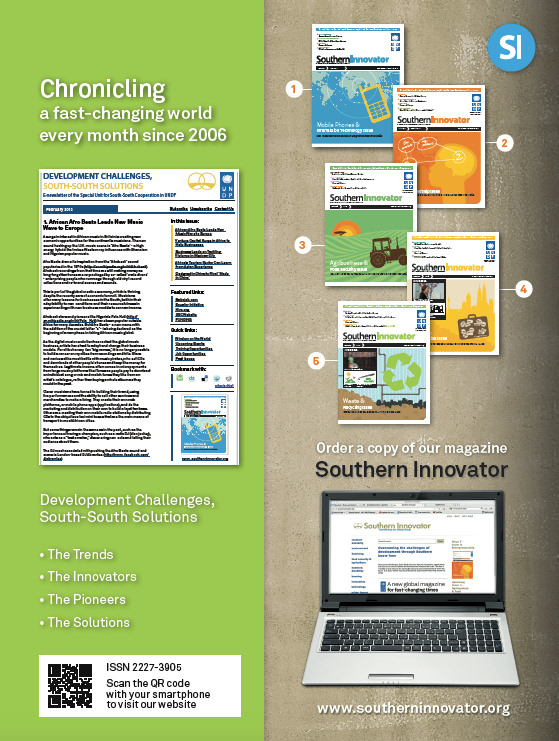
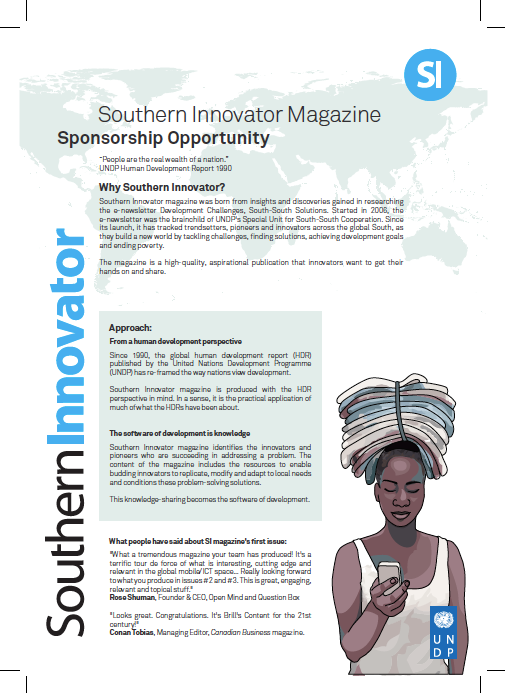
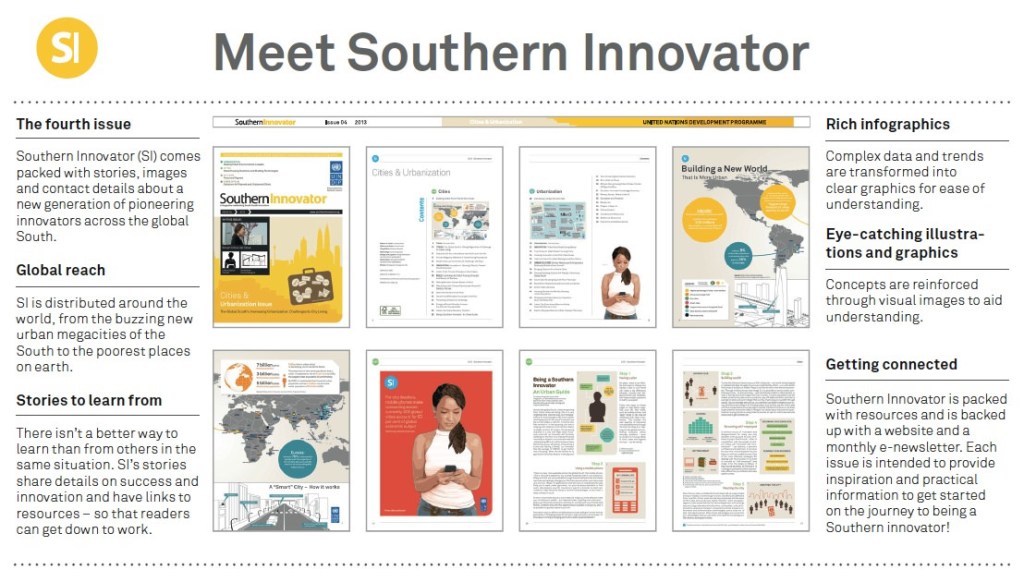
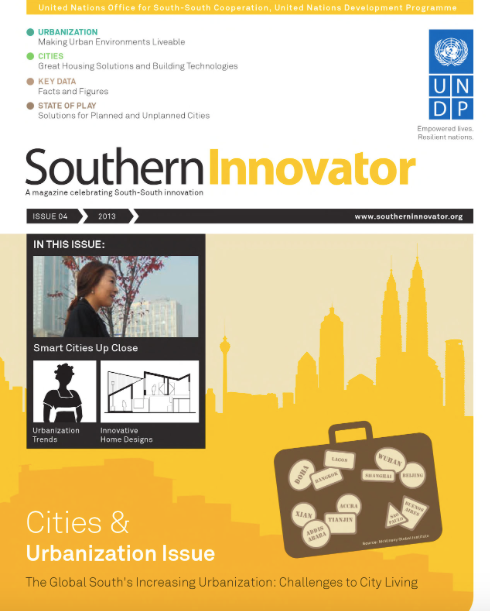
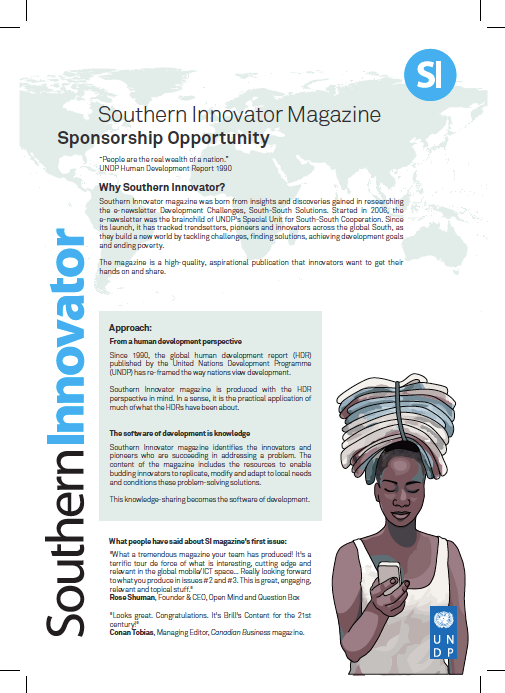
Development Challenges, South-South Solutions was launched as an e-newsletter in 2006 by UNDP’s South-South Cooperation Unit (now the United Nations Office for South-South Cooperation) based in New York, USA. It led on profiling the rise of the global South as an economic powerhouse and was one of the first regular publications to champion the global South’s innovators, entrepreneurs, and pioneers. It tracked the key trends that are now so profoundly reshaping how development is seen and done. This includes the rapid take-up of mobile phones and information technology in the global South (as profiled in the first issue of magazine Southern Innovator), the move to becoming a majority urban world, a growing global innovator culture, and the plethora of solutions being developed in the global South to tackle its problems and improve living conditions and boost human development. The success of the e-newsletter led to the launch of the magazine Southern Innovator. 

Creative Commons License

This work is licensed under a
Creative Commons Attribution-Noncommercial-No Derivative Works 3.0 License.

ORCID iD: https://orcid.org/0000-0001-5311-1052.

© David South Consulting 2022

Categories
Archive Development Challenges, South-South Solutions Newsletters

Mobile Applications Market: Opportunities for South

By David SouthDevelopment Challenges, South-South Solutions

SOUTH-SOUTH CASE STUDY

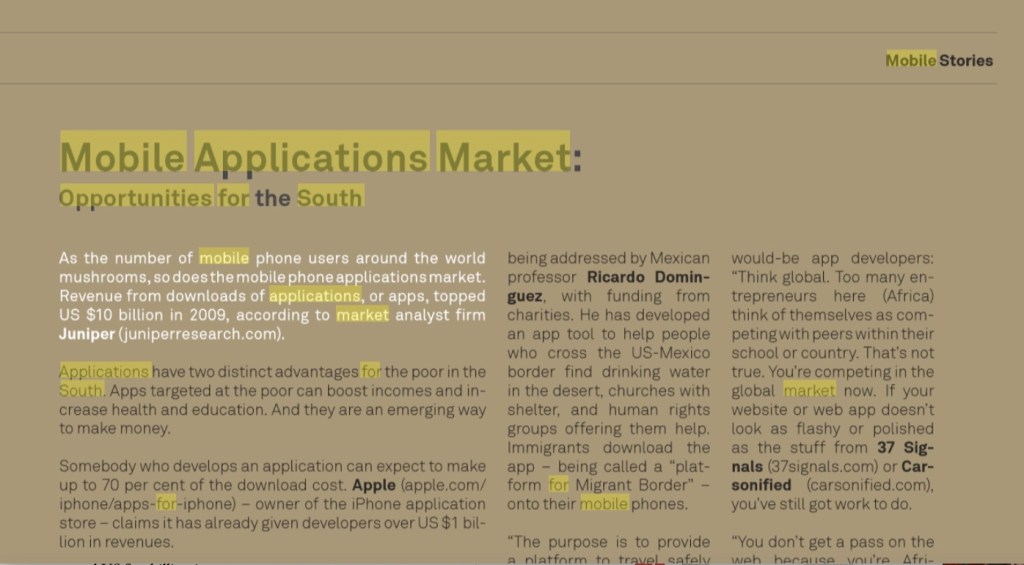
As the number of mobile phone users around the world mushrooms, so does the mobile phone applications market. Revenue from downloads of applications, or apps, topped US $10 billion in 2009, according to market analyst firm Juniper (http://juniperresearch.com).

Applications have two distinct advantages for the poor in the South. Apps targeted at the poor can boost incomes and increase health and education. And they are an emerging way to make money.

Somebody who develops an application can expect to make up to 70 percent of the download cost. Apple (http://www.apple.com/iphone/apps-for-iphone) – owner of the iPhone application store – claims it has already given developers over US $1 billion in revenues.

It is a growing industry. The market-leading Apple App Store now boasts more than 225,000 applications for download and sale. It says they have been downloaded an impressive 5 billion times.

Android Market (http://www.android.com/market/#app=com.com2us.HG), run by the search engine Google, has more than 60,000 apps on offer. GetJar (www.getjar.com), an independent mobile phone application store from Sweden, says it has 72,000 apps available and has had 1 billion downloads.

Now that the apps economy has been running for a couple years, it is possible to divine what increases a developer’s success. Some believe the apps marketplace mimics the dynamics of the music business, rather than the traditional software business.

GetJar chief executive Ilja Laurs told the Economist that it takes as long to write an app as a song. Apps on average cost about the same as a music download: US $1.90. And just like the pop music charts, a few become big hits but most never make it. Apps are also a quick hit: even after becoming successful they can quickly fade back to obscurity again. In short, they are fad and trend driven and are very much about the moment and a current need.

That means they are wide open to newcomers from the South.

With mobile phones now the main channel for information in East Africa, for example, and mobile penetration exceeding 40 percent of the population there, vast markets have opened for apps. East Africa has more than 120 million citizens, with a large majority living in rural areas: many needing poverty-fighting apps to change their lives.

Various new applications show the creative thinking already coming out of the South. South Africa’s Afridoctor (www.afridoctor.com) is Africa’s first personal mobile health clinic. Users submit photos of ailments and receive advice from a panel of professionals, or use the mapping feature to find doctors, clinics and all health industry related services nearby. The emergency feature notifies next of kin of your distress and location. Features include symptom checkers, first-aid information, health calculators and quizzes. Afridoctor hopes to make health care affordable and accessible to Africans. It is made by 24.com (http://store.ovi.com/publisher/24.com), South Africa’s largest digital brands group.

In Mexico, the tragedy of migrants dying as they try to cross the border to the United States is being addressed by Mexican professor Ricardo Dominguez, with funding from charities. He has developed an app tool to help people who cross the US-Mexico border find drinking water in the desert, churches with shelter, and human right groups offering them help. Immigrants download the app – being called a “platform for Migrant Border” – onto their mobile phones.

“The purpose is to provide a platform to travel safely through the desert,” said Dominguez, who led the design team.

App action has heated up in India, where Spice Mobiles (http://www.spiceglobal.com/SpiceMobiles/SpiceMobiles.aspx) – a wing of the Spice Group – is launching an application store with 250 content providers. India’s Bharti Airtel launched its first home-grown mobile application store in February of this year – Airtel App Central (http://www.airtel.in/apps). It clocked up over 13 million downloads in four months.

India’s Reliance Communications (http://www.rcom.co.in/Rcom/personal/home/index.html) also launched an application called Socially. It has been designed to enable users to follow the recent activity of friends, and also allows the user to update their status on different social networks like Facebook, Twitter and LinkedIn through a single client.

Jon Gosier, from Appfrica Labs (http://appfrica.net/blog) – behind the highly successful crisis crowdsourcing Ushahidi application (http://www.ushahidi.com) – explained the thinking behind apps in Africa:

“Our goal is to show the world that Africa is capable of solving some of its own problems,” he told CP-Africa.com. “Too often Africans aren’t even considered as a resource when discussing how to improve their own quality of life.”

He has the following advice for would-be app developers: “Think global. Too many entrepreneurs here (Africa) think of themselves as competing with peers within their school or country. That’s not true. You’re competing in the global market now. If your website or web app doesn’t look as flashy or polished as the stuff from 37 Signals (www.37signals.com) or Carsonified (www.carsonified.com), you’ve still got work to do.

“You don’t get a pass on the web because you’re African. You get the challenge of working harder.”

NEW: Apps4Africa Competition: Apps 4 Africa is a regional competition with the goal of promoting local technology entrepreneurs as they build tools to serve the needs of NGOs and the local community. This unprecedented partnership meshes civil society with developers and designers to create technical solutions to local challenges. The competition will ask civil society and citizens throughout the region to submit local community challenges on issues like transparency and better governance, health, education and more where technology can be a part of the solution. The burgeoning ranks of innovative techies in the region will then use this list of community challenges as the basis of their work, thus creating “an app for that.” Website:www.apps4africa.org

Published: August 2010

Deadline: August 31, 2010

Resources

Development Challenges, South-South Solutions was launched as an e-newsletter in 2006 by UNDP’s South-South Cooperation Unit (now the United Nations Office for South-South Cooperation) based in New York, USA. It led on profiling the rise of the global South as an economic powerhouse and was one of the first regular publications to champion the global South’s innovators, entrepreneurs, and pioneers. It tracked the key trends that are now so profoundly reshaping how development is seen and done. This includes the rapid take-up of mobile phones and information technology in the global South (as profiled in the first issue of magazine Southern Innovator), the move to becoming a majority urban world, a growing global innovator culture, and the plethora of solutions being developed in the global South to tackle its problems and improve living conditions and boost human development. The success of the e-newsletter led to the launch of the magazine Southern Innovator.  

Creative Commons License

This work is licensed under a
Creative Commons Attribution-Noncommercial-No Derivative Works 3.0 License.

ORCID iD: https://orcid.org/0000-0001-5311-1052.

© David South Consulting 2022

Categories
Archive Development Challenges, South-South Solutions Newsletters Southern Innovator magazine

Africa’s Fast-Growing Cities: A New Frontier of Opportunities

By David SouthDevelopment Challenges, South-South Solutions

SOUTH-SOUTH CASE STUDY

According to a new report by the International Institute for Environment and Development, Africa now has a larger urban population than North America and 25 of the world’s fastest growing big cities. Europe’s share of the world’s 100 largest cities has fallen to under 10 percent in the past century.

Counter to common misperceptions about what is luring people to big cities, the report’s author, David Satterthwaite, said it isn’t because governments and aid are attracting them: government “policies leave much to be desired as they tend to neglect the urban poor, leading to high levels of urban poverty, overcrowding in slums and serious health problems. Governments should see urbanisation as an important part of a stronger economy and their expanding urban population as an asset, not as a problem.”

But global perceptions of Africa are changing. The Mo Ibrahim Foundation has listed the most efficiently run African economies, with a strong correlation between good governance and higher growth rates (Mauritius, Seychelles, Botswana, South Africa, Namibia, Ghana and Senegal).

In most of urban French West Africa, extensive interviews with micro-entrepreneurs and micro-finance practitioners found that most operating micro-enterprises in the informal economy are entrepreneurs by necessity, and that their most basic needs drove their business activities and behaviours. Success was held back by lack of capital, poor training, and a general aversion to risk (Faculty of Management, Dalhousie University).

While access to capital has been identified as the key factor in opportunity, entrepreneurs aren’t even waiting for microfinance institutions to help them. “I started this business of selling chips (French fries) two years ago using money we raised as a group of 30 women,” said Mary Mwihaki, 27, who lives in the Mathare slum area outside Nairobi.

Each member of her group of women contributes about US 30 cents a day and the resulting US $9 is given to a different member of the group on a rotating basis, she told IRIN news agency. Mwihaki waited three months to raise the US $27 she needed. She joins many other women across the country taking the same approach to raising capital.

For some entrepreneurs, it is just the proximity to a buzzing urban atmosphere that is a spur to action. One clothes seller told the African Executive he has been able to make enough money to get a house built just selling second hand clothing. Twenty-three-year-old Henry Mutunga in Nairobi, Kenya takes advantage of the high turnover of the city’s Machakos Country bus terminal to sell second hand clothes.

“After months of searching for a job, I asked myself, ‘Why am I wasting the business studies knowledge I acquired in school?’ I was not comfortable being left in the house every morning, with nothing to do, while my uncle went to work in order to feed me and pay the house rent. I got hooked to the urban mentality and tried my hand at selling trousers.”

Now with two employees, he is able to rent his own house, and is able to use extra money to have his own house built. He urges other youth to become employers, not employees.

At the technological end of entrepreneurship, in Nairobi, Kenya, Mumbi’s Dial-a-Cab company is joining 20 fleet firms in the country to adopt a new mobile phone-based vehicle-tracking technology developed by two young African IT entrepreneurs, Waweru Kimani and Paul Mahiaini. The technology allows management to know how low fuel is, which car has gone where, when a car has been hijacked, what car doors are open, how long it has been stopped, and where it is located. Impressively, it also allows management to stop the car at the touch of a button if it has been stolen. It costs US $570 to install, and costs US $40/month to use.

Other entrepreneurs are piggy backing their success on the booming housing markets in Angola, Ivory Coast, Liberia, Nigeria, Congo, Mali, Morocco, Tunisia, Botswana, Ghana, Mozambique, Rwanda, Kenya, Mauritius, Uganda, Algeria, Egypt, Senegal: all creating enormous opportunities for entrepreneurs providing other services, like furniture, appliances, insurance, landscaping, security, architecture etc.

And the giant US internet search engine Google is now setting up operations in West Africa, based in Dakar – a sure sign that they see this as a new boom market. And Indian investment in Africa has also dramatically shot up this year, according to mergers and acquisitions magazine, The Deal. In 2005, US $81 million was invested in Africa. In 2006, US $340 million; and in 2007, US $294 million.

Published: November 2007

Resources

Development Challenges, South-South Solutions was launched as an e-newsletter in 2006 by UNDP’s South-South Cooperation Unit (now the United Nations Office for South-South Cooperation) based in New York, USA. It led on profiling the rise of the global South as an economic powerhouse and was one of the first regular publications to champion the global South’s innovators, entrepreneurs, and pioneers. It tracked the key trends that are now so profoundly reshaping how development is seen and done. This includes the rapid take-up of mobile phones and information technology in the global South (as profiled in the first issue of magazine Southern Innovator), the move to becoming a majority urban world, a growing global innovator culture, and the plethora of solutions being developed in the global South to tackle its problems and improve living conditions and boost human development. The success of the e-newsletter led to the launch of the magazine Southern Innovator.  

Creative Commons License

This work is licensed under a
Creative Commons Attribution-Noncommercial-No Derivative Works 3.0 License.

ORCID iD: https://orcid.org/0000-0001-5311-1052.

© David South Consulting 2023

Categories
Archive Development Challenges, South-South Solutions Newsletters

Cheap Indian Tablet Seeks to Bridge Digital Divide

By David SouthDevelopment Challenges, South-South Solutions

SOUTH-SOUTH CASE STUDY

India has had many false starts in innovating in information technology. While the country and its talented army of software engineers have a global reputation for innovation, the fits and starts that have accompanied attempts to create new hardware and devices have drawn a range of emotions, from amusement to frustration.

India faces an urgent problem: the country is falling behind others in the global South in access to the Internet. Based on 2009 data, there are 5.1 Internet users for every 100 Indians. This compares poorly with Brazil at 39.2 per 100 and China at 28.5.

The challenge is to find inexpensive devices that allow people to access the Internet through mobile phone networks. With 37 percent of India’s 1.21 billion people living below the official poverty line – and some estimates placing the number at up to 77 percent – cheap devices are urgently needed to reach the poor. A study developed by the Oxford Poverty and Human Development Initiative (OPHI),  found eight Indian states account for more poor people than the 26 poorest African countries combined. The Indian states had 421 million “poor” people, compared to 410 million poor in the poorest African countries, it concluded.

The World Bank recently criticised India for lacklustre results in addressing poverty levels.

Five years ago, the Indian government launched a competitive search for an inexpensive device for the masses. The government has been supporting the development of these devices through its National Mission on Education through Information and Communication Technology (Sakshat) (http://www.sakshat.ac.in). It aims to link 25,000 colleges and 400 universities in India in an e-learning program.

The motivation behind these attempts is a good one: to try and find an affordable device to bridge the digital divide (http://en.wikipedia.org/wiki/Digital_divide) and reach the majority of the population living on less than US $2 a day.

But the search has had mixed results.

Low points included a failed attempt to make a rival to the One Laptop Per Child (http://www.onelaptop.org) computer from MIT (Massachusetts Institute for Technology) with an Indian version selling for US $10. What was offered instead in 2009 was a device with no screen or keyboard, requiring an additional laptop and paper to access its stored files. It was also made in Taiwan, rather than India.

Another first stab at making a US $35 tablet computer was launched in 2010 with much fanfare, but by January 2011 the Indian government had dropped manufacturers HCL Technologies for failing to honour its 600 million rupee (US $13 million) contract.

What these first steps show is the complexity of hardware development and how challenging it is to get the user experience right for customers while keeping the price affordable.

But India recently relaunched what it is calling the world’s cheapest tablet computer, selling for US $35. It is called Aakash (http://www.akashslate.com) (http://www.aakashcomputer.co.in), meaning “sky” in the Sanskrit language, and is being sold as an e-learning tool to bridge the digital divide in the country.

The utility of tablets (http://en.wikipedia.org/wiki/Tablet_personal_computer) and e-readers (http://en.wikipedia.org/wiki/Comparison_of_e-book_readers) for people in the global South is clear: they can enable people to bypass the lack of local library facilities to store vast personal archives of books. This is a powerful educational tool: imagine a village doctor with easy access to thousands of medical texts and papers, or a child preparing for university exams no longer having to worry they can find study texts. It also is a cost-effective way to publish in many local languages and break the stranglehold English-language publishing has had on delivering e-books.

Aakash will be sold for US $35 to educational institutions and marketed for private sale for US $61 under the UbiSlate brand name (http://www.ubisurfer.com). It is also hoped the tablet can be sold in the UK and the USA.

Jointly developed by engineers in India, Canada and the UK, it will be assembled at DataWind’s manufacturing plant in Hyderabad, India (http://datawind.com/products.html). Datawind also makes other low-cost, portable devices like the PocketSurfer3 (http://www.pocketsurfer.co.uk).

The project is run by two Indian-born Canadians, DataWind chief executive officer Suneet Singh Tuli and his brother Raja Singh Tuli.

Based in Montreal, Canada, DataWind bills itself as “a leading developer of wireless web access products and services.”

Suneet Singh Tuli wants to sell 1 million tablets a month. The first 100,000 tablets are being bought by the Indian government and then sold to university students.

The Aakash uses the Google Android operating system (http://www.android.com) and has a WiFi capability, 17.78 centimetre wide screen, two USB ports (http://en.wikipedia.org/wiki/USB) and battery that can last three hours. It can stream high-definition videos, read e-books and run Microsoft Windows Office applications.

The components in the device are a mix, including parts DataWind has designed itself to save costs.

“This is not a one-time opportunity,” Suneet Singh Tuli told the Toronto Star newspaper. “There are 2½ to 3 million students entering university every year, as well as 80 million students in Grades 9 to 12, and the government is very serious about making mobile products available to this age group.

“I could tell you a romantic story about two Indian brothers who arrive in Montreal to get a great Canadian education, become citizens, and then go back to India to bring Internet to the masses,” says Tuli.

“But the reality is, this is all about profit – my investors and board wouldn’t want it any other way.”

To compare, the Amazon Kindle Fire device (http://www.amazon.com/Kindle-Fire-Color/dp/B0051VVOB2), which launched recently, sells for US $199 and has fewer features.

“The rich have access to the digital world; the poor and ordinary have been excluded. Aakash will end that digital divide,” Kapil Sibal, India’s education minister told the Financial Times.

India’s initiatives are heating up competition with the One Laptop Per Child project set up by MIT professor Nicholas Negroponte (http://one.laptop.org). The colourful OLPC laptop sells for around US $200, and 2 million have been distributed to Latin America, Africa elsewhere.

While many companies and entrepreneurs are developing products for the poor and the bottom of the pyramid (BOP) markets, it is still a difficult thing to get right. A big issue is aspiration: consumers are still attracted to products they perceive as aspirational and quality, despite a higher price.

“(Aakash) might suffer the Nano syndrome,” Shashi Bhusan, technology analyst at brokerage Prabhudas Lilladher, told the Financial Times, referring to the cheap made-in-India car that failed to catch on (http://tatanano.inservices.tatamotors.com/tatamotors). “It is always difficult to predict the market’s reaction to a product, but what we have learnt from the Nano is that people don’t want to buy the ‘car-like’ product, they want the real thing … I feel the same will probably happen with this ‘laptop-like’ product.”

And others strongly disagree that gadgets can transcend the deep-seated social problems that need radical change.

“It is charity of a very superficial nature,” said George Mathew, director of Delhi’s Institute of Social Sciences. “It has nothing to do with the structure and permanency of our society and our system – you have to work for systemic change.”

Earlier this year an Indian company produced a rival to Amazon’s Kindle (http://www.amazon.co.uk/Kindle-Store/b?ie=UTF8&node=341677031). The Wink (http://www.thewinkstore.com/ereader/index) is designed to accommodate 15 common Indian languages, comes in an eye-catching design and is complemented by a sleek website stuffed with e-books ready for download. The entire package is very well-thought-out and marketed.

The Wink was developed and built by EC Media International and retails, according to its website, for Rs 8,999 (US $200). It looks similar to the Kindle, but where the Kindle is grey the Wink is white. This Indian rival has some impressive capabilities: it can not only support 15 Indian languages, it can also access an online library of more than 200,000 book titles. They range from arts and entertainment to biography, newspapers and science topics. There is also a large archive of free books for download.

But it has come in for criticism for its price, which some say is far too high for the Indian market.

As has been shown by the information technology experience in other countries, it is constant innovation and trial and error which will eventually create successes. But with persistence, this is one space to keep watching.

Published: October 2011

Resources

1) How to build your own personal computer: This guide helps to demystify computing hardware and shows how to build a computer at home. Website: http://www.buildeasypc.com/

2) Hardware design and architecture: An archive of free e-books on all aspects of computer hardware and architecture design. An outstanding resource to get anyone started in computer engineering. Website: http://www.e-booksdirectory.com/listing.php?category=38

3) Jonathan Ive is the man behind the highly successful and user-friendly modern design that has turned the Apple computer brand into such a global success story. He provides tips on how to design usable computer hardware and shares the secrets of his success. Website: http://www.wired.com/culture/design/news/2003/06/59381

Development Challenges, South-South Solutions was launched as an e-newsletter in 2006 by UNDP’s South-South Cooperation Unit (now the United Nations Office for South-South Cooperation) based in New York, USA. It led on profiling the rise of the global South as an economic powerhouse and was one of the first regular publications to champion the global South’s innovators, entrepreneurs, and pioneers. It tracked the key trends that are now so profoundly reshaping how development is seen and done. This includes the rapid take-up of mobile phones and information technology in the global South (as profiled in the first issue of magazine Southern Innovator), the move to becoming a majority urban world, a growing global innovator culture, and the plethora of solutions being developed in the global South to tackle its problems and improve living conditions and boost human development. The success of the e-newsletter led to the launch of the magazine Southern Innovator.  

Creative Commons License

This work is licensed under a
Creative Commons Attribution-Noncommercial-No Derivative Works 3.0 License

ORCID iD: https://orcid.org/0000-0001-5311-1052.

© David South Consulting 2023