Categories
Archive Blogroll Great Ormond Street Hospital for Children/Institute of Child Health United Nations Development Programme

Awards 1998-2003 | February 2020

UN/UNDP Mongolia Development Portal (www.un-mongolia.mn) 

I launched this portal in 1997, in the middle of a major economic crisis in Mongolia. This award-winning (winner in 1998 of the People’s Choice WebSite 500 award and the CyberTeddy Top 500 Website award) and pioneering United Nations Mongolia development web portal was singled out by UN headquarters as an example of what a country office website should be like.

At this time, Mongolia was still recovering from the chaotic and turbulent transition from Communism to free markets and democracy begun at the start of the 1990s, called by some “one of the biggest peacetime economic collapses ever” (Mongolia’s Economic Reforms: Background, Content and Prospects, Richard Pomfret, University of Adelaide, 1994). There was a thirst for information: access to the Internet was still limited and access to mobile phones was just the preserve of the rich. As a legacy of the past, information, especially that about the outside world and the country’s true economic and social conditions, was restricted. During the years of Communism, even simple travel from one place to the next was strictly regulated.

While today we can take it for granted that the Internet, and mobile and smart phones, deliver the world’s information in seconds, this just was not the case in the late 1990s in Mongolia.

“Cyber-Teddy’s Top 500 Web Site” was an online award from the late 1990s.
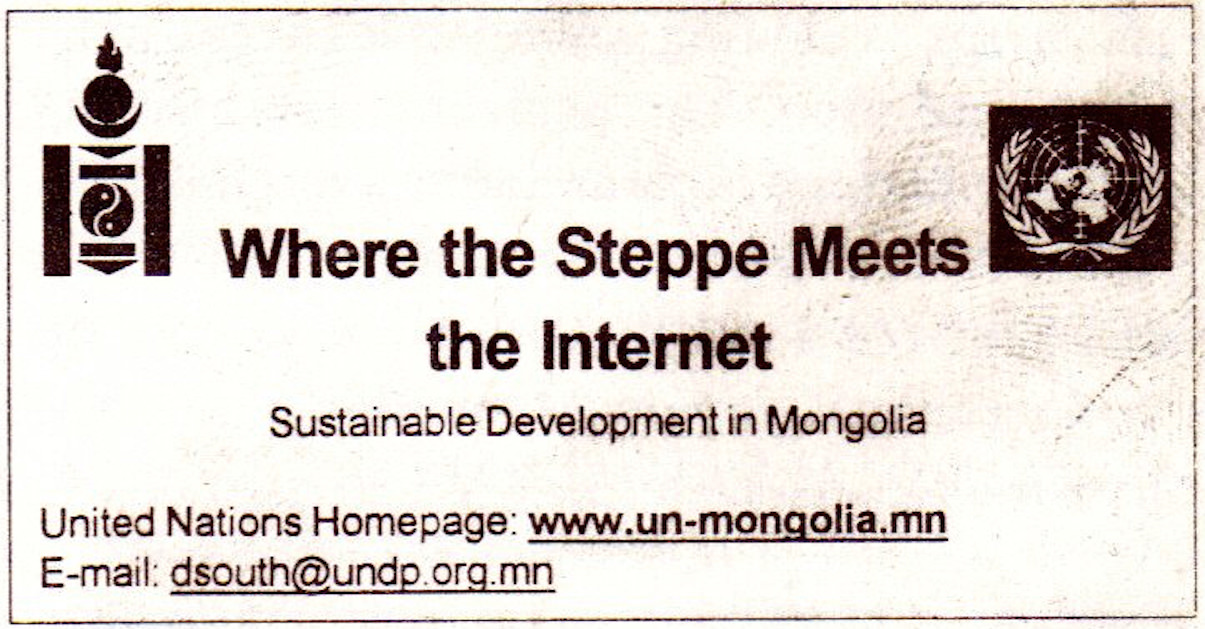
The UN/UNDP Mongolia development web portal addressed the urgent need to communicate what was happening in the country during a major crisis, and to transparently show what the UN was doing to address the crisis. It made critical data on the country’s development easy to find, and informed the wider world about the country and its people and culture. While the Internet had only just arrived in Mongolia, from the start the UNDP Mongolia Communications Office was experimenting with this powerful new technology to reach a global audience. This included Mongolia’s first web magazine, Ger (launched in 1998). After the http://www.un-mongolia.mn website launched in 1997, a media campaign began to inform readers of its presence. This ad appeared regularly in magazines, newsletters and newspapers.
“A UN System site. A very nice, complete, professional site. Lots of information, easily accessible and well laid out. The information is comprehensive and up-to-date. This is a model of what a UNDP CO web site should be.”

I was head of communications for the United Nations mission in Mongolia from 1997 to 1999. The mission had to primarily tackle three major crises: the country’s turbulent transition from Communism to free markets and democracy, the social and economic crash this caused, and the Asian Financial Crisis (Pomfret 2000) (Quah 2003)*.

UNDP Mongolia staff photo 1997. I served for two years as the UNDP Mongolia head of communications (1997-1999). I am sitting front row centre left of the UN Resident Coordinator Douglas Gardner.

Richard Pomfret said in 1994 “In 1991 Mongolia suffered one of the biggest peacetime economic collapses ever (Mongolia’s Economic Reforms: Background, Content and Prospects, Richard Pomfret, University of Adelaide, 1994).”

From Curbing Corruption in Asia: A Comparative Study of Six Countries by Jon S. T. Quah: “The combined effect of these three shocks was devastating as ‘Mongolia suffered the most serious peacetime economic collapse any nation has faced during this century’. Indeed, Mongolia’s economic collapse ‘was possibly the greatest of all the (peaceful) formerly’” Communist countries. 

“The years 1998 and 1999 have been volatile ones for Mongolia, with revolving door governments, the assassination of a minister, emerging corruption, a banking scandal, in-fighting within the ruling Democratic Coalition, frequent paralysis within the Parliament, and disputes over the Constitution. Economically, the period was unstable and rife with controversies.” Mongolia in 1998 and 1999: Past, Present, and Future at the New Millennium by Sheldon R. Severinghaus, Asian Survey, Vol. 40, No. 1, A Survey of Asia in 1999 (Jan. – Feb., 2000), pp. 130-139 (Publisher: University of California)

Writing in 2018, author John West  found, in a chapter titled Mongolia’s Corruption Curse (Transparency International and the World Bank had found corruption worsened in Mongolia after 2001), “In many ways, Mongolia has everything going for it. After being a satellite state of the former Soviet Union for much of the twentieth century, Mongolia regained its independence with the end of the Cold War. A relatively peaceful political revolution in the early 1990s ushered in a multi-party democracy and open society which have remained in place. … And it is blessed with vast reserves of copper, gold, coal, molybdenum, fluorspar, uranium, tin and tungsten deposits. True, Mongolia experienced great upheavals as the breakup of the Soviet Union saw its trade decline by 80%. But Mongolia was also perfectly placed to benefit from the commodity super cycle driven by China, which is now the destination for the vast majority of its exports.

“However, despite much hype about the Mongolian “wolf economy”, this country of so much promise is being dragged down by massive corruption. …

“Mongolia’s corruption is greatly weakening its attractiveness as an investment destination, is fracturing society and weakening its fragile political institutions. Its culture of corruption has also fed its love-hate relationship with foreign investors, which has destabilized the economy.” Asian Century … on a Knife-edge: A 360 Degree Analysis of Asia’s Recent Economic Development by John West, Springer, 24 January 2018.  

In this role, I pioneered innovative use of the Internet and digital resources to communicate the UN’s work and Mongolia’s unfolding crises. The UN called this work a “role model” for the wider UN and country offices. A survey of United Nations country office websites in 2000 ranked the UN Mongolia website I launched in 1997 and oversaw for two years (1997-1999), third best in the world, saying: “A UN System site. A very nice, complete, professional site. Lots of information, easily accessible and well laid out. The information is comprehensive and up-to-date. This is a model of what a UNDP CO web site should be.” (http://www.scribd.com/doc/274319690/UNDP-Mongolia-United-Nations-2000-Survey-of-Country-Office-Websites)

As part of a strategic plan to raise awareness of Mongolia’s development challenges and to spur action on meeting them, a Communications Office was established for the UN mission in 1997. Acting as a strategic hub, the Communications Office and its dynamic and talented team, were able to leverage the existing budget to spur action on many fronts.

In 2001, the UN won the Nobel Peace Prize for “their work for a better organized and more peaceful world” and its communications innovations, with work such as that in Mongolia being cited as a contributing factor to the awarding of the Prize

The Nobel Peace Prize 2001 joint winners.

GOSH Child Health Portal (www.gosh.nhs.uk)

In 2001 I undertook a two-year contract to modernise the online resources for the Great Ormond Street Hospital for Children NHS Trust (GOSH)/Institute of Child Health (ICH). My strategy was inspired and informed by initiatives encountered while working as a health and medical journalist in 1990s Canada – a time where government austerity spurred a need to experiment and try new ways of doing things.

Having seen the impact first-hand of pilot experiments in Toronto aimed at widening access to information and resources for patients and their families, I applied this knowledge to the GOSH Child Health Portal Project (2001 to 2003). Drawing on the wider NHS Modernisation Plan, and a multi-year consultation process undertaken by the hospital, the Project was launched in three phases. 

How far the UK had fallen out of step with global developments with the Internet became clear from the start. The distance that had to be traveled in the span of two years was vast. Essentially, to go from being a web laggard to a web leader. 

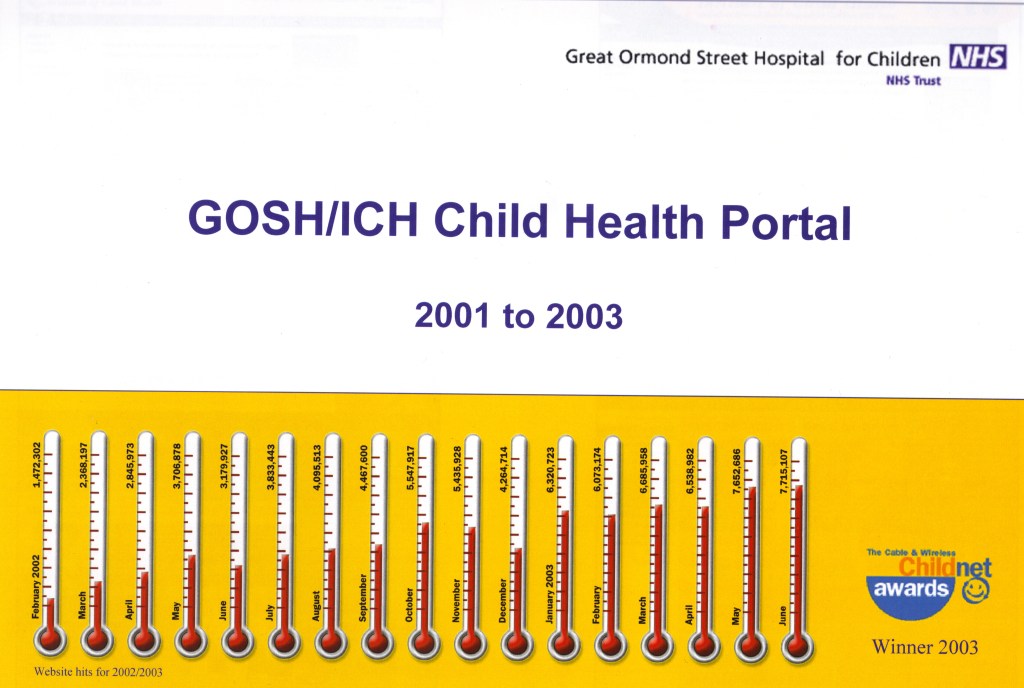
Award-winning (http://www.scribd.com/doc/35249271/Childnet-Awards-2003-Brochure), the GOSH Child Health Portal was called by The Guardian newspaper one of the “three most admired websites in the UK public and voluntary sectors,” and a UK government assessment called the overall GOSH child health web portal a role model for the NHS. At the time, Prime Minister Tony Blair (whose wife, Cherie Blair, was an early supporter and champion of the project) had this to say: “Making sure that your child has helpful, easy-to-read information will make a significant difference to their time in hospital. I am sure that this website will prove very useful for children and their families.”

The project was delivered in three phases. At every stage, progress was communicated to the wider public and colleagues in various ways, via in-house media and through constant engagement with British news outlets. Screen grabs and other resources from the project can be found online here: 

Phase 1: https://books.google.co.uk/books?id=g826gFjEXWsC&printsec=frontcover&dq=gosh+health+phase+1a&hl=en&sa=X&ved=0ahUKEwj5u__dqIHLAhVJOxoKHZ3IDZcQ6AEIJTAA#v=onepage&q=gosh%20health%20phase%201a&f=false 

Phase 2: https://books.google.co.uk/books?id=E2ZVlFbrCzsC&printsec=frontcover&dq=gosh+health+phase+2a&hl=en&sa=X&ved=0ahUKEwjEodr0qIHLAhWK2BoKHStJB7QQ6AEIJjAA#v=onepage&q=gosh%20health%20phase%202a&f=false

Phase 3: https://books.google.co.uk/books?id=KVE6QqDp1HsC&printsec=frontcover&dq=gosh+health+phase+3&hl=en&sa=X&ved=0ahUKEwiXwe-FqYHLAhVBvxoKHXhOCooQ6AEIJjAA#v=onepage&q=gosh%20health%20phase%203&f=false

Project documents: https://books.google.ca/books?id=4aeDBgAAQBAJ&dq=gosh+child+health+portal+key+documents&source=gbs_navlinks_s

The Cable and Wireless Childnet Award called Children First “an outstanding example of how a hospital can create quality, authoritative information on issues relating to health in a fun, child-centered and accessible way.”

More here from The Guardian and CBS: Hospital unveils international website for children and Web Projects For Kids Get Their Due 

The Childnet Awards in 2003 were awarded by Trond Waage, the Norwegian Ombudsman for Children, at the Science Museum in London.
The GOSH Child Health Portal team receive the Childnet Award in 2003 at London’s Science Museum (Photo: CBBC Newsround).
“Web Projects For Kids Get Their Due.”
“Hospital unveils international website for children.”
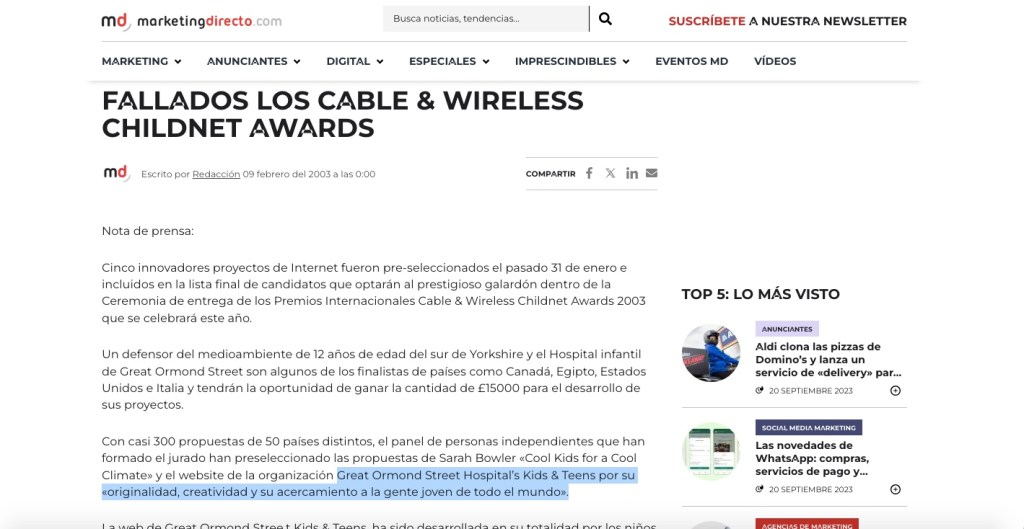
“… Great Ormond Street Hospital’s Kids & Teens por su «originalidad, creatividad y su acercamiento a la gente joven de todo el mundo». La web de Great Ormond Street Kids & Teens, ha sido desarrollada en su totalidad por los niños del hospital de mayor tamaño de Gran Bretaña.”

ORCID iD: https://orcid.org/0000-0001-5311-1052.

© David South Consulting 2024

Categories
Archive Blogroll data Development Challenges, South-South Solutions Newsletters digital ID Southern Innovator magazine

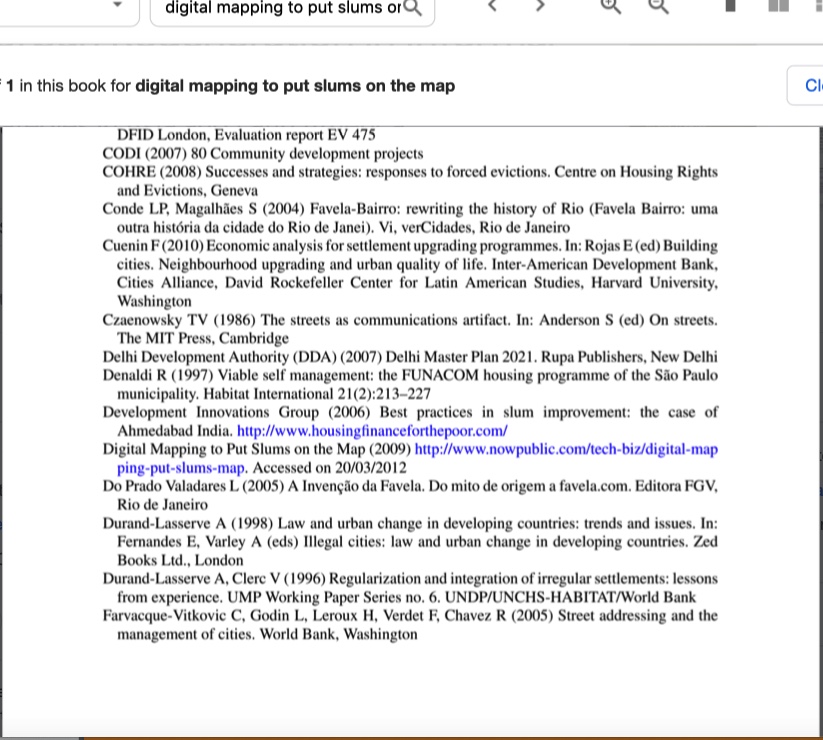
Digital Mapping to put Slums on the Map

By David SouthDevelopment Challenges, South-South Solutions

SOUTH-SOUTH CASE STUDY

Mobile phones are more and more part of daily life in the South’s slums – even for the poorest people. One result is that it has now become possible to undertake digital mapping initiatives to truly find out who is where and what is actually going on.

About one-third of the world’s urban dwellers live in slums, and the United Nations estimates that the number of people living in such conditions will double by 2030 as a result of rapid urbanization in developing countries. How to improve their living conditions and raise their standard of living is the big challenge of the 21st century.

With just over five years until the 2015 deadline to meet the Millennium Development Goals (http://www.undp.org/mdg/), and the current economic downturn reversing some gains, any tool that can make development decisions more precise has to be a benefit.

People are now turning to the growing penetration of digital technologies into slums and poor areas to find solutions. With mobile phones available across much of the global South, and plans underway to expand access to broadband internet even in poorly served Africa, it is becoming possible to develop a digital picture of a slum area and map its needs and population.

Put to the right use, this powerful development tool can fast-track the delivery of aid and also better connect people to markets and government services.

In November, an NGO called Map Kibera (www.mapkibera.org) began work on an ambitious project to digitally map Africa’s largest slum, Kibera in Nairobi, Kenya .

The partners behind Map Kibera are Humanitarian OpenStreetMap, JumpStart International, WhereCampAfrica, the Social Development Network, Pamoja Trust, Hands on Kenya and others.

Estimates place the number of residents in Kibera at one million, but nobody really knows how many live there (UN-HABITAT). The slum is typical of such deprived areas, lacking in health and water resources and plagued by chaotic traffic and housing. Few fully grasp where everything is in the sprawl.

While data does exist on the slum, it is not shared or collated into one source. The Map Kibera project uses an open-source software programme, OpenStreetMap (http://www.openstreetmap.org/), to allow users to edit and add information as it is gathered. This information is then free to use by anybody wanting to grasp what is actually happening in Kibera: residents, NGOs, private companies and government officials.

This will literally put Kibera on Kenya’s map.

The mapping team started with 12 young people recruited in Kibera to start the work in November of this year. They will be trained and also receive support from the growing Nairobi technology community.

“The project will provide open-source data that will help illustrate the living conditions in Kibera,” said Map Kibera’s Mikel Maron. “Without basic knowledge of the geography of Kibera it is impossible to have an informed discussion on how to improve the lives of residents of Kibera.”

Workshops will communicate with local residents and show them the findings available from the map. Paper maps will be distributed to residents and then updated as new information comes in. It is critical local people are kept informed to build trust and avoid conflict. As can be seen from the Google Street Views (http://www.google.co.uk/help/maps/streetview/) controversy, nobody likes to be mapped without their permission or consent.

Like Kenya, Brazil has a long history of sprawling slums sprouting around its cities. Called favelas, they are complex places, with both rudimentary dwellings and elaborate mansions. Walking into a favela can be a journey through the dreams and aspirations of generations of people, often reflected in their dwellings. Favelas have many services, including hospitals, and there are restaurants and coffee shops. In short, while they are not in the official development plans, the favelas are vibrant economic entities and home to hundreds of thousands of people.

But since they are chaotic and undocumented by official maps, the economic and social development of the favelas is hindered as even basic services like mail delivery are difficult to provide.

An NGO called Rede Jovem (http://www.redejovem.org.br/) is deploying youths armed with GPS (global positioning system)-equipped (http://en.wikipedia.org/wiki/Global_Positioning_System) mobile phones to map the favelas of Rio de Janerio. To start with, they are mapping five favelas: Complexo do Alemão, Cidade de Deus, Morro do Pavão-Pavãozinho, Morro Santa Marta and Complexo da Maré.

“The main goal was to mark public interest spots on a map and show places like schools and institutions and hospitals and restaurants,” Natalia Santos, the executive coordinator for Rede Jovem, told MobileActive (www.mobileactive.org) . “We wanted to spread the news about what slums do have, so all the people can get to know that the slum is not just a place for violence and marginality and robbery.”

The mapping process works like this: the mappers physically travel around the favela and upload information on each, individual landmark (restaurants, roads etc.) as they go. They use Nokia N95s mobile phones that are connected to Google Maps (www.maps.google.com).

According to Santos, reporters enter the information on the map displayed on the phone, and they can video or photograph to add more detail. They are using Wikimapa (www.wikimapa.org.br), and Twitter (www.twitter.com) to log the information.

As Rede Jovem recruited young mappers, they discovered an interesting fact: the male reporters (aged between 17 and 25) were frightened to enter a favela with a mobile phone for fear of either being mugged or being stopped by the police. Because of this fact, all the mappers are young women.

They are ambitious for the future despite their funds running out in December. “We want everyone who has a cell phone with GPS to be a wikireporter,” said Santos .

How important it is to the favela residents to be recognised like this can’t be overstated. “I think they are very happy because they’re seeing that they exist,” said Santos. “And the mailman says that now he can deliver the mail.”

Published: December 2009

Resources

  • Mobile Active.org: MobileActive.org is a community of people and organizations using mobile phones for social impact. They are committed to increasing the effectiveness of NGOs around the world who recognize that the over 4 billion mobile phones provide unprecedented opportunities for organizing, communications, and service and information delivery. Website: http://www.mobileactive.org
  • Google Android: Get inventing! This software enables anyone to start making applications for mobile phones. And it offers a platform for developers to then sell the applications to others. Website: http://www.android.com/
  • Ushahidi: is a website that was developed to map reports of violence in Kenya after the post-election fallout at the beginning of 2008. The new Ushahidi Engine is being created to use the lessons learned from Kenya to create a platform that allows anyone around the world to set up their own way to gather reports by mobile phone, email and the web – and map them. It is being built so that it can grow with the changing environment of the web, and to work with other websites and online tools. Website: http://blog.ushahidi.com/
  • Textually.org: is the entry point of three weblogs devoted to cell phones and mobile content, focusing on text messaging and cell phone usage around the world, tracking the latest news and social impact of these new technologies. Website: http://www.textually.org/
  • Betavine Social Exchange has launched. It’s a matching site for NGOs looking for mobile solutions, and developers who can help build them, all brought to you by Vodafone. Website: http://www.betavine.net

Citations

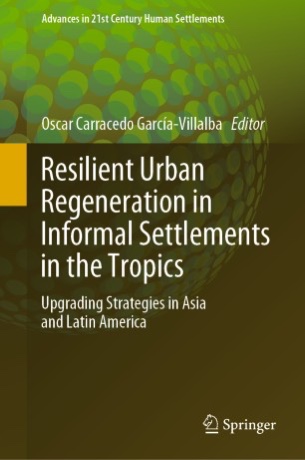
Resilient Urban Regeneration in Informal Settlements in the Tropics: Upgrading Strategies in Asia and Latin America, Publisher: Springer Singapore (2020)

The story first appeared in the UN e-newsletter Development Challenges, South-South Solutions in 2009. It was simultaneously published on the Vancouver, Canada-based crowd-powered news website, NowPublic. It was then published in the UN magazine Southern Innovator.

Streets as Tools for Urban Transformation in Slums: A Street-led Approach to Citywide Slum Upgrading, Publisher: United Nations Human Settlements Programme (UN-Habitat) (2012)

Other Stories on Mapping

https://davidsouthconsulting.org/2021/08/28/african-entrepreneur-wants-to-bring-order-to-urban-chaos/

https://davidsouthconsulting.org/2020/12/04/big-data-can-transform-the-global-souths-growing-cities/

https://davidsouthconsulting.org/2021/03/04/indian-id-project-is-foundation-for-future-economic-progress/

https://davidsouthconsulting.org/2022/10/31/mapping-beirut-brings-city-to-light/

https://davidsouthconsulting.org/2022/10/17/mapping-to-protect-kenyas-environment-the-emazingira-solution/

https://davidsouthconsulting.org/2021/03/31/new-weapon-against-crime-in-the-south/

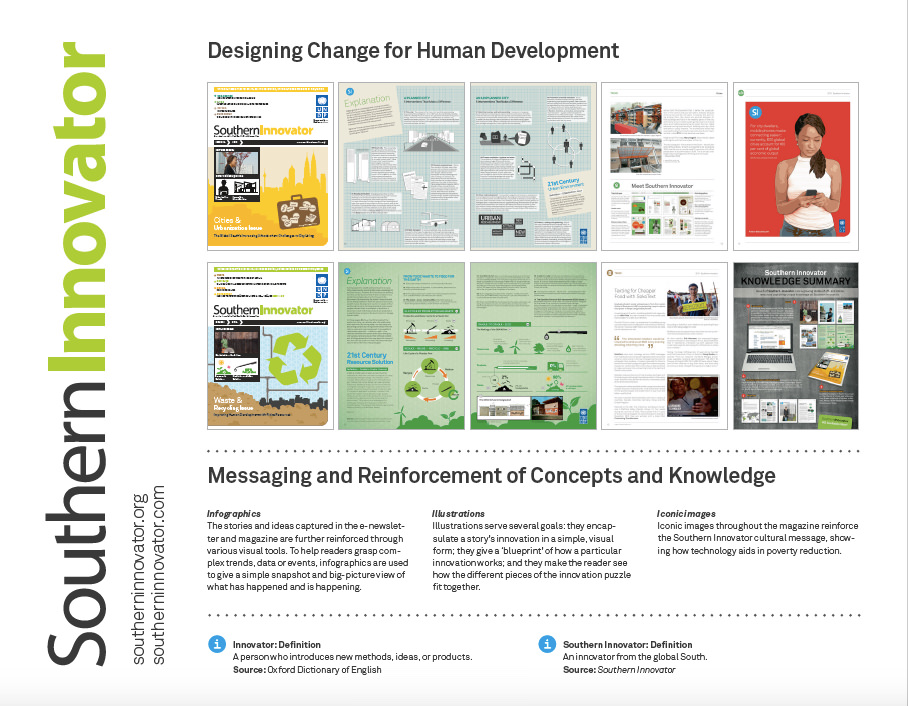
By 2014, Southern Innovator had published five issues and become a recognised global innovation brand.

https://davidsouthconsulting.org/2021/03/05/southern-innovator-issue-4/

Follow @SouthSouth1

Slideshare: http://www.slideshare.net/DavidSouth1/development-challengessouthsouthsolutionsnovember2010issue

Southern Innovator Issue 1: https://books.google.co.uk/books?id=Q1O54YSE2BgC&dq=southern+innovator&source=gbs_navlinks_s

Southern Innovator Issue 2: https://books.google.co.uk/books?id=Ty0N969dcssC&dq=southern+innovator&source=gbs_navlinks_s

Southern Innovator Issue 3: https://books.google.co.uk/books?id=AQNt4YmhZagC&dq=southern+innovator&source=gbs_navlinks_s

Southern Innovator Issue 4: https://books.google.co.uk/books?id=9T_n2tA7l4EC&dq=southern+innovator&source=gbs_navlinks_s

Southern Innovator Issue 5: https://books.google.co.uk/books?id=6ILdAgAAQBAJ&dq=southern+innovator&source=gbs_navlinks_s

Creative Commons License

This work is licensed under a
Creative Commons Attribution-Noncommercial-No Derivative Works 3.0 License.

ORCID iD: https://orcid.org/0000-0001-5311-1052.

© David South Consulting 2022

Categories
Archive data Development Challenges, South-South Solutions Newsletters digital ID

Microwork Pioneer Transforms Prospects For Poor, Vulnerable

By David SouthDevelopment Challenges, South-South Solutions

SOUTH-SOUTH CASE STUDY

A pioneering technology social enterprise has found a way to connect people around the world to the new digital economy, transforming their lives and providing long-term employment opportunities. It is closing the digital divide in a very practical way, teaching new skills and, most importantly, providing income to the poor and vulnerable.

The San Francisco, USA-based non-profit social enterprise Samasource (samasource.org) uses what it calls microwork – a virtual assembly line of small tasks broken down from a larger project so they can be completed over the Internet – to outsource work to its network of workers around the world.

The tasks in this virtual piecework range from writing to transcribing to organizing online content.

The company organizes the projects using its own online work distribution system connecting workers around the world to the SamaHub in San Francisco. Most of the workers are women, youth and refugees. When they complete their task, it is sent back to the SamaHub in San Francisco where the staff check it and assure its quality. Once approved and completed, the project is returned to the client.

The company was founded in 2008 and draws on experts in “distributed work, economic development, and outsourcing.”

The microwork is divided into three areas: content services, data enrichment and transcription.

Content services can include writing descriptions for online business listings, organizing large databases on information or creating brief descriptions of existing content to make it easier for search engines to find it. “Data enrichment” tackles the vast quantity of information on the Internet that needs to be kept up to date and reliable. It also includes ‘tagging’, where text or images on the Internet need to have appropriate ‘tags’ or labels. And finally, transcription services include digitizing paper documents like receipts or books or transcribing audio and video files for the web.

All these tasks are labour intensive and require high attention to detail. And they are critical to any online business’s success if it wants a reputation for accuracy and consistency.

Samasource is optimistic about its future potential because of the sheer size of the market for business process outsourcing: estimated to be worth over US $100 billion. What Samasource does, called ‘impact sourcing’ – outsourcing to people in the developing world living in poor or remote communities – is a market worth US $5 billion, according to Samasource’s website.

It differs from conventional business process outsourcing in a number of respects, including the educational background of the workers. Most conventional outsourcing goes to college graduates in cities in India, China and the Philippines. Impact outsourcing is done by people with at most a high school education.

The digital economy needs these workers to handle the many millions of detailed tasks required to link together information. It is easy to take this for granted because it is hidden from view, but it is what enables the Internet to function and businesses to thrive. Samasource provides outsourcing services including content moderation and data entry to clients like LinkedIn, Intuit and the US State Department.

“We bring dignified, computer-based work to women, youth, and refugees living in poverty,” said Samasource’s founder and chief executive officer, Leila Janah.

Janah has a background in development studies and formerly worked for the World Bank. This experience convinced her that much foreign aid was failing to target what poor people are really looking for: a job that pays well.

Samasource sees what it does as work, and not handouts.

It also believes it is changing perspectives, proving people from the poorest places on earth can become trustworthy, hard-working knowledge workers.

The Internet is a unique medium because it transcends borders and smooths contact between people with varying linguistic, cultural and educational capabilities.

“The Internet reduces the friction of collaboration across all of these centres and time zones, and with a highly distributed workforce,” said Janah.

Samasource claims to have paid out US $1 million in wages to more than 1,500 workers around the world. Ambitiously, it wants to expand this to reach some of the 144 million youth between 16 and 24 living on less than US $2 a day.

Youth are a particular focus for Samasource. Samasource targets young people who are literate and have received an education but still can’t get a job.

As for the many women employed by Samasource, they were either unemployed or earning poverty-level wages doing precarious work in low-level manufacturing and not building their skills.

Samasource currently has 16 partnerships in Haiti, India, Pakistan, Kenya, Uganda and South Africa. Criteria to work with Samasource includes being in a high-poverty region. Another criteria is for most of the money earned to stay within the region where the work is done and adhere to the standards laid down by Samasource.

Samasource’s success means it has attracted further funding. In December 2011, it was given a US $1.5 million grant from Google.org – the Google.com search engine’s charity. It has also raised US $5 million from non-profit investors, including the Ford Foundation, the Rockefeller Foundation and the eBay Foundation. The challenge for the Samasource model will be to prove, with this new funding, that it can scale its operations to pay out more to its workers than it is taking in to meet its operating costs.

Microwork is turning out to be big work indeed!

Published: January 2012

Development Challenges, South-South Solutions was launched as an e-newsletter in 2006 by UNDP’s South-South Cooperation Unit (now the United Nations Office for South-South Cooperation) based in New York, USA. It led on profiling the rise of the global South as an economic powerhouse and was one of the first regular publications to champion the global South’s innovators, entrepreneurs, and pioneers. It tracked the key trends that are now so profoundly reshaping how development is seen and done. This includes the rapid take-up of mobile phones and information technology in the global South (as profiled in the first issue of magazine Southern Innovator), the move to becoming a majority urban world, a growing global innovator culture, and the plethora of solutions being developed in the global South to tackle its problems and improve living conditions and boost human development. The success of the e-newsletter led to the launch of the magazine Southern Innovator.  

Follow @SouthSouth1

Like this story? Here is a dirty secret: this website is packed with stories about global South innovators. We spent 7 years researching and documenting these stories around the world. We interviewed the innovators to learn from them and we visited them to see how they did it. Why not use the Search bar at the top and tap in a topic and see what stories come up? As for my work, I have been involved with start-ups and media ventures since the early 1990s. In the years since I have learned a great deal about innovation and digital and have shared these insights in the stories on this website as well as in the 5 issues of Southern Innovator magazine. So, stick around and read some more!    

Google Books: https://books.google.co.uk/books?id=qLYTxcC8HgcC&dq=development+challenges+january+2012&source=gbs_navlinks_s

Slideshare: http://www.slideshare.net/DavidSouth1/development-challengessouthsouthsolutionsjanuary2012issue

Southern Innovator Issue 1: https://books.google.co.uk/books?id=Q1O54YSE2BgC&dq=southern+innovator&source=gbs_navlinks_s

Southern Innovator Issue 2: https://books.google.co.uk/books?id=Ty0N969dcssC&dq=southern+innovator&source=gbs_navlinks_s

Southern Innovator Issue 3: https://books.google.co.uk/books?id=AQNt4YmhZagC&dq=southern+innovator&source=gbs_navlinks_s

Southern Innovator Issue 4: https://books.google.co.uk/books?id=9T_n2tA7l4EC&dq=southern+innovator&source=gbs_navlinks_s

Southern Innovator Issue 5: https://books.google.co.uk/books?id=6ILdAgAAQBAJ&dq=southern+innovator&source=gbs_navlinks_s

Creative Commons License
This work is licensed under a
Creative Commons Attribution-Noncommercial-No Derivative Works 3.0 License.

ORCID iD: https://orcid.org/0000-0001-5311-1052.

© David South Consulting 2021

Categories
Archive Blogroll United Nations Development Programme

UN Ukraine Web Development Experience | 2000

In November/December 2000 I worked in Kyiv/Kiev, Ukraine for the United Nations mission on the strategic re-launch of the mission website as a portal, whilst also advising the UN Resident Coordinator/UNDP Resident Representative Douglas Gardner on communications strategy. It was an extraordinary experience on many levels. It was a time when the Internet was fast evolving and required quick thinking and an ability to innovate; it was also a key moment in Ukraine’s history. 

The dangers at the time for communicating on the Internet were starkly clear: on September 16, the Ukrainian journalist Georgy Gongadze was murdered. In 2013 Aleksei Pukach, former head of the surveillance department in the Ministry of Interior, was convicted of the murder. 

According to Olena Nikolayenko in Youth Movements and Elections in Eastern Europe (Cambridge University Press, 2017), “Gongadze’s murder in September 2000 engendered the Ukraine without Kuchma Movement. The website Maidan (http://maidanua .org) was initially set up by civic activists to provide extensive coverage of the movement’s activities.”

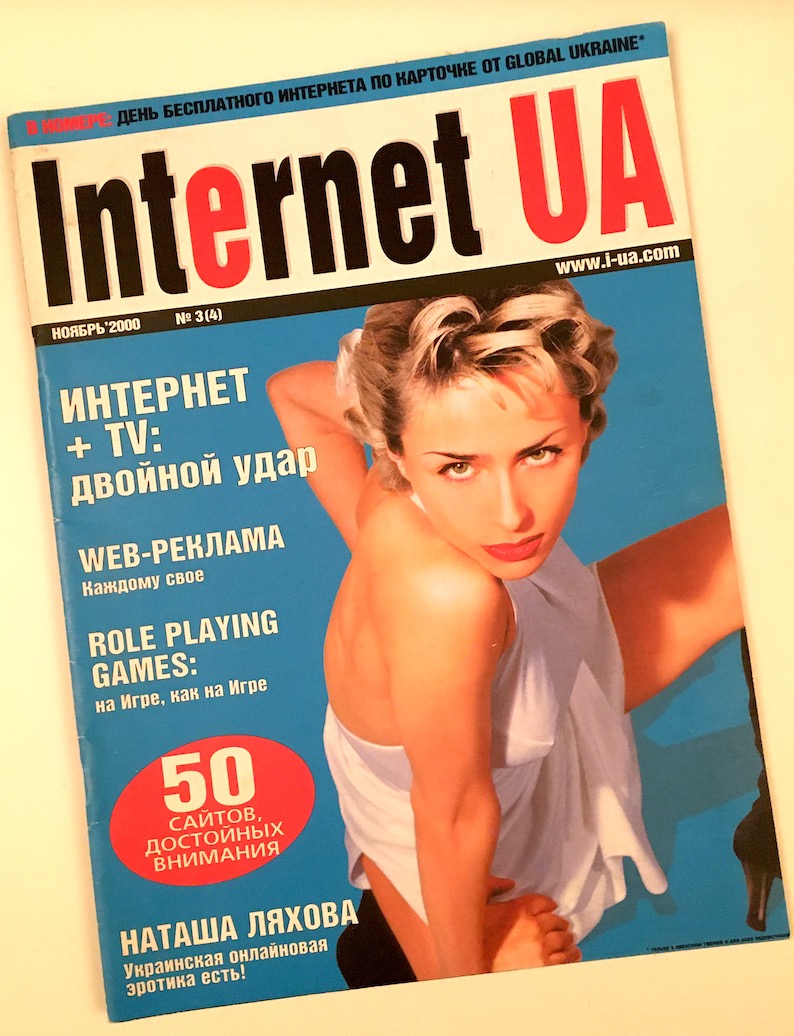
But despite those dangers and clear threats from the government of the time, there was a flourishing and inventive Internet and digital economy. The magazine Internet UA (whose editor I enjoyed meeting) gave a great overview of the scene in Ukraine and its creativity. Just as now, the creation of Internet stars who can exploit the medium (in this case sexy videos: a very large online market today) was driving viewers and subscribers. But there was also a vibrant online news media, blogging, commerce and gaming presence as well.

Internet UA magazine: Sex sells and the sex industry has always had pioneers seeking new ways to get eyeballs for their content. The Internet from its early days has been driven by the search for nude pictures and sex videos. In this cover feature, “Internet + TV: Double Impact”. That content mix has become the foundation of websites such as Pornhub etc.

According to ain.ua, the Ukrainian digital economy today is ” … ‘local’ only just figuratively speaking. Ukrainian startups are initially focused on international markets. Product companies are included into international industry ratings. Outsourcing works with clients from all over the world. Global players enter Ukrainian market, opening R&D offices, acquiring and investing into local companies. There are no boundaries.” 

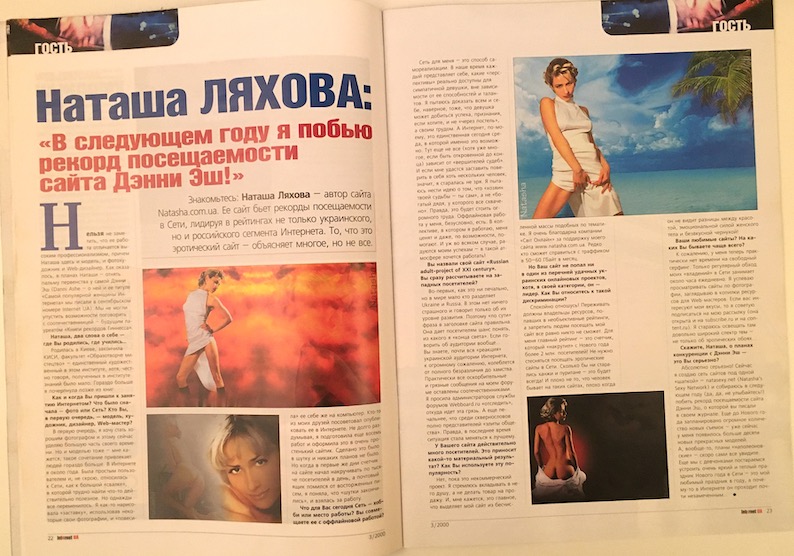
A magazine feature on ‘Natasha’s’ Internet content offering.

It is easy to take digital freedoms for granted now but there was great resistance at the time and, unlike today, many governments were openly hostile to digital technology, online communications and e-commerce.

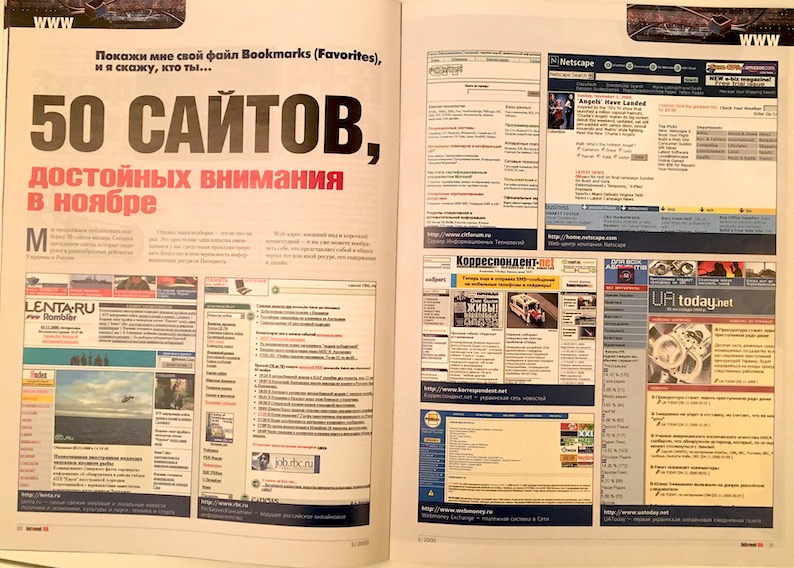
50 websites to bookmark in 2000.

The UN itself was evolving and embracing the communications and design revolution being driven by digital change. This was the first “dot.com” boom, which had begun in 1997. I had played a key role in pioneering online content for Mongolia (1997-1999) and could bring this experience to Ukraine. In particular, I launched an award-winning web portal for the UN Mongolia mission in 1997 (www.un-mongolia.mn) and also the country’s first web magazine, Ger

The UN Ukraine brief involved creating content that was accessible to users with low bandwidth, dial-up connections (few had mobile phones in 2000). I had been building new media experience throughout the 1990s, tracking the cable and satellite TV and mobile/Internet revolutions for the Financial Times as a journalist, as well as launching websites for various media clients. 

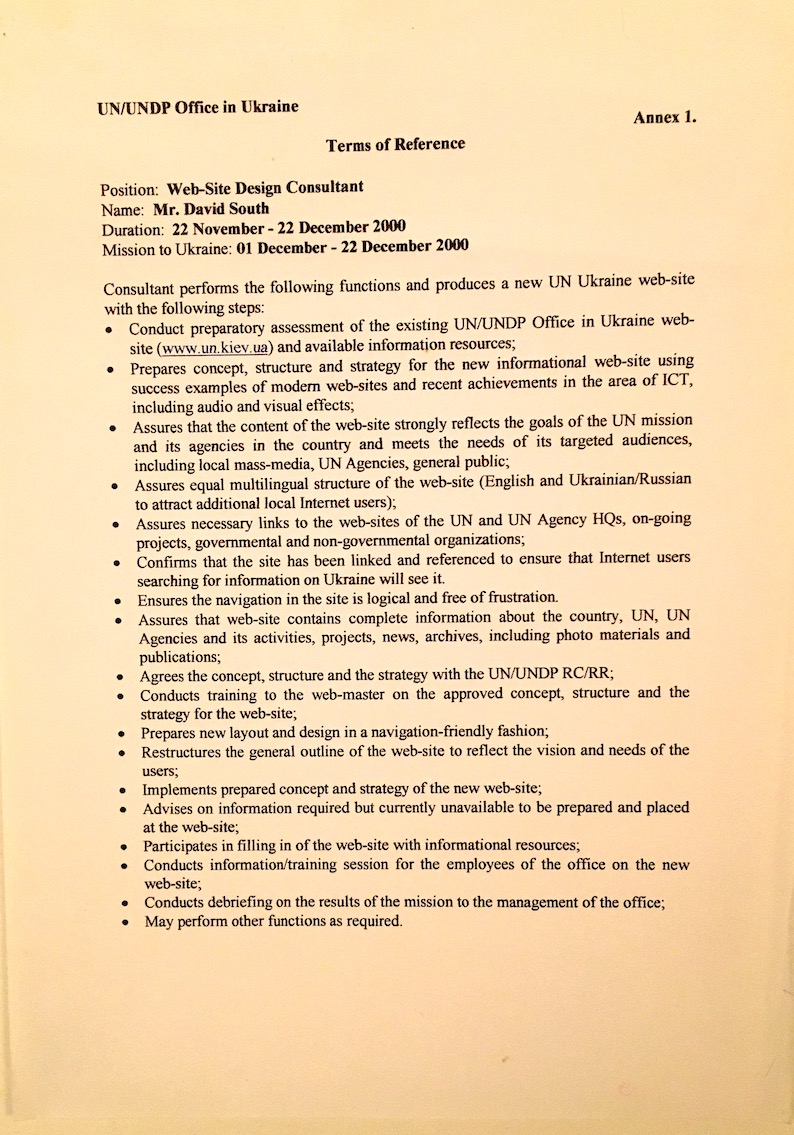
The Terms of Reference for the UN/UNDP Ukraine assignment.
The assignment business card.
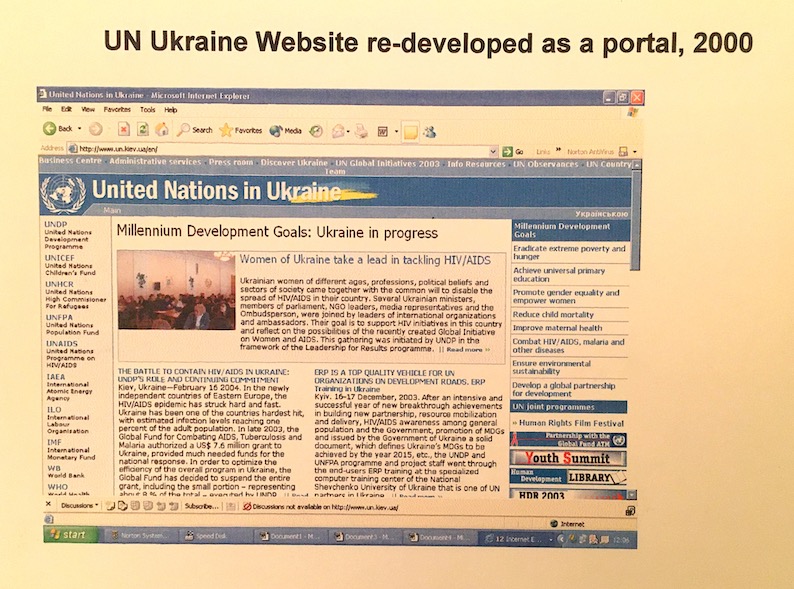
The UN/UNDP Ukraine website before launch as a portal.
The first iteration of the new UN Ukraine portal.

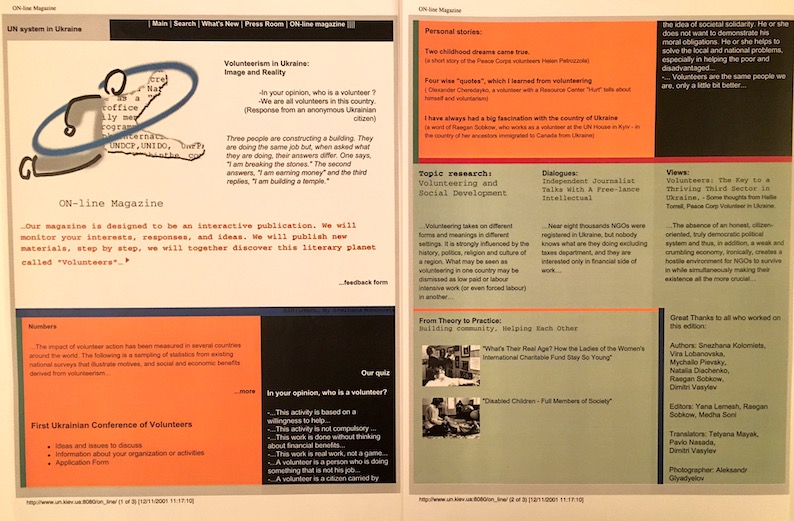
Key content created and launched on the UN Ukraine portal included critical information on the HIV/AIDS crisis in Ukraine, UN Ukraine’s first online magazine to explore perceptions of volunteering and NGOs in the post-communist period, and content preparing for the visit of the UN Secretary-General Kofi Annan, by showing how Ukraine was engaging with global development priorities, for example the eight Millennium Development Goals (MDGs), and bringing together UN agencies and entities into a cohesive web and “One UN” experience.

The first UN Ukraine online magazine.
Bringing together UN agencies and entities into a cohesive web and “One UN” experience.

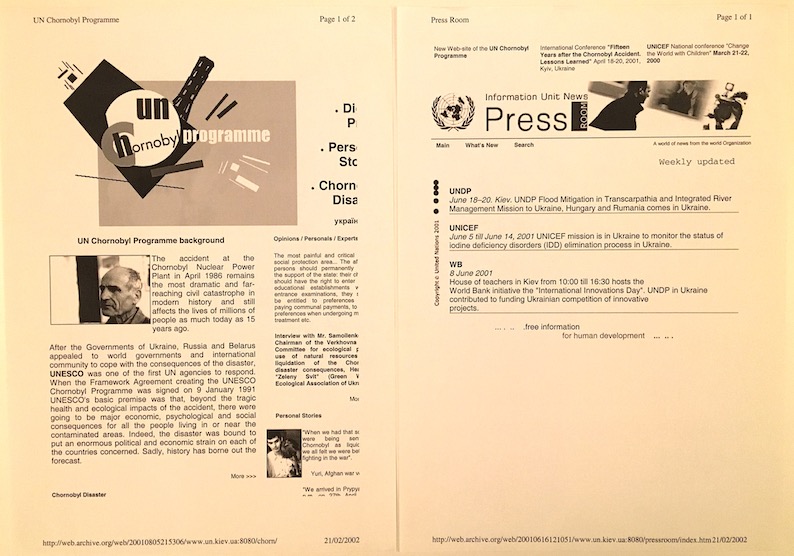
One highlight of this assignment was working with the “UN Chornobyl Programme” to develop its web content. This included visiting Pripyat (https://en.wikipedia.org/wiki/Pripyat),an abandoned city because of the Chernobyl Nuclear Power Plant disaster in 1986. I have visited many abandoned and “secret” cities and towns in the course of working with the United Nations but this particular visit had the added dimension of an environmental and human health disaster hanging over it (and as a former healthcare worker at Canada’s top cancer hospital and research institute, I couldn’t forget the impact of high radiation levels on the body).  

UN Chornobyl Programme website in development, 2000.
UN agencies in Ukraine.
UNDP in Ukraine.

The power of the Internet and the digital economy to engage people, especially the young, despite living in a country with significant political repression of free speech and even physical intimidation and murder, stuck with me. This work also contributed to laying the foundations for Ukraine’s growing freedoms and greater engagement with Europe. 

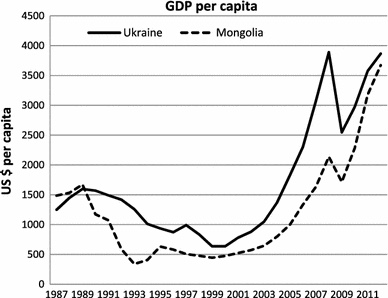
As this chart shows, increasing connectivity had a profound impact on living standards in Ukraine and Mongolia post-2000. The extreme turbulence Mongolia experienced in the 1990s – after the collapse of support mechanisms from the Soviet Union – calmed down as Mongolia integrated with the global economy, especially a booming China.

Read about my work in Mongolia in the late 1990s:

High Impact Communications In A Major Crisis: UNDP Mongolia 1997-1999 | 18 February 2016

CASE STUDY 4: UN + UNDP Mongolia | 1997 – 1999

https://davidsouthconsulting.org/2022/11/23/papers/

https://davidsouthconsulting.org/2021/11/16/us-mongol-construct-2000-business-prospectus-building-a-new-democracy-2000/

https://davidsouthconsulting.org/2020/11/05/wild-east-17-years-later-2000-2017/

Creative Commons License

This work is licensed under a
Creative Commons Attribution-Noncommercial-No Derivative Works 3.0 License.

ORCID iD: https://orcid.org/0000-0001-5311-1052

© David South Consulting 2024