The image of Africa as a technological laggard is set to be seriously challenged as a number of developments converge in 2007. Alongside the booming African mobile phone market – itself now getting global attention for innovation – the African computer scene will soon have both the software and hardware that acknowledge the continent’s unique needs while being affordable. Further challenging stereotypes, the continent’s burgeoning and dynamic open source software movement is the subject of a new film by a Danish filmmaker, and the African-made Ubuntu, Linux-based operating system now has a new user manual to help it attract new adherents.
African technological innovation rarely makes headlines in the West. But a Danish filmmaker is changing these perceptions with his film showing the dynamism and enthusiasm behind the open source software movement in Africa. The yet-untitled film, directed by David Madie, is from Eighty Days Productions and is due for release in the spring of 2007. It follows a young computer entrepreneur, Wire Lunghabo James, from Uganda’s Linux Solutions in Africa, who has been instrumental in building the Web’s presence in the country and in East Africa.
“This film will show the characters fighting for what they believe in. This happens to be Open Source, which I think is an important agenda,” director Madie told Tactical Technology Collective ( www.tacticaltech.org), a website “demystifying technology for non-profits.”
Unlike off-the-shelf software, open source software has many advantages. It is free, and no licence fee is required, so as many copies as necessary can be made. It is fully customisable, so local languages and cultural conditions can be taken into consideration. It is a universal language (the most popular is Linux) and thus it is easier to understand how a specific application works. For developing countries, it has the advantage of empowering local programmers and dymistifying computer programming, removing it from the domain of private companies and large government agencies. In 2005 the New Partnership for African Development (NEPAD) urged African countries to embrace open source software to encourage the growth of indigenous software development.
“I think he (James) is also a role model in the sense that he combines doing a business, with doing social work. To him these things are not opposites: these are things that can perfectly work well together. You can do business in a social manner,” Madie said.
The Ubuntu software programme is a complete, free operating system that emphasizes community, support, and ease of use while refusing to compromise on speed, power, and flexibility. Ubuntu is an ancient African word meaning humanity to others, and its software version is described as Linux for human beings – designed for everyone from computer novices to experts. Ubuntu is the most in-demand Linux system in Africa, and the official guide is aimed at NGOs, home users or small businesses.
One Laptop Per Child Project (OLPC)
In another development, the One Laptop Per Child project (OLPC) has announced the release for general sale of its durable bright green and yellow laptops ready loaded with Linux-based operating systems. Customers in wealthy countries will have to buy two laptops, with the second going to a developing country. Five million will be delivered to the developing world over the summer of 2007. The eventual aim is to sell the machine to developing countries for US $100, but the current cost of the machine is about US $150. The OLPC laptop’s software has been designed to work specifically in an educational context. It has built-in wireless networking and video conferencing so that groups of children can work together. The OLPC project is working with the search engine Google, who will act as “the glue to bind all these kids together”. Google will also help the children publish their work on the internet.
The One Laptop Per Child project (http://wiki.laptop.org/go/Home) has struck its first deal with Rwanda’s president Paul Kagame to provide every school pupil with a laptop computer within the next five years. The laptops and all the support costs will be covered by OLPC.
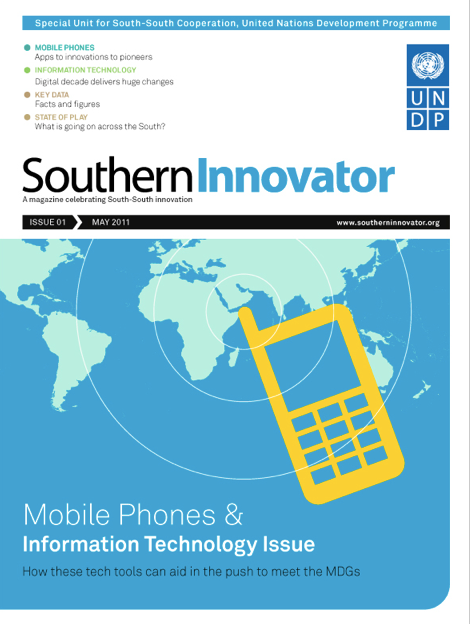
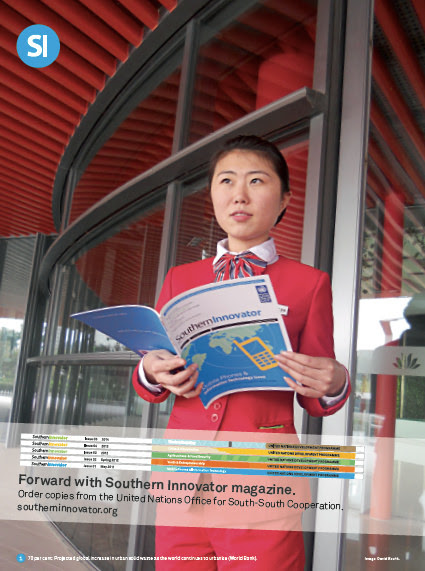
Development Challenges, South-South Solutions was launched as an e-newsletter in 2006 by UNDP’s South-South Cooperation Unit (now the United Nations Office for South-South Cooperation) based in New York, USA. It led on profiling the rise of the global South as an economic powerhouse and was one of the first regular publications to champion the global South’s innovators, entrepreneurs, and pioneers. It tracked the key trends that are now so profoundly reshaping how development is seen and done. This includes the rapid take-up of mobile phones and information technology in the global South (as profiled in the first issue of magazine Southern Innovator), the move to becoming a majority urban world, a growing global innovator culture, and the plethora of solutions being developed in the global South to tackle its problems and improve living conditions and boost human development. The success of the e-newsletter led to the launch of the magazine Southern Innovator.
Cities across the South choke on the pollution made by the small two-stroke engines (http://www.howstuffworks.com/two-stroke.htm) powering motor scooters, motorcycles, auto rickshaws, tuk-tuks and other vehicles. People choose these vehicles to get around because they are cheap, powerful and easy to fix. But the environment – and human health – suffers as a result. And as cities balloon and populations grow, the number of journeys and two-stroke engines grows with it.
In large cities across Asia, 1 million three-wheeled auto-rickshaws form an important means of daily transportation, and a source of income for their drivers. And the Asian Development Bank estimates there are over 100 million vehicles using two-stroke engines in Southeast Asia. But these vehicles cause serious air pollution and emissions of carbon dioxide (CO2), which contributes to global warming.
Because two-stroke engines burn an oil-gasoline mixture, they also emit more smoke, carbon monoxide, hydrocarbons and particulate matter than the gas-only, four-stroke engines found in newer vehicles.
In the Philippines, auto rickshaw drivers are pioneering specially adapted two-stroke engines that reduce particulate emissions by 70 percent and carbon dioxide emissions by 76 percent.
Tim Bauer, the 31-year-old American mechanical engineer who developed the technology, said auto rickshaws “play an essential role in the social and economic fabric. But their impact on public health is disastrous.”
Motorized tricycles produce an astonishing amount of pollution: each one is equivalent to 50 cars. In Bangkok, Thailand, two-stroke engines contribute 47 percent of pollution particulates in the air.
The World Health Organization (www.who.org) ranks urban outdoor air pollution as the 13th greatest contributor to disease burden and death worldwide. It has been estimated that the air pollution leads to the deaths of more than half a million people a year. About two-thirds of the residents of Delhi and Calcutta suffer from respiratory symptoms such as common cold and dry and wet cough, much of this caused by two-stroke engine emissions.
Two-stroke engines are highly inefficient users of fuel: up to 40 percent of the fuel and oil goes out of the exhaust pipe unburned. This exhaust is packed with oxides of carbon, nitrogen, sulphur, hydrocarbons and fine dust – all toxic contributors to air pollution.
But the attraction of these engines remains strong. “They are powerful, simple, reliable and robust,” said Bauer, “and spare parts are easy to find. They also have a long lifetime.”
Bauer faced some strict constraints in developing the technology.
“It had to substantially reduce emissions without impairing the engine’s performance. It had to be installed without machining the engine crankcase, and with only a basic tool set. Of course, it also had to be affordable for Filipino drivers.”
Using off-the-shelf components, Bauer developed a kit that turns two-stroke engines into fuel-injection machines. This adjustment reduced particulate emissions by 70 percent and carbon dioxide emissions by 76 percent. He now sells the kits through Envirofit, a non-profit organization (http://www.envirofit.org/). It has been pilot tested at two Filipino holiday resorts, Vigan and Puerto Princesa.
Auto-rickshaw drivers tend to be poor and earn on average US $3 to US $4 a day. The cost of fitting vehicles with Bauer’s new technology is met by microcredit.
“Drivers earn money daily, so it’s easy for them to pay back their loan, and 90 percent of them do it in less than a year,” he said. Over 260 taxi drivers have already installed the new kit.
“These drivers are at the base of the economic pyramid and these tricycles are a testament to their ingenuity and work ethic. At the end of the day, we can improve their lives with a cylinder head, a few brackets and, of course, hard work.”
Bauer pioneered his solution while working on fuel injection in snowmobiles at the Engines and Energy Conservation Lab at Colorado State University. He started to market the solution in Asia in 2004. Bauer has won a Rolex Award for Enterprise to pay for the distribution of the kits throughout Asia.
There is, of course, another solution: an outright ban or measures to push the vehicles off the road. In the Philippines’ San Fernando City, economic incentives were what drove the transition from two-stroke to four-stroke (less polluting) tricycles. In 2001, three-quarters of the city’s 1,600 registered tricycles ran on two-stroke engines. But after a city council mandate to totally phase out the vehicles by 2004, and offers of interest-free loans for down-payments on four-stroke models, more than 400 four-stroke tricycles had replaced the older two-stroke models.
When Bangkok toughened up vehicle inspections and emissions standards in 2000, two-wheelers made up over 96 percent of the city’s traffic. But by March 2004, they made up only 40 percent, according to Supat Wangwongwatana, deputy director general of Thailand’s Pollution Control Department.
The Hybrid Tuk Tuk Battle is a competition to come up with less polluting auto rickshaws, clean up the air in Asian cities, and improve the economic conditions for auto rickshaw drivers. Website:http://hybridtuktuk.com/
The Clean Air Initiative for Asian Cities promotes and demonstrates innovative ways to improve the air quality of Asian cities through partnerships and sharing experiences. It is run by the Asian Development Bank together with the World Bank and the US Agency for International Development. Website:http://www.cleanairnet.org/
A new book launched in April 2019 by journalist Beth Gardiner (@Gardiner_Beth), “Choked: The Age of Air Pollution and the Fight for a Cleaner Future” (Granta) (University of Chicago Press), explores today’s global air pollution crisis in the world’s cities. Gardiner is an environmental journalist who writes for The New York Times, The Guardian and other publications (bethgardiner.com).
Called “One of the Guardian’s Best Books of 2019“. The UK cover for Choked: The Age of Air Pollution and the Fight for a Cleaner Future (Granta, 2019).
Cutting-edge medical research in China is promising to boost human health and development. Futuristic science is being conducted on a large scale and it is hoped this will increase the pace of discovery.
Around the world, rapid progress is being made in understanding the role played by genes and how they affect our overall health and susceptibility to diseases. Other developments are leading to the possibility of creating replacements for organs and other body parts that have been damaged through accidents, disease or genetic faults – without the need for organ donors.
Medical advances straight out of science fiction could be closer than many believe. By using machines and gene therapy, radical new methods will emerge to deal with damage done to human bodies as a result of accidents or disease. These solutions will become, in time, quicker, smaller and cheaper and will be available to more and more countries. They will spread outwards around the global South just as mobile phones and computing electronics have done.
In China, the government is investing heavily in this cutting-edge research and attracting investment and projects from around the world to increase the pace of progress in these areas.
In September 2013, Reuters reported that a 22-year-old man named Xiaolian in Fuzhou, China had a new nose grown on his forehead to replace his original nose that had been damaged in a car accident. Conventional reconstructive surgery was not possible, so this radical new approach was taken.
The advantages of growing a nose on the patient include a reduced chance of rejection by the body when the new organ is attached. Transplants of body parts from other people come with a high risk of rejection and require many drugs to prevent it. Using skin near where the transplant is to take place, on the face, improves the chances of success and the blood vessels in the forehead offer nourishment to grow the new nose.
The procedure works like this: tissue expanders are placed on the patient’s forehead. As it grows, the doctors cut the mass of tissue into the shape of a nose and cartilage from the patient’s ribs is placed inside to give the nose shape. The new proboscis (http://en.wikipedia.org/wiki/Proboscis) grows under the skin until it is the right size and then transplanted onto the patient’s face where their old nose was.
Many believe this is just the beginning and that in the future replacement organs will be also grown in a lab. And this is where the new medical technology of 3D bioprinting comes into play.
3D printing machines (http://www.k8200.eu/), or fabricators, can create 3D objects based on a design sent from a computer. This concept is now also being applied to biological materials with 3D bioprinters.
Hangzhou Dianzi University of Electronic Science and Technology (hdu.edu.cn) in China launched the Regenovo 3D Bio-printer in August 2013. It prints living tissue and looks like a silver metal frame with various nozzles situated above a platform for printing the tissue. Its makers claim it can print a liver in 40 minutes to an hour or an ear in 50 minutes.
A sheet of hydrogel is placed on the platform and then the bioprinter deposits cells into the hydrogel. As the process is repeated over and over again, layer after layer, a 3D biological structure emerges.
Unique Technology (sinounic.com) in Qingdao, Shandong province has also launched a 3D printer called “Re-human”. It is capable of printing at 15 microns and can operate in temperatures of between 0 and 300 degrees Celsius. Scientists there are working on clinical trials of 3D-printed tissue scaffolds and bones.
China is very advanced in the development of 3D manufacturing technology, and is home to the world’s largest 3D printers, developed by Dalian University of Technology (http://www.dlut.edu.cn/en/). Another Chinese company pioneering this technology is Shaanxi Hengtong Intelligent Machines (http://www.china-rpm.com/english/), which sells various laser-using rapid prototyping machines and 3D machines.
Around the world, bioprinting is currently being pioneered for printing heart valves, ears, artificial bones, joints, vascular tubes, and skin for grafts.
The number of scientific papers mentioning bioprinting tripled between 2008 and 2011 according to Popular Science. But why is this happening? Three things are occurring at once: sophisticated 3D printers are now available, there are significant advances in regenerative medicine, and CAD (computer-aided design) (http://en.wikipedia.org/wiki/Computer-aided_design) software continues to become more advanced.
San Diego, California’s Organovo (organovo.com), a company that designs and creates functional human tissues using 3D bioprinting, has big ambitions for the technology.
“Getting to a whole organ-in-a-box that’s plug-and-play and ready to go, I believe that could happen in my lifetime,” its chief technology officer, Sharon Presnell, told Popular Science.
In the field of gene science, China is also investing significant resources to make rapid progress. China is working to make its genetic research industry into one of the country’s pillar industries.
Beijing Genomics Institute (BGI) (http://www.genomics.cn/en/index) is the world’s largest genome-mapping institute, with more than 1,000 biological analysis devices working with top-of-the-line genome-sequencing machines. What makes BGI different is scale: it can handle data in vast quantities and industrialize its research, according to China Daily.
But what will they do with this information? By doing embryo screening, it will be possible to pick the brightest zygote (http://en.wikipedia.org/wiki/Zygote) and ensure an entire generation’s intelligence is increased by five to 15 IQ (intelligence quotient) points. This could have a significant impact on the country’s economic performance, the researchers believe, and help in the country making more rapid economic and development gains. This line of research is also seen globally as being fraught with ethical dilemmas and is controversial.
But the Chinese researchers believe the country’s economic productivity, business success, international competitiveness and the amount of innovation in the economy could all increase with an IQ boost.
The eggs are fertilized in the lab with the father’s sperm and the embryos are tested until they find the smartest one.
Embryo analysis could take place on a large scale in a few years. But it is not just better brains that are possible with this technique: choices can be made about hair and eye colors, and physical attributes such as body shape.
This level of research is benefiting from vast investments in higher education in China.
And it isn’t just human beings receiving the vast investment in gene research.
To help agriculture and agribusiness, the National Center for Gene Research (NCGR) (ncgr.ac.cn) is mapping and sequencing the rice genome, and genomes of other organisms. Since 2007, it has been using the latest generation sequencing technology to map the rice genome to identify common genetic factors. It has 50 million base pairs of rice genomic DNA sequences in its public database. It is hoped this will lead to more robust rice varieties that can withstand disease and climate fluctuations and help meet the food needs of a growing global population.
Published: November 2013
Resources
1) Wake Forest Institute for Regenerative Medicine: Wake Forest Innovations was created in 2012 as a new operating division of Wake Forest Baptist Medical Center. As the Medical Center’s technology commercialization arm, Wake Forest Innovations supports scholarship, investing in the innovative potential of academic and clinical communities and helping translate ideas and discoveries into valuable commercial products and services. Website: http://www.wakehealth.edu/WFIRM/
2) DEKA Research & Development: DEKA Research and Development Corporation is an established company focused on the development of radical new healthcare technologies that span a diverse set of applications. Website: http://www.dekaresearch.com/index.shtml
3) Organovo: Organovo design and create functional human tissues using proprietary three-dimensional bioprinting technology. The goal is to build living human tissues that are proven to function like native tissues. Website: http://www.organovo.com/
6) Autodesk is working on CAD software for bioprinting. Website: autodesk.co.uk
7) BGI Cognitive Genetics Project: BGI Cognitive Genomics is an interdisciplinary research group at BGI, one of the largest genomics institutes in the world. The focus is human cognition, with emphasis on the use of tools made available by rapid advances in DNA sequencing technology. Website: https://www.cog-genomics.org/
8) Institute of Genetics and Developmental Biology Chinese Academy of Sciences: The mission of the institute is to address fundamental questions in genetics and developmental biology and to develop new technologies for the uses in health care and agriculture sciences as well as to meet the nation’s strategic needs in science and technology. Scientists in the institute use both plant and animal models to address fundamental questions in life sciences, such as genetic control of growth and development, gene expression, signal transduction, structural and functional genomics, biotech and molecular breeding, bioinformatics and systems biology. As China owns the biggest agricultural market in the world, researchers in the Institute have also made significant efforts on water saving agriculture and agronomic studies, focusing on the improvement of crop productivity and quality as well as bio-safety. Website: http://english.genetics.cas.cn/au/
Development Challenges, South-South Solutions was launched as an e-newsletter in 2006 by UNDP’s South-South Cooperation Unit (now the United Nations Office for South-South Cooperation) based in New York, USA. It led on profiling the rise of the global South as an economic powerhouse and was one of the first regular publications to champion the global South’s innovators, entrepreneurs, and pioneers. It tracked the key trends that are now so profoundly reshaping how development is seen and done. This includes the rapid take-up of mobile phones and information technology in the global South (as profiled in the first issue of magazine Southern Innovator), the move to becoming a majority urban world, a growing global innovator culture, and the plethora of solutions being developed in the global South to tackle its problems and improve living conditions and boost human development. The success of the e-newsletter led to the launch of the magazine Southern Innovator.
Since the 1950s, science fiction has been telling the world we will soon be living with robots. While robots have emerged, they have been mostly kept to heavy industry, where machines can perform dangerous, hot and unpleasant repetitive tasks to a high standard.
But China is pioneering the move to mainstream robots in more public spheres. And the country is promising big changes in the coming decade.
Robots, strange as it may seem, can play a key role in development and fighting poverty.
If used intelligently, the rise of robots and robotics – itself a consequence of huge technological advances in information technology, the Internet, nanotechnology,artificial intelligence, and mobile communications – can free workers from boring, difficult and dangerous jobs. This can ramp up the provision of public goods like cleaning services in urban areas, or remove the need to do back-breaking farming work.
Robotics also offers a new field of high-tech employment for countries in the global South who are producing far more educated engineering and science students than they can currently employ. These students can help build the new robot economy.
China is considered to be in the early stages of competing with robot pioneers such as Japan, Switzerland, Germany, Sweden and the United States. And China still has a low penetration of industrial robots per population. In 2011 estimates placed the number of industrial robots in China at 52,290 (International Federation of Robotics) (ifr.org).
In the years ahead, China confronts a double demographic problem. It has the world’s largest elderly population, who will need care, and it also has a shrinking number of young people available to work as a result of the country’s one-child policy (http://en.wikipedia.org/wiki/One-child_policy).
Robots can help solve these problems.
China started its robotics research in the 1970s and ramped it up from 1985. It has already made significant progress manufacturing domestic robots for cleaning. The Xiamen Lilin Electronics Co., Ltd. (http://cnlilin.en.made-inchina.
For the heavy duty stuff, there is Ningbo’s Dukemen Robot, sold with the slogan “man, technology, robot”. The company manufactures arm-like robots for heavy lifting and lifting in dangerous or uncomfortable environments (dukerobot.com/ks/robot-manufacturers/).
A company called Quick specializes in making soldering equipment for manufacturing electronic components and sells robots that can do this with high accuracy and speed (quick-global.com/9-new-soldering-robot-1.html).
Other robotic advances in China include a robot dolphin that swims through the water measuring its quality.
There are also robots in development to do housework and help people who need assistance in the home like the elderly and the disabled. These robots can monitor a person’s physical condition and provide psychological counselling and search for, and deliver, requested items. One example is called UNISROBO, and is based on the Japanese robot PaPeRo robot (http://www.nec.co.jp/products/robot/en/index.html).
Even more ambitiously, China is developing robots to send to the moon.
The push to introduce robots into the workplace and wider society is receiving considerable attention in China.
The Taiwan-based technology company Foxconn – well-known for assembling products for the American company Apple, maker of the iPad and iPhone -has pledged to deploy a million robots in its Chinese factories in the coming years to improve efficiency.
Some are forecasting that if China starts building robots on the scale it has pledged, then the world’s population of manufacturing robots will grow tenfold in 10 years.
China is also broaching one of the trickiest aspects of robotics – getting robots to interact with humans.
The tricky bit in robotics is getting interaction with human beings right and to avoid the experience being intimidating or frightening. One sector that is already ahead in experimenting with this aspect of robots is the restaurant business. One robot being used in restaurants sits on a tricycle trolley laden with drinks. It cycles from table to table in endless rotation allowing customers to choose drinks when they like.
The first robot restaurant started a trial run in 2010 in Jinan (http://en.wikipedia.org/wiki/Jinan), the capital of Shandong Province. The hot pot restaurant uses six robots to help with the service. The restaurant has also given itself the perfect name for this new approach: Continental Robot Experience Pavilion. Adorned with robot posters, the restaurant is 500 square metres in size and can seat 100 diners.
Diners at the Continental Robot Experience Pavilion are greeted by two ‘female’ “beauty robot receptionists” dressed in uniforms. Inside, the six robot waiters serve the customers. There are two to deliver drinks and two to serve the small tables and two to serve the big tables.
The robot comes to the table and takes the customers’ orders for food dishes and drinks. The robots, designed with sensors to stop them moving when they sense something or someone in front of them, are able to handle 21 tables and deal with the 100 customers at a single sitting.
The robots have proven so effective, the restaurant’s staff can stay focused on administration and providing assistance. The cooking is still done by human beings.
This trial run is designed to test the concept and the novelty of having robots attracting customers, the restaurant’s manager told the People’s Daily Online.
The plan is to increase the number of robots to 40 and also to have robots do cleaning and other tasks.
“They have a better service attitude than humans,” said Li Xiaomei, 35, who was visiting the restaurant for the first time. “Humans can be temperamental or impatient, but they don’t (the robots) feel tired, they just keep working and moving round and round the restaurant all night,” Li said to China Daily.
Published: March 2012
Resources
1) The Robot Report: It boasts compiling more than 1,400 robotics-related links and is about “Tracking the business of robotics”. Website: therobotreport.com
2) The Robot Shop: Bills itself as “The world’s leading source for professional robot technology” and sells online all the parts, kits, toys, tools and equipment to get any enthusiast or small and medium enterprise working with robotics quickly. Website: robotshop.com
3) Robot App Store: Sells ‘apps’ or software applications to expand the capabilities of robots. It also operates as a store for application developers to sell their robot apps to others. Also has information and resources on how to get started making robot apps and making money from making robot apps. Website: robotappstore.com
4) Roboearth: Funded by the European Union, RoboEarth is an online, open source network where robots can communicate with each other and share information and “learn from each other about their behaviour and their environment. Bringing a new meaning to the phrase “experience is the best teacher”, the goal of RoboEarth is to allow robotic systems to benefit from the experience of other robots, paving the way for rapid advances in machine cognition and behaviour, and ultimately, for more subtle and sophisticated human-machine interaction. Website: roboearth.org
5) Robotland: A blog writing about the “visions, ideas, innovations, awards, trends and reports from leading robotics research and development places in the world”. Website: http://robotland.blogspot.co.uk/
6) China Hi-Tech Fair: Running from 16-21 November 2012, the Fair is a great way to see the latest developments in robotics in China. Website: chtf.com/english/
7) Singularity Hub: A cornucopia of robotic resources and news on “science, technology and the future of mankind”. Website: http://singularityhub.com/
Development Challenges, South-South Solutions was launched as an e-newsletter in 2006 by UNDP’s South-South Cooperation Unit (now the United Nations Office for South-South Cooperation) based in New York, USA. It led on profiling the rise of the global South as an economic powerhouse and was one of the first regular publications to champion the global South’s innovators, entrepreneurs, and pioneers. It tracked the key trends that are now so profoundly reshaping how development is seen and done. This includes the rapid take-up of mobile phones and information technology in the global South (as profiled in the first issue of magazine Southern Innovator), the move to becoming a majority urban world, a growing global innovator culture, and the plethora of solutions being developed in the global South to tackle its problems and improve living conditions and boost human development. The success of the e-newsletter led to the launch of the magazine Southern Innovator.
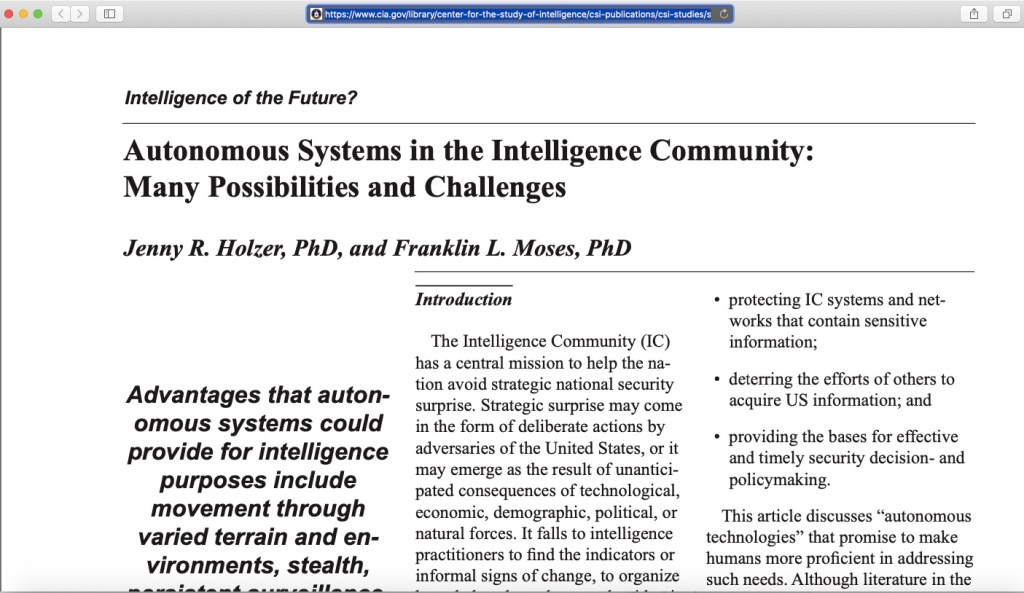
Studies in Intelligence, Vol. 59, No.1 (Unclassified articles from March 2015). Autonomous Systems in the Intelligence Community: Many Possibilities and Challenges by Jenny R. Holzer, PhD, and Franklin L. Moses, PhD in Studies in Intelligence Vol 59, No. 1 (Extracts, March 2015).Autonomous Systems in the Intelligence Community: Many Possibilities and Challenges by Jenny R. Holzer, PhD, and Franklin L. Moses, PhD in Studies in Intelligence Vol 59, No. 1 (Extracts, March 2015).Link: https://www.cia.gov/resources/csi/studies-in-intelligence/volume-59-no-1/autonomous-systems-in-the-intelligence-community-many-possibilities-and-challenges/.









 David South Consulting
You must be logged in to post a comment.