A Report from the UN Conference on the Social and Political Dimensions of the Global Crisis: Implications for Developing Countries (12-13 November 2009)
Organised by the United Nations Research Institute for Social Development (UNRISD), Geneva, Switzerland. Held at the Palais des Nations.
Session 3: Social Policy: Global Perspective
The third session attempted to capture the overall state-of-play at this juncture in the crisis. The panel found states are competing to reduce the welfare state to pay off debts. The global downturn was being used as an opportunity to reduce the wages of workers. The downturn was being characterised as not a banking failure, but a social one: the message being given is that income inequalities are not caused by economic causes but by social choice.
The orthodoxy of neo-liberalism is well-prepared and is taking advantage of the crisis, while left alternatives are much more divided. The neo-liberals see this an opportunity to roll forward the neo-liberal agenda, not roll back. As one panellist said: “I wish it was the demise of neo-liberalism, but it is not.” It’s a crisis for the left – capitalism will stagger back onto its feet.
Ben Fine from London’s School of Oriental and African Studies, drew attention to the fact 200,000 homes could have been built for the cost of bailing out the failed UK lender Northern Rock.
The “crisis has sharply discredited the model of development we have been under for the past 30 years. But I am afraid it is being resurrected,” concluded Fine.
The panellists outlined the conditions for a sustainable developmental state. Two things are required: do not have exclusion; and reduce inequalities that affect 60 to 70 percent of people.
With neo-liberalism far from finished, we do not hear the articulation of an alternative that is strong as we build a new world order, added the panel.
The global downturn has led to emerging crises: 1) cost will be distributed on to labour, yet it is very difficult for workers to move around, 2) it will be distributed from North to South – example, a reduction in economic aid, 3) youth employment: mostly young workers will suffer with unemployment, and they will live with climate change.
Any alternative vision put forward will have to resolve these crises.
Anger was directed towards the two Bretton Woods institutions: the World Bank and the IMF. It was claimed the World Bank is destroying what has been achieved in Vietnam – and they did not recommend any country borrow from the World Bank. Other options include the Asian Development Bank (ADB), which is more progressive.
Some of the policy options the panel suggested included prices/incomes policy, debates over limiting incomes of the elite, and introducing high taxes on financial transactions.
The panel noted that hardly anyone has raised questions on global governance, “and the structural failure of the UN system to deliver really depresses me,” concluded one panellist.
A Report from the UN Conference on the Social and Political Dimensions of the Global Crisis: Implications for Developing Countries (12-13 November 2009)
Organised by the United Nations Research Institute for Social Development (UNRISD), Geneva, Switzerland. Held at the Palais des Nations.
Just as now (2021) 2009 was a year in which the questions revolved around receiving a vaccine (for H1N1) and how best to affirm a person’s identity and citizenship.
Session 2: Social Policy: Country and Regional Perspectives
China’s role in the crisis and the recovery was tackled by UNRISD’s director, Dr. Sarah Cook. China has travelled a long way from 30 years ago, when it was poor and isolated. Twenty years ago it faced severe internal crisis, but by the Asian economic crisis in 1997 it was economically dynamic enough to help pull the rest of Asia out of the crisis. Cook noted China now sits at the cusp of becoming a global leader and this poses the question: Can China save the global financial system?
The country was able to draw on its substantial cash reserves to launch a large fiscal stimulus of 4 trillion Yuan (US $600 bn). This has meant most of the current growth in China is being generated by the stimulus. And the main driving factor behind government policy is social stability, with the state and bureaucracy playing key roles in setting priorities.
Thailand in 1997 was compared with India today by Govind Kelkar, from the Institute for Human Development. India saw a big fall in domestic demand, and lost confidence in short-term growth. There has been a 30 percent growth in women in low-pay occupations, while skilled workers have lost jobs, and temporary workers at construction sites have all but disappeared. Even India’s prosperity darling, information technology, has experienced a slowing in growth. Many IT workers had their pay cut 50 percent and were seconded to NGOs to keep them busy.
Women and children are entering the workforce to help families survive. And more people are working longer hours for less pay.
The Indian Government has been able to offer help to the rural, agricultural sector through fertiliser and food subsidies. The NREGA (http://nrega.nic.in/) (National Rural Employment Guarantee Act) is reaching 50 million households. However, mostly men have benefited because the work on offer is skilled work.
The Indian stimulus for rural areas is a direct result of the rural poor vote being a large lobby in the world’s biggest democracy. And while the rapid growth of the past decade has helped the urban upper class, the government is being forced back into inclusive growth because of the pressure of politics. This contrasts with Thailand in 1997, where many women went into sex work, and the government targeted its stimulus at the urban market because the rural vote was not powerful.
Shiree (http://www.shiree.org/), Bangladesh, an NGO supporting the Government of Bangladesh to achieve the Millennium Development Goal targets on income poverty and hunger, called for a portion of the bank bailouts to go to the poor.
It reported Bangladesh was unprepared for the crisis and has not responded well. Interestingly, Shiree believes any organisation targeting the extreme poor should be obligated to graduate them from poverty within three years and to keep them out of extreme poverty for at least three to five years.
Another country that has been caught out by the global economic crisis is Senegal. Elizabeth Paul from the University of Liege and Ousmane Faye from African Population and Health Research Center (APHRC), pointed out subsidies for fuel and food hurt the public finances but didn’t help the poor. Within Senegal, 44 percent of people believe poverty in households has grown. While at first Senegal didn’t think it would be affected, the consequences of the downturn have been many: tourism is down, foreign direct investment (FDI) is down, exports are down 13 percent, there is a reduction in aid flows, and overall government revenue is down.
Senegal is a member of the West African Economic and Monetary Union (http://www.uemoa.int/index.htm) and found its hands tied when it came to how it could respond because it must stick to the terms of the Union. Overall, the researchers observed, the government has not reflected on the crisis and just focused on the public finances, with no special measures for the crisis.
Funding pensions is a hot topic all around the world. While the legacy of well-funded public pensions in developed countries after the Second World War had become much-admired, recent years have shown these funds to be inadequately funded to meet need. This has led to many governments seeing a solution in privatising public pension funds. But the cases of Argentina and Nigeria – both inspired by the experience of Chile – offers lessons in what not to do.
Camila Arza, Latin American School of Social Sciences (FLACSO) Argentina (http://www.flacso.org.ar/), explained how much of the new money was absorbed by administration costs, rather than expanding the fund. It also failed to keep up with the expansion of informal employment and extending coverage to these workers.
The experience of the Nigerian pension system was presented by Bernard H Casey, of the University of Warwick. Inspired by reforms in Chile (unfortunately just around the time Chile was abandoning those reforms), the Nigerian pension scheme only covered 10 percent of the workforce, comprising some of the public sector and large private sector firms. Yet most employment in Nigeria is informal and outside the pension system.
The new fund had such high administration fees, around 40 percent of what is saved over a lifetime was eaten up by the fees. Worse, the fund invested in the highly volatile stock market and earned returns that were 5 percent below the inflation rate: a loss of 60 percent during the lifetime of the pension.
Casey concluded it is a mistake to use pension reform to spur economic development; economic development should instead create well-funded pensions. This sort of massive mismanagement of government programmes has the effect of generating significant public cynicism in the government’s ability to run social programmes.
The rise of social networking websites has created new opportunities for the poor to gain access to much needed credit. Kiva.org is pioneering a new way for entrepreneurs in the South to obtain for their businesses unsecured, no-interest financing from lenders worldwide. By just a click of the mouse a person anywhere in the world can lend as little as US $25 or more to aspiring entrepreneurs in developing countries.
Kiva, which means “agreement” or “unity” in Swahili, was founded by Matthew and Jessica Flannery after time spent in East Africa. They built upon the idea of Nobel Peace Prize Winner, Mohammud Yunus’ Grameen Bank but took it a step further by tapping into the resources of the web. It works by allowing potential lenders to search for an entrepreneur via the website. Each entrepreneur’s business idea is explained, a photo of the entrepreneur is posted and the amount of the loan they require and how much they have raised so far are clearly displayed. It is then a simple matter of the lenders using their credit cards to make a loan online. Kiva then transfers all the funds to their local partners (microfinance institutions) which, in turn, disburse the loans to each business. All entrepreneurs are screened for their trustworthiness and the viability of their business. Loans are usually between 6 to 12 months and lenders receive regular email journal updates from the business they sponsor. Gradually, the loan is paid back and the lender is returned the full value of the loan.
The process is so simple that one may ask, “Does this really work?” Take the story of Nicholas Kristof, columnist for the New York Times who recently accounted his experience with Kiva.org in his New York Times Op-Ed piece, “You, Too, Can Be a Banker to the Poor”. Through Kiva.org he chose two entrepreneurs, a baker and an owner of a TV repair shop in Afghanistan and lent them US $25 each instantly making himself a business partner with total strangers. He recently visited Afghanistan to see their progress and found two thriving businesses. Mr. Abdul Satar, the baker, borrowed a total of US $425 from a variety of lenders, Nicholas being one of them, and was able to open a second bakery with four employees. Mr. Abdul Saboor who runs a small TV repair shop now has a second shop with two new employees.
By harnessing a user friendly website to make instant cash loans, Kiva has come up with one of the simplest and most direct ways to help poor entrepreneurs who need start up capital. It was first tried out in Uganda about a year ago where partnerships were forged with local microfinance institutions that examined and evaluated each business before they were posted on the website. It has now attracted close to 18,000 lenders contributing an average of US $82.
“I believe the real solutions to poverty alleviation hinge on bringing capitalism and business to areas where there wasn’t business or where it wasn’t efficient,” co-founder Matthew Flannery told the New York Times. “This doesn’t have to be charity. You can partner with someone who’s halfway around the world.”
Published: April 2007
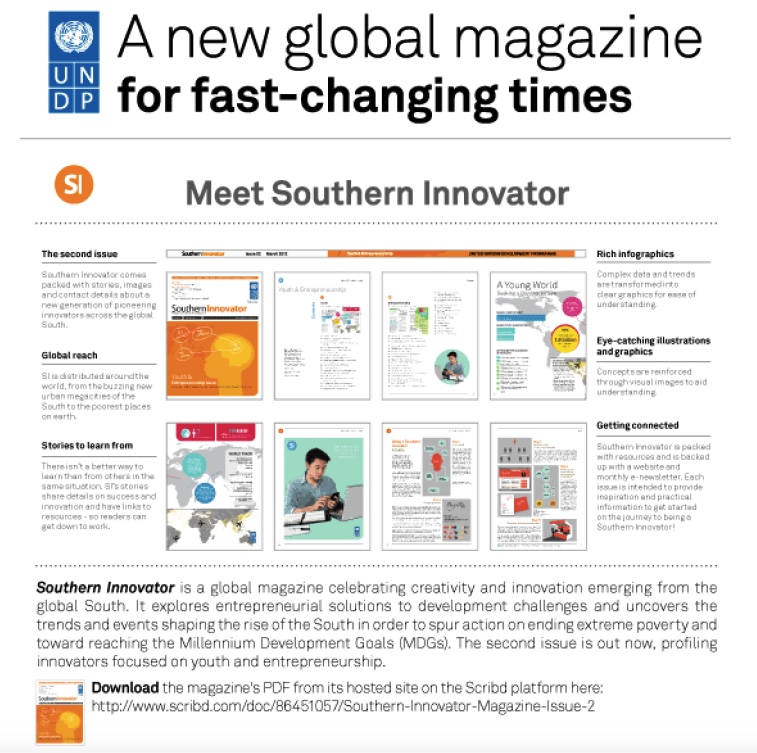
Development Challenges, South-South Solutions was launched as an e-newsletter in 2006 by UNDP’s South-South Cooperation Unit (now the United Nations Office for South-South Cooperation) based in New York, USA. It led on profiling the rise of the global South as an economic powerhouse and was one of the first regular publications to champion the global South’s innovators, entrepreneurs, and pioneers. It tracked the key trends that are now so profoundly reshaping how development is seen and done. This includes the rapid take-up of mobile phones and information technology in the global South (as profiled in the first issue of magazine Southern Innovator), the move to becoming a majority urban world, a growing global innovator culture, and the plethora of solutions being developed in the global South to tackle its problems and improve living conditions and boost human development. The success of the e-newsletter led to the launch of the magazine Southern Innovator.
Education is recognized as critical for development and improving people’s lives. Universal primary education is a Millennium Development Goal and countries are now allocating more funds for primary education across the global South. However, the options available to youth after primary education are often very limited.
The World Bank estimates that only nine percent of youth in the developing world will be able to go to a university or benefit from higher education scholarships. For the vast majority of youth, getting a job is often the only viable option to securing a livelihood; but in most developing countries the number of formal sector jobs is low and the only option is self-employment. Acquiring relevant training and practical skills can be crucial to becoming successfully self-employed. But where will the training and skills come from and who will provide it and pay for it?
This dilemma is being addressed by the “self-sufficient schools” concept. The model combines entrepreneurship and vocational education through school-based businesses that blend training and revenue-generation. The principle is simple: entrepreneurship and entrepreneurial skills are taught by successful entrepreneurs.
The model is being pioneered in several countries and has been successfully applied by UK-based charity TeachAManToFish in Ghana and Paraguay, targeting rural youth from farming families through a network of 250 vocational experts and institutions in 45 countries. The approach promotes a model for making education both more relevant and financially sustainable in rural communities.
Self-sufficient schools share several characteristics: they produce and sell goods and services; they focus on developing an entrepreneurial culture; they make a direct connection between theory, practical work and financial reward; they encourage learning by doing; they strive to keep improving in order to remain economically competitive; students are encouraged to work cooperatively; and students receive support after graduating, often in the form of microfinance for their new businesses.
In the South American nation of Paraguay, the Fundacion Paraguaya – San Francisco Agricultural High School – run by an NGO committed to poverty reduction through supporting entrepreneurship – found that small-scale farmers not only knew how to produce food, they also knew how to make a prosperous living out of it when given the right tools. Taking over a school previously run by a religious order, the NGO had the opportunity to put the concept to the test.
The organization’s head, Martin Burt states, ”It is not a matter of knowing how to grow the crop, or raise the animal; it is a matter of how to make money and then how to be financially successful doing farming in poor countries.”
The Paraguayan school is half way through its five-year plan, and already is covering two thirds of its recurring costs from the production and sale of goods and services, including specialist cheeses.
Published: May 2007
Resources
A paper on the concept of self-sufficient schools: Click here
CIDA City Campus, Johannesburg, South Africa: CIDA is the country’s only “’free’, open-access, holistic, higher educational facility” and is “operated and managed by its students, from administration duties to facilities management. In addition every student is required to return to their rural schools and communities, during holidays, to teach what they have learnt.”
The First International Conference on Self-Sufficient Schools is being planned by TeachAManToFish. Expressions of interest are sought from all individuals and organizations interested in taking part in the conference. Email conference@teachamantofish.org.uk for more information.
Development Challenges, South-South Solutions was launched as an e-newsletter in 2006 by UNDP’s South-South Cooperation Unit (now the United Nations Office for South-South Cooperation) based in New York, USA. It led on profiling the rise of the global South as an economic powerhouse and was one of the first regular publications to champion the global South’s innovators, entrepreneurs, and pioneers. It tracked the key trends that are now so profoundly reshaping how development is seen and done. This includes the rapid take-up of mobile phones and information technology in the global South (as profiled in the first issue of magazine Southern Innovator), the move to becoming a majority urban world, a growing global innovator culture, and the plethora of solutions being developed in the global South to tackle its problems and improve living conditions and boost human development. The success of the e-newsletter led to the launch of the magazine Southern Innovator.






 David South Consulting
You must be logged in to post a comment.