Nigeria has an unfortunate global reputation as the home of 419 scams (http://en..wikipedia.org/wiki/Advance-fee_fraud). A typical 419 scam involves sending emails to people around the world in order to extort money from them. Online scams may show an unexpected technical sophistication for a country associated with poverty, but are a sign that some of Nigeria’s plentiful talents are being turned to illegal activities rather than building legitimate businesses.
Many argue that Nigeria is missing its potential to become an African legal software powerhouse. The Institute of Software Practitioners of Nigeria said the country’s annual consumption of software reached US $900 million in 2006, making it possibly Africa’s biggest market.
“Nigeria stands a good chance of dominating both the local and West African diaspora in a thriving global software market,” it argues.
Production of computer software is a major income earner for countries like the United States and India.
Many argue that Nigeria has enormous potential, if it can address some common problems: an absence of software quality assurance, poor investment in software development, poor product standards and a lack of proper documentation. In short: if Nigeria’s software industry takes on board global best practice, then it is sitting on a goldmine of legitimate business opportunities.
Chris Uwaje, president of the Institute of Software Practitioners of Nigeria (ISPON), told Business Day that the country’s software technology, if well retooled and strategically positioned for global competitiveness, could earn about US $10 billion annually from foreign software exchange.
He argued that developing the software industry would have many benefits for the population as a whole.
“Software has … become and will remain one of the fastest growing industries with power to enrich, and sustain national economies,” Uwaje said.
Some estimates put the world software industry and associated markets at US $1,300 billion, with 90 percent of the world’s software exports coming from the United States and Europe. Outside the U.S., U.K., Germany and Japan, the new and emerging countries within the software industry are India and China, and to a lesser extent Singapore and Malaysia.
According to market researcher DataMonitor, the worldwide software industry grew by 6.5 percent between 2007 and 2008.
DataMonitor forecasts that in 2013, the global software market alone will have a value of US $ 457 billion, an increase of 50.5 percent since 2008 (Datamonitor’s Software: Global Industry Guide).
Africa has a high proportion of entrepreneurs because people have next to no social supports to fall back on and need to do business to survive. Nigeria’s large youth population – 43.2 percent of the total – could be the driver of this new economy if used right.
Nigeria mostly imports software solutions despite having an extensive capacity in software development. If developed well, software could surpass oil as a revenue generator for the country.
According to A Profile of Nigeria’s Software Industry by H. Abimbola Soriyan and Richard Heeks, “A typical software company (in Nigeria) had between 11 and 50 customers (the average was 36 though a few firms involved with package installation had several thousand). There was a strong concentration among these customers. Almost all were private sector … There was a surprising lack of government/public sector organizations as customers (reflected above in the limited number of firms found in Abuja).”
Jimson Olufuye, president of the Information Technology Association of Nigeria (ITAN), believes that more needs to be done to support the software developers. And while on paper there is strong support for this sector in information technology policy, “In addition, we need to establish more IT parks with appropriate policies on infrastructure, human resources, incentives and business plan.”
Wahab Sarumi, chief executive officer of Wadof Software Consulting, explains the problem: “Indigenous software developers are an endangered species, abandoned by the government, neglected by its own people and bullied by the poachers from India, to whom Nigerian businesses rush to buy software applications to solve local business problems.”
Already, Nigerian software firms are offering existing off-the-shelf software that they custom package with local services. This recognizes software made in advanced countries isn’t entirely right for developing countries: and this is where business opportunities await for software developers.
But the key to success, at the end of the day, is to be the best solution on offer for the right price. James Agada, managing director of ExpertEdge Limited, believes people buy the best software for the task and don’t care where it comes from.
“If you want to sell software, the buyer does not buy the software alone, he buys the software, buys capacity to support the software, buys your capacity to improve on the software, he buys what he assumes is your mastery of the domain the software … the software must be able to compete favourably with its competitors.”
2) Rogue Economics: A website accompanying the book by Loretta Napoleoni on the illegal economic activities unleashed after the fall of communism. Website: http://www.lorettanapoleoni.com/
4) Changing Dynamics of Global Computer Software and Services Industry: Implications for Developing Countries: A report from UNCTAD on how computer software can become the most internationally dispersed high-tech industry. Website:http://www.unctad.org/templates/webflyer.asp?docid=1913&intitemid=2529&lang=1
5) A Profile of Nigeria’s Software Industry by H. Abimbola Soriyan and Richard Heeks, Paper No 21, 2004, Development Informatics: Working Paper Series. Website: http://tinyurl.com/yh25dpa
6) Institute of Software Practitioners of Nigeria: A great contact point for finding legitimate software developers in Nigeria. Website: http://www.ispon.org/
Development Challenges, South-South Solutions was launched as an e-newsletter in 2006 by UNDP’s South-South Cooperation Unit (now the United Nations Office for South-South Cooperation) based in New York, USA. It led on profiling the rise of the global South as an economic powerhouse and was one of the first regular publications to champion the global South’s innovators, entrepreneurs, and pioneers. It tracked the key trends that are now so profoundly reshaping how development is seen and done. This includes the rapid take-up of mobile phones and information technology in the global South (as profiled in the first issue of magazine Southern Innovator), the move to becoming a majority urban world, a growing global innovator culture, and the plethora of solutions being developed in the global South to tackle its problems and improve living conditions and boost human development. The success of the e-newsletter led to the launch of the magazine Southern Innovator.
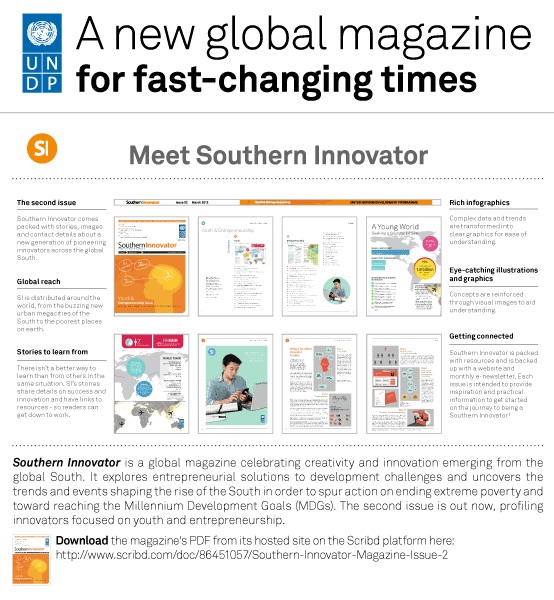
Southern Innovator was initially launched in 2011 with the goal of – hopefully – inspiring others (just as we had been so inspired by the innovators we contacted and met). The magazine seeks to profile stories, trends, ideas, innovations and innovators overlooked by other media. The magazine grew from the monthly e-newsletter Development Challenges, South-South Solutions published by the United Nations Office for South-South Cooperation (UNOSSC) since 2006. A selection of books and papers citing stories from the magazine are featured below to aid researchers, in particular those interested in health and human development and the role of innovators in international development.
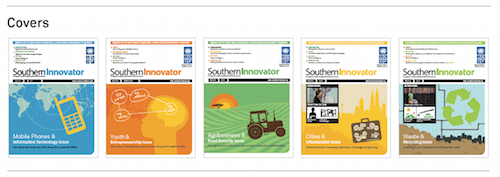
The first five issues of Southern Innovator from 2011 to 2014. Called a “Beautiful, inspiring magazine from UNDP on South-South innovation.”
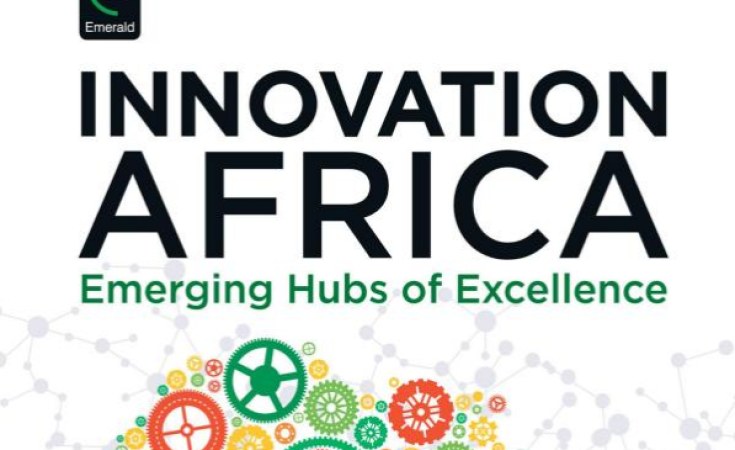
“Innovation is critical to growth and development in Africa. In the context of a continent characterized by fast growing economies as well as an array of socioeconomic challenges, such as high levels of poverty and inequality, innovation in Africa must be understood in an encompassing manner. Africa needs to support the emergence of its own Silicon Valleys, but it must also foster the invention and adoption of cleaner technologies that limit respiratory illnesses, deforestation and combat climate change. This book contains a number of analytical case studies that examine the nature and origins of emerging high-end innovation hubs in Africa. These “hubs” or ecosystems are both understudied and little known inside and outside the continent. With this analysis, the book highlights and draws lessons from some of the most promising and successful innovation cases in Africa today, exploring the key factors driving their successful emergence, growth and future prospects. Relevant for scholars, policymakers, and business leaders, the book provides both inspiration and useful policy advice that can inform strategies and concrete measures to speed up the pace of innovation in Africa today.”
“Research on gated communities is moving away from the hard concept of a ‘gated community’ to the more fluid one of urban gating. The latter allows communities to be viewed through a new lens of soft boundaries, modern communication and networks of influence.
The book, written by an international team of experts, builds on the research of Bagaeen and Uduku’s previous edited publication, Gated Communities (Routledge 2010) and relates recent events to trends in urban research, showing how the discussion has moved from privatised to newly collectivised spaces, which have been the focal point for events such as the Occupy London movement and the Arab Spring.
Communities are now more mobilised and connected than ever, and Beyond Gated Communities shows how neighbourhoods can become part of a global network beyond their own gates. With chapters on Australia, Canada, Europe, South America, Asia, Africa and the Middle East, this is a truly international resource for scholars and students of urban studies interested in this dynamic, growing area of research.”
“The economic, political and social situation in Chile shows a country in transition. Some observers anticipate a broad “reboot” of the nation. While Chile is still seen by many as an example of progress in South America and of developmental potential in the global South, it faces a complex political constellation, particularly in the aftermath of the re-election of Michelle Bachelet. Many wonder how social and institutional innovations can be incepted without interrupting the country’s remarkable success over the past decades.
This book provides an interdisciplinary analysis of Chile’s situation and perspectives. In particular, it addresses the questions:
What is Chile’s real socio-political situation behind the curtains, irrespective of simplifications?
What are the nation’s main opportunities and problems?
What future strategies will be concretely applicable to improve social balance and mitigate ideological divisions?
The result is a provocative examination of a nation in search of identity and its role on the global stage.
Roland Benedikter, Dr., is Research Scholar at the Orfalea Center for Global and International Studies, University of California, Santa Barbara, Senior Research Scholar of the Council on Hemispheric Affairs Washington D.C., Trustee of the Toynbee Prize Foundation Boston and Full Member of the Club of Rome.
Katja Siepmann, MA, is Senior Research Fellow of the Council on Hemispheric Affairs Washington D.C., Member of the German Council on Foreign Relations, and Lecturer at the Faculty of Interdisciplinary Cultural Sciences of the European University Frankfurt/Oder.
The volume features a Foreword by Ned Strong, Executive Director of the David Rockefeller Center for Latin American Studies, Harvard University, and a Preface by Larry Birns, Director of the Council on Hemispheric Affairs, Washington D.C., and Former Senior Public Affairs Officer of the United Nations’ Economic Commission for Latin America (Santiago, Chile).”
“A Sociological Approach to Health Determinants investigates how the social works in determining health and health inequity. Taking a global perspective, the book shines a light on how experiences of health, illness and health care are shaped by a variety of complex social dynamics. Informed primarily by sociology, the book engages with the WHO’s social determinants of health approach and draws on contributions from history, political economy and policy analysis to examine issues such as class, gender, ethnicity and indigeneity, and the impact they have on health. A Sociological Approach to Health Determinants is a comprehensive resource that provides a new perspective on the influence of social structures on health, and how our understanding of the social can ensure improved health outcomes for people all over the globe. Toni Schofield is Associate Professor at the University of Sydney. She specialises in research and teaching in sociology, and public policy and administration.”
New Directions in Children’s and Adolescents’ Information Behavior Research edited by Dania Bilal and Jamshid Beheshti (Emerald Group Publishing: 2014)”This book comprises innovative research on the information behavior of various age groups. It also looks at special populations such as ethnic minorities, indigenous peoples, and users with disabilities. The book presents research and reflections on designing systems that help the new generation cope with a complex knowledge society.
Economy Reports for APEC Economies on demographics, policies & ICT applications for people with Special Needs (Seniors and People with Disabilities), Asia-Pacific Economic Cooperation, APEC Telecommunications and Information Working Group, January 2013
Taming the Tide: Stories from India by Claire Bentley, Vanessa Brombosz, Sofianne Gabrielli, Ga Eun Lee, Vaidehi Nafade, Lindsay Steele and Muhammad Wali, Global Health Case Studies: A Compilation from PPHS 511 Fundamentals of Global Health, McGill Global Health Programs, Case studies – Fall 2015, pages 23 to 32
If you would like to either sponsor an issue of Southern Innovator or place an advertisement in the magazine, then please contact southerninnovator@yahoo.co.uk.
Good ideas are plentiful, but how to fund life-improving projects has always been a thorny issue. Judging how effective a project is can also be fraught with debate and contention. Over the past two decades, the number of NGOs in the global South has exploded (http://lboro.ac.uk/gawc/rb/rb144.html). The best of them offer the local knowledge and understanding required to make development gains. But unlike NGOs in the North, many lack the powerful fundraising capabilities of the big global NGO brands.
An exciting new initiative based in Germany, but already featuring hundreds of projects from across the South, is using the power of the internet to directly connect projects and donors.
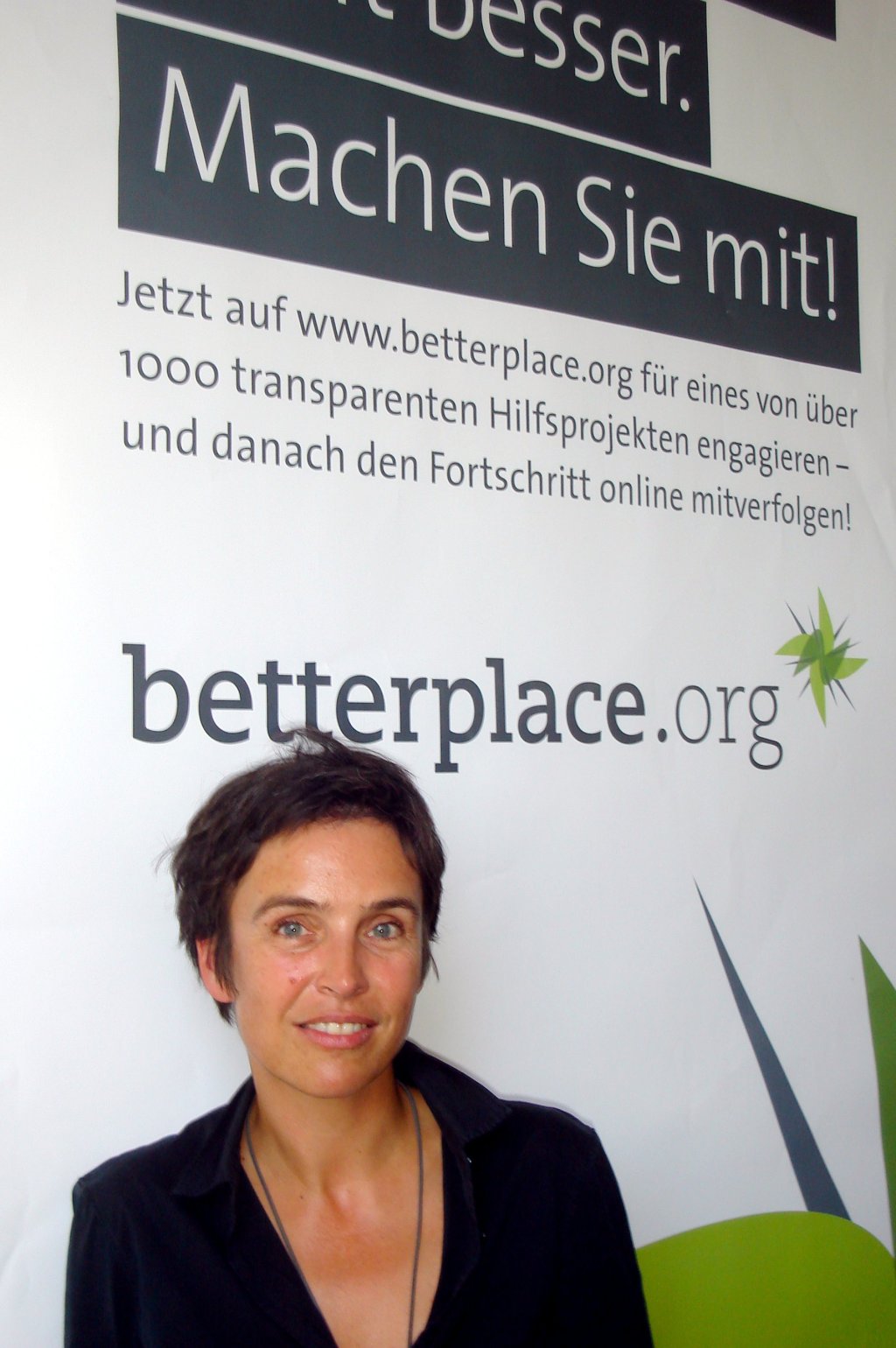
Joana Breidenbach, an anthropologist, author and co-founder of betterplace.org (www.betterplace.org), says NGOs are emerging in India and other countries of the South to challenge the big Northern global NGOs.
“Why wouldn’t you want to donate to these Southern NGOs? There are more entrepreneurs and local approaches which are better.
“Betterplace gives local institutions a platform to express themselves.”
Started in 2007, betterplace is an online marketplace for projects to raise funds. It is free, and it passes on 100 percent of the money raised on the platform to the projects. The foundation that runs betterplace supports its overheads by offering additional services that people can pay for if they wish. It works in a way similar to the online marketplace eBay (http://www.ebay.com): NGOs post their project, set up an account, blog about their achievements and successes and needs, and receive donations direct to their bank account when they come in.
Breidenbach points out up to a third of any NGO’s income is spent on fundraising. In Germany, that represents more than Euro 1.3 billion out of over Euro 4 billion in private donations – money that could have gone directly into the hands of the people needing help.
With betterplace, donators can surf through the projects and pick the one they want. Already, more than 100 large corporations trawl through betterplace seeking projects to fund to meet their corporate social responsibility (CSR) obligations (http://en.wikipedia.org/wiki/Corporate_social_responsibility).
“I find it very exciting to introduce a good and innovative NGO to a corporate sponsor,” Breidenbach said.
Breidenbach says betterplace’s ultimate goal is “to transfer the donation market online.” It hopes to change the rules in donation and charity in the same way blogs and the search engine Google changed the way people publish and search for information.
“This provides better transparency, feedback,” Breidenbach said. “Now (with betterplace) donors and organizations can cut out the middlemen. A lot of established organizations do not like this too much.”
Over the past decade, new concepts like social entrepreneurs and venture philanthropy have emerged to straddle the delicate line between social good and private profit. Betterplace joins this wave of new thinking about how to do development better.
In the 20 months since betterplace went online more than 1,500 projects have joined. They are now averaging between 20 to 35 new projects joining every week.
Betterplace is a simple open-plan office on the top floor of a Berlin warehouse beside the city’s Spree river. The small team (http://www.betterplace.org/about_us/team) work on laptop computers. A blackboard on the wall details in bright colours a running tally of the projects that have joined.
Breidenbach gives the example of a mother in Cameroon who is using betterplace to raise the school fees for her children. The mother blogs about the children’s progress and has been able to raise the fees for a year and a half.
“People are now directly connected to somebody in need.”
“Right now the functionality (of the website) does not allow people getting in contact publicly and we want to enable this knowledge transfer in 2010. If you want to build a well in Cameroon then you could search for the best technology and to contact other people who are doing similar projects to learn from them.”
Success on betterplace is by no means certain. “The experience of the project managers has been as varied as development work is – some have done really well, raising thousands of Euros over the website – others have received no funding at all,” Breidenbach said.
But betterplace provides tools to give the projects the best chance possible. “Projects can present their work, breaking it down in a transparent way (in order to let supporters know exactly what is needed for their realization), there are sound payment processes in place and project managers can give feedback through their project blog, supporters can download project widgets etc., all supplied free of charge.”
Breidenbach has other tips for making betterplace work for a project: post details in English when creating a profile, break down the project into much smaller, low-cost goals (few people are willing to make large donations) – this also has the advantage of receiving payments straight away when they are small. Tell a good story about the project, and try and use actual testimonials from the people affected. Blog and update regularly with photos and videos to keep people engaged. Also avoid copying and pasting text from a previous grant application.
“We have the numbers to show that projects which give regular feedback and have a lively web of trust receive more donations than others, which are not very active.”
“Don’t think you can just go on to betterplace and the money starts rolling in,” said Breidenbach.
The betterplace platform places all projects seeking funds on the same level, allowing individuals and small NGOs to compete equally with the big, branded global NGOs with their websites and sophisticated fundraising operations.
“All the big NGOs have their own websites,” continues Breidenbach. “But it is the small initiatives that often don’t have a website or know how to use Pay Pal etc. (http://www.paypal.com). We are very useful for smaller NGOs.”
“Another big advantage is that we are a real marketplace: whatever your interests (as a potential donor), you will find a project tackling this issue on the platform.”
But what about fraud and people seeing betterplace as a coin-making machine rather than a way to make the world a better place?
“We have a feeling for dodgy projects. We check the IP address. We have a number of trust mechanisms in place (and are currently working on enlarging them). Thus projects on betterplace can create trust through their good name … But we also include something which I would call network-trust: In our web of trust different kinds of stakeholders of an organization or a project have a voice and can publicly state what they think of it. Thus beneficiaries of a project can say if the project has done them good or has been counterproductive, people who have visited the project on the ground can describe what they have seen etc. … we hope to give a much denser and more varied impression of social work and give donors (a terribly badly informed group of people), the basis for a much more informed choice.
“If a contributor to a project is dissatisfied with the project’s outcome … she can either directly contact the project manager via betterplace, or openly voice her concern on the project page for other potential donors to see her views.”
For now, betterplace is still only useful to people who have access to the internet and have a bank account (necessary for the money transfers). But in the future betterplace hopes to have mobile phone interactivity and more features to expand who they can reach.
“We are also re-working our site to make it more intuitive and easier to use for people without computer skills,” Breidenbach said. “In the pipeline is also a knowledge backbone, enabling people to access knowhow about development and social innovation issues and exchange views and experiences. This will be very useful for projects in the South as so many people are working on the same issues without knowing about it. They could learn a lot from each other, without the “help” of the north.”
With internet broadband in Africa set to take off, according to the report Africa Connect: Undersea Cables to Drive an African Broadband Boom (http://www.pyr.com/downloads.htm?id=5&sc=PR090309_INSAME1.6), even more people will soon be able to make the most of initiatives like betterplace.
Published: September 2009
Resources
1) CSR Wire: This is a news service with all the latest news, reports and events and where companies announce their CSR (corporate social responsibility) programmes and how much they are contributing. A great resource for any NGO looking to make a targeted appeal for funds. Website:http://www.csrwire.com/
2) Alibaba: Alibaba.com is an online marketplace started in China but is now global. It allows businesses from all over the world to trade with each other, make deals and find funding. Website:http://www.alibaba.com/
Development Challenges, South-South Solutions was launched as an e-newsletter in 2006 by UNDP’s South-South Cooperation Unit (now the United Nations Office for South-South Cooperation) based in New York, USA. It led on profiling the rise of the global South as an economic powerhouse and was one of the first regular publications to champion the global South’s innovators, entrepreneurs, and pioneers. It tracked the key trends that are now so profoundly reshaping how development is seen and done. This includes the rapid take-up of mobile phones and information technology in the global South (as profiled in the first issue of magazine Southern Innovator), the move to becoming a majority urban world, a growing global innovator culture, and the plethora of solutions being developed in the global South to tackle its problems and improve living conditions and boost human development. The success of the e-newsletter led to the launch of the magazine Southern Innovator.
“A few weeks ago, David South, Development consultant and author of UNDP’s Development Challenges, South-South Solutions Newsletter, came by the betterplace office to take a look at our work. When I asked him how he had come about betterplace.org, he answered: he found me on twitter! So much for the twitter-scepticts. Read the article about how we can Make the World a Better Place for Southern Projects. (As the UNDP always publishes the newsletter on its South to South Website only months later, here is the link via David South’s blog).”
Crime in the South’s fast-growing cities has a negative affect on economic development and social and community harmony. In Africa, with one fifth of the world’s population, for example, data is very poor on crime and its victims. The absence of good data means prevention and detection of crime is poor, and resources to fight it can’t be allocated effectively.
Over 900 million people – almost a sixth of the world’s population – now live in urban slums (UN) – high-tension places that offer a fertile environment for crime to flourish. In developing countries 43 per cent of urban dwellers live in slums – and in the least-developed countries the figure is 78 per cent. Keeping these areas safe is a serious challenge, especially when trust in police and local authorities is low. People are often afraid of how police will react to reporting of crime. Many rightly believe they will be asked for a bribe, or that reporting a crime somehow singles them out as a troublemaker.
Harnessing the power of people organizing together offers one way of fighting back against crime, and combating the paralysis of feeling there is nothing that can be done. An initiative in Brazil is turning to the powerful collaborative potential of Web 2.0 to track crime and help to solve it. And for the first time in history, Brazilians can now see in more or less real time what crime there is and where it is happening in their country.
Wikicrimes, the brainchild of Professor Vasco Furtado of the University of Fortaleza’s Knowledge Engineering Research Group, is inspired by the very popular user-contributed encyclopaedia Wikipedia, and germinated in his mind while on an academic sabbatical at Stanford University in California in 2006.
Victims of crime can simply map and report crimes using the website, which uses brightly coloured drawing pins to indicate where a cluster of crimes has taken place. Site users answer a series of questions on suspects and witnesses. Anyone planning a journey can then easily zoom in on the places where they will go, and see the crime profile of that area – and perhaps be more cautious and aware to avoid becoming victims themselves.
Brazil’s crime problem is huge: Films like City of God – where gangs fight deadly battles in the slums or favelas – shows how vicious it is.
Wikicrimes, whose motto is “Share crime information, Keep safe!”, began development in April 2006, and went ‘live’ with a launch at the end of 2007. Starting with just two employees, it has now grown to a team of 10.
Furtado was frustrated with police hoarding crime statistics in Brazil, and not letting people know where crimes were taking place: he also believes the police, as in many other countries, manipulate statistics for various political purposes. “The traditional mechanism of data-gathering for which police are responsible ends up giving them a monopoly over the handling of information on criminal occurrences,” Furtado said. And that “is not always in keeping with the precept of transparency and public availability of information required by a democratic system.”
Furtado believes transparent crime statistics are vital to a well-functioning democracy.
“We are still facing very big challenges,” he said. “Cultural change is one of them. We don’t have in Brazil the culture of sharing information for benefiting others. People need to realize that when they register a crime they are helping others, and that should be the reason others will act in the same fashion.”
He tried to get the police involved in the project, by contributing data, but with no luck. Brazil’s police argue their monopoly over crime statistics exists for some very serious reasons. “We are very worried about revealing police data which may restrict the work of the police,” Antenor Martins of Rio’s Civil Police Department told the BBC. “Also we don’t want a feeling of insecurity for the people – they don’t deserve that here or anywhere else in the world.”
Many also worry about a crime profile of an area dragging that area down, scaring people away. The police also worry about inaccurate information. “When people walk into a police station, you sign an incident report. If you give information which isn’t true, you have to respond to charges of giving false evidence,” said Martins.
But Furtado believes trust between citizens and the police is so low, it is hurting the fight against crime.
“The police suffer a lack of credibility among the populace which, in turn, contributes toward the low rate of reporting such occurrences: the so-called underreporting effect,” he said. “Research conducted with victims of crime in several Brazilian states has shown that underreporting may, in densely-populated areas, reach up to 50 per cent for certain types of crimes.”
Furtado believes a better picture of crime will lead to better public policies and policing: “The result of this can be disastrous in terms of formulation of public policies and especially in the planning of police actions, in view of the fact that the official criminal mapping may reflect a trend that is quite unlike what is actually occurring in real life.
“WikiCrimes intends to change the traditional logic of handling information on crimes that have already occurred, and considers that such a change is up to the citizens themselves. It is based on the principle that with adequate support, citizens will be capable of deciding how and when historical information on criminal occurrences can be publicized as well as for what purpose.”
Sao-Paulo-based NGO Sou de Paz works to reduce violence in Brazil, and is a big supporter of Wikicrimes. “If we develop Wikicrimes, we can look at things like domestic violence or information on drug trafficking – things that affect communities but that people don’t report either because of shame or fear,” the group’s Denis Mizne told the BBC. “If you can get access to this information or publicise it together with Wikicrimes, it could help in areas that suffer most from violent crime.”
Wisely, Wikicrimes is acting to address police concerns over accurate reporting of crimes.
“Technically the big challenge is to define mechanisms to identify false registering,” Furtado said. “We are creating fields in WikiCrimes for the user to provide further information that brings more reliability to the crime information registered — links to newspapers, for instance. We are also defining algorithms to compute the reputation of the informants.”
And Wikicrimes is not just for Brazil: they want people from around the world to add to the site and help build up the crime profile of all countries.
Furtado said responses from the general public have largely been positive. “The best I could ever hope,” he said. “The project is for the citizen and I feel that they realize this. Every day, I receive messages from people offering support and giving congratulations.”
“I had no idea of similar projects before doing Wikicrimes, but, recently, I have received some messages of similar initiatives even though with a local scope in Brazil, Argentina and USA,” he added.
“In terms of crime it would be nice if this would show that it’s necessary to publish the crime data that we have in law authorities and institutions,” he said. “If this is a success, I am sure that all the crime data will be available for people, because they will realize there is no way that the authorities can keep it all to themselves.”
Furtado keeps a rolling report on progress with Wikicrimes on his blog.
Development Challenges, South-South Solutions was launched as an e-newsletter in 2006 by UNDP’s South-South Cooperation Unit (now the United Nations Office for South-South Cooperation) based in New York, USA. It led on profiling the rise of the global South as an economic powerhouse and was one of the first regular publications to champion the global South’s innovators, entrepreneurs, and pioneers. It tracked the key trends that are now so profoundly reshaping how development is seen and done. This includes the rapid take-up of mobile phones and information technology in the global South (as profiled in the first issue of magazine Southern Innovator), the move to becoming a majority urban world, a growing global innovator culture, and the plethora of solutions being developed in the global South to tackle its problems and improve living conditions and boost human development. The success of the e-newsletter led to the launch of the magazine Southern Innovator.


























 David South Consulting
You must be logged in to post a comment.