Tag: Development Challenges

  • Energy-Efficient Wooden Houses are also Earthquake Safe

    Energy-Efficient Wooden Houses are also Earthquake Safe

    By David SouthDevelopment Challenges, South-South Solutions

    SOUTH-SOUTH CASE STUDY

    In Argentina, an innovative housing project has married good design with energy efficiency, earthquake resilience and the use of local materials and labour. As energy resources continue to be stretched around the global South, innovative building designs will be critical to the creation of sustainable housing for the future.

    The happy mix of efficient modern design with affordable local materials and labour can be seen in three row houses designed and built by Buenos Aires-based Estudio BaBO (estudiobabo.com.ar) in the El Once neighbourhood in Villa La Angostura, Patagonia, southern Argentina.

    The wooden houses are built in a Norwegian style. Estudio BaBO, founded in 2007, discovered that the Scandinavian nation’s housing traditions were well suited to the particular needs of the region and the local government.

    The local government imposed a number of planning guidelines and restrictions that needed to be met to receive planning permission. This included creating row houses which must be made of wood – a plentiful local resource. They also had to be earthquake-safe since the region is seismically active and be able to withstand the heavy rains common to the region.

    Looking around for the right guidance to tackle this brief, Estudio BaBO discovered SINTEF – Norway’s leading disseminator of research-based knowledge to the construction industry (http://www.sintef.no/home/Building-and-Infrastructure/). The Nordic nation has many wooden homes and also has similar environmental conditions and challenges to Patagonia – though its precipitation tends to fall as rain, rather than snow.

    The black-painted homes look typically Norwegian, with a tasteful and clean design that does not clash with the forested surroundings. An air chamber has been created inside the homes’ walls allowing for constant ventilation of the wood, which prevents the wood from rotting and extends the life of the house. With the high rainfall of the region, wood is at risk of rotting if allowed to become damp. The air cavity also insulates the house, providing significant energy savings while keeping the interior warm and comfortable.

    Adding to the energy efficiency of the design, the windows are double glazed and heat is also circulated through the floor – an efficient way to heat a home because heat rises.

    To keep costs down and the project simple, the palette used for the homes is simple but attractive: black, white, wood and metal. The local wood is cypress and is painted black. The interior walls are all white and the floors are made from black granite on the ground floor and cypress wood parquet on the upper floor. The rest of the woodwork in the house is also made of cypress.

    Using locally sourced materials also helps to keep costs down.

    The project was initially conceived in 2009 and the houses were built in 2010-2011. While wood is plentiful in Patagonia, traditionally the use of wood in construction was rudimentary and local labour skill levels were low. This meant the design had to be simple and easy to build.

    “Despite the profusion of wood as a material in the south of Argentina, the lack of specialized knowledge and of a specialized industry narrow its uses to isolated structural elements and interior and exterior finishes,” said one of the architects, Marit Haugen Stabell.

    The three units of two-storey row houses each come with a living room, dining room, kitchen, toilet, two bedrooms and a laundry room. Each home also has an outdoor patio. The homes are designed to receive maximum natural light. Deploying this energy efficient design is considered unusual for Argentina and Estudio BaBO has set a new standard for sustainable housing in the country.

    It looks like the CLF Houses could inspire others to look again at wood as a building material.

    Published: November 2012

    Resources

    1) A story on how researchers are perfecting wooden home designs to withstand heavy earthquakes. Website:http://inhabitat.com/wooden-house-can-withstand-severe-earthquakes/

    2) A website packed with photographs of wooden and other houses for inspiration and lesson learning. Website:http://www.trendir.com/house-design/wood_homes/

    3) A step by step slideshow on how a Norwegian wooden house was re-built. Website:http://www.dwell.com/articles/norwegian-wood.html

    4) Inspirational wooden home decorating ideas from across Scandinavia. Website:http://myscandinavianhome.blogspot.cz/

    https://davidsouthconsulting.org/2022/10/19/chinese-building-solution-for-rapidly-urbanizing-global-south/

    https://davidsouthconsulting.org/2021/09/01/disaster-recovery-ten-years-after-the-gujarat-india-experience/

    https://davidsouthconsulting.org/2021/09/01/haiti-earthquake-prompts-tech-aid/

    https://davidsouthconsulting.org/2017/10/27/information-accelerates-crisis-recovery-and-development-1997/

    https://davidsouthconsulting.org/2021/02/12/rebuilding-after-chinese-earthquake-beautiful-bamboo-homes/

    https://davidsouthconsulting.org/2021/02/23/southern-innovator-in-southasiadisasters-net/

    https://davidsouthconsulting.org/2022/09/26/3d-home-printing-landmark-10-houses-in-a-day/
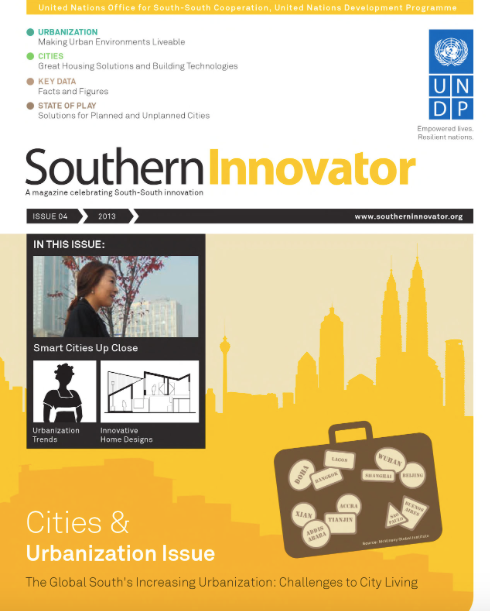
    https://davidsouthconsulting.org/2021/03/05/southern-innovator-issue-4/

    Development Challenges, South-South Solutions was launched as an e-newsletter in 2006 by UNDP’s South-South Cooperation Unit (now the United Nations Office for South-South Cooperation) based in New York, USA. It led on profiling the rise of the global South as an economic powerhouse and was one of the first regular publications to champion the global South’s innovators, entrepreneurs, and pioneers. It tracked the key trends that are now so profoundly reshaping how development is seen and done. This includes the rapid take-up of mobile phones and information technology in the global South (as profiled in the first issue of magazine Southern Innovator), the move to becoming a majority urban world, a growing global innovator culture, and the plethora of solutions being developed in the global South to tackle its problems and improve living conditions and boost human development. The success of the e-newsletter led to the launch of the magazine Southern Innovator.

    Creative Commons License

    This work is licensed under a
    Creative Commons Attribution-Noncommercial-No Derivative Works 3.0 License.

    ORCID iD: https://orcid.org/0000-0001-5311-1052.

    © David South Consulting 2023
  • Housing Solution for World’s Growing Urban Population

    Housing Solution for World’s Growing Urban Population

    By David SouthDevelopment Challenges, South-South Solutions

    SOUTH-SOUTH CASE STUDY

    Across the South, cities are expanding and urban populations growing at a phenomenal rate — the cities of Africa and Asia are growing by a million people a week. Megacities and sprawling slums will be the hallmarks of this majority urban world. In sub-Saharan Africa, 72 percent of the population already lives in slum conditions.

    How people will be housed is an urgent problem. There are many ways to build a dwelling, from scavenged materials, to labour-intensive and expensive custom-built construction, yet affordable and safe construction techniques for the poor are sorely needed.

    The danger of building unsafe housing can be seen in the recent devastating earthquake in Haiti, where many buildings collapsed, killing an estimated 212,000 people. If the rapid growth in urban populations is to be safe and sustainable, then new dwellings will need to be built that meet high standards of durability.

    In South Africa, one company believes it has the right technology for an age of rapid urban population growth and the need for quick and safe housing construction.

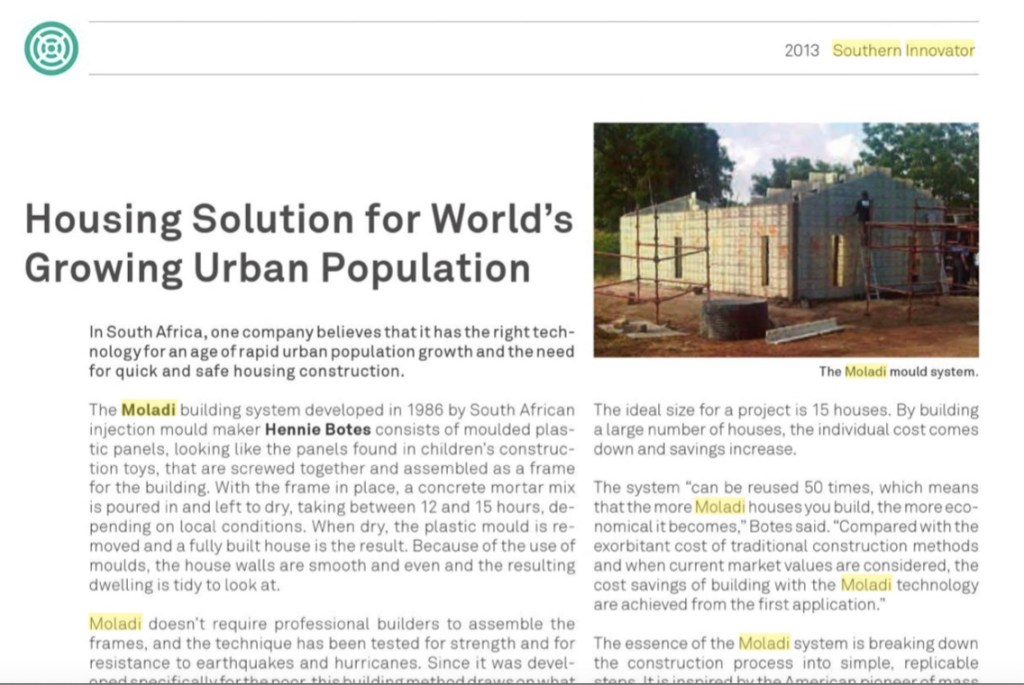
    The Moladi building system (http://moladi.com/) (http://www.moladi.net/default.aspx?AspxAutoDetectCookieSupport=1) developed in 1986 by South African injection mold maker Hennie Botes consists of molded plastic panels, looking like the panels found in children’s construction toys that are screwed together and assembled as a frame for the building. With the frame in place, a concrete mortar mix is poured in and left to dry: depending on local conditions, taking between 12 and 15 hours. When dry, the plastic mold is removed and a fully built house is the result. Because of the use of molds, the home’s walls are smooth and even and the resulting home is tidy to look at.

    Moladi doesn’t require professional builders to assemble the frames, and the technique has been tested for strength and for resistance to earthquakes and hurricanes. Since it was developed specifically for the poor, this building method draws on what is called ‘sweat equity’: often the only asset a poor person has to contribute to the cost of building a home is their free labour.

    Because the dimensions of the home have already been established when the plastic frames were molded, common on-site mistakes are avoided.

    Moladi benefits from South Africa’s Black Economic Empowerment programme (http://www.southafrica.info/business/trends/empowerment/bee.htm) and is certified for its quality with the South African Bureau of Standards (SABS) (https://www.sabs.co.za/). Moladi contractors and developers are working in 15 countries and the technique is distributed in a further seven countries.

    The Moladi construction technique was born of frustration with the traditional approach of laying one brick on top of another. This traditional construction method, dating back thousands of years, just doesn’t match the needs of our times. It is slow and requires highly skilled bricklayers to be done right. Across the developing world, it is possible to see poorly constructed brick dwellings – often built unevenly with poor quality mortar holding the bricks together – that are unsafe in an earthquake.

    Training in the Moladi technique takes from one to two weeks for unskilled workers depending on the size of the home. Moladi provides handbooks and all the necessary resources to complete the project. Each project has its own custom-built plastic frames made based on the home’s design.

    “There is no flat fee for on-site training; the client is only responsible for covering the travel and living expenses for the Moladi representative or training foreman,” said Hennie Botes.

    The ideal size for a project is 15 homes. By building a large number of homes, the individual cost comes down and savings increase.

    The system “can be reused 50 times, which means that the more Moladi houses you build, the more economical it becomes,” Botes said. “Compared with the exorbitant cost of traditional construction methods and when current market values are considered, the cost savings of building with the Moladi technology are achieved from the first application.”

    As the world’s cities grow, and slums become larger and more prevalent, the urgent need for affordable and decent housing will go hand-in-hand with a need for jobs — particularly jobs for unskilled workers. There just won’t be enough skilled workers to go around to build the homes. Even in developed countries, this has become a problem.

    “The recent earthquake disaster in Haiti could benefit from the Moladi system,” Botes said. “Job creation for Haitians is desperately needed and Moladi can immediately facilitate an income for family groups, as over 95 percent of the construction team consists of unskilled labourers. There is no requirement for heavy machinery, or even electricity, and remote areas can be easily accessed; Moladi also allows for the utilisation of building rubble resulting from the earthquake in the construction of new buildings.”

    The essence of the Moladi system is breaking down the construction process into simple, replicable steps. It is inspired by the American pioneer of mass production, car maker Henry Ford (http://en.wikipedia.org/wiki/Henry_Ford), who achieved efficiency and low costs in production by simplifying production into standardized and modulated steps.

    “The Moladi construction process should be viewed as a workflow process similar to that of a vehicle assembly line,” Botes said. “Through the simplification, standardization, modularization, and industrialization of the construction process, efficiency and cost savings are achieved and maintained by managing the continuous flow process on site.

    “Contractors must make sure that they have planned their project roll-out and budget well and have clearly defined goals as to what they want to achieve. It is very important to have all team players and professionals on the same page with regards to their roles and responsibilities.”

    In the beginning, Botes encountered resistance to his innovative production methods. “I was highly motivated and really believed in my idea, but when I presented it to investors, they’d shoot holes in it. … It’s been a 22-year journey, but I always kept the goal in mind. Moses spent 40 years in the desert … I’m quite happy my desert experience was only 20-odd years, though,” he told Men’s Health magazine.

    South Africa is facing a population growth rate of 1.73 percent a year (UNICEF). It also has 61 percent of the urban population trying to live on four percent of the land, according to Botes. This urban population grows at 2.7 percent a year, yet existing housing needs are not being met. There is already a backlog of 2.2 million homes needed to be built, and this grows by 180,000 every year, according to the Banking Association of South Africa (http://www.banking.org.za/default.aspx).

    “Even though the need for housing has always been a fundamental requirement to sustain one’s health and welfare, the advances in this area have been seriously lacking,” said Botes. “The brick and mortar method of construction was recorded as early as 1458 B.C, which means that very little has changed in terms of building structures over a period of almost 3.5 millennia.

    “We cannot expect to resolve the housing crisis in our age with a technique developed for the requirements of society 3468 years ago.”

    With the success of the Moladi building system, Hennie is working on “producing windows, doors, toilet seats, window frames, sinks and washbasins. If I can include these as part of my product, I’ll reduce the total unit cost of the house.”

    Published: February 2010

    Resources

    1) Cradle to Cradle: Remaking the Way We Make Things: This radical concept is about how products, can be used, recycled, and used again without losing any material quality—in cradle to cradle cycles. Website:http://www.mcdonough.com/cradle_to_cradle.htm

    2) Builders Without Borders: Is an international network of ecological builders who advocate the use of straw, earth and other local, affordable materials in construction. Website:http://builderswithoutborders.org/

    3) World Hands Project: An NGO specialising in simple building techniques for the poor. Website:http://www.worldhandsproject.org

    4) CIDEM and Ecosur specialise in building low-cost community housing using eco-materials. They have projects around the world and are based in Cuba. Website:http://www.ecosur.org

    5) The Rural Development Institute focuses on land rights for the poor and has a series of articles on China’s land reforms. Website: http://www.rdiland.org

    6) More Urban, Less Poor: The first textbook to explore urban development and management and challenge the notion unplanned shanty towns without basic services are the inevitable consequence of urbanization. Website:http://www.earthscan.co.uk/

    7) Building and Social Housing Foundation: The Building and Social Housing Foundation (BSHF) is an independent research organisation that promotes sustainable development and innovation in housing through collaborative research and knowledge transfer. Website: http://www.bshf.org/

    https://davidsouthconsulting.org/2022/05/23/debt-free-homes-for-the-poor/

    https://davidsouthconsulting.org/2021/11/11/decent-and-affordable-housing-for-the-poor/

    https://davidsouthconsulting.org/2022/11/16/housing-innovation-in-souths-urban-areas/

    https://davidsouthconsulting.org/2021/02/12/rammed-earth-houses-china-shows-how-to-improve-and-respect-traditional-homes/

    https://davidsouthconsulting.org/2021/02/12/rebuilding-after-chinese-earthquake-beautiful-bamboo-homes/

    https://davidsouthconsulting.org/2022/11/19/securing-land-rights-for-the-poor-now-reaping-rewards/

    https://davidsouthconsulting.org/2022/05/23/solar-bottle-bulbs-light-up-dark-homes/

    https://davidsouthconsulting.org/2022/11/17/tiny-homes-to-meet-global-housing-crisis/

    https://davidsouthconsulting.org/2021/03/05/southern-innovator-issue-4/

    Creative Commons License

    This work is licensed under a
    Creative Commons Attribution-Noncommercial-No Derivative Works 3.0 License.

    ORCID iD: https://orcid.org/0000-0001-5311-1052.

    © David South Consulting 2023

  • Decent and Affordable Housing for the Poor

    Decent and Affordable Housing for the Poor

    By David SouthDevelopment Challenges, South-South Solutions

    SOUTH-SOUTH CASE STUDY

    Urban populations across the South are growing fast: by 2030, some 5 billion people around the world will live in cities. This year will be the first year in which urban dwellers (3.3 billion people) will outnumber rural residents for the first time (UNFPA).

    Africa now has a larger urban population than North America and 25 of the world’s fastest growing big cities. Asia and Africa’s cities are growing by an incredible 1 million people a week, with 72 per cent of the population in sub-Saharan Africa living in slum conditions.

    How well people dwell is integral to their mental and physical health. Most squatters and slum dwellers – a category that includes half the urban population of Africa, a third in Asia and a fourth in Latin America and the Caribbean – live in makeshift homes made from whatever they can get their hands on. These dwellings are usually unsafe and vulnerable to fire, floods, and earthquakes. On top of this, these sprawling slums can be depressingly grim to look at for those living there.

    In Brazil’s Sao Paulo neighbourhood of Heliopolis – the largest of the city’s 400 favelas, or shantytowns – the majority of its dwellings are made from cement and brick. It is stigmatised as the ugliest part of the city, yet a unique initiative has transformed perceptions of the area – and brought pride to its residents. The project offers a model for slum areas looking to make the next leap up the ladder of development. Heliopolis first sprang up in the 1970s, wedged between highways and roads. Plagued by crime, there is a wide spread in incomes and urbanisation among the 120,000 residents packed into the one-and-a-half square mile. Older parts have many services, while newer areas lack basics like plumbing and electricity.

    Well-known Sao Paulo-based Brazilian architect Ruy Ohtake (http://www.geocities.com/capitolhill/3836/saopaulo.html) mobilised the 6,000 residents to use a fixed palette of six colours – from bright yellow to deep purples – to create a look described as akin to an Italian hill town.

    “Ohtake told a newspaper that Heliopolis was the ugliest part of the city, so we went to him and asked him to figure out how to make it beautiful,” Geronino Barbosa, director of the Heliopolis community group UNAS, told the design magazine Dwell.

    Ohtake, famous for his hotel designs and renovating former colonial areas, rose to the challenge: “I believe in beauty as a social function, so what better way to exercise that belief,” he said. To avoid the initiative feeling like something being imposed from on high, the plan did not go ahead until the residents were happy. And to make sure they felt they owned the results, they did all the painting themselves. The result is a river of colour running through a landscape of dreary, unfinished brick homes jammed between streets and factories. The Italian hill town-effect leaves pedestrians experiencing a surprise as they turn through the streets, happening upon hidden plazas and little bars.

    “Our dream is to expand this project to the entire favela,” said Barbosa. “People love their painted houses. One of our participants told me that her house has been transformed into a sort of Carnival parade.”

    “Who doesn’t want to live in a beautiful house?” said UNAS’ head, Joao Miranda, to Dwell. “We want the same things as everyone else.”

    Another architect has tackled the problem of how to create inexpensive but durable and beautiful homes for the poor. Iranian-born architect Nader Khalili (http://www.calearth.org/) has created what he calls ‘super adobe’ dwellings inspired by traditional Iranian rural homes. The cone-shaped homes are made from sandbags piled one on top of the other in a circular pattern. A basic home is three rooms of 400 square feet, and can be built by five people (with only one needing skills), within weeks. Being sandbags, the homes can easily be dismantled and moved or adapted to meet new space needs.

    Khalili first fell in love with the sand adobe homes of Iran in the 1970s. He had been on a journey to find a home design that was both environmentally harmonious and could be built anywhere in the world quickly and cheaply. But while the original Iranian sand adobe is easily destroyed by earthquakes and bad weather, the ‘super adobes’ are earthquake, hurricane and flood resistant. They are now being built across the Americas , Asia and Africa.

    “You can never build one of these that doesn’t look beautiful,” he said. “Just as you have never seen an ugly tree or an ugly flower.”

    Published: January 2008

    Resources

    • Builders Without Borders: Is an international network of ecological builders who advocate the use of straw, earth and other local, affordable materials in construction. Website: http://builderswithoutborders.org/
    • World Hands Project: An NGO specialising in simple building techniques for the poor. Website:http://www.worldhandsproject.org
    • Tsunami-Safe House: A design for Prajnopaya Foundation: a project coordinated by the SENSEable City Laboratory, a new research initiative between the Department of Urban Studies and Planning and the Media Lab at the Massachusetts Institute of Technology in Boston. Website:http://senseable.mit.edu/tsunami-prajnopaya/
    Creative Commons License

    This work is licensed under a
    Creative Commons Attribution-Noncommercial-No Derivative Works 3.0 License.

    ORCID iD: https://orcid.org/0000-0001-5311-1052.

    © David South Consulting 2021

  • Taxis Promote African Music Beats

    Taxis Promote African Music Beats

    By David SouthDevelopment Challenges, South-South Solutions

    SOUTH-SOUTH CASE STUDY

    South Africa’s township music is pounding its way into the global music charts. How has music made in the impoverished townships that are a hangover from decades of apartheid – the country’s former racial separation laws, which trapped millions of black South Africans in disenfranchisement and poverty – travelled around the world? By hitching a ride with the country’s ubiquitous taxi drivers.

    In the age of digital downloads and rampant pirating of music CDs by bootleggers, musicians in the South face an epic struggle to earn income from their music. It’s estimated 95 percent of digital downloads of music are unauthorized, with no payment to artists and producers (www.ifpi.org).

    And for musicians and artists from the world’s poorest places, who are far out of sight of the mainstream music business, life is even harder. The question remains: what on earth do you do to get heard?

    Many South Africans are big fans of European House, a type of dance music. An enterprising group of producers living in the townships of Pretoria started to experiment, taking the House they loved and turning it into something more reflective of where they lived. The result, dubbed Township House, blends the school-of-hard-knocks beats of South African hip-hop, Kwaito, with House music’s tempos and electronic sounds.

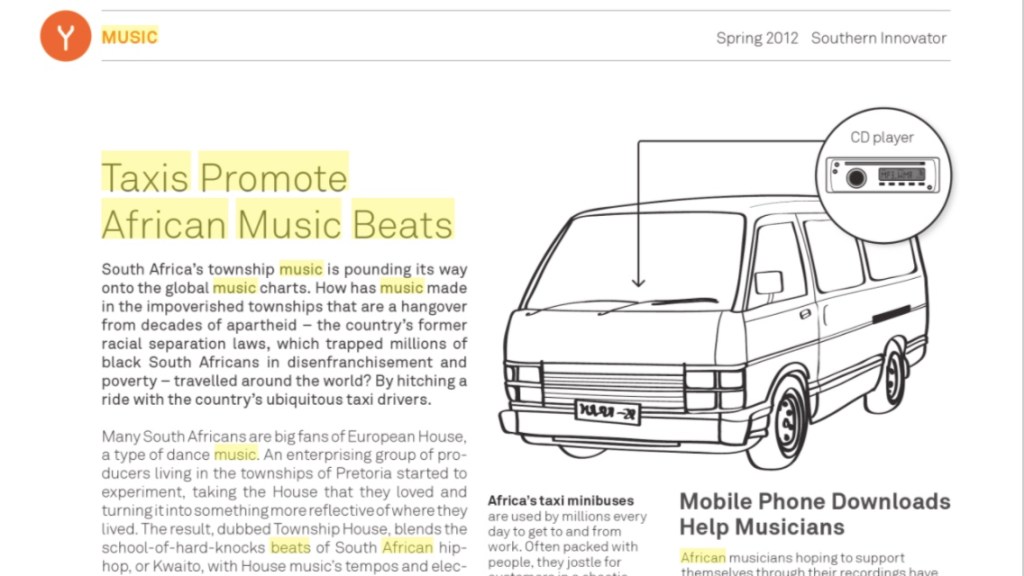
    Being from the townships meant the musicians behind Township House were frozen out of the mainstream music industry. And as every artist knows, if you can’t get heard, then your music will go nowhere. Rejected by radio stations and big record labels, they turned to an unlikely outlet: taxis, the ubiquitous small minibuses that are the only alternative form of transportation for people who do not have a car.

    They are heavily used: the University of Pretoria (www.web.up.ac.za) estimates between 5 and 10 million people use minibus taxis every day to get to work or get around.

    “In South Africa, the easiest way to the people is through the taxis,” musician DJ Qness told CNN.

    The vast network of taxis serving the country represent a captive audience of listeners. Many are simply bored as they endure lengthy commutes. The Township House producers handed out compact discs (CDs) of their tracks to taxi drivers to play. They soon had a hit on their hands. But without any presence in record stores people couldn’t buy the CDs they wanted. And a new source of income was born for taxi drivers: selling CDs from their taxi stands or roadside stalls.

    With appetites whetted for Township House, it started to outsell imported dance music.

    The biggest hit maker of this pioneering group was DJ Mujava, whose track Township Funk was a global dance club hit in 2008.

    “These people created a demand. The Mujava’s ‘Township Funk’ blew up on the streets and everything went crazy,” said Qness, who works for record label Sheer Music.

    After all this home-grown success, the record labels jumped in. DJ Mujava landed a record deal with the small label Sheer Music. But the township musicians were still just reaching a local audience. However, by putting together a low-budget video using township dancers, and by posting the video on the YouTube (www.youtube.com) video-sharing website, they attracted the attention of British record labels Warp Records and This is Music, who re-mixed the track for clubs.

    The model of using taxis as a music distribution vehicle has been copied by others. Pretoria’s Gospel Taxi Club uses the method to promote their religious music. Political parties are also using music CDs to get their message out.

    Other Pretorian township successes are making waves as well. They include Bojo Mujo and Tembisa Funk by McLloyd.

    “By combining the electronic sound from European House with the hard drum and the raw snare they’ve created something totally unique. You can’t find it anywhere in the world — only in South Africa,” said Qness.

    Published: June 2009

    Resources

    DJ Mujava: Listen to all of DJ Mujava’s tracks at his website. Website:www.myspace.com/mujavaDigiArts Africa: The DigiArts Africa network is a tool to find people working in Digital Arts in Africa and to provide a collaborative working space to promote digital arts in Africa. Website:http://portal.unesco.org/culture/en/ev.php-URL_ID=5346&URL_DO=DO_TOPIC&URL_SECTION=201.htmlAfrican Musicians Profiles: A lively website featuring profiles of African musicians by alphabetical listing and also reviews African films. Website: www.africanmusiciansprofiles.comRecording Industry of South Africa (RiSA): RiSA is the main body representing the South African recording industry. Website: www.risa.org.za 

    ISSN Portal.
    Creative Commons License

    This work is licensed under a
    Creative Commons Attribution-Noncommercial-No Derivative Works 3.0 License.

    ORCID iD: https://orcid.org/0000-0001-5311-1052.

    © David South Consulting 2023