Tag: Development Challenges

  • Debt-free Homes For the Poor

    Debt-free Homes For the Poor

    By David SouthDevelopment Challenges, South-South Solutions

    SOUTH-SOUTH CASE STUDY

    As the population around the world’s cities grows, and slums grow larger and more prevalent, the urgent need for affordable and decent housing becomes more pressing. The world’s megacities – like Buenos Aires, Argentina, where more than 13 million live in the metropolitan region – have to find a way to provide housing that is both cheap and does the minimum possible amount of harm to the environment.

    About one-third of the world’s urban dwellers live in slums, and the United Nations estimates that the number of people living in such conditions will double by 2030 as a result of rapid urbanization in developing countries. Latin America is already the most urbanized region in the developing world.

    “Throughout Latin America you have economies that are growing and doing well, but the way the economies are growing is actually generating more shanty towns,” said Erik Vittrup, senior adviser on Latin America and the Caribbean for the U.N. Human Settlements Program. “It’s a growth that is just generating wealth for those who (already) have it.”

    How well people dwell is integral to their mental and physical health. Most squatters and slum dwellers live in makeshift homes made from whatever they can get their hands on. These dwellings are usually unsafe and vulnerable to fire, floods, and earthquakes.

    But across the South, initiatives are proving it is possible to build good quality homes for the poor while avoiding burdening them with debt. Pioneering ways are being developed for the poor to build their own high-quality houses using recycled materials and environmentally friendly products.

    In Colombia , Alejandro Salazar, a chemical engineer, professor at the Universidad del Valle (http://www.univalle.edu.co/english/) and innovator running several companies pioneering new building technologies using recycled waste, is building high-quality, inexpensive houses for the poor.  By combining free building materials recovered from waste, a government grant and the voluntary labour of the homeowners, Salazar’s company is able to build homes for the poor that don’t leave them with ongoing bank debt from mortgages.

    Based in Cali, Colombia (http://gosouthamerica.about.com/od/cali/p/Cali.htm), his companies Ecoingenieria (product and material research and development), Ecomat SA (production of eco-materials using industrial waste and construction rubble), Constructora Paez, (social housing construction using eco-products) and Wassh SA (environmental management and transformation of dangerous solid waste into non-dangerous materials), are focused on pioneering new technologies for housing.

    “Our company uses two basic technologies,” said Salazar. “The production of eco-materials from solid waste and demolition waste, and the implementation of an agile building system, which does not require skilled labour and is hand-transportable. All the pieces are produced in a prefabrication plant that uses the eco-materials.”

    Salazar has found a way to provide homes quicker than existing NGOs – Popular Housing Organizations (OPV), as they are called – established to address homelessness in Colombia. The homeless poor are caught in a Catch-22: they need to have a formal job to receive homebuilding assistance from the government, and they usually can not save up enough money for a down payment on the home.

    Salazar’s solution is to take the maximum grant given by the central government, which is US $4,730, and combine it with the recycled building materials and homeowners’ own labour. He says this allows a house to be built for roughly half the price of a similarly sized one that uses conventional materials: the eco-materials house costs around US $ 6,590, compared to US $12,000 using conventional materials. Land is often either donated by the municipality or the family already owns it. And in Salazar’s experience, the whole family chips in with the building: husbands, sons, brothers, fathers, wives.

    The training takes just three days on eco-materials and a day in construction techniques for house building.

    “To date, we have built with this method 306 houses,” said Salazar. “For the coming year, we expect to deliver around 500 houses or more. To build a house, after acquiring the land, we need three people working eight hours a day to build it in four weeks – all under the supervision of a workforce teacher and the supervision of an engineer or architect.

    “The houses are designed by architects with the participation of the community or families. They do some workshops and the design conforms to their vision and expectation. In Colombia, there is an earthquake resistance code which is binding in law and provides detailed specifications of the materials, foundations, structure and roof.”

    The pre-fabricated building materials are made from recovered waste from a wide variety of sources: ceramic red brick, coarse ash and fly ash, slag from steel, copper slag, porcelain insulators used for electrical power lines, nickel slag, sludge from sugar and alcohol plants and water treatment plants.

    “The raw materials we use are industrial solid waste and demolition waste. It costs the industry a lot to throw away this waste,” Salazar said.

    He said the biggest obstacle to the new homes is psychological: many people initially “tend to reject at first-hand the technology.”

    “When visiting the factory and then visiting the homes – or model homes – they then compare it with a traditional house, and realize that the best eco-homes when finished meet the standards of Colombian earthquake resistance and are also cheaper,” he said.

    Compared to using conventional building materials, the eco-materials reduce the cost of a new home. And the company still makes a profit from it!

    In Paraguay, Elsa Zaldivar is using recycled plastic, cotton netting, corn husks, and loofah sponges (http://en.wikipedia.org/wiki/Luffa) to make cheap, lightweight construction panels for housing. This has a double benefit: it makes for cheap housing and it is good for the environment.

    “That’s very important in Paraguay,” said Zaldivar, “because we’ve already reduced our original forest to less than 10 percent of the national territory.”

    Zaldivar got her experience working with people in the impoverished area of Caaguazú, where in the past she helped with the building of toilets and making stoves. She found that involving local people in this work made a huge difference: “They told me: ‘Now we feel like we’re people with dignity.’”

    She encourages local women to grow loofah – a plant that once flourished but was being ignored. While the fruit is edible she was more interested in the crusty sponge that is left over when the plant is dried. The women started a cooperative selling loofah sponges, mats and slippers. But there was a lot of waste in the process, with a third not suitable for export. She then came up with the idea to use the loofahs for wall and roof panels for cheap housing.

    Along with industrial engineer Pedro Padros, she developed a way to combine loofah with plastic waste. Padros invented a machine to melt the recycled plastic and mix the molten plastic with loofah, vegetable fibres and chopped corn husks. It has produced a building panel that is lighter and easier to move around than lumber or brick. With a grant from the Inter-American Development Bank, design improvements have been made and the cost-per-panel brought down from US $6 per square meter. It is now competitive with the cost of wood panels. The great thing about the panels is that they can be recycled again when they wear out, completing the cycle.

    “To have a decent home liberates people,” said Zaldivar.

    Published: January 2009

    Resources

    • Cradle to Cradle: Remaking the Way We Make Things: This radical concept is about how products, can be used, recycled, and used again without losing any material quality—in cradle to cradle cycles. Website: http://www.mcdonough.com/cradle_to_cradle.htm
    • Builders Without Borders: Is an international network of ecological builders who advocate the use of straw, earth and other local, affordable materials in construction. Website: http://builderswithoutborders.org/
    • World Hands Project: An NGO specialising in simple building techniques for the poor. Website: www.worldhandsproject.org
    • CIDEM and Ecosur specialise in building low-cost community housing using eco-materials. They have projects around the world and are based in Cuba. Website: http://www.ecosur.org

    Follow @SouthSouth1

    Slideshare: http://www.slideshare.net/DavidSouth1/development-challengessouthsouthsolutionsnovember2010issue

    Southern Innovator Issue 1: https://books.google.co.uk/books?id=Q1O54YSE2BgC&dq=southern+innovator&source=gbs_navlinks_s

    Southern Innovator Issue 2: https://books.google.co.uk/books?id=Ty0N969dcssC&dq=southern+innovator&source=gbs_navlinks_s

    Southern Innovator Issue 3: https://books.google.co.uk/books?id=AQNt4YmhZagC&dq=southern+innovator&source=gbs_navlinks_s

    Southern Innovator Issue 4: https://books.google.co.uk/books?id=9T_n2tA7l4EC&dq=southern+innovator&source=gbs_navlinks_s

    Southern Innovator Issue 5: https://books.google.co.uk/books?id=6ILdAgAAQBAJ&dq=southern+innovator&source=gbs_navlinks_s

    https://davidsouthconsulting.org/2021/02/04/cubas-hurricane-recovery-solution/

    https://davidsouthconsulting.org/2021/11/11/decent-and-affordable-housing-for-the-poor/

    https://davidsouthconsulting.org/2022/11/16/housing-innovation-in-souths-urban-areas/

    https://davidsouthconsulting.org/2021/11/11/housing-solution-for-worlds-growing-urban-population/

    https://davidsouthconsulting.org/2021/02/12/rammed-earth-houses-china-shows-how-to-improve-and-respect-traditional-homes/

    https://davidsouthconsulting.org/2021/02/12/rebuilding-after-chinese-earthquake-beautiful-bamboo-homes/

    https://davidsouthconsulting.org/2022/11/19/securing-land-rights-for-the-poor-now-reaping-rewards/

    https://davidsouthconsulting.org/2022/05/23/solar-bottle-bulbs-light-up-dark-homes/

    https://davidsouthconsulting.org/2021/03/05/southern-innovator-issue-4/

    https://davidsouthconsulting.org/2021/03/05/southern-innovator-issue-5/

    https://davidsouthconsulting.org/2022/11/17/tiny-homes-to-meet-global-housing-crisis/

    Creative Commons License

    This work is licensed under a
    Creative Commons Attribution-Noncommercial-No Derivative Works 3.0 License.

    ORCID iD: https://orcid.org/0000-0001-5311-1052.

    © David South Consulting 2023
  • Insects Can Help in Food Crisis

    Insects Can Help in Food Crisis

    By David SouthDevelopment Challenges, South-South Solutions

    SOUTH-SOUTH CASE STUDY

    For many years it was a given that the world’s problem was not a lack of food, but that it was unfairly shared. But as the switch to biofuels gathers pace, farmland is being diverted away from growing food for people, to food for fuel. On top of this, growing prosperity in many countries in the South has boosted demand for better quality food, including grain-devouring meat diets – it takes 10 kilograms of grain to get one kilogram of meat from a cow. The crisis has deeply alarmed the UN’s World Food Programme and the World Bank. In the economic battle for food, the poor are the most vulnerable.

    So-called agflation (agricultural inflation) has seen spiraling food prices, which in turn are causing food shortages, hunger and malnutrition around the world. For example, rice in Thailand has jumped from US $400 per 100 kilograms in January, to US $760. World grain stocks are at their lowest level in four decades.

    But where can new sources of food be found? And what would be a more efficient use of the world’s resources to feed the growing population? One answer, surprisingly, is insects.

    In February this year the UN’s Food and Agriculture Organization held a conference in Chiang Mai, Thailand to devour the dietary value of insects as food and discuss how to harvest more of them. The working group of three dozen scientists from 15 countries probed the role of edible forest insects in food security. They explored insect protein as a contributor to better nutrition, the economics of collecting edible forest insects, methods of harvesting, processing and marketing edible forest insects, and ways of promoting insect eating with snacks, dishes, condiments — even recipes.

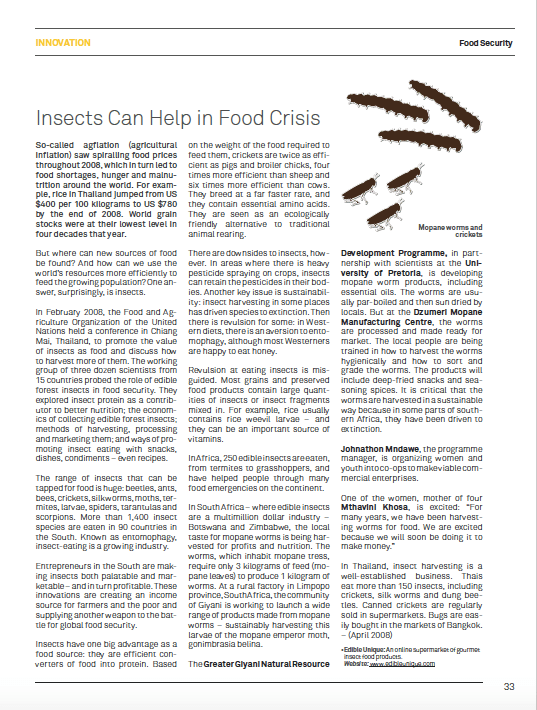
    The range of insects that can be tapped for food is huge: beetles, ants, bees, crickets, silk worms, moths, termites, larvae, spiders, tarantulas and scorpions. More than 1,400 insect species are eaten in 90 countries in the South. Known as entomophagy, insect eating is a growing industry. Entrepreneurs in the South are making insects both palatable and marketable – and in turn profitable. These innovations are adding another income source for farmers and the poor, and supplying another weapon to the battle for global food security.

    Insects have one big advantage as a food source: they are efficient converters of food into protein. Based on the weight of the food required to feed them, crickets are twice as efficient as pigs and broiler chicks, four times more efficient than sheep and six times more efficient than cows. They breed at a far faster rate, and they contain essential amino acids. They are seen as an ecologically friendly alternative to traditional animal rearing.

    There are downsides to insects, however. In areas where there is heavy pesticide spraying on crops, insects can retain the pesticides in their bodies. Another key issue is sustainability: insect harvesting in some places has driven species to extinction. Then there is revulsion for some: in Western diets, there is an aversion to entomophagy, although most Westerners are happy to eat honey.

    Revulsion at eating of insects is misguided. Most grains and preserved food products contain large quantities of insects or insect fragments mixed in. For example, rice usually contains rice weevil larvae – and they can be an important source of vitamins.

    In Africa, 250 edible insects are eaten, from termites to grasshoppers, and have helped people through many food emergencies on the continent.

    In South Africa — where edible insects are a multimillion dollar industry — Botswana and Zimbabwe, the local taste for mopane worms is being harvested for profits and nutrition. The worms, which inhabit mopane tress, require only three kilograms of feed (mopane leaves) to produce one kilogram of worms. At a rural factory in Limpopo province, South Africa, the community of Giyani is working to launch a wide range of products made from mopane worms – sustainably harvesting this larvae of the mopane emperor moth, gonimbrasia belina.

    The Greater Giyani Natural Resources Development Programme in partnership with scientists at the University of Pretoria, is developing mopane worm products, including essential oils. The worms are usually par-boiled and then sun dried by locals. But at the Dzumeri Mopane Manufacturing Centre, the worms are processed and made ready for market. The local people are being trained in how to harvest the worms hygienically, and how to sort and grade the worms. The products will include deep-fried snacks and seasoning spices. It is critical the worms are harvested in a sustainable way, because in some parts of southern Africa, they have been driven to extinction.

    Johnathon Mndawe, the programme manager, is organizing women and youth into co-ops to make viable commercial enterprises. “We expect the product to hit supermarket shelves in 2009,” said Morewane Mampuru, coordinator for the Centre for Scientific and Industrial Research, another partner.

    One of the women, mother of four Mthavini Khosa, is excited: “For many years, we have been harvesting worms for food. We are excited because we will soon be doing it to make money.”

    In Thailand, insect harvesting is a well-established business. Thais eat more than 150 insects, including crickets, silk worms and dung beetles. Canned crickets are regularly sold in supermarkets. Bugs are easily bought in the markets of Bangkok.

    Online vendor Thailand Unique, based in Udon Thani, sells and markets a wide range of edible insects. They include edible scorpions, preserved giant water bugs, roasted grasshoppers, edible big crickets, bamboo worms, crushed giant bug paste, and introducing this year, Bug Snackz and Scorpion Thai Green Curry. There is even a ‘Bug Sample Pack’, containing a mix of seven edible insects and arachnids, all slow roasted for easy snacking.

    Another important centre for insect harvesting is Latin America. In Venezuala, the Pemon Indians eat fire ants during the rainy season.

    In Colombia, so-called “fatass ant” or “hormiga culona” is eaten like popcorn in movie theatres. Some believe it is a defence against cancer, or a natural aphrodisiac. Eating the ants or culona, has been happening right back to the ancient Guane Indians.

    In Santander province, farmers are exporting the ants for sale, some being dipped in Belgian chocolate and sold as a luxury food in London’s Harrods and Fortnum and Mason department stores. The abundant ant population brings in US $11 a pound (kilogram conversion) for the farmers, a doubling in price since 2000.

    Farmers in the artist colony of Barichara harvest the ants – though concerns have been raised that they have been over-harvesting the population. Restaurants in the area offer ant-based spreads for bread and an ant-flavored lamb sauce.

    “It’s an age-old dilemma for the farmer — should I kill it or eat it?” said Andres Santamaria to CBS News, who was given a $40,000 grant from Santander’s government to develop an environmentally sustainable, export-oriented programme for breeding the ants.

    In Tijuana, Mexico, ancient Aztec, pre-Colombian insect meals are on offer at this restaurant, joining a global trend. Cien Anios (“100 Years”), specialises in pre-Colombian, Aztec insect recipes. It is proof there is money in preparing insects for food. Typical dishes include garlicky ant eggs and cactus worms in butter.

    Published: April 2008

    Resources

    • A network for insect collectors: Website: www.insect.net
    • Sunrise Land Shrimp: A do-it-yourself guide to raising and harvesting insects for food, with important information on health and hygiene: Website: www.slshrimp.com
    • Edible Unique: An online supermarket of gourmet insect food products. Website: www.edibleunique.com

    https://davidsouthconsulting.org/2022/11/18/farmers-weather-fertilizer-crisis-by-going-organic/

    https://davidsouthconsulting.org/2022/11/11/urban-farming-to-tackle-global-food-crisis/

    Tijuana‘s Cien Años was the original inspiration for this story. As one of the first stories to draw attention to the insects-for-food market, it contributed to a growing awareness of this exciting food source. I had a delicious all-insect meal there in 2002.

    https://davidsouthconsulting.org/2021/03/05/southern-innovator-issue-3/

    Creative Commons License

    This work is licensed under a
    Creative Commons Attribution-Noncommercial-No Derivative Works 3.0 License.

    ORCID iD: https://orcid.org/0000-0001-5311-1052.

    © David South Consulting 2022

  • Landmark Study Finds Simple Toys Key to Boosting Educational Development and Meeting MDGs

    Landmark Study Finds Simple Toys Key to Boosting Educational Development and Meeting MDGs

    By David SouthDevelopment Challenges, South-South Solutions

    SOUTH-SOUTH CASE STUDY

    African youth need to play more according to a new landmark study published in the UK’s leading medical journal, The Lancet. The study tackles the high rates of illiteracy and educational under-achievement in Africa and finds that malnourishment and lack of stimulation are leaving millions unable to benefit from schooling. It found projects that encouraged learning through play led to children boosting their IQs and getting better reading skills. And it comes up with a very simple and low-cost solution – but excellent opportunity for entrepreneurs – toys and play.

    “These are not high tech interventions,” said team leader for the study, Professor Sally McGregor of the Institute of Child Health of University College London. “Research over decades in Jamaica (and other countries) has shown that women with only primary school-level education and a few home made toys can be trained to make a significant difference in the education, intelligence and mental health of disadvantaged children. The Millennium Goal of universal primary education for all cannot be met unless these children’s poor development is tackled.”

    The paper – Strategies to Avoid the Loss of Developmental Potential among Over 200 Million Children in the Developing World – is published in three parts in the journal.

    Twenty projects around the world were evaluated for the benefits they produce for children under five who use toys. McGregor, who has set up several projects in Kenya, Tanzania and Uganda designing and constructing toys using whatever materials are available, was appalled by the widespread neglect of play throughout these countries. With play, the study found children read better, have better mental health and better self-esteem. In Africa it is ‘desperate, really desperate’ she says.

    African primary school enrolments and literacy rates are among the lowest in the world, with over 42 million school children in sub-Saharan Africa not enrolled in school, and many children not able to afford to go or stay in primary school. Today a little more than half of African adults are literate and some 60 per cent of children go to school, according to UNESCO. The agency has forecasted the need for an additional 1.6 million teachers in Sub-Saharan African classrooms by 2015 – an increase of 68 percent.

    The materials used to construct the toys do not need to be expensive or sophisticated. Toys can be constructed from banana trees, mud, corn on the cob, old plastic bottles, or cloth and straw dolls. It is key that the toys are safe for children under five and that anyone building such toys for sale must follow existing manuals.

    McGregor continues: ‘One mother in a village was doing marvellous things with tiny scraps of material to make a doll. She received no recognition in the village for the work she was doing yet it was so important. It doesn’t take much – dolls or simple wooden blocks – they are so versatile. You see schools with nothing – it is unforgivable. The problem is how poor these people are – food just takes priority over toys – it is that stark.”

    Locally produced toys are key to resolving this crisis for several reasons. Cost is the most important, with those most adversely affected also the least able to pay for toys and who are already living a precarious existence where basic survival takes precedence over play. Another factor is Africa being home to the countries who import the least number of toys: Somalia, Liberia, Togo, Rwanda and Chad. But the situation for African toymakers is often desperate as well, with many craft workers living at the economic margins. Several initiatives have emerged in the last couple of years to address this problem and ensure African toys are local and toymakers earn a living.

    Initiatives like the African Toyshop based in Johannesburg, South Africa – a fair trade business – work to ensure African toymakers can make a living and get their wares to as wide a market as possible. The toymakers featured all use natural resources or recycled materials. Most work at the village level and produce toys that are culturally relevant to Africa. The organization COFTA – Cooperation For Fair Trade in Africa – is a network of Fair Trade producer Organizations in Africa involved and working with disadvantaged grassroots producers to eliminate poverty through fair trade. It is an excellent resource for grassroots organizations wanting to work with African toymakers.

    Published: January 2007

    Resources

    The UK charity TALC – Teaching-aids At Low Cost – is planning to make available toy making manuals on a CD. Tel: (0) 1727 853869

    This website also has excellent resources for budding toy and play area makers in Africa.

    Online exhibition of African toys: Click here

    Book: Africa on the Move: Toys from West Africa Stefan Eisenhofer, Karin Guggeis, Jacques Froidevaux Stuttgart, Germany: Arnoldsche, 2004. 216 pp., 195 color, 28 b/w illustrations. $75.00, cloth.

    SDG Resource Centre: The southern origins of sustainable development goals: Ideas, actors, aspirations.

    https://davidsouthconsulting.org/2021/06/02/case-study-5-gosh-ich-child-health-portal-2001-2003/

    https://davidsouthconsulting.org/2021/02/05/channel-regulation-swedes-will-fight-childrens-advertising-all-the-way/

    https://davidsouthconsulting.org/2021/07/29/infographics-2005-2014/

    https://davidsouthconsulting.org/2021/03/04/innovation-villages-tackling-mdgs/

    https://davidsouthconsulting.org/2016/04/14/interviews-for-the-gosh-child-health-portal-2001-2003-14-april-2016/

    https://davidsouthconsulting.org/2020/12/10/one-world-youth-conferences-mongolia-1998-1999/

    https://davidsouthconsulting.org/2021/03/05/southern-innovator-issue-2/

    https://davidsouthconsulting.org/2020/12/09/study-finds-simple-toys-key-to-boosting-educational-development-january-2007/

    https://davidsouthconsulting.org/2022/10/27/tapping-the-power-of-child-play/

    https://davidsouthconsulting.org/2021/02/11/turning-street-children-into-entrepreneurs/

    Creative Commons License

    This work is licensed under a
    Creative Commons Attribution-Noncommercial-No Derivative Works 3.0 License.

    ORCID iD: https://orcid.org/0000-0001-5311-1052.

    © David South Consulting 2023

  • Social Franchising Models Proving Poor Bring Profits

    Social Franchising Models Proving Poor Bring Profits

    By David SouthDevelopment Challenges, South-South Solutions

    SOUTH-SOUTH CASE STUDY

    The four billion people in the world who live on less than US $2 a day have been described as the bottom of the economic pyramid, or BOP for short. In his book The Fortune at the Bottom of the Pyramid, Indian business consultant and professor CK Prahalad argues that this attitude must be turned on its head: rather than seeing the world’s poor as a burden, only worthy of charity, Prahalad sees nothing but opportunity and unmet needs that business can address. In short, he argues, profits can be married with the goal of eradicating poverty.

    Prahalad has gone so far as to claim this is a market potentially worth US $13 trillion, while the World Resources Institute puts it at US $5 trillion in its latest report, The Next 4 Billion.

    One of the tools business is turning to reach the world’s poor is known as social franchising. The concept borrows from the business world and the highly successful franchise models that are more commonly associated with fast-food restaurants and computer and clothing retailers – wherever rapid expansion and scale are required to reach the biggest market possible. And there is no bigger market, social franchising advocates claim, than the world’s four billion poorest people.

    In the past, most formal business in developing countries chased the small middle class or the even smaller elite or foreign expatriate communities. Traditional poverty eradication strategies have also been criticized for being too narrow, focused on a very small group, or for wasting time and resources replicating what has already been achieved elsewhere, and for ballooning and shrinking depending on aid grants or success at fundraising. Social franchising aims to bypass these weaknesses by finding models that work, making sure they are self-financing, and then quickly scaling them up to reach as many people as possible. It’s a model that is gaining more followers and the serious interest of big and small businesses.

    One example is the Scojo Foundation in India, established to tackle the common problem of blurry vision as people age (presbyopia). Not a disease, the first symptoms occur between the ages of 40 and 50. Low vision affects 124 million people in the world according to the World Health Organization’s Vision 2020 campaign, organizers of World Sight Day 2007 on October 11.

    Blurry vision is a serious disability for weavers, mechanics, goldsmiths and others whose livelihoods depend on near vision. As vision deteriorates, these people are unable to provide for their families. Yet it is easily treatable with a pair of eyeglasses.

    Since, 2002, the Scojo Foundation (the social franchising wing of eyeglasses manufacturer Scojo New York, has launched operations in Bangladesh, Mexico, Guatemala, El Salvador and Ghana. Its largest and fastest growing operation is in India, where it employs more than 560 entrepreneurs in rural villages, and selling more than 50,000 pairs of glasses since 2001.

    It has grown quickly because the business model has been replicated by local staff who work as franchisees. It has followed the franchise model by building a network of “vision entrepreneurs” – low-income men and women, who in turn sell reading glasses directly to rural villagers throughout India. The franchise model enables the “vision entrepreneurs” to earn a good income, and gain respect from other community members.

    Nico Clemminck, co-author of a case study on Scojo, found the price was very competitive with other options in India, and that the higher quality of the glasses made them attractive to villagers.

    “The franchisees, or Vision Entrepreneurs as Scojo calls them, that we met were very involved with Scojo – some of them shifting away their focus from previous occupations to spend the majority of their time on conducting vision screenings and selling glasses. The main reason is that the business is quite profitable to them – they make a US $1 margin per glasses sold, which is very high compared to other retail products. A trend we did notice is that commitment decreases over time, as the entrepreneurs exhaust their immediate circle of relatives or target village populations, and the incremental sale becomes tougher to make.”

    According to Clemminck, Scojo has been able to quickly and successfully expand to other countries by forming partnerships with existing networks that reach into villages.

    The profit hierarchy works like this: the manufacturer charges US $1 for the reading glasses, Scojo charges another US $1, the franchisee a further US $1, and the customer pays US $3 for the glasses. By creating profit at each stage, the model ensures the financial incentives are there to keep the distribution network active.

    Prior to Scojo, it was believed developing infrastructure in rural Indian communities is too high to sustain a franchising model for low-cost products. Scojo found it was possible to succeed with this model, by focusing on profitability and sustainability right from the start, pursuing aggressive growth through partnerships to build economies of scale, blocking competitors by having a strong brand and first-mover advantage, constantly refining the model across regions, and delivering a tangible social benefit, both economic and health.

    On average, franchisees work 20-30 hours per month and earn US $15 to US $20 per month. Considering most franchisees were living on US $1 a day, the extra income is very welcome, Clemminck said.

    “This project gave me insight into the large, untapped market opportunity that exists,” says case study co-author Sachin Kadakia, “and how the concept of ‘Bottom of the Pyramid’ provides a tangible and significant improvement to the quality of life of people in these communities.”

    Another social franchise gaining ground in India is Medicine Shoppe. As a chain of pharmacies, Medicine Shoppe targets underserved communities by offering entrepreneurs franchises. It is an offshoot of the largest franchiser of independent community pharmacies in the US, Medicine Shoppe International Inc.. It can draw on its strong brand and identity to appeal to potential franchises.

    Acumen Fund fellow Nadaa Taiyab, who is working with Medicine Shoppe’s expansion to help the rural and urban poor, found it was important to learn lessons and adapt the model.

    “When I arrived in December (2006),” she said, “we opened the first Sehat Clinic. Last weekend we opened the seventh, with an eighth shortly underway. The model has undergone a tremendous evolution in the past six months. We shifted our site selection strategy from relatively affluent areas with a slum nearby, to locating the clinics right inside slums. We redesigned the process through which we recruit doctors and created an employment package that allows us to hire experienced doctors at a salary we can afford.

    “We also implemented an entirely new concept for Medicine Shoppe called community marketing outreach. Through this program, we hire local women in each area to make daily home visits, refer patients to the clinic, spread health education and awareness, and promote our free health camps and health clinics. In the past four months we have held over 35 health-plus-vision-testing camps, serving over 4,000 people.

    “We have also made some changes to the look and feel of the clinics and shops and put all our marketing materials in the local language, to make our services more appealing to low-income markets.”

    There are critics of the BOP approach, however. Aneel Karnani from the Ross School of Business at the University of Michigan, argues from a for-profit perspective, business would be much better off targeting the needs of the growing middle classes, especially in countries like India and China. He, however, does acknowledge that social franchising businesses like above, where social responsibility is key, are relevant to meeting the needs of the poor.

    Published: August 2007

    Resources

    • A detailed and thorough case study of how the Scojo Foundation model works is found here
    • An excellent set of decision matrices to help budding social entrepreneurs and existing businesses to decide if social franchising is the right solution: www.createproject.org
    • The Social Enterprise Alliance has built a knowledge network and extensive range of resources (including 160 case studies) on social enterprise.

    Creative Commons License

    This work is licensed under a
    Creative Commons Attribution-Noncommercial-No Derivative Works 3.0 License.

    ORCID iD: https://orcid.org/0000-0001-5311-1052.

    © David South Consulting 2023