Tag: Development Challenges

  • Carbon Credits Can Benefit African Farmers Thanks to New System

    Carbon Credits Can Benefit African Farmers Thanks to New System

    By David SouthDevelopment Challenges, South-South Solutions

    SOUTH-SOUTH CASE STUDY

    The global carbon credit trading schemes emanating from the Kyoto Protocol are now creating a multi-billion dollar market – the European carbon market was worth €14.6 billion in 2006 – and represents one of the fastest growing business opportunities in the world. Being green has finally come of age. Yet all the benefits of this are largely bypassing Africa despite more than 70 percent of the continent’s inhabitants earning a living off the land.

    The World Agroforestry Centre – whose mission is to advance the science and practice of agroforestry to transform the lives and landscapes of the rural poor in developing countries – in partnership with Michigan State University has developed a method using satellite imagery and infrared sensing that measures carbon storage in African farmland. They have completed a pilot programme in western Kenya and are ready to encourage poor farmers to plant trees as soon as the European Union allows carbon credits under the Kyoto Protocol to be awarded for this kind of scheme. Further pilot projects will be rolled out in 2007 in partnership with CARE International and the WWF.

    But European Union policies on carbon credits are holding back this significant opportunity to enhance African livelihoods. Europe’s Emissions Trading Scheme (ETS) is at present not willing to recognize the new method of verifying carbon storage in farmland. The ETS is the largest multi-country, multi-sector greenhouse gas emission trading scheme in the world. The issue of carbon storage, or carbon “sinks” as they are known, is very controversial in the world of Kyoto agreement implementation. Non-government organizations that advocate for forests and indigenous people have worked hard to exclude the use of forestry credits to offset fossil fuel burning, arguing that forestry offsets to date have been for big monoculture plantations of fast-growing eucalyptus or pine trees. It is claimed they are net carbon emitters over their lifetimes and also cause additional environmental and social problems.

    But the World Agroforestry Centre’s approach is very different from a monoculture plantation. Their scheme is to help rural Africans to integrate more trees into their agricultural production systems, with benefits besides storing carbon. They argue that the right kinds of trees can increase the productivity and resilience of the land. Trees provide food, fuel, fertilizer, and medicine – medicinal trees are the main source of medication for 80 percent of Africa’s population.

    Louis Verchon, the lead scientist for climate change at the World Agroforestry Centre, believes that if the EU would put in place a new scheme to credit farmers who capture carbon in their land, “millions of dollars in carbon credits could begin flowing to the world’s rural poor.” At present, Verchon says two-thirds of the carbon credit business is being captured by Asian countries who are mostly offering industrial solutions. “Africa has something to offer on this – it can’t compete with the likes of South Korea on industrial solutions, but it has plenty of land.”

    In order to make the scheme work, two things will need to be improved: Africa’s institutional weakness and the paucity of qualified carbon credit verifiers. A network of verifiers would be required to inspect farm sites and make the calculations required to allocate carbon credits to poor farmers. At present, there are no qualified African-born verifiers in Africa according to Verchon.

    The WAC are working with WWF and CARE to build up NGO capacity and start demonstration projects to prove it can work – two pilot projects are already up and running in Kenya. They are also automating much of the process by building a web portal.

    Verchon says the WAC “are in it for the long-haul and we will see this grow over the next ten years.”

    Published: January 2007

    Resources

    • More on emissions trading: Click here
    • Kenya’s Greenbelt Movement: Founded by Nobel Peace Prize winner Wangari Maathai, it provides income and sustenance to millions of people in Kenya through the planting of trees.
    Creative Commons License


    This work is licensed under a
    Creative Commons Attribution-Noncommercial-No Derivative Works 3.0 License.

    ORCID iD: https://orcid.org/0000-0001-5311-1052.

    © David South Consulting 2023
  • Kenyan Book Company Brings Online Sales to East Africa

    Kenyan Book Company Brings Online Sales to East Africa

    By David SouthDevelopment Challenges, South-South Solutions

    SOUTH-SOUTH CASE STUDY

    The Internet has revolutionized retail sales in many developed countries – and nowhere more so than for booksellers. The ability to offer an almost unlimited supply of books through a website is revolutionizing the way people shop and giving life to books long out of print or by unknown authors.

    Kenya has recently gained a reputation for doing things differently in Africa and making great strides when it comes to using information technologies. And the next development in this story is the launch of a Kenyan online book shop modelled on the successful U.S. online bookseller Amazon (amazon.com).

    A book boom is well underway across the global South. Literary festivals continue to expand, from Colombia in South America to India to Nigeria in West Africa, and so do sales of books, newspapers and magazines. While the publishing industries in developed countries despair at the impact of digital media on their profits, in the global South, rising prosperity and literacy are fuelling greater interest in reading and a growing print publishing industry. For example, India is experiencing 15-per-cent-a-year growth for its publishing industry, which is valued at nearly US $2 billion (Frankfurt Book Fair).

    Kenya’s Text Book Centre (TCB) (textbookcentre.com), considered one of the country’s most reputable booksellers, has launched its own online book selling portal and its “eBook web store”. It is targeting readers across East Africa and sells books in 14 categories. Being Kenyan, it is taking an innovative approach that recognizes the large numbers of people who are doing all their transactions over mobile phones. The book portal allows customers to make purchases with their mobile phones using mobile money. This system uses the Kopo Kopo (kopokopo.com) software platform, which allows small and medium sized businesses to accept mobile phone payments.

    Kopo Kopo was first developed in Sierra Leone in 2011, before being further prototyped in Kenya. Kopo Kopo wanted to develop an effective mobile platform to help small and medium sized businesses to better interact with their customers. The Kopo Kopo service was officially launched in February 2012 and is partnered with Safaricom, using its M-PESA Buy Goods service. It is being currently used by hundreds of businesses, from “salons to restaurants to office supply stores”, according to Kopo Kopo’s website.

    As an added benefit, the Kenyan online book platform is joined by a new marketplace for thousands of African ebooks. This part of the service is called eKitabu (ekitabu.com).

    EKitabu will be a big boost to the continent’s authors and also open up new opportunities for budding authors who previously would have struggled to get published and distribute their work. If the ebook web store follows the dynamic of online booksellers in more developed markets, then this ability to gain exposure for author’s work and find an audience could also attract bigger publishers and spark interest in international book deals for formerly obscure writers.

    The Text Book Centre was founded in 1964 by two Indian business partners in Kenya, Mr. SV Shah and Mr. MJ Rughani, and is now considered the leading bookstore in Kenya, specializing in leisure and educational books, according to its website.

    Headquartered in Nairobi’s central business district, it focuses on providing books for the educational sector and strives to be “East Africa’s leading leisure and educational bookstore and office support resource centre”. It also supplies to customers in Uganda, Sudan, Somalia, Malawi, Zanzibar and Tanzania.

    Published: March 2013

    Resources

    1) Tara Books: Based in Chennai, India, the book publisher is a co-operative and has published 200,000 hand-made books since its founding in 1994. Website: http://www.tarabooks.com/

    2) Pathlight: A Beijing, China-based literary magazine with new writing and poetry. Website: http://paper-republic.org/pubs/pathlight/

    3) “Indian readers keep publishing industry on growth track”. Website: http://hcilondon.in/headlines_1686.html

    4) African Publishers Network (APNET): APNET’s vision is the transformation of African peoples through books. APNET’s mission is to strengthen African publishing through networking, training, trade promotion, Intellectual Property (IP) and advocacy, in partnership with other stakeholders, to fully meet Africa’s need for quality, relevant books. Website: http://www.african-publishers.net/

    Southern Innovator logo

    London Edit

    31 July 2013

    Creative Commons License

    This work is licensed under a
    Creative Commons Attribution-Noncommercial-No Derivative Works 3.0 License.

    ORCID iD: https://orcid.org/0000-0001-5311-1052.

    © David South Consulting 2023

  • Solar Bottle Bulbs Light Up Dark Homes

    Solar Bottle Bulbs Light Up Dark Homes

    By David SouthDevelopment Challenges, South-South Solutions

    SOUTH-SOUTH CASE STUDY

    Finding ways to generate low-cost or free light has captured the imagination of innovators across the global South. The desire for light is strong: Light gives an immediate boost to income-making opportunities and quality of life when the sun goes down or in dark homes with few windows.

    More than 1.7 billion people around the world have no domestic electricity supply, of whom more than 500 million live in sub-Saharan Africa (World Bank). Without a source of electricity, it is difficult to use conventional technology to switch the lights on.

    While it is possible to run lights using batteries or diesel generators, these are expensive options that are not possible for many poor people. The more of a slim income that is spent on light, heat or cooking fuel, the less there is left for better-quality food, clothing, transport or education and skills development.

    Low-cost light is great, but free light is even better – and one Brazilian solution is offering this.

    Brazilian innovator and mechanic Alfredo Moser has taken the common plastic water bottle and created a low-cost lighting solution for dark spaces. Often makeshift homes lack decent lighting or a good design that lets the light in during the day. This means it may be a bright, sunny day outside, but inside the home or workplace, it is very dark and reading or working is difficult.

    Moser came upon the idea during regular blackouts in his home city of Uberaba (http://www.uberaba.mg.gov.br/portal/principal) in southern Brazil during 2002. During the blackouts, only factories were able to get electricity, leaving the rest of the population in the dark.

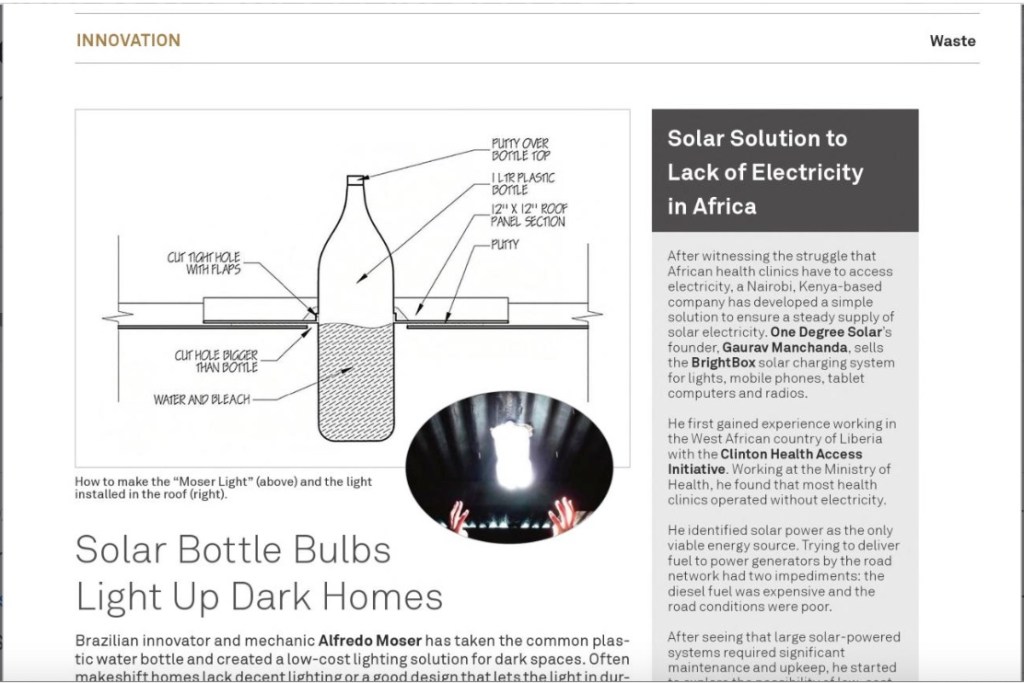
    The “Moser Light” involves taking plastic bottles, which are usually just thrown away or recycled, and filling them with water and bleach to draw on a basic physical phenomenon: the refraction of sunlight when it passes through a water-based medium.

    It is a simple idea: Holes are drilled in the ceiling of a room and the bottles placed in the holes. The liquid-filled bottle amplifies the existing sunlight (or even moonlight) and projects it into the dark room. This turns the plastic bottle into a very bright lightbulb that does not require any electricity.

    Moser uses a solution of two capfuls of bleach added to the water to prevent anything growing in the water such as algae because of the exposure to sunlight.

    “The cleaner the bottle, the better,” he said.

    Polyester resin is used to seal the hole around the plastic bottle and make it watertight from rain.

    Moser claims his bottle innovation can produce between 40 and 60 watts of light.

    Moser uses recycled plastic bottles, so the carbon footprint is minimal compared to the manufacture of one incandescent bulb, which takes 0.45 kilograms of CO2 (UN). Running a 50 Watt incandescent light bulb for 14 hours a day for a year, around the same light as produced by the bottle bulb, produces a carbon footprint of nearly 200 kilograms of CO2.

    “There was one man who installed the lights and within a month he had saved enough to pay for the essential things for his child, who was about to be born. Can you imagine?” Moser told the BBC.

    The plan is to try and get as many as a million homes fitted with the lighting system by the end of 2013.

    In many poor areas, it is common to live in makeshift or rudimentary dwellings. These are often built to crude designs and, in order to keep costs down and boost security, will have few or no windows. These dwellings will consequently be very dark inside, even on the brightest days. This leaves people having to turn to a source of artificial light if they want to do something indoors like read or work. And this costs money. Be it electricity from a mains, or battery-powered lamps or gas-powered lanterns, the cost will eat into a person’s tight income. This is where Moser’s simple solution saves the day and saves pennies: it is free light once the bottle lamp system is installed.

    Placing the bottle lights in the ceiling transforms the ceiling into something akin to the night sky, with many points of light shining down into the room like stars. It also means the occupant of the room does not just have to strain to see with the use of a single light but now has many lights illuminating the room from all angles.

    “It’s a divine light,” Moser told the BBC World Service. “God gave the sun to everyone, and light is for everyone. Whoever wants it saves money. You can’t get an electric shock from it, and it doesn’t cost a penny.”

    It has not been a road to riches for Moser. He has made some money installing the system in a local supermarket and nearby homes, and he has inspired a charity to install the lighting system and to train people to do the installation and make an income from it.

    The MyShelter Foundation in the Philippines was inspired by Moser’s invention and has installed the system in some 140,000 homes there, the BBC reported.

    “We want him to know that there are a great number of people who admire what he is doing,” MyShelter Executive Director Illac Angelo Diaz said of Moser.

    Using bottle bulbs instead of electricity or generators means families can save US $6 per month, according to Diaz (CNN). The Philippines is reported to have the most expensive electricity in Asia and slum homes usually do not have electricity.

    It is estimated 15 other countries also have homes using the Moser system. The MyShelter Foundation believes 1 million homes worldwide have used the Moser system as of 2013.

    Liter of Light (http://aliteroflight.org), run by the MyShelter Foundation, offers instructions on how to install the lighting system on its website.

    Published: September 2013

    Resources

    1) D-Lab: MIT: Development through Dialogue, Design and Dissemination: D-Lab is building a global network of innovators to design and disseminate technologies that meaningfully improve the lives of people living in poverty. The program’s mission is pursued through interdisciplinary courses, technology development, and community initiatives, all of which emphasize experiential learning, real-world projects, community-led development, and scalability. Website: http://d-lab.mit.edu/

    2) d.light Solar: d.light is a for-profit social enterprise whose purpose is to create new freedoms for customers without access to reliable power so they can enjoy a brighter future. d.light design manufacture and distribute solar light and power products throughout the developing world. Website: http://www.dlightdesign.com/

    3) Liter of Light:  It brings the eco-friendly bottle light to communities living without electricity. Website: http://aliteroflight.org

    4) Solar Sister: Solar Sister eradicates energy poverty by empowering women with economic opportunity.  They combine the breakthrough potential of solar technology with a deliberately woman-centered direct sales network to bring light, hope and opportunity to even the most remote communities in rural Africa. Website: http://www.solarsister.org/

    Creative Commons License

    This work is licensed under a
    Creative Commons Attribution-Noncommercial-No Derivative Works 3.0 License.

    ORCID iD: https://orcid.org/0000-0001-5311-1052.

    © David South Consulting 2023