Tag: Development Challenges

  • Recycling Waste to Boost Incomes and Opportunities

    Recycling Waste to Boost Incomes and Opportunities

    By David SouthDevelopment Challenges, South-South Solutions

    SOUTH-SOUTH CASE STUDY

    We all know that green is good, but often the best way to encourage recycling and other environment-improving activities is to put in place economic incentives. It is one thing to admonish people and tell them something is the right thing to do; it is another to make keeping a clean environment pay.

    Many initiatives across the global South have proven it is possible to develop an economy of recycling and garbage collection in poor neighbourhoods. These economies take many forms and models.

    At the most basic end of the scale are the desperate, survival-driven examples of recycling. In countries likeIndia, recycling can be purely a question of survival – people are so poor they can’t allow anything that might have income potential go to waste. Other countries are very familiar with large numbers of desperately poor people picking through garbage dumps and waste to eke out a living. Or, for example in Brazil, as in many other countries, it’s common to see poor and homeless people picking through garbage on the streets.

    These are examples of degrading ‘green’ economies. But there other ways to encourage waste recycling that offer real income benefits and life improvements.

    Brazil, a world leader in waste recycling and green technologies, has pioneered the recycling of plastic bottles, aluminum, steel cans, solid plastic waste and glass. And now energy companies inBrazilhave created credit schemes that encourage waste recycling while giving people real economic benefits in return for doing the right thing for the environment. The first scheme went so well, it quickly inspired others to replicate its programme in other poor communities.

    Coelce (http://www.coelce.com.br/default.aspx) is a power company in the Ceará State in northeastern Brazil. The company is primarily engaged in the distribution of electrical power for industrial, rural, commercial and residential consumption. In 2007 it set up Ecoelce (http://www.coelce.com.br/coelcesociedade/programas-e-projetos/ecoelce.aspx), a programme allowing people to recycle waste in return for credits towards their electricity bills. The success of the programme led to an award from the United Nations.

    The programme works like this: people bring the waste to a central collection place, a blue and red building with clear and bright branding to make it easy to find. In turn they receive credits on a blue electronic card – looking like a credit card – carrying a picture of a child and arrows in the familiar international recycling circle.

    These credits are then used to calculate the amount of discount they should receive on their energy bill. The scheme is flexible, and people can also use the credits for food or to pay rent. In 2008, after its first yearthe scheme had expanded to 59 communities collecting 4,522 tons of recyclable waste and earning 622,000 reais (US $349,438) in credits for 102,000 people. People were receiving an average of 5 to 6 reais (US $2.80 to US $3.37) every month towards their energy bills.  A clear success leading to an expansion of the scheme.

    Now in Ceará’s state capital, Fortaleza (http://en.wikipedia.org/wiki/Fortaleza), – population 3.5 million – there are more than 300,000 people recycling a wide range of materials, from paper, glass, plastics, and metals to cooking oil to get electricity discounts, according to the Financial Times.

    In Brazil’s second largest city, Rio de Janeiro, a favela clean-up programme is being run by electricity firm Light S.A. (http://www.light.com.br/web/tehome.asp), which took its inspiration from the success of the Ecoelce experience.

    The number of favelas, or informal slum neighbourhoods (http://en.wikipedia.org/wiki/Favela), in Rio is debated: according to the federal government, there are 1,020 favelas, while Rio’s housing department lists 582. The government has been trying to tackle the law and order problems in these neighbourhoods – many are plagued with violent drug gangs – and endemic poverty. It calls this programme “pacification” (http://brazilportal.wordpress.com/2011/10/20/rios-top-cop-talks-public-safety-policy-favela-pacification-program/) as it tries to bring law and order and boost economic development and social gains.

    Recycling programmes are helping to bring improvements to life in the favelas by simultaneously cleaning up neighbourhoods and boosting household wealth.

    Light S.A. is a Brazilian energy company working in the generation, transmission, distribution and marketing of electricity. It distributes to 31 municipalities inRio de Janeiroand has around 3.8 million customers.

    According to the Financial Times, the Light project pays residents 0.10 reais per kilogram of paper and plastic (US .5 cents). It also pays 2.50 reais per kilogram of aluminum and lead (US $ 1.40).

    Importantly for community relations, the scheme is open not just to favela residents but to nearby middle class neighbourhoods.

    “The idea is to unite the community and the people living around it,” Fernanda Mayrink, Light’s community outreach officer, told the Financial Times.

    The project has helped improve theSanta Martafavela ofRio, where police have been working since 2008 to take back the neighbourhood from the control of violent drug gangs. Community police officers can now do their job of taking care of safety for the 6,000 residents.

    “You don’t see drugs and guns any more but you do see lots of rubbish,” Mayrink said.

    “This project encourages recycling within the company’s concession area and at the same time contributes to sustainable development and the consumer’s pocket. Light wins, the customer wins (and) the environment wins.”

    In Vietnam, the NGO Anh Duong (http://www.anhduonghg.org/en/) or “Sun Ray” shows schoolchildren how to collect plastic waste to sell for recycling. In return, their schools receive improvements and the students can win scholarships. It is estimated ruralVietnam is littered with 100 million tons of waste every year. Much of it is not picked up.

    The project is operating in 17 communities in Long My and Phung Hiep districts in southernVietnam, mobilising children from primary and secondary schools. School children wearing their uniforms fan out in groups and collect the plastic waste. The money made from selling the plastic waste is being used to improve school facilities and fund scholarships for poor children.

    In 2010, the project reported that 10,484 kilograms of plastic waste was collected by 26,015 pupils. This provided for 16 scholarships for school children.

    The Anh Duong NGO was set up by a group of social workers with the goal of community development. They target the poorest, bringing together the entire community and seek out “low cost and sustainable actions”. The NGO has a mix of specialties, from agriculture to aquaculture, health, microfinance and social work.

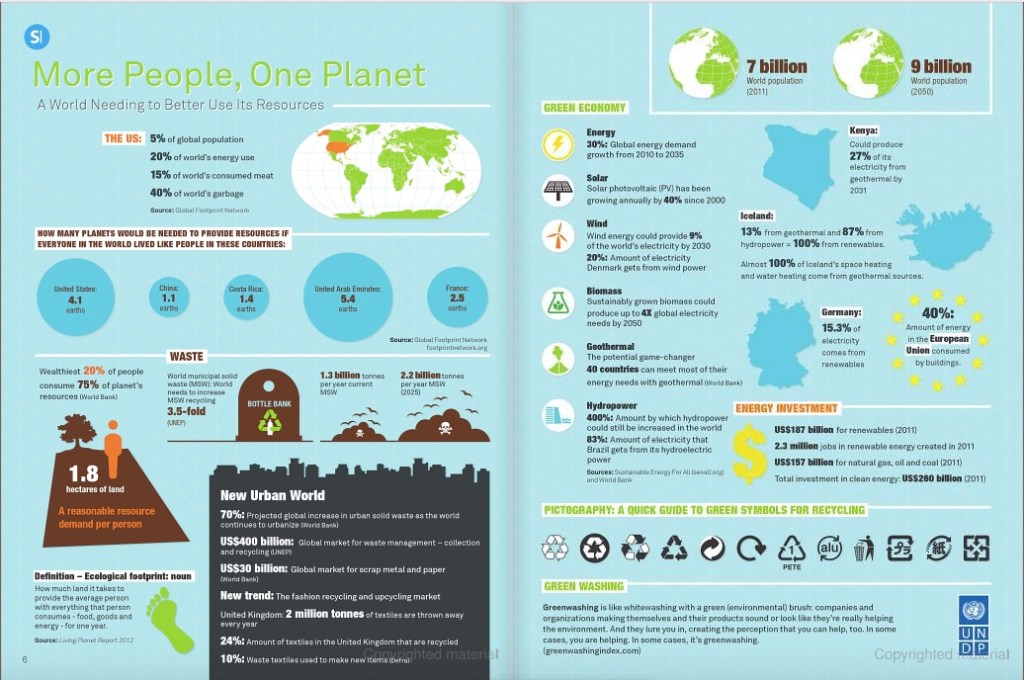
    “Close, but no cigar” some might say, but we were genuinely flattered to be shortlisted in 2014 for inclusion in the book Visual Storytelling: Infographic Design in News published by Images Publishing in Shanghai, China. It is a lovely book to look at and the quality of infographics chosen for the book is high so it must have been a tough call. It was further proof Southern Innovator was getting known around the world and gaining respect for its content and design. The excellent work done by our graphic designer and illustrator Solveig Rolfsdottir speaks for itself.
    Graphic Designer and Illustrator: Sólveig Rolfsdóttir.

    Published: November 2011

    Resources

    1) A travelling exhibit, In The Bag: The Art and Politics of the Reusable Bag Movement, showcases bags and art produced by communities throughout the world and by individual artists. Website:http://www.unrisd.org/80256B3C005BE6B5/%28httpNews%29/D1AB353A91EC2466C125793600519C7B?OpenDocument

    2) EPAP guide: Based on extensive research throughout Mongolia by UNDP, this guide includes the application of the Blue Bag project to Mongolia’s sprawling slum districts surrounding the capital Ulaanbaatar. Website:http://tinyurl.com/yfkn2dp

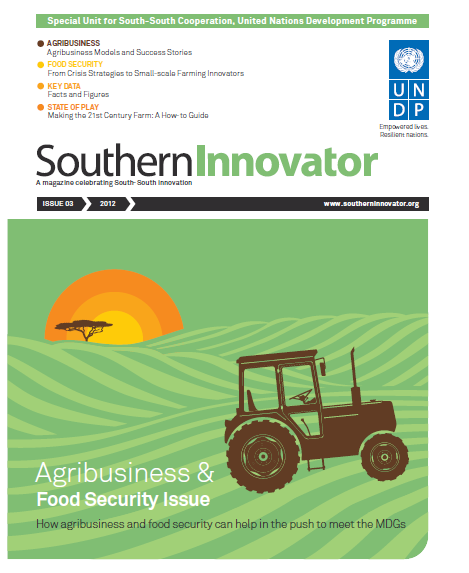
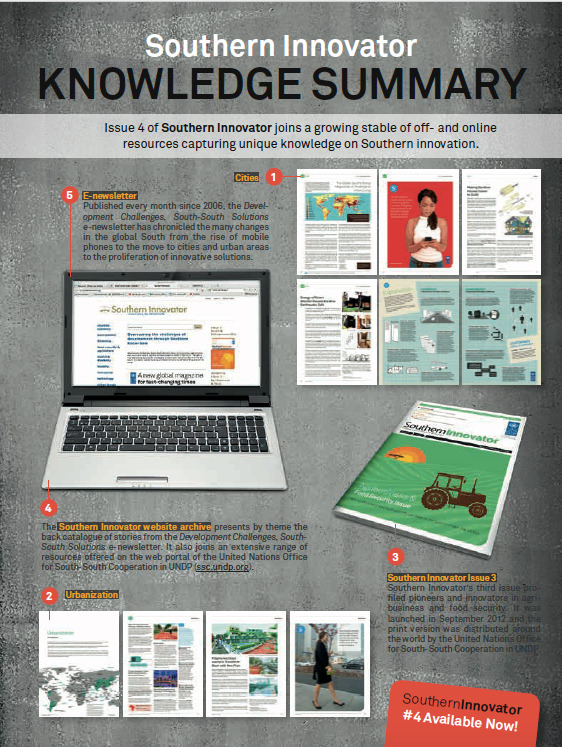
    Development Challenges, South-South Solutions was launched as an e-newsletter in 2006 by UNDP’s South-South Cooperation Unit (now the United Nations Office for South-South Cooperation) based in New York, USA. It led on profiling the rise of the global South as an economic powerhouse and was one of the first regular publications to champion the global South’s innovators, entrepreneurs, and pioneers. It tracked the key trends that are now so profoundly reshaping how development is seen and done. This includes the rapid take-up of mobile phones and information technology in the global South (as profiled in the first issue of magazine Southern Innovator), the move to becoming a majority urban world, a growing global innovator culture, and the plethora of solutions being developed in the global South to tackle its problems and improve living conditions and boost human development. The success of the e-newsletter led to the launch of the magazine Southern Innovator.  

    Follow @SouthSouth1

    Google Books: https://books.google.co.uk/books?id=waeXBgAAQBAJ&dq=Development+Challenges+February+2008&source=gbs_navlinks_s

    Slideshare: http://www.slideshare.net/DavidSouth1/development-challengessouthsouthsolutionsfebruary2008issue

    Southern Innovator Issue 1: https://books.google.co.uk/books?id=Q1O54YSE2BgC&dq=southern+innovator&source=gbs_navlinks_s

    Southern Innovator Issue 2: https://books.google.co.uk/books?id=Ty0N969dcssC&dq=southern+innovator&source=gbs_navlinks_s

    Southern Innovator Issue 3: https://books.google.co.uk/books?id=AQNt4YmhZagC&dq=southern+innovator&source=gbs_navlinks_s

    Southern Innovator Issue 4: https://books.google.co.uk/books?id=9T_n2tA7l4EC&dq=southern+innovator&source=gbs_navlinks_s

    Southern Innovator Issue 5: https://books.google.co.uk/books?id=6ILdAgAAQBAJ&dq=southern+innovator&source=gbs_navlinks_s

    Creative Commons License

    This work is licensed under a
    Creative Commons Attribution-Noncommercial-No Derivative Works 3.0 License.

    ORCID iD: https://orcid.org/0000-0001-5311-1052.

    © David South Consulting 2023

  • Women Mastering Trade Rules

    Women Mastering Trade Rules

    By David SouthDevelopment Challenges, South-South Solutions

    SOUTH-SOUTH CASE STUDY

    Market trading is a vital lifeline for most people in the South. Plenty of delights usually await people in the market, where live animals, herbs and spices, fresh fruits and vegetables, and life’s necessities compete for customers’ money. The formal and informal food sector plays a crucial role in empowering women and providing food to the poor. Women are often those mostly responsible for selling fresh products and street food, and running small catering operations. By being a vendor and getting food at a lower cost, they are able to contribute to their families’ food security.

    Trading and selling in the marketplace can be one of the best options for poor women. By trading, women gain economic independence, learn vital business skills and enjoy the social benefits of interacting with others. But the highly individualistic nature of market trading has its downside: traders must do everything themselves and a day not spent at market is a day’s income lost. They also can only buy in small quantities, and usually pay a higher price. Or don’t know what the competitive price is, so are in a weaker bargaining position with wholesalers.

    Making market trading more efficient has huge advantages, the primary one being more money for the trader.

    Women market traders in Nigeria are improving their efficiency and income with mobile phones. Rural women market traders in the Obiaruku market are using mobile phones to call their suppliers, access information like commodity prices, and contact customers. A survey of the traders found 95 per cent thought mobile phones had a big impact on their business. This has included fewer trips to suppliers, a quicker way to get help when they have been robbed, and opportunities to top-up incomes by selling airtime, handsets or mobile phone accessories.

    In Nigeria, mobile phone use has shot up at a rate of 25 per cent a year. A recent study found that out of a population of 140 million, 12.1 million now have mobile phones and 64 million use mobile phones through street-side phone centres. Phones are also helping women market traders to keep tabs on price fluctuations – giving them an advantage when bargaining with crafty – mostly male – suppliers. A weak bargaining position is a common problem: In Ghana, for example, product producers are forced to sell through “market queens” who take advantage of the lack of price transparency and do not always pay producers fairly (De Lardemelle, 1995).

    In the Madurai region in southern India, women market traders are using a system called CAM. It allows them to record all their business transactions. CAM uses a Nokia 6600 mobile phone to record daily transactions. This includes small loans, buying livestock, or operating tiny retail businesses. The phone’s camera takes pictures of bookkeeping forms to identify and track all documents. The phone then asks the user to input numbers to the data fields. At the last key, the data is sent via text message to a central server. According to Tapan Parikh, a professor at the University of California at Berkeley School of Information in the United States, the most successful technological solutions work because they include village leaders, customers, NGOs, and others in the design process. “This is the only way to ensure long-term sustainability and benefit,” he said.

    In Soweto, South Africa a simple solution to a chronic problem for women market traders has emerged. After seeing hundreds and sometimes thousands of women selling their goods in the marketplace, it became clear they all had one thing in common: they closed on Mondays. They did this because they needed to go to the wholesaler to buy their goods. And they mostly did this by piling into taxis to get there. It hurt the profitability of their businesses in many ways: there was the cost of the taxi, the fact they could only buy small amounts to squeeze in the taxi, a day’s business was lost, and the lack of a discounted, bulk price.

    But the solution to this problem is a bright one: the women place a bulk, wholesale order with a go-between who works with a computer out of a former shipping container. He logs the orders into his computer and sends one big order. The wholesaler is happy with the big order, and delivers it and gives him a 15 per cent discount. This is his profit. The women pay the same price as before, but do not have to pay for the taxi and the goods are delivered directly to them. On top of this, the women can stay open on Monday and make more money!

    Published: May 2008

    Resources

    Creative Commons License

    This work is licensed under a
    Creative Commons Attribution-Noncommercial-No Derivative Works 3.0 License.

    ORCID iD: https://orcid.org/0000-0001-5311-1052.

    © David South Consulting 2023

  • Web 2.0 to the Rescue! Using Web and Text to Beat Shortages in Africa

    Web 2.0 to the Rescue! Using Web and Text to Beat Shortages in Africa

    By David SouthDevelopment Challenges, South-South Solutions

    SOUTH-SOUTH CASE STUDY

    The beep-beep of a received text on a mobile phone is now becoming a much-needed lifeline to Africans. Zimbabweans, who continue to struggle every day with inflation that has shot to 3,731 percent (Zimbabwe Central Statistical Office), have usd African ingenuity and 21st century technology to survive another day.

    New website services have become a literal lifeline for millions suffering from economic and social hardships. At least four new web-based services have stepped in to link expatriate Zimbabweans working outside the country with their relatives back home. All share a common service: people can log into the websites and shop and select what they like to purchase or transfer to their relativs. Once a purchase has been made, a message is sent by mobile phone text to Zimbabwe, either transferring money credits or credits for fuel, food or medical services.

    Mukuru.com is the most elaborate and ambitious of the services, and is expanding across Africa (currently in Zimbabwe and South Africa, it is expanding to Kenya, Malawi and Zambia). Started in 2006, it now boasts 8,000 customers and is averaging 1,200 orders per month, ranging from money transfers to fuel and digital satellite television subscriptions. A voucher number sent by mobile phone also allows the recipient to swap a PIN (personal identification) number for coupons redeemable at certain garages.

    One of the great advantages of this new technology is its ability to give real-time updates and tracking throughout the transaction. Senders are informed about every stage of the transaction, right up until the gas is gushing into the car’s tank.

    “Basically anybody who is able to work will do their best to support family back home,” said Mukuru’s UK-based Nix Davies. “Mukuru’s birth is the result of our inability to sit back and watch, as well as the desperate need to help those back home. The power of an instant SMS being able to provide value to its recipient is inspiring.

    “Launching Mukuru.com has not been without its hurdles,” continues Davies. “Promoting a brand with one foot in the first world and having to deal with third world inconsistencies is always challenging.” Mukuru also has plans to expand into travel, freight, mail (letters are printed out and sent within Zimbabwe), and music to help local musicians.

    Over at another website, Zimbuyer.com, expatriate Zimbabweans can buy groceries for their relatives at home and make sure that the money is not spent on the wrong thing.
    “They’re a lot of people who left Zimbabwe and, for example, have left their children over there,” a spokesman told the BBC’s website. “But sometimes the money they have sent home for the care of the children is diverted into other things. With our service, people buy the stuff – and we deliver them to the recipients so they know what they’re buying.”

    Zimbuyer’s website is similar to food shopping websites in developed countries. Prices are listed in British pounds, but the food items are Zimbabwean staples like sadza maize, Cashel Valley Baked Beans and Ingrame Camphor Cream – all delivered to people living in Harare, Chitungwiza and Bulawayo.Zimbuyer’s most popular products are cooking oil and sugar, while “power generators are proving popular because the electricity always goes off nearly every day.”

    Another service is Zimland.com, which has a network of 52 supermarkets nationwide. As it starkly boasts on its website, it gives Zimbabweans abroad “a quick and efficient way of ensuring their families do not starve in Zimbabwe.”

    The Zimland Superstore offers a variety of hampers of food and essentials for families, from the Madirativhange to the Mafidhlongo to the Hotch Potch Delux, and boys and girls ‘Back to School’ hampers.

    Yet another service has taken on the problem of paying for medical and health services. Beepee Medical Services allows Zimbabweans to pay for doctors’ appointments, prescription drugs and surgery for relatives.

    Launched in September 2006 by Dr Brighton Chireka and his wife Prisca, a nurse, the business is small but growing.

    “Mostly we’re running it as a service to help people,” said Dr Chireka, adding he gets about two consultation bookings a day (US $30 an appointment). “It should be able to pay for itself… We’ve employed people who are working full-time in Zimbabwe. This side (the UK), it’s on a part-time basis to answer the calls.”

    Please visit the following link for more information:

    An up-to-date report from The Economist magazine on the country situation in Zimbabwe: www.economist.com

    Published: November 2008

    https://davidsouthconsulting.org/2022/10/14/anti-bribery-website-in-india-inspires-others/

    https://davidsouthconsulting.org/2022/06/24/dabbawallahs-use-web-and-text-to-make-lunch-on-time/

    https://davidsouthconsulting.org/2022/03/07/david-south-consulting-ranked-in-the-top-10-million-websites/

    https://davidsouthconsulting.org/2021/05/25/ger-mongolias-first-web-magazine-and-a-pioneering-web-project-for-the-united-nations-12-january-2016/

    https://davidsouthconsulting.org/2022/06/25/shoes-with-sole-ethiopian-web-success-story/

    https://davidsouthconsulting.org/2022/10/21/social-networking-websites-a-way-out-of-poverty/

    https://davidsouthconsulting.org/2021/05/14/un-ukraine-web-development-experience-2000/

    https://davidsouthconsulting.org/2022/11/18/web-2-0-networking-to-eradicate-poverty/

    Creative Commons License

    This work is licensed under a
    Creative Commons Attribution-Noncommercial-No Derivative Works 3.0 License.

    ORCID iD: https://orcid.org/0000-0001-5311-1052.

    © David South Consulting 2023

  • Picking Money from the Baobab Tree 

    Picking Money from the Baobab Tree 

    By David South, Development Challenges, South-South Solutions

    SOUTH-SOUTH CASE STUDY

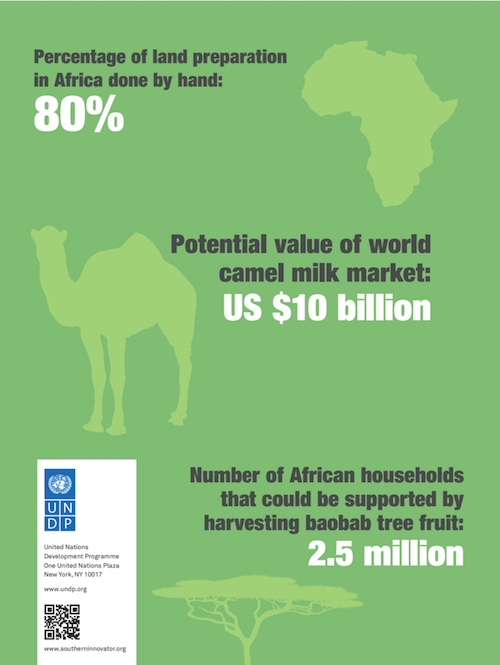
    The fruit of the highly revered African baobab tree is being seen as a great new opportunity for the poor, after a recent decision by the European Commission to allow its importation. According to one study, gathering the fruit has the potential to earn an extra US $1 billion a year for Africa, and bring work and income to 2.5 million households, most of them African bush dwellers (Britain’s Natural Resources Institute).

    The fruit of the African baobab tree is mostly collected in the wild from the ancient trees, which can live for 500 years, with some as old as 5,000 years. The baobob enjoys the veneration and respect traditionally accorded to age in Africa, and features in many stories and myths.

    The fruit is seen as highly nutritious and a new taste option for the European market. This could be a major potential boost to Africa; the European Union is the world’s biggest trader, accounting for 20 percent of global imports and exports, and a major trading partner of most African countries. South Africa alone exports Euro 20.9 billion a year to Europe (2007).

    But serious concerns have been raised about how the harvesting of the fruit will be done, and under what conditions. Getting this right is critical if the sustainability of the fruit is to be maintained, local populations are to benefit, and local use of this food source — eaten by both people and animals — does not suffer.

    European food and drink companies are looking to use the fruit of the tree to flavour a large range of products, from cereal to drinks.

    Baobab fruit is valued for its alleged medicinal properties in treating fevers and diarrhoea, and as a calcium supplement.

    “The potential is huge … We’re quite confident that it’s going to represent significant returns for rural producers,” Dr. Lucy Welford, marketing manager of PhytoTrade Africa, a trade organisation that campaigns for the sustainable use of African natural products, told Reuters.

    “I’d say it’s somewhere between grapefruit and tamarind as a kind of flavour,” said Welford, who expects baobab fruit to be used at first to flavour smoothies and cereal bars. It could also be used in juices, ice-creams and jams or bakery products.

    PhytoTrade works with South African firm Afriplex, which supplies baobab fruit pulp and extracts.

    A refreshing juice made from baobab fruit pulp, known as “bouye” is widely served.

    “The tart flavour, the interesting vitamin and nutrition profile and the sexy story that goes with it — that it’s wild harvested from a very lovely tree — these things add value to the existing products,” said marketing economist Ben Bennet, who wrote the 2007 Natural Resources Institute’s report.

    In the baobab forests around Tandene village in Senegal, local farmers said they looked forward to earning much more from the trees. Prices for a kilo of baobab fruit varied between 40 US cents and a dollar, they said.

    “If people know (that European consumers will buy the product) then they’ll look after the trees better and feed them less to their animals,” said farmer Alassane Sy.

    Chido Makunike, an active commentator on food and agricultural issues in Africa, raises some serious concerns about how this is handled. “Being a non-cultivated forest product, who ‘owns’ the baobab fruit? Can anybody just take a truck into the forest, collect the fruit and export it? Obviously the sudden dramatic change in the economic importance of the baobab will open up many questions that will need regulation.”

    He worries the fruit will just be exported in its raw form, and processed into products in Europe – leaving Africa and Africans the ones who benefit least economically.

    “Yet baobab is a dry, not-easily perishable, easy to process fruit,” he said. “It would not be difficult to have the smoothies and cereal bars that are being contemplated for its use made in Africa and exported as finished product, producing many downstream benefits and keeping more of the wealth to be generated within the continent.”

    Published: October 2008

    Resources

    • The Chamber of Commerce for Switzerland is specially targeting trade deals with Africa and its entrepreneurs. Website: www.swisscham-africa.ch
    • Food Safety – From the Farm to the Fork is the European Commission’s guidelines on food safety and how to prepare food for import into the European Community. Website: http://ec.europa.eu/food/international/trade/index_en.htm
    • EMN Europe is a company that organises all logistics for importing goods into Europe, including making sure all legal requirements are met.
      Website: www.eurotradeconcept.nl
    • The Baobab Fruit Company Senegal has been producing organic baobab products for the nutrition and cosmetics industries.
      Website: http://www.baobabfruitco.com/
    • The Fairtrade Labelling Organization sets the standards for fair-trade and is the place to go to receive official certification.
      Website: www.fairtrade.org.uk
    • Just Food is a web portal packed with the latest news on the global food industry and packed with events and special briefings to fill entrepreneurs in on the difficult issues and constantly shifting market demands. Websitehttp://www.just-food.com
    Creative Commons License

    This work is licensed under a
    Creative Commons Attribution-Noncommercial-No Derivative Works 3.0 License.

    ORCID iD: https://orcid.org/0000-0001-5311-1052.

    © David South Consulting 2022