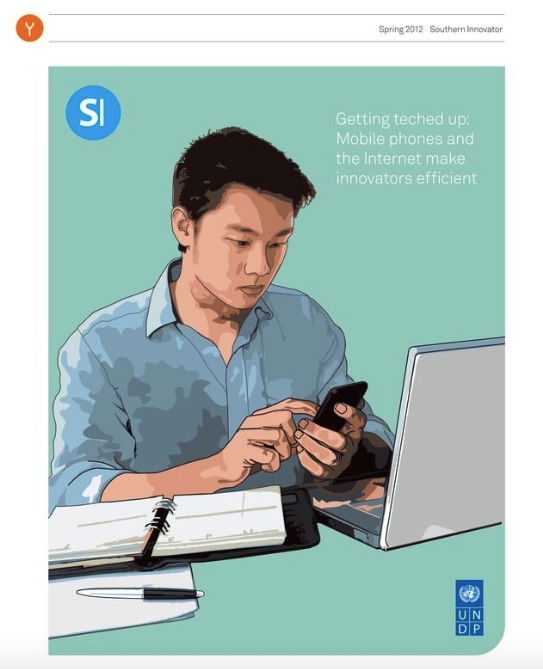
Tag: Development Challenges

  • Popular Chinese Social Media Chase New Markets

    Popular Chinese Social Media Chase New Markets

    By David SouthDevelopment Challenges, South-South Solutions

    SOUTH-SOUTH CASE STUDY

    China has a vast and growing market for the Internet and mobile devices. Over the past decade that market has been largely confined to China –  most businesses have had enough domestic demand and opportunities inside the country to keep them busy.

    But now companies in China’s dynamic Internet and mobile sector are seeking out new markets outside the country. Both online shopping service Alibaba (alibaba.com) and Weibo (weibo.com), the Chinese version of Twitter (twitter.com), are seeking to list on the New York Stock Exchange. The excitement this news has generated shows how many people want to get a piece of the large Chinese market for technology, social networks and online shopping. It is also sending a chill through America’s Silicon Valley – home to the country’s innovative high technology sector – that they are missing out on China’s fast-growing marketplace. Many American services are banned from operating in China. Even more worrying for Silicon Valley, these home-grown Chinese companies, with the market sewn up at home, are now set to compete globally for customers using their increasingly deep pockets.

    One example is Tencent (http://www.tencent.com/en-us/index.shtml), owner of popular Chinese social messaging application (app) Weixin (weixin.qq.com), known as WeChat (wechat.com) outside China. Used on mobile phones and smartphones, Weixin has gained 300 million users in just three years, becoming the dominant social messaging service in the world’s largest smartphone market. Its has been so successful that many rivals are trying to chip away at its customer base.

    Weixin, pronounced way-shin, allows smartphone users to send messages and share news, photos, videos and web links with friends. One of its selling points is its claim to not store messages on its servers.

    Building on its success in social networking in China, it is looking to expand in other markets, including Southeast Asia, Europe and Latin America. It also wants to grow its offerings in online payment and e-commerce.

    One factor in Weixin’s success is the ability to send messages by recording a voice message rather than just typing in characters: very useful for non-Latin script users, and especially for Chinese-language users, who use thousands of characters in everyday communication.

    One ambitious forecast claims Weixin could reach 400 million users and make US $500 million revenue within a year.

    Cosmetics marketer Jenny Zhao, who uses an iPhone 5, told The New York Times: “I’m probably on Weixin six hours a day. A lot of what I do revolves around it.”

    “I use Weixin every day,” said Zhang Shoufeng, a food and drinks seller. “My friends are on it and my boss is on it. We are talking about where to eat, where to hang out and where to meet for company conferences. This is how we communicate.”

    Analysts believe Weixin has benefitted from not having to compete with banned-in-China American company Facebook (facebook.com).

    “Even if Facebook had permission, it’s probably too late,” said Wang Xiaofeng, an analyst at Forrester Research. “Weixin has all the functionality of Facebook and Twitter, and Chinese have already gotten used to it.”

    Tencent is an example of a wider trend: As Chinese companies and offerings have become stronger, wealthier and more innovative, they increasingly look to build their customer base outside China.

    Founded in November, 1998, Tencent, Inc. has grown into China’s largest and most used Internet service portal. Its most popular services include QQ (QQ Instant Messenger), WeChat, QQ.com, QQ Games, Qzone, 3g.QQ.com, SoSo, PaiPai and Tenpay, as well as Weixin.

    The company claims to put innovation at the heart of its business, with more than half of its employees devoted to research and development. The Tencent Research Institute, established in 2007 with RMB 100 million (US $16 million), calls itself “China’s first Internet research institute, with campuses in Beijing, Shanghai, and Shenzhen.” It has patents for technologies it has developed for instant messaging, e-commerce, online payment services, search, information security, and gaming.

    Tencent was driven to innovate by a fear it could quickly become irrelevant in the information technology space. Weixin is also pioneering ways to book taxis, hotels and airline flights through the service and even ways to control home appliances.

    “Chinese Internet companies are no longer behind,” said William Bao Bean, a managing director at the venture capital firm SingTel Innov8 (http://innov8.singtel.com/). “Now in some areas, they’re leading the way.”

    Published: April 2014

    Resources

    1) Weibo: Sina Weibo is a Chinese microblogging (weibo) website. Akin to a hybrid of Twitter and Facebook, it is one of the most popular sites in China, in use by well over 30 per cent of Internet users, with a market penetration similar to what Twitter has established in the USA. Website: weibo.com

    2) Laiwang: A variation on the WeChat service, its biggest competitor. Website: laiwang.com

    3) WhatsApp: WhatsApp Messenger is a cross-platform mobile messaging app which allows you to exchange messages without having to pay for SMS. Website: whatsapp.com

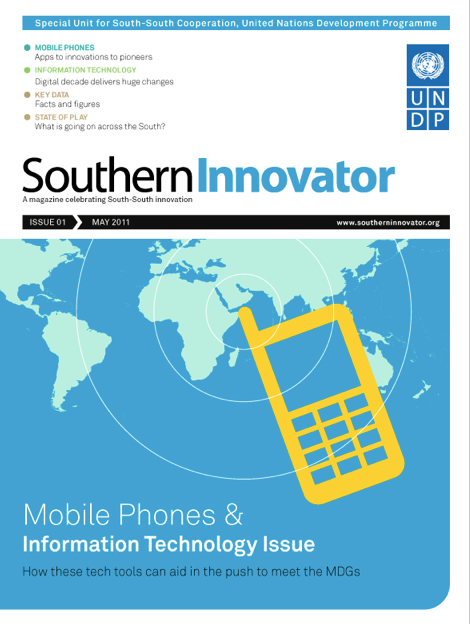
    4) Southern Innovator Issue 1: Mobile Phones and Information Technology: Pioneering and innovative ways to deploy mobile phones and information technology to tackle poverty. Website: http://www.scribd.com/doc/57980406/Southern-Innovator-Magazine-Issue-1 and here: http://tinyurl.com/q6bfnpz
    https://davidsouthconsulting.org/2022/10/20/china-consumer-market-asian-perspective-helps/

    https://davidsouthconsulting.org/2020/12/10/china-sets-sights-on-dominating-global-smartphone-market/

    https://davidsouthconsulting.org/2021/03/20/computer-gold-farming-turning-virtual-reality-into-real-profits/

    https://davidsouthconsulting.org/2021/01/26/designed-in-china-to-rival-made-in-china/

    https://davidsouthconsulting.org/2022/10/26/tackling-chinas-air-pollution-crisis-an-innovative-solution/

    https://davidsouthconsulting.org/2020/04/17/virtual-supermarket-shopping-takes-off-in-china/

    Citation

    Qianyu, Ji (2014) “Exploring the Concept of QR Code and the Benefits of Using QR Code for Companies,” Lapland University of Applied Sciences, School of Business and Culture Degree Programme in Business Information Technology, 2014.

    Development Challenges, South-South Solutions was launched as an e-newsletter in 2006 by UNDP’s South-South Cooperation Unit (now the United Nations Office for South-South Cooperation) based in New York, USA. It led on profiling the rise of the global South as an economic powerhouse and was one of the first regular publications to champion the global South’s innovators, entrepreneurs, and pioneers. It tracked the key trends that are now so profoundly reshaping how development is seen and done. This includes the rapid take-up of mobile phones and information technology in the global South (as profiled in the first issue of magazine Southern Innovator), the move to becoming a majority urban world, a growing global innovator culture, and the plethora of solutions being developed in the global South to tackle its problems and improve living conditions and boost human development. The success of the e-newsletter led to the launch of the magazine Southern Innovator.  

    Creative Commons License

    This work is licensed under a
    Creative Commons Attribution-Noncommercial-No Derivative Works 3.0 License.

    ORCID iD: https://orcid.org/0000-0001-5311-1052.

    © David South Consulting 2025
  • The BRCK: Kenyan-Developed Solution to Boost Internet Access 

    The BRCK: Kenyan-Developed Solution to Boost Internet Access 

    By David SouthDevelopment Challenges, South-South Solutions

    SOUTH-SOUTH CASE STUDY

    Using the Internet in Africa has its challenges, as anyone who has worked there knows. Issues can include weak Wi-Fi signals, slow Internet service providers, electricity outages and power surges that can damage or destroy sensitive electronic devices.

    Power surges (http://electronics.howstuffworks.com/everyday-tech/surge-protector3.htm) can occur for a variety of reasons but are usually a sudden surge in the current flowing to the wall outlet from the power mains. They are common in developing countries, and can be tragic for electronic devices.
    Most electronic devices are designed for use in developed countries where people can take the power supply, and ubiquitous Internet access, for granted. This affects the way devices are made. Designers will assume many things are available to users and build the electronic devices accordingly. But for users in Africa and across the global South, what seems easy in the developed world is fraught with frustration and wasted time.

    This is a big obstacle to economic development and places people in Africa at a disadvantage in the modern world of fast communications.

    One initiative is out to transform this experience for the better with a made-in-Africa solution that is being modified based on real-world experience and user feedback.

    The BRCK (brck.com) bills itself as “your backup generator for the Internet” and is intended to address the problems of finding a reliable Internet connection, staying online in a power blackout and saving devices from destruction when there is a power surge.

    Anyone who has tried to use a laptop computer to upload some photographs in Africa will know the frustration felt when the Wi-Fi signal drops away. The BRCK hunts around for the strongest signal and grabs it so the user can carry on working.

    Built to be robust and take knocks and bruises, it is a sleek, black plastic brick-shaped device with the letters BRCK elegantly embossed on the side.
    The BRCK can function as a hub for up to 20 devices, with a built-in Wi-Fi signal able to cover multiple rooms (so a team can work off a single Internet connection), a battery that can last eight hours, a 16-gigabyte on board memory hard drive, and software to allow for remote management  by apps on other devices such as smartphones. While it is not able to speed up an already poor connection or increase low bandwidth, it can “scavenge” around to find the strongest signal and hop to it right away. It can work with Ethernet, Wi-Fi, and 3G and 4G networks.

    If a blackout occurs, it quickly switches to the onboard battery without forcing a re-boot of the computer.

    It has been developed in Nairobi, Kenya and the first plastic prototype of the BRCK device was milled at the Fab Lab Nairobi (http://fablab.uonbi.or.ke/) using a 3D fabricator machine.

    The BRCK’s makers describe it as a tool “trying to create ubiquitous Internet” and an “enabler of the Internet of things.” The BRCK is designed around the changing way people work and access the Internet, frequently moving from place to place. People now don’t just rely on one device but have many – a mobile phone or smartphone, a laptop, a tablet, an iPod or other device.

    A Kickstarter fundraising campaign (https://www.kickstarter.com/projects/1776324009/brck-your-backup-generator-for-the-internet) gives more details on the origins of the project and offers many ways to support the different stages of development, right up to mass manufacturing of the BRCK.

    One application of the BRCK is for research. It could be deployed to gather data at a field site, then connect via the Cloud (http://en.wikipedia.org/wiki/Cloud_computing) to pass data back to a lab at a university in another country for analysis.

    The BRCK is being built by Ushahidi (ushahidi.com), a non-profit technology company that makes open source software and made its name with the crowdsourced mapping platform it built during the post-election violence in Kenya in 2008. The Ushahidi platform has been deployed around the world since in many crisis situations.

    Founded by David Kobia, Juliana Rotich and Erik Hersman, the Ushahidi team is focused on “building tools that improve the way information flows in the world.” It is about making tools to help people communicate in the most difficult places.

    BRCK comes with a visually appealing website that makes excellent use of the BRCK’s ebony good looks.

    The website boasts: “If it works in Africa, it’ll work anywhere”.

    The ongoing development of the BRCK can be followed on the website’s blog: http://www.brck.com/2014/01/they-case-for-engineering-brck-in-africa-part-1/.

    “The idea is to build a company around the product rather than just do a one-off product – and to gradually improve the product through new versions,” said BRCKs chief technology officer Reg Orton.

    “Our engineers are based in Kenya now – we are not based in China, we are not based in the (Silicon) Valley. What that means for us we are able to go out there and (be) able to see the problems directly.”

    The BRCK can be ordered online and will be available for sale soon, according to the website.

    Published: April 2014

    Resources

    1) Momax iPower Milk External Battery:  Inspired from daily life, the creative iPower Milk looks like a cute and fresh milk carton. It fulfills your daily energy need just as pure milk. iPower Milk comes in a variety of cheerful candy colors, so choose one which suits your taste. The tiny and delicate iPower Milk has 1.5A USB output, which is compatible with most digital devices, including tablets. Website: http://shop.brando.com/Momax-iPower-Milk-External-Battery-2600mAh_p09700c1595d003.html

    2) Southern Innovator Issue 1: Mobile Phones and Information Technology: Pioneering and innovative ways to deploy mobile phones and information technology to tackle poverty. Website: http://www.scribd.com/doc/57980406/Southern-Innovator-Magazine-Issue-1 and here: http://tinyurl.com/q6bfnpz
    3) iHub Nairobi: Nairobi’s Innovation Hub for the technology community is an open space for the technologists, investors, tech companies and hackers in the area. This space is a tech community facility with a focus on young entrepreneurs, web and mobile phone programmers, designers and researchers. It is part open community workspace (co-working), part vector for investors and VCs (venture capitalists) and part incubator. Website: ihub.co.ke

    4) Fab Lab Nairobi: Fablab (fabrication laboratory or “fabulous laboratory”) is a workshop with an array of computer controlled tools with the aim to make “almost anything”. Fab labs provide widespread access to modern means for invention. They began as an outreach project from MIT’s Center for Bits and Atoms (CBA). CBA assembled millions of dollars in machines for research in digital fabrication, ultimately aiming at developing programmable molecular assemblers that will be able to make almost anything. Fab labs fall between these extremes, comprising roughly fifty thousand dollars in equipment and materials that can be used today to do what will be possible with tomorrow’s personal fabricators. Website: http://fablab.uonbi.or.ke/

    https://davidsouthconsulting.org/2021/03/20/accessing-global-markets-via-design-solutions/

    https://davidsouthconsulting.org/2022/10/26/africa-to-get-own-internet-domain/

    https://davidsouthconsulting.org/2022/10/24/brazilian-solar-powered-wifi-for-poor-schools/

    https://davidsouthconsulting.org/2020/04/30/crowdsourcing-mobile-phones-to-make-the-poor-money/

    https://davidsouthconsulting.org/2020/05/01/diy-solution-charges-mobile-phones-with-batteries/

    https://davidsouthconsulting.org/2022/10/17/east-africa-to-get-its-first-dedicated-technology-city/

    https://davidsouthconsulting.org/2020/12/20/kenya-reaches-mobile-phone-banking-landmark/

    https://davidsouthconsulting.org/2022/11/23/kenyan-farmer-uses-internet-to-boost-potato-farm/

    https://davidsouthconsulting.org/2020/12/20/mobile-phones-bring-the-next-wave-of-new-ideas-from-the-south/

    https://davidsouthconsulting.org/2021/03/20/texting-for-cheaper-marketplace-food-with-sokotext/

    https://davidsouthconsulting.org/2022/10/10/wireless-internet-culture-helping-zimbabwe-economy-recover/

    Development Challenges, South-South Solutions was launched as an e-newsletter in 2006 by UNDP’s South-South Cooperation Unit (now the United Nations Office for South-South Cooperation) based in New York, USA. It led on profiling the rise of the global South as an economic powerhouse and was one of the first regular publications to champion the global South’s innovators, entrepreneurs, and pioneers. It tracked the key trends that are now so profoundly reshaping how development is seen and done. This includes the rapid take-up of mobile phones and information technology in the global South (as profiled in the first issue of magazine Southern Innovator), the move to becoming a majority urban world, a growing global innovator culture, and the plethora of solutions being developed in the global South to tackle its problems and improve living conditions and boost human development. The success of the e-newsletter led to the launch of the magazine Southern Innovator.  

    https://davidsouthconsulting.org/2021/03/05/southern-innovator-issue-1/

    Creative Commons License

    This work is licensed under a
    Creative Commons Attribution-Noncommercial-No Derivative Works 3.0 License.

    ORCID iD: https://orcid.org/0000-0001-5311-1052.

    © David South Consulting 2023

  • Innovative Solutions Celebrated in Ashden Awards

    Innovative Solutions Celebrated in Ashden Awards

    By David SouthDevelopment Challenges, South-South Solutions

    SOUTH-SOUTH CASE STUDY

    The world’s population is heading towards 9.6 billion by 2050 (UN). Combined with a growing middle class and rising living standards across the global South, that means ever-greater demand on the world’s finite resources. This raises a crucial question: Where will the energy to power rising living standards come from, and how much damage will be done to the planet’s environment by pollution created generating it (https://www.un.org/en/development/desa/news/population/un-report-world-population-projected-to-reach-9-6-billion-by-2050.html)?

    The solution advocated by the world’s scientists is to move to sustainable energy creation, which does not rob from the future to create energy for today.

    Such an approach requires fresh thinking and engagement from those who are actually involved in the struggle to raise living standards and improve human development.

    One way to do this is to use high-profile awards and prizes to lure out fresh thinking and innovators and help them get the funding they need to realize their plans.

    The International Ashden Awards (ashden.org) – considered the “leading green energy awards” – is about championing and promoting “practical, local energy solutions that cut carbon, protect the environment, reduce poverty and improve people’s lives”. It recently announced the finalists and winners for 2014.

    The international finalists are 10 sustainable energy enterprises drawn from Africa (Burkina Faso, Tanzania), India and Southeast Asia (Cambodia, Myanmar). A handy, clickable and searchable online map (http://www.ashden.org/winners) further explains the winners and finalists for 2014 and previous years.

    “With the stark warnings from the IPCC (Intergovernmental Panel on Climate Change) of the impacts of climate change, especially for the most vulnerable, we need to find solutions before it is too late,” said Ashden founder-director Sarah Butler-Sloss.

    “Our role at Ashden is to shine a light on those organizations around the world that are helping reduce carbon emissions and finding ways of adapting to the effects of climate change.”

    The mix of non-profit organizations and businesses among 2014’s winners and finalists shows there is no shortage of enthusiasm and fresh thinking out there. Proof the global South is alive with innovators with solutions.

    Among the five international winners – who will receive between US $8,566 and US $68,531 each – is India’s Greenway Grameen (greenwaygrameen.com). It is tackling the problem of harmful pollution caused by cooking. Despite rapid economic growth and the spread of consumer goods such as televisions and mobile phones, most Indian women still cook with wood or dung. This is not only time-consuming, it also produces health-damaging smoke. Greenway Grameen was founded by two young MBA graduates in 2010 to make and sell affordable, desirable cookstoves that reduce smoke, cook food more quickly and stay cleaner for longer, dramatically improving the quality of life for many women and girls. As of March 2014 more than 120,000 of Greenway’s made-in-India smart stoves had been sold, benefitting around 610,000 people.

    Another Indian winner is Infosys (infosys.com). India’s fast-growing economy is making ever-greater demands on its electrical grid. Global IT giant Infosys is leading the way to more sustainable growth by embracing green building measures, decreasing electricity consumption per staff member across its Indian business campuses. Success lies in seizing every opportunity to cut energy consumption in its existing buildings – from reducing the size of chiller plants for air conditioning to painting roofs white to reflect the heat. Cutting-edge design of new buildings also helps keep offices cooler and maximizes natural light. Taking US $80 million off its electricity bills, Infosys has proven the business case for large companies to invest in energy efficiency – not just in India but around the globe.

    Among the other winners:

    – Tanzania’s Off Grid Electric (offgrid-electric.com) is a leader in solar energy in East Africa, using mobile money to sell solar power as a daily service at an affordable price. Mobile money – where customers pay with their mobile phones – is increasingly used as a method of payment. Off Grid stands out because it understands the importance of customer service, offering an all-day customer care telephone line and ongoing support from a local agent. More than 10,000 households have taken up the service since April 2012. As fast as systems are manufactured they are off to customers – thanks to a sophisticated mobile phone app-based customer registration and product-tracking system.

    – Myanmar’s Proximity Designs (proximitydesigns.org) is introducing treadle pumps (http://en.wikipedia.org/wiki/Treadle_pump) and other sustainable agriculture technologies to the country for the first time. Lifting water from wells and carrying it across fields is back-breaking, time-consuming work for rural farmers. Combined with water-saving drip irrigation technology, foot-operated treadle pumps that draw up water from wells can dramatically increase yields and incomes. Farmers are now seeing their lives transformed with some harvests and incomes more than doubling – and the pumps are helping ease the daily drudgery of farming. With over 90,000 households benefiting so far, Proximity Designs continues to adapt and introduce new products like solar pumps, to meet the needs of this rapidly changing country.

    – Cambodia’s Sustainable Green Fuel Enterprise (http://www.sgfe-cambodia.com/environment) is turning leftover coconut shells and other waste into clean-burning briquettes for use as cooking fuel in the capital Phnom Penh’s homes and restaurants. While most Cambodians cook on wood charcoal, contributing to the country’s rampant deforestation and air pollution, this pioneering Cambodian business – led by Carlo Figà Talamanca – can scarcely keep up with demand.

    The finalists are also an innovative lot too. Kéré Architecture (kerearchitecture.com) in Burkina Faso, Africa, has set a new standard for green school buildings. The school it built has a ventilated roof and other clever design features, providing a much cooler environment for children to study in. Not only that, the school was built by local people, and largely with local materials. Germany-based Francis Kéré, originally from Burkina Faso, designed and built the school in his home village. Kéré Architecture has since designed and built more than 20 innovative, naturally cooled public buildings in Africa.

    India’s Sakhi Unique Rural Enterprise (sureindia.co.in), or SURE, is a not-for-profit social enterprise in central Maharashtra that has selected, trained and supported more than 600 female micro-entrepreneurs to sell clean energy products such as solar lanterns and cleaner cookstoves to other women. For the women entrepreneurs, selling energy products boosts income and carries a social cachet, while customers also see their lives improved with time-saving products.

    Another Indian innovator, Mera Gao Power (http://meragaopower.com/), is demonstrating the business case for meeting the needs of some of the poorest people in India with unsubsidized commercial micro-electric grids, connecting more than 20,000 Uttar Pradesh families to clean, affordable power. Each system is easy to install and provides seven hours of light and mobile phone-charging for up to 32 houses. And with weekly payments of just US $0.42 cents, the electricity is even cheaper than kerosene.

    The Rajasthan Horticulture Development Society (http://horticulture.rajasthan.gov.in/) in India has come up with a novel way to boost green agriculture and boost farming incomes. Farmers in the desert state of Rajasthan are seeing their sons return from cities to work on their farms thanks to a new solar-powered agricultural boom. The Rajasthan Horticulture Development Society (RHDS) has provided more than 10,000 farmers with new solar-powered water pumps, enabling year-round cultivation of high-value crops and the kind of high-tech horticulture that’s never been seen in the region before. With farmers’ incomes more than doubling, the programme has given them the “gift of life”.

    And finally, Tanzania’s SimGas (simgas.com) is selling biogas plants that help people turn manure into clean gas for cooking instead of using charcoal, helping reduce deforestation. The plants are factory-produced and made of plastic, so they can be installed much more quickly than conventional plants and reach many more thousands of people. SimGas has just installed the largest plastic injection-moulding machine in East Africa, creating the potential to roll out biogas plants across East Africa.

    The Ashden Awards were set up in 2001 to champion trailblazing sustainable energy enterprises and programmes that improve people’s lives and tackle climate change. Ashden says its 150 award winners have improved the lives of 37 million people worldwide, and are now saving over 5 million tonnes of carbon emissions every year.

    Published: July 2014

    Resources

    1) Innovation Prize for Africa: The IPA is an initiative of the African Innovation Foundation (AIF) started in 2011. IPA honours and encourages innovative achievements that contribute toward developing new products, increasing efficiency or saving cost in Africa. Website: http://innovationprizeforafrica.org

    2) Champions of the Earth Award: The Champions of the Earth Award recognizes outstanding environmental leaders, whether individuals or organizations, that have exemplified inspiration, vision, innovation, leadership and action for the environment. This international award was established by UNEP in 2004. Website: unep.org/awards/

    The SEED Awards: The SEED Award recognizes innovation in local, environmentally-responsible and sustainable entrepreneurship. This international award is the flagship programme of the SEED Initiative, a partnership founded by the United Nations Development Programme (UNDP), UNEP, and the International Union for Conservation of Nature (IUCN). Website: seedinit.org

    4) Green Star Awards: The Green Star Awards recognize those who have made remarkable efforts to prevent, prepare for, and respond to environmental disasters around the world. This international award is a joint initiative between UNEP, the UN Office for the Coordination of Humanitarian Affairs and Green Cross International. Website: http://www.gcint.org/green-star-awards3

    Creative Commons License

    This work is licensed under a
    Creative Commons Attribution-Noncommercial-No Derivative Works 3.0 License.

    ORCID iD: https://orcid.org/0000-0001-5311-1052.

    © David South Consulting 2023

  • Powerful Solar Light Spurring Income-Making Opportunities

    Powerful Solar Light Spurring Income-Making Opportunities

    By David SouthDevelopment Challenges, South-South Solutions

    SOUTH-SOUTH CASE STUDY

    A clever innovator from India has built a highly durable solar lantern that also doubles as a mobile phone charger.

    The Sunlite lantern – the JS 30 MOB Sunlite – made by Sunlite Solar (sunlite-solar.com) is an LED (http://en.wikipedia.org/wiki/Light-emitting_diode) light packed with clever innovations. It is completely self-contained and does not require any extra parts, cables or separate solar panel to charge it. The clever design includes a pop-up, fold-down handle, a powerful solar PV (photovoltaic) panel on its top that – with a day out in the sun – charges the lantern’s battery enough to provide around 8 hours of 360-degree light when the sun goes down. It is also highly durable and moisture and heat resistant and can withstand a drop on a hard floor.

    The manufacturer of the Sunlite lantern is India Impex, which focuses on making and exporting high quality off-grid solar lighting products and sees itself as a “socially driven company.” Founded in 2009, it has built up its reputation as a global vendor to humanitarian and relief agencies.

    To date, the Sunlite lantern has been distributed to people following Japan’s 2011 earthquake and tsunami, after Thailand’s 2011 floods and to refugees caught up in the ongoing crisis in Syria.

    “For the size of the lamp, for the number of hours, for the features we give, including the mobile (phone) charging – we are 100 per cent portable – it is all integrated,” said Sunlite representative Divyesh Thakkar, while demonstrating the lantern at the 2012 Global South-South Development Expo, held recently in Vienna, Austria (southsouthexpo.org).

    The mobile phone charging capability has been seized as a great way to turn the lantern into an income-generating opportunity. Already, people are forming co-ops and charging rent time on the lantern for recharging mobile phones. And there are a few clever tweaks to the lantern to help control this.

    “I don’t want this to be abused – I want it to be smart,” said Thakkar. “When someone comes in and charges the mobile phone and forgets, it is going to cut off after 20 minutes.”

    Sunlite lanterns have many uses, according to the product’s maker. One aspect the manufacturer is emphasizing is the importance of light to the security of women and children. There is overwhelming evidence that better lighting makes for a more secure environment, and allows people to do more things safely at night. Children can look out for environmental threats such as poisonous snakes and spiders, and women and girls can feel safe doing things like going to the toilet without worrying that somebody might attack them in the dark.

    Solar power is being seen as a way to get electricity to people in areas bypassed by conventional electricity grid networks. It also helps move people away from expensive, polluting and dangerous alternatives such as diesel generators, paraffin lamps, gas stoves and coal or dung fires.

    “We compare our solar lantern to the kerosene lantern,” Sunlite representative Sagar Mehta explained. “On a payback basis, you use an approximate of 30 to 40 cents of a US dollar of kerosene every day for a four-hour light. First of all, it is very harmful – smoke inhalation, illnesses, burns, all sorts of things, security issues.

    “That will cost a family one third or half of its income on a daily basis. If we can change this around where if we can make a solar lantern, where the sun is free, that can pay back in three months and you start earning rather than paying, (they are) making a living.”

    Solar-powered devices have many advantages. They can power up their batteries during the day while sitting in the sunshine and then be a source of light and electricity at night. This free energy source reduces the cost of running lights at night and means people can do a wide range of activities, from reading and studying to running a business or socializing. Some have even used Sunlite lanterns as landing lights for aircraft runways in Africa.

    Sunlite lanterns are currently being distributed to people in disaster situations and also in refugee camps and displaced persons communities.

    “The lamp was developed as a basic light for refugees who don’t have anything and have been displaced from homes,” said Mehta. “We supply in excess of 50,000 lamps every year to aid agencies, in particular the (UN’s) refugee agency.”

    In order to keep tight control on quality and be able to have an inventory of lanterns ready to go on a moment’s notice, the company has invested in and set up its own in-house manufacturing facilities in India.

    Sunlite Solar sees itself as a social enterprise. It is not focused on quick profits, and developing the lantern has taken time.

    “It requires a huge amount of investment and time,” said Thakkar. “We spent two years without selling a single piece. What we did was our R&D and went out in the field, some of the most dangerous places – Rwanda, Uganda – actually training people to use it and getting the awareness.

    “When you work with the UN, when you work through other government channels, it is just a long process which you have to be willing to go through.”

    Published: December 2012

    LINKS:

    1) More information on how renewable solar technologies work. Website:http://www.energysavingtrust.org.uk/Generating-energy/Choosing-a-renewable-technology/Solar-panels-PV 


    2) Solar Sister: Solar Sister eradicates energy poverty by empowering women with economic opportunity. Website:http://www.solarsister.org/

    3) D.Light Design: D.light is a for-profit social enterprise whose purpose is to create new freedoms for customers without access to reliable power so they can enjoy a brighter future. Website: http://www.dlightdesign.com/

    Development Challenges, South-South Solutions was launched as an e-newsletter in 2006 by UNDP’s South-South Cooperation Unit (now the United Nations Office for South-South Cooperation) based in New York, USA. It led on profiling the rise of the global South as an economic powerhouse and was one of the first regular publications to champion the global South’s innovators, entrepreneurs, and pioneers. It tracked the key trends that are now so profoundly reshaping how development is seen and done. This includes the rapid take-up of mobile phones and information technology in the global South (as profiled in the first issue of magazine Southern Innovator), the move to becoming a majority urban world, a growing global innovator culture, and the plethora of solutions being developed in the global South to tackle its problems and improve living conditions and boost human development. The success of the e-newsletter led to the launch of the magazine Southern Innovator.  

    Creative Commons License

    This work is licensed under a
    Creative Commons Attribution-Noncommercial-No Derivative Works 3.0 License.

    ORCID iD: https://orcid.org/0000-0001-5311-1052.

    © David South Consulting 2022