Tag: Development Challenges

  • Ghanaian Coffins Prove Design and Craftsmanship Boost Incomes

    Ghanaian Coffins Prove Design and Craftsmanship Boost Incomes

    By David SouthDevelopment Challenges, South-South Solutions

    SOUTH-SOUTH CASE STUDY

    In many parts of the world, indigenous ingenuity and craft skills are finally getting the recognition they deserve. The quirky but very inventive gadgets and solutions featured on the Afrigadget blog (http://www.afrigadget.com) never fail to inspire and amaze. The Democratic Republic of the Congo’s (DRC) fashionable gentlemen (http://www.henryherbert.com/gentlemen-of-bacongo/) grabbed the attention of – and inspired – European fashion designers with their creativity and flair. And then there are the Africa Maker Faires, gatherings of clever and innovative thinkers and inventors who get down to work generating solutions to today’s problems.

    Beyond the grim stories of development failures and human tragedies, there is another Africa full of creativity and can-do attitude.

    Amongst the Ga people (http://en.wikipedia.org/wiki/Ga_people) of Teshi, Ghana there is a tradition with a twist: custom-designed coffins. A Ghanaian pioneer has been transforming the way people deal with that most sombre and respectful of rituals, the funeral. Coffin-artist Paa Joe is drawing on a modern-day tradition in Ghana dating back to the 1950s. Coffins – which are normally made from wood and follow the standard template of a narrow, body-length box – are transformed into grand and lively statements about the deceased person’s life.

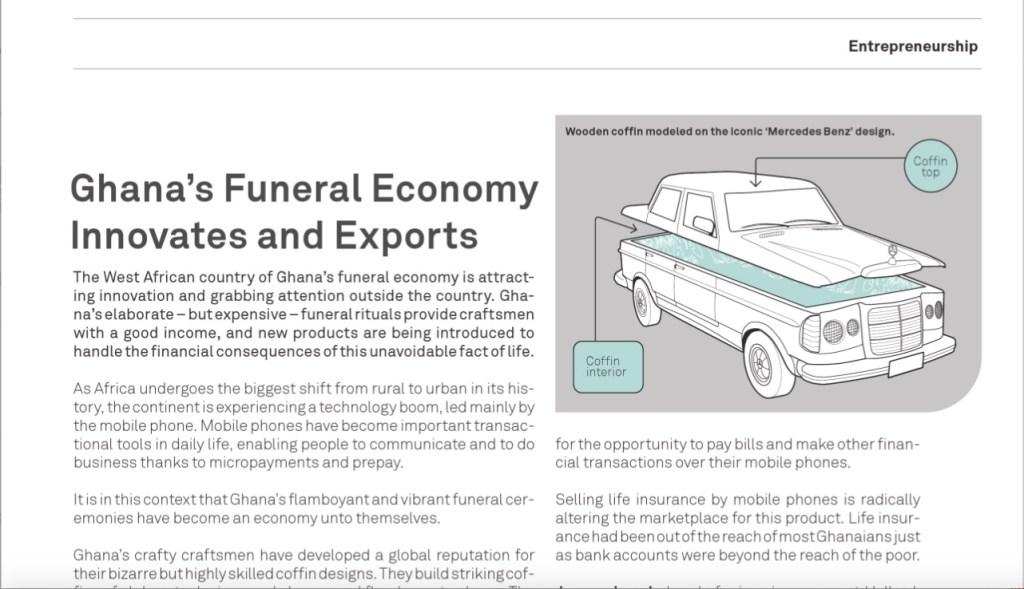
    Designs have included a giant pink fish, a Ghana Airways plane, a souped-up Mercedes Benz and an African eagle.

    “The Ga people (http://www.ghanaweb.com/GhanaHomePage/tribes/ga.php), from the south-east coast of Ghana, revere their ancestors and give great importance to funeral celebrations,” Jack Bell, a London gallery owner exhibiting the coffins, told The Observer newspaper. “Their tradition of creating beautifully carved figurative coffins originated in the 1950s.”

    Paa Joe was born in the Akwapim hills north-east of Accra in 1945. He is considered the top sculpted coffin maker of his generation. He apprenticed with the pioneer of the craft, Kane Kwei (http://www.culturebase.net/artist.php?153) – the man who began this unique vocation in the 1950s. The skill and artistry involved is now recognized in museums around the world, including London’s British Museum.

    The community had a history of highly skilled woodwork and elaborate carvings were regularly created for village chiefs – giant eagles or even the surreal spectacle of a giant cocoa pod.

    The bespoke coffins are an example of how long-standing skills were applied to a new product. The idea of making custom-sculpted coffins begun by Kane Kwei evolved from being a livelihood for Kwei to an apprenticed craft passed down to younger craftsmen. When Kane Kwei’s grandmother died in 1951, without fulfilling her lifelong wish to fly on a plane, Kane made a plane-shaped coffin for her. This coffin was admired by others and Kane got the idea of setting up a workshop and making custom-designed coffins symbolizing the
    deceased’s status and achievements in life.

    “Families commission the coffins – sometimes to a brief designed by the deceased – to represent the aspirations or achievements of a deceased relative, or to characterize their personality: a car for a businessman, a cocoa pod for a farmer, a bible, or even a camera,” Bell said.

    For people with modest means, there are simpler designs of boats, canoes and books. Prices are negotiated with the coffin maker.

    Where there were none, now there are multiple workshops providing custom coffins for funerals. Traditional Ghanaian funerals are lively, colourful events, but the coffin sculptures of Teshi are a modern phenomenon and proof that innovation and good design can transform the most sombre of items into something special.

    Published: December 2010

    Resources

    • Maker Faire Africa: Flickr photo gallery: A clickable archive of the Maker Faire inventors and their inventions. Website:http://www.flickr.com/groups/makerfaireafrica/pool/
    • Afrigadget: Afrigadget: ‘Solving everyday problems with African ingenuity’: This blog never ceases to amaze and fascinate. Website: http://www.afrigadget.com/
    • E-machine Shop: eMachineShop: This remarkable service allows budding inventors to download free design software, design their invention, and then have it made in any quantity they wish and shipped to them: Amazing! Website: http://www.emachineshop.com/ 4) Maker Faire Africa 2010: Catch up on the last Maker Faire Africa. Website: (http://makerfaireafrica.com)
    • Afrigadget: ‘Solving everyday problems with African ingenuity’: This blog never ceases to amaze and fascinate. Website: http://www.afrigadget.com/
    • International Development Design Summit: The Summit is an intense, hands-on design experience that brings together people from all over the world and all walks of life to create technologies and enterprises that improve the lives of people living in poverty. Website:http://iddsummit.org/

    https://davidsouthconsulting.org/2022/10/20/bangladesh-coffin-maker-offers-an-ethical-ending/

    https://davidsouthconsulting.org/2022/10/20/ghanas-funeral-economy-innovates-and-exports/

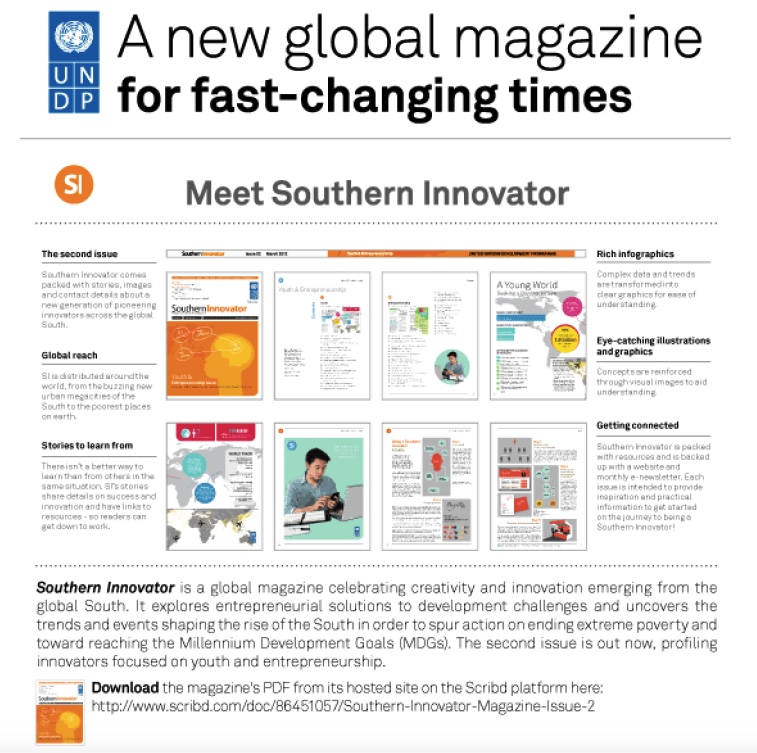
    Development Challenges, South-South Solutions was launched as an e-newsletter in 2006 by UNDP’s South-South Cooperation Unit (now the United Nations Office for South-South Cooperation) based in New York, USA. It led on profiling the rise of the global South as an economic powerhouse and was one of the first regular publications to champion the global South’s innovators, entrepreneurs, and pioneers. It tracked the key trends that are now so profoundly reshaping how development is seen and done. This includes the rapid take-up of mobile phones and information technology in the global South (as profiled in the first issue of magazine Southern Innovator), the move to becoming a majority urban world, a growing global innovator culture, and the plethora of solutions being developed in the global South to tackle its problems and improve living conditions and boost human development. The success of the e-newsletter led to the launch of the magazine Southern Innovator. 
    https://davidsouthconsulting.org/2021/03/05/southern-innovator-issue-2/

    Creative Commons License

    This work is licensed under a
    Creative Commons Attribution-Noncommercial-No Derivative Works 3.0 License.

    ORCID iD: https://orcid.org/0000-0001-5311-1052.

    © David South Consulting 2023

  • Ghana Wants to Tap Global Trendy Party Scene

    Ghana Wants to Tap Global Trendy Party Scene

    By David SouthDevelopment Challenges, South-South Solutions

    SOUTH-SOUTH CASE STUDY

    Tourism is big business – and one of the most resilient parts of the global economy. Despite the international economic crisis that has wreaked havoc and increased unemployment and poverty in many countries since 2007, tourism is still going strong.

    The UN’s World Tourism Organization (UNWTO) (http://www2.unwto.org/) found international tourist arrivals grew by 5 per cent during the first half of 2013 from the same period in 2012, reaching 500 million arrivals.

    “The fact that international tourism grew above expectations confirms that traveling is now part of consumer patterns for an increasing number of people in both emerging and advanced economies,” said UNWTO Secretary-General Taleb Rifai. “This underlines the need to rightly place tourism as one of the key pillars of socio-economic development, being a leading contributor to economic growth, exports and jobs.”

    One successful way to lure tourists, especially young tourists, is to nurture hubs of culture, outdoor activities, music and fashion around a holiday destination – generally one involving sun and sand. Such “party scenes” can be found in hotspots as far afield as Florida, the Spanish island of Ibiza and Koh Samui (http://www.kohsamui.com/) in Thailand. While at times annoying to local people, these groups of young tourists do bring significant wealth to smaller towns and seaside communities.

    And now there are some in Africa who want to replicate this successful business formula in beach communities.

    The Ghanaian fishing village of Kokrobrite (http://en.wikipedia.org/wiki/Kokrobite), located west of the capital, Accra, has become a nascent hub for a dance music scene and beach parties.

    “We are organizing an all-day-long beach party with DJs, food and partying, inspired by the kind of summer jams that are held in Miami,” Basil Anthony, Chief Executive of Silky Entertainment (http://www.silkyentertainment.com/), told The Guardian newspaper. Silky Entertainment is organizer of Ghana Summer Beach Rave 2013.

    “We are expecting partygoers in the thousands, and double the number we had last year. It’s going to be big.”

    Other popular events include Tidal Rave (http://www.youtube.com/watch?v=8f5Wy3g9Y7w), aimed at university students, and an upmarket champagne party at Bella Roma beach which attracts expats and wealthy Ghanaians.

    While these events have been very popular locally, ambitious entertainment entrepreneurs want to take the parties to the next level and make them truly global events, attracting tourists from around the world.

    “The next Ibiza will be in Africa. It has already started,” said Andrew Tumi, also known as Won, a singer from the group Supafly.

    “We are trying to recreate the good things about going to Ibiza, the music and the vibes. But more and more we are creating our own sound here, an Afro-house, reggae, African mashup… It’s really blending the African rhythm into a house scene.”

    Dance music is hot right now, and is being refreshed with new trends in Afro-house and Afro-pop from across the continent. This in turn is creating a demand for parties to celebrate and enjoy the music.

    The economic impact is considerable as the parties inspire other businesses to feed off the good vibrations. DJ MoBlack, who works in a nightclub in Accra, told The Guardian, “It’s not just the music, it’s a whole scene that’s on the rise – goods, fashion, jewelry – there is a style revolution happening around it. It’s a unique African vibe, but something that people everywhere can relate to.”

    The impact on the tourism sector is already quantifiable. Tourist visits to Ghana grew from 400,000 a year in 2005 to 1 million in 2011.

    Ben Ohene-Aryeh at the Ghana Tourism Authority (http://www.ghana.travel/) is optimistic bigger things are to come: “[The scene] is catching on well with the youth and now we hope that it will be done on a massive scale,” he said.

    There is, however, a downside to this strategy: drug use is on the increase. According to the West Africa Commission on Drugs (wacommissionondrugs.org), marijuana use is on the rise as well as harder drugs such as cocaine.

    It’s clear there are pitfalls to the youth-tourism strategy, but these can be managed with the right strategy – and the economic opportunities for small communities are substantial.

    Published: November 2013

    Resources

    1) Information on drug tourism from DARA Thailand: DARA is Asia’s first and leading international destination for drug and alcohol rehabilitation. Website: http://alcoholrehab.com/alcohol-rehab/drug-tourism/

    2) 3rd UNWTO International Conference on Tourism and the Media: How new media is shaping the news: With the rise of the new media, both the media landscape and the way stories are being told are changing. Millions of consumers now have the possibility to directly engage in the editorial process due to faster than ever evolving technology. More recently, mobile technology and a myriad of applications for smart phone devices are increasingly influencing communication flows. Website: http://www2.unwto.org/en/event/3rd-unwto-international-conference-tourism-and-media-how-new-media-shaping-news

    3) The UNWTO World Tourism Barometer: A regular publication of the Tourism Trends and Marketing Strategies Programme of UNWTO aimed at monitoring the short-term evolution of tourism and providing the sector with relevant and timely information. Website: http://mkt.unwto.org/en/barometer

    Tourism Investment and Business Forum for Africa: INVESTOUR is an annual tourism business and knowledge exchange platform in which representatives of African tourism and potential Spanish and Portuguese investors/partners meet to discuss about business and cooperation opportunities. Website: http://africa.unwto.org/en/event/v-tourism-investment-and-business-forum-africa-investour-edition-2014-madrid-spain

    Development Challenges, South-South Solutions was launched as an e-newsletter in 2006 by UNDP’s South-South Cooperation Unit (now the United Nations Office for South-South Cooperation) based in New York, USA. It led on profiling the rise of the global South as an economic powerhouse and was one of the first regular publications to champion the global South’s innovators, entrepreneurs, and pioneers. It tracked the key trends that are now so profoundly reshaping how development is seen and done. This includes the rapid take-up of mobile phones and information technology in the global South (as profiled in the first issue of magazine Southern Innovator), the move to becoming a majority urban world, a growing global innovator culture, and the plethora of solutions being developed in the global South to tackle its problems and improve living conditions and boost human development. The success of the e-newsletter led to the launch of the magazine Southern Innovator. 

    Creative Commons License

    This work is licensed under a
    Creative Commons Attribution-Noncommercial-No Derivative Works 3.0 License.

    ORCID iD: https://orcid.org/0000-0001-5311-1052.

    © David South Consulting 2023

  • Ghana: Oil-rich City Sparks Entrepreneurs and Debate

    Ghana: Oil-rich City Sparks Entrepreneurs and Debate

    By David SouthDevelopment Challenges, South-South Solutions

    SOUTH-SOUTH CASE STUDY

    Commodity booms can seem like the answer to a poor nation’s prayers, a way to fulfil all their development dreams and goals. The reality, however, is far more complex. More often than not, the discovery of resources sparks a mad scramble for profits and patronage, as politicians and politically connected elites carve out their slice of the new resource boom before anyone else.

    The twin cities of Sekondi-Takoradi (http://en.wikipedia.org/wiki/Sekondi-Takoradi) in the Western Region of Ghana are now experiencing an oil boom. Ghana’s oil production went online in December 2010 and the government is hoping it will double the country’s growth rate.

    Large supplies of oil were found off the coast in 2007, transforming Takoradi from a sleepy, rundown port city into the hub for the oil boom.

    Local man Peter Abitty told the BBC he was renting out an eight-bedroom house for US $5,000 a month. The house overlooks the sea and comes with banana and coconut trees.

    “Tenants that come here can take the coconuts for free! We don’t charge anything,” Abitty said.

    He put the strong interest in the house down to a simple fact: “It’s out there: oil, oil, oil.”

    People’s hopes are being raised in Ghana’s case because it has built a reputation as a better-governed country than other African petro states like Nigeria and Angola.

    But others argue that price increases caused by the boom are destroying local businesses. A report on the Ghana Oil news website found popular local businesses suffering. One example it gave was the Unicorn Internet Café, an employer of local youth, which shut down in 2010 because of high rents.

    It found businesses have shut down in the following sectors: timber, sawmilling, super markets, mobile phone shops, boutiques and trading shops. But it also found many new businesses opening up, including banks, insurance companies and hotels.

    The challenge facing Ghana is to ensure oil brings a long-term change to a higher value business environment and economy, rather than just an unequal and temporary boom.

    Another challenge is to connect the many youth leaving education in the city with the jobs and opportunities being created by the oil industry. The twin cities are a regional educational centre with a lot of technical colleges and secondary schools.

    To counter these concerns, a Regional Coordinating Council is promising to place the growth of small and medium enterprises at the centre of regional development.

    The dreams and promises for Takoradi are very ambitious. “In five years time, I see Takoradi becoming one of the modern cities of the world,”  Alfred Fafali Adagbedu, the owner of Seaweld Engineering (www.seaweldghana.com), a new local company set up to service the oil sector, told the BBC.

    “I can imagine skyscrapers, six-lane highways and malls.”

    “The transport industry is going to improve, because workers on the rig are going to need to be transported. Agriculture is going to see a boom because all those people on the rig will need to be fed.

    “Even market women are going to see more business, because a lot of workers are going to have very fat paychecks. Everyone in this city is going to gain in business.”

    How far Takoradi has to travel to come close to meeting these dreams and expectations can be seen in its current state. The railway station has a train with laundry hanging from it because it hasn’t moved in years, reported the BBC. People are living in the sleeping car of the train.

    But the typical signs of a boom are all visible: traffic jams, booked hotels, rising rents and prices, and it is already hurting people on fixed salaries.

    Local authorities have plans to demolish rundown parts of the city and rebuild with modern office environments for the new businesses resulting from the oil economy.

    An estimated US $1 billion a year in revenue will go to the Ghanaian government and local authorities want 10 percent of this to be ring-fenced for regional development.

    “Many resources are coming from the western region. From years back, gold is here, timber is here, diamonds are here,” said Nana Kofi Abuna V, one of the few female chiefs in the area.

    “But when they share the cake up there, they leave out the western region. This time, if there is oil and gas in the region we should benefit more than everybody else.”

    But Adagbedu at Seaweld Ghana believes Ghana will see real improvements.

    “I’m very sure we will avoid the mistakes,” he said. “Ghana is a democracy, everyone is watching, so there is going to be a lot of improvement here.”

    And to help in keeping these promises, the BBC will continue to return to Sekondi-Takoradi to track its changes and see how things improve.

    Published: September 2011

    Resources

    1) BarCamp Takoradi: BarCamp is an international network of user-generated conferences (or unconferences). They are open, participatory workshop-events, the content of which is provided by participants. Website:http://twitter.com/#!/barcamptakoradi

    2) Ghana Ports and Harbours Authority: The Authority overlooks the Takoradi port. Website:http://www.ghanaports.gov.gh/GPHA/takoradi/index.html

    3) Friends of the Nation (FON): The NGO serves as a catalyst towards increased action for sustainable natural resource management and health environment in the Takoradi region. Website: http://www.fonghana.20m.com/aboutus1.htm

    4) Takoradi City: A website packed with information and photos on the city. Website:http://www.takoradicity.com/pages/sections.php?siteid=takoradicity&mid=39

    Development Challenges, South-South Solutions was launched as an e-newsletter in 2006 by UNDP’s South-South Cooperation Unit (now the United Nations Office for South-South Cooperation) based in New York, USA. It led on profiling the rise of the global South as an economic powerhouse and was one of the first regular publications to champion the global South’s innovators, entrepreneurs, and pioneers. It tracked the key trends that are now so profoundly reshaping how development is seen and done. This includes the rapid take-up of mobile phones and information technology in the global South (as profiled in the first issue of magazine Southern Innovator), the move to becoming a majority urban world, a growing global innovator culture, and the plethora of solutions being developed in the global South to tackle its problems and improve living conditions and boost human development. The success of the e-newsletter led to the launch of the magazine Southern Innovator. 

    Creative Commons License

    This work is licensed under a
    Creative Commons Attribution-Noncommercial-No Derivative Works 3.0 License.

    ORCID iD: https://orcid.org/0000-0001-5311-1052.

    © David South Consulting 2023

  • Ghana’s Funeral Economy Innovates and Exports

    Ghana’s Funeral Economy Innovates and Exports

    By David SouthDevelopment Challenges, South-South Solutions

    SOUTH-SOUTH CASE STUDY

    The West African nation of Ghana’s funeral economy is attracting innovation and grabbing attention outside the country. The nation’s elaborate – but expensive – funeral rituals provide craftsmen with a good income. And new products are being introduced to handle the financial consequences of this unavoidable fact of life.

    As Africa undergoes the biggest shift from rural to urban in its history, the continent is experiencing a technology boom, mainly led by the mobile phone. Mobile phones have become important transactional tools in daily life, enabling people to communicate and to do business, thanks to micropayments and prepay. Interwoven in these twin phenomena of greater urbanization and the mobile phone economy is a rising and growing middle class population with spare cash to spend on more than just the basics of survival. And all of this is throwing up new economies and new products to sell to these middle class customers.

    It is in this context that Ghana’s flamboyant and vibrant funeral ceremonies have become an economy unto themselves.

    Ghana’s crafty craftsmen have developed a global reputation for their bizarre but highly skilled coffin designs. They build striking coffins of elaborate designs and shapes and flamboyant colours. The coffins usually take on the shape of an aspect of the deceased’s former profession or vocation. For example, a pilot gets buried in a mock-up of the plane they flew, or a farmer is buried in his main crop, like a giant corn cob.

    It is proof the creative economy works and adds value to existing products and services. What were just simple coffins for a utilitarian task (burying the dead) becomes an elaborate work of art and transforms burial into a grander experience.

    One of the most popular designs is the now-ubiquitous and much-coveted mobile phone: Africa’s great electronic connector. And it is the mobile phone that is allowing people to buy life insurance to be able to pay for the coffins and elaborate funerals.

    Mobile money is a dynamic and fast-growing industry that is firmly established in the global South. Some are forecasting the market in mobile payments will reach US $60 billion by 2015.

    A range of companies are now offering life insurance policies that can be paid for in small “micropayments” by mobile phone. This is an important service for people who may not have a formal bank account and who can be devastated by the costs of a family member’s funeral.

    The two companies pioneering this “micro-insurance” service are Hollard Insurance (http://www.hollard.co.za) and Mobile Financial Services Africa (http://mfsafrica.com). Both are offering funeral insurance by mobile phones. Working with MTN – Africa’s largest mobile phone group (www.mtn.com.gh) – they are launching the mi-Life insurance product, sold for between US 0.80 cents and US $4 for a month’s coverage.

    MTN pioneered its Mobile Money service in 2009. Out of 9 million MTN mobile phone subscribers in Ghana, 1.8 million have signed up for the opportunity to pay bills and make other financial transactions over their mobile phones.

    Selling life insurance by mobile phones is radically altering the marketplace for this product. Life insurance had been out of the scope of most Ghanaians just as bank accounts were beyond the reach of the poor.

    Jeremy Leach, head of micro-insurance at Hollard, told AllWestAfrica (allwestafrica.com), that 55 percent of Ghanaians say they can’t afford life insurance. “In terms of affordability, we’ve tried to address that.”

    MTN Mobile Money Ghana’s general manager, Bruno Akpaka, told the Financial Times mi-Life is 50 to 70 per cent cheaper than comparable policies.

    Subscribers sign up by using their mobile PIN (personal identification number) at a local kiosk, or send a short message service (SMS) on their handset. Once signed up, a monthly premium is taken from their account. When it runs out, they top it up at the kiosk again.

    It currently offers basic funeral cover: a lump sum to the family when the main income earner dies. This money is used towards the costs of expensive funerals. Other products in the pipeline include insurance for school fees.

    For the coffin craftsmen, the fast-growing economy of African online shopping is helping with sales. The elaborate craft coffins can be bought online from various platforms including eShopAfrica.com, which promises to sell “fair trade direct from Africa.” Its dedicated Ghana coffin pages (www.eshopafrica.com/acatalog/Ga_Coffins.html) advertise small coffins that take a month to make, and larger ones can take up to three months to build. Prices advertised on the eShop site range from US $1,500 for a full-sized, six-foot coffin, to US $175 for a “desk top chest.”

    Designs range from a mobile phone to a Ferrari race car to a computer mouse. But it is not just the resting places for the deceased that are on sale. The cabinet- and coffin-making skills are also turned to making a wide range of storage cabinets in bright colours and imaginative shapes, from a football to a red pepper and a beer-bottle shaped drinks cabinet.

    The global attention for the craftsman has been impressive. They are lauded by fine art collectors around the world and have been shown in galleries such as London’s Jack Bell Gallery (www.jackbellgallery.com/paajo.html). The legendary coffin artist Paa Joe is one of the most featured in gallery shows.

    Published: April 2011

    Resources

    1) Shop Africa 53: An online shopping website allowing independent traders to vend their products to the rest of Africa and the world. Website: www.shopafrica53.com

    3) Going into Darkness: Fantastic Coffins from Africa by Thierry Secretan, details the culture and the craftsmen, behind the iconic coffins. Website:www.amazon.com/exec/obidos/ASIN/0500278393/cordelinetwebstu%22

    4) Creative Economy Programme: The creative economy is an emerging concept dealing with the interface between creativity, culture, economics and technology in a contemporary world dominated by images, sounds, texts and symbols. Website:www.unctad.org/Templates/StartPage.asp?intItemID=4577&lang=1

    Bangladesh Coffin-Maker Offers an Ethical Ending

    https://davidsouthconsulting.org/2022/10/20/bangladesh-coffin-maker-offers-an-ethical-ending/

    https://davidsouthconsulting.org/2022/10/20/ghanaian-coffins-prove-design-and-craftsmanship-boost-incomes/

    Development Challenges, South-South Solutions was launched as an e-newsletter in 2006 by UNDP’s South-South Cooperation Unit (now the United Nations Office for South-South Cooperation) based in New York, USA. It led on profiling the rise of the global South as an economic powerhouse and was one of the first regular publications to champion the global South’s innovators, entrepreneurs, and pioneers. It tracked the key trends that are now so profoundly reshaping how development is seen and done. This includes the rapid take-up of mobile phones and information technology in the global South (as profiled in the first issue of magazine Southern Innovator), the move to becoming a majority urban world, a growing global innovator culture, and the plethora of solutions being developed in the global South to tackle its problems and improve living conditions and boost human development. The success of the e-newsletter led to the launch of the magazine Southern Innovator. 

    Creative Commons License

    This work is licensed under a
    Creative Commons Attribution-Noncommercial-No Derivative Works 3.0 License.

    ORCID iD: https://orcid.org/0000-0001-5311-1052.

    © David South Consulting 2023