Tag: Development Challenges

  • Creative and Inventive Ways to Aid the Global Poor

    Creative and Inventive Ways to Aid the Global Poor

    By David SouthDevelopment Challenges, South-South Solutions

    SOUTH-SOUTH CASE STUDY

    As the saying goes, “necessity is the mother of invention”. Poverty can be a major spur to invention, and invention a route out of poverty – but only if the poor in the developing world can get the recognition, capital and support for navigating the legal and bureaucratic hurdles that will inevitably stand in their way. Thankfully many new initiatives acknowledge this.

    Contrary to popular perception, the poor do have buying power, as has been documented by Massachusetts Institute of Technology (MIT) professors Abhijit Banerjee and Esther Duflo in their paper “The Economic Lives of the Poor”. Surveying 13 countries, they found those living on less than a dollar a day, the very poor, actually spent 1/3 of their household income on things other than food, including tobacco, alcohol, weddings, funerals, religious festivals, radios and TVs. The researchers also found that the poor increasingly used their spending power to seek out private sector options when the public sector failed to provide adequate services. As awareness of global poverty has grown in the past decade, a new wave of scientists, inventors and entrepreneurs has started to apply their considerable brain power to tackling the everyday problems of the poor.

    Afrigadget, a website celebrating African ingenuity and inventions, serves as a goldmine for small-scale entrepreneurs looking for inspiration. All the inventions on the website share something in common: they are grassroots, homemade and handmade solutions to everyday problems of the poor. Examples of inventions profiled on the website include multi-machines, basically a 3-in-1 machine used as a metal lathe, mill and drill press, all built by hand from old car engine parts; a US $100 bicycle motor that gets 50 kilometres per liter made in Kisumu, Kenya; hand-made African wire toys; do-it-yourself telephone handsets which are then used to run roadside phone booths as a small business; and Malawian homemade windmills used to generate electricity for both home use and as a business to recharge mobile phone and radio batteries.

    Another African invention tackles the urgent need for inexpensive or free common toilets that are self-financing. In the Kibera slum of Nairobi, Kenya, where 60 percent of the city’s inhabitants live, the lack of decent toilet facilities has led to the widespread use of so-called “flying toilets”, plastic bags filled with excrement and then flung as far away as possible. The resulting build-up turns the streets into a foul-smelling sludge in the rainy season and causes disease outbreaks like diarrhoea and typhoid fever. Up to now, conventional attempts to provide communal toilets have failed to resolve the problem, because they charge too much to use. But an innovative solution has been developed: bio-latrines that capture the methane gas produced by the toilets for sale as gas for cooking, heating and lighting, and the sludge for fertilizer. A joint initiative between a Kenyan company, Globology Limited, and the NGOs Umande Trustand Ushirika Roho Safi Laini Saba, it is partly funded by the Swedish International Development Agency (SIDA). The toilets are used by 500 people a day and are self-financing from the profits made by the sale of the gas and fertilizer.

    In India, social entrepreneurs have stepped in to help the rural poor navigate the Indian government bureaucracy. Drishtee, an internet service provider – offers a fast-track to government services used by the poor in rural villages through its e-government services information kiosk. Using a franchise model, it has branches spread out through 160 locations in the country and serves 1.5 million people. Drishtee’s niche is that it saves the poor the exhausting and draining time and long travel normally required to access any government services. Drishtee’s “ask a government employee” service brings government to the poorest people.

    Operating out of New Zealand and South Africa, Ecologics is an engineering company focused on developing appropriate technologies for sustainable livelihoods in developing countries. All their inventions are built around the principles of low maintenance and costs, and ease of use. Its African operations are based in South Africa and run under the Black Economic Empowerment (BEE) scheme. It builds step powered pumps, the Step Action Water Pump which works just like a gym step exercise machine and is a highly efficient way to power the pump – for small scale mining and agricultural irrigation. The pumps can deliver 5,000 to 6,000 litres of water per hour, weigh just 11 kilograms, and have been field tested in Fiji, Lesotho and South Africa.

    Published: April 2007

    Resources

    • NextBillion.net: Hosted by the World Resources Institute, it identifies sustainable business models that address the needs of the world’s poorest citizens.
    • A paper on social lending via the web: PDF version
    • African Inventors Museum: The International African Inventors Museum promotes positive images and self-esteem in children and adults and teaches people of all nationalities about the contributions that Africans throughout the world have given to society.
    • AU-WIPO Prize: The AU-WIPO is an initiative of the Africa Union Commission and the World Intellectual Property Organization. It is a leading continental award in Africa honoring the scientists and technologists whose efforts are towards addressing critical problems in Africa and the attainment of the Millennium Development Goals.
    United Nations e-newsletter Development Challenges, South-South Solutions visited the Berlin, Germany headquarters of start-up betterplace.org in 2009. It was the dawn of the Berlin digital tech boom.

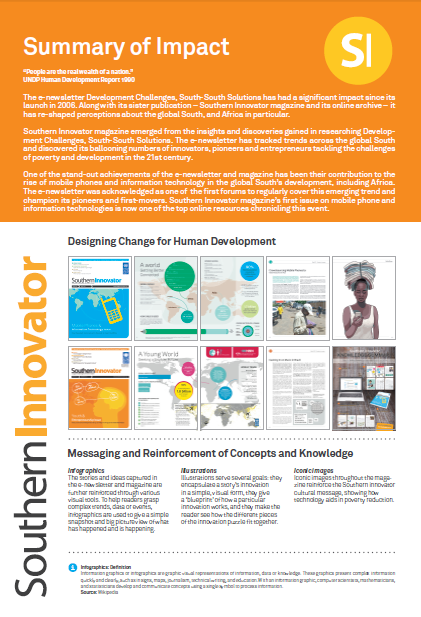
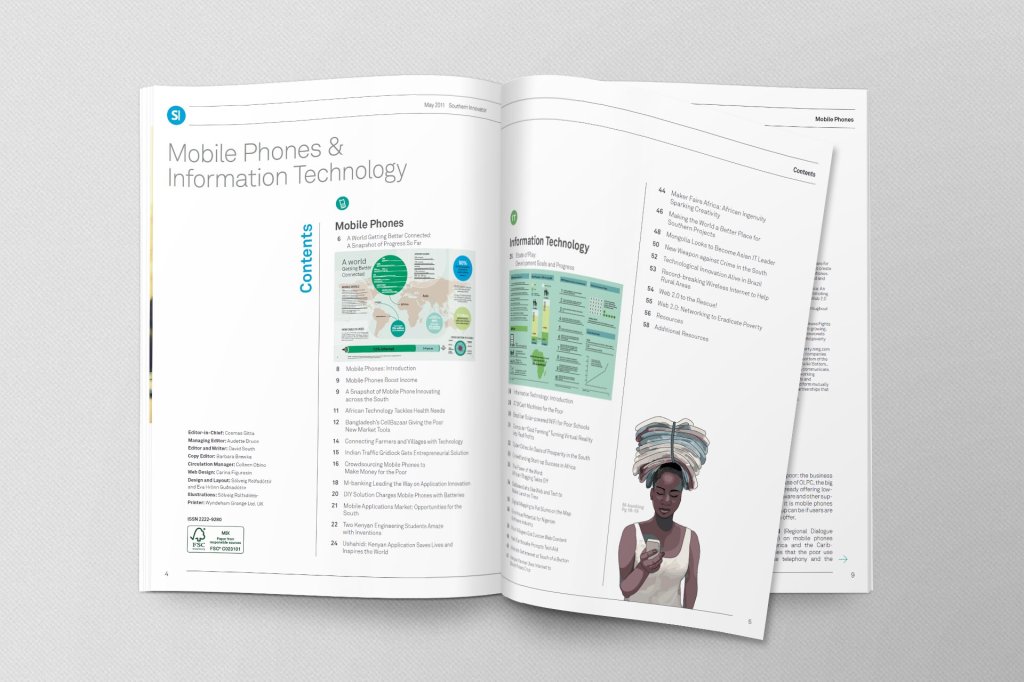
    Development Challenges, South-South Solutions was launched as an e-newsletter in 2006 by UNDP’s South-South Cooperation Unit (now the United Nations Office for South-South Cooperation) based in New York, USA. It led on profiling the rise of the global South as an economic powerhouse and was one of the first regular publications to champion the global South’s innovators, entrepreneurs, and pioneers. It tracked the key trends that are now so profoundly reshaping how development is seen and done. This includes the rapid take-up of mobile phones and information technology in the global South (as profiled in the first issue of magazine Southern Innovator), the move to becoming a majority urban world, a growing global innovator culture, and the plethora of solutions being developed in the global South to tackle its problems and improve living conditions and boost human development. The success of the e-newsletter led to the launch of the magazine Southern Innovator. 

    Creative Commons License

    This work is licensed under a
    Creative Commons Attribution-Noncommercial-No Derivative Works 3.0 License.

    ORCID iD: https://orcid.org/0000-0001-5311-1052.

    © David South Consulting 2023

  • Many Positive Trends for Africa in 2010

    Many Positive Trends for Africa in 2010

    By David SouthDevelopment Challenges, South-South Solutions

    SOUTH-SOUTH CASE STUDY

    While 2009 saw the global economic crisis spread around the world, the story is more complex and more hopeful than many believe. For Africa, various trends are pointing to positive economic development in 2010, despite the continent’s numerous political, social and environmental challenges. Pragmatism is driving stronger economic ties between Africa and the rest of the world, while long-running trends are delivering opportunity to millions despite setbacks.

    The Standard Chartered bank (http://research.standardchartered.com/Pages/home.aspx) believes sub-Saharan Africa will jolt itself out from the 1 percent growth it had in 2009, to reach 4.7 percent growth in 2010 and 5.7 percent in 2011 (http://research.standardchartered.com/researchdocuments/Pages/ResearchArticle.aspx?&R=66952). The reason? The world’s strong appetite for commodities and food, which will continue to draw in business. And much of this business will be done by that powerhouse of the global South, China.

    The fact that China is trading better infrastructure – roads, rail and ports – for commodities means other businesses can also benefit from the improving environment. Throughout the downturn in 2009, China actually increased its investments in Africa.

    The United States is also trying to increase its economic relationship with Africa. It wants a third of its oil imports to come from West Africa by 2015.

    And the competition for food in the world, as countries address the global food crisis, has seen companies from the Middle East to Asia to Britain purchasing land in Africa to grow more food.

    The Annansi Chronicles blog on African business and culture trends (www.annansi.com) has come up with a list of the big trends to watch out for on the continent in 2010. They build upon many of the patterns that have emerged in the past few years in Africa.

    The blog predicts that Africa will increasingly be an innovation incubator. Concepts like the bottom of the pyramid – where the poor are seen as an unserved marketplace of needs – will draw more private companies in to innovate new products and services. Already, products and services trialled in Africa are then launched in other places in the world. One example has been mobile phone banking. The blog sees the challenge for Africa as finding ways to increase innovation and harness its economic benefits within the continent, and to direct resources to the African pioneers out there who need money and infrastructure support to grow their ideas.

    Mobile phones will continue to be the source of opportunity in Africa in 2010. Get ready for more businesses to take advantage of the move from analog to digital in Africa, as fibre optic cables continue to expand. Just as the introduction of broadband internet in developed countries gave birth to new businesses like You Tube (www.youtube.com), so it will create new opportunities in Africa. The key to growing the prosperity from this is to see governments and the private sector better connect with African technology pioneers, as can be found in hot spot countries like Ghana.

    Along with technology comes content. And the people to make the content interesting and attractive will be Africa’s so-called ‘creative class’: savvy young African entrepreneurs and thinkers. They have drawn on the rising urbanization of the continent and greater international travel to explore new ways of representing African culture. This has come forward in the explosion in media, fashion, music and design. The blog believes the 2010 FIFA World Cup in South Africa (http://www.fifa.com/worldcup) is going to thrust the world’s attention on to Africa’s creative class: a global media burst that will be an opportunity not to be missed.

    And this will also challenge global perceptions of “brand Africa.” Already, the world’s tourists flow to Africa in greater numbers, defying decades of negative media publicity. Brand Africa will be up for grabs in 2010.

    And finally, while China has been the big story in terms of economic investment in Africa, India will start to make more moves to catch up by flexing its information technology muscles. Look for more joint partnerships between African countries and Indian technology companies.

    In short, Africa has as many positive trends for 2010 as negative ones. It is just a matter of focusing on the good so the negative will not have a fighting chance in 2010.

    Published: January 2010

    Resources

    1) Design Indaba: See the latest on the catwalks in all-day fashion shows; attend short films, talks and product launches; be enticed to buy from more than 260 exhibitors and hobnob with the designers in person. Above all, be awed by the creative spirit of innovative South Africans. Website: http://www.mobileactive.org

    2) Maker Faire Africa: African pioneers in grassroots innovation offer inspiring inventions. Website: http://makerfaireafrica.com/

    3) Arise Africa Fashion Week: The place to be seen and to see. Website: http://www.africanfashioninternational.com/africaFashionWeek/

    https://davidsouthconsulting.org/2020/12/15/development-challenges-south-south-solutions-newsletter-2007-2010-2/

    https://davidsouthconsulting.org/2022/11/29/new-magazine-13-october-2010/

    https://davidsouthconsulting.org/2022/11/28/new-website-on-the-way-16-september-2010/

    https://davidsouthconsulting.org/2022/12/01/off-to-the-printers-with-a-new-name-southern-innovator-14-may-2010/

    https://davidsouthconsulting.org/2022/11/01/southern-innovator-magazine-2010-2014/

    https://davidsouthconsulting.org/2021/02/22/team-southern-innovator-phase-1-development-2010-2015/

    https://davidsouthconsulting.org/2021/10/28/2010-development-challenges-south-south-solutions/

    https://davidsouthconsulting.org/2022/10/25/2011-trends-for-the-south/

    Development Challenges, South-South Solutions was launched as an e-newsletter in 2006 by UNDP’s South-South Cooperation Unit (now the United Nations Office for South-South Cooperation) based in New York, USA. It led on profiling the rise of the global South as an economic powerhouse and was one of the first regular publications to champion the global South’s innovators, entrepreneurs, and pioneers. It tracked the key trends that are now so profoundly reshaping how development is seen and done. This includes the rapid take-up of mobile phones and information technology in the global South (as profiled in the first issue of magazine Southern Innovator), the move to becoming a majority urban world, a growing global innovator culture, and the plethora of solutions being developed in the global South to tackle its problems and improve living conditions and boost human development. The success of the e-newsletter led to the launch of the magazine Southern Innovator. 

    Creative Commons License

    This work is licensed under a
    Creative Commons Attribution-Noncommercial-No Derivative Works 3.0 License.

    ORCID iD: https://orcid.org/0000-0001-5311-1052.

    © David South Consulting 2023

  • 2011 Trends for the South

    2011 Trends for the South

    By David SouthDevelopment Challenges, South-South Solutions

    SOUTH-SOUTH CASE STUDY

    The world has been through a dramatic and fascinating period since the global economic crisis erupted in 2008. While the wealthy, developed nations of the North have been pitched into one crisis after another, the countries of the global South (many of whom are well accustomed to crises) have been part of a powerful new economic phenomenon: the rapid growth of South-South trade, investment and exchange. Its effects include stronger ties between Asia and South America and between China and Africa.

    South-South trade is the great economic success story of the past decade. World Trade Organization (WTO) (www.wto.org) figures show South-South trade grew to 16.4 percent of the US $14 trillion in total world exports in 2007, from 11.5 percent in 2000. While the global economic crisis has slowed trade down, the overall trend for South-South trade and connections seems firmly established.

    South-South trade made up 20 percent of global exports by 2010, and foreign direct investment to developing economies rose by 10 percent in 2010 due to a rapid economic recovery and increasing South-South flows.

    Trade between China and Africa has surged during the decade since China joined the WTO in 2001, from around US $10 billion in 2000 to US $73.3 billion in 2007, a year-on-year increase of 32.2 percent. By 2008, it had soared by 44.1 percent to reach a record high of US $106.84 billion, according to Zhang Yongpeng of the Institute for West Asian and African Studies (IWAAS).

    The surge is remarkable and recent. For example, according to accountants KPMG, between 2001 and 2009 China invested just US $215 million in Brazil. But in 2010, China invested US $20 billion in energy and chemical companies in Argentina and Brazil. And Luis Alberto Moreno, president of the Inter-American Development Bank, told the Financial Times that “seven percent of Colombian gasoline has been replaced by domestic ethanol, produced with green Indian technology – while Indian companies, including Infosys and Tata, now have 17,000 employees in Latin America and the Caribbean.”

    This jump in investment has also had its downside: coming fast and furious as investment cash chases better investment profits in the global South, it has pushed up inflation and commodity prices and spawned property speculation bubbles. This, as can be seen across North Africa and the Middle East, can lead to political and social instability.

    A review of the big trends bubbling under the surface in 2011 shows how important South-South exchange will be in alleviating poverty and improving lives in the run-up to the 2015 Millennium Development Goals (http://www.un.org/millenniumgoals/). It also shows up the dangers inherent in this new environment – rising inflation without economic growth can crush the poor. A focus on innovation and new thinking will be necessary to get through this year and beyond.

    Some of the top trends that will have a big impact in 2011 are:

    – Inflation: In 2011 it looks like we will hear a lot about inflation. As the global economy tries to stabilize and return to growth, there will be inflation surges for a wide variety of reasons. People will need strategies and new techniques to make sure they can afford the necessities of life. This will be critical if development gains from the past decade are not to be lost.

    – Super cycle: Some are putting forward the theory we are entering a ‘super cycle’ (http://www.bloomberg.com/news/2011-01-23/super-cycle-leaves-no-economy-behind-as-davos-shifts-to-growth-from-crisis.html) created by better connectivity, global travel and mobility and the ease of moving around investment to create businesses and jobs. The super cycle theory claims that this will spark the greatest period of human development in history – raising all national economies – as more and more people benefit from rising living standards and opportunities.

    – Switch to South-South trade: With the trend of increasing South-South trade now firmly established, there is a greater awareness now of the power of sharing ideas across the South. One example of this idea-sharing is the annual Global South-South Development Expo (http://www.southsouthexpo.org/) run by UNDP’s Special Unit for South-South Cooperation Unit (http://ssc.undp.org/).

    – New technologies: The spread of new technologies around the world will continue and bring many changes. Africa is seeing increasing access to high-speed Internet as new undersea cables are laid around the continent. Mobile phones will continue to be a critical tool for many to stay in touch and boost incomes.

    – MDGs on horizon in 2015: The Millennium Development Goals (MDGs) target of 2015 is just four years away. This will face the headwinds of the global economic crisis and urgent attention will be needed to make sure gains are not lost as 2015 approaches. The role played by South-South trade will be a critical partner in aiding goal achievements.

    – Cities: A surge to the urban was pronounced by 2007 and we are now living in a majority urban world. Innovation and sharing experiences and knowledge will play a key role in ensuring this is not a disaster. A recent book, Arrival City by Canadian journalist Doug Saunders, detailed this urban surge occurring across the global South, the largest movement of people to cities and urban and semi-urban areas in human history. It follows the pattern that was seen in Europe in the 19th century, as economies change and people seek the new opportunities promised by cities, or find rural economies unsustainable.

    – The China model of development: The big talking point will be China’s economic model for eradicating poverty on a mass scale. A new book by Dambisa Moyo, How the West Was Lost: Fifty Years of Economic Folly – And the Stark Choices Ahead, investigates the mistakes made in developed, Western nations and what can be learned from the experiences in the global South.

    – Food crisis: At the beginning of February, the Food and Agricultural Organization (FAO) issued a warning about the risk of a new global food crisis after its food price index reached a record high in January 2011. The FAO also issued an alert about severe drought in China, the world’s largest wheat producer. Flooding in Brazil and Australia have also devastated crops, much of which are exported to countries across the South. There is also risk to crops from flooding in southern Africa. Wheat, corn and soybean prices are rising, and prices reached a peak just as they did in 2008 (FAO).

    Even developed countries normally used to food surpluses are at risk. In the US, corn reserves are at a 15 year low (US Department of Agriculture), and the price of corn has doubled in past six months.

    A billion people go to bed hungry every night; someone starves to death every 3.6 seconds – 75 percent are children under five, according to the World Food Programme (http://www.wfp.org/1billion).

    Published: 2011

    Resources
    1) Global Information and Early Warning System on Food and Agriculture: A data mix tracking global food prices and situation reports. Website: http://www.fao.org/worldfoodsituation/wfs-home/en/
    2) World Bank Food Crisis blog: Website: http://www.worldbank.org/foodcrisis/
    3) Trade Law Centre for Southern Africa: “Building capacity to help Africa trade better”: tralac’s mission is to build trade law capacity in southern Africa so that these countries can participate effectively in the global economy; to negotiate trade agreements that will support their development objectives, and so that they can implement the agreements to ensure that they realise the potential benefits of international trade. Website: http://www.tralac.org/cgi-bin/giga.cgi?cmd=cause_dir_cause&cause_id=1694
    4) Future Forum world videos: Compelling animated videos exploring the hard choices of an urbanizing world and the need to promote sustainable development and environmental harmony. Website: http://www.youtube.com/user/forumforthefuture96

    Development Challenges, South-South Solutions was launched as an e-newsletter in 2006 by UNDP’s South-South Cooperation Unit (now the United Nations Office for South-South Cooperation) based in New York, USA. It led on profiling the rise of the global South as an economic powerhouse and was one of the first regular publications to champion the global South’s innovators, entrepreneurs, and pioneers. It tracked the key trends that are now so profoundly reshaping how development is seen and done. This includes the rapid take-up of mobile phones and information technology in the global South (as profiled in the first issue of magazine Southern Innovator), the move to becoming a majority urban world, a growing global innovator culture, and the plethora of solutions being developed in the global South to tackle its problems and improve living conditions and boost human development. The success of the e-newsletter led to the launch of the magazine Southern Innovator. 

    Creative Commons License

    This work is licensed under a
    Creative Commons Attribution-Noncommercial-No Derivative Works 3.0 License.

    ORCID iD: https://orcid.org/0000-0001-5311-1052.

    © David South Consulting 2022

  • Pakistan Simplifies Job-matching Services

    Pakistan Simplifies Job-matching Services

    By David SouthDevelopment Challenges, South-South Solutions

    SOUTH-SOUTH CASE STUDY

    An innovative job-matching service from Pakistan is trying to bring together people who normally live separate lives. It is eliminating the middlemen who gouge both employers and employees for job-seeking fees and opening up a new world of opportunities for the poor.

    Connecting employees and employers is a problem being compounded in countries all over the world by the global economic crisis, as people retrench to their own communities and stick with known and trusted contacts. While this is a natural response to crisis, it is highly damaging to economies and social mobility.

    Pakistan (http://www.tourism.gov.pk) has had to contend with multiple challenges in the last few years. It has been hard hit during the global economic crisis. It is also experiencing stress from the ongoing conflict resulting from terrorism and the nearby war in Afghanistan. And 2010’s floods devastated large swathes of the country’s crops.

    As the World Bank noted in its Pakistan Economic Update June 2011, “Pakistan continues to face significant political challenges in achieving durable development. The domestic security situation as a result of (the) campaign against terrorism is a direct and indirect tax on the costs of economic activity and the achievement of the kinds of social stability required to promote a supportive environment for businesses.”

    The World Bank estimates that 30 percent of the population lives below the poverty line, although Pakistan’s finance ministry has recently estimated it to be 43 percent.

    “Due to the global financial crisis, many businesses in Pakistan either scaled down their operations or had to close down,” said Asim Fayaz, one of the people behind Pakistan Urban Link and Support, or PULS (http://www.puls.pk).

    “As a result, the income of the informal sector was also affected because many of them became unemployed. In turn, the supply surplus meant the job market became more competitive, further affecting their income growth.”

    Job-hunting is time-consuming for everyone involved in any country, worse still during an economic downturn. The hunt for a job or for the right employee is part and parcel of a dynamic economy. The more dynamic and fast-evolving an economy, the more employees will move around looking for the best deal and the more employers will need to seek out people with the latest skills and best attitudes to stay competitive. A fluid labour market is a good thing if a country wants to be competitive.

    PULS bills itself as a “Telecommunications Software Platform for Job Search and Networking between the Working Poor and Educated Elite of Pakistan” (http://www.puls.pk). It was a semi-finalist in the 2011 Dell Social Innovation Competition (http://www.dellsocialinnovationcompetition.com/ideaView?id=08780000000DaC6AAK).

    “Conventionally, the informal sector workforce has found employment primarily through personal connections,” explains Fayaz. “In cases where that doesn’t work, they approach employment agencies and get enlisted. These employment agencies, behaving as middle men, charge both the employer and the employee upon making a connection. PULS removes the need for the middle man. Employees sign up on this platform themselves. Employers will only be charged a very small amount if they wish to contact a listed employee. If the employee is actually hired, PULS does not find out about the transaction and does not make anything off it.”

    As an e-marketplace accessible through SMS and Web, PULS matches the working poor to the educated elite of Pakistan. It is hoped it will boost the creation of jobs in Pakistan and help in raising incomes. PULS defines working poor as skilled but undereducated domestic workers (cooks, drivers, guards, gardeners, tailors, etc.), independent laborers and self-employed craftspeople.

    Pakistan has a population of over 169 million (World Bank, 2009). Of that, PULS estimates there are 20 million people who are literate and have access to mobile phones but not the Internet.

    Then there is the elite, defined as educated employers and formal-sector professionals. They live in extended family households and employ one or more domestic workers. Of this elite group, around 10 million are regular Internet users.

    The much larger group of working poor have little access to the resources found on the Internet or in employment databases. Because of this, most turn to word-of-mouth and informal connections to the elite for new jobs and upward mobility.

    These groups have traditionally failed to meet. The educated elite, with their access to online search-engines and classifieds, only ever see other people engaged with the formal employment sector. Those in the informal sector are left out of the loop in accessing these better quality jobs with better pay.

    Fayaz says PULS enables jobseekers to “get access to more employment opportunities outside their network.”

    “They will be able to contact those potential employers directly without going through a middle man,” he said. “Most importantly, this service will be free for employees.”

    He says the platform could potentially be used for other transactions, such as buying and selling cars, electronics and other equipment.

    PULS has built a multi-use, “mobile-to-web software platform explicitly designed for semi-literate mobile phone users and fully literate Web users.”

    The first version, PULS 1.0, has an SMS (short message service) interface in the Urdu language and enables domestic employees to register, create a profile, and communicate with employers. All an employer has to do is pull up the PULS 1.0 website. The employer creates a profile as well, searches for potential employees, and sends SMS messages to employees through an anonymous gateway.

    “In addition to employer-to-employee broadcasting, PULS will also (eventually) provide the informal sector a simple means to self-promote and broadcast custom messages back to employers,” Fayaz said. “Presumably PULS will eventually offer a multi-use tool for advertising, networking, job search, and even financial transactions, all via SMS-to-Web.”

    PULS is a non-profit entity developed by a team from The Fletcher School, Tufts University in the United States (http://fletcher.tufts.edu) and aims to be financially sustainable as it grows and the service stays affordable for its users. Employees can use the system for free as long as they pay standard SMS charges, while employers must buy credits. To get things started, employers are given 1,000 credits for free. PULS is also offering premium services such as mass-communication surveys, market research, and advertising.

    Developing the technology didn’t prove difficult in Pakistan, Fayaz says.

    “We have a large of pool of skilled workers equipped to develop such platforms, very high cellular penetration and one of the lowest SMS rates in the world!”

    Fayaz advocates taking an organic approach to developing a new technology like PULS.

    “Setting up the technology is just one part of the picture,” he said. “You should identify a problem, look at how it’s currently being addressed, see how you can improve, research on how it’s being addressed in similar circumstances elsewhere (in our case, India works best), design your solution with just the main use cases addressed, and aggressively roll out.

    “You should remember that you have to make revenue at some point but don’t let it be a hurdle in the short term. Don’t jump back to the drawing board if the first few people find your service hard to use. Also, you may want it to look fancier than Facebook but remember, they also took time getting there!”

    Published: August 2011

    Resources

    1) Dell Social Innovation Competition: The competition is looking for students with the most innovative ideas to solve a social or environmental problem anywhere in the world and the first prize is US $50,000. Website: http://www.dellsocialinnovationcompetition.com/

    2) Taka Taka Solutions: TakaTaka Solutions is a social enterprise that collects and recycles waste. It aims to bring about social and environmental change through a commercially viable business approach in Kenya. Website: http://www.facebook.com/pages/TakaTaka-Solutions/101240103296048

    Development Challenges, South-South Solutions was launched as an e-newsletter in 2006 by UNDP’s South-South Cooperation Unit (now the United Nations Office for South-South Cooperation) based in New York, USA. It led on profiling the rise of the global South as an economic powerhouse and was one of the first regular publications to champion the global South’s innovators, entrepreneurs, and pioneers. It tracked the key trends that are now so profoundly reshaping how development is seen and done. This includes the rapid take-up of mobile phones and information technology in the global South (as profiled in the first issue of magazine Southern Innovator), the move to becoming a majority urban world, a growing global innovator culture, and the plethora of solutions being developed in the global South to tackle its problems and improve living conditions and boost human development. The success of the e-newsletter led to the launch of the magazine Southern Innovator. 

    Creative Commons License

    This work is licensed under a
    Creative Commons Attribution-Noncommercial-No Derivative Works 3.0 License.

    ORCID iD: https://orcid.org/0000-0001-5311-1052.

    © David South Consulting 2022