Tag: Development Challenges

  • Tackling China’s Air Pollution Crisis: An Innovative Solution

    Tackling China’s Air Pollution Crisis: An Innovative Solution

    By David SouthDevelopment Challenges, South-South Solutions

    SOUTH-SOUTH CASE STUDY

    China reached an undesired landmark in 2013. While the country’s impressive economic growth has amazed the world, it has come at a price: pollution. China recorded record levels of smog in 2013, with some cities suffering air pollution many times above what is acceptable for human health.

    This is evidence of the perils of rapid industrialization using non-green technologies. China relies on coal burning, a highly polluting resource, for 70 to 80 per cent of its electricity. It also uses coal for factories and winter heating.

    Burning coal causes smog, soot, acid rain, global warming, and toxic air emissions (http://www.ucsusa.org/clean_energy/coalvswind/c01.html). Environmental group Greenpeace claims 83,500 people died prematurely in 2011 from respiratory diseases in Shandong, Inner Mongolia and Shanxi – the top three coal-consuming provinces in China.

    Anyone visiting Beijing or other Chinese cities will notice the high levels of smog and how this interferes with access to sunshine and curbs visibility. Worse still for human beings and the environment, this level of pollution causes severe respiratory problems, and has the potential to cause a rise in cancer rates, among other health problems.

    Beijing had record pollution levels in January 2013. That haze, according to China’s Ministry of Environmental Protection, covered 1.43 million square kilometers.

    Generated by industry and coal-fired power stations, particulate matter (http://www.epa.gov/pm/) or PM, is a complex mix of extremely small particles and liquid droplets. Particle pollution is made up of a number of components, including acids (such as nitrates and sulfates), organic chemicals, metals, and soil or dust particles.

    In October 2013, Beijing announced a series of emergency measures to tackle the record high levels of pollution and smog (http://edition.cnn.com/2013/10/23/world/asia/china-beijing-smog-emergency-measures/index.html). The Heavy Air Pollution Contingency Plan uses a color-coded warning system if serious pollution levels occur in three consecutive days. This means kindergartens, primary and middle schools will need to stop classes. Eighty per cent of government cars must come off the roads and private cars can only enter the city on alternate days based on a ballot system. Emergency measures will come into play when the air quality index for fine particulate matter, called PM2.5 (http://www.epa.gov/pmdesignations/faq.htm#0) – very fine particles that lodge in the lungs and are very harmful to human health – exceed 300 micrograms per cubic meter for three days in a row. According to the World Health Organization (WHO), the safe limit for human beings is 20 micrograms (http://www.who.int/mediacentre/factsheets/fs313/en/).

    The only serious, long-term solution is to switch to non or low-polluting green energy sources. But, meanwhile, some are coming up with stop-gap measures that also help to educate people about the necessity to do away with this major threat to human health.

    Dutch designer Daan Roosegaarde (studioroosegaarde.net) thinks he has a temporary solution to the pollution problem – a “vacuum cleaner” to clean up the sky. And the city of Beijing is taking the solution seriously.

    The proposed technology works like this: a system of buried coils of copper produce an ion electrostatic field that attracts smog particles. The particles are magnetized and are drawn downwards, creating a gap of clean air above the coil.

    Called the Smog project, it is already under discussion with the mayor of Beijing. An animation video explains how it works: http://studioroosegaarde.net/video/the-smog-project/.

    Talking to CNN, Roosegaarde likened the science behind the invention to what happens when “you have a balloon which has static (electricity) and your hair goes toward it. Same with the smog.”

    In a deal with the Beijing city government, the technology will be tested in the city’s parks.

    Roosegaarde has successfully tested the technology indoors and found it worked in the experiment.

    He told CNN: “Beijing is quite good because the smog is quite low, it’s in a valley so there’s not so much wind. It’s a good environment to explore this kind of thing.”

    “We’ll be able to purify the air and the challenge is to get on top of the smog so you can see the sun again.”

    Roosegaarde thinks that successfully running the experiment in a Beijing park makes a radical statement and shows the benefits of breathing clean air and being able to see the sun on most days.

    But he is not deluded that this is the final solution for pollution: “This is not the real answer for smog. The real answer has to do with clean cars, different industry and different lifestyles.”

    With many people resigned to the pollution, at least for now, China’s entrepreneurs are making the face masks and air filters people wear to protect their lungs from the pollution more fashionable and appealing to look at, the South China Morning Post reported.

    Xiao Lu, a saleswoman at Panfeng Household Products, explained the varying fashion tastes in masks: “Young people tend to like bright colors. Men prefer blue or black masks. Right now, UV proof masks are popular.”

    Lu told the newspaper that customers make their decisions based on comfort and price.

    Popular brands include Respro (http://respro.com/), Totobobo (totobobo.co.uk) and 3M9010 (http://solutions.3m.com/wps/portal/3M/en_US/3M-PPE-Safety-Solutions/Personal-Protective-Equipment/Products/Product-Catalog/?N=5022986&rt=c3).

    But, why not just move out of cities and avoid breathing bad air? Things are not that simple from an economic perspective. The South China Morning Post quoted Rena from Urumqi in China’s western Xinjiang province, who came to Beijing for the better job opportunities.

    “Going back to Urumqi means less job opportunities and the air is not necessarily better,” she said. “Staying in Beijing means wearing a mask most days. It’s not very comfortable.

    “But I can’t cover my face forever,” she said. “I’d prefer to live in a cleaner environment.

    Published: December 2013

    Resources

    1) eChinacities: Waiting to Exhale: Guide to Buying Face Masks in China. Website: http://www.echinacities.com/expat-corner/Waiting-to-Exhale-Guide-to-Buying-Face-Masks-in-China

    2) Pollution-China.com: Living in China despite the pollution. Website: http://www.pollution-china.com/vmchk/RESPRO-masks/View-all-products.html

    3) My Health Beijing: A family doctor’s evidence-based guide to wellness and public health. Website: http://www.myhealthbeijing.com/china-public-health/respro-vs-totobobo-which-mask-works-better-for-air-pollution/

    4) Dutch Design in Development: DDiD is the agency for eco design, sustainable production and fair trade. We work with Dutch importers and designers and connect them to local producers in developing countries and emerging markets. Together products are made that are both profitable and socially and environmentally sustainable. Website: http://www.ddid.nl/english/

    5) Coal power: A map of China’s 2,300 coal-burning plants. Website: http://world.time.com/2013/12/13/one-map-shows-you-why-pollution-in-china-is-so-awful/

    https://davidsouthconsulting.org/2021/02/20/baker-cookstoves-designing-for-the-african-customer/

    https://davidsouthconsulting.org/2022/02/14/cleaner-stoves-to-reduce-global-warming/

    https://davidsouthconsulting.org/2023/02/03/environmental-public-awareness-handbook-case-studies-and-lessons-learned-in-mongolia/

    https://davidsouthconsulting.org/2022/11/18/successful-fuel-efficient-cookers-show-the-way/

    https://davidsouthconsulting.org/2020/04/25/two-stroke-engine-pollution-solution/

    https://davidsouthconsulting.org/2021/01/02/a-undp-success-story-grassroots-environmental-campaign-mobilizes-thousands-in-mongolia-1998/

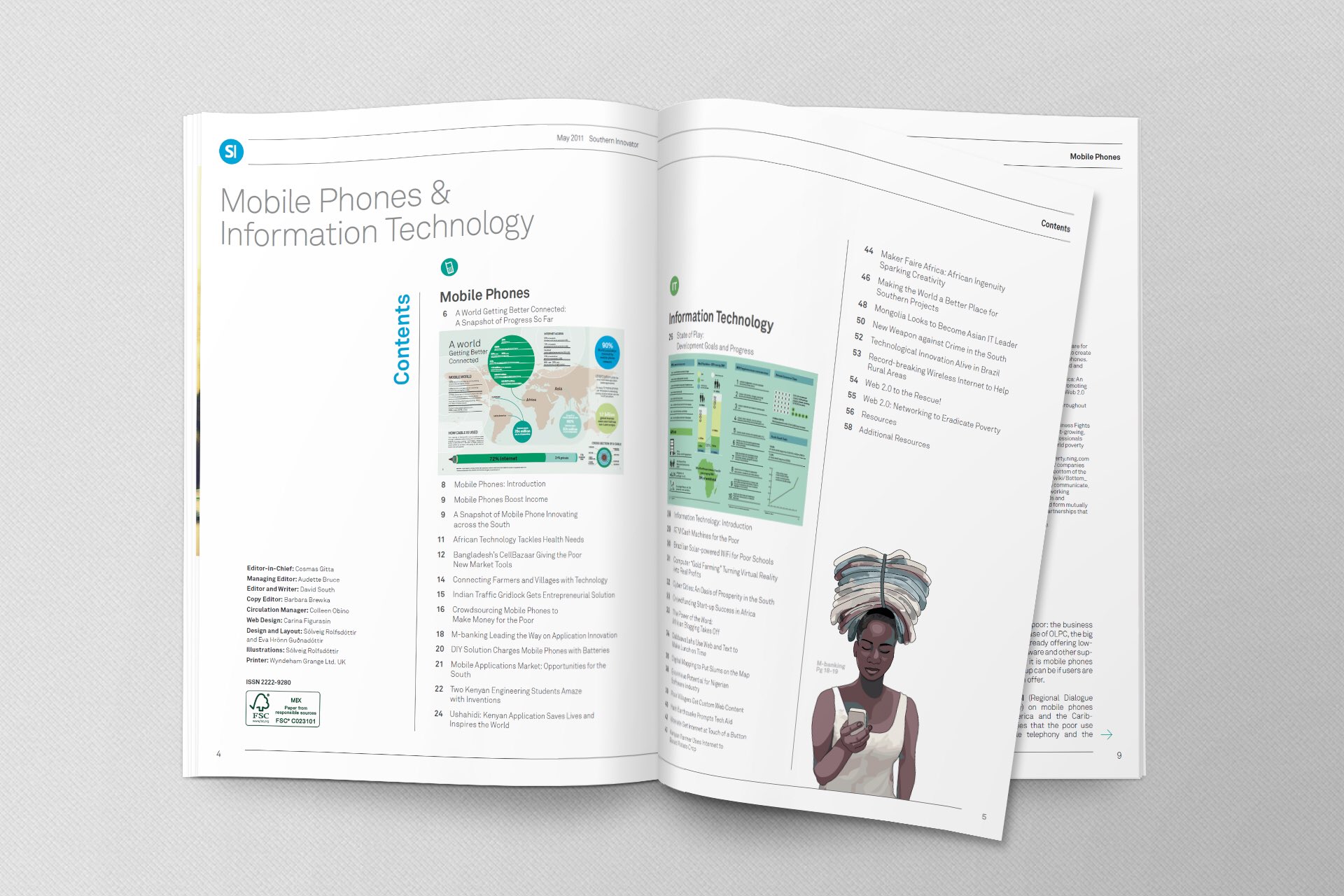
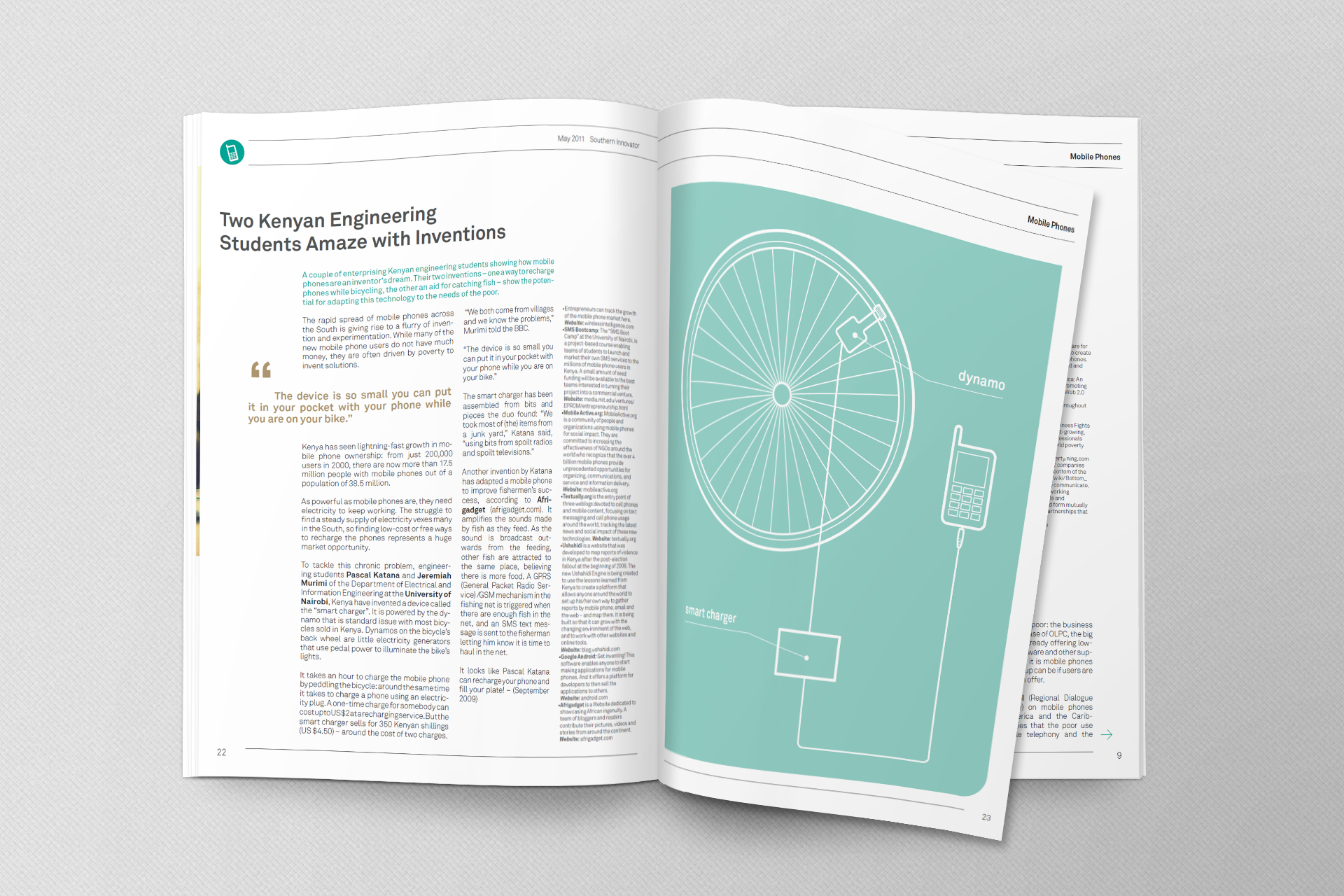
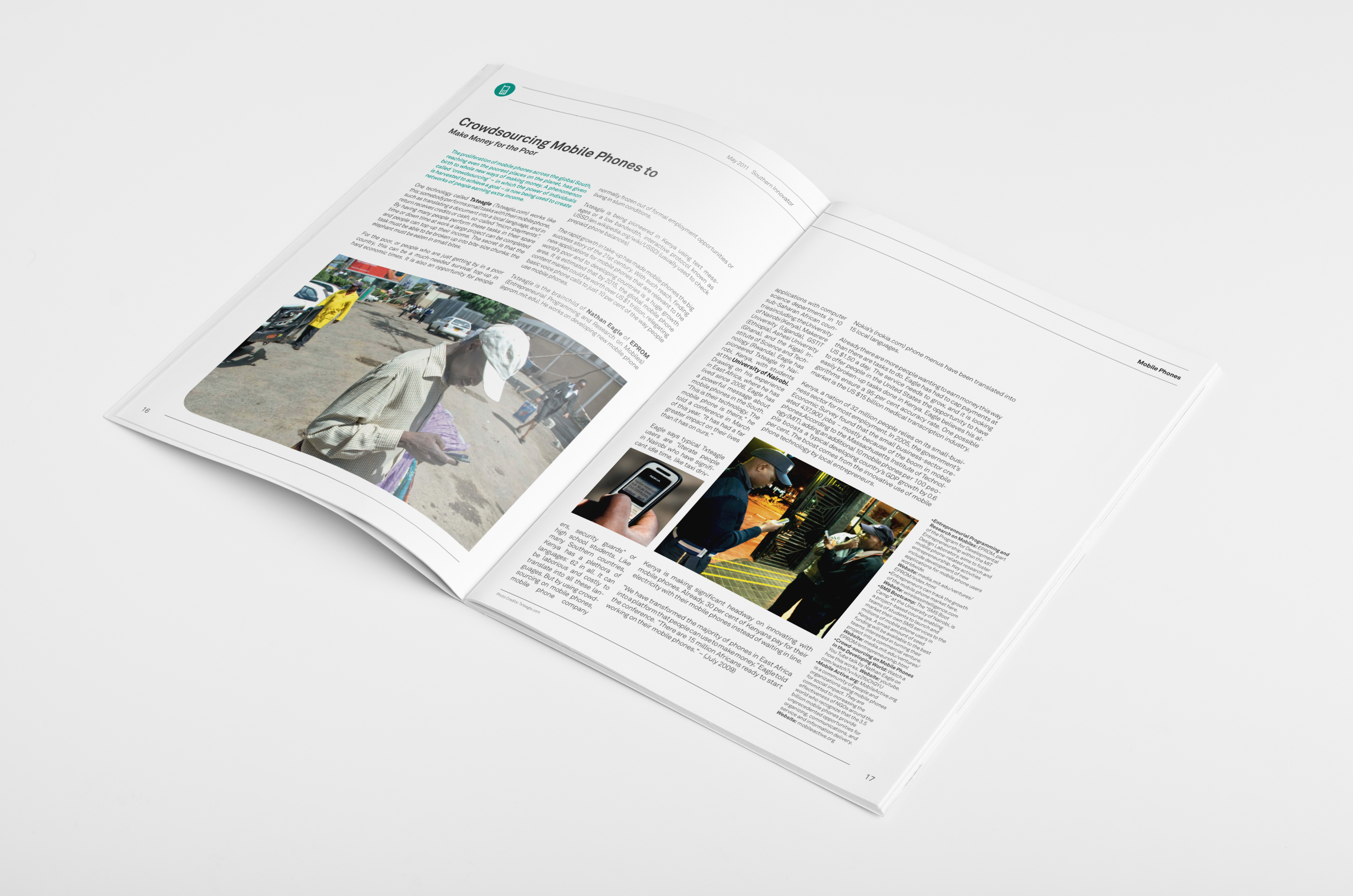
    Development Challenges, South-South Solutions was launched as an e-newsletter in 2006 by UNDP’s South-South Cooperation Unit (now the United Nations Office for South-South Cooperation) based in New York, USA. It led on profiling the rise of the global South as an economic powerhouse and was one of the first regular publications to champion the global South’s innovators, entrepreneurs, and pioneers. It tracked the key trends that are now so profoundly reshaping how development is seen and done. This includes the rapid take-up of mobile phones and information technology in the global South (as profiled in the first issue of magazine Southern Innovator), the move to becoming a majority urban world, a growing global innovator culture, and the plethora of solutions being developed in the global South to tackle its problems and improve living conditions and boost human development. The success of the e-newsletter led to the launch of the magazine Southern Innovator. 

    Creative Commons License

    This work is licensed under a
    Creative Commons Attribution-Noncommercial-No Derivative Works 3.0 License.

    ORCID iD: https://orcid.org/0000-0001-5311-1052.

    © David South Consulting 2023

  • African Trade Hub in China Brings Mutual Profits

    African Trade Hub in China Brings Mutual Profits

    By David SouthDevelopment Challenges, South-South Solutions

    SOUTH-SOUTH CASE STUDY

    South-South trade is the great economic success story of the past decade. World Trade Organization (WTO) (www.wto.org) figures show South-South trade accounted for 16.4 percent of the US $14 trillion in total world exports in 2007, up from 11.5 percent of the total in 2000. While the global economic crisis has slowed things down, the overall trend is firmly established.

    Trade between China and Africa has surged over the past decade since China joined the WTO in 2001, from around US $10 billion in 2000 to US $73.3 billion in 2007, registering a year-on-year increase of 32.2 percent. In 2008, it soared by 44.1 percent to reach a record high of US $106.84 billion, registering a year-on-year increase of 45.1 percent, according to Zhang Yongpeng of the Institute for West Asian and African Studies (IWAAS).

    In the southern Chinese city of Guangzhou (http://en.wikipedia.org/wiki/Guangzhou) , a trading hub nicknamed “Africa Town” has emerged since 1998. A conglomeration of buildings around the Xiaobei road in Yuexiu district of the city, it has been equated to the famous Chungking Mansions of Hong Kong (http://en.wikipedia.org/wiki/Chungking_Mansions) . There are officially 20,000 African traders and entrepreneurs in the city of 18 million, but unofficial estimates put the number at more than 100,000. This African trading hub has emerged to the benefit of both the Chinese and Africans. It is a coming together of small traders matching Africa’s strong demand for consumer goods with China’s manufacturing powerhouse.

    The traders export generators, toys, mopeds, construction equipment and other products back to Africa. The traders act as go-betweens, bringing their local knowledge of African market demands to the Chinese manufacturers.

    Citizens from over 19 African countries are represented, the majority from Nigeria.

    “Almost 90 per cent of goods in African markets come from China, Thailand and Indonesia,” Sultane Barry, president of Guangzhou’s Guinean community, told the Globe and Mail newspaper.

    Barry has an entire floor for business in a 35-storey building packed with shops, offices, freight-forwarding companies, African restaurants, hairdressers and furnished apartments for rent by the week.

    “We’re not here for fun,” said Ibrahim Kader Traore, an entrepreneur from Ivory Coast. “We work hard and do well. In Abidjan, people still swear by France, where you might be able to save US $13,000 over 25 years; in China, you can have US $130,000 in just five years.”

    A trading success story, the hub has run into problems over visas and the upcoming November Asian Games in Guangzhou, which is increasing identity checks.

    “I sell more than 50 per cent of the output of my brother-in-law’s TV factory to Africans,” one saleswoman told the Globe and Mail. “We need them and I’m worried there are going to be fewer of them.”

    Brought together by trade and mutual interest, both communities still have much to learn about each other. Relations have had their ups and downs and Africans can face discrimination.

    But the trading relationship is teaching both sides important lessons. “The arrival of the Africans taught the Chinese how to look for business opportunities,” said Barry. “The secretaries we had here didn’t speak a word of English. Our presence started a craze for learning languages: English and French. The Chinese didn’t know the basic rules of international trade. They knew nothing about documentary credit. They paid for everything cash in hand.

    “The Chinese people will soon realize that it’s better for business to deal directly with ordinary Africans.”

    And the pressure is on to see who will keep trading relations with Africa positive. “The door to the Chinese market has only opened a crack, mostly because visa requirements are so tough,” said Zango, a trader from Mali.

    Published: July 2010

    Resources

    1) A Financial Times report on Africa-China trade in 2010. Website: http://www.ft.com/reports/africa-china-trade-2010

    2) An article about “Africa Town” from the official Guangzhou website. Website: http://www.lifeofguangzhou.com

    3) Trade Winds: Guangzhou’s African Community by Graeme Nicol is a photo book about the community. Website: http://graemenicol.com/?page_id=115

    https://davidsouthconsulting.org/2022/06/02/afghanistans-juicy-solution-to-drug-trade/

    https://davidsouthconsulting.org/2022/11/02/african-online-supermarket-set-to-boost-trade/

    https://davidsouthconsulting.org/2022/11/21/chinese-trade-in-angola-helps-recovery/

    https://davidsouthconsulting.org/2022/04/12/djibouti-re-shapes-itself-as-african-trade-hub/

    https://davidsouthconsulting.org/2021/07/19/global-south-trade-boosted-with-increasing-china-africa-trade-in-2013/

    https://davidsouthconsulting.org/2021/07/19/south-south-trade-helping-countries-during-economic-crisis/

    https://davidsouthconsulting.org/2022/10/20/trade-to-benefit-the-poor-up-in-2006-and-to-grow-in-2007/

    https://davidsouthconsulting.org/2022/10/05/women-empowered-by-fair-trade-manufacturer/

    https://davidsouthconsulting.org/2022/06/16/women-mastering-trade-rules/

    Development Challenges, South-South Solutions was launched as an e-newsletter in 2006 by UNDP’s South-South Cooperation Unit (now the United Nations Office for South-South Cooperation) based in New York, USA. It led on profiling the rise of the global South as an economic powerhouse and was one of the first regular publications to champion the global South’s innovators, entrepreneurs, and pioneers. It tracked the key trends that are now so profoundly reshaping how development is seen and done. This includes the rapid take-up of mobile phones and information technology in the global South (as profiled in the first issue of magazine Southern Innovator), the move to becoming a majority urban world, a growing global innovator culture, and the plethora of solutions being developed in the global South to tackle its problems and improve living conditions and boost human development. The success of the e-newsletter led to the launch of the magazine Southern Innovator. 

    Creative Commons License

    This work is licensed under a
    Creative Commons Attribution-Noncommercial-No Derivative Works 3.0 License.

    ORCID iD: https://orcid.org/0000-0001-5311-1052.

    © David South Consulting 2022

  • South Gets Reading Bug with more Festivals

    South Gets Reading Bug with more Festivals

    By David SouthDevelopment Challenges, South-South Solutions

    SOUTH-SOUTH CASE STUDY

    There is no better indicator of significant economic progress than the rise and rise of book festivals across the South. These symbols of intellectually curious and globally aware middle classes are also boosting economies and contributing to a bigger, more sophisticated creative economy – something that will drive future growth across many sectors.

    The trend is most advanced in Asia, where according to the OECD, “large numbers of Asians are expected to become middle class in the next 10 years” (OECD Working Paper No. 285). But the rising middle class can also be found across the South – and so can the new book festivals.

    According to Sanjoy Roy, managing director of New Delhi-based festival producer Teamwork Productions (www.teamworkfilms.com) ,” India’s rising economic growth has ensured that the great middle class is happy to travel and to spend.”

    “More and more Indians are taking to tourism both local and international. India’s large middle-aged upper middle class and wealthy sector feeds occasions like the literature festival, ensuring attendance, making it a word of mouth must-be-seen, must-attend occasion on the social season calendar.”

    Recognition of the importance of this trend can be seen in the recent growth in book festivals associated with the Hay Festival (www.hayfestival.com) based in Hay-on-Wye, Wales. There are now Hay festivals in Beirut, Lebanon; Bogota and Cartagena, Colombia; Zacatecas, Mexico; Nairobi, Kenya; the Maldives; and the Indian state of Kerala.

    The festivals are part of the powerful global creative economy, which is seen as the “interface between creativity, culture, economics and technology in a contemporary world dominated by images, sounds, texts and symbols” (UNCTAD). The cultural sector has been shown to be an effective way for emerging economies to leapfrog into high-growth areas in the 21st century world economy.

    Roy also confirms the economic impact of book festivals. He produces India’s Jaipur Literature Festival (www.jaipurliteraturefestival.org) , which attracted over 32,000 visitors this year. The hard numbers show the economic impact of the event: “Approximately 3,000 room nights were booked by visitors during this period at an average of US $100 per night,” Roy said. “Our own spend in Jaipur during this period was approximately US $500,000. Shopping, meals and transport spend I would peg at between US $200,000 and US $300,000.”

    The OECD defines the global middle class as those living in households with daily per capita incomes of between US$10 and US$100. It calculates that Asia accounts for less than one-quarter of today’s middle class, but says that share could double by 2020. Within a decade, “more than half of the world’s middle class could be in Asia and Asian consumers could account for over 40 per cent of global middle class consumption.”

    The World Bank takes an even more optimistic view, seeing this burgeoning middle class’ spending power as being triggered once people get out of the desperation of a subsistence existence. This means the “developing world’s middle class is defined as those who are not poor when judged by the median poverty line of developing countries, but are still poor by US standards. The “Western middle class” is defined as those who are not poor by US standards.” Although barely 80 million people in the developing world entered the Western middle class over 1990-2002, it found an extra 1.2 billion people joined the developing world’s middle class. Four-fifths came from Asia, and half from China (World Bank).

    With the rise of the creative sector, significant innovation will come from the global South, according to the director of the Hay Festival, Peter Florence.

    “The digital revolution will be absolutely essential to developing countries,” he told the Associated Press. “They are going to skip two levels of publishing industry tradition. The mobile phone is more important for writers in those societies than pen and paper is. That is a very interesting continuation of oral culture. At the same time the West has decided to start moving from audio editions to digital downloads, oral culture is just moving straight into digital culture in many places around the world.”

    The impact of a growing middle class can be seen in fast-growing India, which is forecast to become the largest market for English language books within a decade.

    A survey by Tehelka (www.tehelka.com) found Indians favour stories about local conditions and set in the places where they live.

    India’s most popular current writer is Chetan Bhagat, a former investment banker. He has sold more than 3 million books in the last five years. His latest, Two States, sold a million copies in four months.

    Bhagat writes about the country’s aspiring middle class. His publisher, Rupa (www.rupapublications.com/Client/home.aspx) , believes he appeals to a “pan-Indian, pan-age group.”

    For Roy, it is still too early to tell how the new Hay Kerala festival in the state capital, Thiruvananthapuram, will affect the economy of the area (the first one is from November 12 to 14, 2010).

    “In the long term we hope this too becomes like Jaipur, attracting an international and national audience from outside the state,” he said. “Kerala has a robust economy. What it may do is increase the total tourist influx into the city and divert some of the annual Goa traffic to its own benefit.”

    Roy says the Hay Festival Kerala will follow the programming pattern of other Hay festivals, combining international authors with a strong local flavour.

    “India is celebrating its golden age in the creative arts and literature not just in English but across all official and subsidiary Indian languages,” he said. “The depth, scope, extent and range of writing in both fiction and non-fiction is incredible.”

    Drawing on his success with the festival in Jaipur, Roy has advice for others in the South looking for creative economy success.

    “It’s all about location, location, location,” he said. “A festival city like that of Cannes, Venice, Edinburgh, Avignon, Hay are special. Choose the right location, be inclusive and bring the local community on board and have the power to sustain – and in due course with a strong programming base, the festival will grow.

    “Every festival will have its own learning (curve) and those who take these on board will find it easier to be successful.”

    Published: June 2010

    Resources

    Development Challenges, South-South Solutions was launched as an e-newsletter in 2006 by UNDP’s South-South Cooperation Unit (now the United Nations Office for South-South Cooperation) based in New York, USA. It led on profiling the rise of the global South as an economic powerhouse and was one of the first regular publications to champion the global South’s innovators, entrepreneurs, and pioneers. It tracked the key trends that are now so profoundly reshaping how development is seen and done. This includes the rapid take-up of mobile phones and information technology in the global South (as profiled in the first issue of magazine Southern Innovator), the move to becoming a majority urban world, a growing global innovator culture, and the plethora of solutions being developed in the global South to tackle its problems and improve living conditions and boost human development. The success of the e-newsletter led to the launch of the magazine Southern Innovator. 

    Creative Commons License

    This work is licensed under a
    Creative Commons Attribution-Noncommercial-No Derivative Works 3.0 License.

    ORCID iD: https://orcid.org/0000-0001-5311-1052.

    © David South Consulting 2023

  • Africa’s Consumer Market in Spotlight for 2011

    Africa’s Consumer Market in Spotlight for 2011

    By David SouthDevelopment Challenges, South-South Solutions

    SOUTH-SOUTH CASE STUDY

    While other parts of the world will spend 2011 worrying about their debt levels and how to spur economic growth, many factors are pointing to Africa potentially following a different story. A frenzy of activity has been building around Africa’s market opportunities and its growing middle class consumer population. Years of steady growth rates up to 2008 and the vast, untapped opportunities on the continent have sparked interest from investors and businesses alike.

    Foreign direct investment (FDI) to developing economies rose by 10 percent in 2010 due to fast economic recovery and increasing South-South flows. Africa peaked in 2008 because of the resource boom and fell by 14 percent to US $50 billion in 2010 (UNCTAD). Rising FDI from Asia and Latin America has still yet to match the decline from developed countries – still the majority of FDI to Africa.

    However, foreign direct investment to Africa had risen sixfold to US $58.56 billion between 2000 and 2009 (UNCTAD). The amount going to manufacturing and services has been growing, despite the slow down in 2009 because of the global economic downturn. Africa’s 11 largest economies are now being seen as the next to match Brazil and Russia, economic stars of the last few years.

    The continent as a whole forms the 10th largest economy in the world. Of Africa’s more than 1 billion people, 900 million can be classified as part of the consumer economy. Out of this group, there is a third – approximately 300 million people – who make modest sums by Western standards, about US $200 a month, but have spare cash to buy things like mobile phones, DVDs and new clothes, or pay for better schools. They are the population that is overlooked when attention is focused only on the very poor living on less than US $2 a day.

    This vast group is captured in the book Africa Rising by University of Texas professor Vijay Mahajan, which details the phenomenon of Africa’s middle class consumer society. He calls this group of middle class consumers “Africa 2,” with the desperately poor called Africa 3s, and the extremely rich Africa 1s.

    This new group has expanded far beyond ruling elites and government workers. Many of its members work in the private sector, as secretaries, computer entrepreneurs, merchants and others who have benefited from consistent growth rates in many African countries.

    The portion of African households with discretionary spending power rose from 35 percent in 2000 to 43 percent in 2008. The challenge will be to turn this wealth to the benefit of made-in-Africa businesses and to create stable, high-quality jobs to ensure this wealth effect lasts.

    The new wealth effect can give Africa the tools needed to tackle its long-standing development challenges and lift more and more people out of poverty and misery while reducing dependence on foreign aid. And this can add rocket fuel to the surge toward meeting the Millennium Development Goals deadline in 2015 (http://mdgs.un.org/unsd/mdg/Default.aspx).

    The rapidly rising profile of Africa is reflected by the prestigious business newspaper the Wall Street Journal recently running a series titled “Africa’s Growing Consumer Class Lures Multinationals” (http://online.wsj.com/article/SB10001424052748704720804576009672053184168.html).

    Consulting firm McKinsey (http://www.mckinsey.com/) believes Africa’s billion citizens should be seen as consumers and says the continent’s growing number of middle-income consumers now outstrips India’s. It boldly claims consumer spending will reach US $1.4 trillion in Africa by 2020, up from US $860 billion in 2008. Consumer spending rose by 16 percent a year from 2005 to 2008 before the global economic crisis.

    It is forecast that 220 million Africans now frozen out of this consumer wave will become consumers by 2015 if current trends continue.

    The IMF believes the steady growth will continue, with 5.5 percent growth for the 47 sub-Saharan countries this year.

    That’s the good news. But many African countries still rank at the bottom in the World Bank’s Ease of Doing Business survey (http://www.doingbusiness.org/rankings). Africa remains a logistical nightmare for companies. Poor quality roads, inadequate harbours and inefficient rail systems, all make it difficult to move goods around the continent and across borders.

    This makes distribution in Africa costly. Companies also often have to import building supplies and equipment to construct factories and plants. Then there is the unreliable electricity supply. Unable to trust local power supplies, many companies use their own electricity generators.

    If handled right, new brands and companies are set to join African global success stories like Mo Ibrahim (http://en.wikipedia.org/wiki/Mo_Ibrahim), who founded the mobile telecommunications company Celtel.

    Some of the new success stories include African companies pairing up with global firms as they seek local knowledge and experience. This will be a substantial opportunity for companies wise enough to organise themselves for global competition. In 2010, Sweden’s Electrolux – one of the world’s largest makers of home appliances – bought Egypt’s Olympic Group (http://www.ameinfo.com/145039.html), a North African powerhouse for household goods.

    In the Ivory Coast, Nouvelle Parfumerie Gandour (http://www.npgandour.com/english/index.html) – makers of perfume, cologne, cosmetics and talcs – is an African cross-border success story. It has factories in Ivory Coast, Senegal, Morocco and Cameroon. Thirty percent of its profits come from exports, some of which are to the United States and Europe.

    Sonatrach (http://www.sonatrach-dz.com/NEW/) in Algeria is the largest oil and gas company in Algeria and Africa. Is using its base in oil and gas exploration, production, pipeline transportation and marketing of hydrocarbons and by products, to move into other areas. It is increasing its investments in power generation, new and renewable energies, water desalination, and mining exploration and exploitation. Looking to grow its business with 30 percent coming from exports by 2015, it has spread across Africa ( Mali , Niger , Libya , Egypt ), to Spain , Italy , Portugal , United Kingdom , Peru and the United States.

    Marwa (http://www.marwa.es/) from Casablanca, Morocco, is an African fashion success story. The brand started by Karim Tazi in 2003 began with just two stores in Casablanca and Rabat. It identified the niche of very fashionable but good quality and inexpensive clothing. It blends international trends with subtle influences from Moroccan tradition. Its prices hover between six euros for a t-shirt and 100 euros for a coat. It has successfully created a Moroccan high-street fashion look that can be exported. It has opened a branch in Zaragoza, Spain and is expanding to Riyadh, Saudi Arabia, Paris, France, Beirut, Lebanon and Istanbul, Turkey.

    A survey by consultants AT Kearney (http://www.atkearney.com) found eight out of nine West African subsidiaries of global consumer goods companies discovered quicker revenue growth than their parent companies.

    All this new wealth and growth provides substantial opportunities to African brands to build their businesses and markets. The big issue will be who will rise to the occasion and who will be clever enough to learn from existing African brands that are already thriving and have shown the way.

    Two trends will also power this growth: urbanization and large youth populations. Africa’s youthful, urban population has already been reached by the telecoms sector through the rapid growth of mobile phones. More than 500 million subscribers have been signed up since 2000 (Informa Telecom and Media), a user base greater than the entire US population.

    “By 2040, the continent will be home to one in five of the planet’s young people and will have the world’s largest working-age population,” according to Charles Roxburgh and Susan Lund, authors of a study for the McKinsey Global Institute.

    “If Africa can give its young people sufficient education and skills, they could be a substantial source of consumption and production in years ahead.”

    Published: January 2011

    LINKS:

    1) Afrique Avenir: Inspiring blog tracking Africa’s rising middle class and their global economic impact. Also great photo gallery The Other Africa, a photographic journey through all 54 African countries featuring the rising middle class. Website: http://www.afriqueavenir.org/en/

    2) Afrocoffee: A design-savvy South African coffee shop chain that has expanded to Europe. It uses a modern African-themed design in its shops and product range. Website: https://www.afrocoffee.com/index.php?id=4&menustate=&L=1

    3) Africa Rising: A book by Professor Vijay Mahajan on how Africa’s consumer economy is growing and growing. Website: http://tinyurl.com/2vk3m9n

    4) Arise Magazine: Arise is a Nigerian style monthly started by Nigerian media mogul Nduka Obaigbena, who also publishes Nigeria’s leading newspaper, This Day. Website: http://www.arisemagazine.net/

    5) A video on the rising African consumer market. Website:http://annansi.com/blog/2010/12/growth-and-spending-of-african-consumer-video/

    6) Annansi Chronicles: A blog packed with the latest news and media on African business and culture trends. Website: http://annansi.com/blog/

    7) An interactive map of Africa’s new wealth and where to find it. Website:http://online.wsj.com/article/SB10001424052748704720804576009672053184168.html#project%3DAFRICAMAP0111%26articleTabs%3Dinteractive

    https://davidsouthconsulting.org/2021/10/30/2011-development-challenges-south-south-solutions/

    https://davidsouthconsulting.org/2022/10/25/2011-trends-for-the-south/

    https://davidsouthconsulting.org/2020/12/15/development-challenges-south-south-solutions-newsletter-2011-2014-2/

    https://davidsouthconsulting.org/2021/09/20/southern-innovator-and-the-gssd-expo-2011-2014/

    https://davidsouthconsulting.org/2022/12/01/southern-innovator-goes-to-south-south-expo-13-december-2011/

    https://davidsouthconsulting.org/2022/12/01/southern-innovator-magazine-is-printed-and-readied-for-distribution-31-may-2011/

    Development Challenges, South-South Solutions was launched as an e-newsletter in 2006 by UNDP’s South-South Cooperation Unit (now the United Nations Office for South-South Cooperation) based in New York, USA. It led on profiling the rise of the global South as an economic powerhouse and was one of the first regular publications to champion the global South’s innovators, entrepreneurs, and pioneers. It tracked the key trends that are now so profoundly reshaping how development is seen and done. This includes the rapid take-up of mobile phones and information technology in the global South (as profiled in the first issue of magazine Southern Innovator), the move to becoming a majority urban world, a growing global innovator culture, and the plethora of solutions being developed in the global South to tackle its problems and improve living conditions and boost human development. The success of the e-newsletter led to the launch of the magazine Southern Innovator. 

    https://davidsouthconsulting.org/2021/03/05/southern-innovator-issue-1/

    Creative Commons License

    This work is licensed under a
    Creative Commons Attribution-Noncommercial-No Derivative Works 3.0 License.

    ORCID iD: https://orcid.org/0000-0001-5311-1052.

    © David South Consulting 2023