Tag: Development Challenges

  • Traditional Medicine is now a Proven Remedy

    Traditional Medicine is now a Proven Remedy

    By David SouthDevelopment Challenges, South-South Solutions

    SOUTH-SOUTH CASE STUDY

    Once dismissed as old fashioned, ineffective and unscientific, traditional medicine is now seen as a key tool in bringing healthcare and healing to poor people bypassed by existing public and private health measures.

    Acknowledging traditional medicine as a useful tool goes back to the World Health Organisation’s Alma-Ata Declaration in 1978, which urged governments for the first time to include traditional medicine in their primary health systems and recognise traditional medicine practitioners as health workers. During the last 30 years there has been a considerable expansion in the use of traditional medicine across the world. Despite their ancient origins, it is still critical these medicines do meet efficacy and health standards and are proven to work.

    In Mongolia, when the Soviet Union collapsed a decade and a half ago, new market forces meant that supplies of conventional medicines became prohibitively expensive for most of the population. With one doctor for 600 people in the rural areas – and the vast distances to be covered – medical services were virtually unobtainable in rural communities.

    This situation led to a revival of Mongolia’s 2,000-year-old traditional medicine. This includes acupuncture, cauterisation, manual therapy, blood letting and therapies using mares’ milk – all integral to the rural way of life.

    Research by the Japanese Nippon Foundation – the largest private foundation in Japan – explored how Mongolia’s public health care could be improved through traditional medicine. It focused on the possible use of traditional medicine alongside Western medicine, the depth of faith in traditional medicine, the affordability of traditional medicine, and the lifestyles of herdsmen living in remote areas away from hospitals. The project, launched in 2004, distributes medical kits with 12 types of traditional medicines to households in rural areas. As they use them, the households pay for them. The kits, which mostly target stomach and intestinal ailments and fever, have so far been distributed to 10,000 households (50,000 people) across the country. The Foundation found doctors’ house calls were down by 25 per cent after one year of the project.

    In India, Gram Mooligai and its Village Herbs label helps bring quality healthcare to the country’s 170 million rural poor currently left out by public healthcare programmes, or who can’t afford private services. At present, the Indian government has been unable to find adequate funds to provide healthcare to all its people. Gram Mooligai uses a network of 300 women health practitioners to reach villagers who spend on average US $50 a year on health services – so far, they reach 30,000 households. It has built trust with the poor by offering herbal remedies based on India’s strong Ayruvedic heritage of herbal healing. It also draws on India’s rich biodiversity by harvesting medicines sustainably from native plant species – over 18,000 are known.

    The company is owned by a network of rural growers that manufacture herbal remedies like Trigul balm for joint pain, Sugam cough syrup and Jwaracin fever reducer. Gram Mooligai combines modern heathcare with local remedies familiar to rural villagers.

    The website gives a good example of this folksy approach. In answer to a villager whose daughter is complaining of pain in her legs and back, the villager is advised to give her milk and ghee (clarified butter). “Add nuts and dry fruits to her daily diet in small quantity. If she is lean, then a weekly massage with Lakshadi Thailam (which is available in the Ayurvedic shops) is very useful. Slightly warm the oil before massage and add a pinch of common salt to the oil for better absorption.”

    Published: September 2007

    Resources

    • Mongolian Traditional Medicine Website: www.baigal.com
    • Asia-Pacific Traditional Medicine and Herbal Technology Network: an excellent first stop for any entrepreneur, where they can find out standards and regulations and connect with education and training opportunities: www.apctt-tm.net and www.aptm.cn

    Development Challenges, South-South Solutions was launched as an e-newsletter in 2006 by UNDP’s South-South Cooperation Unit (now the United Nations Office for South-South Cooperation) based in New York, USA. It led on profiling the rise of the global South as an economic powerhouse and was one of the first regular publications to champion the global South’s innovators, entrepreneurs, and pioneers. It tracked the key trends that are now so profoundly reshaping how development is seen and done. This includes the rapid take-up of mobile phones and information technology in the global South (as profiled in the first issue of magazine Southern Innovator), the move to becoming a majority urban world, a growing global innovator culture, and the plethora of solutions being developed in the global South to tackle its problems and improve living conditions and boost human development. The success of the e-newsletter led to the launch of the magazine Southern Innovator.

    Creative Commons License

    This work is licensed under a
    Creative Commons Attribution-Noncommercial-No Derivative Works 3.0 License.

    ORCID iD: https://orcid.org/0000-0001-5311-1052.

    © David South Consulting 2022
  • Cooking up a Recipe to End Poverty

    Cooking up a Recipe to End Poverty

    By David SouthDevelopment Challenges, South-South Solutions

    SOUTH-SOUTH CASE STUDY

    Like music, food has a powerful ability to jump across cultural and regional barriers and unite people in the sheer pleasure of the meal. Tapping the rich vein of regional culinary heritages is also a great way to make money. Promoting local recipes and foods has other benefits: as the global obesity (or globesity as WHO calls it) epidemic reaches into the urban areas of cities in the developing world, anything that pulls people away from fast food and high-fat foods is a good thing. Doctors have found home cooking keeps people thin and is better for them.

    The trend across the developing world towards eating away from home is another factor in the growing obesity crisis. While cooking at home allows for control of ingredients and portion sizes, eating out usually means more high energy and fatty foods. The global obesity crisis is threatening to reverse many essential health gains brought about by development. As communities prosper, diets become more reliant on junk food and fast food.

    The International Obesity Task Force found 1.7 billion people in the world need to lose weight. There are now more overweight people in the world than hungry people. Neville Rigby, the policy director of the task force, told The Associated Press, “What’s clear is that the developing world in particular is going to bear the enormous brunt of this weight gain. It’s rapidly accelerating. We’re even seeing obesity in adolescents in India now. It’s universal. It has become a fully global epidemic – indeed, pandemic.”

    According to Dr Susan Jebb, Medical Research Council Director of Studies, Human Nutrition Centre, University of Cambridge, “getting back to a bit of home cooking could be a good start” to tackling the obesity crisis.

    Increasing awareness of traditional and local recipes can generate income in many ways. From publishing cookbooks to inspiring restaurant and food vendor menus to sparking up supermarket product lines, whole industries can be built up from the humble recipe. Supermarkets in Africa are a growing sector. Executives from South Africa’s Shoprite supermarket chain recently announced a doubling of their supermarkets in Uganda, and called supermarkets one of the fastest growing businesses in East Africa. UK supermarket chain Sainsbury’s has already started to dispatch Fairtrade Ambassadors to Africa to trawl the continent for new products to stock their shelves.

    So, the time is right for entrepreneurs to target the African food market and raise its profile. Seizing this opportunity is an ambitious project to digitally archive the vast and often hard-to-find treasure trove of African cookbooks. Announced at a conference in Tanzania this summer, the African Cookbook Project is seeking to gather together in one place all the past and present African cookbooks, effectively creating the most comprehensive resource of African recipes.

    Published: August 2007

    Resources

    • Africooks: Culinary Literature by Jessica B. Harris: This established African cookbook writer offers an excellent role model for budding cookbook authors: www.africooks.com
    • A success story about a Senagalese restaurant in the US: NYTimes article
    • BetumiBlog and Betumi.com (www.betumi.com): Betumi is the African Culinary Network and “connects anyone who delights in African cuisine, foodways and food history.” View photos.
    • An extensive list of African cookbooks available for sale: here
    • Africa’s Big Seven: held every year, it is the main event that brings together food retailers and producers and is a perfect place to bring a new product looking to be launched.

    https://davidsouthconsulting.org/2022/11/21/agribusiness-food-security/

    https://davidsouthconsulting.org/2022/11/10/brazilian-restaurant-serves-amazonian-treats/

    https://davidsouthconsulting.org/2022/06/24/dabbawallahs-use-web-and-text-to-make-lunch-on-time/

    https://davidsouthconsulting.org/2022/11/11/havanas-restaurant-boom-augers-in-new-age-of-entrepreneurs/

    https://davidsouthconsulting.org/2022/10/14/indias-modernizing-food-economy-unleashing-new-opportunities/

    https://davidsouthconsulting.org/2022/05/04/insects-can-help-in-food-crisis/

    https://davidsouthconsulting.org/2022/10/24/latin-american-food-renaissance-excites-diners/

    https://davidsouthconsulting.org/2022/10/20/new-appetite-for-nutritious-traditional-vegetables/

    https://davidsouthconsulting.org/2023/03/27/rats-a-solution-in-food-crisis/

    https://davidsouthconsulting.org/2021/03/05/southern-innovator-issue-3/

    https://davidsouthconsulting.org/2022/11/16/thai-organic-supermarkets-seek-to-improve-health/

    https://davidsouthconsulting.org/2022/11/11/woman-restaurant-entrepreneur-embraces-brand-driven-growth/

    Development Challenges, South-South Solutions was launched as an e-newsletter in 2006 by UNDP’s South-South Cooperation Unit (now the United Nations Office for South-South Cooperation) based in New York, USA. It led on profiling the rise of the global South as an economic powerhouse and was one of the first regular publications to champion the global South’s innovators, entrepreneurs, and pioneers. It tracked the key trends that are now so profoundly reshaping how development is seen and done. This includes the rapid take-up of mobile phones and information technology in the global South (as profiled in the first issue of magazine Southern Innovator), the move to becoming a majority urban world, a growing global innovator culture, and the plethora of solutions being developed in the global South to tackle its problems and improve living conditions and boost human development. The success of the e-newsletter led to the launch of the magazine Southern Innovator.

    Creative Commons License

    This work is licensed under a
    Creative Commons Attribution-Noncommercial-No Derivative Works 3.0 License.

    ORCID iD: https://orcid.org/0000-0001-5311-1052.

    © David South Consulting 2023

  • African Culture as Big Business

    African Culture as Big Business

    By David SouthDevelopment Challenges, South-South Solutions

    SOUTH-SOUTH CASE STUDY

    In the last decade the world’s creative industries (including crafts, fashion and design) have gained greater respect for being the spark that drives economic development and entrepreneurship. They are seen as fast growers and good job creators, and importantly, the lynch pin in cultural identity and cultural diversity. UNESCO, through its Global Alliance for Cultural Diversity, has been in the forefront of helping African countries re-shape their policies to take this into consideration. The promotion of cultural industries also has been incorporated into the New Partnership for Africa’s Development (NEPAD).

    The global clothing industry is estimated to be worth US $900 billion a year. Culture and creativity are big businesses: according to UNESCO, in 2002 the UK exported US $8.5 billion in cultural goods, the United States US $7.6 billion, and China US $5.2 billion. The UK’s Burberry fashion label alone made £157 million in 2006.

    This is good news for Africa’s growing fashion industry, which is finally getting the attention and respect it deserves. Entrepreneurs are tapping into this awareness as a great way to make money. Well-known Nigerian fashion designer Alphadi says the continent’s fashion industry is “giving Africa a chance to show its true self, its solidarity, its huge generosity and its greatness.”

    Africa’s fashion entrepreneurs are showing more and more confidence and striding with pride across catwalks around the world. And despite the problems faced by black models – as highlighted by supermodel Naomi Campbell in her recent press conference in Kenya – some African models have a growing international profile: these include Alek Wek from southern Sudan, and Waris Dirie from Somalia. Campbell has said she plans to set up a modelling agency in Kenya to increase opportunities.

    Just as African music has fans around the world, the continent’s growing fashion scene is gaining fans and more attention. From Hollywood stars to European catwalks, African fashion designers and apparel makers are feeding the industry’s hunger for novelty and new ideas.

    African entrepreneurs, from village craftsmen to ambitious and creative urbanites, are finding ways to cash in on this rising awareness.

    The rising stars of South Africa were on full display at this August’s Cape Town Fashion Week. David Tlale, who produces glamorous haute couture creations, places community empowerment in his hometown of Johannesburg at the centre of his business. Tlale was joined by rising stars Thabani Mavundla, Thula Sindi, and Craig Jacobs.

    Creator and founder of the Fundudzi label of Johannesburg, Jacobs presented a couture collection at Paris Fashion Week in July. A former TV presenter-turned-fashion designer, Jacobs sees a renewed pride in African creativity and a new dialogue about Africa’s place in the world. His motto is: “Africa reworked…Africa re-inspired… Africa renewed”.

    Established in 2004, his clothing company for women strives to be socially and environmentally responsible: “Fundudzi is also an eco-conscious label, utilizing materials such as organic cottons, soy and bamboo as well as cashmere produced in Africa which is not harmful to the environment,” he said. “The message which we want to resonate with the rest of the world is that Africa has always been organic.”

    “Our label has grown out of the desire to help change the perception of our home, Africa, by presenting clothing designed and created here which can compete on the world stage.”

    Jacob benefited from support from various organizations in South Africa to get his business plans sorted out. The country’s tourism body has focused on fashion with its C’est Couture campaign. But he has also struggled with the complexities of exporting his designs and navigating global customs regulations.

    “There has been a lot of interest internationally in our collection, but I am not sure what the rules and regulations are … We need an over-riding body to help assist us young entrepreneurs. My experience in Paris, in July, has been that we do have something new and fresh to say in fashion, and we can produce at the same standard as the rest of the world.

    There was validation of that. But we as Africans need to follow our own signature, look internally to come up with inspiration, and show that to the rest of the world. “The global village environment, and the access that technologies such as the Internet have provided, means that we can tune into the same stimuli in terms of trends and fashion directions to ensure that we are on par with the rest of the planet. I do believe that the world, bored with the same trends they have been exposed to for so long, are looking for a new guard of inspiration – and we need to empower ourselves with the right tools to answer that call.

    “Our positioning is quite simple – our label is dedicated to creating jobs in Africa, thereby reducing our dependency on aid in securing our future …I wanted to create a label which is rooted in Africa, which tells African stories, but which is not tradition or museum curio – rather, intelligent pieces which can fit seamlessly into the global firmament of fashion. The label is focused on redressing the prejudices about the “dark continent” – each collection is designed as a travelogue, informing the world about the rich tapestry of life in Africa.”

    Another hub of dynamism in the African fashion scene is Nairobi, Kenya. Kikoromeo connects its catwalk fashion designs with the principle of community development. The label uses mostly Kenyan materials – cotton, silk and wool – and works with local artisans, including women’s groups. Its bags are woven with Kenyan Sisal by Machakos women’s groups, and the beadwork is done by Maasai women’s groups.

    Anna Trezbinski of Nairobi, who is popular in Hollywood and has contracts to provide items to top designers like Paul Smith, employs 800 people – mostly Masai women in her workshop in the Great Rift Valley.

    This new wave of African fashion designers is proving that anyone with talent, a website and a fan base can puncture the bubble of the European and New York catwalks and make a splash.

    “Africa is a haven of inspiration,” says the Tanzanian-born, Nairobi-based designer and collector Lisa Christofferson, who has clothed Ralph Fiennes, Rachel Weiss and Jane Seymour. “Africa for many years now has been the flavour of fashion,” she says. “It has really opened the door for us.”

    She believes the internet has expanded her business and her brand. It gives clients and boutiques around the world the ability to import her hand-painted, African-inspired cashmere sweaters, bedspreads and throws. Many are ceremonial cloths of the Kuba Kingdom in Congo.

    Another designer based in Kenya, Annabelle Thom, believes changes in the last seven years are responsible: access to TV and film, music channels and a burgeoning middle class with money. “People care more about fashion and if you look around in Nairobi, the average person is beautifully dressed – people are spending money on themselves,” she said.

    Ethiopia has also been identified as a bubbling fashion hot spot for its indigenous raw cotton and potential to produce other natural fibres. Ethiopian designer Guenet Fresenbet launched Ethiopia’s first fashion magazine, Gigi, to help take the lead.

    Published: October 2007

    Resources

    • Afromix: Great links to African fashion designers and fashion events and media.
    • Kikoromeo: Based in Nairobi, Kenya Kikoromeo’s founder and principal apparel designer trained in Rome and Milan and has been in production in Kenya since 1997.
    • South Africa’s leading fashion weeks: Johannesburg Fashion Week or Capetown Fashion Week
    • A video about Kenya’s fashion boom: Click here to view.
    • Uzuri: Premier International African Inspired Fashion Magazine: A quarterly magazine founded in 2005 and based in Texas, it is dedicated to highlighting high fashion in Africa.
    • Dobizo: An excellent website with all the resources necessary for a budding entrepreneur to get started in the fashion business, from step-by-step guides to common mistakes and how to choose a logo.
    • Fashion Nigeria: Newly launched Nigerian fashion magazine.

    Development Challenges, South-South Solutions was launched as an e-newsletter in 2006 by UNDP’s South-South Cooperation Unit (now the United Nations Office for South-South Cooperation) based in New York, USA. It led on profiling the rise of the global South as an economic powerhouse and was one of the first regular publications to champion the global South’s innovators, entrepreneurs, and pioneers. It tracked the key trends that are now so profoundly reshaping how development is seen and done. This includes the rapid take-up of mobile phones and information technology in the global South (as profiled in the first issue of magazine Southern Innovator), the move to becoming a majority urban world, a growing global innovator culture, and the plethora of solutions being developed in the global South to tackle its problems and improve living conditions and boost human development. The success of the e-newsletter led to the launch of the magazine Southern Innovator.

    Creative Commons License

    This work is licensed under a
    Creative Commons Attribution-Noncommercial-No Derivative Works 3.0 License.

    ORCID iD: https://orcid.org/0000-0001-5311-1052.

    © David South Consulting 2022

  • Agricultural Waste Generating Electricity

    Agricultural Waste Generating Electricity

    By David SouthDevelopment Challenges, South-South Solutions

    SOUTH-SOUTH CASE STUDY

    Agriculture around the world produces a great deal of waste as a by-product. It can be animal faeces, or the discarded plant husks thrown away when rice, grains or maize are harvested. When this waste meets the urgent need for electricity, something special can happen.

    The number of people still without electricity in the South is vast. The failure of major electricity generating power stations to reach so many people has spurred entrepreneurs to come to the rescue. Power is critical to so many things: small businesses need it, anyone wanting access to computers and the Internet needs it, and modern appliances like refrigerators run on it. During the past 25 years, electricity supplies have been extended to 1.3 billion people living in developing countries. Yet despite these advances, roughly 1.6 billion people, a quarter of the global population, still have no access to electricity and some 2.4 billion people rely on traditional biomass fuels, including wood, agricultural residues and dung, for cooking and heating. More than 99 percent of people without electricity live in developing regions, and four out of five live in rural areas of South Asia and sub-Saharan Africa (International Energy Agency, IEA).

    Power outages in Africa are a serious and frequent problem and a significant force holding back development. With global oil prices on the rise, turning to diesel generators is an expensive option.

    According to the IEA, the lack of electricity leaves poor countries “trapped in a vicious circle of poverty, social instability and underdevelopment.”

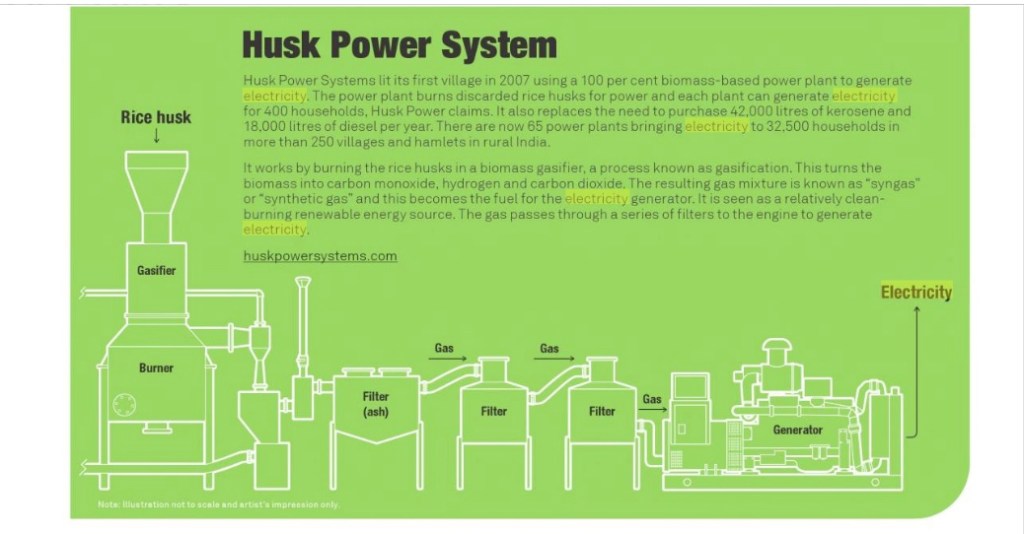
    In India, 80,000 of the country’s half a million villages lack electricity. Two students, Charles Ransler and Manoj Sinha, have started a business providing electricity to some of these villages by turning rice husks – a by-product of rice milling – into gas that then powers an electricity generator.

    Already, two of their rice-burning generators are providing electricity to 10,000 rural Indians. The hope is to rapidly expand the business to hundreds of small village power plants.

    The business, Husk Power Systems, was started while the two were at the University of Virginia’s Darden School of Business.

    While the generator burns the rice husks to make a gas to produce electricity, it also leaves behind a waste product of ash that is sold as an ingredient in cement.

    This technology can provide off-grid power to rural Indian villages of 200 to 500 households. Using the husk-powered mini power plant, the team plans to offset close to 200 tons of carbon emissions per village, per year in India.

    The idea for the rice husk generators was originally conceived by Sinha and Gyanesh Pandey, the third partner in Husk Power, who left an engineering career in Los Angeles to return to India and oversee the rice husk project. Sinha and Pandey went to college together in India and both come from rural Indian villages that struggle with a lack of electricity.

    “We grew up in those areas,” said Sinha. “Our relatives still do not have electricity. We wanted to give back to those areas.” Originally they envisioned refining the generator concept and raising enough money to donate rice-husk generators for two or three villages near where they grew up, said Sinha.

    But instead, after some research, they realised it could be a financially viable business expandable to hundreds of villages. There are 480 million Indians with no power and 350 million of them live in rural villages, concentrated in eastern India’s “Rice Belt,” where the villagers are “rice rich and power poor,” said Ransler.

    The project has already won a fistful of prizes, including US$50,000 from the Social Innovation Competition at the University of Texas.

    They think that each rice husk generator is to break even in about two and a half years.

    And they like to think this is the Starbucks of off-grid electricity generation, potentially as successful as the globe-spanning US coffee shop chain. “You can put one of these in 125,000 locations, hire local people, and turn a raw material into money – just substitute rice husks for coffee beans,” said Ransler.

    Another maker of biomass mini power plants in India is Decentralised Energy Systems India (DESI power). It is a New Delhi-based non-profit company specialising in building a decentralised power network for rural India. It was formed by Development Alternatives, India’s largest sustainable development NGO. It is able to provide a megawatt of electricity to a village for the cost of 44 million rupees, rather than 57 million rupees from the central grid.

    Published: June 2008

    Resources

    https://davidsouthconsulting.org/2022/10/06/battery-business-brings-tanzanians-cheap-electricity/

    https://davidsouthconsulting.org/2023/02/03/environmental-public-awareness-handbook-case-studies-and-lessons-learned-in-mongolia/

    https://davidsouthconsulting.org/2021/02/01/kenya-turns-to-geothermal-energy-for-electricity-and-growth/

    Development Challenges, South-South Solutions was launched as an e-newsletter in 2006 by UNDP’s South-South Cooperation Unit (now the United Nations Office for South-South Cooperation) based in New York, USA. It led on profiling the rise of the global South as an economic powerhouse and was one of the first regular publications to champion the global South’s innovators, entrepreneurs, and pioneers. It tracked the key trends that are now so profoundly reshaping how development is seen and done. This includes the rapid take-up of mobile phones and information technology in the global South (as profiled in the first issue of magazine Southern Innovator), the move to becoming a majority urban world, a growing global innovator culture, and the plethora of solutions being developed in the global South to tackle its problems and improve living conditions and boost human development. The success of the e-newsletter led to the launch of the magazine Southern Innovator.

    https://davidsouthconsulting.org/2021/03/05/southern-innovator-issue-5/

    Creative Commons License

    This work is licensed under a
    Creative Commons Attribution-Noncommercial-No Derivative Works 3.0 License.

    ORCID iD: https://orcid.org/0000-0001-5311-1052.

    © David South Consulting 2022