Tag: development challenges south-south solutions

  • Decent and Affordable Housing for the Poor

    Decent and Affordable Housing for the Poor

    By David SouthDevelopment Challenges, South-South Solutions

    SOUTH-SOUTH CASE STUDY

    Urban populations across the South are growing fast: by 2030, some 5 billion people around the world will live in cities. This year will be the first year in which urban dwellers (3.3 billion people) will outnumber rural residents for the first time (UNFPA).

    Africa now has a larger urban population than North America and 25 of the world’s fastest growing big cities. Asia and Africa’s cities are growing by an incredible 1 million people a week, with 72 per cent of the population in sub-Saharan Africa living in slum conditions.

    How well people dwell is integral to their mental and physical health. Most squatters and slum dwellers – a category that includes half the urban population of Africa, a third in Asia and a fourth in Latin America and the Caribbean – live in makeshift homes made from whatever they can get their hands on. These dwellings are usually unsafe and vulnerable to fire, floods, and earthquakes. On top of this, these sprawling slums can be depressingly grim to look at for those living there.

    In Brazil’s Sao Paulo neighbourhood of Heliopolis – the largest of the city’s 400 favelas, or shantytowns – the majority of its dwellings are made from cement and brick. It is stigmatised as the ugliest part of the city, yet a unique initiative has transformed perceptions of the area – and brought pride to its residents. The project offers a model for slum areas looking to make the next leap up the ladder of development. Heliopolis first sprang up in the 1970s, wedged between highways and roads. Plagued by crime, there is a wide spread in incomes and urbanisation among the 120,000 residents packed into the one-and-a-half square mile. Older parts have many services, while newer areas lack basics like plumbing and electricity.

    Well-known Sao Paulo-based Brazilian architect Ruy Ohtake (http://www.geocities.com/capitolhill/3836/saopaulo.html) mobilised the 6,000 residents to use a fixed palette of six colours – from bright yellow to deep purples – to create a look described as akin to an Italian hill town.

    “Ohtake told a newspaper that Heliopolis was the ugliest part of the city, so we went to him and asked him to figure out how to make it beautiful,” Geronino Barbosa, director of the Heliopolis community group UNAS, told the design magazine Dwell.

    Ohtake, famous for his hotel designs and renovating former colonial areas, rose to the challenge: “I believe in beauty as a social function, so what better way to exercise that belief,” he said. To avoid the initiative feeling like something being imposed from on high, the plan did not go ahead until the residents were happy. And to make sure they felt they owned the results, they did all the painting themselves. The result is a river of colour running through a landscape of dreary, unfinished brick homes jammed between streets and factories. The Italian hill town-effect leaves pedestrians experiencing a surprise as they turn through the streets, happening upon hidden plazas and little bars.

    “Our dream is to expand this project to the entire favela,” said Barbosa. “People love their painted houses. One of our participants told me that her house has been transformed into a sort of Carnival parade.”

    “Who doesn’t want to live in a beautiful house?” said UNAS’ head, Joao Miranda, to Dwell. “We want the same things as everyone else.”

    Another architect has tackled the problem of how to create inexpensive but durable and beautiful homes for the poor. Iranian-born architect Nader Khalili (http://www.calearth.org/) has created what he calls ‘super adobe’ dwellings inspired by traditional Iranian rural homes. The cone-shaped homes are made from sandbags piled one on top of the other in a circular pattern. A basic home is three rooms of 400 square feet, and can be built by five people (with only one needing skills), within weeks. Being sandbags, the homes can easily be dismantled and moved or adapted to meet new space needs.

    Khalili first fell in love with the sand adobe homes of Iran in the 1970s. He had been on a journey to find a home design that was both environmentally harmonious and could be built anywhere in the world quickly and cheaply. But while the original Iranian sand adobe is easily destroyed by earthquakes and bad weather, the ‘super adobes’ are earthquake, hurricane and flood resistant. They are now being built across the Americas , Asia and Africa.

    “You can never build one of these that doesn’t look beautiful,” he said. “Just as you have never seen an ugly tree or an ugly flower.”

    Published: January 2008

    Resources

    • Builders Without Borders: Is an international network of ecological builders who advocate the use of straw, earth and other local, affordable materials in construction. Website: http://builderswithoutborders.org/
    • World Hands Project: An NGO specialising in simple building techniques for the poor. Website:http://www.worldhandsproject.org
    • Tsunami-Safe House: A design for Prajnopaya Foundation: a project coordinated by the SENSEable City Laboratory, a new research initiative between the Department of Urban Studies and Planning and the Media Lab at the Massachusetts Institute of Technology in Boston. Website:http://senseable.mit.edu/tsunami-prajnopaya/
    Creative Commons License

    This work is licensed under a
    Creative Commons Attribution-Noncommercial-No Derivative Works 3.0 License.

    ORCID iD: https://orcid.org/0000-0001-5311-1052.

    © David South Consulting 2021
  • Ring Tones and Mobile Phone Downloads are Generating Income for Local Musicians in Africa

    Ring Tones and Mobile Phone Downloads are Generating Income for Local Musicians in Africa

    By David SouthDevelopment Challenges, South-South Solutions

    SOUTH-SOUTH CASE STUDY

    African musicians hoping to support themselves through their recordings have always had to contend with the added burden of poor copyright control over their work. While musicians in the West are supported by a highly regulated regime of copyright protection – ensuring some to become the richest people in their respective countries – most African musicians have had to stand back and watch their work being copied, sold and exchanged with little chance of seeing any royalties. Global audiences know of the success of artists like Fela Kuti, Youssou N’Dour, Manu Dibango and Miriam Makeba, but most African musicians can look forward to scant earnings from recording their music.

    Anyone who has walked through the markets of Africa will know there are plenty of pirated CDs for sale, yet it is of no use to a musician who never sees the money. Poverty is endemic amongst African musicians as a result of this loss of income. While music is a global business worth US $40 billion according to the Recording Industry Association of America, pirated music in Africa is rampant – some estimates by the Recording Industry of South Africa put it at over 80 percent of available music. How much money is being lost can be judged from the estimated daily income of a pirate music vendor in Africa, ranging between Euro 762 and Euro 2,744.

    But a solution to this problem is being pioneered in Botswana in southern Africa. A partnership between mobile phone provider Orange Botswana and Small House Records/Mud Hut Studios, ensures musicians get a slice of the profit pie. Managing director Solomon Monyame of Small House Records has signed a contract with Orange to share the profits from ring tone and song downloads to mobile phone subscribers. With more than 76.8 million people currently subscribing to mobile phone services in Africa, and the number growing by about 58 percent each year for the last five years, the potential royalties market for African musicians is vast if this initiative is replicated across the continent.

    In the paper “Development Goes Wireless” to be published in the spring 2007 issue of the journal of the Institute of Economic Affairs, lead researcher Karol Boudreaux of George Mason University’s Mercatus Center and Enterprise Africa!, discovered mobile phones and mobile phone companies can give artists a new way to control royalties for their work. She found that in the absence of effective copyright control mechanisms – as is the case in many African countries – the mobile phone company can step in to save the day.

    “When you walk through the markets there you see so much music available on the street, but there is little intellectual property rights protection,” she said.

    “In other countries, like the UK, you have strong intellectual property rights protection, but this just isn’t the case in much of Africa. The mobile phones are a very good way to get around this problem as long as cell phone providers are willing to make the contracts. Botswana is very lucky in that they have a very good contract environment, but this isn’t necessarily the case in other countries. It is a win-win for music providers and mobile companies.”

    The NetTel@Africa project started by USAID and the Center to Bridge the Digital Divide, in partnership with many African and US universities, is also championing copyright protection strategies.

    How important creative industries are becoming to economic development is slowly being recognized. It is now seen as an important component of modern post-industrial, knowledge-based economies, but equally also a way for economically underdeveloped countries to generate wealth. Not only are they thought to account for higher than average growth and job creation, they are also vehicles of cultural identity and play an important role in fostering cultural diversity. Initiatives like UNESCO’s Global Alliance for Cultural Diversity attempt to document this phenomenon and back it up with hard numbers.

    UNESCO also has a project to establish musicians’ cooperatives across Africa. As such, the musicians are able to pool their production resources, which are individually insufficient to ensure the economic viability of a small or medium-sized business. In Burkina Faso, a co-operative is working with the International Labour Organisation. Click here for more information.

    Festivals like Mali’s annual Festival in the Desert in the oasis of Essakane, 65 kilometers from Timbuktu, is an example of how African musicians are finding their own way to reach audiences. Targeted above all to promote African and Malian Music inside the continent, the Festival has also boosted international tourism to the region and almost 10 percent of last year’s 6,000 visitors came from outside of Africa.

    Another initiative for African musicians is the DigiArts Africa network. It was founded by UNESCO and aims to increase communication between artists, industries and educators, make musicians self-sustainable, use the ICT industries to support and contribute to cultural activities, and better promote African musicians within and outside Africa. Click here for more information.

    Well-known Senegalese musician Thione Seck is blunt about the economic effect of piracy on his income.

    “Were there no piracy, I could have bought an island, seeing the number of songs that I composed in more than 30 years of my career”, he told a local newspaper.

    According to Abdoul Aziz Dieng, president of the Senegal Music Works Association (AMS) and Chairman of the Board of the Senegalese Copyright Office (BSDA) (www.mali-music.com), out of 10 Senegalese artists’ CDs available on the local market, “only two are legal”. For audio cassettes, the ratio is three pirate copies out of every five sold.

    Opportunities to combat piracy and generate income are also not limited to just musicians. Filmmakers in Africa are starting to learn how to exploit the opportunities thrown up by the fast-expanding mobile phone networks on the continent. Already a phenomenon in South Africa (www.filmmaker.co.za), director Aryan Kaganof is in the process of releasing SMS Sugar Man, a feature length movie shot entirely with mobile devices. The movie will be beamed to cell phones in three-minute clips over 30 days.

    What are the effects of Piracy?

    • Artist
      • No royalty payments, no money to live
    • Record companies
      • No return on investments. Staff retrenchments
    • Retailers
      • Cannot compete with low prices. Staff retrenchments
    • Consumers
      • Many copies are of inferior quality. If tracks are missing or the sound quality is poor, no exchange or refunds
      • May be contributing to “organized crime” syndicates which are heavily involved in international music piracy

    Source: Recording Industry of South Africa

    Published: January 2007

    Resources

    Lively website about African musicians

    BBC website on African music

    Further reading from UNESCO: African music: new challenges, new vocations: Click here

    https://davidsouthconsulting.org/2022/10/02/african-afro-beats-leads-new-music-wave-to-europe/

    https://davidsouthconsulting.org/2022/11/11/berber-hip-hop-helps-re-ignite-culture-and-economy/

    https://davidsouthconsulting.org/2022/11/17/cashing-in-on-music-in-brazil/

    https://davidsouthconsulting.org/2022/12/18/disabled-congolese-musicians-become-world-hit/

    https://davidsouthconsulting.org/2021/11/09/mauritanian-music-shop-shares-songs-and-friendship/

    https://davidsouthconsulting.org/2023/02/07/mongolian-rock-and-pop-book-mongolia-sings-its-own-song/

    https://davidsouthconsulting.org/2020/12/17/mongolias-musical-entrepreneurs-led-way-out-of-crisis-2018/

    https://davidsouthconsulting.org/2021/03/05/southern-innovator-issue-1/

    https://davidsouthconsulting.org/2021/03/05/southern-innovator-issue-2/

    https://davidsouthconsulting.org/2021/11/09/taxis-promote-african-music-beats/

    Creative Commons License

    This work is licensed under a
    Creative Commons Attribution-Noncommercial-No Derivative Works 3.0 License.

    ORCID iD: https://orcid.org/0000-0001-5311-1052.

    © David South Consulting 2023

  • Taxis Promote African Music Beats

    Taxis Promote African Music Beats

    By David SouthDevelopment Challenges, South-South Solutions

    SOUTH-SOUTH CASE STUDY

    South Africa’s township music is pounding its way into the global music charts. How has music made in the impoverished townships that are a hangover from decades of apartheid – the country’s former racial separation laws, which trapped millions of black South Africans in disenfranchisement and poverty – travelled around the world? By hitching a ride with the country’s ubiquitous taxi drivers.

    In the age of digital downloads and rampant pirating of music CDs by bootleggers, musicians in the South face an epic struggle to earn income from their music. It’s estimated 95 percent of digital downloads of music are unauthorized, with no payment to artists and producers (www.ifpi.org).

    And for musicians and artists from the world’s poorest places, who are far out of sight of the mainstream music business, life is even harder. The question remains: what on earth do you do to get heard?

    Many South Africans are big fans of European House, a type of dance music. An enterprising group of producers living in the townships of Pretoria started to experiment, taking the House they loved and turning it into something more reflective of where they lived. The result, dubbed Township House, blends the school-of-hard-knocks beats of South African hip-hop, Kwaito, with House music’s tempos and electronic sounds.

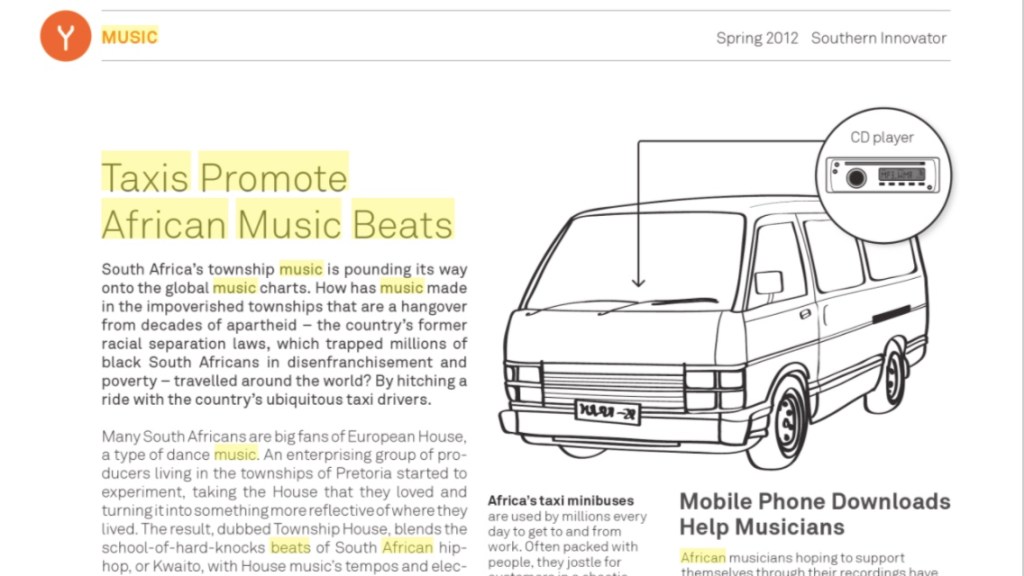
    Being from the townships meant the musicians behind Township House were frozen out of the mainstream music industry. And as every artist knows, if you can’t get heard, then your music will go nowhere. Rejected by radio stations and big record labels, they turned to an unlikely outlet: taxis, the ubiquitous small minibuses that are the only alternative form of transportation for people who do not have a car.

    They are heavily used: the University of Pretoria (www.web.up.ac.za) estimates between 5 and 10 million people use minibus taxis every day to get to work or get around.

    “In South Africa, the easiest way to the people is through the taxis,” musician DJ Qness told CNN.

    The vast network of taxis serving the country represent a captive audience of listeners. Many are simply bored as they endure lengthy commutes. The Township House producers handed out compact discs (CDs) of their tracks to taxi drivers to play. They soon had a hit on their hands. But without any presence in record stores people couldn’t buy the CDs they wanted. And a new source of income was born for taxi drivers: selling CDs from their taxi stands or roadside stalls.

    With appetites whetted for Township House, it started to outsell imported dance music.

    The biggest hit maker of this pioneering group was DJ Mujava, whose track Township Funk was a global dance club hit in 2008.

    “These people created a demand. The Mujava’s ‘Township Funk’ blew up on the streets and everything went crazy,” said Qness, who works for record label Sheer Music.

    After all this home-grown success, the record labels jumped in. DJ Mujava landed a record deal with the small label Sheer Music. But the township musicians were still just reaching a local audience. However, by putting together a low-budget video using township dancers, and by posting the video on the YouTube (www.youtube.com) video-sharing website, they attracted the attention of British record labels Warp Records and This is Music, who re-mixed the track for clubs.

    The model of using taxis as a music distribution vehicle has been copied by others. Pretoria’s Gospel Taxi Club uses the method to promote their religious music. Political parties are also using music CDs to get their message out.

    Other Pretorian township successes are making waves as well. They include Bojo Mujo and Tembisa Funk by McLloyd.

    “By combining the electronic sound from European House with the hard drum and the raw snare they’ve created something totally unique. You can’t find it anywhere in the world — only in South Africa,” said Qness.

    Published: June 2009

    Resources

    DJ Mujava: Listen to all of DJ Mujava’s tracks at his website. Website:www.myspace.com/mujavaDigiArts Africa: The DigiArts Africa network is a tool to find people working in Digital Arts in Africa and to provide a collaborative working space to promote digital arts in Africa. Website:http://portal.unesco.org/culture/en/ev.php-URL_ID=5346&URL_DO=DO_TOPIC&URL_SECTION=201.htmlAfrican Musicians Profiles: A lively website featuring profiles of African musicians by alphabetical listing and also reviews African films. Website: www.africanmusiciansprofiles.comRecording Industry of South Africa (RiSA): RiSA is the main body representing the South African recording industry. Website: www.risa.org.za 

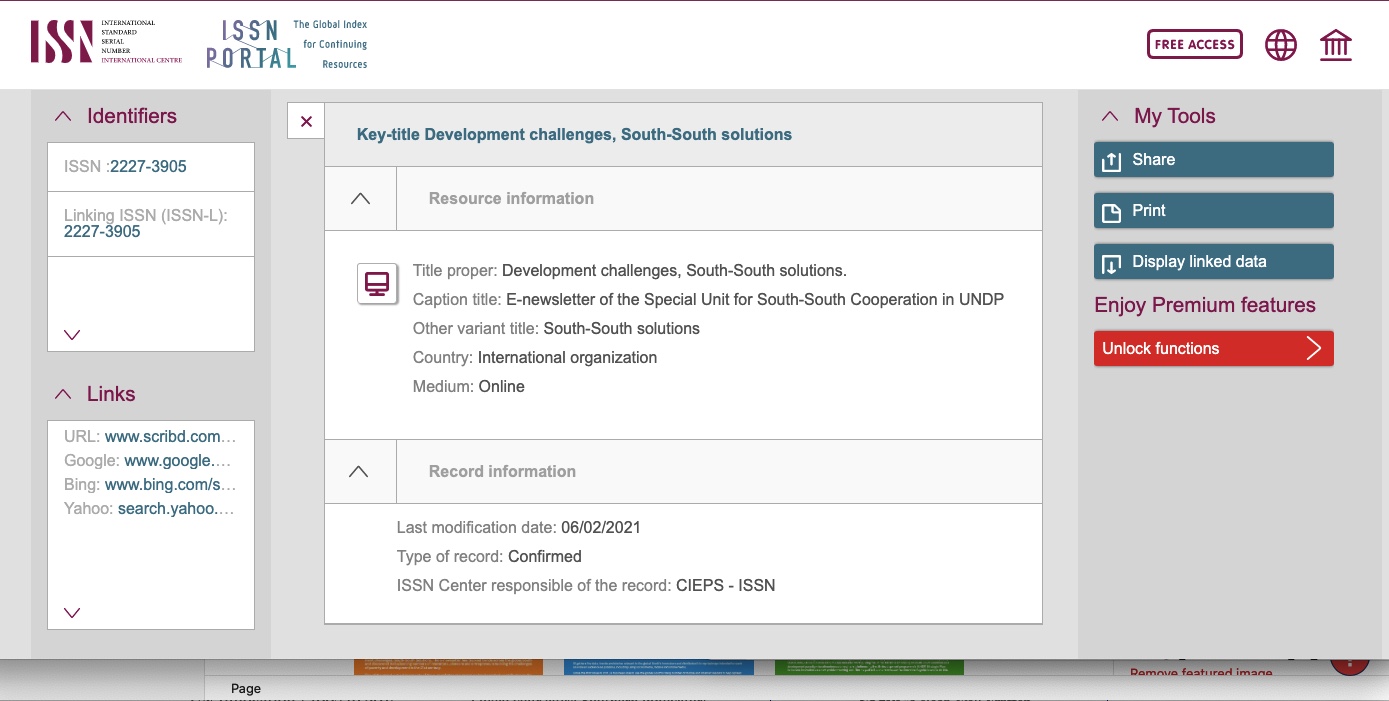
    ISSN Portal.
    Creative Commons License

    This work is licensed under a
    Creative Commons Attribution-Noncommercial-No Derivative Works 3.0 License.

    ORCID iD: https://orcid.org/0000-0001-5311-1052.

    © David South Consulting 2023

  • Mauritanian Music Shop Shares Songs and Friendship

    Mauritanian Music Shop Shares Songs and Friendship

    By David SouthDevelopment Challenges, South-South Solutions

    SOUTH-SOUTH CASE STUDY

    Around the world, traditional music stores selling vinyl records, tapes and CDs (compact discs) are closing down. Digital downloads distributed over the Internet and mobile phones make it unnecessary to build a music collection in these hard formats.

    While this has been a revolution that has made acquiring music as simple as firing up a digital download service like iTunes, it has many downsides as well. One of them has been the loss of vast swathes of musical history, as many songs recorded in the past have not made their way into digital downloads. And how can you find music online if you only remember part of a tune or song and can’t remember its title or the musician?

    The background and knowledge that was once imparted by an informed person in a music store has been lost in the world of digital downloads.

    A Mauritanian music shop is showing how a traditional record store can stay relevant and commercially viable in the 21st century. Entrepreneur Mohamed Vall’s Saphire d’Or store in Mauritania’s capital Nouakchott (http://en.wikipedia.org/wiki/Nouakchott), is a treasure trove of the sort of long-lost recorded songs that normally vex lovers of African music. Pictures of the shop can be seen at the sahelsounds blog (http://sahelsounds.com/?p=887).

    Vall has run the shop for three decades and amassed a large collection of rare African music on records and tapes. He has married this trove of African creativity to a clever business model: Vall doesn’t let customers buy the precious records themselves but instead will transfer the songs to a disc or a USB stick (http://en.wikipedia.org/wiki/USB_flash_drive) for US 30 cents each.

    He has also used traditional hospitality to create an atmosphere that encourages people to interact and keep coming back.

    “I have the biggest collection in Mauritania,” Vall told The Guardian newspaper. “Any music you want from Africa – I mean the kind of music that puts Africa on the map – I have it.”

    The shop is down an alleyway in the bustling capital and offers a refuge for music lovers.

    The atmosphere encourages friendly conversation and lets customers take their time making a selection. Customers can relax in armchairs while browsing and drink some traditional mint tea or enjoy a snack from a communal bowl.

    The shop uses traditional Mauritanian nomadic hospitality to improve the customer experience. It also uses the music it sells to heal rifts between the different cultures that cross Mauritania, as it bridges Arabic-speaking North Africa and the majority black sub-Saharan Africa.

    “When you are here, it doesn’t matter who you are,” Vall said. “We get youngsters wanting 1940s ballads and old people whose minds are musical museums. We get toubabs (white people) who heard one song decades ago.”

    One of the treasure troves held in the shop is the recordings made by West African orchestras during the post-colonial period.

    The shop also acts as an interactive museum and archive of many African musical greats, from Senegal’s Youssou N’Dour to Nigerian afrobeat pioneers, Guinean pop legends and Maliaian and Congolese musicians.

    Its collection ranges beyond Africa to take in musical genres from around the world, from blues to salsa to rock.

    “The music allows you to travel in your head,” said one customer, teacher Abdoul Kaba.”When I first came to Mauritania from Guinea, I went round and round looking for zouk (West African funk) music that everybody listens to in Guinea until I ended up here.”

    The shop also serves as a sanctuary for many from life’s everyday hardships.

    “It’s not about the music any more. People come back because in here you can be free. You can listen to music and forget this hard life,” Kaba said.

    Published: June 2012

    Resources 

    1) The African Music Encyclopedia: Search by alphabetical listing the continent’s musicians. Website: http://africanmusic.org/

    2) African Musicians Profiles: African Musicians Profiles (AMP) is a website for the promotion and publicity of African musicians. Each musician “has a profile, and there are pages on news of recent and future events, special features, recommended CDs, relevant reading (biographies, reference books and magazines) and photos”. Website: http://www.africanmusiciansprofiles.com/

    Creative Commons License

    This work is licensed under a
    Creative Commons Attribution-Noncommercial-No Derivative Works 3.0 License.

    ORCID iD: https://orcid.org/0000-0001-5311-1052.

    © David South Consulting 2023