Tag: development challenges south-south solutions

  • Better by Design in China

    Better by Design in China

    By David SouthDevelopment Challenges, South-South Solutions

    SOUTH-SOUTH CASE STUDY

    In recent decades, China has been known more for its inexpensive manufactured goods than as a producer of high quality products. But this is changing as the country seeks to move up the economic chain.

    China’s long-established design traditions were largely overlooked as the country made its breakneck push to become the world’s manufacturing powerhouse. But now Chinese manufacturers want to be known for high-quality designs and products rather than just for cheap-and-cheerful merchandise.

    China is a critical lesson for the rest of the global South, and offers much inspiration to any country trying to develop, modernize and eradicate poverty.

    The country is the main reason for the dramatic reductions in global extreme poverty rates, and it can be proud of using its average yearly economic growth rate of 10 per cent to lift 440 million Chinese out of poverty – the biggest reduction of poverty in history (The Economist). The strategy of exporting manufactured goods into Western markets at competitive prices has dominated the past 20 years.

    But China faces a dilemma as other nations in the global South are moving into this niche. It needs to quickly become a high-value nation, with unique products and designs generated in the country.

    Luckily, a renaissance in Chinese design in the last five years has been gradually grabbing the attention of the world’s creative community.

    Innovative Chinese designers are creating home furnishings and interiors that are being snapped up by European companies.

    The Italian kitchen utensil design company Alessi turned to eight Chinese architects – including Ma Yansong and Yung Ho Chang – to design a range of trays called (Un) Forbidden City. The architects’ designs were manufactured in Italy – a reversal of the pattern that has dominated for the past 20 years.

    The architects drew on Chinese traditions and 21st century technologies to design the trays. One was made using a 3D scanner which captured images used to make a mould.

    The drive to change and transform China’s global economic role was promoted in 2011’s Beijing International Design Week (http://www.bjdw.org/en/), with its theme of transforming “Made in China to Designed in China.”

    “When you have so much of a manufacturing base in one place, it’s natural that people start thinking about how to climb the value chain,” Philip Tinari, director of Beijing’s Ullens Centre for Contemporary Art (UCCA) (http://ucca.org.cn/) – a champion of new artists and designers – told howtospendit.com.

    “Chinese design has become something to rally around and, unlike art, enjoys great official support because it’s a way of improving China’s long-term economic position, as opposed to expressing thoughts about what’s been going on.”

    Other Chinese designers grabbing attention include Chen Xuan, who makes tables; chair-maker Gui Yang; Li Bowen, a maker of wicker chairs; and Ge Wei, a maker of jewellery boxes.

    Designer Huo Yijin makes contemporary tea trays, using heat-reactive lacquer coating to create dazzling effects.

    “Users can see the wonderful effect of water and temperature reacting on the tea trays when they drink Kungfu tea in the traditional way,” Huo explained.

    Jingdezhen, Jiangxi province – a city that has been making ceramics since the Ming Dynasty (1368–1644) – is now attracting craftspeople from around the world looking to tap into its expertise and skill. One attraction is Mr Yu’s Big Ware Factory. Its unparalleled ability to create giant-size pottery is a design niche with much potential.

    Many foreign creatives are being drawn to China for its can-do attitude and the ability to break with conventions stifling creativity in the West. The next five years could see the world’s design centre of gravity shift eastwards again.

    Published: November 2012

    Resources

    1) Ullens Centre for Contemporary Art (UCCA): The Ullens Center for Contemporary Art (UCCA) is a comprehensive, not-for-profit art center serving a global Beijing public. Website: http://ucca.org.cn/

    2) ChinaShijitanContemporaryArtCenter: A mixed-use art venue with experimental theatre, exhibition space, art gallery and production spaces. Website: http://www.ar-chiasmus.cn/project_6.html

    3) Pearl Lam Galleries: Pearl Lam Galleries lead a stable of International and Chinese artists who are multidisciplinary, refuting the hierarchy of art forms. The galleries do not follow the model of Western galleries; rather, they have evolved from the philosophy of Chinese Literati, which does not segregate between the different art disciplines. Website: http://pearllamgalleries.blogspot.co.uk/p/about.html

    4) School of Design of the China Central Academy of Fine Arts (CAFA): The Central Academy of Fine Arts, located in Beijing, the capital of China, is an academy where culture, history and art are flourishing, which enjoys the best art resources of the world. Website: http://www.cafa.edu.cn/aboutcafa/lan/?c=1101

    5) Beijing’s legendary 798 art district: “798” is located in the Dashanzi area, to the northeast of central Beijing. It is the site of state-owned factories including Factory 798, which originally produced electronics. Beginning in 2002, artists and cultural organizations began to divide, rent out, and re-make the factory spaces, gradually developing them into galleries, art centers, artists’ studios, design companies, restaurants, and bars. Website: http://www.798space.com/subpage_en.asp?classid=17

    https://davidsouthconsulting.org/2021/03/20/accessing-global-markets-via-design-solutions/

    https://davidsouthconsulting.org/2021/03/12/afro-coffee-blending-good-design-and-coffee/

    https://davidsouthconsulting.org/2021/02/20/baker-cookstoves-designing-for-the-african-customer/

    https://davidsouthconsulting.org/2021/08/29/brazilian-design-for-new-urban-middle-class-world/

    https://davidsouthconsulting.org/2022/10/04/the-brck-kenyan-developed-solution-to-boost-internet-access/

    https://davidsouthconsulting.org/2020/12/10/china-sets-sights-on-dominating-global-smartphone-market/

    https://davidsouthconsulting.org/2021/01/26/designed-in-china-to-rival-made-in-china/

    https://davidsouthconsulting.org/2021/06/11/indonesian-wooden-radio-succeeds-with-good-design/

    https://davidsouthconsulting.org/2022/10/04/popular-chinese-social-media-chase-new-markets/

    https://davidsouthconsulting.org/2021/10/04/putting-quality-and-design-at-the-centre-of-chinese-fashion/

    Creative Commons License

    This work is licensed under a
    Creative Commons Attribution-Noncommercial-No Derivative Works 3.0 License.

    ORCID iD: https://orcid.org/0000-0001-5311-1052.

    © David South Consulting 2023
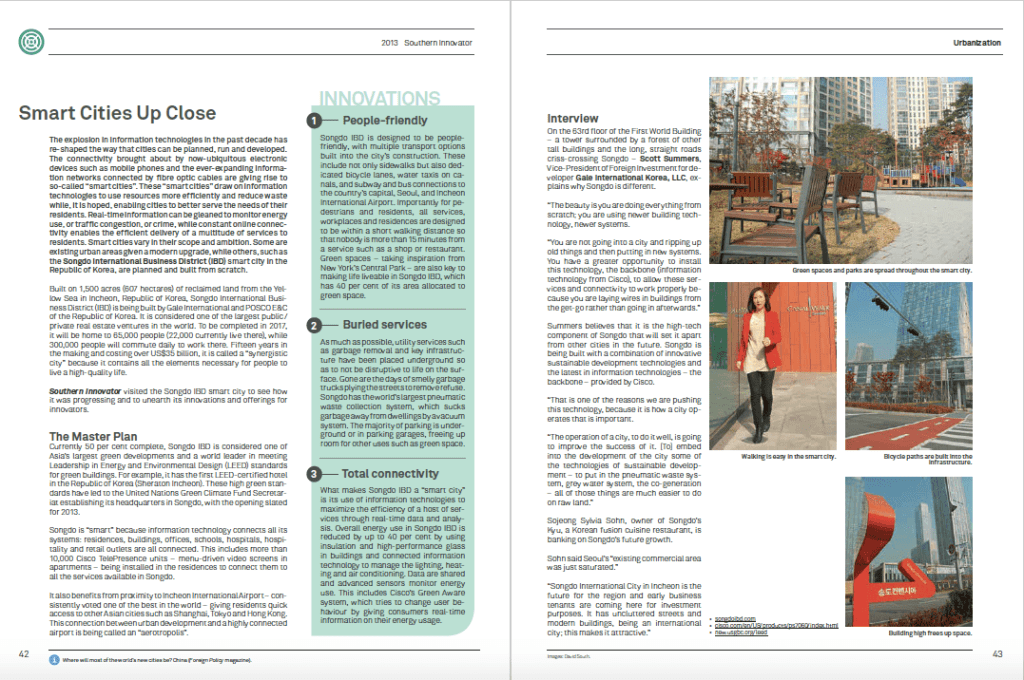
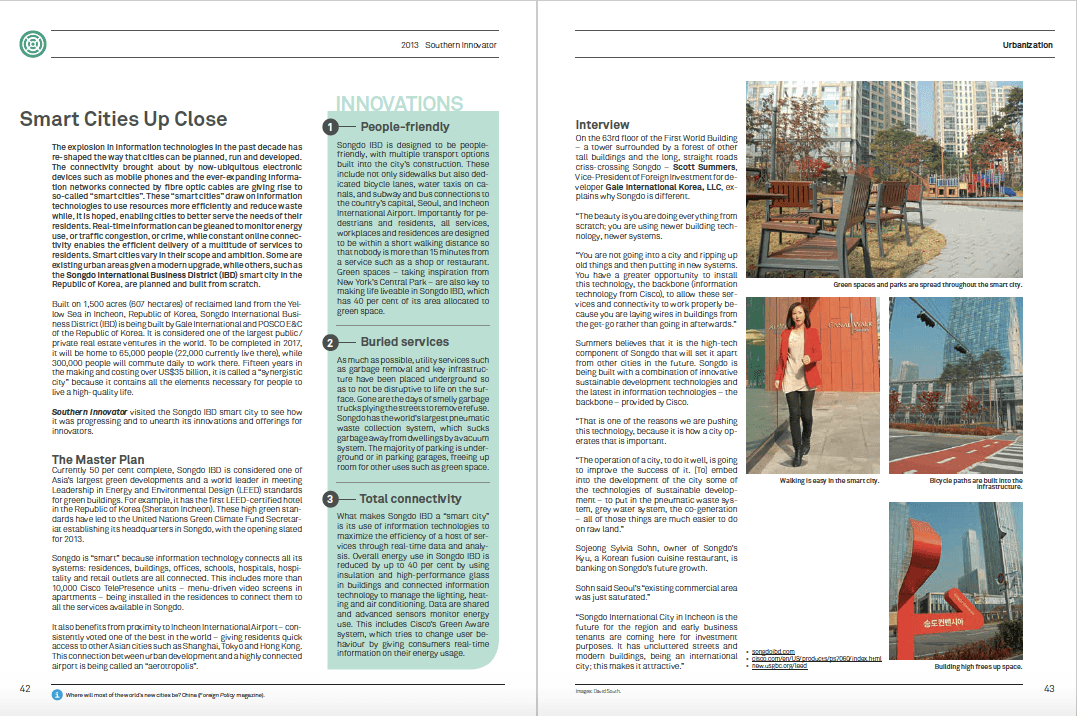
  • Global South’s Rising Megacities Challenge Idea of Urban Living

    Global South’s Rising Megacities Challenge Idea of Urban Living

    By David SouthDevelopment Challenges, South-South Solutions

    SOUTH-SOUTH CASE STUDY

    The world crossed the threshold from being a majority rural world to a majority urban one at the end of the first decade of the 21st century. The reason for this is the fast-growing urban areas of the global South. And this is having a profound affect on how the world’s people live.

    Across the global South, there are many examples of unchecked growth leading to squalor and poor housing conditions, and in turn to poor health and high rates of crime and disorder. Yet, the urbanization happening today across the global South is unprecedented for both its speed and its scale.

    And, unlike previous surges in urbanization, it is this quality that is far more challenging for governments and policymakers.

    Many countries and regions are experiencing highly stressed environmental conditions, with poor access to water and rising air pollution damaging human health, for example. But on the other side, there is also unprecedented change in technology and communications taking place. Every year, more and more of the world’s population gain access to 21st century communications such as smart phones and the Internet or ‘apps’ (applications), allowing the exchange of solutions and ideas at a rapid pace.

    Many are weighing up the benefits and downsides of such an urban, dense world. Denser cities make it easier and more efficient to deliver services, and proponents see a rapid rise in living standards in these megacities. Others see wide-scale poverty and vicious fights over resources in crime-ridden, unhealthy packed megacities. These pessimists point to current conditions in many megacities across the global South.

    No matter what perspective, many agree there has to be a cultural change in how people live and behave to make the megacities work.

    The contrasting approaches taken by two giants of the global South – India and China – provides lessons and ideas.

    The first big push from rural to urban took place in Europe in the 19th century. In 1800, just three per cent of the world’s population lived in cities. All the cities now seen as cosmopolitan hubs of economic and creative energy were just shadows of themselves prior to the 19th-century industrial revolution.

    Lessons were learned from hard experience and one of the most important lessons was this: if a city is to grow – and grow quickly – then it must plan for this growth and put the well-being of people at the centre of this plan. This is critical to ensure public health is improved and that the transition to more dense living conditions improves human well-being, rather than making it worse.

    A megacity is a city with a population greater than 10 million people (http://en.wikipedia.org/wiki/Megacity). The number of such cities will double over the next 10 to 20 years and many of these cities are in south and east Asia. By 2025, seven of the world’s top 10 megacities will be in Asia. Whole new cities are rising up that most people across the world have never heard about – yet.

    One of the most rapidly urbanizing countries in the world is China. At the beginning of 2012, Chinese authorities announced the country was now a majority urban place, with most citizens living in cities. This population of 690.79 million people outpaced the rural population of 656.56 million people.

    China is exploring a variety of solutions to making high-density city living work. Some of these solutions include creating multiplexes containing modern shopping, leisure, recreational and housing in one location. One example of this is The New Century Global Centre (http://cd.qq.com/a/20101018/000099.htm) in Chengdu, the capital of Sichuan. It is being called the world’s largest standalone complex. Chengdu is now a city of 14 million people and projected to be heading to 20 million people.

    It includes design by noted Iraqi architect Zaha Hadid (zaha-hadid.com).

    There are 1.5 million square metres of floor plans, two 1,000-room five-star hotels, an ice-skating rink, a 20,000 capacity marine park with 400 meters of artificial coastline and 5,000 square metres of artificial beach, including hot springs.

    In contrast, the more chaotic and unplanned approach taken in India – also a country experiencing rapid growth in its cities – has come under intense criticism. Dr Rumi Aijaz of the Delhi-based Observer Research Foundation (observerindia.com) told The Guardian that Indian infrastructure improvements will be difficult to achieve: “Our urban areas are in a raw form.

    All the basics are at a very low level. And the Indian state has been trying for a very long time to address this but a lack of capacity and endemic corruption has meant not much success.”

    In 2001, India had 290 million people living in cities. By 2008, this reached 340 million. It is predicted this will reach 590 million people – 40 per cent of the population – by 2030. McKinsey and Company (mckinsey.com) believe by 2030 India will have 68 cities of more than one million people, 13 will have four million people and six megacities will be greater than 10 million people.

    India faces an urban infrastructure crisis of epic proportions, McKinsey believes. Many millions will not have access to clean drinking water, adequate sewage, and will have to cope with poor transport.

    China, on the other hand, has invested seven times more in urban infrastructure than India. And one example of how this investment pays off is Chengdu.

    The fast-growing city of Chengdu’s mayor is trying to manage growth directly through the city’s policies. This involves managing the push and pull incentives driving people to cities and lifting the standard of living in the surrounding countryside.

    Chengdu’s mayor Ge Honglin told The Guardian: “The first thing I did was to improve the conditions – schools, shops, garbage collection, the sewage system. We had to cut the gap between rural and urban areas. If people could have a brighter future in the countryside, they’d stay there. So we’re not seeing people swarm into the city= Instead there are people in the city considering moving to the country.”

    “Chengdu is the only super-large central city that has narrowed the urbanrural income gap alongside rapid economic growth in China,” Ge said.

    Hundreds of schools have been built surrounding Chengdu and partnerships made between rural and urban schools to help raise standards.

    Chengdu is also pioneering new ways to address urban squalor with new information technologies. Patrols use mobile phones and cameras to document broken infrastructure and health and safety problems, and to locate and assist the homeless.

    “You can barely see a begger in Chengdu,” said Gu. “We have a special system for monitoring them, and it works. Beggars are taken to the assistance centre, where they are given food and shelter and money to take them back to their home. If I say there are no more than 10 beggars on the street you will think there’s some sort of tyranny, but there isn’t. We’re trying to solve their problems.”

    Published: May 2012

    Resources

    1) Endless City and Living in the Endless City: LSE Cities is an international centre at the London School of Economics and Political Science that carries out research, education and outreach activities in London and abroad. Its mission is to study how people and cities interact in a rapidly urbanizing world, focussing on how the design of cities impacts on society, culture and the environment. Website: http://lsecities.net/publications/books/the-endless-city/

    2) Planet of Slums by Mike Davis: According to the United Nations, more than one billion people now live in the slums of the cities of the South. Mike Davis explores the future of a radically unequal and explosively unstable urban world. Website: http://books.google.co.uk/books/about/Planet_Of_Slums.html?id=FToaDLPB2jAC

    3) An infographic from The Guardian newspaper showing the rise of the megacity in world history. Website: http://image.guardian.co.uk/sysimages/Observer/Pix/pictures/2012/01/21/urban2.jpg

    4) Arrival City by Doug Saunders: A third of humanity is on the move. History’s largest migration is creating new urban spaces that are this century’s focal points of conflict and change — unseen districts of rapid transformation and febrile activity that will reshape our cities and reconfigure our economies.Website: http://arrivalcity.net/

    5) Global Urbanist: The Global Urbanist is an online magazine reviewing urban affairs and urban development issues in cities throughout the developed and developing world. Website: http://globalurbanist.com/

    6) The Spirit of Cities: Why the Identity of a City Matters in a Global Age by Daniel A. Bell and Avner de-Shalit. Website: amazon.com

    7) Rise of the Asian Megacity: Website: http://www.bbc.co.uk/news/worldasia-pacific-13800944

    8) Capitals of the Connected World: Mapping the New Global Power Structure. Website: http://www.theatlantic.com/special-report/capitalsconnected-world/

    Creative Commons License

    This work is licensed under a
    Creative Commons Attribution-Noncommercial-No Derivative Works 3.0 License.

    ORCID iD: https://orcid.org/0000-0001-5311-1052.

    © David South Consulting 2023
  • Energy-Efficient Wooden Houses are also Earthquake Safe

    Energy-Efficient Wooden Houses are also Earthquake Safe

    By David SouthDevelopment Challenges, South-South Solutions

    SOUTH-SOUTH CASE STUDY

    In Argentina, an innovative housing project has married good design with energy efficiency, earthquake resilience and the use of local materials and labour. As energy resources continue to be stretched around the global South, innovative building designs will be critical to the creation of sustainable housing for the future.

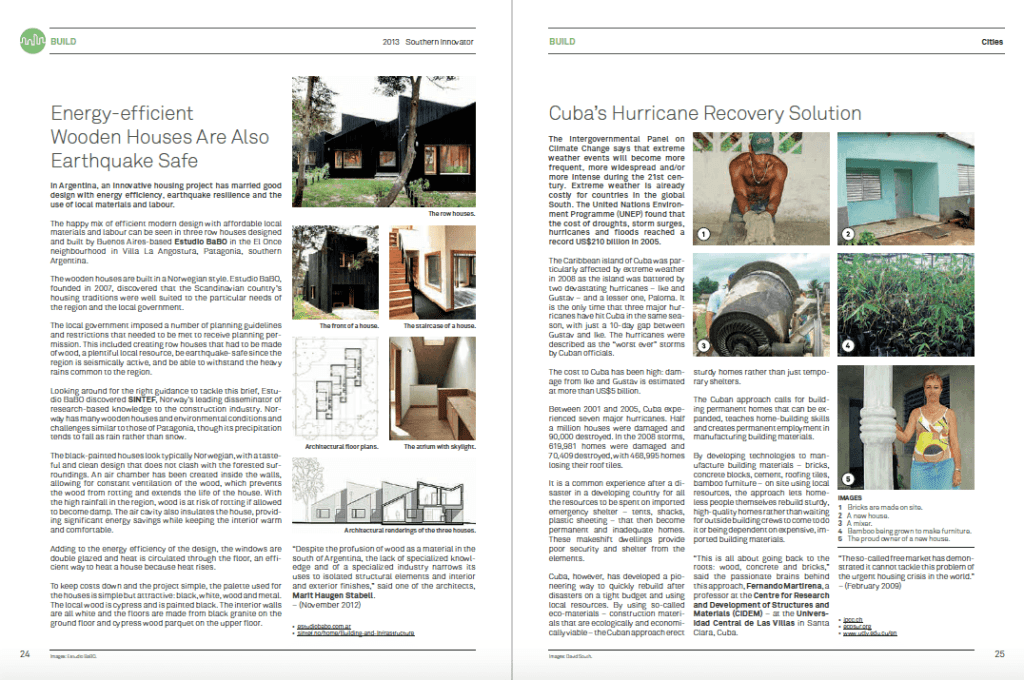
    The happy mix of efficient modern design with affordable local materials and labour can be seen in three row houses designed and built by Buenos Aires-based Estudio BaBO (estudiobabo.com.ar) in the El Once neighbourhood in Villa La Angostura, Patagonia, southern Argentina.

    The wooden houses are built in a Norwegian style. Estudio BaBO, founded in 2007, discovered that the Scandinavian nation’s housing traditions were well suited to the particular needs of the region and the local government.

    The local government imposed a number of planning guidelines and restrictions that needed to be met to receive planning permission. This included creating row houses which must be made of wood – a plentiful local resource. They also had to be earthquake-safe since the region is seismically active and be able to withstand the heavy rains common to the region.

    Looking around for the right guidance to tackle this brief, Estudio BaBO discovered SINTEF – Norway’s leading disseminator of research-based knowledge to the construction industry (http://www.sintef.no/home/Building-and-Infrastructure/). The Nordic nation has many wooden homes and also has similar environmental conditions and challenges to Patagonia – though its precipitation tends to fall as rain, rather than snow.

    The black-painted homes look typically Norwegian, with a tasteful and clean design that does not clash with the forested surroundings. An air chamber has been created inside the homes’ walls allowing for constant ventilation of the wood, which prevents the wood from rotting and extends the life of the house. With the high rainfall of the region, wood is at risk of rotting if allowed to become damp. The air cavity also insulates the house, providing significant energy savings while keeping the interior warm and comfortable.

    Adding to the energy efficiency of the design, the windows are double glazed and heat is also circulated through the floor – an efficient way to heat a home because heat rises.

    To keep costs down and the project simple, the palette used for the homes is simple but attractive: black, white, wood and metal. The local wood is cypress and is painted black. The interior walls are all white and the floors are made from black granite on the ground floor and cypress wood parquet on the upper floor. The rest of the woodwork in the house is also made of cypress.

    Using locally sourced materials also helps to keep costs down.

    The project was initially conceived in 2009 and the houses were built in 2010-2011. While wood is plentiful in Patagonia, traditionally the use of wood in construction was rudimentary and local labour skill levels were low. This meant the design had to be simple and easy to build.

    “Despite the profusion of wood as a material in the south of Argentina, the lack of specialized knowledge and of a specialized industry narrow its uses to isolated structural elements and interior and exterior finishes,” said one of the architects, Marit Haugen Stabell.

    The three units of two-storey row houses each come with a living room, dining room, kitchen, toilet, two bedrooms and a laundry room. Each home also has an outdoor patio. The homes are designed to receive maximum natural light. Deploying this energy efficient design is considered unusual for Argentina and Estudio BaBO has set a new standard for sustainable housing in the country.

    It looks like the CLF Houses could inspire others to look again at wood as a building material.

    Published: November 2012

    Resources

    1) A story on how researchers are perfecting wooden home designs to withstand heavy earthquakes. Website:http://inhabitat.com/wooden-house-can-withstand-severe-earthquakes/

    2) A website packed with photographs of wooden and other houses for inspiration and lesson learning. Website:http://www.trendir.com/house-design/wood_homes/

    3) A step by step slideshow on how a Norwegian wooden house was re-built. Website:http://www.dwell.com/articles/norwegian-wood.html

    4) Inspirational wooden home decorating ideas from across Scandinavia. Website:http://myscandinavianhome.blogspot.cz/

    https://davidsouthconsulting.org/2022/10/19/chinese-building-solution-for-rapidly-urbanizing-global-south/

    https://davidsouthconsulting.org/2021/09/01/disaster-recovery-ten-years-after-the-gujarat-india-experience/

    https://davidsouthconsulting.org/2021/09/01/haiti-earthquake-prompts-tech-aid/

    https://davidsouthconsulting.org/2017/10/27/information-accelerates-crisis-recovery-and-development-1997/

    https://davidsouthconsulting.org/2021/02/12/rebuilding-after-chinese-earthquake-beautiful-bamboo-homes/

    https://davidsouthconsulting.org/2021/02/23/southern-innovator-in-southasiadisasters-net/

    https://davidsouthconsulting.org/2022/09/26/3d-home-printing-landmark-10-houses-in-a-day/

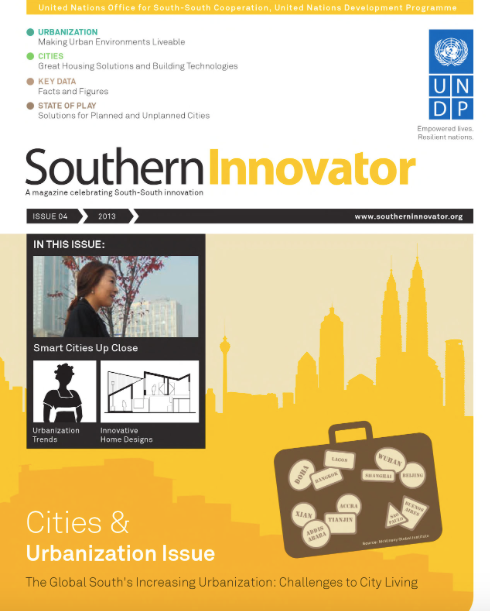
    https://davidsouthconsulting.org/2021/03/05/southern-innovator-issue-4/

    Development Challenges, South-South Solutions was launched as an e-newsletter in 2006 by UNDP’s South-South Cooperation Unit (now the United Nations Office for South-South Cooperation) based in New York, USA. It led on profiling the rise of the global South as an economic powerhouse and was one of the first regular publications to champion the global South’s innovators, entrepreneurs, and pioneers. It tracked the key trends that are now so profoundly reshaping how development is seen and done. This includes the rapid take-up of mobile phones and information technology in the global South (as profiled in the first issue of magazine Southern Innovator), the move to becoming a majority urban world, a growing global innovator culture, and the plethora of solutions being developed in the global South to tackle its problems and improve living conditions and boost human development. The success of the e-newsletter led to the launch of the magazine Southern Innovator.

    Creative Commons License

    This work is licensed under a
    Creative Commons Attribution-Noncommercial-No Derivative Works 3.0 License.

    ORCID iD: https://orcid.org/0000-0001-5311-1052.

    © David South Consulting 2023

  • Housing Solution for World’s Growing Urban Population

    Housing Solution for World’s Growing Urban Population

    By David SouthDevelopment Challenges, South-South Solutions

    SOUTH-SOUTH CASE STUDY

    Across the South, cities are expanding and urban populations growing at a phenomenal rate — the cities of Africa and Asia are growing by a million people a week. Megacities and sprawling slums will be the hallmarks of this majority urban world. In sub-Saharan Africa, 72 percent of the population already lives in slum conditions.

    How people will be housed is an urgent problem. There are many ways to build a dwelling, from scavenged materials, to labour-intensive and expensive custom-built construction, yet affordable and safe construction techniques for the poor are sorely needed.

    The danger of building unsafe housing can be seen in the recent devastating earthquake in Haiti, where many buildings collapsed, killing an estimated 212,000 people. If the rapid growth in urban populations is to be safe and sustainable, then new dwellings will need to be built that meet high standards of durability.

    In South Africa, one company believes it has the right technology for an age of rapid urban population growth and the need for quick and safe housing construction.

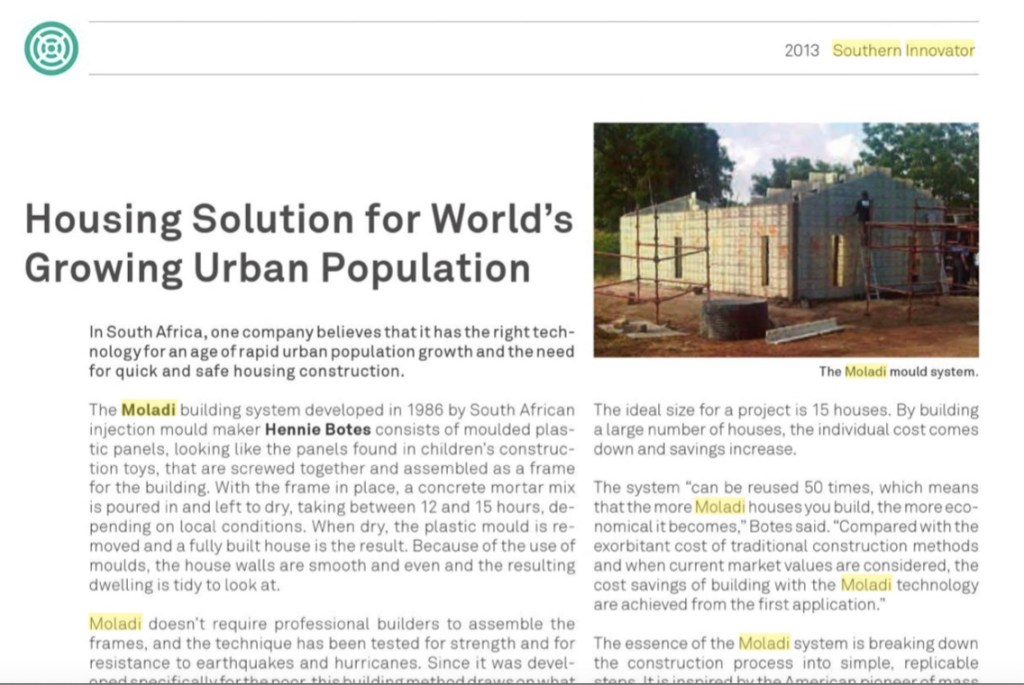
    The Moladi building system (http://moladi.com/) (http://www.moladi.net/default.aspx?AspxAutoDetectCookieSupport=1) developed in 1986 by South African injection mold maker Hennie Botes consists of molded plastic panels, looking like the panels found in children’s construction toys that are screwed together and assembled as a frame for the building. With the frame in place, a concrete mortar mix is poured in and left to dry: depending on local conditions, taking between 12 and 15 hours. When dry, the plastic mold is removed and a fully built house is the result. Because of the use of molds, the home’s walls are smooth and even and the resulting home is tidy to look at.

    Moladi doesn’t require professional builders to assemble the frames, and the technique has been tested for strength and for resistance to earthquakes and hurricanes. Since it was developed specifically for the poor, this building method draws on what is called ‘sweat equity’: often the only asset a poor person has to contribute to the cost of building a home is their free labour.

    Because the dimensions of the home have already been established when the plastic frames were molded, common on-site mistakes are avoided.

    Moladi benefits from South Africa’s Black Economic Empowerment programme (http://www.southafrica.info/business/trends/empowerment/bee.htm) and is certified for its quality with the South African Bureau of Standards (SABS) (https://www.sabs.co.za/). Moladi contractors and developers are working in 15 countries and the technique is distributed in a further seven countries.

    The Moladi construction technique was born of frustration with the traditional approach of laying one brick on top of another. This traditional construction method, dating back thousands of years, just doesn’t match the needs of our times. It is slow and requires highly skilled bricklayers to be done right. Across the developing world, it is possible to see poorly constructed brick dwellings – often built unevenly with poor quality mortar holding the bricks together – that are unsafe in an earthquake.

    Training in the Moladi technique takes from one to two weeks for unskilled workers depending on the size of the home. Moladi provides handbooks and all the necessary resources to complete the project. Each project has its own custom-built plastic frames made based on the home’s design.

    “There is no flat fee for on-site training; the client is only responsible for covering the travel and living expenses for the Moladi representative or training foreman,” said Hennie Botes.

    The ideal size for a project is 15 homes. By building a large number of homes, the individual cost comes down and savings increase.

    The system “can be reused 50 times, which means that the more Moladi houses you build, the more economical it becomes,” Botes said. “Compared with the exorbitant cost of traditional construction methods and when current market values are considered, the cost savings of building with the Moladi technology are achieved from the first application.”

    As the world’s cities grow, and slums become larger and more prevalent, the urgent need for affordable and decent housing will go hand-in-hand with a need for jobs — particularly jobs for unskilled workers. There just won’t be enough skilled workers to go around to build the homes. Even in developed countries, this has become a problem.

    “The recent earthquake disaster in Haiti could benefit from the Moladi system,” Botes said. “Job creation for Haitians is desperately needed and Moladi can immediately facilitate an income for family groups, as over 95 percent of the construction team consists of unskilled labourers. There is no requirement for heavy machinery, or even electricity, and remote areas can be easily accessed; Moladi also allows for the utilisation of building rubble resulting from the earthquake in the construction of new buildings.”

    The essence of the Moladi system is breaking down the construction process into simple, replicable steps. It is inspired by the American pioneer of mass production, car maker Henry Ford (http://en.wikipedia.org/wiki/Henry_Ford), who achieved efficiency and low costs in production by simplifying production into standardized and modulated steps.

    “The Moladi construction process should be viewed as a workflow process similar to that of a vehicle assembly line,” Botes said. “Through the simplification, standardization, modularization, and industrialization of the construction process, efficiency and cost savings are achieved and maintained by managing the continuous flow process on site.

    “Contractors must make sure that they have planned their project roll-out and budget well and have clearly defined goals as to what they want to achieve. It is very important to have all team players and professionals on the same page with regards to their roles and responsibilities.”

    In the beginning, Botes encountered resistance to his innovative production methods. “I was highly motivated and really believed in my idea, but when I presented it to investors, they’d shoot holes in it. … It’s been a 22-year journey, but I always kept the goal in mind. Moses spent 40 years in the desert … I’m quite happy my desert experience was only 20-odd years, though,” he told Men’s Health magazine.

    South Africa is facing a population growth rate of 1.73 percent a year (UNICEF). It also has 61 percent of the urban population trying to live on four percent of the land, according to Botes. This urban population grows at 2.7 percent a year, yet existing housing needs are not being met. There is already a backlog of 2.2 million homes needed to be built, and this grows by 180,000 every year, according to the Banking Association of South Africa (http://www.banking.org.za/default.aspx).

    “Even though the need for housing has always been a fundamental requirement to sustain one’s health and welfare, the advances in this area have been seriously lacking,” said Botes. “The brick and mortar method of construction was recorded as early as 1458 B.C, which means that very little has changed in terms of building structures over a period of almost 3.5 millennia.

    “We cannot expect to resolve the housing crisis in our age with a technique developed for the requirements of society 3468 years ago.”

    With the success of the Moladi building system, Hennie is working on “producing windows, doors, toilet seats, window frames, sinks and washbasins. If I can include these as part of my product, I’ll reduce the total unit cost of the house.”

    Published: February 2010

    Resources

    1) Cradle to Cradle: Remaking the Way We Make Things: This radical concept is about how products, can be used, recycled, and used again without losing any material quality—in cradle to cradle cycles. Website:http://www.mcdonough.com/cradle_to_cradle.htm

    2) Builders Without Borders: Is an international network of ecological builders who advocate the use of straw, earth and other local, affordable materials in construction. Website:http://builderswithoutborders.org/

    3) World Hands Project: An NGO specialising in simple building techniques for the poor. Website:http://www.worldhandsproject.org

    4) CIDEM and Ecosur specialise in building low-cost community housing using eco-materials. They have projects around the world and are based in Cuba. Website:http://www.ecosur.org

    5) The Rural Development Institute focuses on land rights for the poor and has a series of articles on China’s land reforms. Website: http://www.rdiland.org

    6) More Urban, Less Poor: The first textbook to explore urban development and management and challenge the notion unplanned shanty towns without basic services are the inevitable consequence of urbanization. Website:http://www.earthscan.co.uk/

    7) Building and Social Housing Foundation: The Building and Social Housing Foundation (BSHF) is an independent research organisation that promotes sustainable development and innovation in housing through collaborative research and knowledge transfer. Website: http://www.bshf.org/

    https://davidsouthconsulting.org/2022/05/23/debt-free-homes-for-the-poor/

    https://davidsouthconsulting.org/2021/11/11/decent-and-affordable-housing-for-the-poor/

    https://davidsouthconsulting.org/2022/11/16/housing-innovation-in-souths-urban-areas/

    https://davidsouthconsulting.org/2021/02/12/rammed-earth-houses-china-shows-how-to-improve-and-respect-traditional-homes/

    https://davidsouthconsulting.org/2021/02/12/rebuilding-after-chinese-earthquake-beautiful-bamboo-homes/

    https://davidsouthconsulting.org/2022/11/19/securing-land-rights-for-the-poor-now-reaping-rewards/

    https://davidsouthconsulting.org/2022/05/23/solar-bottle-bulbs-light-up-dark-homes/

    https://davidsouthconsulting.org/2022/11/17/tiny-homes-to-meet-global-housing-crisis/

    https://davidsouthconsulting.org/2021/03/05/southern-innovator-issue-4/

    Creative Commons License

    This work is licensed under a
    Creative Commons Attribution-Noncommercial-No Derivative Works 3.0 License.

    ORCID iD: https://orcid.org/0000-0001-5311-1052.

    © David South Consulting 2023