Tag: development challenges south-south solutions

  • Djibouti Re-shapes Itself as African Trade Hub

    Djibouti Re-shapes Itself as African Trade Hub

    By David SouthDevelopment Challenges, South-South Solutions

    SOUTH-SOUTH CASE STUDY

    Trade hubs can prove to be decisive in boosting regional growth. Trade hubs are places where commerce congregates, for a mix of geographical, cultural and economic reasons. Like a bicycle wheel, a trade hub sits at the centre as the spokes of trade routes travel towards it. Throughout history, trade hubs have emerged, from the outposts of the Silk Route running through Asia and Central Asia to the Hanseatic League cities of Northern Europe in the Middle Ages.

    Trade is critical to increasing prosperity, and the more efficient trade becomes – and the greater the variety of goods and affordable prices – the higher the standard of living for the nations doing the trading.

    With South-South trade the great economic success story of the past decade, new trade hubs are emerging. World Trade Organization (WTO) (www.wto.org) figures show South-South trade accounted for 16.4 percent of the US $14 trillion in total world exports in 2007, up from 11.5 percent in 2000. While the global economic crisis has slowed things down, the overall trend is firmly established.

    One country hoping to become a key 21st century trade hub is the tiny African nation of Djibouti, which sits strategically between the Red Sea and the Gulf of Aden. It is surrounded by the nations of Eritrea, Ethiopia and Somalia and is across the Bab al Mandab Strait from Yemen.

    It is at the nexus of Africa and Asia. Some of the busiest shipping lanes in the world float by the country’s coastline. Much of the oil shipped to Europe and the United States passes by.

    “Djibouti is perfectly positioned to become a services and logistics hub,” said Jerome Martins Oliveira, chief executive officer of Djibouti port, operated by a subsidiary of Dubai World.

    PwC (PriceWaterhouseCoopers) (http://www.pwc.co.uk), which recently published its third Transportation & Logistics 2030 Report, predicts that global trade hubs and routes will shift to emerging markets within the next 20 years.

    “Trade volumes will move towards emerging markets such as Africa or Asia and competition for future large transport contracts will be determined within the next few years,” said Akhter Moosa, PwC’s South African Transport and Logistics Leader.

    This underscores the growing importance of emerging markets. The majority of global trade is forecast to shift to emerging markets by 2030. As the trade shifts, so new trade routes emerge. PwC sees strong links between Asia and Africa and Asia and South America, as well as trade within Asia, transforming global supply chains.

    Hot spots for trade are showing impressive growth. Trade between Asia and the former Soviet states grows at 42 percent a year. The volume of trade between South America and Africa is growing by double digits.

    “China already owns seven of the world’s twenty largest ports,” said Christopher Siewierski, associate director in Corporate Finance at PwC. “India, Russia and South Africa are also expected to play a significant role as logistics giants.”

    Respondents to the Transportation & Logistics 2030 Report
    (http://www.pwc.com/gx/en/transportation-logistics/tl2030/tl2030-pub.jhtml ) believe it is unlikely that companies from emerging countries will seek further growth in the developed European and North American markets. Instead, they will concentrate on domestic markets and the strong growing neighbouring countries.

    All of this is good news for Djibouti. At present, the population of Djibouti
    (http://en.wikipedia.org/wiki/Djibouti) is small at around 864,202 people (2009 World Bank).

    Ancient Djibouti traded hides and skins for the perfumes of Egypt, India and China: a classic South-South trade heritage. Djibouti became a French colony and gained its independence from France in 1977.

    The geography is harsh: a rocky semi desert of plateaus and highlands. Djibouti has few resources, apart from its large salt reserves – the country has a long history of salt mining. Djibouti must depend on foreign assistance – or innovative trade.

    Djibouti has to be clever in increasing income opportunities: the country has an estimated unemployment rate of between 40 and 50 percent. The country is heavily dependent on imports for food and fuel, and over the past decade has experienced recession – in the wake of a 1991 to 1994 civil war – and a growing population.

    For years, the tiny state was overlooked and development had proceeded at a slow pace. But now investment from Dubai is pouring in to upgrade the port to make it a regional gateway.

    The Djibouti Free Zone (http://www.djiboutifz.com/) was set up in the wake of the country being designated a free-export processing zone in 1995. In practice, this means a company or business working to export products can be designated as an Export Processing Company (EPC).

    It was created to re-shape the landscape in Africa when it comes to trade. Push out the red tape, and bring efficiency and plenty of services: the prime habitat for business to flourish free of restrictions. Prospective businesses can find modern offices, distribution, storage and light manufacturing facilities.

    Djibouti provides services as both a transit port for the region and an international trans shipment and refuelling center.

    And even more ambitious plans are afoot: a multi-billion dollar, 29-kilometre bridge across the Red Sea has been proposed. The Bridge of the Horns (http://en.wikipedia.org/wiki/Bridge_of_the_Horns) will link Djibouti with Yemen and two new cities will be built on either side of the bridge. The new Noor City on the Djibouti side will become the “financial, educational, and medical hub of Africa” according to its developers.

    Elsewhere, the United States is funding and operating four regional trade and competiveness hubs in sub-Saharan Africa. They aim to assist, enhance and broaden the flow of trade between the United States and the region, both inside and outside the terms of the historic African Growth and Opportunity Act (AGOA) (http://www.agoa.gov/). The four trade hubs — located in Ghana, Senegal, Botswana and Kenya — provide information and technical expertise to enhance and expand bilateral trade between the United States and Africa.

    Published: December 2010

    Resources

    • Port Management Association of Eastern and Southern Africa: Is a regional organisation for the ports and maritime sector in Eastern and Southern Africa. It seeks to promote and nurture best practices among member ports by creating an enabling environment for exchange of information and capacity building to contribute to the economic development of the region. Website: http://www.pmaesa.org/welcome.htm
    • Dubai World: Global holding company Dubai World “focuses on the strategic growth areas of Transport & Logistics, Drydocks & Maritime, Urban Development, Investment & Financial Services. Our portfolio contains some of the world’s leading companies in their industries, including Drydocks World, Economic Zones World, Istithmar World, Nakheel and majority ownership of DP World.” Website: http://www.dubaiworld.ae/
    • A Financial Times report on Africa-China trade in 2010. Website: http://www.ft.com/reports/africa-china-trade-2010
    • West Africa Trade Hub: The USAID West Africa Trade Hub uses a market-driven approach to increase exports from the region – making West Africa competitive in world markets. The Trade Hub provides direct assistance to hundreds of companies in six value chains. That work is complemented by teams tackling problems in transportation, telecommunications, access to finance and business environment that make it difficult for West African companies to compete. Website: http://www.watradehub.com/
    • Biz Community.com: Africa’s Leading Daily Retail News: Where the action is on Africa’s fast-growing retail markets. Website: http://www.bizcommunity.com/196/160.html
    Creative Commons License

    This work is licensed under a
    Creative Commons Attribution-Noncommercial-No Derivative Works 3.0 License.

    ORCID iD: https://orcid.org/0000-0001-5311-1052.

    © David South Consulting 2023

  • Technological Innovation Alive in Brazil

    Technological Innovation Alive in Brazil

    By David SouthDevelopment Challenges, South-South Solutions

    SOUTH-SOUTH CASE STUDY

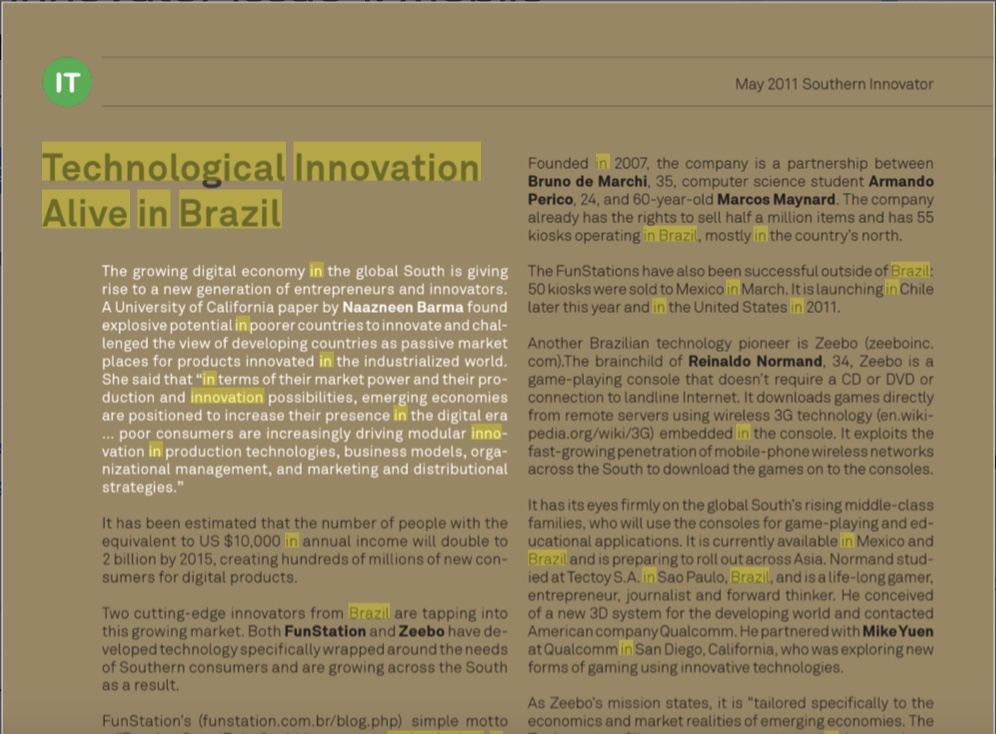
    The growing digital economy in the global South is giving rise to a new generation of entrepreneurs and innovators.

    A University of California paper by Naazneen Barma found explosive potential in poorer countries to innovate, and challenged the view of developing countries as passive market places for products innovated in the industrialized world. She said that “in terms of their market power and their production and innovation possibilities, emerging economies are positioned to increase their presence in the digital era … poor consumers are increasingly driving modular innovation in production technologies, business models, organizational management, and marketing and distributional strategies.”

    It has been estimated that the number of people with equivalent to US $10,000 in annual income will double to 2 billion by 2015, creating hundreds of millions of new consumers for digital products.

    Two cutting-edge innovators from Brazil are tapping into this growing market. Both FunStation and Zeebo have developed technology specifically wrapped around the needs of Southern consumers and are growing across the South as a result.

    FunStation’s (http://www.funstation.com.br/blog.php)simple motto – “Touch – Get – Enjoy” – hides a savvy technological innovation aimed at the growing army of digital downloaders on the march across the South. Sao Paulo’s FunStation entertainment kiosk system serves up video, audiobooks, songs, and ringtones to mobile phones and MP3 (http://en.wikipedia.org/wiki/MP3) players. Customers just need to plug into one of the large futuristic white kiosks, scroll through the choices, select what they want, pay and download. By going to the kiosk, customers avoid the need to download from the internet, which can take a lot of time depending on the connection and bandwidth. The kiosk is speedy, with 14 musical tracks downloaded to a device in 10 seconds.

    Apart from the convenience and speed of the kiosks, they also have other benefits: customers do not need to register with a download site like iTunes on the internet. This means they do not have to run the risks of giving away bank details or other personal information.

    Customers buy something called a Funcard which is similar to a pre-pay phone plastic phone card, with a PIN number. Cards are sold with values ranging from US $2 to US $50. The user just punches the number into the kiosk to pay for the download.

    The kiosks are being located in high-traffic places like festivals, airports, universities, retail shopping centres and transport systems.

    Founded in 2007, the company is a partnership between Bruno de Marchi, 35, computer science student Armando Perico, 24, and 60-year-old Marcos Maynard. The company already has the rights to sell half a million items and has 55 kiosks operating in Brazil, mostly in the country’s north. “People are poorer in those places,”de Marchi told Monocle magazine. “Usually they have an MP3 player but no computer.”

    The FunStations have also been successful outside of Brazil: 50 kiosks were sold to Mexico in March. It is launching in Chile later this year and in the United States in 2011. Always evolving, the business is also working with the University of Lugano in Switzerland to develop new software and keep the kiosks fresh and lively.

    Another Brazilian technology pioneer is Zeebo (http://www.zeeboinc.com). The brainchild of Reinaldo Normand, 34, Zeebo is a game-playing console that doesn’t require a CD or DVD, or connection to landline internet. It downloads games directly from remote servers using wireless 3G technology (http://en.wikipedia.org/wiki/3G)embedded in the console. It exploits the fast-growing penetration of mobile phone wireless networks across the South to download the games on the consoles.

    It has its eyes firmly on the global South’s rising middle-class families, who will use the consoles for game-playing and educational applications. It is currently available in Mexico and Brazil and is preparing to roll out across Asia. Normand studied at Tectoy S.A. in Sao Paulo, Brazil, and is a life-long gamer, entrepreneur, journalist and forward thinker. He conceived of a new 3D system for the developing world and contacted American company Qualcomm. He partnered with Mike Yuen at Qualcomm in San Diego, California, who was exploring new forms of gaming using innovative technologies.

    As Zeebo’s mission states, it is “tailored specifically to the economics and market realities of emerging economies. The Zeebo system fills an enormous unmet need in these regions. At the same time it opens an immense new market for interactive content and products.”

    Normand is ambitious and wants to reach a vast market of 340 million Chinese families. “By 2011, I want to close deals in China to manufacture televisions with this technology built in, therefore entering the homes of millions of families,” he told Monocle.

    Zeebo makes some games for the console and also buys in other games from big-name game makers like Electronic Arts and Activision. The games are downloaded from the internet using a 3G mobile chip already built in to the consoles. The games are priced between US $5 and US $13.

    The Zeebo system will roll out to China, the US and India in 2011, and Eastern Europe in 2012.

    Published: August 2010

    Resources

    • Afrinnovator: Is about telling the stories of African start-ups, African innovation, African made technology, African tech entrepreneurship and entrepreneurs. Their mission is to ‘Put Africa on the Map’ by covering these kinds of stories from all over Africa. As their website says, “if we don’t tell our own story, who will tell it for us?” Website: http://afrinnovator.com
    • AfricaUnsigned: This African alternative way of producing African music started this year. Unsigned artists record their music, funded by fans. Music fans from all over the world listen to the selection of artists, pick their favorite(s) and chip in a minimum of $1 dollar to the recording of a professional EP. The music is then distributed to the fans who backed the artist and sold on all major online stores (incl. Amazon & iTunes). Website: www.AfricaUnsigned.com
    • TechMasai: Pan-African start-up news and reviews. Website: www.techmasai.com
    • The Emerging Economies in the Digital Era: Market Places, Market Players, and Market Makers by Naazneen Barma, University of California. Website: http://tinyurl.com/3xjf2ps

    https://davidsouthconsulting.org/2022/02/17/african-digital-laser-breakthrough-promises-future-innovation/

    https://davidsouthconsulting.org/2022/10/05/african-innovation-eco-system-taking-shape/

    https://davidsouthconsulting.org/2021/05/18/african-innovation-helps-make-banking-transactions-safer/

    https://davidsouthconsulting.org/2022/11/16/brazils-agricultural-success-teaches-south-how-to-grow/

    https://davidsouthconsulting.org/2022/11/10/brazilian-restaurant-serves-amazonian-treats/

    https://davidsouthconsulting.org/2022/10/10/bringing-the-invention-and-innovation-mindset-to-young-kenyans/

    https://davidsouthconsulting.org/2022/11/17/cashing-in-on-music-in-brazil/

    https://davidsouthconsulting.org/2020/04/25/china-looking-to-lead-on-robot-innovation/

    https://davidsouthconsulting.org/2022/10/24/flurry-of-anti-poverty-innovations/

    https://davidsouthconsulting.org/2021/03/24/frugal-innovation-trend-meets-global-souths-innovation-culture/

    https://davidsouthconsulting.org/2017/10/18/innovation-agenda-and-timeline-2007-2015/

    https://davidsouthconsulting.org/2020/04/27/innovation-from-the-global-south/

    https://davidsouthconsulting.org/2020/12/14/innovation-in-growing-cities-to-prevent-social-exclusion/

    https://davidsouthconsulting.org/2022/11/11/innovation-cairos-green-technology-pioneers/

    https://davidsouthconsulting.org/2021/03/04/innovation-villages-tackling-mdgs/

    https://davidsouthconsulting.org/2021/10/22/innovations-in-green-economy-top-three-agenda/

    https://davidsouthconsulting.org/2022/10/27/kenyan-mobile-phone-innovations/

    https://davidsouthconsulting.org/2021/03/02/new-3d-technology-makes-innovation-breakthrough-and-puts-mind-over-matter/

    https://davidsouthconsulting.org/2022/10/09/next-generation-of-innovation-for-the-grassroots/

    https://davidsouthconsulting.org/2016/04/14/southern-innovator-and-the-growing-global-innovation-culture-14-april-2016/

    https://davidsouthconsulting.org/2021/03/05/southern-innovator-issue-1/

    Creative Commons License

    This work is licensed under a
    Creative Commons Attribution-Noncommercial-No Derivative Works 3.0 License.

    ORCID iD: https://orcid.org/0000-0001-5311-1052.

    © David South Consulting 2023

  • Mobile Phone Peacekeeping

    Mobile Phone Peacekeeping

    By David SouthDevelopment Challenges, South-South Solutions

    SOUTH-SOUTH CASE STUDY

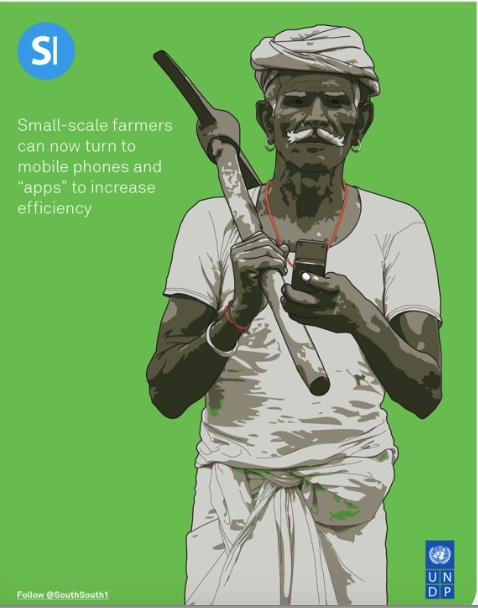
    Last month UN secretary-general Ban Ki-moon pointed out the urgent need for interesting and relevant content to attract Africans to the internet. Official statistics can make for grim reading: the continent has less bandwidth than Ireland (World Economic Forum). While it is true Africa is restricted by serious technological and economic disadvantages, African ingenuity, creativity and hard work are bypassing these impediments to get things done nonetheless. While word has got out about the impressive take-up of mobile phones in Africa, the new world of Web 2.0 is also spawning a new generation of inspiring African technology whizzes transforming perceptions and grabbing the world’s attention.

    Alongside the combination of innovation and affordability that has made Africa the fastest growing mobile phone market in the world, there is a home-grown technology boom underway: “African firms are already participating in the forefront of technological developments and investment opportunities,” according to the Africa Competitiveness Report 2007.

    Powerful and easy-to-use Web 2.0 tools are being used by Africans during times of crisis. Among the most innovative are “mash-ups” – a term once used to refer to the musical style of combining two or more song tracks that has come to mean the blending together of various software programmes. These Web 2.0 software mashups combine weather information, maps, webcams, population figures, even restaurant locations – in fact any application that can be easily added to a website. The possibilities are limitless, and this is what is causing so much excitement for development in the South.

    In Kenya, a website called Ushahidi (Swahili for testimony), is using ICT (information and communications technology) and mobile phones to save lives in the post-election violence. People on the ground can send in live situation reports and alerts through the web and mobile phones to the website, which then maps violence in real time.

    According to the site’s originator, Kenyan Ory Okolloh, Ushahidi.com “is a tool for people who witness acts of violence in Kenya in these post-election times. You can report the incident that you have seen, and it will appear on a map-based view for others to see.”

    It has been put together by Kenyan web developer David Kobia (also the developer of Mashada, an online African community), and inspired by African blogger Erik “Hash” Hersman and other Kenyan bloggers and activists.

    At the start of the violence, Okolloh had put out a message for help on the web. “Google Earth supposedly shows in great detail where the damage is being done on the ground,” Okolloh said on the site. “It occurs to me that it will be useful to keep a record of this, if one is thinking long-term. For the reconciliation process to occur at the local level the truth of what happened will first have to come out. Guys looking to do something – any techies out there willing to do a mashup of where the violence and destruction is occurring using Google Maps?”

    The website came together quite quickly: after initial discussions amongst the team of five on January 5, it was live by January 9 (they estimate 40 hours for development and 20 to 30 hours for testing and promotion).

    For others who want to do the same, the key is good relationships, not necessarily technology, the Ushahidi team says. “My advice is to make sure you’re well networked with the right people before something like this is needed,” said Erik Hersman, who runs Afrigadget and White African blogs. “By the time you need a site like Ushahidi, it’s too late to start making connections, it’s time to build … everyone needs the passion to fulfill the vision of the project.”

    And to keep it going is not that time consuming, they say. The largest part of their time is spent keeping in contact with NGOs and a volunteer network in Kenya, and verifying the information.

    “My advice would be to keep things as simple as possible.,” said Kenyan David Kobia. “Mashups are basically methods of relaying data, so simplicity is absolutely key.”

    “The feedback has been phenomenal. Ushahidi’s graphical representation of events illustrates to some degree the magnitude of the events to people outside Kenya. The enormity of the situation can be understood better as events unfold, keeping everyone in the loop with a point of reference – people tend to become apathetic when regular news moves from the front page.”

    Ushahidi has been praised for providing NGOs, the international community and humanitarian agencies with vital information they can use to help people.

    Kobia has also launched a new mashup to promote Kenyan unity called  ihavenotribe.

    AfricaNews.com has also been turning to mobile phones to get the news out on the Kenyan crisis. The agency’s reporters use internet-enabled mobile phones with portable keyboards to transmit photos, video and text for reports. All of it is uploaded to the www.africanews.com website. Some are calling this the first use of mobile phone journalism in Africa.

    Published: February 2008

    Resources

    • Pambazuka News Action Alert blog for Kenya updates.
    • Web 2.0 tools that are for free and how to use them: an excellent resource from San Francisco’s  Techsoup.
    • An excellent set of links to Web 2.0 tools and which ones are free, is here:  directimpactnow.com
    • Mashups.com has the latest news and links to get involved in this new internet phenomenon:
    • Programmable Web: This outstanding website links to all active mashups on the web by category and gives real-time reports on progress and lots of links and support to get started.
    • African Web 2.0: 2007 was a busy year for African Web 2.0 sites, as they have grown in number and sophistication. Here you can see an at-a-glance collage of the sites’ logos and links to them:  flickr.com
    Creative Commons License

    This work is licensed under a
    Creative Commons Attribution-Noncommercial-No Derivative Works 3.0 License.

    ORCID iD: https://orcid.org/0000-0001-5311-1052.

    © David South Consulting 2023

  • Help is at Hand for India’s Beleaguered Bus-riders

    Help is at Hand for India’s Beleaguered Bus-riders

    By David South, Development Challenges, South-South Solutions

    SOUTH-SOUTH CASE STUDY

    The website is a simple affair: a distinctive logo sits above a lean-looking booking system that allows users to enter their journey start and end destination, date and then click for available buses and prices. Its simplicity is deceptive: redBus is a smart technological solution to a very complicated problem in India: booking and buying a bus ticket. The service it offers – relief from a chaotic, frustrating and time-consuming task – is transforming the experience of travel in India.

    Based in India’s technology hub of Bangalore (http://en.wikipedia.org/wiki/Bangalore), redBus (redbus.in) is a web start-up begun by young whizzes from technology companies who decided to take a risk and venture out and do something new.

    Back in 2005, redBus’ three founders, all graduates of one of India’s top engineering schools, were working in Bangalore for well-known information technology companies such as IBM, Texas Instruments and Honeywell.

    As they tell the story on their website, it was the difficulty of getting a bus home during the Hindu religious festival of Diwali that prompted the inspiration. The trip was a last-minute decision, and buying bus tickets proved far from easy. On top of failing to get a ticket from various travel agents, journeying around Bangalore meant encountering the city’s traffic gridlock.

    This experience led to the idea of developing a service to book bus tickets over the Internet.

    RedBus quickly evolved into an innovative service offering multiple options to customers. They can call a phone number and speak to a customer service representative or use a mobile phone to book a ticket. RedBus claims to have sold more than 8,000,000 tickets to date.

    Tickets are also delivered to customers in major cities in advance of their travel. Even more conveniently, redBus developed a service called mTicket. It sends the ticket by SMS (mobile phone text message) straight away when a customer makes a booking. The mTicket appears on the display screen of the mobile phone and the customer just has to show their mTicket to the driver to board the bus.

    RedBus uses partnerships to expand their distribution network, and this means redBus tickets can be purchased at more than 75,000 outlets. The company now works with more than 350 bus operators, allowing customers to book tickets on more than 4,500 routes across India.

    The service set out to achieve two goals: create a one-stop shop for ticket purchases, and to make it possible for customers to get tickets when they needed them and not be told they have been sold out.

    Indians were already having success with booking airline tickets online. But nobody else had thought of doing central, online sales for bus tickets before.

    Research was behind redBus’ success. The founders interviewed bus operators, consumers and venture capitalists before setting up the business.

    They then set about writing the code for the Internet service and put together a business plan and presented it to The Indus Entrepreneurs (TiE) (tie.org) – a network of mentors who help young entrepreneurs. With the support in place, they were able to leave their well-paying, secure jobs to start redBus.

    Among the many challenges they faced was changing the mindset of bus operators used to dealing only with travel agents working out of sales offices.

    It also took time for the concept to take off. But as word-of-mouth got around, more people started to use the website. The young team grew from just three to 50 within nine months.

    Their business success, as they describe it, is the result of listening to, and soliciting feedback from their customers. They say it has helped them identify what is going wrong and fix it, and describe their business culture as “learn, implement, grow.” They also have a culture of sharing ideas and mistakes to encourage learning. It seems it is this buzzy, youthful and always-learning business culture that is behind redBus’ success.

    Resources

    1) IDiscoverIndia: A website detailing how to explore India’s vast bus network.Website: http://www.idiscoverindia.com/Travel_Info/india_travel_bus.html

    2) TiE: Fostering Entrepreneurship Globally: The Indus Entrepreneurs (TiE),was founded in 1992 in Silicon Valley by a group of successful entrepreneurs, corporate executives, and senior professionals with roots in the Indus region. TiE’s mission is to foster entrepreneurship globally through mentoring, networking, and education. Dedicated to the virtuous cycle of wealth creation and giving back to the community, TiE’s focus is on generating and nurturing our next generation of entrepreneurs. Website: tie.org

    Creative Commons License

    This work is licensed under a
    Creative Commons Attribution-Noncommercial-No Derivative Works 3.0 License.

    ORCID iD: https://orcid.org/0000-0001-5311-1052.

    © David South Consulting 2021