Tag: development challenges south-south solutions

  • Asian Factories Starting to go Green

    Asian Factories Starting to go Green

    By David SouthDevelopment Challenges, South-South Solutions

    SOUTH-SOUTH CASE STUDY

    Media headlines have recently highlighted the growing air pollution crisis in Asia’s expanding cities. This is caused by a mix of factors – the growing number of vehicles, coal-powered factories, people burning dirty fuels to heat their homes, and poor enforcement of standards – and has severe consequences for human health. If it’s not tackled, more and more countries will see large rises in respiratory problems, cancers and early deaths from pollution-caused illnesses (http://www.nrdc.org/air/).

    The World Health Organization (WHO) says air pollution is the world’s largest environmental health risk, killing 7 million people every year. Asia has the largest number of air pollution deaths in the world, with 3.3 million deaths linked to indoor air pollution and 2.6 million deaths related to outdoor air pollution (Clean Air Asia).

    While most of the Asian countries where this is a problem are also aggressively growing their economies in order to get richer and raise living standards, there is a rising awareness of the need to balance a modern, industrial economy with human health and the environment.

    One solution is to adopt green and sustainable building standards when constructing new factories. This is more than just a public relations exercise: the energy savings possible from building smart pay off in the long run. And green factories not only pollute less, they save lives and the environment.

    Asia plays a critical role in producing the world’s consumer products, from the small and simple to the highly complex components used in 21st-century computing technologies.

    Intel (intel.com), the manufacturer of electronic devices and the computer chips that go inside them, is trying to lead the way. It has built a US $1 billion manufacturing plant 16 kilometers outside Ho Chi Minh City, Vietnam, and it is designed to exceed Vietnamese environmental and sustainability guidelines and laws.

    Opened in 2010, it boasts the country’s largest solar power system. It is also currently working on a water reclamation system to reduce water consumption at the plant by 68 per cent, according to The New York Times. It is hoping to receive certification from the US Green Building Council (usgbc.org).

    It is all part of a wider trend that is starting to reverse the damaging, short-termist approach of the past. More and more Western multinationals and their Asian suppliers are building environmentally sound factories in the developing world.

    According to the US Green Building Council, around 300 manufacturing facilities in Asia are either certified or are awaiting Leadership in Energy and Environmental Design (LEED) certification. The LEED certification recognizes the building has met certain standards in becoming a ‘green’ building.

    Going green is more and more part of corporate policy for companies that want to avoid the bad publicity of disasters such as the garment factory collapse that killed 1,135 people in Bangladesh in April 2013.

    But it is not just driven by a desire to avoid bad publicity: large corporations that build factories in the global South are also realizing there are big financial savings to be made.

    Intel has been able to reduce its global energy costs by US $111 million since 2008. It did this by investing US $59 million in 1,500 projects to boost sustainability across its facilities worldwide. The projects have reduced carbon dioxide emissions equivalent to the amount produced by 126,000 American households per year.

    Intel’s solar array in Vietnam, which cost US $1.1 million, offsets the equivalent of 500 pollution-belching motorbikes every day.

    How effective are LEED-certified buildings? The New York Times reported that a 2011 survey compared a typical shoe factory with a LEED factory run by the American sport shoe maker Nike. It found the LEED factory used 18 per cent less electricity and fuel and 53 per cent less water.

    And this trend is creating a new economy unto itself. As an example, a new marketplace for industrial efficiency upgrading is developing in India. Power outages are frequent in India, so finding a way to save electricity and alternatives to dependence on the national power grid is attractive to any economic enterprise.

    Prashant Kapoor, principal industry specialist for green buildings at the International Finance Corporation (IFC), believes demand for upgrades is strong enough that various companies can specialize in this field and profit from it.

    And things are also happening in the notoriously smog-choked cities of China. By the end of 2012, China had certified eight factories and 742 buildings as LEED, according to the China buildings programme at the Energy Foundation (ef.org) in San Francisco.

    Damien Duhamel of Solidiance (solidiance.com), a firm that advises businesses on how to grow in Asia, believes avoiding risk caused by environmental accidents or scandals is heightened by the growing presence of social media, which amplifies negative publicity.

    “The next battle will be here” for higher corporate environmental standards, Duhamel believes. “This is why some smart companies – Intel, for example – took the steps of being proactive.”

    Published: April 2014

    Resources

    1) Leadership in Energy and Environmental Design (LEED): LEED, or Leadership in Energy & Environmental Design, is a green building certification program that recognizes best-in-class building strategies and practices. Website: http://www.usgbc.org/leed

    2) US Green Building Council (USGBC): Its mission is to transform the way buildings and communities are designed, built and operated, enabling an environmentally and socially responsible, healthy, and prosperous environment that improves the quality of life. Website: http://www.usgbc.org/

    3) Dwell: Dwell magazine is focused on demonstrating that modern design can be both functional and comfortable. Website: dwell.com

    4) Inhabitat: Design for a Better World: Inhabitat.com is a weblog devoted to the future of design, tracking the innovations in technology, practices and materials that are pushing architecture and home design towards a smarter and more sustainable future. Website: inhabitat.com

    5) Solidiance: Singapore-based consulting firm specializing in Asia’s green-building sector. Website: solidiance.com

    6) Clean Air Asia: Clean Air Asia was established in 2001 as the premier air quality network for Asia by the Asian Development Bank, World Bank, and USAID. Its mission is to promote better air quality and livable cities by translating knowledge to policies and actions that reduce air pollution and greenhouse gas emissions from transport, energy and other sectors. Website: cleanairinitiative.org

    7) Southern Innovator Issue 4: Cities and Urbanization: This issue is packed with ideas on to how make cities and urban environments greener and reduce air pollution. Website: http://www.scribd.com/doc/133622315/Southern-Innovator-Magazine-Issue-4-Cities-and-Urbanization and here: http://tinyurl.com/oc2mqgm

    8) Better Air Quality Conference 2014 and 8th Regional Environmentally Sustainable Transport Forum in Asia:  From 19 to 21 November 2014 in Colombo, Sri Lanka, BAQ is the leading event on air quality in Asia, covering the key sectors of transport, energy, industry and climate change, with a particular emphasis on government policies and measures. Website: http://cleanairinitiative.org/portal/node/12274

    9) Tianjin Eco-city: The Sino-Singapore Tianjin Eco-city’s vision is to be a thriving city which is socially harmonious, environmentally-friendly and resource-efficient. Website: tianjinecocity.gov.sg

    10) Songdo: Songdo International Business District (IBD) officially opened on August 7, 2009 as a designated Free Economic Zone and the first new sustainable city in the world designed to be an international business district. Website: songdo.com

    https://davidsouthconsulting.org/2022/09/27/caribbean-island-st-kitts-goes-green-for-tourism/

    https://davidsouthconsulting.org/2021/01/25/creating-green-fashion-in-china/

    https://davidsouthconsulting.org/2021/02/01/ethiopia-and-djibouti-join-push-to-tap-geothermal-sources-for-green-energy/

    https://davidsouthconsulting.org/2023/02/03/environmental-public-awareness-handbook-case-studies-and-lessons-learned-in-mongolia/

    https://davidsouthconsulting.org/2021/08/29/indian-business-model-makes-green-energy-affordable/

    https://davidsouthconsulting.org/2022/11/11/innovation-cairos-green-technology-pioneers/

    https://davidsouthconsulting.org/2021/10/22/innovations-in-green-economy-top-three-agenda/

    https://davidsouthconsulting.org/2021/08/07/mongolian-green-book/

    https://davidsouthconsulting.org/2022/04/14/prisons-with-green-solutions/

    https://davidsouthconsulting.org/2021/02/04/us-450-million-pledged-for-green-economy-investments-at-kenyan-gssd-expo/

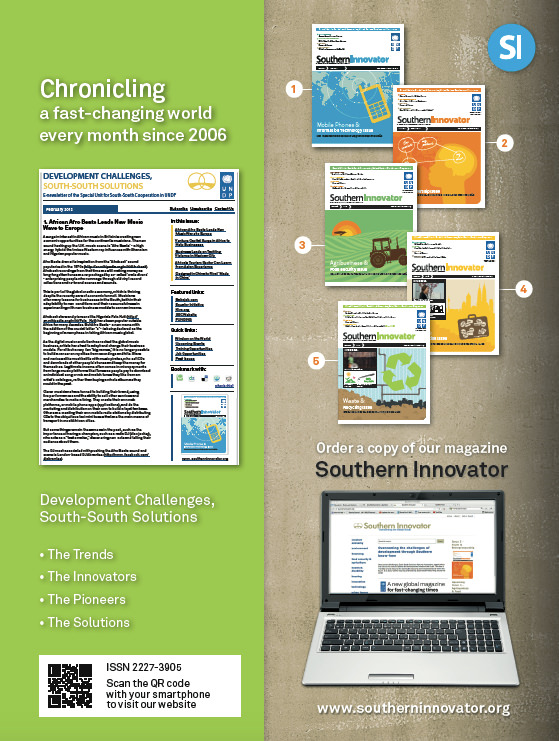
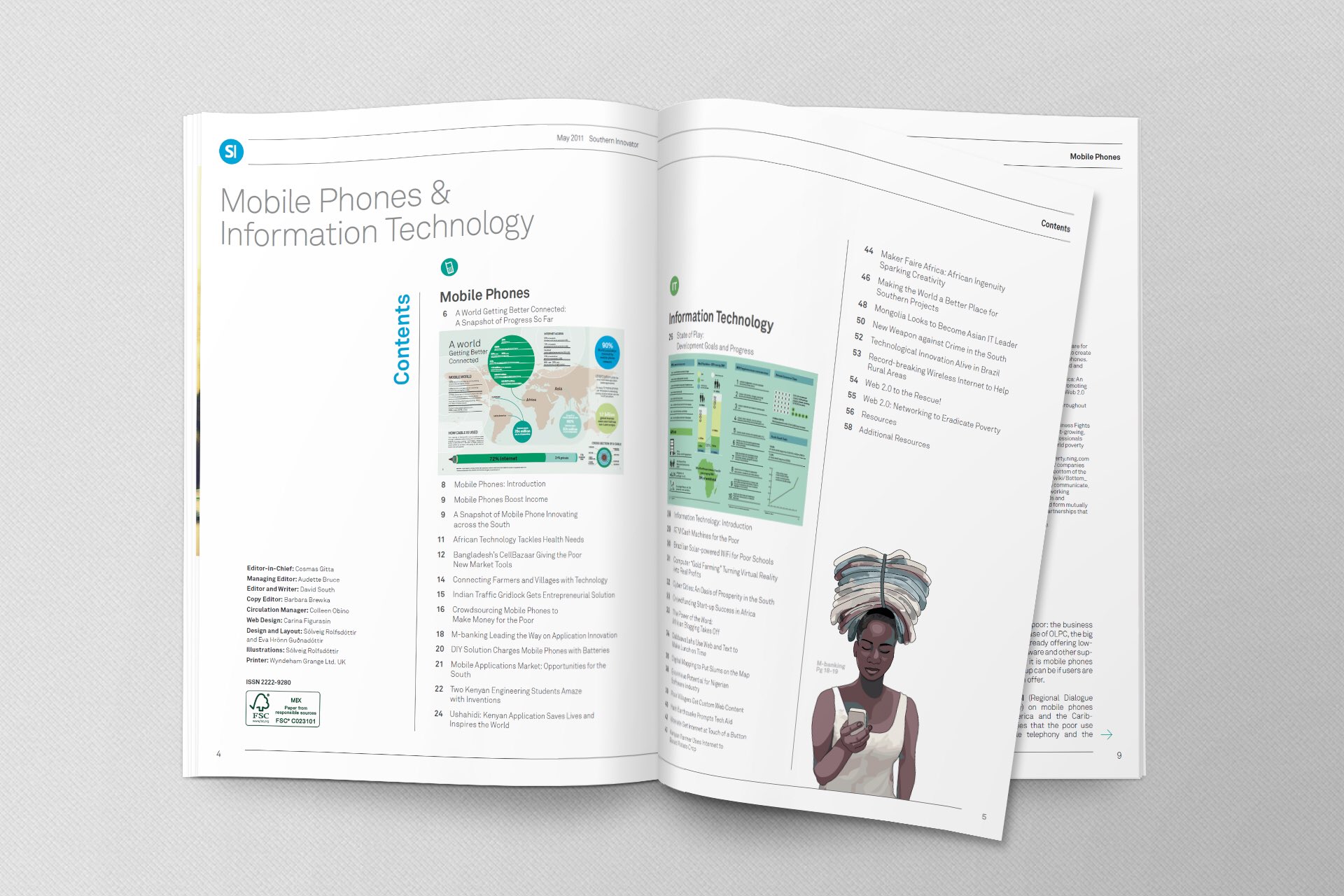
    Development Challenges, South-South Solutions was launched as an e-newsletter in 2006 by UNDP’s South-South Cooperation Unit (now the United Nations Office for South-South Cooperation) based in New York, USA. It led on profiling the rise of the global South as an economic powerhouse and was one of the first regular publications to champion the global South’s innovators, entrepreneurs, and pioneers. It tracked the key trends that are now so profoundly reshaping how development is seen and done. This includes the rapid take-up of mobile phones and information technology in the global South (as profiled in the first issue of magazine Southern Innovator), the move to becoming a majority urban world, a growing global innovator culture, and the plethora of solutions being developed in the global South to tackle its problems and improve living conditions and boost human development. The success of the e-newsletter led to the launch of the magazine Southern Innovator.  

    Creative Commons License

    This work is licensed under a
    Creative Commons Attribution-Noncommercial-No Derivative Works 3.0 License

    ORCID iD: https://orcid.org/0000-0001-5311-1052.

    © David South Consulting 2022

  • Cambodian Bloggers Champion New, Open Ways

    Cambodian Bloggers Champion New, Open Ways

    By David SouthDevelopment Challenges, South-South Solutions

    SOUTH-SOUTH CASE STUDY

    The Southeast Asian nation of Cambodia has had a very difficult history over the past few decades. In the 1950s and 1960s, it was seen as a glamorous and vibrant place. Dynamic, ambitious and newly independent from French colonial rule, Cambodia embarked on an extensive programme of building that is now called “New Khmer Architecture.” It is the most visible legacy of this modernizing time.

    The book Cultures of Independence: An Introduction to Cambodian Arts and Culture in the 1950s and 1960s says architects of the period showed “a willingness to expand and incorporate new elements, looking both outside and inside the newly independent nation …. Whether consciously or not, most of their work took up questions of how to create forms that would be recognised as both Cambodian and modern.”

    But with the war in nearby Vietnam worsening in the 1970s, the destabilising effect of the conflict gave rise to the Khmer Rouge (http://en.wikipedia.org/wiki/Khmer_Rouge), a radical and genocidal movement under the dictator Pol Pot which killed an estimated 2 million Cambodians. It came to an end when newly independent Vietnam invaded the country to overturn the Khmer Rouge regime and end the genocide that had raged between 1975 and 1979.

    By the early 1990s, the United Nations was helping Cambodia make the transition to democracy and redevelop its economy after the trauma of the Khmer Rouge years.

    Today’s Cambodia is a country with a fast-growing economy – at 5.5 percent in 2010 according to Prime Minister Hun Sen – but still trying to come to grips with the pain and damage of the Khmer Rouge period.

    On the internet, pioneering bloggers are trying to bridge the gap between reluctance to speak out about those years and the need for the country to modernize and open up. In the past, keeping quiet in public was the best survival strategy and outspoken voices could end up dead.

    The internet is still in its infancy in Cambodia, with only 78,000 users in 2010 (Internet World Stats) – up from 6,000 in 2000, but still tiny in a population of 14,805,358 (World Bank). Cambodia still has high levels of illiteracy of 26 percent (ILO) and poverty, leaving access to the internet and computers a minority pursuit.

    The first connections to the internet in Cambodia were set up in 1994 and internet cafes have been flourishing since the mid 2000s.

    One role model can be found at the Blue Lady Blog (http://blueladyblog.com/). Its author, Kounila Keo, blogs about her daily frustrations, passions, and life as a young woman who has been working as a newspaper journalist. Her blog tackles anything Cambodian, from education and politics to lifestyle, press freedom, culture and problems facing the country. She is a passionate explainer of Cambodia’s blogging culture.

    She started the Blue Lady Blog in 2007 and in a talk at Phnom Penh’s TEDx in February (http://tedxphnompenh.com/) described how she found blogging has transformed her life in three ways:

    1) Freedom of speech: She could now fully express herself and venture opinions she could not do even as a journalist.

    2) Self-education and self esteem: she has had to learn things on her own and in turn this has boosted her confidence.

    3) Knowledge and new perspectives: blogging connects her with people around the world she would not normally have contact with. And blogging is becoming the new voice of a new generation of youth, allowing them to redefine the country’s development challenges in their own terms.

    Keo found blogging altered the challenges facing youth, posing the question “What can young Cambodians do for Cambodia?” She believes Cambodian youth should do something rather than wait for opportunities to come to them. Young people have told her her blog has spurred them into action.

    “Cloggers” – Cambodian bloggers – are a group of young internet users championing the use of information technologies in everyday life.

    In 2007, the first Clogger Summit (http://cloggersummit.wikispaces.com/) brought together bloggers, webmasters, media representatives and NGOs for the first time to exchange ideas and share and debate. Since then, there has been a proliferation of blogs in the Cambodian language.

    Developing a vibrant – and open – information technology sector has many advantages. Pioneering work by the United Nations in Mongolia as it made its transition to free markets and democracy led to the country becoming one of world’s freest for internet use.

    A vibrant and free information technology sector enables businesses to quickly modernize, connect with customers and markets around the world, spread information and ideas quickly, react to crises and build market efficiencies.

    Honduras, Mali, and Mongolia (http://www.yuxiyou.net/open/) were highlighted as being some of the freest places in the world for the internet in a recent report by Reporters Without Borders (http://en.rsf.org/).

    Published: March 2011

    Resources

    1) A presentation about the Cloggers scene and how it works. Website: http://www.slideshare.net/kalyankeo/cloggers-life-an-introduction-to-cambodian-blogophere 

    2) Afrinnovator: Is about telling the stories of African start-ups, African innovation, African made technology, African tech entrepreneurship and entrepreneurs. Website: http://afrinnovator.com 

    3) Changing Dynamics of Global Computer Software and Services Industry: Implications for Developing Countries: A report from UNCTAD on how computer software can become the most internationally dispersed high-tech industry. Website: http://www.unctad.org/templates/webflyer.asp?docid=1913&intitemid=2529&lang=1 

    4) Advice on starting a business and succeeding in tough economic times. Website: http://www.businesslink.gov.uk/bdotg/action/layer?topicId=1073858805

    5) Ger Magazine: Mongolia’s first online magazine in the late 1990s contributed to the country’s vibrant web culture. Website: http://en.wikipedia.org/wiki/Ger_magazine 

    6) Phnom Penh Post: English-language newspaper. Website: http://www.phnompenhpost.com/

    https://davidsouthconsulting.org/2022/11/21/asia/

    https://davidsouthconsulting.org/2022/11/17/book-boom-rides-growing-economies-and-cities/

    https://davidsouthconsulting.org/2021/09/23/david-south-consulting-books-1997-2014/

    https://davidsouthconsulting.org/2021/07/14/freedom-of-expression-introducing-investigative-journalism-to-local-media-in-mongolia-1999-25-january-2016/

    https://davidsouthconsulting.org/2021/05/25/ger-mongolias-first-web-magazine-and-a-pioneering-web-project-for-the-united-nations-12-january-2016/

    https://davidsouthconsulting.org/2022/06/10/illiterate-get-internet-at-touch-of-a-button/

    https://davidsouthconsulting.org/2022/06/10/info-ladies-and-question-boxes-reaching-out-to-the-poor/

    https://davidsouthconsulting.org/2023/02/07/mongolian-rock-and-pop-book-mongolia-sings-its-own-song/

    https://davidsouthconsulting.org/2022/11/01/new-journal-celebrates-vibrancy-of-modern-africa/

    https://davidsouthconsulting.org/2021/03/05/southern-innovator-issue-1/

    https://davidsouthconsulting.org/2022/12/01/southern-innovator-magazine-is-printed-and-readied-for-distribution-31-may-2011/

    Development Challenges, South-South Solutions was launched as an e-newsletter in 2006 by UNDP’s South-South Cooperation Unit (now the United Nations Office for South-South Cooperation) based in New York, USA. It led on profiling the rise of the global South as an economic powerhouse and was one of the first regular publications to champion the global South’s innovators, entrepreneurs, and pioneers. It tracked the key trends that are now so profoundly reshaping how development is seen and done. This includes the rapid take-up of mobile phones and information technology in the global South (as profiled in the first issue of magazine Southern Innovator), the move to becoming a majority urban world, a growing global innovator culture, and the plethora of solutions being developed in the global South to tackle its problems and improve living conditions and boost human development. The success of the e-newsletter led to the launch of the magazine Southern Innovator.  

    Cited here: https://kounila.com/title-cambodian-bloggers-champion-new-open-ways/.
    Creative Commons License

    This work is licensed under a
    Creative Commons Attribution-Noncommercial-No Derivative Works 3.0 License

    ORCID iD: https://orcid.org/0000-0001-5311-1052.

    © David South Consulting 2023

  • Caribbean Island St. Kitts Goes Green for Tourism

    Caribbean Island St. Kitts Goes Green for Tourism

    By David SouthDevelopment Challenges, South-South Solutions

    SOUTH-SOUTH CASE STUDY

    Going green may sound like the right thing to do but it can also be associated with being a costly burden and boring. But, as one island nation is proving, being green is a great selling point for attracting tourists and investors – especially in a world where many places are grappling with pollution and resource depletion.

    St. Kitts, an island located between the Caribbean Sea and the Atlantic Ocean, is part of the Federation of Saint Kitts and Nevis and has a population of around 35,000 (stkittstourism.kn).

    The country shut down its main source of income, the sugar industry, in 2005. Facing dropping profits, it decided the industry was not worth supporting anymore.

    But what would be the replacement source of income and employment? St. Kitts has turned to tourism for the answer. While many other Caribbean islands have long drawn on tourism – along with banking and finance, in some cases – in order to diversify economies away from dependence on agriculture, St. Kitts had not developed this sector. As a latecomer, St. Kitts needed to think about how it could do things differently and stand out from the crowd.

    St. Kitts decided to become a regional champion for green tourism and green energy, and to lure tourists to the island by championing its green credentials.

    The launch in 2013 of a Euro 1.8 million (US $2.48 million) one-megawatt solar energy farm nearby the Robert L. Bradshaw International Airport (http://www.stkittstourism.kn/explore-st-kitts-getting-here-airport.php) – enough to power a few hundred houses – showed St. Kitts was getting serious about going green (http://www.cuopm.com/?m=201302&paged=13).

    Joining the new solar farm, an all-green resort is hoping to further boost St. Kitts’ green credentials. The ambitious Kittitian Hill (kittitianhill.com) resort stretches across 162 hectares and includes four hotels, an organic farm and multiple restaurants. In the pipeline is a plan to open film production and editing facilities to lure movie-makers looking for a green film-making studio.

    Kittitian Hill is the brainchild of property developer Val Kempadoo (http://www.linkedin.com/pub/valmiki-kempadoo/8/53a/339), who is trying to set a precedent for sustainable resorts in the Caribbean. It is being developed with a mix of foreign experts and local contractors.

    The resort boasts organic food fresh from tropical farms and an on-site tropical forest, described as an “edible landscape” offering a bounty of fresh fruit and vegetables. Around the resort, “Pick Me” signs encourage visitors to pick ripe fruit and sit down and make a meal of it.

    The grounds include rare and heirloom fruit trees, and the resort hopes to create a reserve to protect endangered species. To spread the green message, the plants and seeds are shared locally with farmers and others. It is part of a strategy to encourage farmers to produce organic food, avoiding pesticides and chemicals, and to farm animals ethically.

    The resort’s green ethos even extends to its 18-hole golf course. Golf courses are notorious water-wasters, but this one has a smart water management system, using organic crops and fruit trees to help keep the soil moist, interweaving a farm throughout the golf course. Caddies will guide golfers to the ripest fruits while they putt their way around the course.

    “My vision is to bring together community and culture, along with mindful conservation of natural resources,” said Kempadoo. “This means we can offer our guests an unforgettable experience, while bringing lasting, life-changing benefits to the local people and economy.”

    As an added sweetener to get investment coming in, St. Kitts and Nevis offers citizenship to investors in the country. In return, investors can travel visa-free to 120 countries – something that has appealed to investors from around the global South.

    “It is important for St. Kitts to be selective and careful about development and focus on high-end rather than high-volume tourism,” Kempadoo told Monocle magazine. “The best asset of this island is its natural beauty, and we want to preserve it.”

    Published: June 2014

    Resources

    1) The International Ecotourism Society: The International Ecotourism Society (TIES) is a 501(c)(3) nonprofit organization dedicated to promoting ecotourism. Website: https://www.ecotourism.org/what-is-ecotourism

    2) Top Five Eco Resorts of Mexico: Website: http://www.ecotourismtrips.org/topics/show/3809

    3) 3 Rivers Dominica Eco Lodge: “An award-winning range of comfortable and charming self-contained cottages, nature, adventure and community-based ecotourism activities, restaurant, rivers and relaxation”. Website: http://www.3riversdominica.com/

    4) Jungle Bay Resort and Spa: Award-winning Jungle Bay was built and is operated in alignment with international Geotourism and Ecotourism guidelines. As an alternative to traditional Caribbean tourism, the focus is on enjoyable nature-based activities and wellness of guests with quality service, guided by the principles as set by both National Geographic’s Center for Sustainable Destinations and The International Ecotourism Society (TIES). Website: junglebaydominica.com

    https://davidsouthconsulting.org/2022/10/20/african-tourism-leads-the-world-and-brings-new-opportunities/

    https://davidsouthconsulting.org/2022/09/28/asian-factories-starting-to-go-green/

    https://davidsouthconsulting.org/2022/02/07/boosting-tourism-in-india-with-surfing-culture/

    https://davidsouthconsulting.org/2021/01/25/creating-green-fashion-in-china/

    https://davidsouthconsulting.org/2022/11/20/ecotourism-to-heal-the-scars-of-the-past/

    https://davidsouthconsulting.org/2023/02/03/environmental-public-awareness-handbook-case-studies-and-lessons-learned-in-mongolia/

    https://davidsouthconsulting.org/2021/02/01/ethiopia-and-djibouti-join-push-to-tap-geothermal-sources-for-green-energy/

    https://davidsouthconsulting.org/2022/11/11/innovation-cairos-green-technology-pioneers/

    https://davidsouthconsulting.org/2021/10/22/innovations-in-green-economy-top-three-agenda/

    https://davidsouthconsulting.org/2022/10/10/a-solution-to-stop-garbage-destroying-tourism/

    https://davidsouthconsulting.org/2021/03/05/southern-innovator-issue-5/

    https://davidsouthconsulting.org/2021/02/04/us-450-million-pledged-for-green-economy-investments-at-kenyan-gssd-expo/

    Development Challenges, South-South Solutions was launched as an e-newsletter in 2006 by UNDP’s South-South Cooperation Unit (now the United Nations Office for South-South Cooperation) based in New York, USA. It led on profiling the rise of the global South as an economic powerhouse and was one of the first regular publications to champion the global South’s innovators, entrepreneurs, and pioneers. It tracked the key trends that are now so profoundly reshaping how development is seen and done. This includes the rapid take-up of mobile phones and information technology in the global South (as profiled in the first issue of magazine Southern Innovator), the move to becoming a majority urban world, a growing global innovator culture, and the plethora of solutions being developed in the global South to tackle its problems and improve living conditions and boost human development. The success of the e-newsletter led to the launch of the magazine Southern Innovator.  

    Creative Commons License

    This work is licensed under a
    Creative Commons Attribution-Noncommercial-No Derivative Works 3.0 License

    ORCID iD: https://orcid.org/0000-0001-5311-1052.

    © David South Consulting 2023

  • Avoiding Wasting Food and Human Potential with ICTs

    Avoiding Wasting Food and Human Potential with ICTs

    By David SouthDevelopment Challenges, South-South Solutions

    SOUTH-SOUTH CASE STUDY

    Creative use of information technology in the South is helping to address two very different kinds of waste – of food and of human and community potential.

    In Ghana, a mobile phone-driven Internet marketplace is helping to improve efficiencies in farming and selling food. Another initiative is addressing the crisis in India’s villages by drawing on the diaspora of former villagers now living in urban environments around the world.

    Finding ways to efficiently trade food is crucial to keeping hunger at bay and meeting the needs of growing populations. In a report earlier this year, the UN’s Environment Programme (UNEP) found that more than half of the world’s food is wasted or discarded.

    “There is evidence … that the world could feed the entire projected population growth alone by becoming more efficient,” said Achim Steiner, UNEP Executive Director, at the launch of The Environmental Food Crisis: The Environment’s Role in Averting Future Food Crises.

    Ghana is a country that has already gained a reputation as an IT leader in West Africa (www.ghanaictawards.com). Now a clever technology based in the capital, Accra, is using mobile phones to connect farmers and agricultural businesses and associations to the marketplace. By using SMS (http://en.wikipedia.org/wiki/SMS) text messages, information from the field is gathered and collated. This can include tracking what is happening on the farm, how crops are surviving the weather, and the status of food inventories day-by-day. All the data is collected by the TradeNet website and displayed with prices and deadlines for buyers and sellers to get in touch with each other. This reduces the time and cost involved in gathering updates from thousands of people across the country.

    Launched in 2007, the service recently won the Information Communication Technology innovations contest by the World Summit Award (WAS) (http://www.wsis-award.org/about/index.wbp) of the United Nations’ World Summit on Information Society (WSIS).

    TradeNet is currently collating market data from 13 countries and proclaims itself the largest SMS-based market information service on the continent of Africa. It has more than 12,000 registered users and covers 500 individual markets.

    The service’s full name is TradeNet: Market Information on your Mobile (http://www.tradenet.biz/?lang=en), and it tracks products like ground nuts, sesame, tomato, maize and white beans. It offers market information from Afghanistan , Benin , Burkina Faso , Cameroon , Cote d’Ivoire , Ghana , Madagascar , Mali , Mozambique , Nigeria , Sudan and Togo.

    Founded by its chief executive officer Mark Davies, TradeNet is run out of the internet start-up incubator Busy Lab (http://www.busylab.com/) in Accra. Busy Lab specializes in building mobile web solutions for companies and projects involved in rural media and computing.

    While in India, villages are in crisis: As India’s economy has boomed, its small towns and villages have withered. Home to the majority of the country’s population, they are suffering declining populations and high suicide rates. India’s urban slums are where people are going; they are growing 250 percent faster than the country’s population. Yet so many people share some past connection with the country’s 260,000 ailing villages.

    And while the world has become a majority urban place, it is acknowledged the future for the environment and agriculture rests in the health of villages.

    The social media website Mana Vuru (www.manavuru.com) seeks to connect people living in cities with the villages they were born in, or where their families came from. It is about restoring the broken connection with the village in order to enhance their future development.

    As Mana Vuru declares: “Villages form the backbone of our economy. True progress, growth and prosperity can only be realized when villages become self-sustainable.”

    The site points out that “most villages are suffering from crippling infrastructure and some even lack the basic amenities like electricity and fresh water. We believe that every person who migrated to greener pastures and attained success and wealth should feel some sort of moral responsibility and do their bit for their respective villages.”

    A project of the Palette School of Multimedia (http://www.palettemultimedia.com/) in Hyderabad – one of India’s technology hubs – the site lets former village dwellers register and start meeting and connecting with fellow members of the diaspora. Together they can network to help the village address its development challenges.

    Published: August 2009

    Resources

    1) A video story by CNN on Tradenet. Website: http://www.youtube.com/watch?v=s6z0ywkHPPQ

    2) BOP Source is a platform for companies and individuals at the BOP (bottom of the pyramid) to directly communicate, ultimately fostering close working relationships, and for NGOs and companies to dialogue and form mutually valuable public-private partnerships that serve the BOP.
    Website: http://bopsource.ning.com/

    3) Afriville is a Web 2.0 service and an African Caribbean social network. Afriville is a community website along the lines of the famous MySpace. Users are free to message and post profiles. The difference is that the user is able to choose how closed or open the networks are. The site features a state of the art music management system which allows African and Caribbean artists to get straight in touch with their fans.
    Website: www.afriville.com

    4) Business Action for Africa: Business Action for Africa is an international network of businesses and business organisations from Africa and elsewhere, coming together in support of three objectives: to positively influence policies for growth and poverty reduction, to promote a more balanced view of Africa, and to develop and showcase good business practice in Africa
    Website: www.businessactionforafrica.org

    5) Model Village India: An innovative concept to rejuvenate India’s villages and build economies and self-reliance. Website: http://www.modelvillageindia.org.in/index1.html

    Development Challenges, South-South Solutions was launched as an e-newsletter in 2006 by UNDP’s South-South Cooperation Unit (now the United Nations Office for South-South Cooperation) based in New York, USA. It led on profiling the rise of the global South as an economic powerhouse and was one of the first regular publications to champion the global South’s innovators, entrepreneurs, and pioneers. It tracked the key trends that are now so profoundly reshaping how development is seen and done. This includes the rapid take-up of mobile phones and information technology in the global South (as profiled in the first issue of magazine Southern Innovator), the move to becoming a majority urban world, a growing global innovator culture, and the plethora of solutions being developed in the global South to tackle its problems and improve living conditions and boost human development. The success of the e-newsletter led to the launch of the magazine Southern Innovator.  

    Creative Commons License

    This work is licensed under a
    Creative Commons Attribution-Noncommercial-No Derivative Works 3.0 License.

    ORCID iD: https://orcid.org/0000-0001-5311-1052.

    © David South Consulting 2023