Tag: development challenges south-south solutions

  • Africa’s Fast-Growing Cities: A New Frontier of Opportunities

    Africa’s Fast-Growing Cities: A New Frontier of Opportunities

    By David SouthDevelopment Challenges, South-South Solutions

    SOUTH-SOUTH CASE STUDY

    According to a new report by the International Institute for Environment and Development, Africa now has a larger urban population than North America and 25 of the world’s fastest growing big cities. Europe’s share of the world’s 100 largest cities has fallen to under 10 percent in the past century.

    Counter to common misperceptions about what is luring people to big cities, the report’s author, David Satterthwaite, said it isn’t because governments and aid are attracting them: government “policies leave much to be desired as they tend to neglect the urban poor, leading to high levels of urban poverty, overcrowding in slums and serious health problems. Governments should see urbanisation as an important part of a stronger economy and their expanding urban population as an asset, not as a problem.”

    But global perceptions of Africa are changing. The Mo Ibrahim Foundation has listed the most efficiently run African economies, with a strong correlation between good governance and higher growth rates (Mauritius, Seychelles, Botswana, South Africa, Namibia, Ghana and Senegal).

    In most of urban French West Africa, extensive interviews with micro-entrepreneurs and micro-finance practitioners found that most operating micro-enterprises in the informal economy are entrepreneurs by necessity, and that their most basic needs drove their business activities and behaviours. Success was held back by lack of capital, poor training, and a general aversion to risk (Faculty of Management, Dalhousie University).

    While access to capital has been identified as the key factor in opportunity, entrepreneurs aren’t even waiting for microfinance institutions to help them. “I started this business of selling chips (French fries) two years ago using money we raised as a group of 30 women,” said Mary Mwihaki, 27, who lives in the Mathare slum area outside Nairobi.

    Each member of her group of women contributes about US 30 cents a day and the resulting US $9 is given to a different member of the group on a rotating basis, she told IRIN news agency. Mwihaki waited three months to raise the US $27 she needed. She joins many other women across the country taking the same approach to raising capital.

    For some entrepreneurs, it is just the proximity to a buzzing urban atmosphere that is a spur to action. One clothes seller told the African Executive he has been able to make enough money to get a house built just selling second hand clothing. Twenty-three-year-old Henry Mutunga in Nairobi, Kenya takes advantage of the high turnover of the city’s Machakos Country bus terminal to sell second hand clothes.

    “After months of searching for a job, I asked myself, ‘Why am I wasting the business studies knowledge I acquired in school?’ I was not comfortable being left in the house every morning, with nothing to do, while my uncle went to work in order to feed me and pay the house rent. I got hooked to the urban mentality and tried my hand at selling trousers.”

    Now with two employees, he is able to rent his own house, and is able to use extra money to have his own house built. He urges other youth to become employers, not employees.

    At the technological end of entrepreneurship, in Nairobi, Kenya, Mumbi’s Dial-a-Cab company is joining 20 fleet firms in the country to adopt a new mobile phone-based vehicle-tracking technology developed by two young African IT entrepreneurs, Waweru Kimani and Paul Mahiaini. The technology allows management to know how low fuel is, which car has gone where, when a car has been hijacked, what car doors are open, how long it has been stopped, and where it is located. Impressively, it also allows management to stop the car at the touch of a button if it has been stolen. It costs US $570 to install, and costs US $40/month to use.

    Other entrepreneurs are piggy backing their success on the booming housing markets in Angola, Ivory Coast, Liberia, Nigeria, Congo, Mali, Morocco, Tunisia, Botswana, Ghana, Mozambique, Rwanda, Kenya, Mauritius, Uganda, Algeria, Egypt, Senegal: all creating enormous opportunities for entrepreneurs providing other services, like furniture, appliances, insurance, landscaping, security, architecture etc.

    And the giant US internet search engine Google is now setting up operations in West Africa, based in Dakar – a sure sign that they see this as a new boom market. And Indian investment in Africa has also dramatically shot up this year, according to mergers and acquisitions magazine, The Deal. In 2005, US $81 million was invested in Africa. In 2006, US $340 million; and in 2007, US $294 million.

    Published: November 2007

    Resources

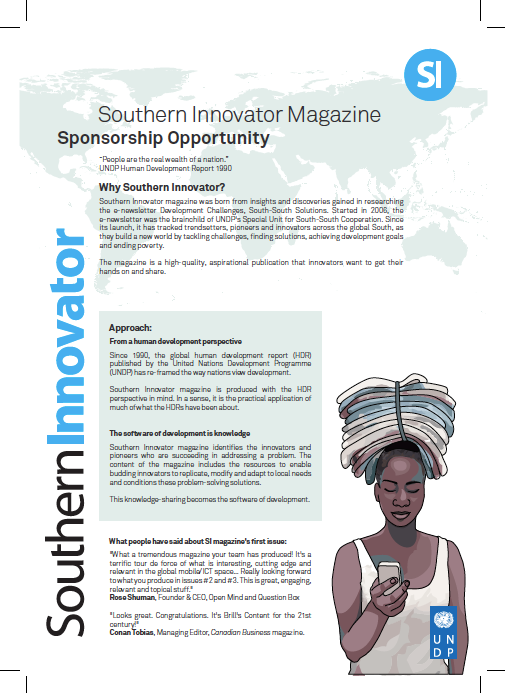
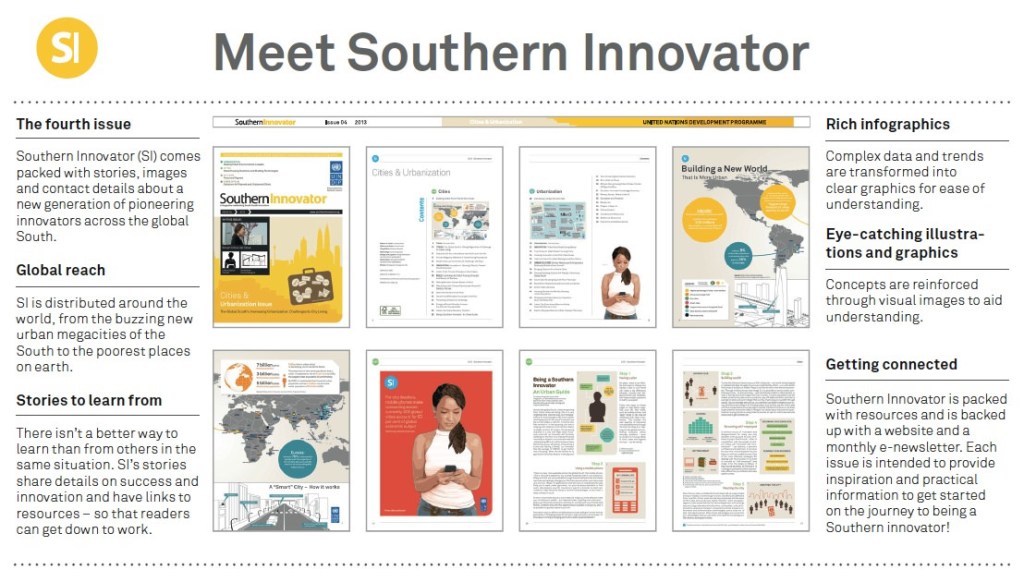
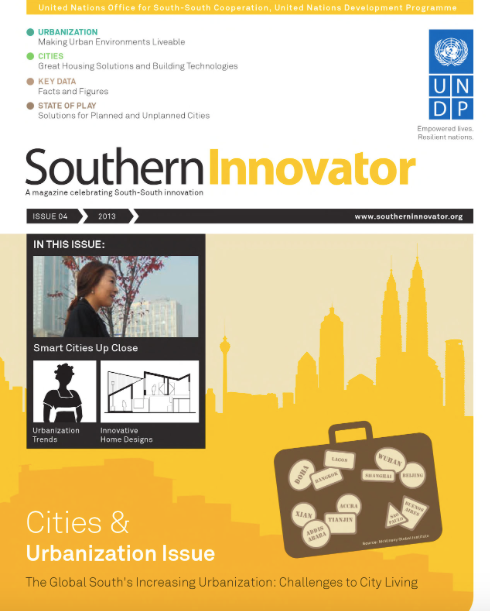
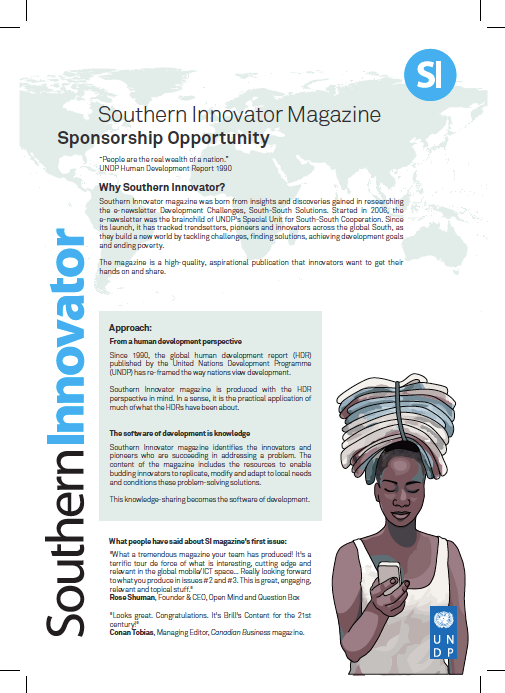
    Development Challenges, South-South Solutions was launched as an e-newsletter in 2006 by UNDP’s South-South Cooperation Unit (now the United Nations Office for South-South Cooperation) based in New York, USA. It led on profiling the rise of the global South as an economic powerhouse and was one of the first regular publications to champion the global South’s innovators, entrepreneurs, and pioneers. It tracked the key trends that are now so profoundly reshaping how development is seen and done. This includes the rapid take-up of mobile phones and information technology in the global South (as profiled in the first issue of magazine Southern Innovator), the move to becoming a majority urban world, a growing global innovator culture, and the plethora of solutions being developed in the global South to tackle its problems and improve living conditions and boost human development. The success of the e-newsletter led to the launch of the magazine Southern Innovator.  
    Creative Commons License

    This work is licensed under a
    Creative Commons Attribution-Noncommercial-No Derivative Works 3.0 License.

    ORCID iD: https://orcid.org/0000-0001-5311-1052.

    © David South Consulting 2023

  • African Technology Tackles Health Needs

    African Technology Tackles Health Needs

    By David SouthDevelopment Challenges, South-South Solutions

    SOUTH-SOUTH CASE STUDY

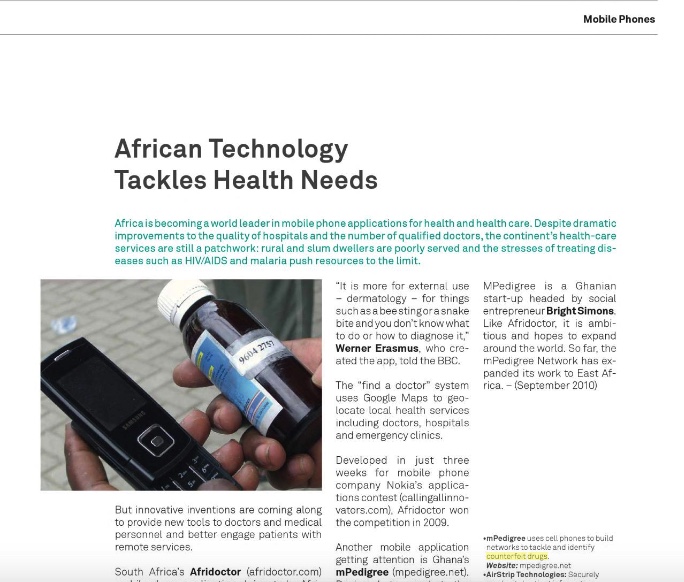
    Africa is becoming a world leader in mobile phone applications for health and healthcare. Despite dramatic improvements to the quality of hospitals and the number of qualified doctors, the continent’s healthcare services are still a patchwork, with rural and slum dwellers poorly served and the stresses of treating patients with contagious diseases like HIV/AIDS and malaria pushing resources to the limit.

    But innovative inventions are coming along to provide new tools to doctors and medical personnel and to better engage patients with remote services.

    South Africa’s Afridoctor (http://twitter.com/afridoctor) mobile phone application claims to be Africa’s first personal mobile health clinic. It lets patients use its “SnapDiagnosis” system to submit photos of their ailments and in turn receive advice from a panel of medical professionals, or use the mapping feature to find doctors, clinics and health industry-related services nearby.

    Afridoctor was conceived to fill the gap across Africa for basic health information that is reliable and trustworthy.

    There is an emergency feature to notify next of kin during a medical emergency and provide a location. Other features include symptom checkers, first-aid information, health calculators and quizzes.

    Expert feedback comes within 48 hours after submission of a request.

    A winner of a Nokia competition, Afridoctor was developed by the labs of media company 24.com (http://20fourlabs.com) of Cape Town, South Africa.

    “It is more for external use – like dermatology – for things like a bee sting or a snake bite and you don’t know what to do or how to diagnose it,” Werner Erasmus, who created the app, told the BBC.

    The “find a doctor” system uses Google Maps to geo-locate local health services including doctors, hospitals and emergency clinics.

    The distress feature enables users to contact a family member or friend at the touch of a button. It does this by storing the mobile phone number of a selected relative. When the distress button is pressed, they are notified of the phone’s location.

    Developed in just three weeks, to enter mobile phone company Nokia’s contest (http://www.callingallinnovators.com) for mobile phone applications, Afridoctor went on to win the competition in 2009. It is now being expanded to be usable on most, if not all, smart phones.

    As in the rest of Africa, mobile phone use in South Africa has dramatically increased in the past 10 years. It is estimated that over 70 percent of South Africans now have access to one.

    Another application getting attention is Ghana’s mPedigree (http://mpedigree.net). Designed to combat the damage done by counterfeit drugs in Africa and across the South, mPedigree works by letting a person send a text message by mobile phone to the mPedigree service to check a drug’s authenticity. A message comes back confirming whether the medicine is authentic or not.

    The World Health Organization (WHO) has estimated that 25 percent of medicines sold around the developing world are counterfeit. Some contain no active ingredients, and others are even harmful.

    MPedigree is a Ghanian start-up headed by social entrepreneur Bright Simons (http://www.worldpress.org/freelancers/index.cfm/hurl/page=freelancerDetails/id=7). Like Afridoctor, it is ambitious and hopes to expand around the world. So far, the mPedigree Network has expanded its work to East Africa.

    Published: September 2010

    Resources

    Development Challenges, South-South Solutions was launched as an e-newsletter in 2006 by UNDP’s South-South Cooperation Unit (now the United Nations Office for South-South Cooperation) based in New York, USA. It led on profiling the rise of the global South as an economic powerhouse and was one of the first regular publications to champion the global South’s innovators, entrepreneurs, and pioneers. It tracked the key trends that are now so profoundly reshaping how development is seen and done. This includes the rapid take-up of mobile phones and information technology in the global South (as profiled in the first issue of magazine Southern Innovator), the move to becoming a majority urban world, a growing global innovator culture, and the plethora of solutions being developed in the global South to tackle its problems and improve living conditions and boost human development. The success of the e-newsletter led to the launch of the magazine Southern Innovator.  
    Creative Commons License

    This work is licensed under a
    Creative Commons Attribution-Noncommercial-No Derivative Works 3.0 License.

    ORCID iD: https://orcid.org/0000-0001-5311-1052.

    © David South Consulting 2023

  • Combating Counterfeit Drugs

    Combating Counterfeit Drugs

    By David SouthDevelopment Challenges, South-South Solutions

    SOUTH-SOUTH CASE STUDY

    Access to good quality drugs is a serious problem across the South. The International Narcotics Control Board estimates that up to 15 per cent of all drugs sold around the world are fake or counterfeit, and in parts of Africa and Asia this figure jumps to 50 per cent. The US Food and Drug Administration estimates counterfeit drugs make up 10 per cent of the global medicine market. The US Centre for Medicines in the Public Interest predicts counterfeit drug sales will reach US $75 billion globally in 2010, an increase of more than 90 per cent from 2005.

    Fake drugs are a major cause of unnecessary death and destroy public confidence in medicines and health services. While counterfeit drugs have been on the rise, there is little co-ordinated or effective action to counter this menace afflicted on the sick.

    But in Ghana, a solution has emerged that shows a way to guarantee that quality drugs get to the sick who need them. CareShop Ghana uses the franchise model – where licenses are sold to approved vendors who adhere to strict guidelines – to ensure that the quality, accessibility and affordability of essential medicines in and around Accra is guaranteed. CareShop has made deals with close to 300 franchisee pharmacies – often modest operations – who sell over-the-counter drugs.

    In Ghana, preventable and curable illnesses like malaria and diarrhoeal diseases are among the leading causes of death. Their treatment pushes many people to financial despair; they can ill afford the extra burden of worrying about counterfeit drugs and the harm they do. Like many countries in the South, Ghana’s public healthcare system is unable to meet these needs and so most people turn to the private sector for help.

    An estimated 65 per cent of people turn to licensed pharmacies. But many of these operate haphazard businesses, dispensing expired or counterfeit drugs.

    The Ghana Social Marketing Foundation Enterprises Limited (GSMFEL) founded CareShop in 2002, hoping to battle common infectious diseases in poor areas by making sure good drugs get through to the sick.

    GSMFEL makes a small profit as the franchisor by selling high-quality drugs to the franchisees. The key to CareShop’s success is imposing standardization on franchisees, so they have to stick to common diagnosis, quality and pricing. They make more money when they adhere to these rules than when they break them. To ensure there is no tampering with the drugs, they are delivered straight to the vendor’s doorsteps, and it is all backed up with health and business training support and branded materials.

    The tide can be turned around on fake drugs: in 2002, the WHO reported that 70 per cent of drugs in Nigeria were fake or substandard: by 2004 that figure had fallen to 48 per cent.

    Stimulating private sector solutions to African healthcare problems is now receiving an additional boost from a new fund established by the World Bank’s private sector arm, the International Finance Corporation. Launched in 2007, it offers cash and loans totalling US $500 million to commercial healthcare projects in Africa. According to its own statistics, 60 per cent of health expenditure in sub-Saharan Africa is privately funded, and the market, excluding South Africa, is worth US $19 billion.

    Published: May 2008

    Resources

    • SafeMedicines.org is a website offering the latest reports on fake medicines and is a good place to report incidences.
      Website: http://safemedicines.org/in_the_news/
    • A paper on the global threat of counterfeit drugs: Click here.

    Development Challenges, South-South Solutions was launched as an e-newsletter in 2006 by UNDP’s South-South Cooperation Unit (now the United Nations Office for South-South Cooperation) based in New York, USA. It led on profiling the rise of the global South as an economic powerhouse and was one of the first regular publications to champion the global South’s innovators, entrepreneurs, and pioneers. It tracked the key trends that are now so profoundly reshaping how development is seen and done. This includes the rapid take-up of mobile phones and information technology in the global South (as profiled in the first issue of magazine Southern Innovator), the move to becoming a majority urban world, a growing global innovator culture, and the plethora of solutions being developed in the global South to tackle its problems and improve living conditions and boost human development. The success of the e-newsletter led to the launch of the magazine Southern Innovator.  

    Creative Commons License

    This work is licensed under a
    Creative Commons Attribution-Noncommercial-No Derivative Works 3.0 License.

    ORCID iD: https://orcid.org/0000-0001-5311-1052.

    © David South Consulting 2022

  • Indian Solar Power Pack Powers Villages

    Indian Solar Power Pack Powers Villages

    By David SouthDevelopment Challenges, South-South Solutions

    SOUTH-SOUTH CASE STUDY

    Developments in India are showing the way forward for low-cost solar power for the poor. The Duron Solar Home Power System (http://www.duronenergy.com/product_info/) is now enabling the rural poor to generate and store solar electricity. It is powerful enough to charge gadgets and appliances and run LED lights. It allows people to do their household chores into the dark hours and to study or earn extra income.

    As the company says, it “allows ample light for cooking, for children to study at night, and for shop owners to stay open later to earn more money.”

    The system removes the need for polluting and dangerous kerosene lamps, which are used by an estimated one million families for lighting in India.

    Kerosene lamps are a major contributor to indoor air pollution, which itself claims the lives of 1.5 million people each year. Kerosene lamps have also caused countless deaths by suffocation, burns and fatal fires.

    The United Nations Environment Program says kerosene fumes are responsible for around 64 percent of deaths for children under the age of five in developing countries.

    More than 1.7 billion people around the world have no domestic electricity supply, of whom more than 500 million live in sub-Saharan Africa (World Bank). Some 400 million people in India do not have access to electricity, according to the World Bank, and 600,000 villages lack an electrical supply. Prime Minister Manmohan Singh has pledged “power for all” by 2012. Without electricity, many development goals remain dreams that will never be achieved.

    Being able to see at night unleashes a vast range of possibilities, but for the very poor lighting is often the most expensive household expense, soaking up 10 to 15 percent of income.

    According to Greenpeace (http://www.greenpeace.org/international/), India could generate 10 percent of its electricity from solar power by 2030.

    The Duron package comes with a five watt solar panel, a cell phone charger connection, three LED (http://en.wikipedia.org/wiki/LED_lamp) lights, and an AC grid charger. After a day of charging, the Duron can power three hours of bright lighting or 10 hours of dim lighting.

    The Duron system sells for about 5,999 rupees, or around US $130, and the typical user to date has been small businesses and schools.

    Duron is selling several thousand units a month and the company is currently scaling up its sales efforts.

    Duron’s approach is to provide a market solution to the huge problem of providing electricity to India’s rural poor.

    The company was launched in 2008 with the goal of providing electricity to those without around the world. It was developed out of the Idea Lab (http://www.idealab.com/), a Pasadena, Californian incubator of technology companies.

    Extensive field research was conducted across India to determine what was the best solution and what were the needs of rural dwellers. Duron moved its headquarters to Bangalore, India in 2009 to be closer to its customers and expand sales. The company operates in the Indian states of Uttar Pradesh and Karnataka.

    By August 2009, more than 2,100 people had light because of the Duron system. The company calculates this translated into 172,500 hours of light.

    One customer, Anil Singh, lives with his family in the unelectrified village of Narainpur. His family used kerosene lamps and was paying US $4 a day for unreliable lighting. But after seeing his neighbour, Santosh Singh, with bright, powerful lights at his home, he was curious as to why. When he found out about Duron’s system, he installed a system to light his front porch and two rooms in his house. His family now enjoys two-and-half hours of reliable light in the evening to do things.

    “The Duron has made my life so much easier,” said Anil. “It’s a much cheaper (lighting) option compared to kerosene lamps, and I now have a reliable source of power on a daily basis,” he told the company’s website.

    Another innovative start-up with offices in India and Africa, is the d.light company, which also has a new, highly-efficient solar-powered product available. The Kiran LED lamp (http://www.dlightdesign.com/products_kiran_global.php) stays lit for eight hours on a full battery and is four times brighter than a kerosene lamp. It illuminates 360 degrees and produces an even, bright white light.

    Published: February 2010

    Resources

    1) Lighting Africa: this website run by the World Bank is a virtual business community and has forums, market intelligence, access to grants, network and partnership opportunities. Website: http://lightingafrica.org/index.cfm?Page=Home

    2) D.light Design is dedicated to bringing modern lighting and power to more than 1.6 billion people globally currently living without electricity. They aim to be the number one player in off-grid lighting and power solutions worldwide. Website: http://www.dlightdesign.com/

    3) Solar Power Answers is a one-stop-shop for everything to do with solar power. It has a design manual and guides to the complex world of solar power equipment. Website: http://www.solar-power-answers.co.uk/index.php

    4) Sun King solar lantern: The lantern provides 16 hours of light for a day’s charge. Website: http://www.greenlightplanet.com/ourusers.html

    Development Challenges, South-South Solutions was launched as an e-newsletter in 2006 by UNDP’s South-South Cooperation Unit (now the United Nations Office for South-South Cooperation) based in New York, USA. It led on profiling the rise of the global South as an economic powerhouse and was one of the first regular publications to champion the global South’s innovators, entrepreneurs, and pioneers. It tracked the key trends that are now so profoundly reshaping how development is seen and done. This includes the rapid take-up of mobile phones and information technology in the global South (as profiled in the first issue of magazine Southern Innovator), the move to becoming a majority urban world, a growing global innovator culture, and the plethora of solutions being developed in the global South to tackle its problems and improve living conditions and boost human development. The success of the e-newsletter led to the launch of the magazine Southern Innovator.  

    Creative Commons License

    This work is licensed under a
    Creative Commons Attribution-Noncommercial-No Derivative Works 3.0 License.

    ORCID iD: https://orcid.org/0000-0001-5311-1052.

    © David South Consulting 2022