Tag: development challenges south-south solutions

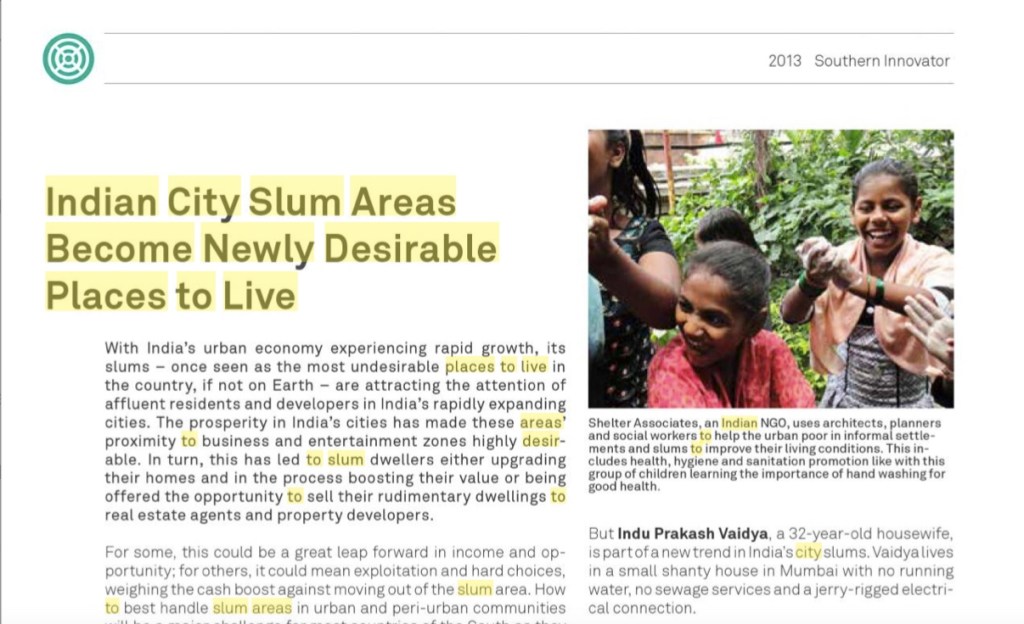
  • Indian City Slum Areas Become Newly Desirable Places to Live

    Indian City Slum Areas Become Newly Desirable Places to Live

    By David SouthDevelopment Challenges, South-South Solutions

    SOUTH-SOUTH CASE STUDY

    With India’s urban economy experiencing rapid growth, its slums – once seen as the most undesirable places to live in the country, if not on Earth – are attracting the attention of affluent residents and developers inIndia’s rapidly expanding cities. The prosperity inIndia’s cities has made these areas’ proximity to business and entertainment zones highly desirable. In turn, this has led to slum dwellers either upgrading their homes and in the process boosting their value, or being offered the opportunity to sell their rudimentary dwellings to real estate agents and property developers.

    For some, this could be a great leap forward in income and opportunity; for others, it could mean exploitation and hard choices, weighing up the cash boost against moving out of the slum area.

    How to best handle slum areas in urban and peri-urban communities will be a major challenge for most countries in the South as they continue to urbanize.

    India’s phenomenal economic growth rate – forecast to be 7.9 percent this year by the Asian Development Bank, after averaging 7.7 percent per year over the past decade – has been the force behind an expanding middle class population, now estimated at 50 million people (McKinsey). Forecasts see it swelling from 5 percent ofIndia’s population to 40 percent by 2025.

    With 30 percent of the population living in urban areas and cities contributing 60 percent of the country’s GDP and 90 percent of government revenues (Wall Street Journal), city-dwellers’ fate is critical to the functioning of the economy.

    According to the 2001 Indian census, slums make up 25 percent of all housing and 26 percent of urban households lack access to sanitation facilities.

    But Indu Prakash Vaidya, a 32-year-old housewife, is part of new trend inIndia’s city slums. Vaidya lives in a small shanty house in Mumbai with no running water, no sewage services and a jerry-rigged electrical connection.

    Vaidya’s home is a just a single room for the five people in her family. They sleep on the cement floor and the ‘kitchen’ is a two-burner gas stove. The dwelling is so poorly constructed that they have to move around inside the room when it rains outside to avoid getting soaked.

    But her humble home has been valued at US $24,000 by people looking to buy it.

    According to real estate agent Hari Ram, the average price of a 91 square metre shanty home in Mumbai is now US $46,000.

    “Shanties as small as 120 square feet… are as expensive as US $93,000,” Dinesh Prabhu, a construction company owner, told NDTV television.

    Sixty percent of Mumbai’s 21 million people live in slums. And many are now finding themselves the subject of a property boom. This has led to the bizarre spectacle of luxury high-rise buildings sprouting up in a sea of slum housing. The slums are attracting the attention of those with money because many busy city workers face long commutes and are desperate for homes closer to work and entertainment areas.

    The value of living close to the action is summed up by one slum dweller:

    “People would kill to be in a place like this,” said slum dweller Sundar. “There are four local train stations close by. And the bus stop is a stone’s throw away.”

    Some say this real estate boom offers enormous potential for the poor.

    “All I can say is, given the current real-estate rates, those slums are invaluable,” said Sharad Mahajan of the Pune-based nonprofit organization Mashal (http://mashalindia.org).  Mashal focuses on the problem of urban shelter and also implements housing projects. It has been working in the Dharavi slum area with theMaharashtra government on its redevelopment. The slum is well-known for its representation in the film Slumdog Millionaire, and the area is next to the Bandra-Kurla Complex business district of Mumbai. Mashal has been mapping the area, home to 60,000 families, to make sure the redevelopment is fair to the families living there.

    Land tenure is an issue however. Many slum dwellers do not have official title to the land they live on. Over time, they have become semi-official places to live as governments have hooked many up to electricity and drinking water. Issues of corruption and exploitation are also other problems that need addressing if this real estate windfall is to actually benefit slum dwellers.

    Typical slum dwellers are day labourers and poor migrants. But others are people who good easily afford to live somewhere else but don’t want the long commutes to work.

    “It is simpler and less expensive to live here,” said Sankaralingam, a plastic merchant, who estimates his annual income at around US $9,300: an amount that could get him a home somewhere nicer.

    For Indu Prakash Vaidya, the dilemma – to sell or not to sell – makes for some painful choices. While her current home is prone to flooding during the rainy season, she feels she would have nowhere else to go if she sold the home.

    Yet the pressure to sell is great and elemental.

    “I have three children, and their education and well-being need to be taken care of. Financial constraints can push me to sell this shanty in the future, then where will I live? I will have nowhere to go,” she told NDTV. 

    Published: December 2011

    Resources

    1) New documentary Urbanized gives a passionate over-view of the challenges facing the rapidly urbanizing world around us. Website: http://urbanizedfilm.com/

    Development Challenges, South-South Solutions was launched as an e-newsletter in 2006 by UNDP’s South-South Cooperation Unit (now the United Nations Office for South-South Cooperation) based in New York, USA. It led on profiling the rise of the global South as an economic powerhouse and was one of the first regular publications to champion the global South’s innovators, entrepreneurs, and pioneers. It tracked the key trends that are now so profoundly reshaping how development is seen and done. This includes the rapid take-up of mobile phones and information technology in the global South (as profiled in the first issue of magazine Southern Innovator), the move to becoming a majority urban world, a growing global innovator culture, and the plethora of solutions being developed in the global South to tackle its problems and improve living conditions and boost human development. The success of the e-newsletter led to the launch of the magazine Southern Innovator. 

    Creative Commons License

    This work is licensed under a
    Creative Commons Attribution-Noncommercial-No Derivative Works 3.0 License.

    ORCID iD: https://orcid.org/0000-0001-5311-1052.

    © David South Consulting 2023

  • Flurry of Anti-poverty Innovations

    Flurry of Anti-poverty Innovations

    By David SouthDevelopment Challenges, South-South Solutions

    SOUTH-SOUTH CASE STUDY

    Innovation is key to transforming the lives of the world’s four billion poor. And it is at the core of much of the new thinking these days. While the world’s poor can’t rely on political developments, or wider macro-economic events to go their way, they can harness the power of invention, innovation and self-reliance to make big changes in the quality of their lives and increase income – and so can those who want to help them. New York Times journalist and author Thomas Friedman put it like this: “Africa needs many things, but most of all it needs capitalists who can start and run legal companies. More Bill Gateses, fewer foundations. People grow out of poverty when they create small businesses that employ their neighbours. Nothing else lasts.”

    In the 1940s, Austrian economist Joseph Schumpeter wrote that “the function of entrepreneurs is to reform or revolutionise the pattern of production.” Schumpeter’s definition remains at the core of an entrepreneurial approach that focuses on innovation and enterprise as a means of addressing social needs. “Social innovators” are pragmatic and embrace innovation to tackle social problems through both for-profit and non-profit models.

    International Development Enterprises India (IDEI) is a non-profit that uses product invention to transform the lives of the poor and tackle hunger and malnutrition. Its approach is to take existing technologies and adapt them, reducing costs and improving effectiveness. By constantly evolving the design, they can focus in on making it cheap and relevant.

    One innovation is the Treadle Pump: a foot operated, water pump for small plots of land. It enables crops to be grown in winter and summer – no need to rely on rain. And since women are key to farm life, it is physically easy for women to use. So far more than 350,000 small farms are using it. It has been calculated the pump increases household incomes by a minimum of US $100/year.

    Another of their innovations is the Affordable Drip Irrigation Technology Intervention. While drip irrigation systems have been for sale in India for the past 15 years, they were not relevant or affordable for small and marginal farms. IDEI adapted these technologies during trials from 1997 to 2000. Existing technologies suffer from two drawbacks: they are complicated to maintain and they are expensive to buy. A big challenge was demystifying the idea that crop irrigation methods were for only the big orchards. The irrigation systems are sold as kits and are scalable so that farmers can expand their systems if they want. IDEI has sold over 85,000 of the various irrigation kits.

    Both inventions are designed to mimic traditional technologies and are inexpensive, thus maximising take-up by small farmers, who can recover the cost within one season of crops.

    They not only do the research and development and product design and manufacturing, but also set up the vertically integrated marketing and sales network and make it viable for the private sector to step up and sell the kits.

    Paul Polak, the founder of the global International Development Enterprises, believes progress is only possible if products are sold at a fair market price. “When you give things away, you lack discipline in how you design them because you don’t have to get feedback from the customer,” he said.

    In the village of Otse, Botswana in southern Africa, the Godisa Technologies Trust has brought affordable solar-powered hearing aids to the poor. Most of the employees are deaf, and as a non-profit social enterprise, its battery chargers – and its branded Solar Aid digital behind-the-ear (BTE) hearing aid – are all for use in developing countries. It is estimated over 600 million people suffer from some form of hearing impairment. According to the World Health Organization, 278 million people in the world are affected by moderate hearing loss. Yet the global production of hearing aids does not come anywhere close to meeting the need.

    The Solar Aid needs only six to eight hours of sunlight to recharge for a full week. And it is fully compliant with WHO guidelines. Conventional hearing aids and batteries are very expensive and often not locally available. Solar Aid batteries can take 400 charges before being replaced.

    The Solar Aid hearing aid was developed through field testing, funds were raised for further design improvements, and it went on to win several awards. But it initially failed to earn back its production costs and so the Godisa Technologies Trust was established to sweat the details on making it sustainable. It was developed in partnership with the Botswana Technology Centre,

    “I want to help other deaf people to have access to education training and employment. I would like to use my skills and opportunities to help other deaf people achieve their goals,” said one of Godisa’s technicians, Sarah Phiri. So successful are these hearing aids, there is interest around the world, including in Canada.

    Adequate street lighting has been proven to cut down muggings and improve public safety, reduce traffic accidents, and boost business confidence in neighbourhoods because people feel safe going there. StarSight’s street lamps combine solar-powered street lighting and internet access in a wireless configuration, freeing up the lighting poles from needing to access the main power and telephone grids. Each one contains VoIP, wi-fi broadband, CCTV and are being rolled out in Istanbul.

    StarSight street lamp poles, designed in Turkey, are also being rolled out in Martinique, Republic of Congo, Cameroon, and Cote d-Ivoire. StarSight’s goal is to install 70,000 street lamps by 2011. Malaysia and Indonesia are next.

    d.light design is a social enterprise targeting the 1.6 billion people who rely on kerosene oil to light their lanterns, or use candles. There is an ambitious goal behind this business: they want to replace all the kerosene lanterns in the world with their lights within the next ten years. They use light emitting diode (LED) technology and are about commercializing light and power solutions for families living without electricity in emerging markets.

    Better lighting has many benefits, including helping children and adults to study and learn during dark hours. Importantly, it will make the air inside dwellings cleaner and the environment safer without the risk of fire. Indoor air pollution is one of the biggest killers of children under five in India. UNDP has found that families with improved lighting see a 30 per cent increase in their income because they can keep doing things at night.

    On high beam, the lights last five hours; on low beam, they last for 200 hours without a charge. It can be re-charged by solar panels or by normal electric outlet. They promise consumers can expect to save $150 over five years. They have received additional support from the Acumen Fund to enter the peri-urban and, later, the rural market in India.

    Published: December 2007

    Resources

    • Rockefeller Foundation Innovation for Development Initiative: It will “spur the development of solutions to the challenges facing poor or vulnerable people around the world.”
      Team leader: Maria Blair, email: Innovation_dev@rockfound.org
    • Pratt Design Incubator for Sustainable Innovation: It brings together the entrepreneurial talents of designers, artists and architects with one goal: to link the social entrepreneur with the business of design. Budding social entrepreneurs get start-up support, design help and connection to mentors.
    • E and Co: An investor providing seed funding to energy entrepreneurs in developing countries.
    • SEAF (Small Enterprise Assistance Fund): A global investment firm focused on helping small companies and entrepreneurs in emerging markets, and those underserved by traditional sources of capital.
    • Microplace: An online marketplace to connect retail investors (anybody looking to invest US $100 or more) with microfinance organisations looking for funds.

    https://davidsouthconsulting.org/2022/02/17/african-digital-laser-breakthrough-promises-future-innovation/

    https://davidsouthconsulting.org/2022/10/05/african-innovation-eco-system-taking-shape/

    https://davidsouthconsulting.org/2021/05/18/african-innovation-helps-make-banking-transactions-safer/

    https://davidsouthconsulting.org/2022/10/10/bringing-the-invention-and-innovation-mindset-to-young-kenyans/

    https://davidsouthconsulting.org/2020/04/25/china-looking-to-lead-on-robot-innovation/

    https://davidsouthconsulting.org/2021/03/24/frugal-innovation-trend-meets-global-souths-innovation-culture/

    https://davidsouthconsulting.org/2022/11/16/housing-innovation-in-souths-urban-areas/

    https://davidsouthconsulting.org/2017/10/18/innovation-agenda-and-timeline-2007-2015/

    https://davidsouthconsulting.org/2022/11/11/innovation-cairos-green-technology-pioneers/

    https://davidsouthconsulting.org/2020/12/14/innovation-in-growing-cities-to-prevent-social-exclusion/

    https://davidsouthconsulting.org/2022/04/28/innovation-in-the-slums-can-bring-peace-and-prosperity/

    https://davidsouthconsulting.org/2020/04/27/innovation-from-the-global-south/

    https://davidsouthconsulting.org/2021/03/04/innovation-villages-tackling-mdgs/

    https://davidsouthconsulting.org/2021/10/22/innovations-in-green-economy-top-three-agenda/

    https://davidsouthconsulting.org/2022/10/27/kenyan-mobile-phone-innovations/

    https://davidsouthconsulting.org/2021/03/02/new-3d-technology-makes-innovation-breakthrough-and-puts-mind-over-matter/

    https://davidsouthconsulting.org/2022/10/09/next-generation-of-innovation-for-the-grassroots/

    https://davidsouthconsulting.org/2022/04/08/technological-innovation-alive-in-brazil/

    Development Challenges, South-South Solutions was launched as an e-newsletter in 2006 by UNDP’s South-South Cooperation Unit (now the United Nations Office for South-South Cooperation) based in New York, USA. It led on profiling the rise of the global South as an economic powerhouse and was one of the first regular publications to champion the global South’s innovators, entrepreneurs, and pioneers. It tracked the key trends that are now so profoundly reshaping how development is seen and done. This includes the rapid take-up of mobile phones and information technology in the global South (as profiled in the first issue of magazine Southern Innovator), the move to becoming a majority urban world, a growing global innovator culture, and the plethora of solutions being developed in the global South to tackle its problems and improve living conditions and boost human development. The success of the e-newsletter led to the launch of the magazine Southern Innovator. 

    https://davidsouthconsulting.org/2022/11/01/southern-innovator-magazine-2010-2014/

    Creative Commons License

    This work is licensed under a
    Creative Commons Attribution-Noncommercial-No Derivative Works 3.0 License.

    ORCID iD: https://orcid.org/0000-0001-5311-1052.

    © David South Consulting 2023

  • Brazilian Solar-powered WiFi for Poor Schools

    Brazilian Solar-powered WiFi for Poor Schools

    By David SouthDevelopment Challenges, South-South Solutions

    SOUTH-SOUTH CASE STUDY

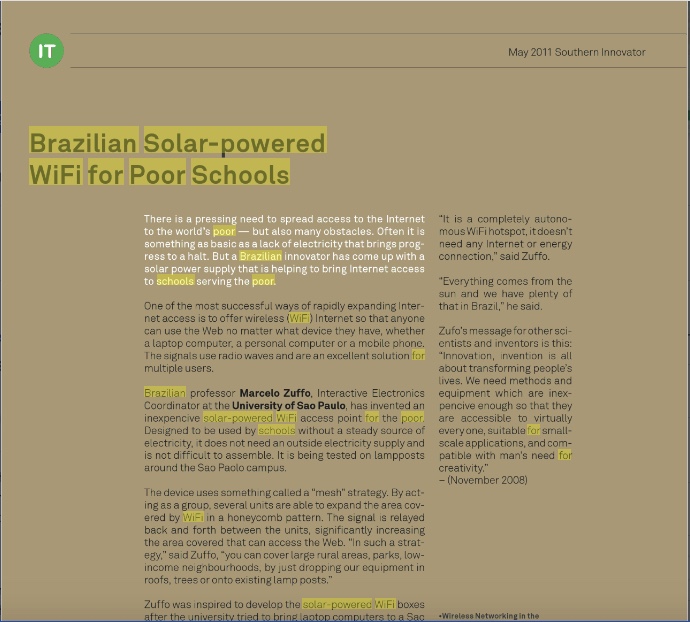
    There is a pressing need to spread access to the internet to the world’s poor — but also many obstacles. Often it is something as basic as a lack of electricity that brings progress to a halt. But a Brazilian innovator has come up with a solar power supply that is helping to bring internet access to schools serving the poor.

    Many initiatives are trying to bring inexpensive access to the internet to rural and remote regions around the world. Schools in poor areas are receiving laptop computers through schemes like the One Laptop Per Child project, but it is common that schools do not have a steady electricity supply to power the computers or the internet connection. One of the most successful ways of rapidly expanding access is to offer wireless (WiFi) internet so that anyone can use the Web, no matter what device they have, whether a laptop computer, a personal computer or a mobile phone. The signals use radio waves, and are an excellent solution for multiple users.

    Brazilian professor Marcelo Zuffo, Interactive Electronics Coordinator at the University of Sao Paulo, has invented a cheap solar-powered WiFi access point for the poor. Designed to be used by schools without a steady source of electricity, it doesn’t need outside electricity supply, and is not difficult to assemble. It is being tested on lampposts around the Sao Paolo campus.

    The device uses something called a ‘mesh’ strategy. By acting as a group, several units are able to expand the area covered by WiFi in a honeycomb pattern. The signal is relayed back and forth between the units, significantly increasing the area covered that can access the Web. “In such a strategy,” said Zuffo,”you can cover large rural areas, parks, low income neighbourhoods, by just dropping our equipment in roofs, trees or on to existing lamp posts.”

    Zuffo was inspired to develop the solar-powered WiFi boxes after the university tried to bring laptop computers to a Sao Paulo school, and found they didn’t have a steady electricity supply.

    “We came up with the idea of taking energy that is most plentiful and cheap, i.e. the sun,” he told the BBC. “We have a solar panel, a cheap motorcycle battery and a circuit that is responsible for energy management. We can have up to two days of full internet coverage and our goal is to increase that to 10 days – so that in the rainy season and the winter, you can have the internet for free.

    “The natural plan is to miniaturize the system so that we can save on costs. So by the end you can imagine these WiFi solar mesh devices being the size of a cellphone or playing card.”

    The low cost, solar-powered access point is ready as soon as it is unpacked and needs neither maintenance nor a power socket to get going.

    “It is a completely autonomous WiFi hotspot, it doesn’t need any internet or energy connection,” said Zuffo.

    “Everything comes from the sun and we have plenty of that in Brazil,” he said.

    The volunteer organization Green WiFi initiative is also developing solar powered technologies to bring ubiquitous internet access to the world’s poor.

    Zufo’s message for other scientists and inventors is this: “Innovation, invention is all about transforming people’s lives. We need methods and equipment which are cheap enough so that they are accessible to virtually every one, suitable for small scale applications, and compatible with man’s need for creativity.”

    The issue of inequality in access to the internet has stark consequences for global economic development. Already, according to the World Information Society Report 2007, “Europe has achieved the largest overall gain in digital opportunity over the last two years, followed by the Americas… Asia and Africa have witnessed smaller gains in digital opportunity. The implications for the digital divide are clear: digital opportunity is becoming more sharply divided by region, not less.”

    Published: November 2008

    Resources

    • Wireless Networking in the Developing World: A Practical Guide to Planning and Building Low-cost Telecommunications Infrastructure. Website:
    • World Information Society Report 2007: A progress report on pledges to bring digital opportunity to all. Website:
    • The Wireless Geographic Logging Engine: This is a website with maps tracking the presence of WiFi access around the globe. So far it maps over 10 million separate WiFi networks. Entrepreneurs only have to log into the website to start searching for wireless networks near them.
    • iTrike: The world’s first solar powered wireless internet rickshaw.
    • The KyaTera lab where the technology was developed. Website: http://kyatera.incubadora.fapesp.br/portal/research/laboratories/interactive-electronic-media

    Development Challenges, South-South Solutions was launched as an e-newsletter in 2006 by UNDP’s South-South Cooperation Unit (now the United Nations Office for South-South Cooperation) based in New York, USA. It led on profiling the rise of the global South as an economic powerhouse and was one of the first regular publications to champion the global South’s innovators, entrepreneurs, and pioneers. It tracked the key trends that are now so profoundly reshaping how development is seen and done. This includes the rapid take-up of mobile phones and information technology in the global South (as profiled in the first issue of magazine Southern Innovator), the move to becoming a majority urban world, a growing global innovator culture, and the plethora of solutions being developed in the global South to tackle its problems and improve living conditions and boost human development. The success of the e-newsletter led to the launch of the magazine Southern Innovator. 
    Creative Commons License

    This work is licensed under a
    Creative Commons Attribution-Noncommercial-No Derivative Works 3.0 License.

    ORCID iD: https://orcid.org/0000-0001-5311-1052.

    © David South Consulting 2023

  • Solar Power Bringing Light and Opportunity to the Poor

    Solar Power Bringing Light and Opportunity to the Poor

    By David SouthDevelopment Challenges, South-South Solutions

    SOUTH-SOUTH CASE STUDY

    Meeting the South’s energy needs will be crucial to achieving radical improvements in quality of life and human development. It is estimated that 1.7 billion people around the world lack electricity (World Bank), of whom more than 500 million live in sub-Saharan Africa.

    Africa’s greater global engagement and economic growth in the past few years has started to draw attention back to the continent’s dearth of reliable power sources and inadequate power infrastructure. With demand for electricity growing fast, it is people running small enterprises and organizations – especially in rural areas – who often get cut out.

    Being able to see at night unleashes a vast range of possibilities, but for the very poor, lighting is often the most expensive household expense, soaking up 10 to 15 percent of income.

    There’s a direct link between lighting and economic development. Each 1 per cent increase in available power will increase GDP by an estimated 2 to 3 per cent.

    A reliable power supply helps people to work longer, important for small businesses, and this increases the amount of wealth that can be created. Lit streets are safer at night, and lure people outside to do business and seek entertainment. It makes it easier for students to study into the night, and in consequence improve their grades.

    To take up this challenge, entrepreneurs are using different approaches across the South, to make solar power affordable and able to reach millions of poor people.

    Marrying new lighting technology such as compact fluorescent light bulbs (CFLs) and light emitting diodes (LEDs) with solar power generation, opens up the possibility to bring clean, portable, durable, low cost, high quality lighting to Africa’s poor. These new lighting systems also come with huge health and safety benefits, compared to gas alternatives.

    In Kenya, more than 80 percent of people lack access to the national grid and depend primarily on fossil fuels for their lighting needs, leading to respiratory diseases and environmental hazards associated with indoor air pollution.

    Kenyan solar entrepreneur Charles Rioba of Kodesha Mwangaza – Rent a Light is impressed by the interest in solar power solutions. An expert in renewable technologies with 15 years’ experience teaching in universities, he “realized that to reach the lower end of the market, one had to design an affordable solution.”

    “The biggest challenges faced are still affordability, and very little disposable income from the potential end users,” he said. “We are currently discussing with a number of micro institutions who have expressed interest on coming on board on rolling out the project.”

    Rioba’s business provides rental solar-charged Powerpacks designed to make electricity affordable for the majority of urban poor, rural households and slum dwellers. The rental system allows the consumer to rent a fully charged Powerpack from designated distributors in the neighbourhood, without having to invest in an off-grid power source, such as a solar panel. The project will set up 100 distribution agents and 10 service centers for the Powerpacks to reach approximately 8,000 households within 18 months. In addition the Powerpack will be used for mobile charging and powering radios, and hopes to create a new market concept for portable electrical energy distribution among the poor in Kenya.

    “My model targets to reach the lower end of the market,” Rioba said. “We are doing this by using existing businesses and groupings without creating new ones. We are also sourcing directly from the suppliers and we are working our project on numbers. In this way the margins are very low but aimed at achieving high usage hence return on investment.”

    Rioba has just been awarded funding by the World Bank’s Lighting Africa initiative, which aims to provide up to 250 million people in sub-Saharan Africa with access to non-fossil fuel based, low cost, safe, and reliable lighting products and associated basic energy services by the year 2030. It uses equipment that can weather long-term use in remote and difficult areas, trains people to service the equipment, and comes up with commercially viable business models to make all of this affordable to the rural poor.

    Rioba says that “for solar to be more attractive in Africa, there are a number of challenges. On the technology side, to make products which are both durable and affordable to the masses. Such new products such as LED lighting may ultimately reduce the size of the solar system and hence the cost.”

    In Laos, the rental mode is also proving effective. Only 48 percent of the country’s 5.7 million people have access to electricity, and most turn to firewood and kerosene for light and energy. Over 74 percent of people live on less than US $2 a day and could not afford to buy a solar-power system outright.

    The company Sunlabob rents solar-powered lanterns for prices beginning at 35,000 kip (US $3.80) per month, lower than the 36,000 to 60,000 kip (US $4.00 to US $6.60) per months households typically pay for kerosene fuel. After 10 hours’ use, the lanterns are recharged for a small fee from the village’s central solar-power collection facility. All fees go towards maintaining the central solar recharging station. The equipment is rented to a village-appointed Village Energy Committee, which sub-leases it to households at prices it sets. Rent covers all costs, including replacements and operational servicing costs. In the event of breakdowns, rent payments are suspended until repairs are made.

    Sunlabob has installed over 5,600 solar power systems since 2000 in over 450 villages and is also working in Cambodia and Indonesia.

    “Sunlabob really works well with local people,” says Bouathep Malaykham, head of the Lao Government Rural Electrification Program. “Because they are a private company they can make things happen quickly.”

    In Bangladesh, more than 230,000 households are now using solar power systems thanks to the government’s Infrastructure Development Company Ltd. (IDCOL), giving rise to opportunities for a whole new generation of entrepreneurs to make use of this new power supply for the poor. IDCOL is run by the Ministry of Finance, and is on course to install 1 million Solar Household Systems (SHS) using solar panels by 2012. The Bangladeshi government is hoping to bring electricity to all its citizens by 2020 – meaning this is now a prime time for entrepreneurs specializing in providing energy efficient products to the poor.

    The Executive Director of IDCOL, Ehsanl Haque, told a recent press conference: “SHS system, containing photo voltaic panels, battery, charge controller, solar lamp and switch, is a convenient mode for supply of power for small electrical loads such as lights, radio, cassette players and black and white TV.”

    It doesn’t provide electricity 24 hours a day, but Haque says even with a few hours of electricity available each day, the rural economy is being transformed. “Now they are using SHS for income-generating activities and working hours have been increased for small businessmen, weavers, tailors, hairdressers, and makers of handicraft items.”

    Among the many benefits of the electricity has been the ability to listen to radio and watch TV: an activity women reported made them feel safer at night.

    Published: September 2008

    Resources

    • Lighting Africa: this website run by the World Bank is a virtual business community and has forums, market intelligence, access to grants, network and partnership opportunities.
      Website: http://lightingafrica.org/index.cfm?Page=Home
    • D.light Design is dedicated to bringing modern lighting and power to over 1.6 billion people globally currently living without electricity. They aim to be the number one player in off-grid lighting and power solutions worldwide.
      Website: http://www.dlightdesign.com/
    • Solar Power Answers is a one-stop-shop for everything to do with solar power. It has a design manual and guides to the complex world of solar power equipment.
      Website: http://www.solar-power-answers.co.uk/index.php

    Development Challenges, South-South Solutions was launched as an e-newsletter in 2006 by UNDP’s South-South Cooperation Unit (now the United Nations Office for South-South Cooperation) based in New York, USA. It led on profiling the rise of the global South as an economic powerhouse and was one of the first regular publications to champion the global South’s innovators, entrepreneurs, and pioneers. It tracked the key trends that are now so profoundly reshaping how development is seen and done. This includes the rapid take-up of mobile phones and information technology in the global South (as profiled in the first issue of magazine Southern Innovator), the move to becoming a majority urban world, a growing global innovator culture, and the plethora of solutions being developed in the global South to tackle its problems and improve living conditions and boost human development. The success of the e-newsletter led to the launch of the magazine Southern Innovator. 

    Creative Commons License

    This work is licensed under a
    Creative Commons Attribution-Noncommercial-No Derivative Works 3.0 License.

    ORCID iD: https://orcid.org/0000-0001-5311-1052.

    © David South Consulting 2022